




Abstract
In our study, we reported a novel CRF01_AE/B/C human immunodeficiency virus type 1 (HIV-1) recombinant form among six epidemiologically unlinked heterosexual patients in Yunnan, China. It was named CRF106_cpx (this is temporary as we have not received the circulating recombinant form [CRF] number from HIV databases). After sequencing and analyzing of the near full-length genome, we found that CRF106_cpx was generated by three B segments and two CRF01_AE segments inserted into the C backbone. There was quite a bit of diversity between sequences of CRF106_cpx, so this seems to be a CRF that has been spreading for many years.
The virus that causes acquired immune deficiency syndrome (AIDS) is the human immunodeficiency virus (HIV). HIV is divided into type 1 (HIV-1) and type 2 (HIV-2). HIV-1 can be divided into three different groups M (main), O (outlier), and N (non-M/non-O, namely new), the difference between each group is >30%.
Groups N and O are mainly prevalent in Cameroon and neighboring countries. Although there are reports in the United States and France, the general epidemic area is relatively limited. However, the epidemic range of group M strains is relatively wide, causing the vast majority (∼98%) of AIDS worldwide. Group M has spread from Africa to the rest of the world. Group M includes A, B, C, D, F, G, H, J, and K, nine subtypes. Scientists in the United States have just confirmed a new subtype (L) belonging to group M. This L subtype appeared in the Republic of Congo very early (a case in 1983, a case in 1990, and a case in 2001). At that time, due to the low viral load and limited samples, the full-length genome was not successfully amplified. Recently, researchers led by the United States used the latest sequencing technology to obtain a complete full-length sequence, and then identified the new subtype. 1
HIV-1 gene recombination has been widely recognized. 2,3 During the transmission of HIV, when two or more viruses infect the same cell, a certain proportion of their genomic information will be exchanged, forming hybrid virus particles, and finally integrated into the host cell chromosome for expression and stable inheritance to form a recombinant virus. 4 HIV-1 undergoes ∼3–12 template conversions per replication cycle. In the process of template conversion, if the two RNA genomes have different subtypes, there may be recombination between the subtypes. 5 The only circulating recombinant forms (CRFs) of HIV-2 are HIV-2_CRF01_AB. The HIV-1 epidemic is wider, and there are more CRFs. There are currently 103 reported CRFs, 22 of which are reported from China. Yunnan Province is one of the earliest areas where HIV-1 was discovered in China, and it is also a hotspot where frequent recombinant strains are formed. CRF07_BC 6 and CRF08_BC 7 were the earliest reported CRF in China. Both were produced by the recombination of HIV-1 subtype B and subtype C and were found in injection drug users (IDUs) in Yunnan.
We used the Pol gene region sequences collected in the laboratory from 2015 to 2018 (4,704 in 2015, 770 in 2016, 1,712 in 2017, and 5,017 in 2018). After adding reference strains, using Aliview software, a phylogenetic tree was built. The clusters that are far from the reference strain, independently clustered, and have a higher check value (higher than 99% for Aliview/Maga) were selected for near full-length gene amplification. Finally, we successfully amplified six full-length sequences. We used the full-length sequences of all Chinese subtypes downloaded from the HIV database as reference strains and imported the six full-length sequences that we successfully amplified. Next, all sequences were aligned. Then Neighbor-Joining was used to build a phylogenetic tree. The phylogenetic tree is shown in Figure 1.
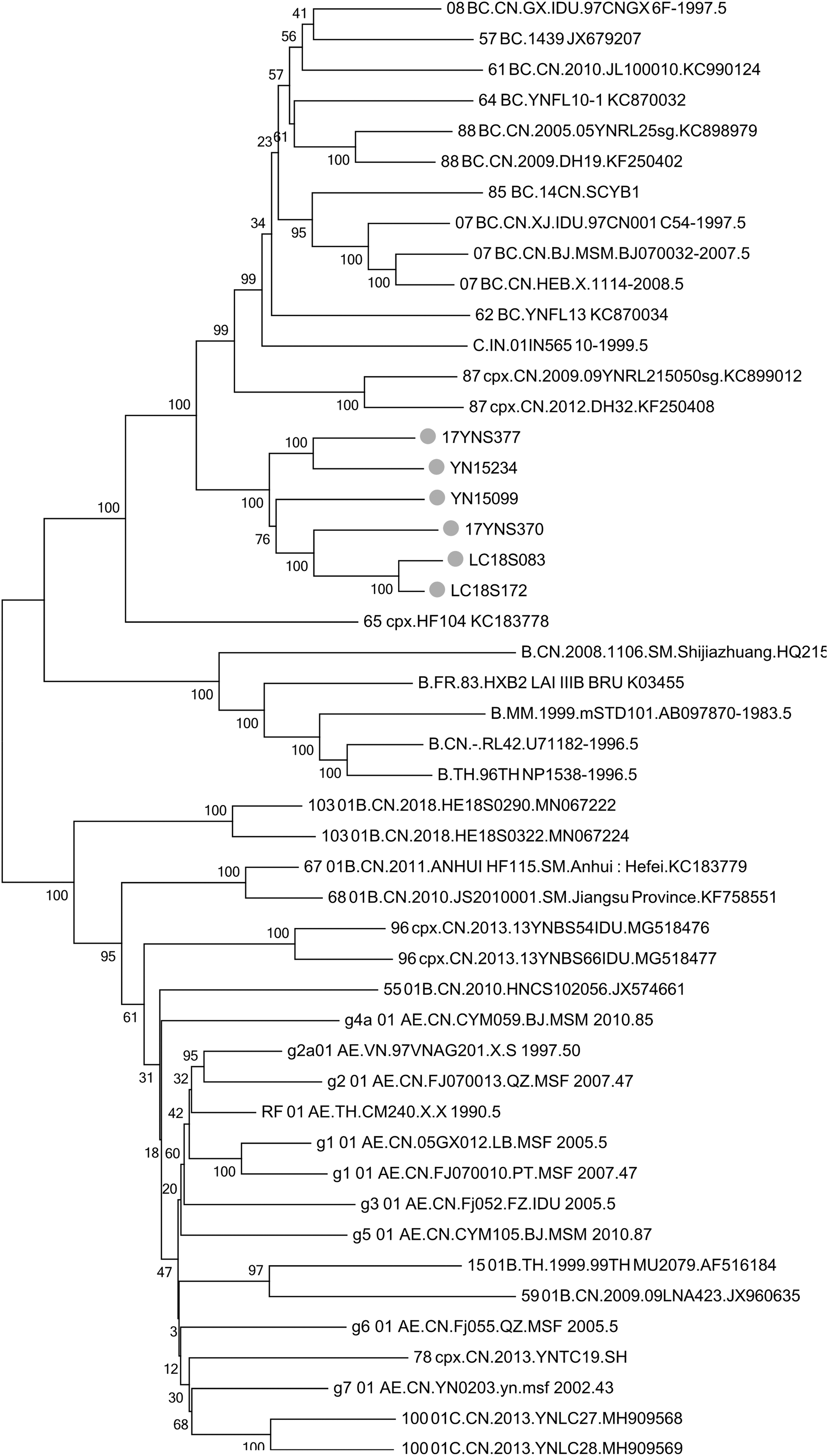
Phylogenetic tree analysis of the near full-length genome sequences of CRF106_cpx and the reference strain downloaded from the HIV database were used to construct the neighbor-joining phylogenetic tree including all subtype references of China. The reliability of tree branches was evaluated by 1,000 bootstrap replicates. The branches of 17YNS377, YN15234, YN15099, 17YNS370, LC18S083, and LC18S172 are marked with gray circles. CRF, circulating recombinant form; HIV, human immunodeficiency virus.
CRF106_cpx from the heterosexual population consisted of six full-length sequences, numbered 17YNS377, YN15234, YN15099, 17YNS370, LC18S083, and LC18S172. Only the patient with the number YN15234 was female, and the remaining five patients were male. The basic information of the sample is shown in Table 1.
Demographic Characteristics of Study Subjects Infected with CRF106_cpx
The recombination analysis was performed with Simplot 3.5.1, and analysis was set by a sliding window of 200 nucleotides (nt) advanced in 20 nt increments. Recombination breakpoint analysis showed that the sequences consisted of CRF01_AE, B, and C (Fig. 2). The map of the recombinant genome is as follows: IC (790–1,650 nt), IIB (1,651–2,050 nt), IIIC (2,051–2,250 nt), IVB (2,251–2,375 nt), VC (2,376–4,000 nt), VICRF01_AE (4,001–4,250 nt), VIIC (4,251–5,350 nt),VIIICRF01_AE (5,351–6,150 nt), IXC (6,151–8,450 nt), XB (8,451–8,625 nt), and XICRF01_AE (8,626–8,875 nt).
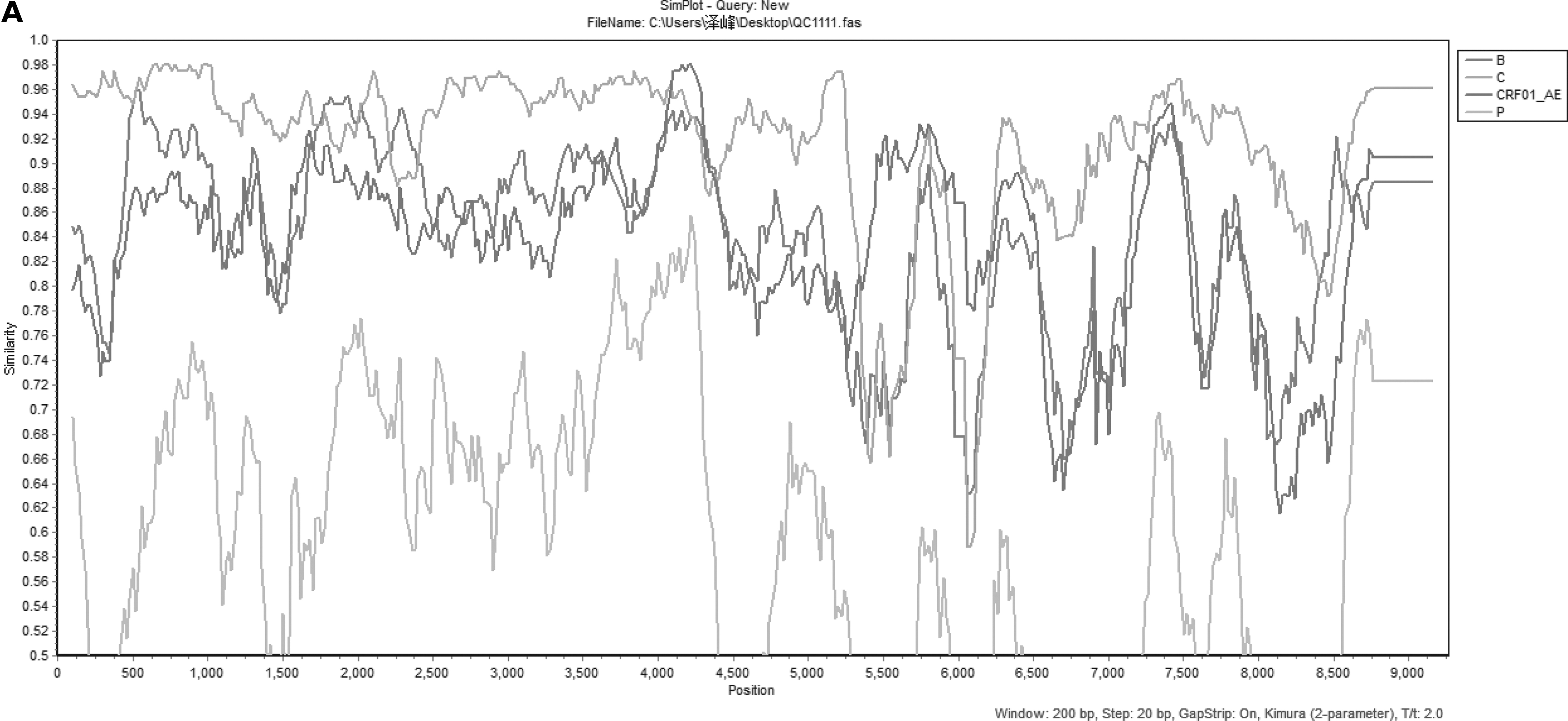
Recombination breakpoint analyses of CRF106_cpx.
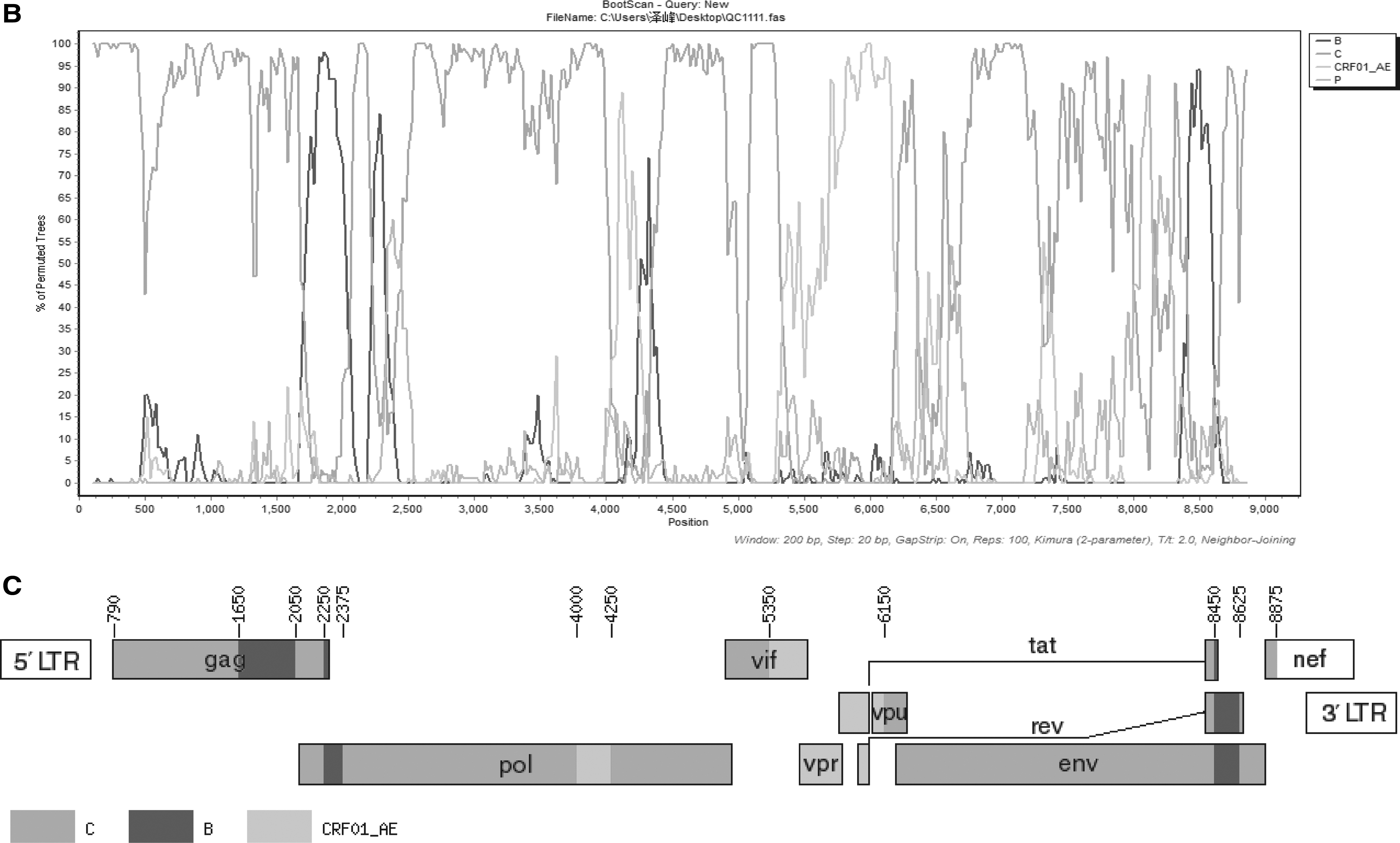
As of May 2020, there were 22 CRFs reported and included in the Los Alamos HIV gene database, of which 12 were reported from Yunnan Province: CRF07_BC, CRF08_BC, CRF57_BC, CRF62_BC, CRF64_BC, CRF78_cpx, CRF86_BC, CRF87_cpx, CRF88_BC, CRF96_cpx, CRF100_01C, and CRF101_01B.
CRF57_BC, CRF88_BC, and CRF96_cpx were spread by IDUs and were found in Yunnan Province of China in 2012, 2016, and 2018, respectively. CRF62_BC, CRF64_BC, and CRF86_BC, formed by the recombination of subtypes B and C, mainly spread through sexual transmission. The reorganization of CRF78_cpx and CRF87_cpx is relatively complicated, being formed by the reorganization of the three subtypes of CRF01_AE, B, and C. They were found in Yunnan Province of China in 2017 and 2016, respectively, and were mainly transmitted through sexual transmission. CRF100_01C 8 is the first recombinant strain formed by CRF01_AE and subtype C identified in China. The two C fragments were inserted into the CRF01_AE framework at the Pol gene region and the 3′end, respectively. It was reported in 2018 in heterosexually infected persons in Yunnan, China. CRF101_01B 9 a recombinant strain formed by inserting two B fragments into the Gag gene region and the Pol gene region, respectively, was reported in Yunnan in 2019.
CRF106_cpx, the fourth CRF formed by the reorganization of CRF01_AE, B, and C in addition to CRF78_cpx, CRF87_cpx, and CRF96_cpx. CRF78_cpx, 10 was formed by inserting one B segment and two C segments into the CRF_01AE skeleton, with five breakpoints. CRF87_cpx 11 was formed by inserting 4 B fragments and 2 CRF_01AE fragments into the C skeleton, with 11 breakpoints. CRF96_cpx 12 was formed by inserting three B fragments and three C fragments into the CRF_01AE skeleton, with eight breakpoints. From the perspective of restructuring or the number of breakpoints, CRF106_cpx and CRF87_cpx have a high similarity.
After analysis, we found that the sequence numbered LC18S083 is identical to the sequence numbered 17YNS370 in the 5′ half of the genome but these two have average similarity to each other in the 3′ half of the genome. Likewise, the sequence numbered LC18S083 is identical to the sequence for LC18S172 in the 3′ half of the genome but these two have an average identity to each other in the 5′ region. In other words, the sequence of CRF106_cpx has a bit of diversity, which may be a CRF that was frequent earlier but discovered later. The determination of CRF106_cpx not only increases the complexity of HIV subtypes in our country, but also can provide help for future subtype classification analysis.
Sequence Data
The sequences have been deposited in GenBank with accession nos.: MT276997–MT277002.
Footnotes
Acknowledgment
The authors thank Dr. Edward C. Mignot, Shandong University, for linguistic advice.
Author Disclosure Statement
No competing financial interests exist.
Funding Information
This study was supported by the Ministry of Science and Technology of China (grant no. 2017ZX10201101). Additional support was provided by the National Natural Science Foundation of China (grant no. 81471962).