




Abstract
We reported a novel human immunodeficiency virus type 1 (HIV-1) circulating recombinant form (CRF) among four epidemiologically unlinked patients through men having sex with men in Heilongjiang Province, China. It was named CRF107_01B (this is temporary as we have not received the CRF number from HIV databases). A near full-length genome phylogenetic tree showed that CRF107_01B was generated by two CRF01_AE segments that was described as cluster 5 lineage of CRF01_AE (CRF01-5) inserted into the B (Western origin) backbone. The emergence of CRF107_01B increased the complexity of HIV-1.
Human immunodeficiency virus type 1 (HIV-1) has high rates of mutation and replication generating various subtypes in the epidemic.
1
Recombination between subtypes leading to a great deal of circulating recombinant forms (CRFs) and unique recombinant forms (URFs).
2
As of July 2020, the Los Alamos National Laboratory HIV Database website (
We used the pol gene region sequences collected in the laboratory in 2018. After adding reference strains, using Aliview software, a Neighbor-Joining phylogenetic tree was built. We found a cluster composed of six sequences (The cluster) in pol gene region, and The cluster had bootstrap values of 99%. Then sequences were analyzed by using the near full-length genome (NFLG) amplification and sequencing. Amplification and sequencing procedures of NFLG were performed as described previously. 9 Viral RNA experiments of subjects 151964 and 15010481 failed, whereas subjects HL18S17, HL18S37, HL18S214, and HL18S214 generated a new CRF (CRF107_01B). The reliability of tree branches was evaluated by 1,000 bootstrap replicates. The branches of HL18S17, HL18S37, HL18S214, and HL18S244 were marked with black diamond (Fig. 1). These patients were all men and unmarried. The other information such as specific age, Sample City, viral load, and CD4 count are shown in Table 1.
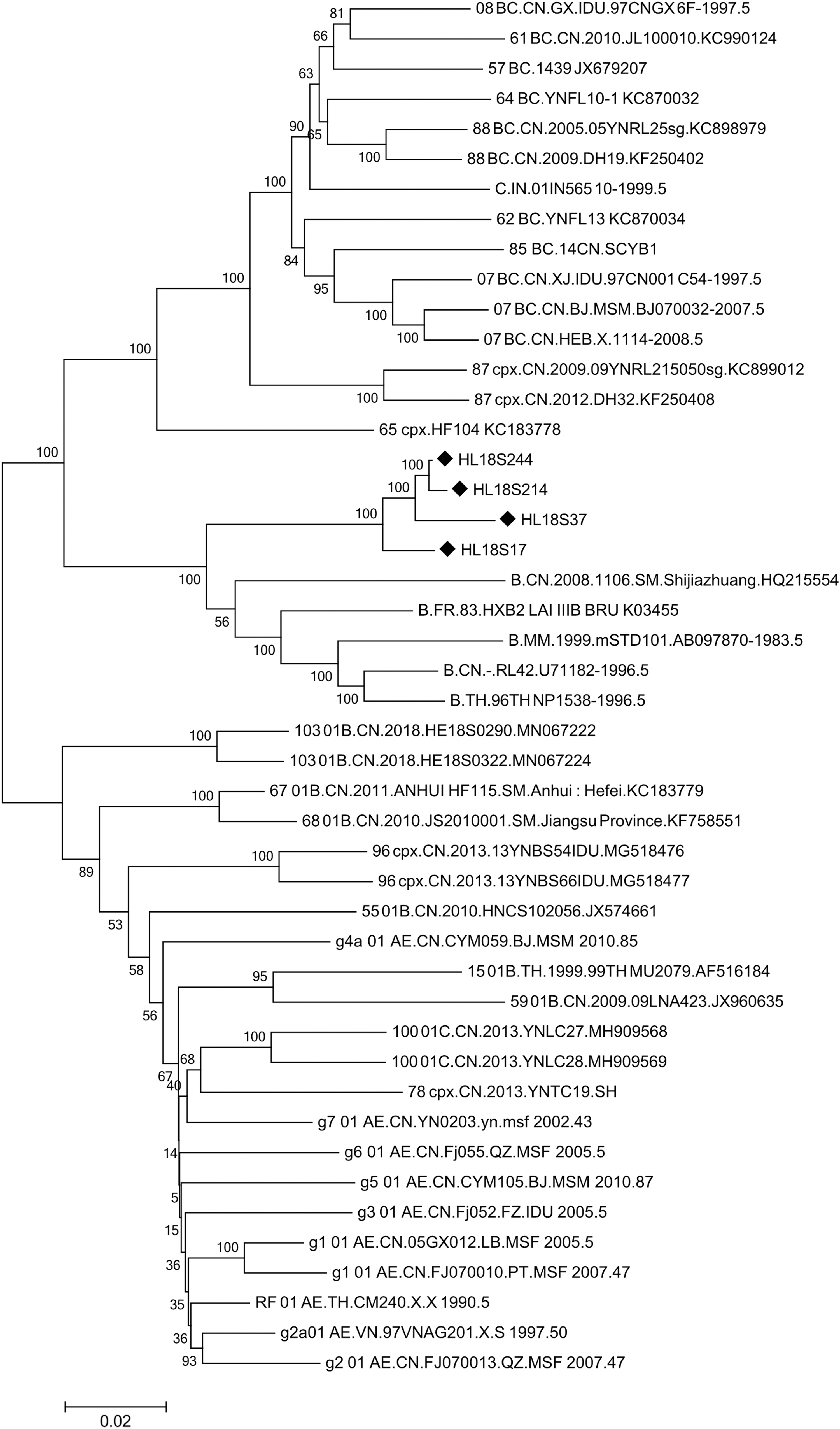
Phylogenetic tree analysis of the NFLG sequences of CRF107_01B and the reference strain downloaded from the HIV database were used to construct the neighbor-joining phylogenetic tree including all subtype references of China. The reliability of tree branches was evaluated by 1,000 bootstrap replicates. The branches of HL18S17, HL18S37, HL18S214, and HL18S244 are marked with black diamond. NFLG, near full-length genome.
Demographic Characteristics of Study Subjects Infected with CRF107_01B
MSM, men having sex with men.
The recombination analysis was performed with Simplot 3.5.1, and analysis was set by a sliding window of 500 nucleotides (nt) advanced in 20 nt increments (Fig. 2). Recombination breakpoint analysis showed that the sequences consisted of CRF01_AE and subtype B. The map of the recombinant genome was as follows: IB (790–2,199 nt), IICRF01_AE (2,200–2,599 nt), IIIB (2,600–4,999 nt), IVCRF01_AE (5,000–5,699 nt), and VB (5,700–9,500 nt) (Fig. 3). An NFLG phylogenetic tree showed that CRF107_01B was generated by three B (Western origin) segments and two CRF01_AE segments. CRF01_AE segments were described as cluster 5 lineage of CRF01_AE (CRF01-5).
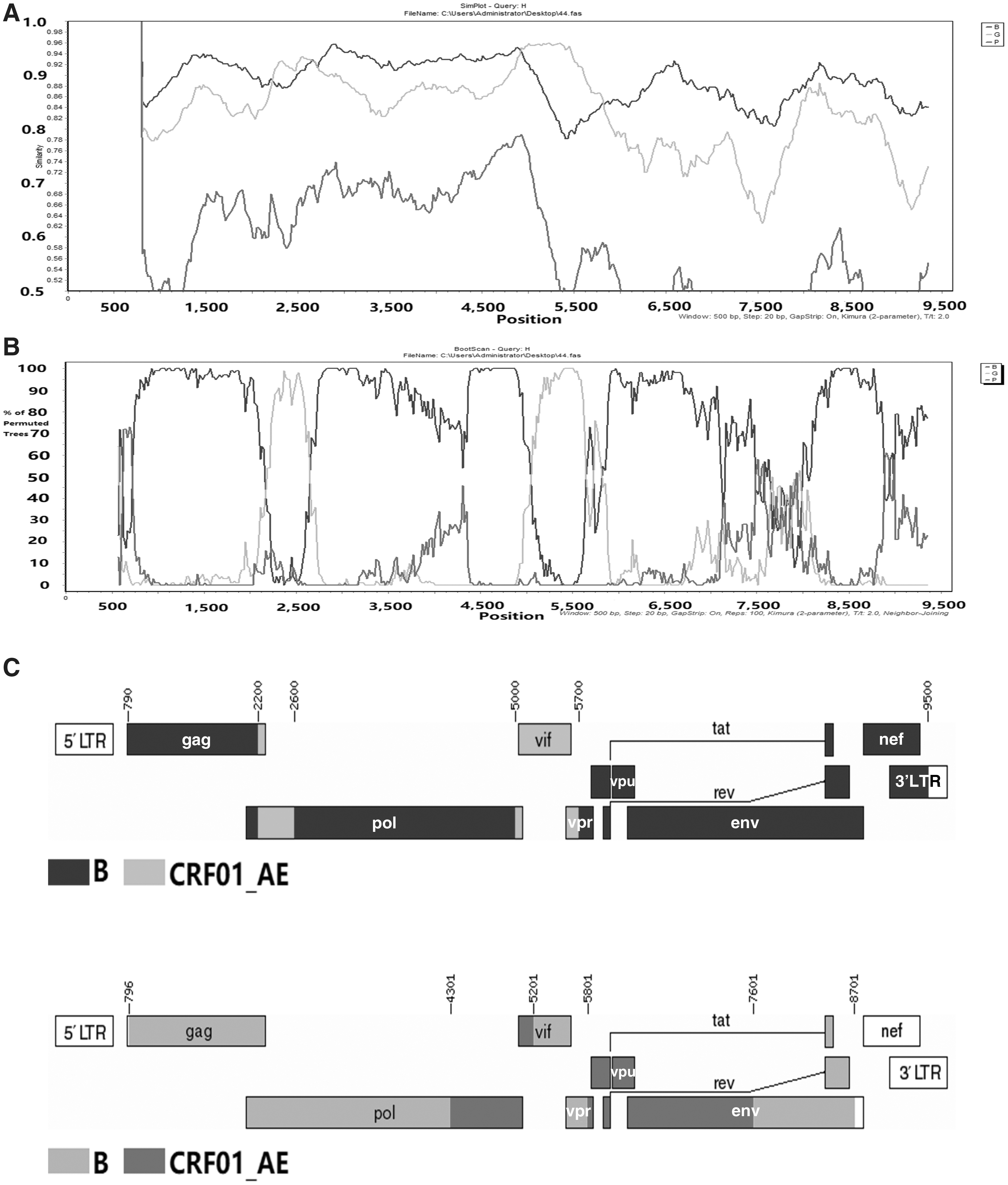
Recombination breakpoint analyses of CRF107_01B.
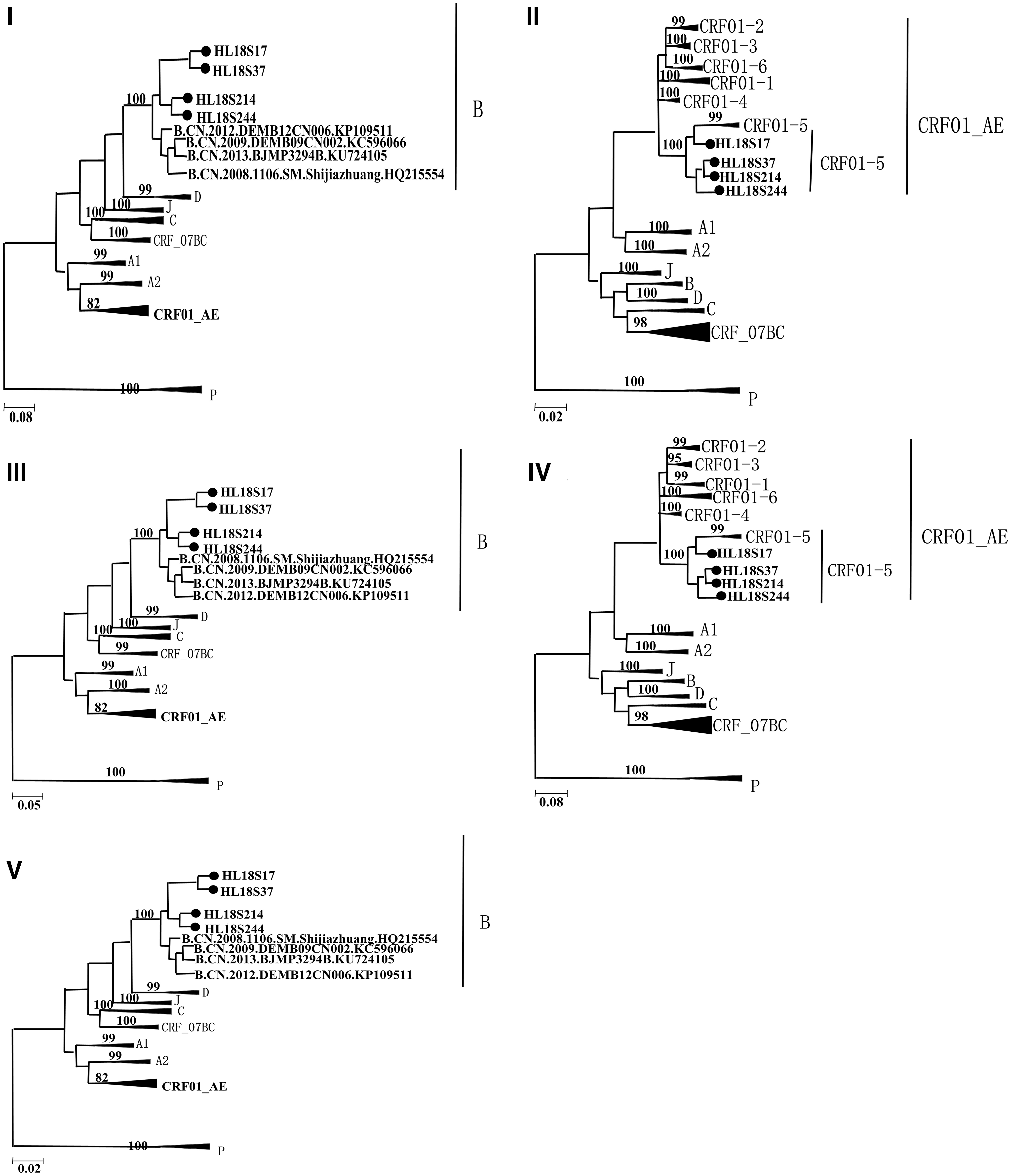
The phylogenetic trees of five mosaic segments (from I to V) defined by neighbor-joining in MEGA 6, and the bootstrap values of 80% and higher are shown. The sequences of CRF107_01B are marked with a solid black circle. CRF01_AE reference sequences is mainly divided into six unique lineages (CRF01-1–CRF01-6) in China. These CRF01_AE lineages were used as reference sequences in this article. Figures can be viewed in greater detail online.
CRF107_01B is the 18th CRF recorded by HIV database and formed by CRF01_AE and subtype B. Among the 18 CRFs, only CRF51_01B and CRF107_01B are formed with subtype B as the backbone, and the CRF01_AE fragments insert into the B backbone. CRF51_01B was reported in the sexually transmitted population in Singapore in 2011. One CRF01_AE fragment inserts into the pol gene region and the other inserts into the vif gene region of the B backbone. 10 Similar to CRF51_01B, CRF107_01B is also the insertion of two CRF01_AE fragments into the B backbone. However, the insertion positions of the two CRFs are different. The two insertion regions of CRF107_01B are pol and env, respectively. In addition to CRF55_01B, 11 CRF59_01B, 12 CRF67_01B, 13 CRF68_01B, 13 and CRF103_01B, 7 CRF107_01B is the sixth CRF formed by recombination of CRF01_AE and subtype B found in China.
In conclusion, we identified a novel HIV-1 CRF (CRF107_01B) among four patients without an obvious epidemiological linkage in Heilongjiang Province, China. The emergence of CRF107_01B makes the HIV epidemic more complicated.
Sequence Data
The sequences have been deposited in GenBank with accession numbers MT712388–MT712391.
Footnotes
Author Disclosure Statement
No competing financial interests exist.
Funding Information
This study was supported by the Ministry of Science and Technology of China (2017ZX10201101). Additional support was provided by the National Natural Science Foundation of China (81471962).