




Abstract
CRF01_AE and CRF07_BC are two widespread human immunodeficiency virus type 1 (HIV-1) strains among different high-risk populations, including men who have sex with men (MSM), in China. This co-epidemic of various HIV strains enables the production of second-generation recombinants. In this study, we detected a novel HIV-1 CRF01_AE/CRF07_BC recombinant from LN321945, an MSM lived in Liaoning province, northeast China. The phylogenetic and recombination analyses indicated the near full-length genome (NFLG) sequence of LN321945 had six recombination breakpoints, with three CRF07_BC fragments inserted into a CRF01_AE backbone. Further subregion trees analysis revealed that both CRF01_AE and CRF07_BC fragments were derived from two predominant HIV-1 strains among MSM. In addition, the NFLG of LN321945 was revealed to be clustered closely to another CRF01_AE/CRF07_BC recombinant previously identified in Shaanxi province, northwest China, but these two recombinants had distinct recombination structure and origin of CRF01_AE fragments. Hence, this study identified a second-generation recombinant between the main strains circulating among MSM, indicating more complicated trend of HIV-1 epidemic in China.
The genetic diversity of human immunodeficiency virus type 1 (HIV-1) is due to its high evolutionary variability and recombination rate. Recombinants readily arise when different HIV strains co-circulate in the same area or within a population. To date, >100 circulating recombinant forms (CRFs) and large number of unique recombinant forms (URFs) have been reported in the Los Alamos HIV sequence database (
China is among the countries that have suffered most from the emergence of complex HIV-1 subtypes and recombinants worldwide. In recent years, HIV-1 infection has spread rapidly among men who have sex with men (MSM) in China, 3 where multiple HIV-1 subtypes have been reported, with CRF01_AE and CRF07_BC domination strains among MSM. Moreover, the CRF01_AE strain has been reported to be further subdivided into at least five to seven distinct lineages because of multiple historical introductions of CRF01_AE strains into China, which subsequently spread in specific populations and regions. 4 –6 Among these, two lineages have been reported to be circulating among MSM in China. 4 The CRF07_BC strain is reported to have emerged in western Yunnan, China, in the mid-1990s, as a result of recombination between Thai B and Indian C HIV strains, and later spread rapidly in China, mainly through drug trafficking activity 7,8 and subsequently through the heterosexual route later. 9 CRF07_BC strains were introduced into the MSM population in around the early 2000s, forming a unique lineage that has spread among MSM around China. 3,10 The co-epidemic of CRF01_AE and CRF07_BC strains enables the generation of secondary recombination events.
In this study, a novel CRF01_AE/CRF07_BC HIV-1 recombinant was detected in Liaoning province, northeast China, with three fragments of CRF07_BC inserted into a CRF01_AE backbone, designated as
The subject, LN321945, was diagnosed with HIV infection in 2015 and self-reported as infected with HIV through homosexual behavior. At the time of diagnosis, the CD4+ T cell count and viral load were 615 cells/μL and 34,900 copies/mL, respectively. Routine drug resistance genotyping test showed that the pol gene sequence was CRF01_AE/CRF07_BC recombination structure. To explore its recombinant structure in detail, we further amplified the near full-length genome (NFLG) from plasma viral RNA. The study was approved by the Medical Research Ethics Committee of the First Hospital of China Medical University.
Viral RNA was extracted from plasma and subsequently reverse-transcribed into cDNA. The amplification and sequencing procedures were performed as described previously.
11
Finally, we obtained an NFLG sequence of 8,859 bp (HXB2:790-9611), designated as
According to the NFLG neighbor-joining tree, LN321945 showed a closer link with kang124 (accession no. KJ778897), a CRF01_AE/CRF07_BC URF previously reported from an MSM lived in Shaanxi province (bootstrap value 96%), rather than any previously published CRF01_AE/CRF07_BC URFs in HIV sequences database (
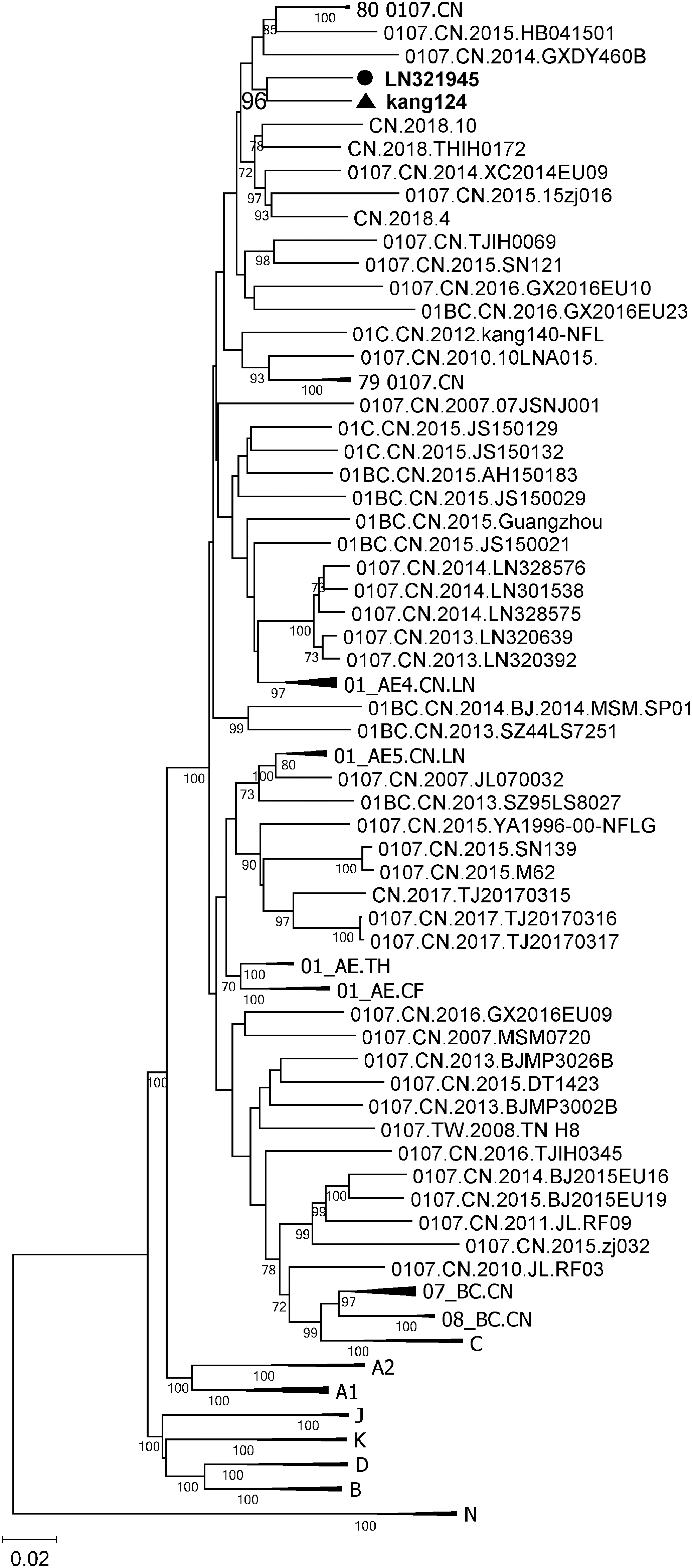
Neighbor-joining tree of the NFLG sequence of LN321945 and publicly available CRF_01AE/CRF07_BC unique recombinant forms. All reference sequences were downloaded from the HIV database (
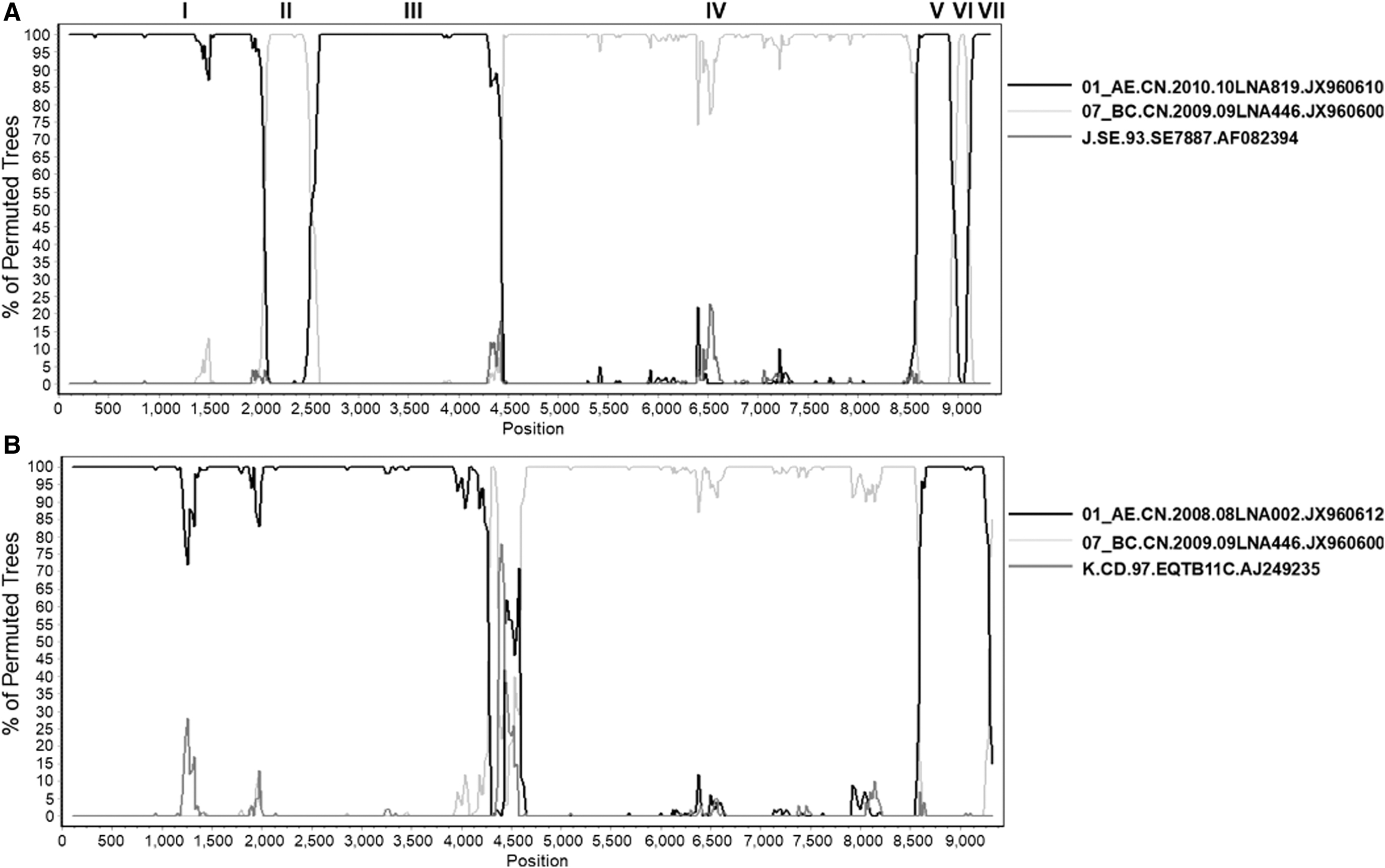
Bootscan analysis of the LN321945
To further explain the close relationship between LN321945 and kang124 in the phylogenetic tree, subregion trees were reconstructed using MEGA 7.0.21 (Fig. 3), including seven CRF01_AE lineage, 4 CRF07_BC, and pure genotypes of HIV-1 group M as reference sequences. The results demonstrated that the fragment spanning the vif, vpr, vpu, env, tat, and rev genes of LN321945 and kang124 (corresponding to fragment IV of LN321945 and fragment II of kang124) clustered with the CRF07_BC lineage predominant in MSM, rather than those from intravenous drug users in China. Four fragments of LN321945 (I, III, V, and VII) clustered together with CRF01_AE lineage 4, but the corresponding regions of kang124 clustered with CRF01_AE lineage 5. Both lineage 4 and lineage 5 of CRF01_AE have been reported to be widespread among MSM in China; however, lineage 5 is more common in northern China, including Liaoning province. 10,11 These results show that the CRF01_AE fragments of LN321945 have a distinct origin from kang124, although their NFLG sequences were close together in the phylogenetic tree.
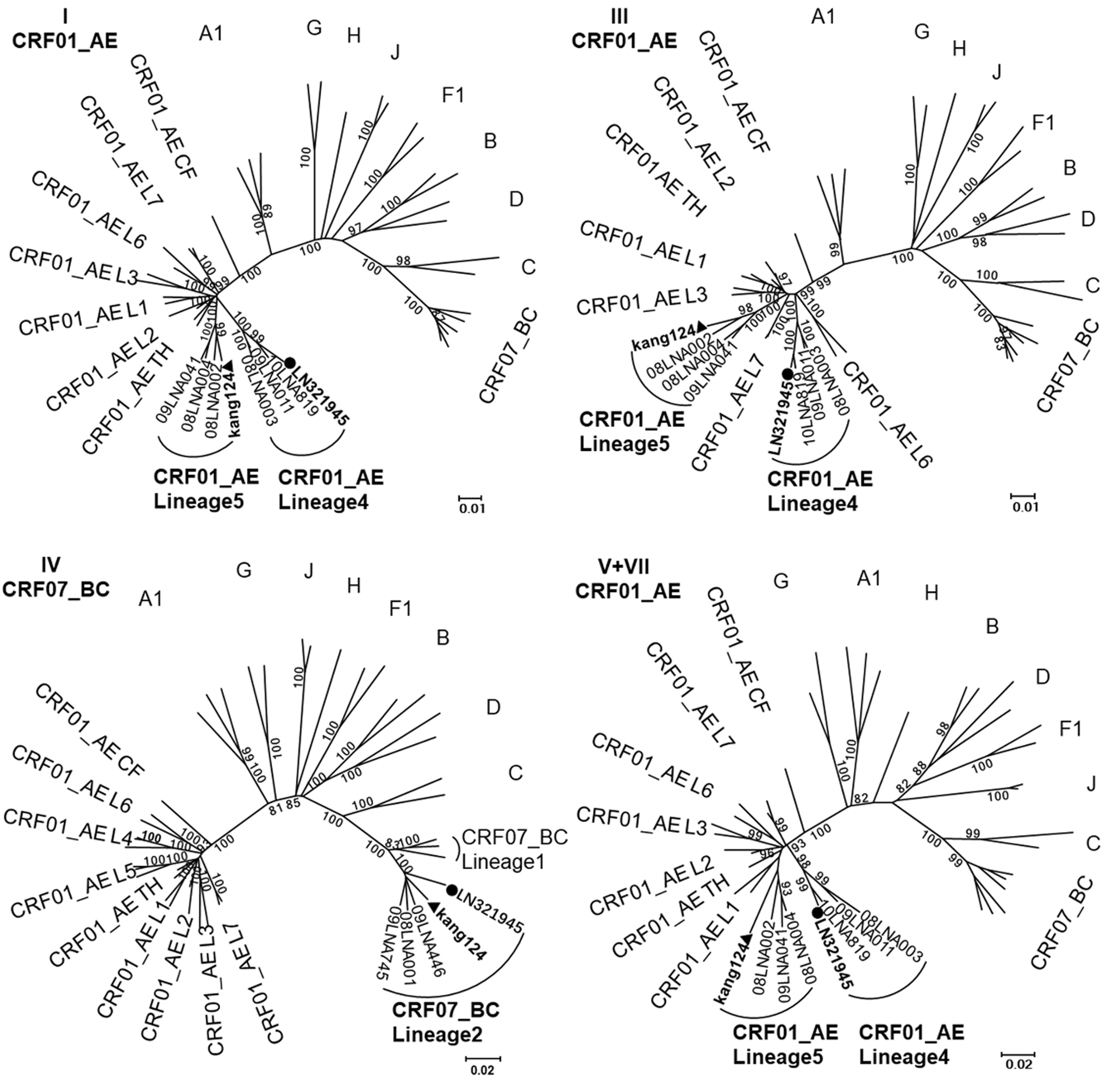
Subregion trees analysis for five fragments of LN321945 and kang124. Solid circles indicate LN321945 fragments and solid upward-pointing triangles indicate kang124 fragments. CRF01_AE L1 to CRF01_AE L7 represent seven lineages of CRF01_AE in China. 4 CRF07_BC Lineage1 and CRF07_BC Lineage2 are spread among the intravenous drug users and men who have sex with men populations, respectively, in China. Scale bars are presented at the bottom right of each tree. Bootstrap values ≥80% are presented at the corresponding nodes.
In summary, we detected a novel HIV-1 CRF01_AE/CRF07_BC URF from an MSM lived in Liaoning province, northeast China, which is a second-generation recombinant from two predominant strains (CRF01_AE and CRF07_BC) among MSM in China. These findings imply a more complicated trend of HIV-1 epidemic in China.
Sequence Data
The nucleotide sequence of LN321945 has been submitted to GenBank with the accession no. KX434796.
Footnotes
Author Disclosure Statement
No competing financial interests exist.
Funding Information
This study was supported by the Mega-Projects of National Science Research for the 13th Five-Year Plan (2018ZX10721102) and the National Natural Science Foundation (81871637). The funding bodies had no role in the design of the study, the collection, analysis, or interpretation of the data, or writing the article.