




Abstract
The wide variety of new HIV-1 recombinant variants are a predominant challenge for understanding the molecular epidemiology and preventing the spread of the HIV-1 epidemic. In this study, we confirmed a novel HIV-1 unique B/C recombinant (ZLQ01186) isolated from a male patient infected with HIV-1 through injection drug use in Foshan city, Guangdong Province. The near full-length genome was amplified, and then the polymerase chain reaction products were sequenced by Sanger sequencing. The genomic sequence of the strain, with two subtype B segments inserted into the subtype C backbone, was 8,953 bp in length, extending from 647 to 9,599 bp according to the HXB2 genome. In addition, this B/C recombinant strain contained the non-nucleoside reverse transcriptase inhibitor resistance mutation K103N and the integrase strand transfer inhibitor other resistance mutation L74I according to the Stanford University HIV Drug Resistance Database program. The drug resistance profile indicates high-level resistance against efavirenz and rilpivirine. This study identified a recombinant between the main circulating strains, indicating a more complicated trend of the HIV-1 epidemic in Guangdong, China.
HIV/AIDS is a tragic health problem globally caused by HIV. The high rate of evolution, combined with natural polymorphisms, error-prone reverse transcription, immune escape mutations, and intersubtype recombination, facilitates a large population of variants. 1 The wide variety of new HIV-1 recombinant variants are a predominant challenge for understanding the molecular epidemiology and preventing the spread of the HIV-1 epidemic. To date, >100 circulating recombinant forms (CRFs) have been reported in the Los Alamos HIV sequence database. In the past decade, a large number of unique recombinant forms (URFs) of HIV-1 have also been identified. 2,3
Guangdong Province is a commercially developed and populous area located on the southern coast of China, where HIV-1 spread quickly after the first HIV/AIDS case was identified in 1986. 4 The predominant subtype circulating in Guangdong Province was CRF01_AE, and CRF07_BC, CRF55_01B, CRF08_BC, subtypes A1, B, C, and CRF59_01B, etc. have also been reported. 5,6 The presence of these various genotypes and a large transient population provided the opportunity for novel mosaic strains to emerge. In this study, a novel B/C HIV-1 recombinant was detected in Guangdong Province, with two fragments of subtype B inserted into a subtype C backbone, designated BC.CN.2018.ZLQ01186.
The sample was isolated from a newly diagnosed male patient, ZLQ01186, in 2018. He was 31 years old, living in Foshan city, and self-reported to be infected with HIV through injection drug use. Routine pretreatment drug resistance genotyping analysis indicated that the partial pol gene of this strain was a B/C recombinant structure. In this study, we further amplified the near full-length genome (NFLG) sequence for plasma viral RNA and investigated the genetic characteristics of this strain. This study was approved by the Institutional Review Board of Guangzhou Eighth People's Hospital, and written informed consent of the patient was obtained before collecting serum samples.
The NFLG sequence was obtained and analyzed as described previously. 7 In brief, viral RNA was extracted from 200 μL of plasma using a magnetic bead-based Viral RNA Extraction Kit and subsequently reverse transcribed into complementary DNA according to the manufacturer's instructions. The overlapping gene fragments were amplified by nested polymerase chain reaction, and the positive product was sequenced by the Sanger sequencing method. Sequencing fragments were assembled by Sequencher software V5.4.6 and submitted to the HIV-1 Sequence Quality Control Tool to check for potential contamination and to confirm the sequence quality. Finally, the NFLG sequence of 8,953 bp (from 647 to 9,599 bp according to the HXB2 calibrator) was obtained, spanning part of the 5′-long terminal repeat; the gag, pol, vif, vpr, tat, vpu, rev, env, and nef genes; and part of 3′-LTR. The sequence was deposited in GenBank with the accession number MW145181.
This NFLG sequence was aligned with standard references downloaded from the Los Alamos HIV database, including nine subtypes (A–D, F–H, J, and K) and predominant CRFs circulating in Guangdong Province (CRF01_AE, CRF07_BC, and CRF08_BC), by BioEdit software V7.0.5. Then, a neighbor-joining (NJ) phylogenetic tree was constructed by MEGA software V6.06 using the Kimura two-parameter model with 1,000 bootstrap replications. 8 The NJ tree showed that the sequence from the ZLQ01186 strain was clustered (bootstrap value 100%) with the reference sequences of subtype C, CRF07_BC, and CRF08_BC but formed a distinct monophyletic branch different from them (Fig. 1). This result indicated that ZLQ01186 might be a different B/C-related recombinant.
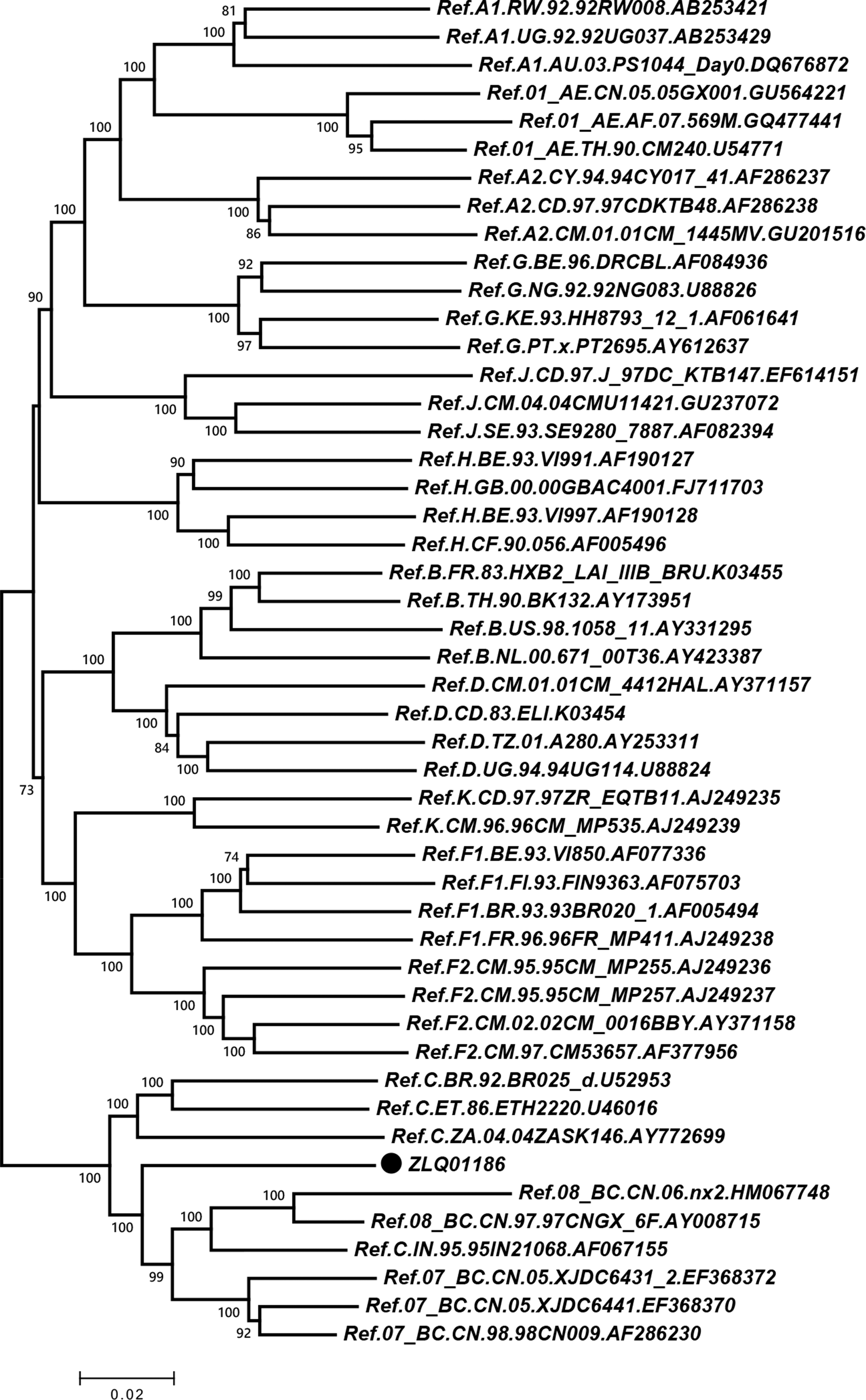
An NJ tree was constructed using the near full-length genome sequences of HIV-1 isolates by the program MEGA V6.0.6. The reference sequences of subtypes A–D, F–H, J, K, CRF07_BC, CRF08_BC, and CRF01_AE were downloaded from the Los Alamos HIV database. Each reference was labeled with the HIV-1 subtype, followed by the sequence name and accession number. The ZLQ01186 strain is labeled with a black dot. The scale bar represents 2% genetic distance. Bootstrap values >70% are presented at the corresponding nodes of the tree. NJ, neighbor-joining.
Similarity plots and bootscanning analysis were subsequently performed by using Simplot software 9 V3.5.1 to position the exact recombination breakpoints by using subtype C (GenBank accession number AB023804) and subtype B (GenBank accession number JF932481) as putative parental reference sequences and subtype H (FJ711703) as an outgroup. The results demonstrated that the NFLG sequence of ZLQ01186 was a recombinant form composed of subtypes B and C, with four unique recombination breakpoints at nucleotide (nt) 2,510, 3,180, 8,490, and 8,993 relative to the HXB2 genome (Fig. 2). The recombinant pattern was further confirmed by the Recombinant Identification Program (Supplementary Fig. S1) and the jumping profile hidden Markov model.

Similarity
The NFLG sequence of ZLQ01186 was consequently divided into five fragments based on four breakpoints corresponding to HXB2 nucleotide positions: region I (HXB2 nt 647–2,509), subtype C; region II (HXB2 nt 2,510–3,179), subtype B; region III (HXB2 nt 3,180–8,489), subtype C; region IV (HXB2 nt 8,490–8,992), subtype B; and region V (HXB2 nt 8,993–9,599), subtype C (Fig. 3A). A mosaic recombinant structure mapped by the Recombinant HIV-1 Drawing Tool is shown in Figure 3B.
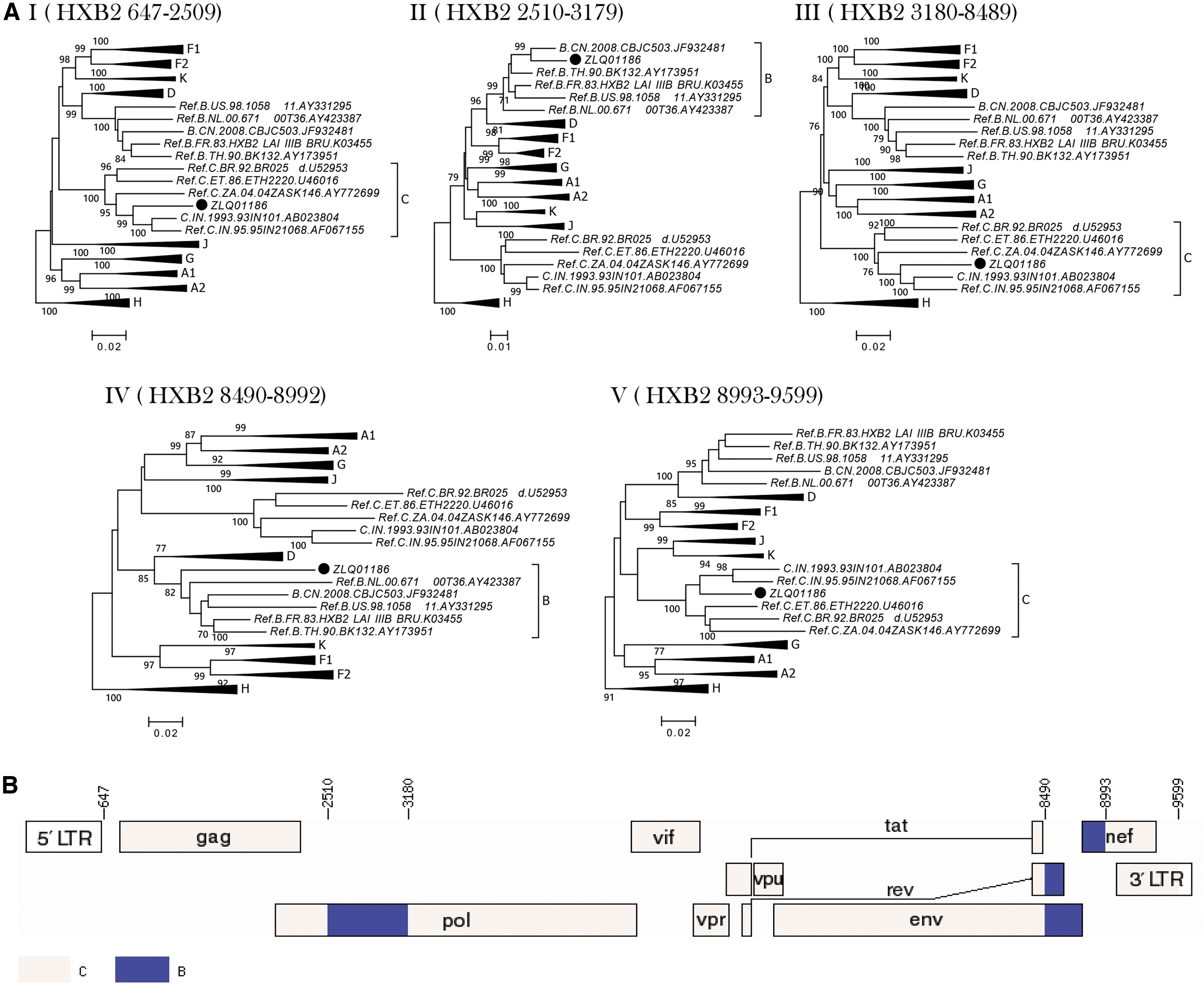
Subregion phylogenetic tree analysis and mosaic recombinant structure of ZLQ01186.
To analyze whether mutations associated with drug resistance existed, the pol gene sequence of this strain was submitted to the Stanford University HIV Drug Resistance Database. The non-nucleoside reverse transcriptase inhibitor (NNRTI) resistance mutation K103N and the integrase strand transfer inhibitor (INSTI) other resistance mutation L74I were found. K103N is a nonpolymorphic mutation that causes high-level reductions in NNRTI efficacy, 10 whereas L74I is highly polymorphic, which does not appear to be associated with reduced INSTI susceptibility and contributes reduced susceptibility to each of the INSTIs when they occur with major INSTI resistance mutations. 11 The drug resistance profile of the patient indicates high-level resistance against efavirenz and rilpivirine. These findings indicated the potential drug resistance of this new URF and the need for continuous monitoring of the spread of drug resistance mutations.
In this research, we report a novel recombinant form of HIV-1 isolated from a male patient in Guangdong Province, China. A sustained rise in URFs of HIV-1 has been observed, suggesting that a more complex HIV genotype is circulating in Guangdong Province. This pre-existing NNRTI- and INSTI-mutated virus also suggests that surveillance of newly diagnosed patients is necessary so that the appropriate treatment can be tailored to the patient to prevent the spread of drug-resistant viruses.
Sequences Data
The sequence was deposited in GenBank with the accession number MW145181.
Footnotes
Author Disclosure Statement
No competing financial interests exist.
Funding Information
This study was funded by the National Grand Program on Key Infectious Disease Control (2018ZX10302103-002 and 2017ZX10202101-003), the Joint-Innovative Program in Healthcare for Special Scientific Research Projects of Guangzhou (201803040002), and Guangzhou Science and Technology Plan Project (202002030028).
Supplementary Material
Supplementary Figure S1
References
Supplementary Material
Please find the following supplemental material available below.
For Open Access articles published under a Creative Commons License, all supplemental material carries the same license as the article it is associated with.
For non-Open Access articles published, all supplemental material carries a non-exclusive license, and permission requests for re-use of supplemental material or any part of supplemental material shall be sent directly to the copyright owner as specified in the copyright notice associated with the article.
