




Abstract
OB-002 is an extremely potent CCR5 antagonist that has previously been shown to completely block transmission in a nonhuman primate model of HIV infection. The purpose of this study was to characterize the safety, acceptability, and pharmacokinetic profile of a gel formulation of OB-002 (OB-002H). The trial had two phases, an open label single dose exposure (vaginal and rectal) and a randomized placebo controlled multiple dose phase during which study participants received five vaginal daily doses of OB-002H gel or matched placebo in a 2:1 ratio. Serum OB-002 levels were quantified at multiple time points up to 24 h after the first dose. A total of thirty female and male participants were enrolled in the study (12 in the single dose phase and 18 in the multiple dose phase). All adverse events were Grade 1 or 2, and the majority was unrelated to study product. Only two product-related transient Grade 2 events (both vulval dryness) occurred in the study, both in the OB-002H gel randomized multiple dose arm. All colposcopic and anoscopic assessments following product exposure were normal. There was no evidence of systemic absorption of OB-002. Overall, the product had a positive acceptability profile, and most study participants would consider using the product for protection against HIV or pregnancy. Future studies are needed to assess the extended safety and acceptability of OB-002H gel in sexually active participants.
Clinical Trial Registration Number: NCT04791007
Introduction
Despite advances in the diagnosis and treatment of HIV infection and increasing availability of oral pre-exposure prophylaxis (PrEP), HIV infection remains a global public health issue. UNAIDS estimates that 1.7 million new HIV infections occurred in 2019 and there were ∼690,000 associated deaths. 1 Although oral PrEP is safe and highly effective, access remains a problem especially for young women living in low-income settings. 2 Uptake of PrEP will be influenced by consumer preference, and having multiple PrEP options (oral, injectable, vaginal rings, and microbicides) may increase overall use of PrEP to prevent HIV infection. 3 Topical microbicides may be of particular interest to individuals who want a product that is safe, effective, and can be used in a coitally dependent manner. 4,5 Topical microbicides also have the potential to be multipurpose products used to prevent pregnancy, HIV, and other sexually transmitted infections. 6
OB-002, also referred to as 5P12-RANTES, is a human CCR5 antagonist that consists of a 69-residue analog of the human chemokine protein RANTES/CCL5 [chemokine (C-C motif) ligand 5]. The analog is manufactured in a Pichia pastoris system 7 and has been shown to have an excellent stability profile in both vaginal and rectal fluid. 8,9 OB-002 has been shown to be highly effective in preventing SHIV infection in a nonhuman primate model of HIV infection, 10 as well as inhibiting HIV infection in human ectocervical and rectal explant tissue models. 11 The development of resistance to OB-002 requires viral evolution from CCR5 to CXCR4. 12 OB-002 has been formulated as a gel, intravaginal ring, and silk fibroin disks. 11,13 –15 Repeat vaginal or rectal dosing of the gel formulation used in this Phase 1 study was safe in rat and rabbit preclinical studies (unpublished data).
The purpose of the OB-002H-101 Phase 1 study was to characterize the safety, acceptability, and pharmacokinetic (PK) profile of a gel formulation of OB-002 (OB-002H gel) following vaginal and rectal administration.
Materials and Methods
Study design and participants
The OB-002H-101 trial was a first in man; Phase 1 study consisted of two consecutive parts. Part 1 was an open-label single-dose vaginal or rectal application of the OB-002H gel in six participants. Part 2 was a multiple-dose vaginal application, with an initial open-label application of OB-002H gel in three participants, followed by a randomized, double-blind placebo-controlled exposure during which study participants received five sequential daily vaginal exposures to OB-002H gel (N = 10) or placebo (N = 5). A total of four cohorts (Cohorts A1–A3, vaginal application, and Cohort B1, rectal application) were started consecutively (Fig. 1). Drug safety, acceptability, and PKs were evaluated after single- and multiple-dose applications, along with changes in cervical and rectal histopathology. The multidose cohort was initiated following PK and safety data evaluation of the single dose data by an independent Safety and Data Monitoring Committee. The study was conducted at a Phase 1 Unit (BioVirtus Research Site, Józefów, Poland). Before implementation, the study protocol was reviewed and approved by the local ethics committee and the Polish Regulatory Authority. All participants provided written informed consent.

OB-002H-101 study design.
Healthy male and female participants were eligible if they were between 18 and 45 years of age (inclusive), HIV seronegative, and willing, during the study period, to use effective contraception, abstain from anal and/or vaginal sex before and after each visit, and from using nontrial vaginal or rectal products. Exclusion criteria included hepatitis B or C infection, active sexually transmitted infection, use of pre- or post-exposure HIV prophylaxis, pregnancy or breastfeeding, and significant gynecological, blood chemistry, or hematologic abnormalities.
Study product and administration
OB-002 is a 69 amino acid recombinant protein analog of the regulated on activation, normal T cell expressed and secreted (RANTES) chemokine. 16 The OB-002H gel product contains 8.0 mg/g or a total dose of 32.0 mg in 4.0 mL of gel. A single-use HTI applicator (HTI Plastics, Lincoln, NE) filled with 4.0 mL of OB-002H gel was used to topically administer either a single dose (Part 1) or once daily dose in the morning for five days, at approximately the same time every day (Part 2). Participants in Part 2 were randomized 2:1 to a treatment (4 mL of OB-002H gel) or placebo gel group. The placebo applicator had the same volume (4 mL), as well as the same components as the OB-002H gel, excluding OB-002. All gel administrations were performed on-site by the investigators.
Safety and acceptability
Adverse events (AEs) were graded using the Division of AIDS Table for Grading the Severity of Adult and Pediatric Adverse Events, Version 1.0, December 2004, as well as Addendum 3 [Rectal Grading Table for Use in Microbicide Studies (
Acceptability questionnaires were completed by each participant after treatment administration to explore reactions to product, applicator, and administration method. Participants were provided with a placebo gel applicator after administration of OB-002H was completed and encouraged to dispense a sample of the placebo gel so that they could make an informed assessment on the acceptability of the gel characteristics, including color, consistency, smell, and stickiness. These assessments identified product attributes likely to challenge and facilitate future sustained use of OB-002H gel when applied vaginally or rectally by participants. Acceptability was quantified using a five-point Likert scale where a high score (≥3) was associated with an acceptable product profile, whereas a lower score (≤2) suggested an unacceptable product profile. Intentionality of future use to protect against pregnancy, HIV, or both conditions was also assessed using a Likert scale in which a score of one was associated with high intentionality of future use and a score of five with very low intentionality of future use.
Histological assessment of cervical and rectal tissue samples
Cervical and rectal biopsies were collected at Baseline and 1 week after the final product exposure. Two biopsies were collected from each site. Biopsies underwent histopathological examination and were given a mucosal damage score that has been used in previous rectal microbicide trials. 17,18 The scoring system was adapted from a system used to characterize mucosal damage associated with inflammatory bowel disease, 19 but had never been used to quantify mucosal damage in cervical tissue samples. In this system, normal histopathological appearances are scored as Grade 0 and mucosal erosions or ulcerations as Grade 5.
Pharmacokinetics
Blood samples were collected before and 1, 2, 4, 6, 8, 10, and 24 h after OB-002H gel administration for all study participants. Participants in Part 1 had blood samples collected before and after single dose administration to OB-002. Participants in Part 2 had blood samples collected before and after the first dose of OB-002 or placebo and before and after the fifth dose of OB-002 or placebo. Serum OB-002 levels were quantified using a validated ELISA assay (WuXi AppTec, Shanghai, China).
Data analysis and sample sizes
The statistical analysis was performed in a descriptive/exploratory manner by providing summary statistics for each treatment group and per cohort. The default summary statistics for quantitative (continuous) variables were the number of observations (n), mean, standard deviation, median, minimum (min), and maximum (max) and quartiles (Q1, Q3), for those participants with available data. For qualitative (categorical) variables, the number (n) and percentage (%) of participants with nonmissing data per category were the default frequency tabulation. Whenever appropriate and present, the number of missing values as a “Missing” category was also displayed.
Results
Study population and visit performance
A total of 70 potential study participants were recruited from the Phase 1 unit's participant database between October 2019 and March 2020. Following screening, a total of 30 participants received the active or placebo study product (Fig. 2). The reasons for screen failures are summarized in Supplementary Table S1.
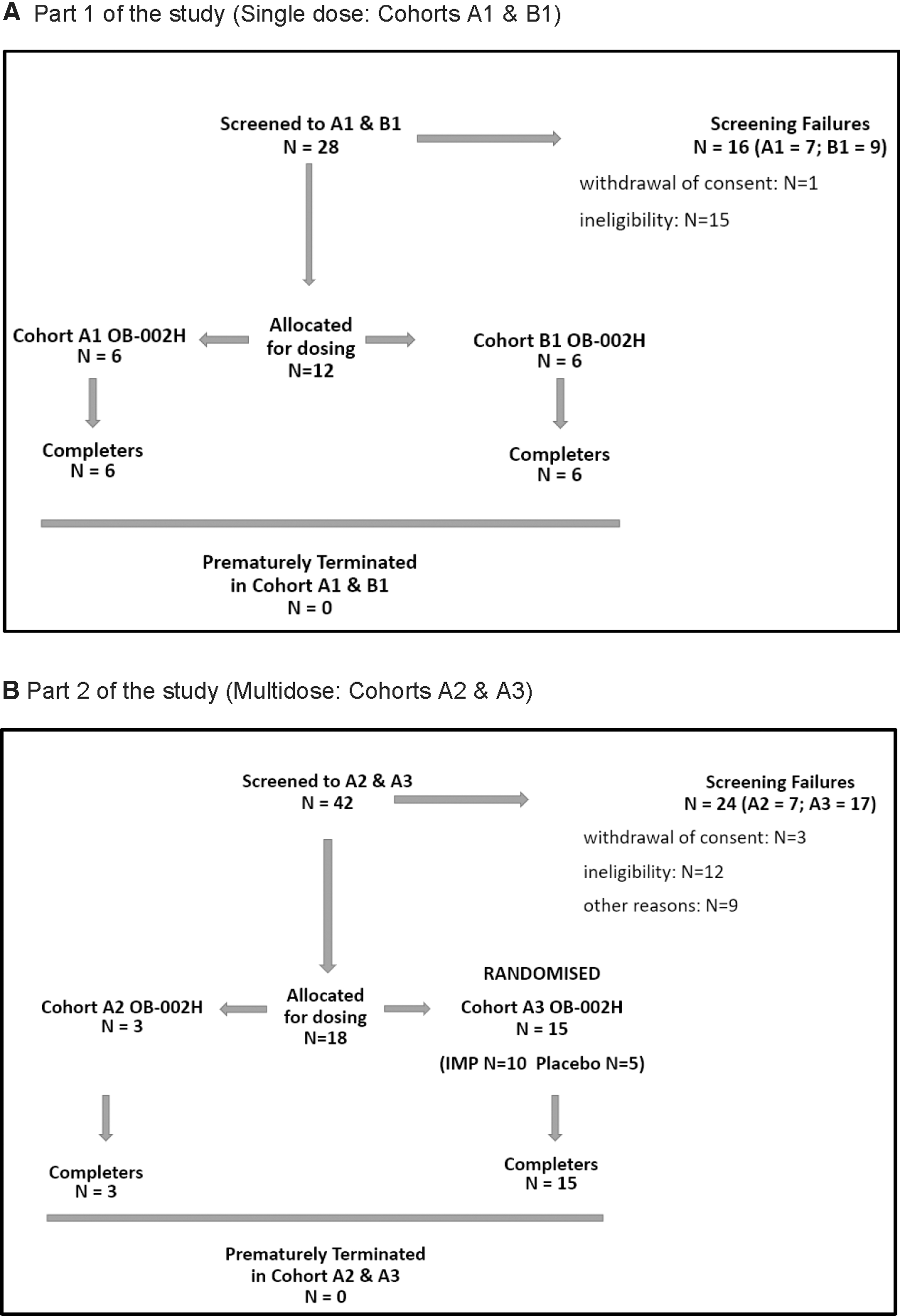
Flow diagram of participant progress through the OB-002H-101 study:
Nine women and three men were enrolled in Part 1 of the trial and allocated to either Cohort A1 (vaginal application; N = 6 women) or Cohort B1 (rectal application; N = 3 women, N = 3 men). The participants' mean age was 35.6 years; most were heterosexual (75%), college-educated (66.7%), identified their race as white or European American (100%), and worked full-time (83.3%) (Table 1).
Study Participant Demographics
E, number of events.
Eighteen women were enrolled in Part 2 of the trial and allocated to either Cohort A2 (N = 3) or Cohort A3 (N = 15). Participants of Cohort A3 were randomized in a 2:1 ratio to either OB-002H (N = 10) or placebo (N = 5) treatment groups. The participants' mean age was 31.3 years; most were heterosexual (100%), college-educated (77.8%), identified their race as white or European American (100%), and worked full-time (61.1%). All participants completed the study on time. The last on-site visit of the final participant was performed by phone due to the safety mitigation introduced during the COVID-19 pandemic.
Since the trial medication was administered by the investigators, the study treatment compliance was 100% for all participants.
Safety
In Part 1, one participant experienced Grade 2 hyperkalemia, which was not considered to be related to product use.
In Part 2, a total of nine treatment emergent adverse events (TEAEs) were observed, seven of which were considered related to product use, and all occurred in Cohort A3. Three participants experienced five Grade 1 TEAEs, which included genital burning sensation and vulvovaginal pruritus in two participants each and vaginal discharge in one participant. In addition, two participants experienced product-related Grade 2 vulval dryness (Grade 2). Two participants experienced headaches (Grade 2), which were considered unrelated to treatment (Table 2).
Summary of Treatment Emergent Adverse Events in the Multiple Dose Cohorts
TEAE, treatment emergent adverse event.
Histopathology
Although two biopsies were requested at Baseline and post-treatment visits, not all biopsies were of sufficient quality for histopathological examination. In the single dose vaginal OB-002H gel administration group (Cohort A1), the average Baseline score was 2.25 (range 0–3; N = 10 samples). The post-treatment average score was 1.9 (range 0–3; N = 10 samples). In contrast, in the rectal OB-002H gel administration group (Cohort B1), the Baseline and post-treatment scores were 1.0 in all participants (N = 10 samples). In the multiple dose vaginal administration groups (Cohorts A2 and A3), the average Baseline cervical score for the placebo participants was 2.0 (range 1–4; N = 9 samples) and the average post-treatment score was 2.0 (range 1–3; N = 8 samples). For the OB-002H gel participants, the average Baseline score was 2.0 (range 0–4; N = 25 samples) and the average post-treatment score was 1.8 (range 0–5; N = 25 samples).
Acceptability
At the end of each product-use period, participants were asked to assess the gel. In general, the majority of the study participants' feedback on the overall acceptability of the gel's characteristics (consistency, color, smell, stickiness, feeling, and lubrication) was positive. None of the participants rated these characteristics lower than three on a 5-point Likert scale; moreover, the majority of the participants confirmed their willingness to use the gel to protect against HIV, pregnancy, or both conditions. More detailed behavioral and acceptability data will be provided in a future article.
Pharmacokinetics
The serum concentration of OB-002 was below the limit of quantification in all blood samples at each time point following product administration.
Discussion
In this Phase 1 study we have demonstrated that the OB-002H gel has an appropriate safety and acceptability profile to advance into later stage clinical development for the prevention of HIV infection. We have also demonstrated that topical administration of OB-002H gel is not associated with systemic exposure to OB-002.
The OB-002H gel Phase 1 study was the first microbicide trial to evaluate a chemokine analog. The majority of microbicide candidates evaluated over the last decade have been repurposed small molecule antiretroviral agents previously developed for the treatment of HIV infection. 5 In contrast, OB-002 was specifically developed for a HIV prevention indication. It was chosen from a series of CCL5 analogs based on its potency, stability, and lack of agonist activity that might induce inflammatory signaling following binding to the CCR5 receptor. 16 In addition, the use of a P. pastoris platform allows scalable manufacturing of OB-002. 7
The OB-002H-101 study was the first microbicide trial conducted in Poland. The Polish National AIDS Centre estimates that up to December 2019, a total of 25,457 HIV infections have been detected in Poland. Of these, 6,396 were in intravenous drug users, 4,149 in men who have sex with men, and 1,922 in heterosexuals. In almost half the reports, no likely route of infection was provided (
Our study was undertaken in a commercial Phase 1 unit, which had access to a large database of healthy volunteers. This allowed for very rapid and coordinated recruitment into the study, which compressed the enrollment period and made study execution much more efficient. The Phase 1 unit provided an ideal environment to undertake the invasive cervical and rectal tissue sampling needed in the study. In retrospect, it was a mistake to use the mucosal injury index for both ectocervical and rectal tissue samples. The index performed as anticipated in the rectal tissue samples but was highly variable in the ectocervical samples even though clinical and colposcopic examinations were all normal. The majority of participants in this study were women, and we would not recommend that this method is used to quantify ectocervical injury in future microbicide studies. As with other microbicide studies that involved vaginal and rectal gel administration such as the MTN-014 study of tenofovir gel, 20 female participants found the vaginal and rectal product administration and sampling procedures acceptable. In the context of OB-002H gel, Phase 2 studies will be needed to provide additional safety data on use of the product over longer periods and in the context of sexual intercourse.
CCR5 antagonism has been extensively evaluated for the prevention and treatment of HIV infection. Maraviroc (MVC) is a licensed antiretroviral agent for the treatment of HIV infection. Oral and topical preparations of MVC have undergone preclinical and clinical investigation as candidate drugs for HIV prevention. Oral MVC was not efficacious in a nonhuman primate model of HIV infection, 21 although it was efficacious when a topical formulation was used which was associated with a 1,000-fold increase in rectal tissue concentrations compared to those achieved through oral dosing. 22 Subsequently, MVC alone and in combination with other antiretroviral agents have been evaluated as potential oral PrEP regimens. The HPTN-069 study demonstrated the safety and acceptability of MVC but was not powered for efficacy 23 but a mucosal substudy failed to show inhibition of colorectal explant infection. 24 It is possible that MVC cannot achieve sustained tissue concentrations needed to inhibit HIV replication or that MVC disassociates from the tissue explants during culture. 25,26 Vicriviroc (VCV) is another CCR5 antagonist that was initially developed for the treatment of HIV infection but was repurposed as a candidate HIV prevention agent. Phase 1 studies of gel and intravaginal ring formulations of VCV have been undertaken. 27,28 Inhibition of explant tissue is related to the innate potency of the candidate microbicide, as well as the concentration of the drug in the ectocervical or rectal tissue at the time of the vaginal challenge. 29,30 In this regard, OB-002 has an advantage over other CCR5 antagonists as it has the highest potency within this class of HIV prevention agents.
The results of the CAPRISA 004 Phase 2B trial of tenofovir gel 31 and the ASPIRE and Ring Phase 3 studies of the dapivirine intravaginal ring 32,33 have demonstrated that topically delivered microbicides can be effective in preventing HIV infection. It is also clear that individuals who have high adherence to topical products can have efficacy rates in excess of 80%. 34 These data suggest that for individuals who do not wish to use oral and, in the future, injectable PrEP could benefit from topical products such as the OB-002H gel. In addition, microbicide gels could be a platform for delivery of multiple prevention interventions, including HIV, pregnancy, and other sexually transmitted infections. 3
In summary, the OB-002H-101 study has demonstrated that the OB-002H gel was both safe and acceptable to men and women enrolled in the study. Despite increasing access to oral PrEP there is still a strong rationale to advance OB-002H gel into later stage development.
Conclusion
Single (vaginal and rectal) or repeat (vaginal) applications of OB-002H gel were found to be safe and acceptable. There was no evidence of systemic absorption of OB-002 and high intentionality of future product use.
Footnotes
Authors' Contributions
I.M.M. designed the study; N.T. helped prepare the article; Be.K. managed the study and helped prepare the article; Bo.K. helped prepare the article; J.E. helped manage the study and prepare the article; M.T.-K. was the principal investigator of the study in Poland; O.H. provided oversight for product manufacturing; and M.T.-K. was the principal investigator of the study.
Acknowledgments
Orion Biotechnology acknowledges the participation of the study volunteers, as well as the members of the independent Safety and Data Monitoring Committee who provided oversight for the study.
Author Disclosure Statement
I.M., Be.K., and Bo.K. are all employees of Orion Biotechnology Polska, Krakow, Poland. N.K., J.E., and O.H. are all employees of Orion Biotechnology, Ontario, Canada. M.T.K. is an employee of the BioVirtus Research Site in Poland.
Funding Information
This research was supported by the National Center for Research and Development (NCBR) under cofinancing agreement no. POIR.01.02.00-00-0003/17–02.
Supplementary Material
Supplementary Table S1
References
Supplementary Material
Please find the following supplemental material available below.
For Open Access articles published under a Creative Commons License, all supplemental material carries the same license as the article it is associated with.
For non-Open Access articles published, all supplemental material carries a non-exclusive license, and permission requests for re-use of supplemental material or any part of supplemental material shall be sent directly to the copyright owner as specified in the copyright notice associated with the article.
