




Abstract
Homosexual contact is one of the main transmission routes of HIV-1 epidemic in Hebei, China. Several subtypes of HIV are prevalent simultaneously in the population, which always lead to the emergency of unique recombinant forms (URFs). In this study, we reported two new URFs from two HIV-1 positive subjects infected through homosexual contact route in Hebei, China. Phylogenetic and recombinant analyses based on the near full-length genome of the two URFs both revealed the two URFs are the second generation of recombinant strains originated from CRF01_AE and CRF07_BC. The CRF01_AE segments of two URFs located in cluster 4 of CRF01_AE strains in the phylogenetic tree. The emergence of the novel CRF01_AE/CRF07_BC recombinant forms with complicated genomic structures indicated the importance of the continuous monitoring of the HIV-1 epidemic and new URFs among the men who have sex with men populations.
Introduction
HIV-1
For the past 40 years in China, the distribution of HIV-1 subtypes has changed dramatically with an increasing number of HIV-1 CRFs and URFs. 4 –7 The predominant HIV-1 subtypes are strains CRF01_AE and CRF07_BC according to the nationwide molecular epidemiological survey in 2016. 8
CRF01_AE strain was initially discovered among heterosexuals and intravenous drug users (IDUs) in Yunnan in the 1990s and rapidly spread throughout the country. Currently, CRF01_AE is one of the most main strains in China, especially in men who have sex with men (MSM). 9,10 CRF07_BC strain was first identified in IDUs in Yunnan, then spread along drug traffic routes to other provinces such as Sichuan and Xinjiang. Recently, CRF07_BC has been found spreading quickly among MSM populations in China. The cocirculation and dual infections of the CRF01_AE and CRF07_BC among MSM will undoubtedly contribute to the emergence of the second-generation recombinant strains.
In this study, two novel URFs originated from CRF01_AE and CRF07_BC were detected in MSM from Hebei province in North China by near full-length genome (NFLG) sequence analyses. Plasma samples were collected from two HIV-positive MSM (HB030009 and HB030021) in Handan district of Hebei. HB030009 was a 33-year-old man who was confirmed as HIV positive in August 2020, whereas HB030021 was a 51-year-old man confirmed as HIV positive in July 2020. Both patients were infected through homosexual transmission (Table 1).
Demographic Characteristic of HIV-1 Infected Participants
MSM, men who have sex with men.
NFLG sequences of HB030009 and HB030021 were amplified due to the discordant subtypes of gag, pol, and env. RNA was extracted from 200 μL of plasma samples. Extracted RNA was reversely transcribed into cDNA using the superscript IV First-strand synthesis system (Invitrogen). Furthermore, the NFLG was obtained in two halves by nested PCR amplification using TaKaRa reagent (TaKaRa). The PCR conditions of two rounds were as follows: 94°C 5 min followed by 30 cycles of 94°C 30 s, 60°C 30 s, and 72°C 6 min, and an extension of 72°C 10 min. The positive products were detected by 1% agarose gel electrophoresis, then purified and sequenced by SinoGenoMax (China) with a series of special primers. Moreover, the chromatogram data were assembled by ContigExpress software (a component of Vector NTI version11.5.1, Invitrogen).
Then, the two NFLG sequences were aligned with subtype reference sequences and CRFs in China (
The NFLG phylogenetic tree (Fig. 1) analysis suggested the two sequences formed a distinct monophyletic cluster separately from other subtypes and CRFs. According to the results of RIP and jpHMM, both two NFLG sequences composed of CRF01_AE and CRF07_BC. HB030009 was three CRF01_AE fragments inserted into CRF07_BC backbone and HB030021 was four CRF01_AE segments inserted into CRF07_BC.
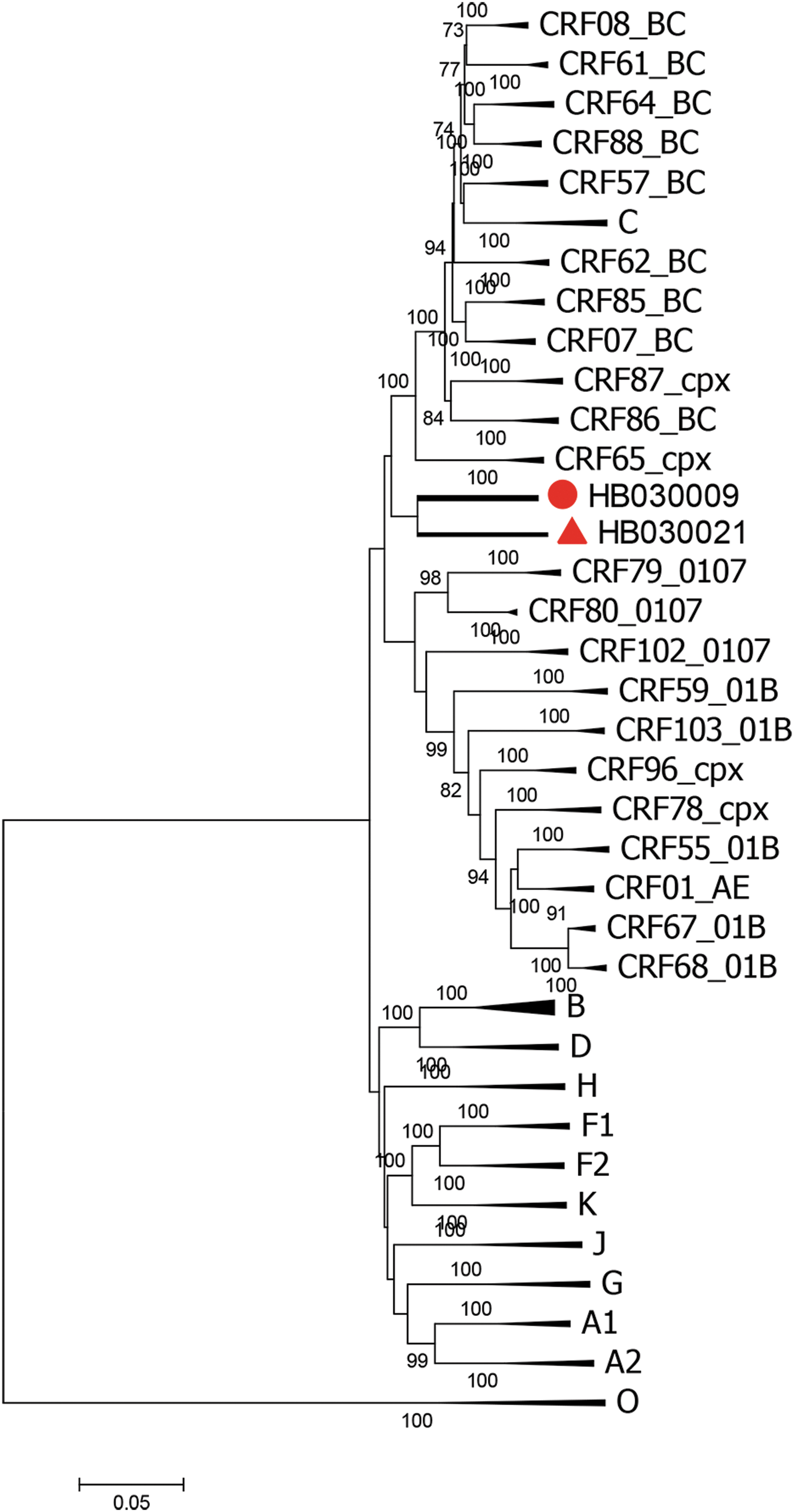
Phylogenetic tree analysis. A neighbor-joining phylogenetic tree of HB030009 (8,771 bp, red circle) and HB030021 (8,937 bp, red triangle) was constructed based on the NFLG sequences using Mega6.0. The stability of each node was assessed by bootstrap tests with 1,000 replicates and only bootstrap values ≥70% were shown at the corresponding nodes. The scale bar represents 5% genetic distance. NFLG, near full-length genome. Color images are available online.
In addition, the mosaic recombinant structure of two sequences were described as follows: ICRF07_BC (HXB2, 780–2,583 nt); IICRF01_AE (HXB2, 3,371–3,679 nt); IIICRF07_BC (HXB2, 3,679–3,904 nt); IVCRF01_AE (HXB2, 3,904–4,284 nt); VCRF07_BC (HXB2, 4,284–5,948 nt); VICRF01_AE (HXB2, 5,948–8,246 nt); VIICRF07_BC (HXB2, 8,246–9,507 nt), HB030009; ICRF01_AE (HXB2, 715–1,172 nt); IICRF07_BC (HXB2, 1,172–4,792 nt); IIICRF01_AE (HXB2, 715–1,172 nt); IVCRF07_BC (HXB2, 5,504–6,218 nt); VCRF01_AE (HXB2, 6,218–7,509 nt); VICRFF07_BC (HXB2, 7,509–7,637 nt); VIICRF01_AE (HXB2, 7,637–9,039 nt); VIIICRFF07_BC (HXB2, 9,309–9,412 nt); HB030021 (Figs. 2 and 3).

RIP analysis of the NFLG sequence of HB030009

Genetic maps of HB030009
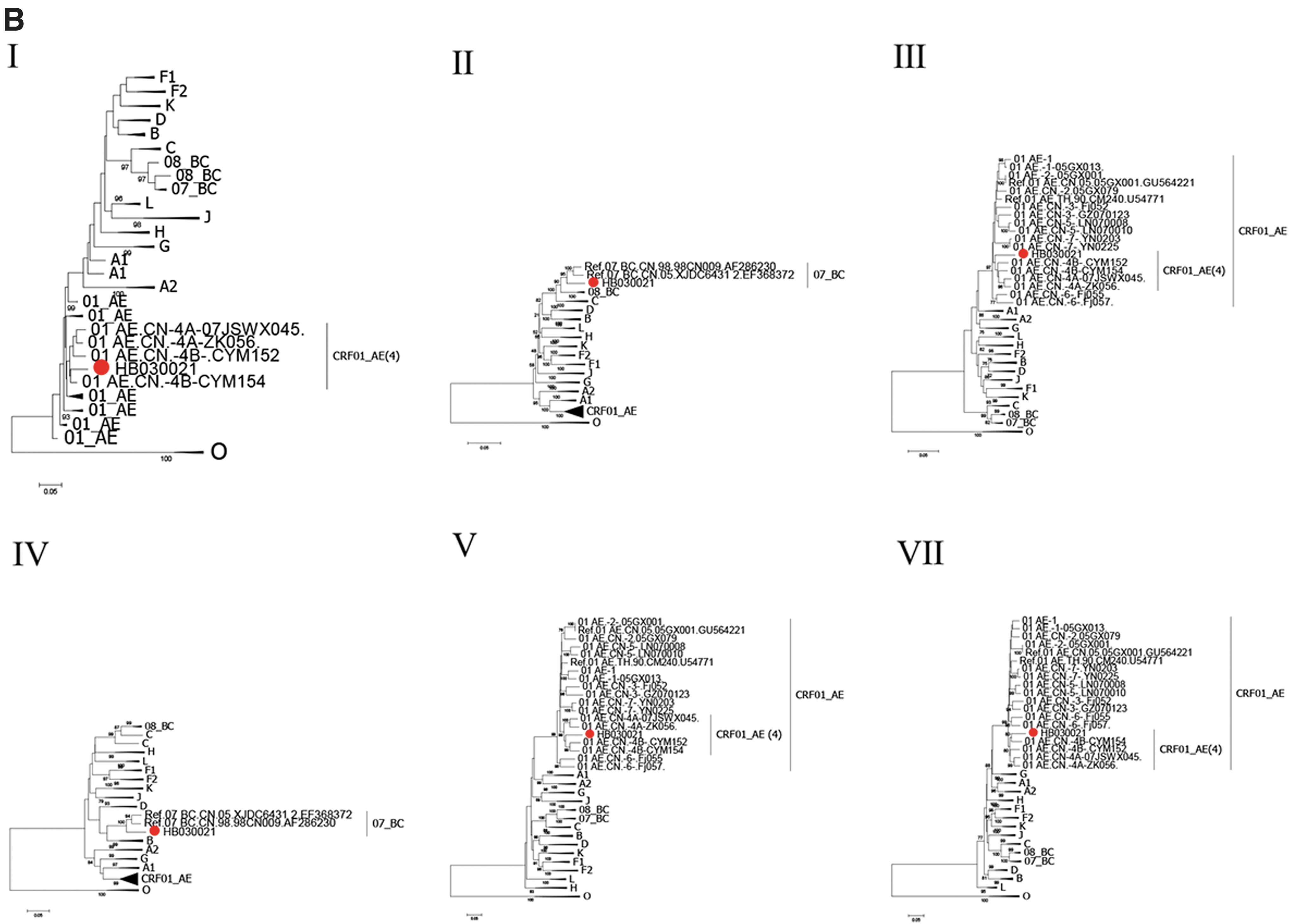
Subregion tree analysis revealed that parental origin of all CRF01_AE regions of two NFLGs were from the MSM-related CRF01_AE cluster 4 linkage, which is circulating primarily among MSM in Beijing (Fig. 4). The CRF07_BC regions in HB030009 (I, III, V, and VII) and HB030021 (II, IV, VI, and VIII) clustered with CRF07_BC reference sequences. In conclusion, the parental origins of the two novel second-generation URFs were CRF01_AE 4 clusters linkage and CRF07_BC.
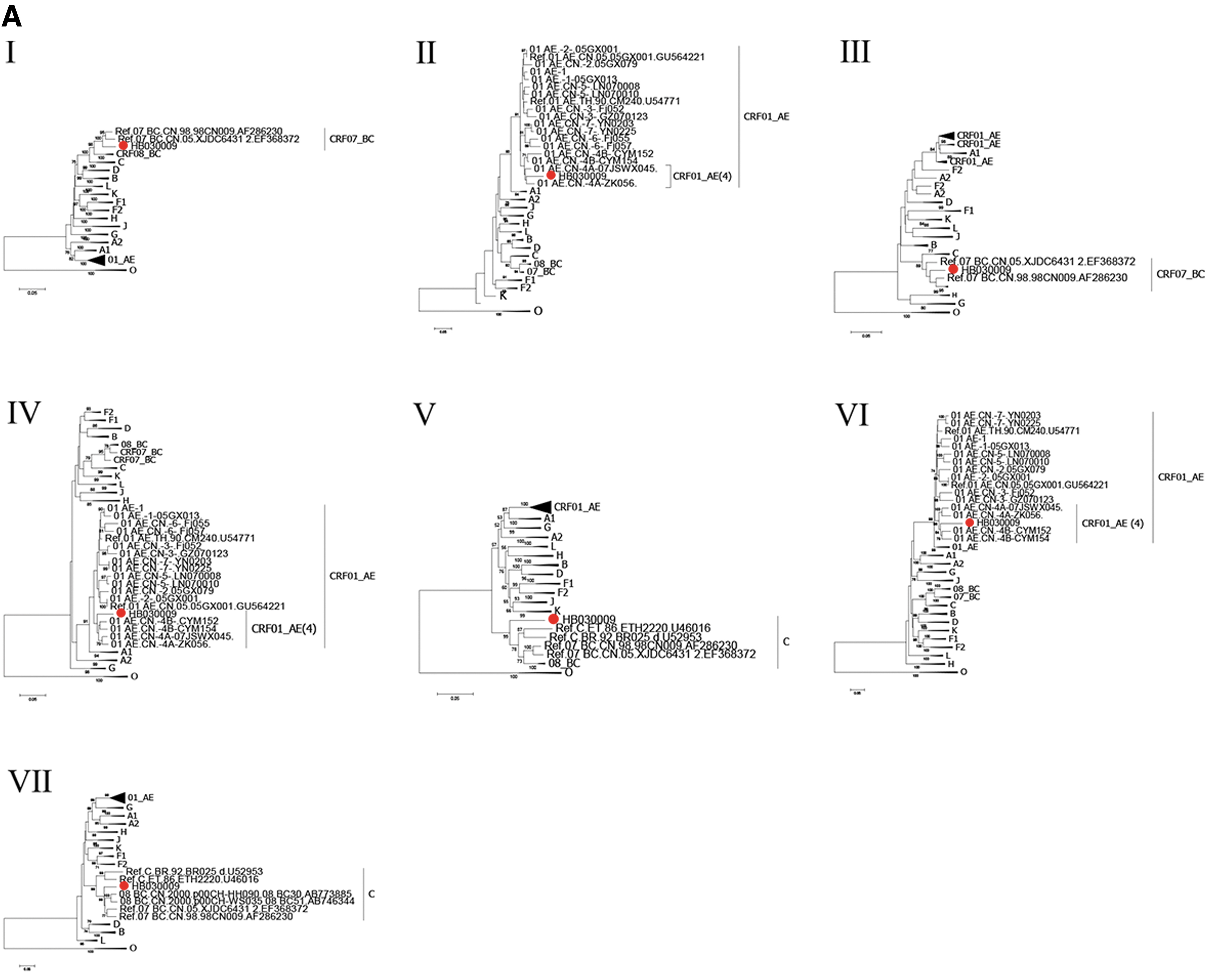
Subregion phylogenetic tree. Subregion phylogenetic analysis of different segments of HB030009
In this study, we reported two novel CRF01_AE/CRF07_BC recombinant forms from MSM populations in Hebei province, China. Hebei is one of the MSM-driven epidemic provinces in China. 11 More and more second-generation recombinant forms have already been reported among local MSM populations according to previous studies. 12,13 The emergency of novel URFs indicated the very complexity of the local HIV epidemic among MSM populations. Therefore, the further molecular surveillance of HIV-1 diversity in this region is necessary to make a better strategy against HIV-1 epidemic.
Sequences data
The gene sequences of HB030009 and HB030021 were deposited in the GenBank with the accession numbers MW728362 and MW728363, respectively.
Footnotes
Authors' Contributions
Article writing, experimental operation, and data analysis by Y.X.; experimental operation and data analysis by Y.G.; sample collection and data analysis by L.W.; article correction and laboratory procedure by H.L.; sequence assembly by J.H.; RNA extraction by X.W.; HIV reference sequences provided by Y.L.; article correction by L.J.; sample information collection and sorting by H.B.; sample storage and transport by C.L.; HIV confirmatory tests conducted by B.L.; experimental conditions provided by L.L.; experimental design, article correction, and experimental samples provided by E.D.
Author Disclosure Statement
No competing financial interests exist.
Funding Information
This study was supported by the NSFC (81773493, 31800149), the State Key Laboratory of Pathogen and Biosecurity (AMMS), and National Grand Program on Key Infectious Disease Control (Grant Nos. 2017ZX10201101, 2018ZX10721102, and 2018ZX10732101-001-003).