







Abstract
Homosexual contact is one of the main transmission routes of the HIV-1 epidemic in Shenzhen. Several subtypes of HIV-1 are prevalent among men who have sex with men simultaneously, which provides favorable conditions for the formation of a unique recombinant form (URF). In this study, we reported two URFs of HIV-1 (LS10525 and LS13740) infected through homosexual contact in Shenzhen. Phylogeny and recombination analyses based on the nearly full-length genome indicated that LS10525 was a second-generation recombinant strain composed of circulating recombinant form (CRF)07_BC and CRF59_01B, and LS13740 was a second-generation recombinant strain composed of CRF07_BC and CRF55_01B. The emergence of the novel structure of URFs urgently needs to surveil the HIV-1 epidemic in the population.
Introduction
Since the first HIV-1 case was reported in the 1980s,
1
37.7 million people worldwide have been infected with HIV-1 by 2020. The HIV-1 virus has a high mutation rate and high replication efficiency, and recombination has greatly improved the diversity of HIV-1 genes.
2
As of October 30, 2021, a total of 118 circulating recombinant forms (CRFs) and numerous unique recombinant forms (URFs) have been reported worldwide (
Shenzhen is one of the earliest opening cities in China. Many of our country's epidemic HIV-1 strains can be found in Shenzhen city. 3,4 Floating people and the complex population conditions of Shenzhen provide favorable conditions for the spread of HIV-1 among the population. CRF07_BC was first found among intravenous drug users in Yunnan and then was spread to other provinces along the drug transport routes. 5,6 Currently, it is widely spread among men who have sex with men (MSM) in China. Based on the detection of newly diagnosed HIV-1–positive cases in Shenzhen city from 2011 to 2018, CRF07_BC had become the main epidemic subtype in Shenzhen. 4 CRF55_01B and CRF59_01B are CRFs discovered in recent years. 7
CRF55_01B was first isolated in the MSM population. 8 Currently, CRF55_01B has become the third dominant strain in Shenzhen city. 9 CRF59_01B was produced by the recombination of CRF01_AE and B subtype around the year 2001. 10 CRF59_01B is the second CRF circulating primarily among MSM in China after CRF55_01B. 11 It has undoubtedly increased the emergence of second-generation recombinant strains that CRF07_BC, CRF55_01B, and CRF59_01B have widespread transmission and multiple infections in the MSM population. 12
In this study, we characterized the near full-length genome (NFLG) of two URFs in Shenzhen city that comprise CRF07_BC, CRF55_01B, and CRF59_01B. Both patients were from the MSM population and were infected through homosexual contact (Table 1). LS10525 was obtained from a 35 years old patient, and LS13740 was obtained from a 34 years old patient. The plasma samples of the two patients were collected, and viral RNA was extracted from 200 μL of plasma. Extracted RNA was reversely transcribed into cDNA using the superscript IV first-strand synthesis system (Invitrogen).
Background Information of the Two Novel Unique Recombinant Forms
MSM, men who have sex with men.
Furthermore, the NFLG was obtained in two halves by nested PCR amplification using TaKaRa reagent (TaKaRa). The PCR conditions of two rounds were as follows: 94°C 5 min followed by 30 cycles of 94°C 30 s, 60°C 30 s and 72°C 6 min, and an extension of 72°C 10 min. The positive products were detected by 1% agarose gel electrophoresis and then purified and sequenced by SinoGenoMax (China) with a series of special primers. Sanger sequences were manually assembled in Contig Express software. The nucleotide positions where the secondary peak was at least 30% as high as the primary peak were counted as the degenerate bases using the International Union of Pure and Applied Chemistry (IUPAC) designations to obtain the fasta sequences.
The final sequences of LS10525 and LS13740 were 8,773 bp length (780–9,595, with HXB2 as the calibrator) and 8,839 bp length (762–9,613, with HXB2 as the calibrator). The HIV-1 strains reference sequences of different subtypes and the epidemic CRFs in China (

Phylogenetic tree analysis. A NJ phylogenetic tree of LS10525 (8,773 bp, black circle) and LS13740 (8,839 bp, black triangle) was constructed based on the NFLG sequences using MEGA 6. All the reference strains were retrieved from the Los Alamos National Laboratory HIV Sequence Database (
In the neighbor-joining tree, the LS10525 and LS13740 sequences formed a separate cluster from other subtype reference sequences and CRFs, supposing that they may be in recombinant form. The genome structure of LS10525 and LS13740 was further analyzed, which supposed that they comprised CRF07_BC, CRF55_01B, and CRF59_01B. The Recombination Identification Program (
LS13740 had four breakpoints, and three gene fragments of CRF55_01B were inserted into the backbone of CRF07_BC (Figs. 2 and 3). The phylogenetic analysis of each subregion was performed to further verify the analysis of jpHMM and RIP. For LS10525, all subregions were clustered with CRF07_BC and CRF59_01B, respectively, suggesting that this was the second-generation recombinant of CRF07_BC and CRF59_01B. For LS13740, all subregions were clustered with CRF07_BC and CRF55_01B, respectively, suggesting that this was a recombinant of CRF07_BC and CRF55_01B (Fig. 4).
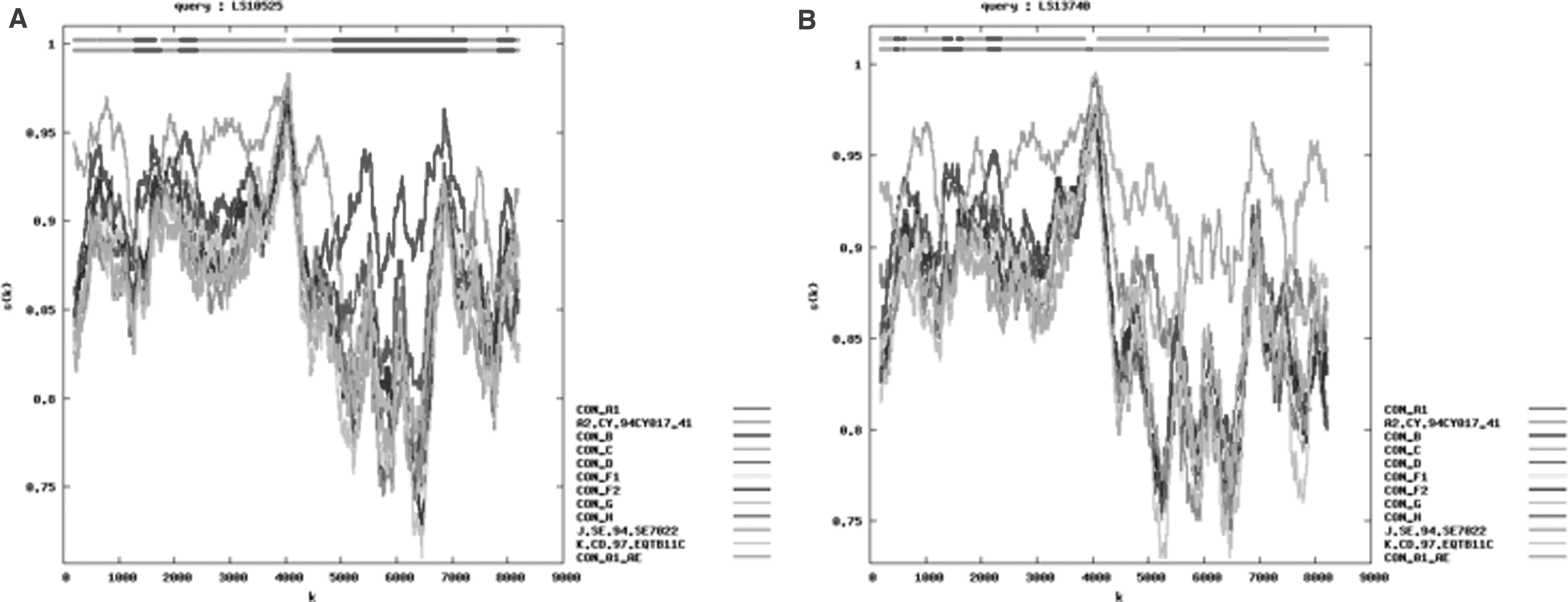
The RIP analysis of the NFLG sequence of LS10525
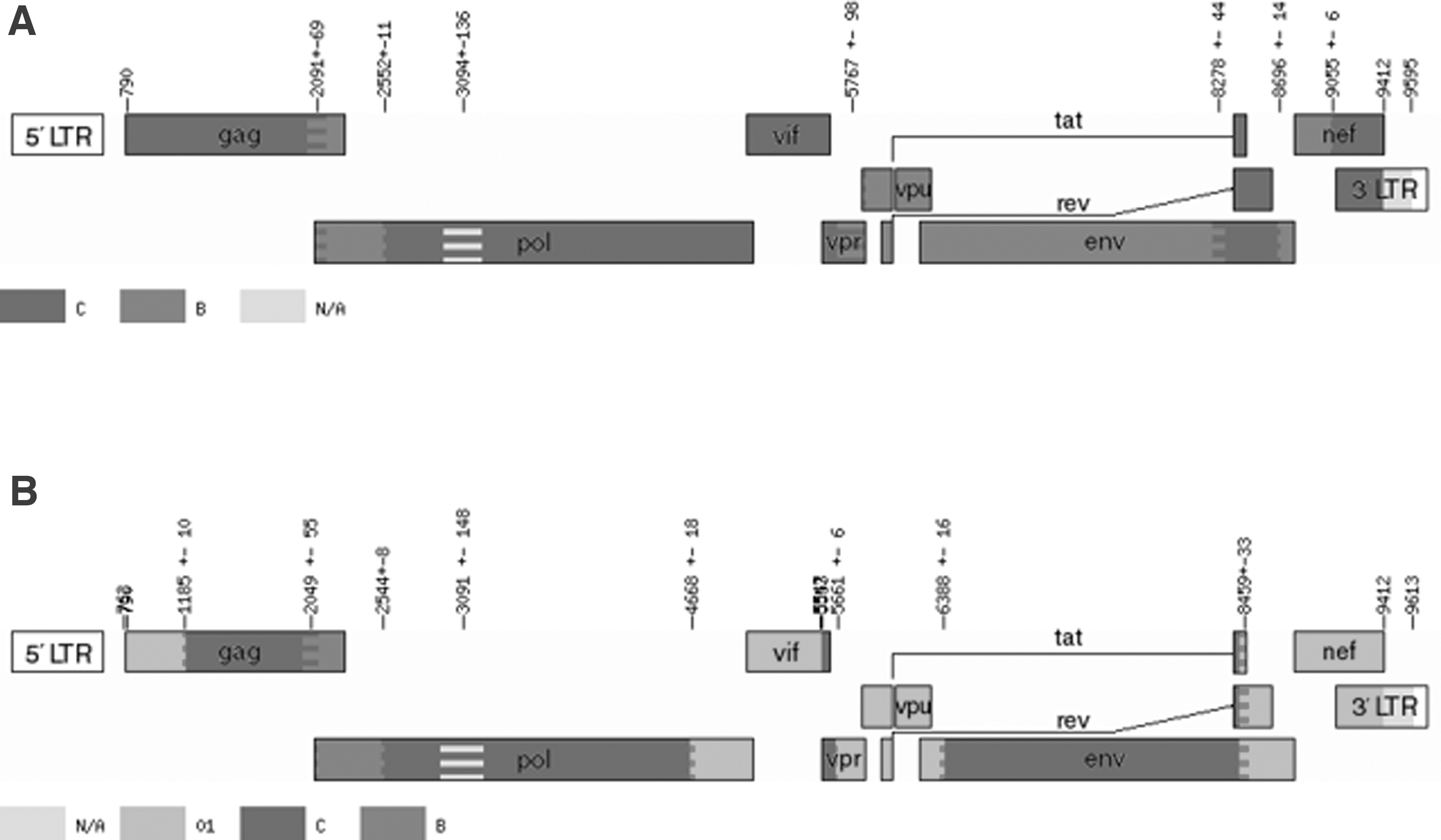
Genomic maps of LS10525

Subregions phylogenetic analysis of LS10525

In addition, the mosaic recombinant structure of two sequences was described as follows: I CRF07_BC (HXB2, 790–5,851 nt); II CRF59_01B (HXB2, 5,852–8,284 nt); III CRF07_BC (HXB2, 8,285–9,411 nt), LS10525; I CRF01_AE (HXB2, 790–1,176 nt); II CRF55_01B (HXB2, 1,177–4,672 nt); III CRF01_AE (HXB2, 4,673–6,375 nt); IV CRF55_01B (HXB2, 6,376–8,447 nt); V CRF01_AE (HXB2, 8,448–9,411 nt), LS13740.
In this study, we reported two novel URFs from the MSM in Shenzhen. Shenzhen city is one of the most densely populated areas in China. In previous studies, more and more URFs were reported in Shenzhen. 13,14 The emergence of the new URF suggested the complexity of the HIV-1 epidemic in the local MSM population. It is urgent to surveil the HIV-1 epidemic in Shenzhen to formulate better prevention and control strategies.
Sequences Data
The gene sequences of LS10525 and LS13740 were deposited in the GenBank with the accession numbers OL791371 and OL791372, respectively.
Footnotes
Author Disclosure Statement
No competing financial interests exist.
Funding Information
This study was supported by the National Key Research and Development Program of China (Grant No. 2020YFA0907000), NSFC (Grant Nos. 81773493, 31800149, and 31900157), the State Key Laboratory of Pathogen and Biosecurity (AMMS) (Grant Nos. SKLPBS2103 and SKLPBS2118).