




Abstract
Two near full-length genome (NFLG) sequences of HIV-1 with undefined subtypes were analyzed to confirm the recombinant characteristics. To analyze the gene recombination patterns and breakpoints of these two NFLGs, the phylogenetic trees based on the NFLG sequences and their subregions were constructed, respectively. Sequences 233 and 953 are novel second-generation recombinant forms of HIV-1 CRF01_AE and subtype B. The NFLG phylogenetic tree analysis showed that these two NFLG sequences formed a unique monophyletic branch, respectively. The recombination breakpoints analysis showed that the recombination pattern of both sequences was that a subtype B fragment was inserted into a CRF01_AE backbone. Subregions I, II, and III were from CRF01_AE, subtype B, and CRF01_AE, respectively. The recombination breakpoints relative to HXB2 of sequences 233 and 953 were 2400 and 4870, and 3363 and 4828, respectively. The emergence of novel recombinant forms of CRF01_AE/B demonstrates that we should carry out the ongoing surveillance of HIV-1 recombinant forms in the sexually transmitted population.
Introduction
According to data released by the joint United Nations program on HIV and AIDS (UNAIDS), 1 37.7 million people worldwide were living with HIV in 2020, however, only 28.2 million of them received antiretroviral therapy, and HIV is still a global pandemic. Owing to the high frequent mutation, replication, and genetic recombination of HIV-1, new HIV-1 recombinant strains emerged continuously in high-risk populations.
Since 1990, global infections caused by HIV-1 recombinant strains have rapidly increased from 9.3% between 1990 and 1999 to 22.8% between 2010 and 2015, and the highest prevalence of HIV-1 intersubtype recombination in the world has occurred in East Asia (80.5%), including China. 2 This poses many difficulties for HIV-1 prevention, control, and treatment.
Despite the increase in HIV patients receiving antiretroviral therapy, HIV-1 infection rates have been rising in all regions of China, especially among high-risk populations such as men who have sex with men. 3 To date, a total of 21 CRFs_01B have been identified, including CRF55_01B, 4 CRF59_01B, CRF67_01B, 5 CRF68_01B, 5 CRF101_01B, 6 CRF103_01B, 7 and CRF107_01B 8 in China.
Hebei province is located in northern China, surrounding the capital Beijing and adjacent to Tianjin in the east, which is closely associated with the high frequent HIV-1 intersubtype recombination. In recent years, the number of HIV/AIDS cases in Hebei Province has presented an increasing trend. Furthermore, sexual transmission has been the main route of HIV-1 transmission, rising from 85.2% in 2010 to 96.8% in 2019, and CRF01_AE, CRF07_BC, and subtype B have been the main prevalent strains in Hebei Province. 9 The occurrence of numerous recombinant strains will lead to an increase in virulence or infectivity of the virus, which accelerates the course of diseases related to HIV-1.
In this study, two new unique recombinant forms (URFs) that derived from CRF01_AE and subtype B were confirmed by the near full-length genome (NFLG) sequence analyses of subject 233 in Cangzhou and subject 953 in Qinhuangdao, Hebei Province, China.
Materials and Methods
Subject 233 was a 23-year-old man newly infected with HIV-1 through homosexual contact in Cangzhou city of Hebei Province, China. Subject 953 was a 28-year-old man infected with HIV-1 through heterosexual transmission in Qinhuangdao City, Hebei Province, China. Both subjects were confirmed as the recent HIV-1 infection in 2020, and their blood plasma samples were collected. HIV-1 NFLG amplification, sequencing, and sequence assembly were performed as previously described. Multiple sequence comparisons and manual editing of Clustal W were then performed using Bio Edit 7.0 software.
Standard reference sequences for HIV-1 subtypes were downloaded from the HIV databases (
This study was approved by the local ethics committee of Hebei Provincial Center for Disease Control and Prevention [No. IRB(S)2020-031].
Results
Figure 1 shows that sequences 233 and 953 formed a distinct monophyletic branch from other subtypes and Circulating Recombinant Forms (CRFs) in the NFLG Neighbor-Joining phylogenetic tree, respectively, suggesting that these two NFLG sequences should be novel recombinant forms. According to the results of the online jpHMM, RIP 3.0, and Simplot 3.5.1 (Figs. 2 and 3), the breakpoints analysis identified that the NFLG sequences were two new URFs originated from CRF01_AE and subtype B, and the NFLGs of sequences 233 and 953 harbored three subregions, respectively.
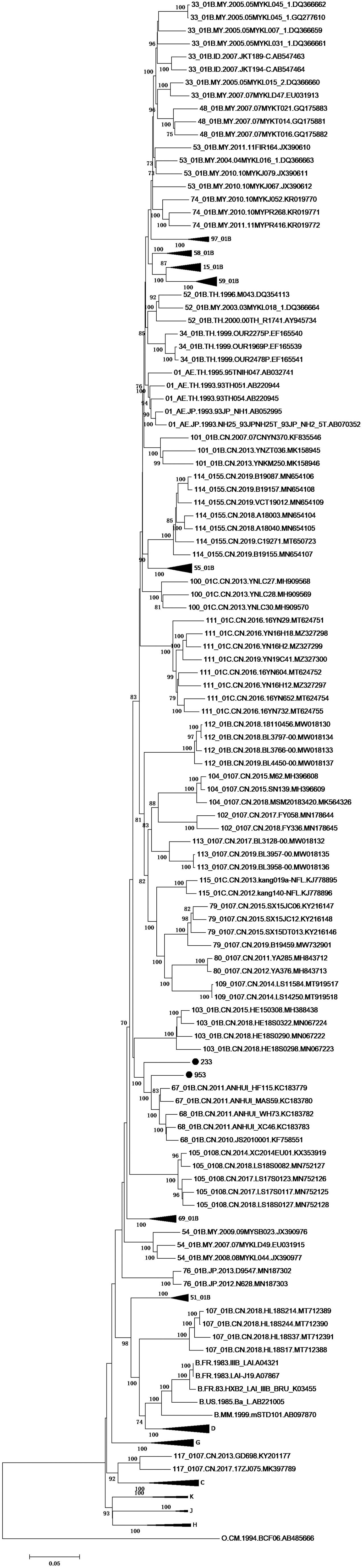
Phylogenetic tree analysis based on HIV-1 NFLG sequences. A neighbor-joining tree was constructed using MEGA 6.0 with 500 bootstrap replicates. The standard reference sequences of HIV-1 subtypes were downloaded from the HIV Databases (
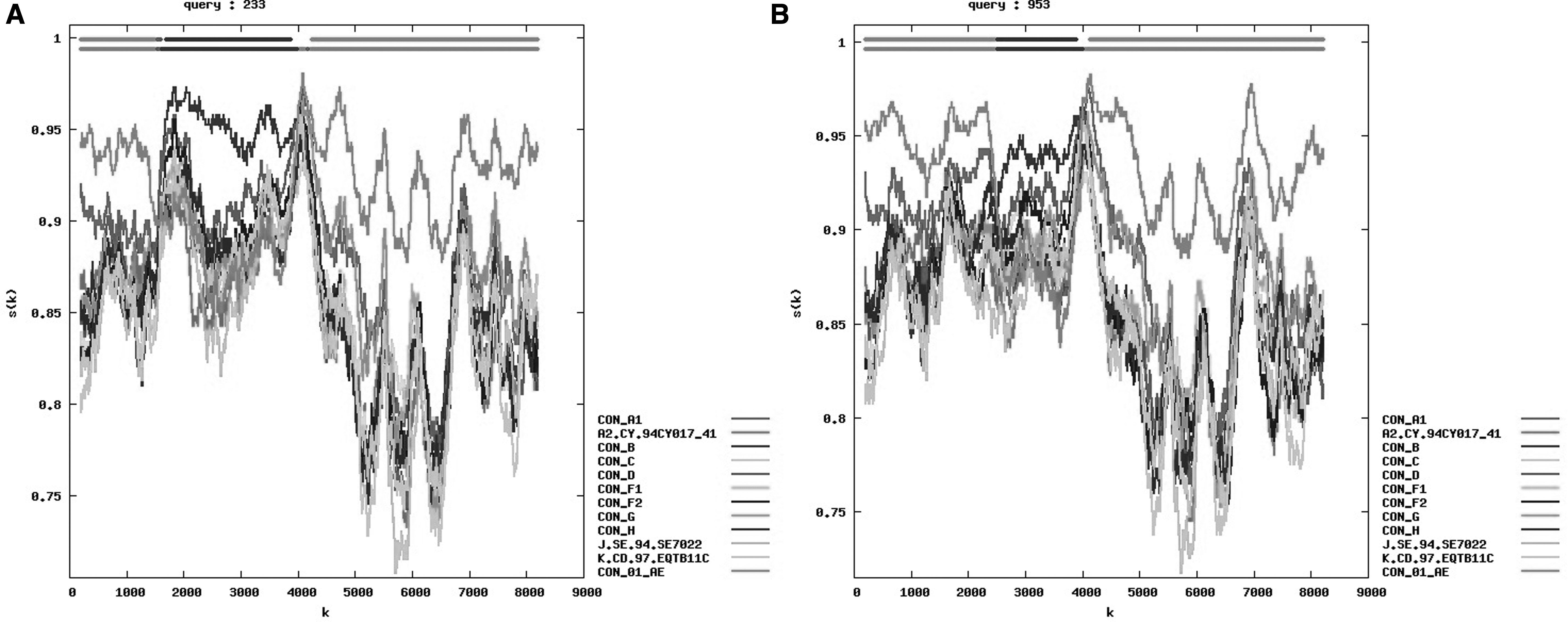
RIP analyses of sequences 233 and 953. Similarity distance analysis was performed using the online RIP (

Bootscan analyses of sequences 233 and 953. Bootscan maps showed that both sequences 233 and 953 consisted of two CRF01_AE fragments and one subtype B fragment, respectively. The standard references of CRF01_AE, B, and J were downloaded from the HIV Databases (
As shown in Figures 2–4, the NFLG mosaic structure of sequences 233 and 953 was analyzed in detail. According to position based on HXB2 numbering, sequence 233: ICRF01_AE (790–2,400 nt), IIB (2,401–4,870 nt), and IIICRF01_AE (4,871–9,411 nt); sequence 953: ICRF01_AE (790–3,362 nt), IIB (3,363–4,828 nt), and IIICRF01_AE (4,829–9,411 nt). The phylogenetic tree analyses (Figs. 4 and 5) of each subregion of the two NFLGs identified that both CRF01_AE fragments and one subtype B fragment within each NFLG (233 and 953) clustered with their respective reference sequences, respectively. Figures 2–5 identified the NFLG mosaic structures of two novel CRF01_AE and subtype B recombinant forms.
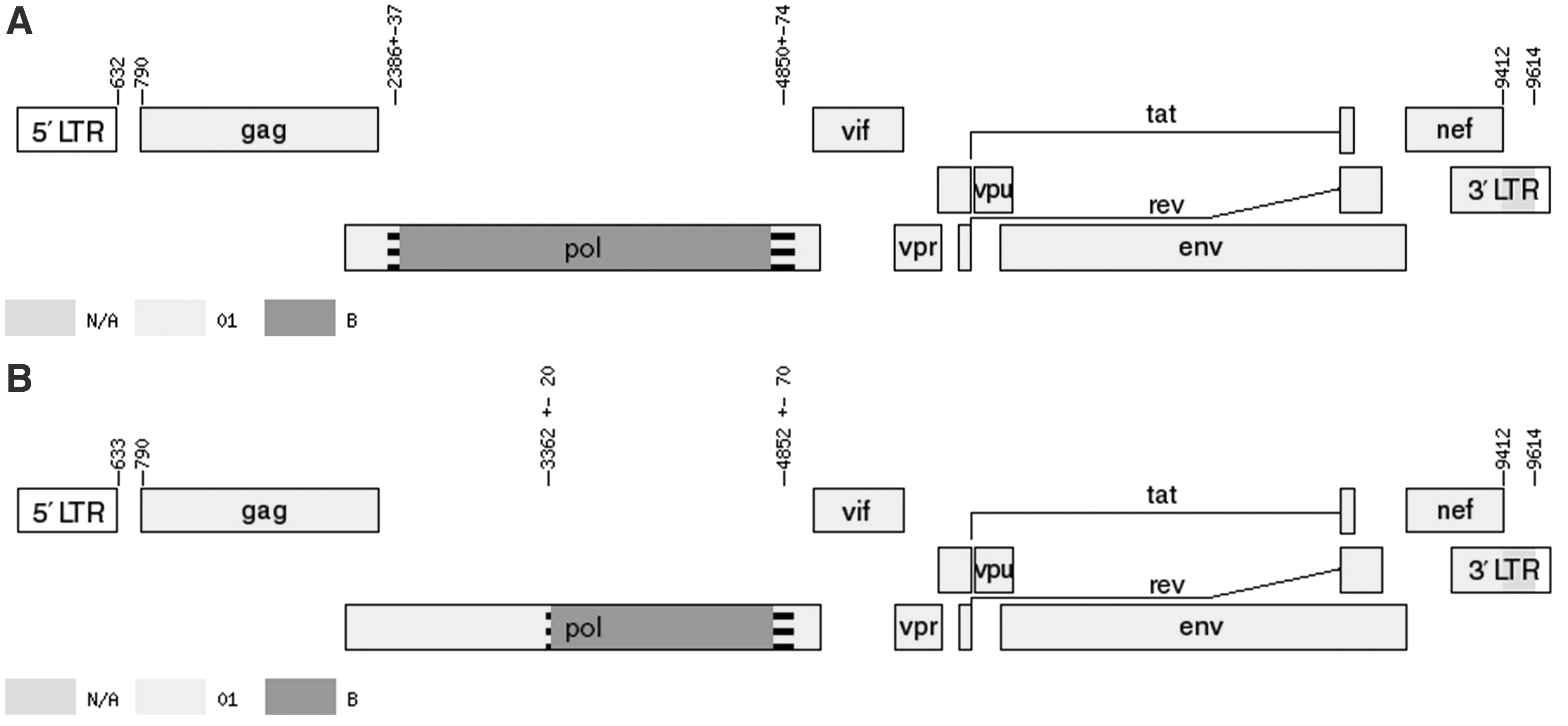
Recombination breakpoints analyses of sequences 233 and 953. The NFLG mosaic maps were obtained using the online jpHMM (

Subregion phylogenetic trees of sequences 233 and 953. A neighbor-joining tree was constructed using MEGA 6.0 with 500 bootstrap replicates. Black dot denotes study subject. Bootstrap values ≥70% are shown at the corresponding nodes. The scale bar represents 5% genetic distance.
Currently, numerous recombinant forms of CRF01_AE and subtype B have been continuously reported in many regions of China, 10 –13 for example, HIV-1 second-generation recombinants identified in Baoding, 7 Handan, 14 and Shijiazhuang, 15 Hebei Province. In this study, we reported two novel CRF01_AE/B recombinant forms of CRF01_AE/B from Hebei Province, China. It is possible that subtype recombination between the CRF01 AE and B subtypes occurs often and in a variety of sexually transmitted populations, enriching the global HIV database. Therefore, further molecular surveillance of HIV-1 diversity in Hebei Province is necessary to develop better strategies to fight against the HIV-1 pandemic.
Sequence Data
Two sequences reported in this study have been submitted to GenBank with accession numbers OP169133 and OP169134.
Footnotes
Authors' Contributions
X.L. conceived the study project. M.L, X.Z., Y.L., Y.W., N.A., and X.T. completed the whole study. X.T. and X.L. analyzed experimental data and drafted the article. Q.L. provided experimental conditions. All authors read and approved the final article.
Informed Consent Statement
Written informed consent was obtained from both HIV-1 individuals before blood collection.
Ethical Approval
This study was approved by the local ethics committee of Hebei Provincial Center for Disease Control and Prevention [No. IRB(S)2020-031].
Author Disclosure Statement
No competing financial interests exist.
Funding Information
This study was supported by the Key Science and Technology Planning Project of Hebei Province (192777107D).