




Abstract
Two HIV-1 infections with unassigned genotypes were identified during HIV-1 pretreatment drug resistance surveillance. The near full-length genome sequences of BL5040-00 and BL5085-00 were obtained and were classified as unique recombinant forms (URFs) between CRF01_AE and CRF07_BC. Simplot (version 3.5) analyses showed that the two URFs shared similar recombinant forms, and in the backbone belonging to CRF01_AE, the gag-pol, vpu, env, and nef gene fragments were genetically substituted by CRF07_BC. BL5040-00, with 10 breakpoints, had 6 CRF07_BC fragments and 5 CRF01_AE fragments, whereas BL5085-00, with 6 breakpoints, had 4 CRF07_BC fragments and 3 CRF01_AE fragments. BL5040-00 strain had two additional recombination breakpoints in pol-vif gene. The presence of URFs suggests that the men who have sex with men population in Beijing has an active HIV epidemic and the genetic diversity of HIV-1 is complex, emphasizing molecular epidemiology and disease progression monitoring should be strengthened.
Introduction
HIV-1
The fourth national molecular epidemiological survey of HIV/AIDS showed that CRF01_AE and CRF07_BC have been identified across 31 provinces, municipalities, and autonomous regions nationwide, accounting for 83% infections. 5 In recent years, HIV-1 infection has spread rapidly among men who have sex with men (MSM) in China. 5
The overall HIV epidemic has slowed in recent years in Beijing, with 37,070 cumulative cases reported as of October 31, 2021, and MSM account for 68.2% (
The individuals were recruited for pretreatment drug resistance surveillance in Fifth Medical Center of the PLA General Hospital. The persons with unassigned subtypes or CRFs were included, suggesting infections with novel recombinant strains. In this study, two individuals were chosen with similar genetic characteristics, for further URFs phylogenetic inference upon near full-length genome (NFLG). The whole blood was collected with informed consent, and the plasma was frozen at −80°C. CD4 cell count and HIV-1 viral load assay were performed.
BL5040-00 and BL5085-00, infected HIV-1 through MSM, were both living in Beijing without local household registration. BL5040-00 was diagnosed on October 15, 2020, at the age of 27 years, and BL5085-00 on December 2, 2020, at the age of 29 years (Table 1).
Demographic Information and Relevant Test Result Information of the Two Cases
NFLG, near full-length genome.
Viral RNA was extracted from 140 μL plasma samples using Qiagen QIAamp Viral RNA Mini kit according to the kit instructions. First complementary DNA (cDNA) strand was synthesized using Invitrogen SuperScript III reverse transcriptase. The cDNA was serially diluted and two overlapping half genomes were amplified using TaKaRa LA Taq reagent. 7 The primers and reaction conditions were described. 8 Positive amplification products were sent to SinoGenoMax Company Limited for sequencing by the Sanger method.
The obtained ABi sequence files were spliced and cleaned using Sequencher (version 5.0). With the subtyping reference strains from the Los Alamos HIV sequence database (
Similarity Plot and BootScan analysis were performed using SimPlot (version 3.5), with the NFLG sequences of CRF01_AE and CRF07_BC from China downloaded from the LANL HIV sequence database. The fragmental NJ trees were constructed based on the breakpoints to verify the recombination and the possible parental strains. Using the Recombinant HIV-1 Drawing tool of the LANL HIV sequence database, genomic mosaics were drawn based on the reference positions of HXB2.
NFLG sequences of BL5040-00 and BL5085-00 were obtained with 8,999 and 8,906 nucleotides, respectively. The NJ trees indicated that BL5040-00 and BL5085-00 were clustered with the CRF01_AE reference strain into a large monophyletic cluster with a bootstrap value of 99% and located at the periphery of the evolutionary cluster, containing recombinant strains such as CRF112_01B and CRF113_0107 (Fig. 1). It is suggested that BL5040-00 and BL5085-00 may have recombination of CRF01_AE with other subtypes of virulent strains.
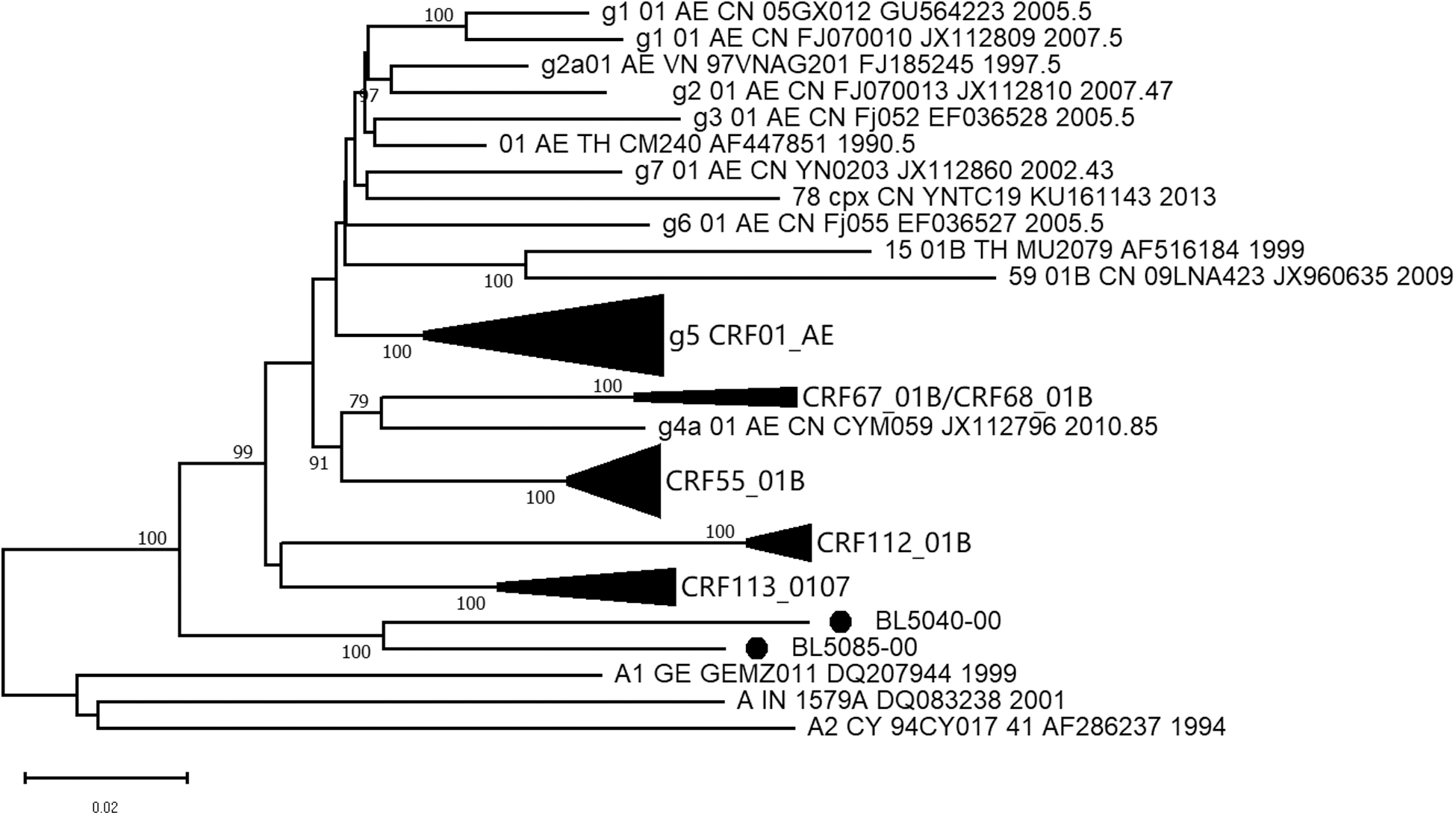
The neighbor-joining tree of the two individuals by HIV-1 near full-length genomes. The solid circles (•) indicate the sequences from the two individuals.
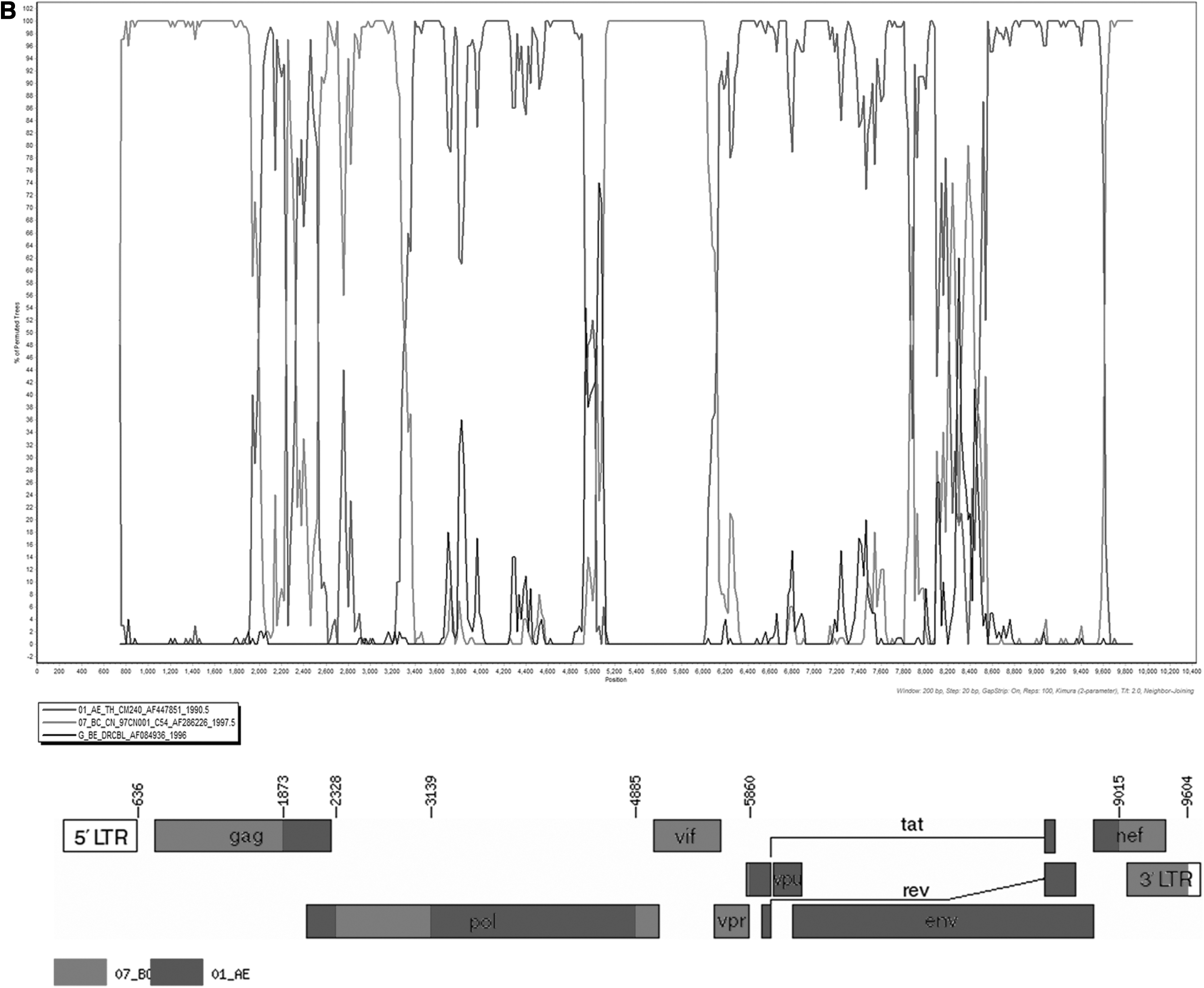
The recombinant analyses were described as follows (Fig. 2): relative to the HXB2 nucleotide numbering system (positions 672–9,613), BL5040-00 has 10 breakpoints, at positions 2,136, 2,286, 3,592, 4,540, 4,880, 5,219, 6,001, 7,353, 7,556, and 9,104, in the gag-pol, vif, vpu, env, and nef-3′ long terminal repeat gene regions, respectively; in the backbone of CRF01_AE, fragments I, III, V, VII, IX, and XI of BL5040-00 were substituted by the counterparts from CRF07_BC; BL5085-00 has six breakpoints at positions 1,873, 2,328, 3,139, 4,885, 5,860, and 9,015, located in the gag-pol, vpu, env, and nef gene regions; the fragments I, III, V, and VII from BL5085-00 backbone of CRF01_AE were replaced by the counterparts from strain CRF07_BC.

The recombinant analyses of two novel unique recombinant forms isolated from men who have sex with men in Beijing, China. The BootScan analysis and the genome mosaics of BL5040-00
Based on the comparison results of the mentioned recombination breakpoints, a subregion phylogenetic tree was constructed (Fig. 3). It showed that BL5040-00 fragments I, III, V, VII, and IX all clustered with CRF07_BC in the phylogenetic tree (bootstrap value of 88%), and fragments II, IV, VI, VIII, and X clustered with CRF01_AE (bootstrap value of 94%). BL5085-00 fragments I, III, V, and VII all clustered with CRF07_BC in the phylogenetic tree (bootstrap value of 99%), and fragments II, IV, and VI clustered with CRF01_AE bootstrap value of 100%). The results of the subregion phylogenetic tree analysis verified the accuracy of Simplot recombination breakpoint definition.

Subregion phylogenetic tree of BL5040-00 and BL5085-00. Segments I, III, V, VII, and IX of BL5040-00 NFLG
The pretreatment drug resistance of the two individuals was interpreted by the Stanford HIV Drug Resistance Database. No drug resistance to protease-reverse transcriptase inhibitors and integrase strand transfer inhibitors were observed.
In recent years, recombinant HIV-1 strains have been frequently reported with a trend of uprising, especially in regions where multiple subtypes or CRFs were cocirculating, such as Asia and Africa. 3,9 Although at present UFRs have not formed an epidemic, the active sex behaviors and the onward transmission in populations at high risk may induce the emergence of CRFs. 10 Novel CRFs were continuously identified as recombination between CRF01_AE and subtypes B, and URFs that have been identified among MSM in China.
Beijing has reported newly identified CRFs such as CRF80_0107, CRF112_01B, CRF113_0107, and CRF103_01B (
In this study, we report two individuals got infected by URFs both comprising CRF01_AE and CRF07_BC from Beijing MSM, suggesting that the HIV epidemic was active. The two URFs shared the same backbone belonging to CRF01_AE and similar recombinant patterns around gag-pol, vpu, env, and nef gene. The emergence of novel URFs urged that it is imperative to strengthen the HIV molecular epidemiological surveillance, and further analyze the genetic characteristics and origination of recombination. It is promised to find clues to curb HIV transmission through the molecular transmission network and phylogeny. 14
Sequence Data
The NFLG sequences of BL5040-00 and BL5085-00 have been deposited to GenBank with the accession nos. OP716544 and OP716545, respectively.
Footnotes
Authors' Contributions
J.L. (Jia Li) and M.D. conceived and designed the study. J.L. (Jie Li), B.S., and H.H.H. collected the samples. H.Y.L. and R.L.X. performed the experiments. J.L. (Jia Li), M.D., and R.L.X. analyzed the data and drafted the article. H.Y.L., H.H.H., and R.L.X. critically revised the article. All authors read and approved the final article.
Author Disclosure Statement
No competing financial interests exist.
Funding Information
This study was sponsored by Beijing Natural Science Foundation (Grant No: 7202074) and Capital's Funds for Health Improvement and Research (Grant No: CFH2022-1G-3015). The funders have no role in the study design, data collection and analyses, decision to publish, or preparation of the article.