




Abstract
Subtypes circulating recombinant form (CRF)01_AE and C are two human immunodeficiency virus (HIV)-1 strains that are prevalent in different key populations such as men who have sex with men (MSM) in China. Co-circulating of different HIV-1 subtypes is easy to result in the generation of second-generation recombinants. In this study, three new HIV-1 CRF01_AE/C recombinants from three MSMs were detected in Hebei province, China. Phylogenetic tree and recombination analysis showed that the near-full-length genomic of S114 had seven recombination breakpoints, including four C fragments inserted into the CRF01_AE backbone; M363 had six recombination breakpoints, including three C fragments inserted into the CRF01_AE backbone; M162 had eight recombination breakpoints, including four C fragments inserted into the CRF01_AE backbone. Furthermore, phylogenetic tree analysis based on subregion gene fragments also identified this kind of CRF01_AE/C recombinant structure. This study suggests a more complex HIV-1 epidemiological trend in Hebei province, China and the urgency of continuous HIV-1 recombinant strain registry in sexually transmitted populations.
Introduction
Human immunodeficiency virus (HIV)-1 has very high genetic variability due to the lack of 3′-5′ directional exonuclease activity and significantly lower fidelity of reverse transcriptase than eukaryotic DNA polymerase. HIV-1 includes four groups: M (major); O (outlier); N (non-Mnon-O), and P 1 and accounts for 95% of all HIV infections worldwide. HIV-1 group M accounts for the majority of global HIV infections, including 9 pure subtypes (A–D, F–H, J, and K) and ∼132 circulating recombinant forms (CRFs), and many unique recombinant forms (URFs). CRFs originate from the recombination of two or more parental strains. The spread of HIV-1 variants has presented an urgent challenge to HIV diagnosis, treatment, and vaccine development. 2
In China, the distribution of HIV-1 subtypes is complex and diverse. CRF07_BC, CRF01_AE, and subtypes B are predominant circulating HIV-1 subtypes. 3 the large number of URFs found indicates that HIV-1 recombination is very active in China. 4 To date, 40 CRFs have been reported in China.
Hebei surrounds Beijing and Tianjin, and has a population of 74.24 million. 5 By the end of 2020, Hebei reported a total of 17,891 AIDS cases. The proportion of sexual transmission contacts increased from 85.2% in 2010 to 96.8% in 2019, thus sexual transmission has become a key factor in the rising trend of HIV in Hebei Province. Previous studies 6 indicated that many CRF_01AE/CRF07_BC, CRF01_AE/B recombinant forms and CRFs have been identified in Hebei. In this study, we identified three novel recombinant strains composed of subtypes CRF01_AE and C by analysis of the near-full-length genomic (NFLG) structures.
Materials and Methods
Three participants infected with HIV-1 through homosexual contact were enrolled in this study and named as M162, M363, and S114, respectively. M162 and M363 comes from Baoding city, and they were a 36-year-old unmarried farmer and a 28-year-old married domestic worker, respectively. S114 was a 50-year-old divorced farmer in Xingtai city (Table 1). Of three participants, both S114 and M162 have ever experienced venereal disease. Written informed consent were obtained from all participants.
Demographic Characteristic of Human Immunodeficiency Virus-1 Infected Participants
MSM, men who have sex with men.
Viral RNA extraction, amplification, and sequencing procedures were performed as described previously.
7
Multiple sequence comparisons and manual editing of Clustal W were then performed using Bio Edit 7.0 software.
8
Standard reference sequences for HIV-1 subtypes were obtained from the HIV databases (
Written informed consent was obtained from three HIV-1 individuals before blood collection.
This study was approved by the Local Ethics Committee of Hebei Provincial Center for Disease Control and Prevention [No. IRB(S)2020-031].
Results
The N-J tree (Fig. 1) showed that three study NFLG sequences did not cluster with the reference sequences, and formed distinct monophyletic branches, indicating three potential novel recombinant forms. As shown in Figures 2 –4, recombination breakpoints were identified using online jpHMM, RIP 3.0, and Simplot 3.5.1. Three NFLGs were new recombinant structures with subtype C fragments inserted into a CRF01_AE backbone. S114 consists of four subtype C fragments inserted into the gag, pol, env, and nef regions of the CRF01_AE backbone. M363 consists of three subtype C fragments inserted into the pol and env regions of the CRF01_AE backbone. M162 consists of four subtype C fragments inserted into the pol, vpr, and env regions of the CRF01_AE backbone.

Phylogenetic tree analysis based on HIV-1 NFLG sequences. A neighbor-joining tree was constructed using MEGA 6.0 with 500 bootstrap replicates. The standard reference sequences of HIV-1 subtypes were downloaded from the HIV databases (
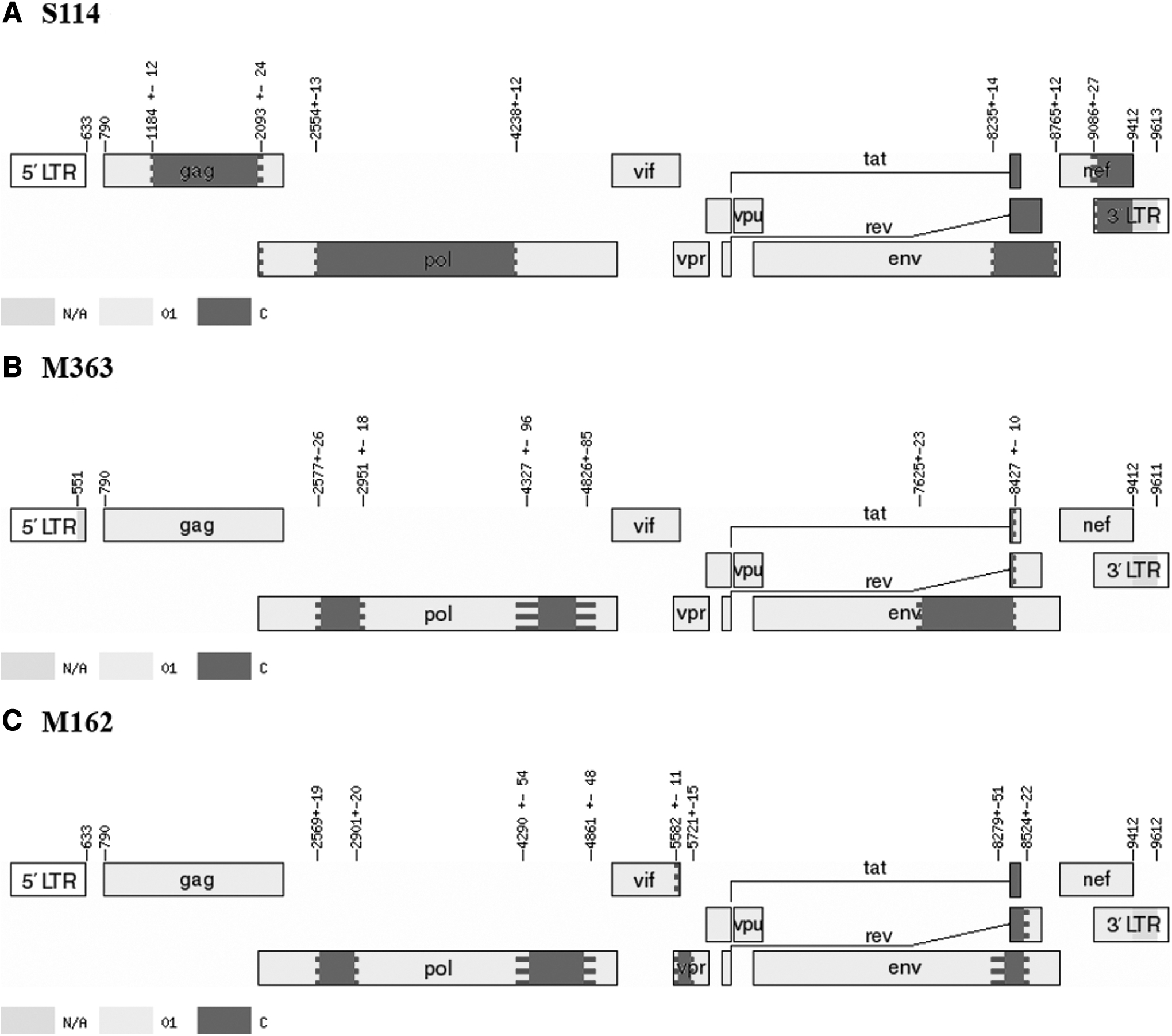
Recombination breakpoints analyses of sequence S114, M363, and M162. The NFLG mosaic maps were obtained using the online jpHMM (
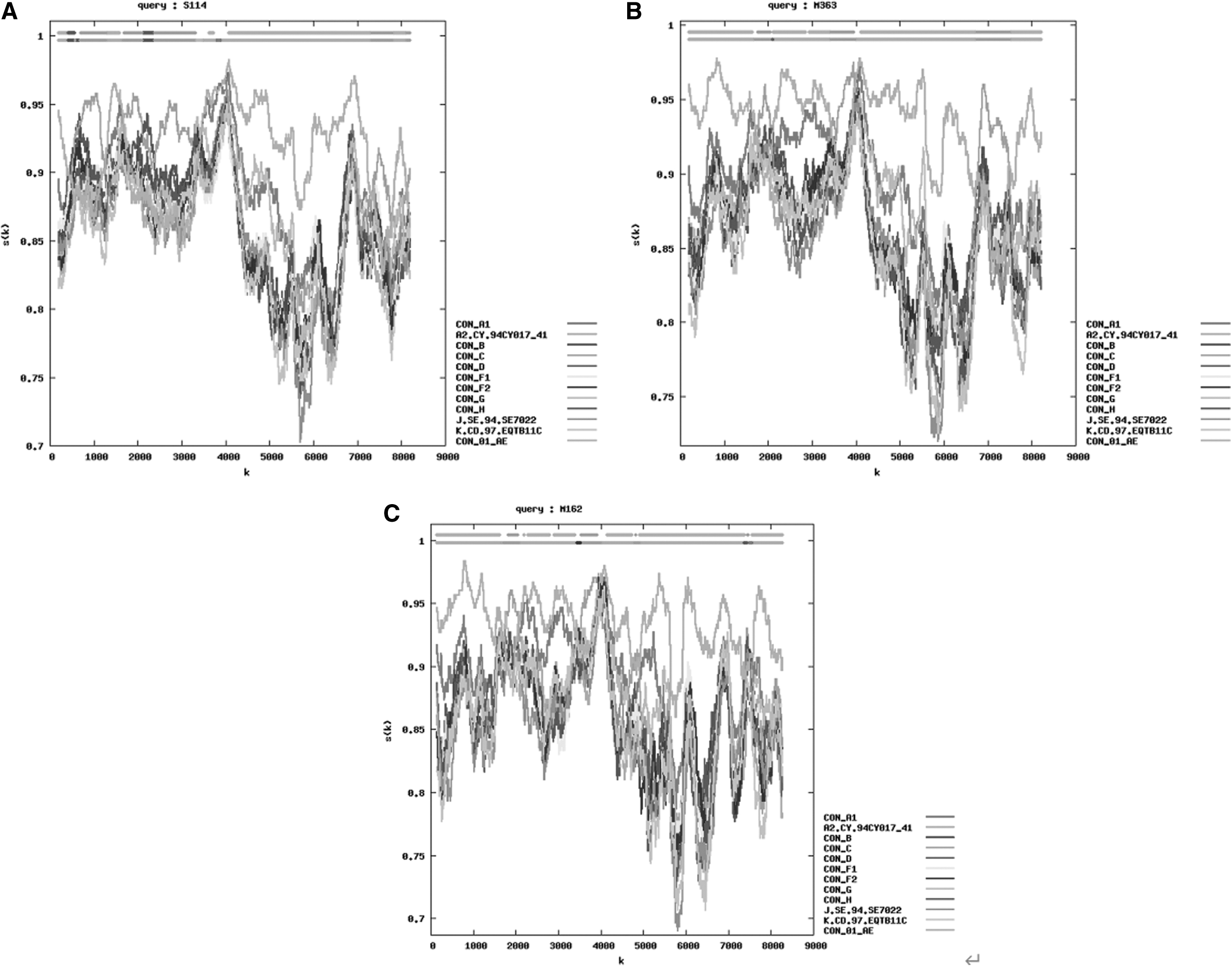
RIP analyses of sequences S114, M363, and M162. Similarity distance analysis was performed using the online RIP (

Bootscan analyses of S114, M363, and M162. Bootscan maps showed that S114 consisted of four CRF01_AE fragments and four subtype C fragment, M363 consisted of four CRF01_AE fragments and three subtype C fragment, M162 consisted of five CRF01_AE fragments and four subtype C fragment, respectively. The standard references of CRF01_AE, B, and J were downloaded from the HIV databases (
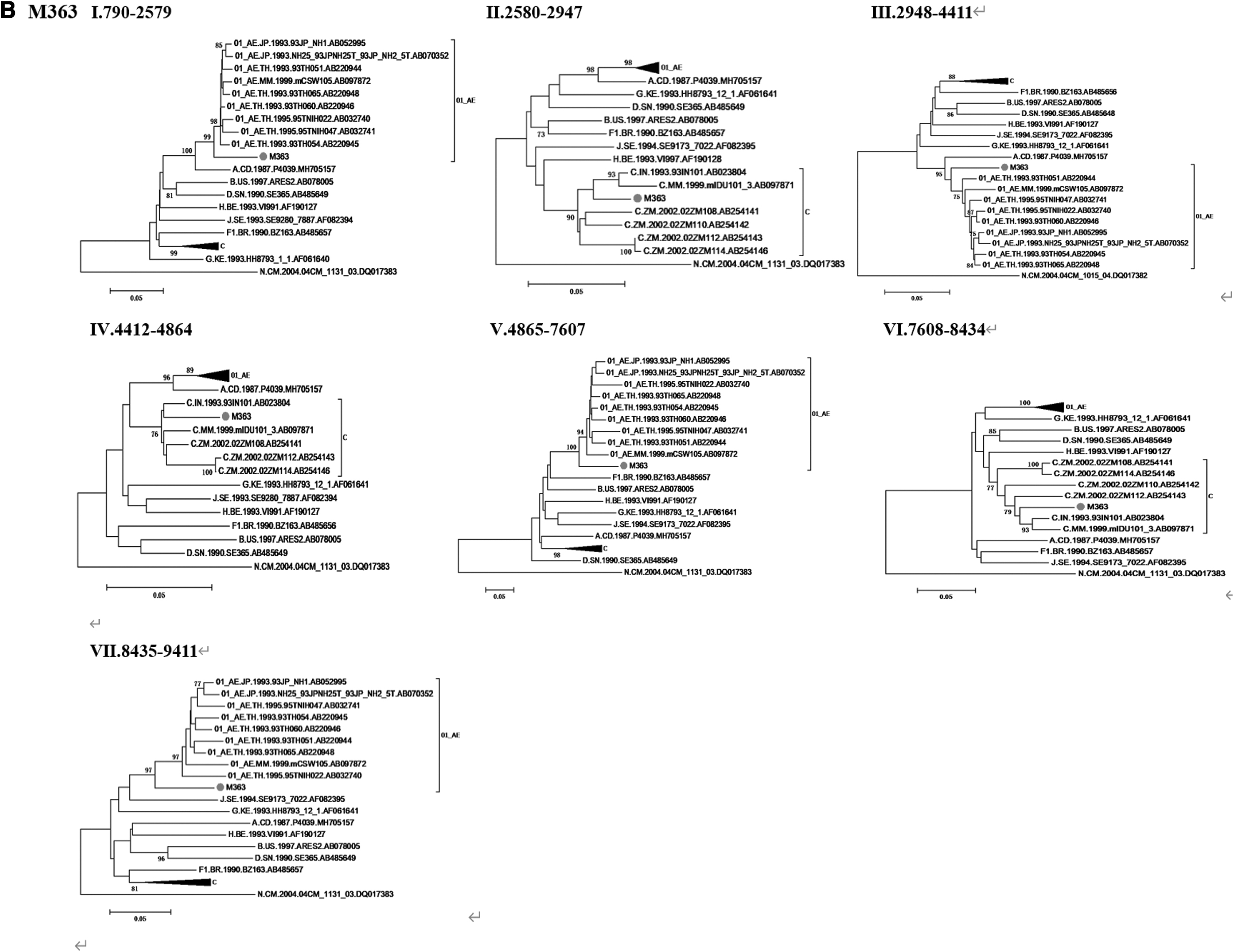
According to position based on HXB2 numbering, recombination breakpoints of NFLGs S114, M363, and M162 were as follows: S114, ICRF01_AE (790–1,176 nt); II subtype C (1,177–2,098 nt); IIICRF01_AE (2,099–2,543 nt); IVsubtype C (2,544–4,228 nt); VCRF01_AE (4,229–8,235 nt); VIsubtype C (8,236–8,766 nt); VIICRF01_AE (8,767–9,069 nt); VIIIsubtype C (9,070–9,411 nt). M363, ICRF01_AE (790–2,579 nt); IIsubtype C (2,580–2,947 nt); IIICRF01_AE (2,948–4,411 nt); IVsubtype C (4,412–4,864 nt); VCRF01_AE (4,865–7,607 nt); VIsubtype C (7,608–8,434 nt), VIICRF01_AE (8,435–9,411 nt). M162, ICRF01_AE (790–2,561 nt); IIsubtype C (2,562–2,890 nt); IIICRF01_AE (2,891–4,250); IVsubtype C (4,521–4,825 nt); VCRF01_AE (4,826–5,588 nt); VIsubtype C (5,589–5,722 nt); VIICRF01_AE (5,723–8,329 nt); VIIIsubtype C (8,330–8,510 nt), IXCRF01_AE (8,511–9,411 nt).
Subregion tree analyses (Fig. 5) further confirmed that these three NFLGs were derived from subtypes CRF01_AE and C. In this study, the recombinant structures of S114, M363, and M162 were complicated, including seven, six, and eight gene recombinant breakpoints, respectively.
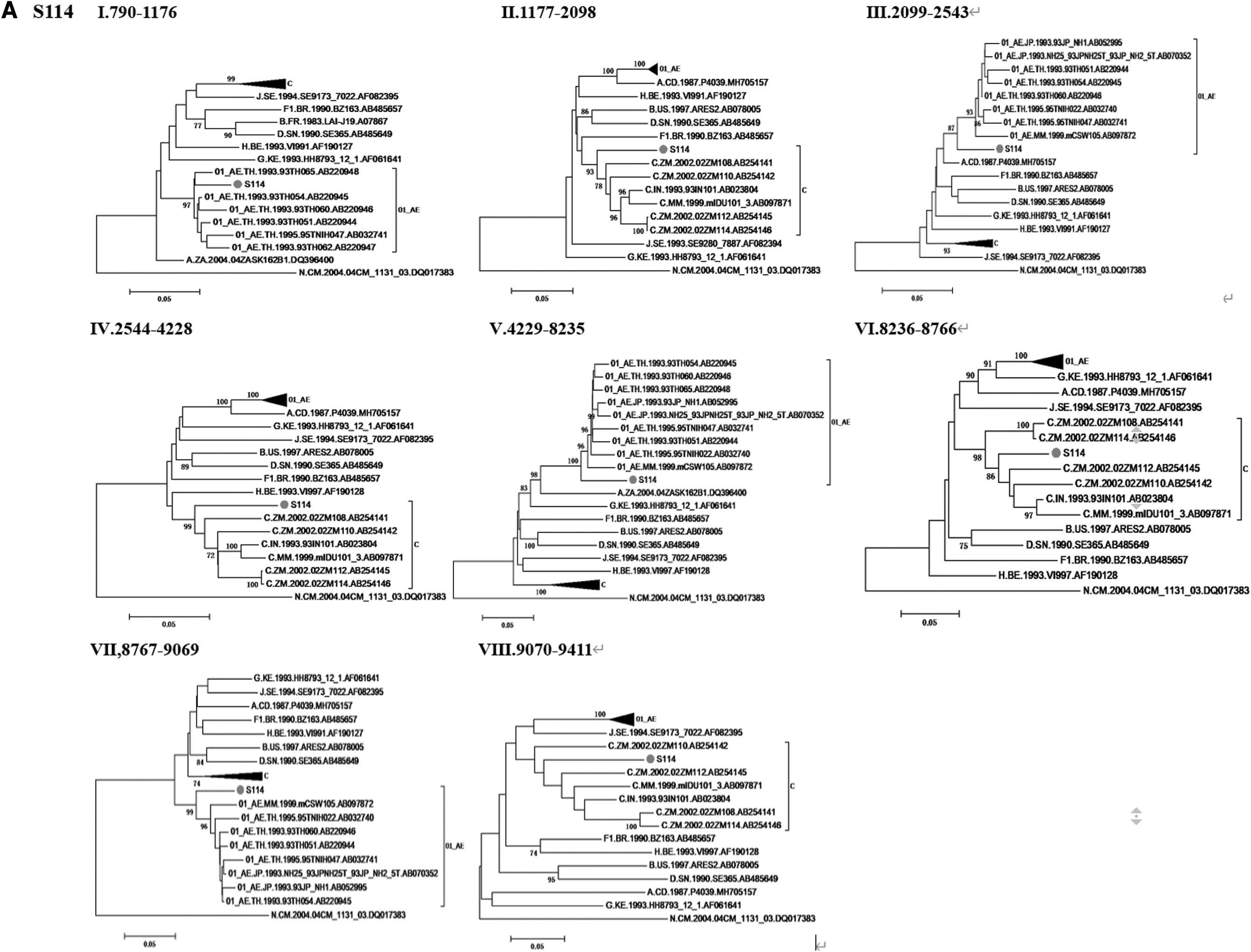
Subregion phylogenetic trees of S114, M363, and M162. A neighbor-joining tree was constructed using MEGA 6.0 with 500 bootstrap replicates. Black dot denotes study subject. Bootstrap values ≥70% were shown at the corresponding nodes. The scale bar represents 5% genetic distance.

CRF01_AE was identified in Thailand in the 1980s, and rapidly expanded in China around 1999–2000 through sexual contact transmission. Since the domain transmission route shifted from blood contamination to sexual behaviors, CRF01_AE has become the main strain responsible for HIV-1 infection in China. 9 The CRF01_AE. strain has the strongest ability to infect people and cause disease. A previous study 10 showed that the prevalence of CRF01_AE was highest in Hebei compared with the most common CRF07_BC in China. HIV-1 subtype C was first introduced from India to Yunnan, China in the early 1990s. 11
Currently, the CRFs formed by the recombination of CRF01_AE and subtype C are only CRF100_01C, CRF111_01C, and CRF115_01C. Of 11 cities in Hebei, Baoding City was the second most severely affected by HIV-1. 12 Historically, an HIV-1 outbreak occurred through blood transmission between 1993 and 1995 in Xingtai. In Baoding and Xingtai, CRF01_AE was the most frequent subtype, accounting for 51.9% 13 and 61.5%, respectively. However, subtype C is a minor HIV-1 subtype in both cities. In this study, the identification of three CRF01_AE/C recombinant forms revealed that promiscuous sexual behaviors among men who have sex with men (MSMs) caused the dual infection and the recombination of different subtypes.
In conclusion, three novel CRF01_AE/C recombinant forms among MSMs in Baoding and Xingtai Cities of Hebei Province were reported, showing that the inter-subtype recombination events between CRF01_AE and subtype C were first identified in Hebei province, China. Continued monitoring and detection of this kind of recombinants as well as accurate classification of HIV-1 subtypes and recombinant forms are vital for tracking HIV-1 genetic recombinant characteristics, enriching antigenic diversity and renewing treatment measures.
Sequence Data
Three sequences reported in this study have been submitted to GenBank with the accession numbers OP921950, OP921951, and OP921952.
Footnotes
Authors' Contributions
X.L. conceived the study project. M.L, X.Z., Y.L., Y.W., N.A., and X.T. completed the whole study. X.Z. and X.L. analyzed experimental data and drafted the article. Experimental conditions were provided by Q.L. All authors read and approved the final article.
Informed Consent Statement
Written informed consent was obtained from three HIV-1 individuals before blood collection. This study was approved by the Local Ethics Committee of Hebei Provincial Center for Disease Control and Prevention [No. IRB(S)2020-031].
Author Disclosure Statement
No competing financial interests exist.
Funding Information
This study was supported by the Key Science and Technology Planning Project of Hebei province (192777107D).