




Abstract
Human immunodeficiency virus (HIV)-1 CRF01_AE is one of the most important genotypes in China, especially in the population of men who have sex with men (MSM). It has become the most prevalent strain among them. Describing the variant characterization of CRF01_AE will help to reveal the reason behind its predominance in MSM. In this study, the complete DNA sequences (CDSs) for gp120 from the envelope protein (env) gene of CRF01_AE in China and Thailand were retrieved from the Los Alamos HIV database. The CDSs for gp120 were divided into three subgroups according to the risk factors for HIV-1 transmission in a variety of populations, such as intravenous drug users (IDU), heterosexual contacts (HC), and MSM. The N-linked CDS glycosylation sites for gp120 in CRF01_AE were analyzed. The results showed a unique hyperglycosylation site N-339 (refer to Hxb2) in the gp120 of CRF01_AE in MSM compared with the IDU and HC groups from China. The result was the same in the MSM group from Thailand, which suggests that the hyperglycosylation site N-339 may explain the widespread CRF01_AE genotype in MSM.
Introduction
As the number of human immunodeficiency virus (HIV)-infected people increases every year, acquired immunodeficiency syndrome (AIDS) remains a major public health problem in China. By the end of October 2020, it was estimated that there were 1.045 million HIV/AIDS patients in China. 1 Currently, HIV is rapidly increasing among men who have sex with men (MSM), and appears to present an increasing national public health challenge in China. 2 The main HIV-1 genotypes in China are subtype B, CRF07_BC, CRF08_BC, CRF01_AE, and CRF55_01B at present. 3
Among them, CRF01_AE has become the predominant genotype among MSM in China. 4 In addition, the CRF55_01B genotype has also been recently reported to be prevalent in different regions of China. 5 Each HIV-1 genotype has unique prevalence advantages in relevant high-risk groups. CRF07_BC has once been the predominant genotype in intravenous drug users (IDU). Some recent studies have shown that it has been replaced by CRF01_AE and become the dominant genotype among MSM in a few regions of China. 6,7
The proportion of subtype B HIV-1 cases has been reported to decrease gradually in each high-risk population in China. 8 Many studies have shown that CRF01_AE is the predominant genotype among MSM in most regions of China, 9 –12 except regions such as Fujian and Guangdong provinces. 6,7,13 Therefore, it is necessary to explore the variant characteristics of CRF01_AE to elucidate the reason for its rapid spread in MSM, which will contribute to prevention and control of a CRF01_AE epidemic.
Materials and Methods
Complete DNA sequences (CDSs) for gp120 in the HIV-1 envelope protein (env) gene were downloaded from the Los Alamos HIV databases (
In addition, 390 CRF01_AE sequences from Thai individuals were also retrieved to verify the analysis results from Chinese patient sequences. The Thai sequences were from 1992 to 2013, of which 240 involved HCs (1992–2013), 114 involved MSM (2009–2013), and 36 involved IDUs (1993–2002).
In addition, the CDS for the gp20 gene from the HxB2 sequence was also retrieved and served as the reference strain. It was uploaded together with the CRF01_AE sequences to the N-GlycoSite online program of HIV databases for further glycosylation site analysis (
Results
There was an additive hyperglycosylation site N-339 (refer to Hxb2) in the gp120 CDS from CRF01_AE retrieved from Chinese MSM group patients. However, this hyperglycosylation site was not found in the HC and IDU groups. The number and position of hyperglycosylation sites in gp120 were consistent in both the HC and IDU groups. The extra hyperglycosylation site N-339 was demonstrated to be unique in the MSM sequences
N-Linked Glycosylation Sites of gp120 in Sequences from Heterosexual Contacts in China (N = 127 a )
Include the Hxb2 strain.
N-Linked Glycosylation Sites of gp120 in Sequences from Intravenous Drug Users in China (N = 36 a )
Include the Hxb2 strain.
N-Linked Glycosylation Sites of gp120 in Sequences from Men Who Have Sex with Men in China (N = 1246 a )
Include the Hxb2 strain.
To verify this finding, more gp120 CDSs from CRF01_AE in non-Chinese individuals were retrieved. Most of the retrieved sequences belonged to Thai patients, and there were a few sequences from other countries or regions of the world. To avoid the analysis bias, the sequences from Thai patients were retained and subjected to a further glycosylation site analysis. Although there were more sequences from the HC group (61.3%) than from the MSM and IDU groups from Thai individuals, the unique hyperglycosylation site N-339 in Thai MSM sequences was also identified, which has also not been found in the sequences from Thai HC and IDU groups.
However, two unique hyperglycosylation sites N-411 and N-465 were present in the HC and IDU sequences from Thai patients, which were not found in the MSM group. Among them, the hyperglycosylation site N-411 was also present in the sequences from the three Chinese risk factor groups. Thus, only the hyperglycosylation site N-465 seems to be unique in the HC and IDU sequences from Thailand
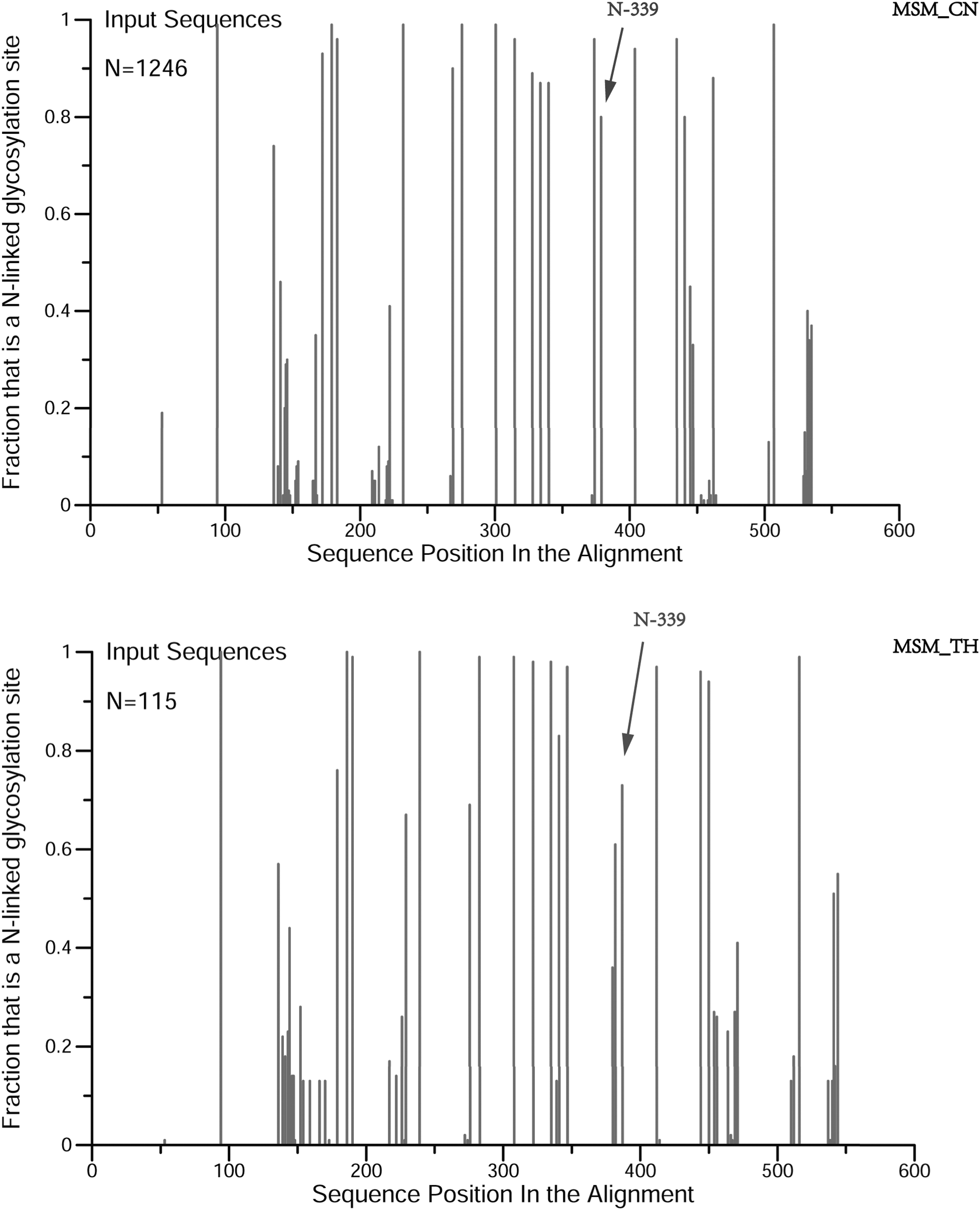
The position and the fraction of glycosylated sites in gp120 among MSM in China (MSM_CN) and Thailand (MSM_TH). The vertical lines represent each glycosylated site distributed in gp120 region, and the arrow indicates the hyperglycosylated site N-339 (coordinate with Hxb2). The scales of horizontal axis indicated the position of sequences in alignment of the inputs. The vertical axis represents the fraction of N-linked glycosylation sites in each position among inputed sequences. MSM, men who have sex with men.
N-Linked Glycosylation Sites of gp120 in Heterosexual Contacts from Thailand (N = 241 a )
Include the Hxb2 strain.
N-Linked Glycosylation Sites of gp120 in Intravenous Drug Users from Thailand (N = 37 a )
Include the Hxb2 strain.
N-Linked Glycosylation Sites of gp120 in Men Who Have Sex with Men from Thailand (N = 115 a )
Include the Hxb2 strain.
Discussion
CRF01_AE is the most prevalent HIV-1 genotype in China. Research has shown that CRF01_AE may have been introduced into China from Southeast Asia, specifically Thailand and Vietnam, in the 1990s. Therefore, the CRF01_AE genotype in China may be evolutionarily closely related to the strains in Thailand. 14,15 This may explain why the high glycosylation site region N-339 in the gp120 gene of CRF01_AE can be found in China and Thailand.
CRF01_AE has distinct transmission advantages in different high-risk populations. At present, CRF01_AE remains the most obvious predominant genotype in MSM instead of the HC and IDU populations in most regions of China. However, some studies have shown that CRF01_AE tends to be replaced by CRF07_BC and CRF55_01B in some regions of China. 6,7 Different high-risk HIV-1 groups have their own respective HIV transmission features. Considering the prevalence of anal sexual behavior in MSM, the glycosylation site characteristics in the gp120 gene in CRF01_AE may make it more suitable for widespread transmission in MSM.
The HIV-1 env gene plays an important role in HIV infection and transmission. Specifically, gp120 of env has a significant role in HIV-1 infection of host cells and promotion of viral membrane fusion. 16 In addition, it also participates in utilizing coreceptors during HIV-1 infection of host cells in humans. 17 The specific N-linked glycosylation sites in gp120 may change the spatial conformation of the viral envelope protein, thereby affecting its use of coreceptors and subsequent host cell infection.
In addition, glycosylation at different sites may also have an impact on host immunity response. The presence of special N-linked HIV-1 glycosylation sites may avoid the host's cytotoxic immunity response, thereby helping them to evade host immunity. 18 Study has shown that the CRF01_AE strain has fewer N-linked glycosylation sites in V2/V4 and more glycosylation sites in the V5 region of the env gene than in other HIV-1 genotypes in China, showing the complexity and specificity of the gp120 gene glycosylation sites in CRF01_AE. 19
Owing to the unique sexual behavior of MSM, the specificity of N-linked glycosylation site in gp120 in CRF01_AE may be important for its rapid spread in the MSM population. The presence of hyperglycosylation site N-339 in gp120 may be favorable for CRF01_AE infection of target host cells during anal sex in MSM or beneficial for its evasion of the host's immune response, thereby contributing to its widespread CRF01_AE transmission in MSM. Hyperglycosylation site N-339 in gp120 may explain the widespread CRF01_AE in MSM, but the exact mechanism needs further validation in cellular models.
Footnotes
Author Disclosure Statement
No competing financial interests exist.
Funding Information
This study is supported by Jilin Provincial Health Youth Science and Technology Backbone Training Program (2019Q034), Jilin Provincial Department of Education “Thirteenth Five-Year” Science and Technology Project (JJKH20200464KJ), and National Natural Science Foundation of China (82272318)