




Abstract
Many men age 50+ with HIV (MWH age 50+) are sexually active. However, little is known about the relationship between the number of sexual partners and patient-reported outcomes in this population. To help address this need, analyses were performed on data from the Aging with Dignity, Health, Optimism and Community cohort, an observational study of adults age 50+ with HIV. Of 876 MWH age 50+, 26.8% had 0 sexual partners in the past year, 27.9% had 1, 21.5% had 2–5, and 23.9% had >5. Men with one partner were significantly less lonely and less depressed than any other group (p < .01 for pairwise comparisons). Men with zero partners were more depressed than any other group. Linear regression controlling for race and relationship status showed men with one partner had lower levels of loneliness than any other group. They also had lower levels of depression than men with zero or more than than five sexual partners, although depression levels were not significantly different for men with one or with two to five partners. Linear regression also showed that men in relationships were less lonely and less depressed than men who were not in relationships, after controlling for race and number of sexual partners. Better understanding of the roles that number of sex partners and relationships play in the mental health of MWH age 50+ may help ameliorate the burden of loneliness and depression in this vulnerable population.
Introduction
More than half (51
To that end, subsections of the ADHOC questionnaire collect data on sexual behavior, relationship status, and patient-reported outcomes such as loneliness and depression. ADHOC data show that 73% of men age 50+ with HIV (MWH age 50+) remain sexually active, often with multiple partners in a given year. ADHOC data and previous research have also shown that loneliness 2,3 and depression 4 are prevalent in older adults living with HIV. Previous research suggests that people in a relationship (i.e., married, coupled, or partnered) tend to experience less loneliness 5 and less depression. 6 This has been shown in both heterosexual and same-sex marriages. However, among men with HIV age 50+, there is a paucity of research on the association between number of sexual partners, relationship status, and patient-reported outcomes.
In this study, we sought to understand the association among MWH age 50+ between number of sexual partners in the past year and two patient-reported outcomes: loneliness and depression. Furthermore, we sought to understand the impact of relationship status on loneliness and depression.
Methods
Participants
To be eligible for ADHOC, participants must have had an HIV-1 or -2 infection, be at least 50 years of age at enrollment, have no known acute medical problems requiring immediate inpatient treatment, be able to read and write in English, and have the ability and willingness to provide online informed consent and complete a detailed online questionnaire. ADHOC participants were primarily identified during visits to clinical practices providing care for HIV. These clinics were in California, Washington DC, Florida, Illinois, North Carolina, Texas, Washington State, and Wisconsin. ADHOC had a total enrollment of 1,039 participants, of whom 876 (84.3%) reported their sex as men, 151 (14.5%) reported their sex as women, and 12 (1.1%) reported their sex as transgender, when asked “How do you identify your gender?” Based on the relative size of these groups, participants who reported their sex as women or transgender were excluded from this analysis.
Study design
The ADHOC online questionnaire uses validated instruments wherever possible to collect self-reported data from participants. Each question requires a response before moving on to the next question, so there are no missing data. Demographic variables included age, sex, race/ethnicity, and relationship status. When asked “What is your race/ethnicity? (Select all that apply),” response options included White, Black, Hispanic/Latino, Asian, American Indian/Alaska Native (AIAN), Pacific Islander/Hawaiian Native, multiple races, other, and “do not wish to disclose.” Asian, AIAN, Pacific Islander/Hawaiian Native, and multiple races/ethnicities were combined into a category called “Additional races/ethnicities.” “Other” and “do not wish to disclose” were combined into a group called “Other.”
Response options for “current relationship status” included single, divorced, separated, widowed, married, coupled or partnered, in a polyamorous relationship, and other. For analytic purposes, single, divorced, separated, and widowed were combined into a group called “Not in a Relationship,” whereas married, polyamorous, and coupled or partnered were combined into a group called “In a Relationship.” Those who selected “other” (N = 16) were excluded because neither clearly fit into either the “In a Relationship” or “Not in a Relationship” groups, and the N's were too small to analyze them separately.
Patient-reported outcomes included loneliness and depression. Loneliness was measured using the Three-item Loneliness Scale (range 3–9, with higher scores indicating greater loneliness), 7 and depression was measured using the Patient Health Questionnaire-2 (range 0–6, with higher scores indicating greater depression). 8 To measure sexual activity, participants were asked, “How many sexual partners have you had in the last year?” and were given the response options of either zero, one, two to three, four to five, more than five, or “I do not wish to respond.” The groups “two to three” (N = 141) and “four to five” (N = 56) were combined for analytic purposes, due to the relatively small number of participants in the “four to five” category. Participants who chose “I do not wish to respond” (N = 19) were excluded from the primary analysis, but were included in an exploratory analysis to determine whether they differed in key attributes from those who chose to disclose their number of sexual partners.
The ADHOC study protocol was approved by Ethical and Independent Review Services (E&I No. 17130) and is registered with
Statistical analyses
Bivariate analyses were used to assess the presence or absence of significant relationships between the number of sexual partners and patient-reported outcomes using Kruskal–Wallis tests followed by Dunn's test with a Holm–Sidák adjustment for multiple comparisons. 9 After those tests, to adjust for the potential influence of race and relationship status, two linear regressions were performed. The first regression used loneliness as the dependent variable, with number of sex partners, race, and relationship status (In a Relationship vs. Not in a Relationship) as predictor variables. The second used depression as the dependent variable, again with number of sex partners, race, and relationship status as predictor variables. All analyses used a significance threshold of p < .05 and were performed in Stata version 15.1. 10
Results
Participant demographics
Of 876 male participants, the mean (standard deviation) age was 58.9 (6.1) years, 74% were White, 51% had <$50,000 in annual household income, and 46% had less than a college degree. The mean loneliness score was 5.6 (2.1), and the mean depression score was 1.4 (1.6). Table 1 shows that 26.8% had 0 sexual partners in the past year, 27.9% had 1 partner, 21.5% had 2–5 partners, and 23.9% had >5 partners.
Number of Sexual Partners in the Past Year Among Older Men Living with HIV
Percentages do not sum to 100% due to rounding.
Number of sexual partners and loneliness
Figure 1 shows that there was significant variation in loneliness scores by number of sexual partners in the past year [H(3) = 68.200, p < .01]. The post hoc test revealed that men with one partner were significantly less lonely than any other group (p < .01 for each comparison), and all the other groups were statistically similar to each other (p > .05 for each comparison). Compared with men with 1 sexual partner, men with 0 partners were 28.8% more lonely, men with 2–5 partners were 23.4% more lonely, and men with >5 partners were 27.8% more lonely.
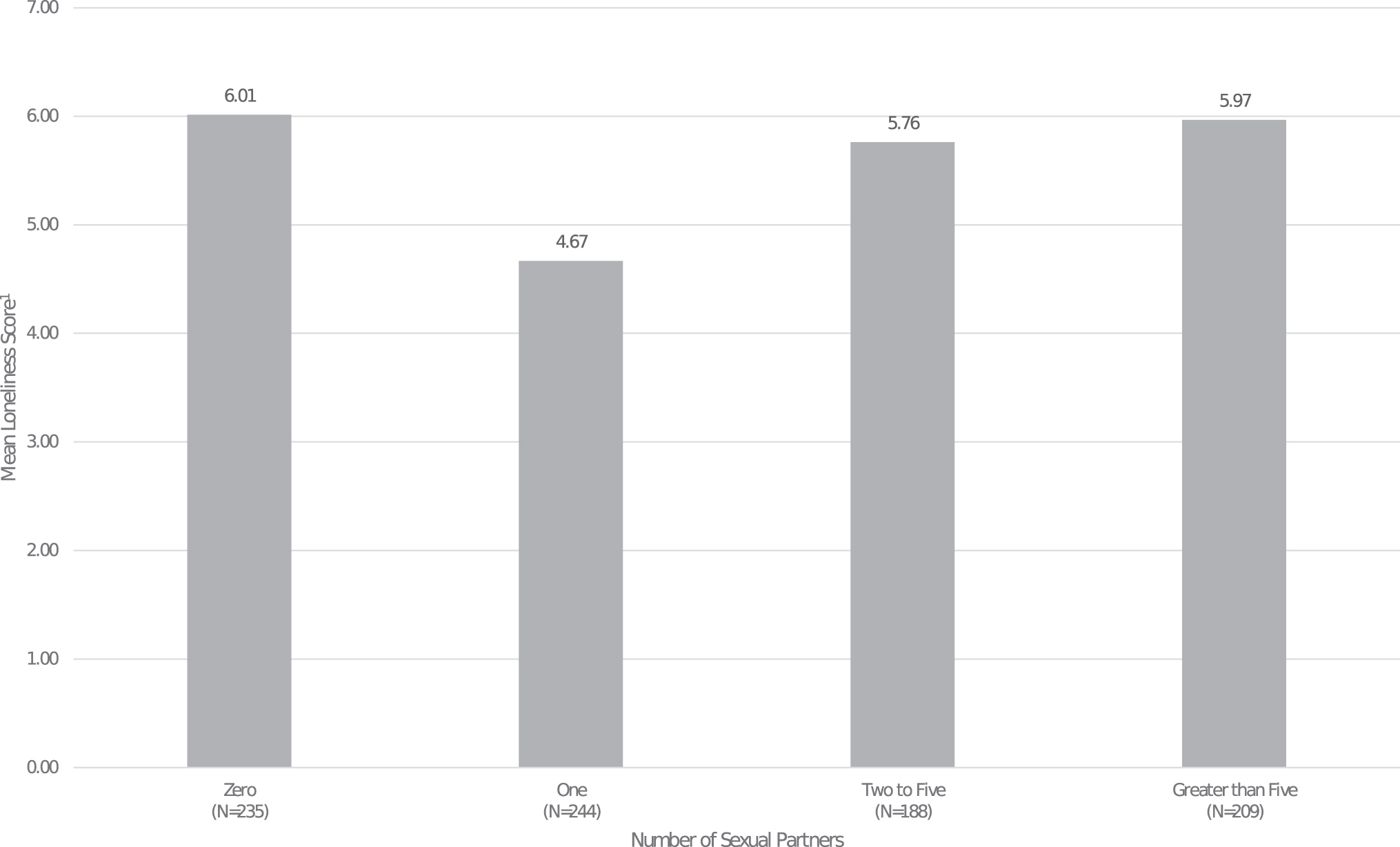
Mean loneliness score by number of sexual partners in the past year among older men living with HIV. Men with one sexual partner were less lonely than any other group (p < .01), and all other groups were statistically similar to each other.
Linear regression showed that participants with one sexual partner were less lonely than participants with zero, two to five, or more than five sexual partners, after controlling for race and relationship status (Table 2). Moreover, men In a Relationship were less lonely than men Not in a Relationship, and Black men were less lonely than White men, after controlling for number of sexual partners [F(8, 855) = 21.46, p < .01, R2 adjusted = 0.159].
Multivariable Linear Regression Model Predicting Loneliness Levels Among Older Men Living with HIV
Measured using the Three-Item Loneliness Scale. 7 Scores range from 3 to 9, with higher scores indicating greater loneliness.
CI, confidence interval.
Number of sexual partners and depression
Figure 2 shows that there was significant variation in depression by number of sexual partners in the past year [H(3) = 35.635, p < .01]. The post hoc test revealed that men with one partner were significantly less depressed than any other group (p < .01 for each comparison), and that men with zero partners were more depressed than any other group (p < .02 for each comparison), but that there was no significant difference between men with two to five or with more than five sexual partners. Compared with men with 1 sexual partner, men with 0 partners were 86.0% more depressed, men with 2–5 partners were 36.7% more depressed, and men with >5 partners were 52.2% more depressed.
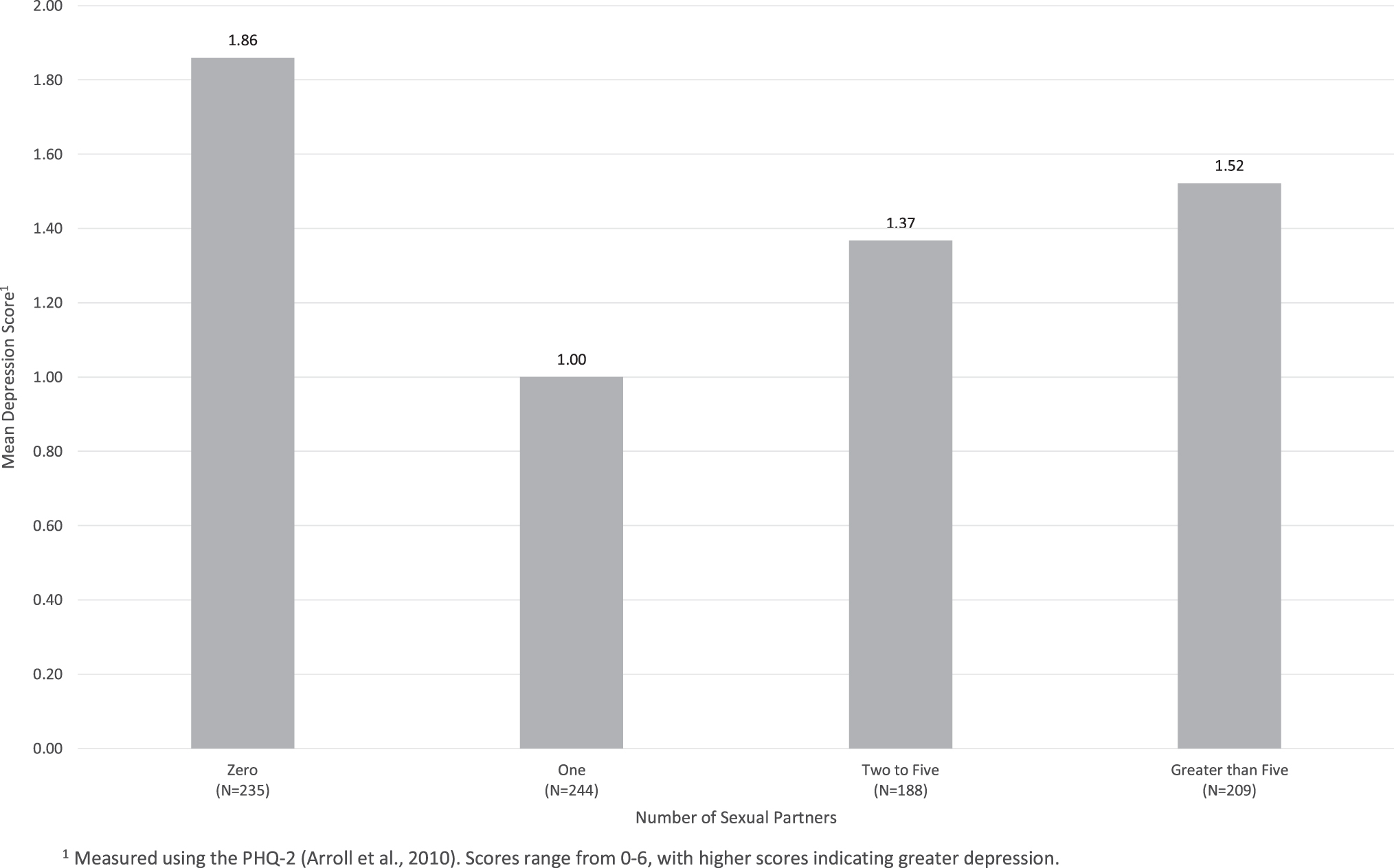
Mean depression score by number of sexual partners in the past year among older men living with HIV. Men with one sexual partner were less depressed than any other group (p < .01), and men with zero sexual partners were more depressed than any other.
Linear regression showed that men with one sexual partner were less depressed than participants with zero or more than five sexual partners, but not significantly different from participants with two to five sexual partners, after controlling for race/ethnicity and relationship status (Table 3). Moreover, men In a Relationship were less depressed than men Not in a Relationship, and White men were less depressed than Hispanic men, after controlling for number of sexual partners [F(8, 855) = 7.38, p < .01, R2 adjusted = 0.056].
Multivariable Linear Regression Model Predicting Depression Levels Among Older Men Living with HIV
Measured using the Patient Health Questionnaire-2. 8 Scores range from 0 to 6, with higher scores indicating greater depression.
Exploratory analyses of excluded participants
Exploratory analyses were conducted to compare the 19 participants who chose not to disclose their number of sexual partners to the 876 participants who did disclose. There were no significant differences in loneliness or depression scores between men who disclosed their number of sexual partners and those who did not.
Discussion
This study examined the relationship between number of sexual partners and two important patient-reported outcomes, loneliness and depression, in older men living with HIV. The results indicated that MWH age 50+ with one sexual partner were significantly less lonely than those with zero or with two or more partners, after controlling for race and relationship status. MWH age 50+ with one sexual partner were also less depressed than those with zero or more than five sexual partners, but not different from participants with two to five partners, after controlling for race and relationship status.
This study also examined the role of being in a relationship with regard to the outcomes of interest. Participants In a Relationship were found to be less lonely and less depressed than their counterparts who were Not in a Relationship, after controlling for race and number of sexual partners.
To our knowledge, this is the first study to demonstrate these findings specifically in older men living with HIV. The findings are important because more than half of adults with HIV age 50+ experience at least mild symptoms of loneliness. 2,3 Previous research has demonstrated the profound impact loneliness can have on older adults, including increased risk of mortality, cardiovascular disease, functional disability, dementia, and cognitive impairment. 11 Loneliness also impacts emotional health and has been associated with anxiety, depression, and reduced quality of life. 11
Similarly, depression is common in older adults living with HIV, 12 and it too has been associated with numerous negative health outcomes, including increased rates of mortality, 13 cardiovascular disease, 14 cognitive decline, 15 and substance abuse. 16
Beyond the impact of differences in the number of sexual partners, these results underscore the important role that relationships play in improving health outcomes. There is a large body of evidence demonstrating that marriage confers a wide range of benefits, including lower rates of loneliness 17 and depression. 18,19 In particular, studies have demonstrated that being married decreases loneliness 5 and depressive symptoms, 20 whereas divorce increases them. 20,21 However, most of this research focuses on heterosexual marriages in younger adults, and not on patients with HIV.
There is a small but growing body of research suggesting similar benefits in PLWH. For example, one study of PLWH found that divorced and separated individuals were 4.3 times more likely to die than married individuals, and single/never married persons were 13 times more likely to die. 22 Other studies found that PWH with a spouse or main partner reported higher levels of social support than those who did not have a main source of support but did have large social networks, which led the authors to conclude that “quality, not quantity, of support is most meaningful.” 23
This study has limitations. It employed a cross-sectional design, meaning a causal relationship between relationship status, number of sex partners, and patient-reported outcomes cannot be inferred. However, other longitudinal studies have suggested that marriage leads to improvements in depression and not vice versa. 20 This study was carried out in older males. Future studies should examine how results differ for women and younger adult PWH.
Conclusion
Among men age 50+ living with HIV, those with one sexual partner were less lonely and less depressed than those with zero or with two or more partners. Furthermore, men in a relationship were less lonely and less depressed than men who were not, even after controlling for the number of sexual partners. Better understanding of the roles that number of sexual partners and that relationships play in the mental health of older men living with HIV may help ameliorate the burden of loneliness and depression in this vulnerable population.
Footnotes
Authors' Contributions
P.M., J.B., and A.Z. formulated the research questions and conceptualized the study. E.L., B.G., and T.N. managed the research program. P.M. and J.B. cleaned, analyzed, and interpreted the data. J.B. wrote the article, with extensive guidance and input from P.M. All authors edited, reviewed, and approved the final article.
Author Disclosure Statement
J.B. and P.M. received research funding from ViiV Healthcare to develop ADHOC and collect data. E.L. received research support from ViiV Healthcare. B.G., T.N., A.C., and A.Z. are employees of ViiV Healthcare.
Funding Information
This research was supported by ViiV Healthcare. The research was conducted “above the brand.”