




Abstract
Acquired immune deficiency syndrome caused by human immunodeficiency virus (HIV) is a serious infectious disease because of its’ high genetic variability. Nowadays, homosexual contact has become the most predominant transmission route in Hebei province, China, leading to the emergence of novel HIV-1 recombinant forms. The neighbor-joining (N-J) phylogenetic trees were constructed using MEGA 6.0 in order to identify the subtypes of H22063 and H22144. Recombination breakpoints were identified using online resources jpHMM, RIP 3.0, and Simplot 3.5.1. In this study, we identified two novel HIV-1 unique recombinant forms (URFs) _0107 from three men who have sex with men in Hebei province, including H22063 and H22144. The near full-length genome analysis showed H22063 has seven gene recombination sub-regions, including three subtype CRF07_BC gene fragments inserted into the CRF01_AE backbone. H22144 has nine gene recombination sub-regions, including four subtype CRF07_BC gene fragments inserted into the CRF01_AE backbone. This study confirms the emergence of novel recombinant forms and suggests we should strengthen the monitoring of novel HIV recombinant forms in order to deal with the complex HIV-1 epidemiological trend in Hebei province, China.
Introduction
The 2024 global AIDS update report 1 indicated that 39.9 million people were living with HIV in 2023. 1.3 million people were newly infected with HIV in 2023, and new HIV infections declined 39% compared with 2.1 million people in 2010. However, this decrease is far short of the target of getting below 370,000 by 2025. HIV diversity forms the severe challenge for the realization of the 2025 target. Globally, the new HIV-1 subtypes emerged continuously in high-risk populations 2,3 because HIV-1 has the high-frequency gene variability and replication ability. The distribution of HIV-1 subtypes was highly diverse and complex in China, and an increasing number of HIV-1 strains with different subtypes and patterns of recombinant forms have been reported. 4,5 Unique recombinant forms (URFs) accounted for 5.8% of 14 HIV-1 genotypes in Hebei, 6 which is similar to the overall prevalence of URFs was 5.9% in China. 5 Of 160 published CRFs listed in HIV Databases, the number of CRFs that were from China has been >50, and more than 40% of them were identified in MSM.
Shijiazhuang, the capital of Hebei province, China, is the first largest city with HIV-1 infections in Hebei. 7 Here, CRF01_AE was the most common genotype, accounting for 49.5%, followed by CRF07_BC (27.5%). 8 In Xingtai, an HIV-1 outbreak occurred through blood transmission between 1993 and 1995. Nowadays, CRF01_AE and CRF07_BC are also the most frequent subtypes in Xingtai. In this study, we identified two new URFs (CRF01_AE/CRF07_BC) by the analysis of the near full-length genomic (NFLG) structures and found that their gene mosaic structures were clearly different from URFs reported.
Materials and Methods
Two participants who were infected with HIV-1 through homosexual behaviors were in included in the current study, named as H22063 and H22144, respectively. Both H22034 aged 28 and H22144 aged 44 were two unmarried MSM, living in Shijiazhuang city and Xingtai city of China, respectively. This study was approved by the Local Ethics Committee of Hebei Provincial Center for Disease Control and Prevention.
According to methods reported previously, 9 we completed HIV-1 RNA extraction, PCR, and sequencing of HIV-1 NFLGs. Multiple sequences were compared using Clustal W with manual editing in Bio Edit 7.0 software. Recombinant maps of HIV-1 NFLGs were confirmed using the neighbor-joining (N-J) phylogenetic trees, jpHMM, RIP 3.0 and Simplot 3.5.1.
Results
As shown in Figure 1, both H22063 and H22144 can’t cluster with the known reference subtypes, suggesting that they may be two novel recombinant forms. As indicated in Figures 2–3, scanning maps of RIP 3.0, jpHMM, and Simplot 3.5.1 identified that the NFLGs of H22063 and H22144 were new URFs, which were composed of CRF07_BC and CRF01_AE fragments: gene segments from CRF07_BC were inserted into a CRF01_AE backbone.

Phylogenetic tree analysis based on HIV-1 NFLG sequences. A neighbor-joining tree was constructed using MEGA 6.0 with 1000 bootstrap replicates. The standard reference sequences of HIV-1 subtypes were downloaded from the HIV Databases (http://www.hiv.lanl.gov/content/index). Bootstrap values ≥70% are shown in the tree. The scale length indicates 5% nucleotide sequence divergence. Black dot denotes study sequences.
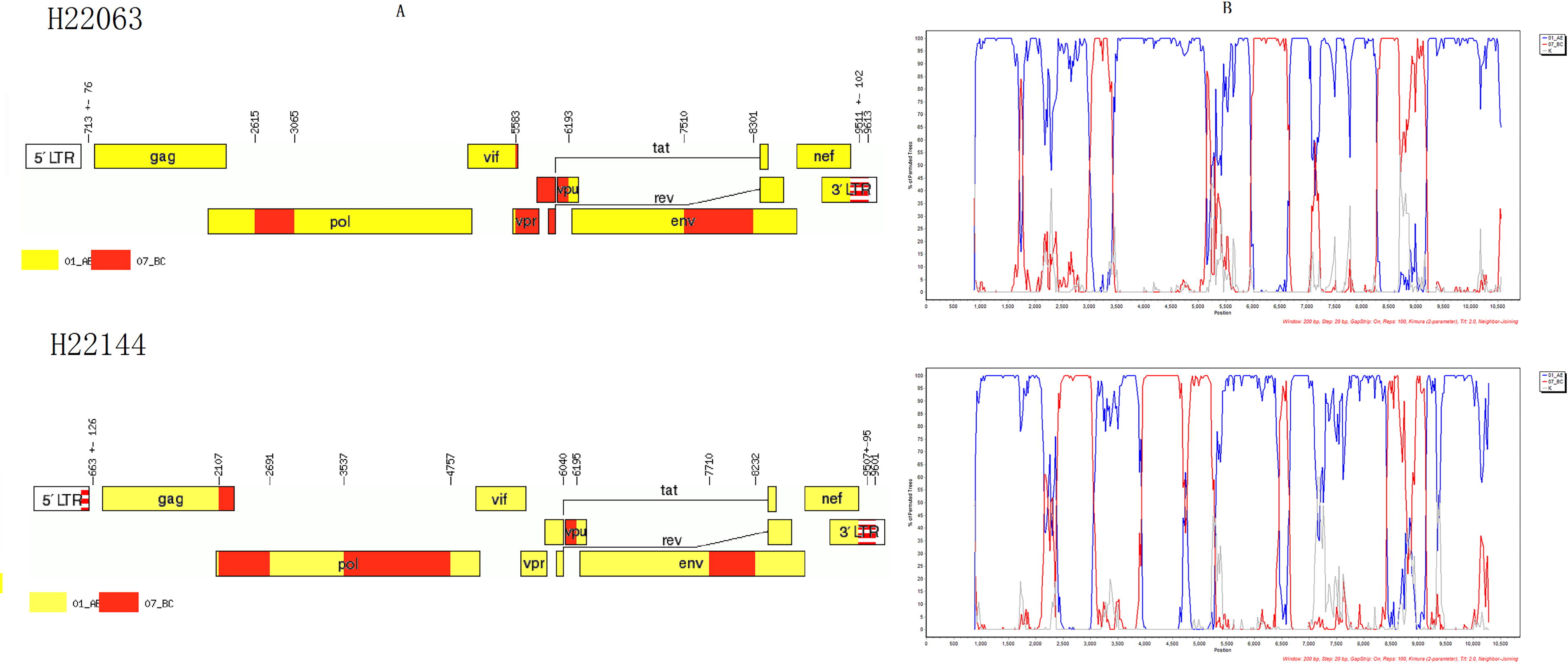
Recombination breakpoints analyses of NFLGs H22063 and H22144.
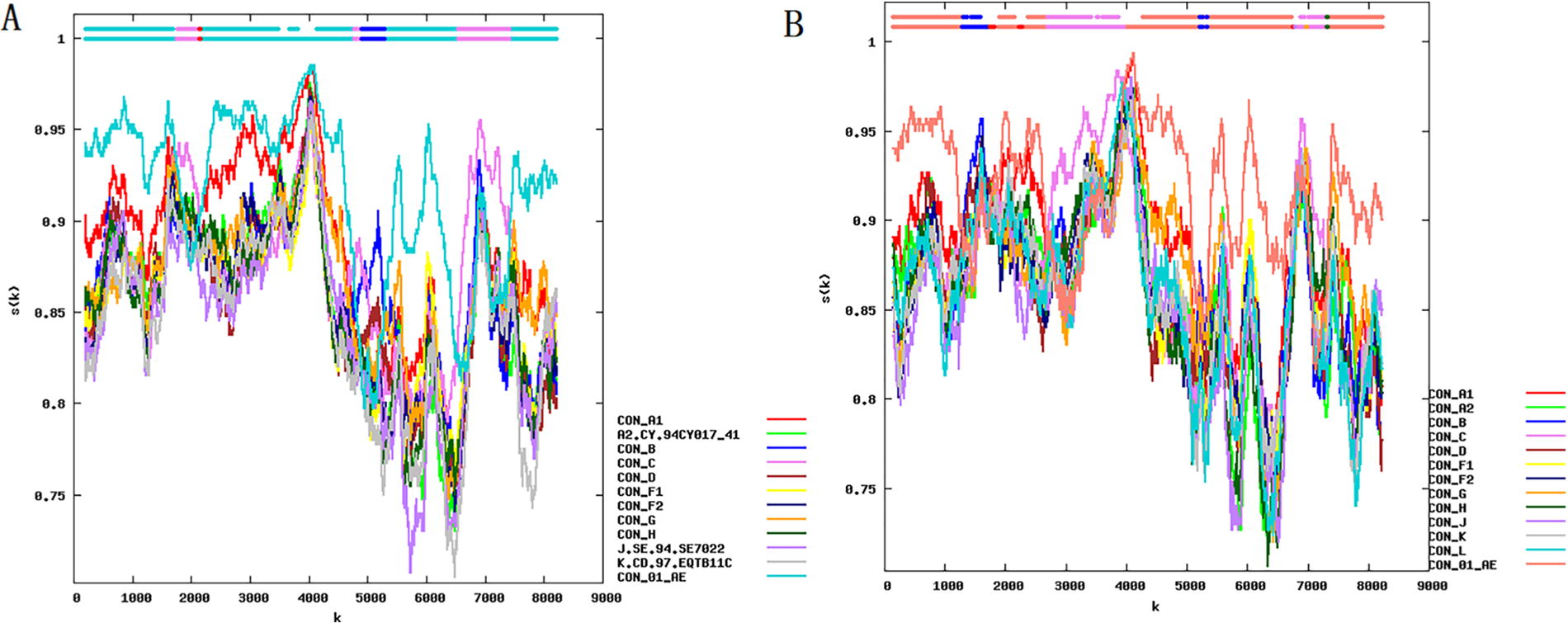
Similarity distance analysis using the online RIP 3.0.
Figures 2–4 listed recombination breakpoints based on HXB2 numbering. The NFLG structure of H22063 consists of seven gene sub-regions, including ICRF01_AE (790–2614 nt), II CRF_07BC (2615–3064 nt), III CRF01_AE(3065–5582), IV CRF_07BC (5583–6192 nt), V CRF01_AE (6193–7509 nt), VI CRF_07BC (7510–8300 nt), and VII CRF01_AE (8301–9409 nt). The NFLG of H22144 contains nine gene sub-regions, composed of I CRF01_AE (790–2106 nt), II CRF07_BC (2107–2690 nt), III CRF01_AE (2691–3536 nt), IV CRF07_BC (3537–4756 nt), V CRF01_AE (4757–6039 nt), VI CRF07_BC (6040–6194 nt), VII CRF01_AE (6195–7709 nt), VIII CRF07_BC (7710–8231 nt), and IX CRF01_AE (8232–9411 nt). The sub-regions N-J trees (Fig. 4) also proved the above recombinant structures.
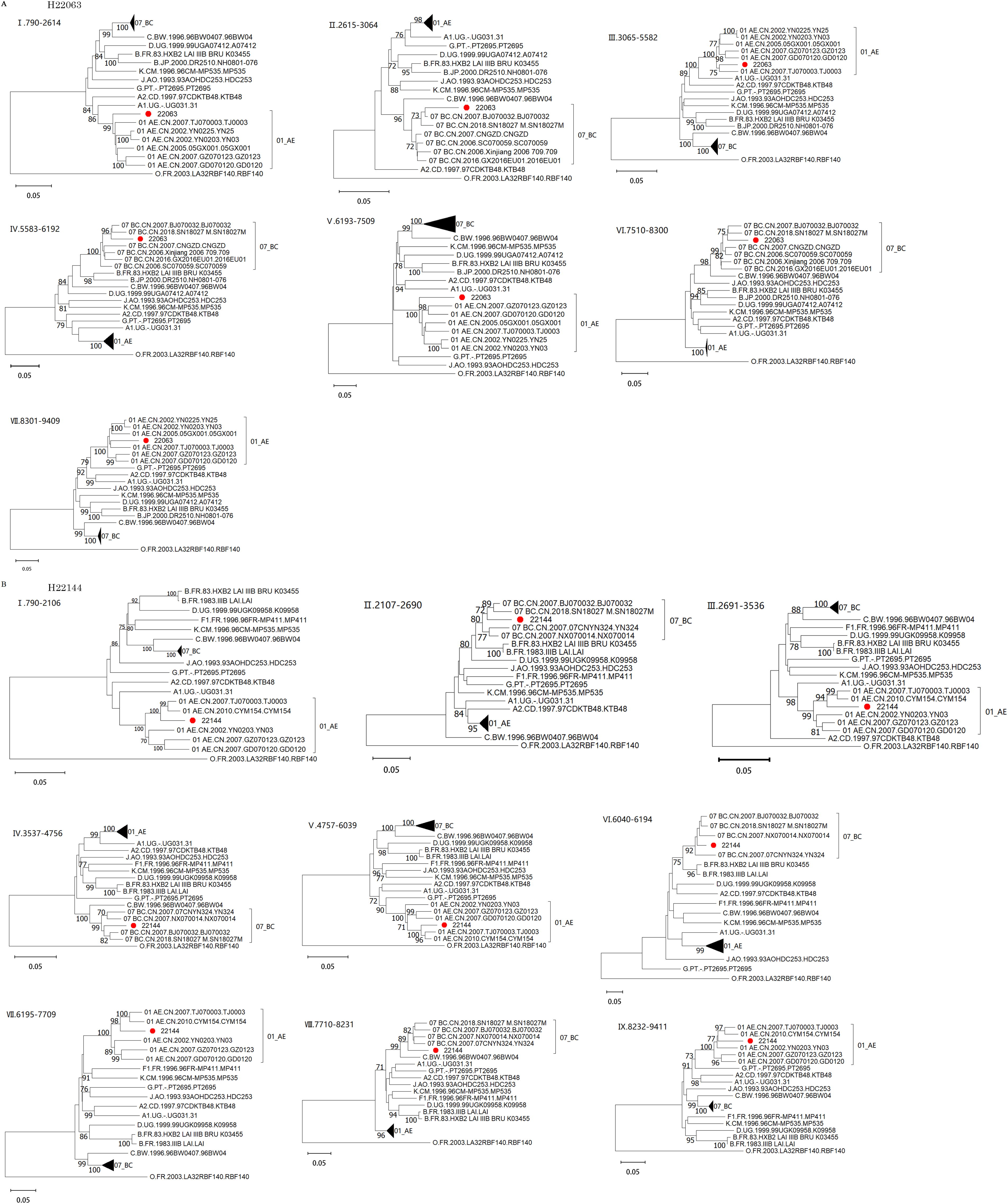
Sub-region phylogenetic trees. The neighbor-joining tree was constructed using MEGA 6.0 with 1,000 bootstrap replicates. Red dot denotes study sequences. Bootstrap values ≥70% were shown at the corresponding nodes. The scale bar represents 5% genetic distance.
Conclusion
In this research, we reported two novels URFs_0107 (CRF01_AE/CRF07_BC), which were isolated from Shijiazhuang and Xingtai, respectively. Hebei province has a population of 74.24 million, containing more than 15 million floating people, which creates a chance for HIV spread. In Hebei, more than 60% of HIV infections were MSM. 10 And 51.9% of MSM were infected with the CRF01_AE strain, and 30.4% were infected with CRF07_BC strain. 6 Recently, lots of URFs have been reported, including CRF01_AE/CRF07_BC, CRF01_AE/B, CRF01_AE/C, and so on. Some of Hebei’s URFs were confirmed CRFs, such as CRF103_01B, 11 CRF123_0107, 12 and CRF159_01103. 6 This suggests that new CRFs will be more and more with the forming of the second-generation recombination between different subtypes. In the high-risk population, HIV-1 co-circulation and dual infections will undoubtedly provide opportunities for the generation of recombinant strains. Therefore, it is necessary to monitor the diversity of HIV-1 among MSM and better control the HIV-1 epidemic.
Sequence Data
This NFLG sequences of H22063 and H22144 reported in this study have been submitted to GenBank with the accession numbers PP212966 and PP212967.
Footnotes
Authors’ Contributions
M.L., Y.G., and J.W. completed sample collecting, data analysis and experiment operation, and drafted the article. All authors read and approved the final article. X.L. conceived the study project, corrected article, and provided experimental conditions.
Informed Consent Statement
Written informed consent was obtained from the HIV-1 individual prior to blood collection. This study was approved by the Local Ethics Committee of Hebei Provincial Center for Disease Control and Prevention (No. IRB[S]2020-031).
Author Disclosure Statement
No competing financial interests exist.
Funding Information
This study was supported by the Key Project of Medical Science Research in Hebei Province (20240010).