




Abstract

The AIVT Commentary “Precision Cut Lung Slices as a Model for 3R Application in Toxicology” by Herbert and Gow (Volume 6, No. 2) 1 is a welcome discussion advocating precision-cut lung slices (PCLS) as an ex vivo system capable of detecting highly relevant endpoints involved in disease. Although the commentary serves as an excellent introduction for many toxicologists to the myriad advantages of PCLS, we would like to expand on their presentation, with a focus on recent advances in culture length, cryopreservation, disease progression endpoints, and other applications to evaluate a wide range of specifically human pulmonary risks. Furthermore, we present an argument that standardization of the human PCLS test system methodology would better position the model for regulatory acceptance as a non-animal alternative for assessing human risk.
A number of laboratories are actively utilizing PCLS in a research setting to evaluate molecular initiating events, lung tissue responses, and key events associated with adverse outcome pathways for various lung diseases. However, the laboratories conducting such research—and that are improving the model to expand its known capability—are employing varied culture methods (CM) and media to maintain the tissues. For example, PCLS can be maintained in a submerged culture, 2 dynamic roller culture, 3 and also at air–liquid interface (ALI). 4 PCLS culture media employed by the different laboratories also vary in the basal medium employed as well as supplements. 5 Although individual laboratories enjoy success in PCLS use, it can be argued that the culture medium (and by extension CM) can influence both maintenance of viability and performance, as was recently shown by the positive effect of insulin 6 on the maintenance of airway contractility. Although current peer-reviewed literature indicates that up to 15 days of viable PCLS culture can be obtained, other published (but nonpeer-reviewed) studies have suggested that cultures of 28 or more days are possible during which macrophages are maintained and fibrotic markers can be detected after PCLS exposures.7,8 Additional recent (not yet published) research evaluating the adverse effects of quartz silica has demonstrated functional macrophages in human PCLS after 28 days in culture (Fig. 1). Since the optimal CM and choice of medium for human PCLS may not yet have been established, the differences in PCLS methodology hamper interlaboratory comparisons and may confuse an assessment of the current state of PCLS.
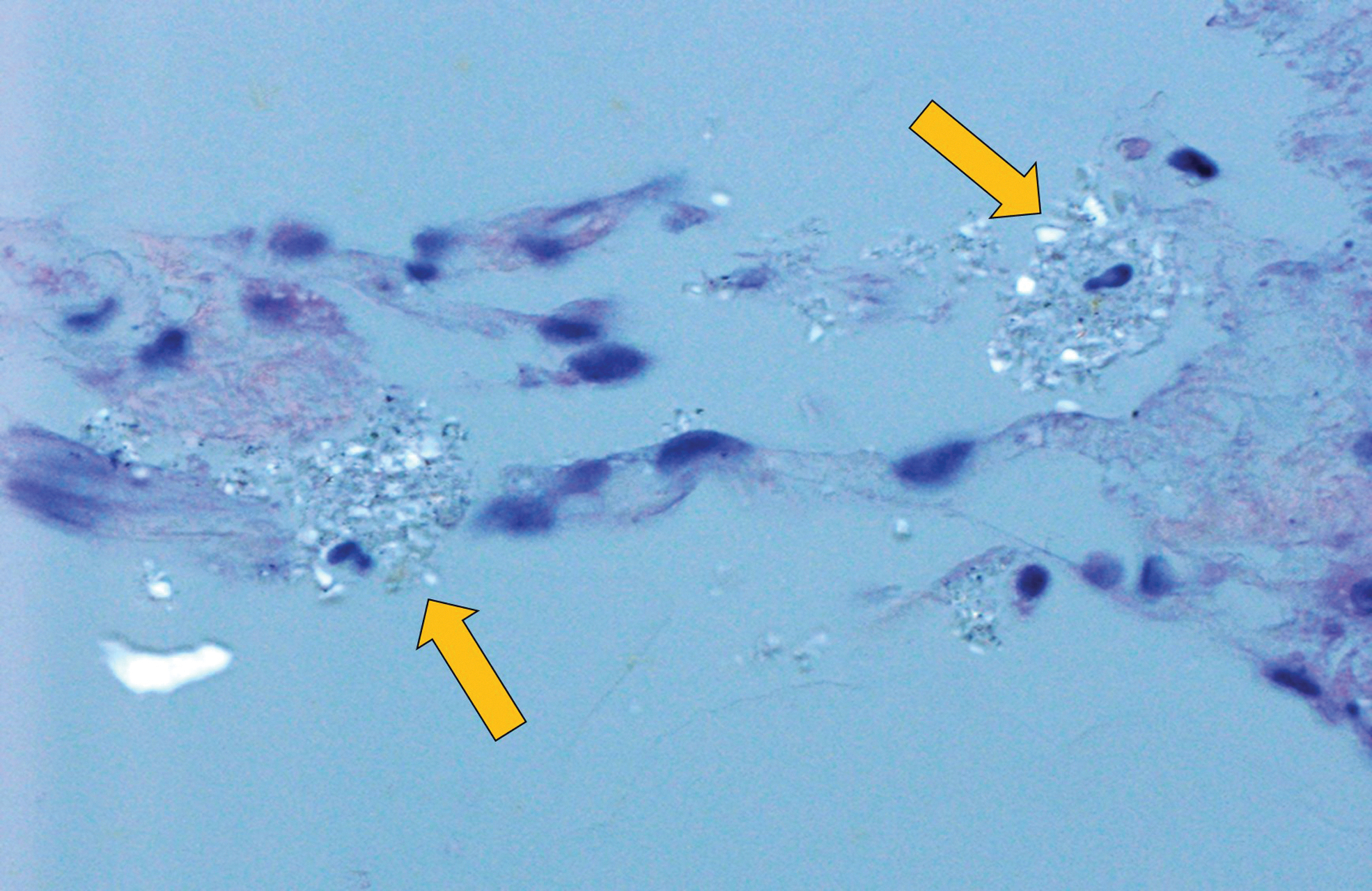
Human PCLS were cultured and exposed to quartz silica (MIN-U-SIL® 5) for 28 days. Functional macrophages are seen engulfing silica particles (arrows). H&E, 60 × objective (Credit: Khalid Amin, MD, Department of Laboratory Medicine and Pathology, University of Minnesota). H&E, hematoxylin and eosin; PCLS, precision-cut lung slices. Color images are available online.
Herbert and Gow correctly cite several key applications and disease endpoints (e.g., fibrosis and airway contractility) for which PCLS can be utilized. In addition, focused PCLS can be used to assess respiratory allergens. 9 With the growing concerns about respiratory sensitization, human PCLS, retaining crucial cell types believed to be associated with the process, may provide the requisite functionality to detect key events associated with such an adverse outcome.
Additional advances in exposure systems have positioned PCLS—especially in ALI culture—for an expanded role in assessing suspected human pulmonary toxicants. The development of nebulizers (for noncombusted aerosol exposures), smoking robots (to evaluate the effects of electronic cigarette aerosols), dust generators, and so on allow more physiological-like exposures to be conducted. Perhaps the most pivotal advance to establish PCLS as a readily available (and not confined to human donor availability) tool is the development of cryopreservation techniques.10–12 Post-thaw functionality is expected to continue to improve, providing the ability to test on demand with human PCLS (of varied disease states) making PCLS an even more attractive and cost-effective platform.
In conclusion, human PCLS have demonstrated great utility for addressing varied pulmonary toxicities and to provide improved translatability of results. With its low throughput, high cost, questionable human translation, and ethical concerns, animal testing for human lung risk grows less attractive by the year. The continuing advances for the human PCLS test system have culminated in a renewed interest in bringing this model to the forefront for human risk assessment. However, without a standardized methodology applied to their use, the reproducibility of results and inherent performance may be difficult to evaluate. To provide regulatory scientists with a robust platform to make informed decisions about human lung exposures and their potential impact on human health, an enhanced emphasis needs to be placed on the optimization and standardization of PCLS techniques.