




Abstract
Background:
The COVID-19 pandemic highlighted critical shortages in personal protective equipment (PPE), particularly respirators, which limited healthcare workers’ safety worldwide. Decontamination and reuse of PPE, including powered-air purifying respirators (PAPR) hoods, became essential to mitigate shortages. Conventional methods were inadequate for complete decontamination, prompting innovative solutions.
Objective:
To design and evaluate a novel device, the PAPR Hood Optimal Decontaminant Distribution System (PHODDS), for efficient decontamination of PAPR hoods using hydrogen peroxide vapor, ensuring safety, sustainability, and scalability.
Methods:
PHODDS was constructed using polyvinyl chloride tubing to facilitate hydrogen peroxide vapor circulation throughout PAPR hoods. Three PAPR models were tested in incremental batches of one, six, 10, and 20 hoods. Biological and chemical indicators (BIs and CIs) were placed in challenging areas to verify decontamination efficacy. Off-gassing of the decontaminant was assessed over 7 days post-decontamination.
Results:
Conventional decontamination methods failed to achieve full decontamination, as indicated by positive biological indicator growth and lack of chemical indicator color change. In contrast, PHODDS demonstrated consistent 6-log reduction efficacy across hoods and batch sizes, with BIs and CIs yielding negative results. The retention of H2O2 was minimal, except in some comfort strips.
Conclusion:
PHODDS successfully achieved effective decontamination of PAPR hoods, offering a scalable, cost-effective solution for PPE shortages during a pandemic response. It enables safe PPE reuse, potentially supporting pandemic resilience and environmental sustainability.
Keywords
Introduction
The COVID-19 pandemic exposed significant shortcomings in public health responses worldwide.1–3 During the initial stages and in some regions throughout the pandemic, shortages of personal protective equipment (PPE), particularly respirators, hindered healthcare workers’ ability to care for patients without the fear of exposure to the virus.4,5 Various strategies were employed to address these shortages, including in-house decontamination and reuse of single-use PPE, increased usage of powered-air purifying respirators (PAPRs), and emergency use authorization of large-scale PPE decontamination efforts. In times of shortages, decontaminating and reusing PPE could be a beneficial strategy for sustainability, availability, and cost-efficiency.6–9 Hospitals implementing PPE reuse strategies could maintain a steady supply, avoid straining financial resources, and reduce their environmental footprint.
In March 2020, the Biosafety team for Duke University and Duke University Health System led a project to decontaminate N-95 respirators to ensure an adequate supply for the healthcare workers. 8 At the same time, they brainstormed possibilities for what other critical PPE might also need to undergo decontamination and reuse if shortages persisted. Anticipating widespread shortages of N-95 to continue, Duke University and the Duke University Health System, like other health systems, determined that it was not feasible to provide unique PAPR hoods for each staff member, so a potential large-scale decontamination strategy was necessary. The biosafety team assessed hydrogen peroxide vapor decontamination of PAPR hoods using conventional approaches and realized that, due to the design of the PAPR hoods, decontamination was not effective. Therefore, a novel device, the PAPR Hood Optimal Decontaminant Distribution System (PHODDS; pronounced “PODS”), was created to allow hydrogen peroxide vapor to circulate inside and outside the hood, thereby achieving full decontamination. Here, we discuss the design, construction, and testing of PHODDS and provide possible avenues for future use during PPE supply shortages.
Methods
Three different brands of PAPR hoods were used during our testing process: Airboss FlexAir, Versaflo, and Ford Limited-Use Public Health Emergency PAPR (Ford).10–12 Clean PAPR hoods were collected from departments around the hospital to ensure testing included relevant models.
Conventional Methods of Decontamination
Since the infrastructure for decontaminating N-95 existed, the team explored ways to decontaminate PAPR hoods using conventional methods to expose the hoods to hydrogen peroxide vapor. 8 Airboss and Versalfo PAPR hoods were placed flat on metal wire racks with the face shield facing downward, hung upside down by the shroud, and lastly, turned completely inside out and placed flat on the rack. Ford hoods were not utilized in the initial methods (Table 1), but were used when comparing PHODDS to convential methods (Table 2). In this context, “conventional” refers to the practical and intuitive ways of arranging the PAPR hoods for decontamination in the absence of a purpose-built system like PHODDS. This does not include manual disinfection methods, such as wiping the hoods with disinfectant for reuse. Biological indicators (BIs) and chemical indicators (CIs) (Bioquell®, Ecolab Inc., Horsham, PA) were strategically placed in hard-to-reach areas to test whether hydrogen peroxide vapor could effectively reach those areas.13,14 PAPR hoods were visually inspected in various configurations to identify areas where vapor movement might be restricted. These hard-to-reach areas included front and back seams deep within double-layered shrouds, folds at the back of the head where the air hose connects, and jaw seams near the face shield, where additional folds could impede hydrogen peroxide vapor penetration.
Building PHODDS
PHODDS was designed to allow hydrogen peroxide vapor to fully circulate into all areas of the PAPR hood and was constructed using ½-inch diameter polyvinyl chloride (PVC) tubing (Silver-Line® PVC-1120 SCH-40 PR 600 PSI at 73°F ASTM D1785-15), which has been previously shown to be resistant to high levels of hydrogen peroxide vapor (Figure 1). 15 Briefly, PHODDS comprises of two hollow rings arranged vertically with two 15-inch PVC side stands. At the center is a vertical 30-inch tube acting as the stand for placing the hood. The base ring is made from ten 8-inch pieces, while the top ring, dubbed the “deep decon ring,” is made from four 3.5-inch PVC tubes and two 9-inch tubes, allowing for deep penetration of hydrogen peroxide vapor between two layers of PAPR hood shrouds. Both the center stand and the deep decon ring have multiple decontaminant outlet ports for optimal hydrogen peroxide vapor distribution. During setup, the PAPR hood was placed on the center stand with the inner layer of the shroud (when present) tucked inside the deep decon ring, and the outer layer was draped over the exterior of PHODDS. The base of PHODDS was connected to a manifold system that allowed for multiple connections. The manifold system was connected to outlet port(s) on the Bioquell® ProteQ hydrogen peroxide vapor machine, leaving one or two ports open to the room to disperse hydrogen peroxide vapor for decontamination of external surfaces (Figure 2). 16 The standard safety measures for using hydrogen peroxide vapor were followed, including sealing the room penetrations and door, as well as monitoring hydrogen peroxide vapor levels before entering the room after the decontamination run.

PHODDS Design and Dimensions: PAPR Hood Optimal Decontaminant Distribution System (PHODDS) was created out of PVC pipes to provide a stand for the PAPR hood to rest on, with rings to separate layers of the PAPR hood shroud, if needed. The rings and the center stand have decontaminant outlet ports to allow for optimal distribution of the decontaminating agent.

Twenty-PHODDS Testing Room Layout: The PHODDS were connected to a manifold, which was connected to a port on the Bioquell® ProteQ. At least one port was left open to allow hydrogen peroxide vapor into the room for decontamination of exterior surfaces.
Testing PHODDS
BIs and CIs were strategically placed in hard-to-reach areas of the PAPR hoods, as described previously, to assess PHODDS efficacy. The BI contained a minimum of 1 × 10⁶ bacterial spores (Geobacillus stearothermophilus ATCC 12980 endospores), and the chemical indicator contained calibrated dyes for assessing H2O2 levels. BIs were incubated in 9 mL of Tryptic Soy Broth (Hardy Diagnostics, Santa Maria, CA, 16 × 100 mm glass tubes, #K88) at 37°C without shaking. A negative result for the BI indicated a 6-log reduction in sporicidal activity. An “exposure control” BI and CI were included at the corners of the room (approximately 6 feet above the floor level) to assess room-level hydrogen peroxide vapor spread and decontamination efficacy. A positive control, i.e., BI not exposed to hydrogen peroxide vapor and incubated with growth media, was included with every set of BI incubation. Our plan was to fill an entire room with PHODDS to assess decontamination of multiple PAPR hoods simultaneously. To achieve this, we initially tested a single PHODDS and then progressed to 6, 10, and 20 PHODDS. BIs and CIs showed negative results for all but one setup of testing (data not shown for 1, 6, or 10 setups). In the initial test of 20 PHODDS, one BI was positive for growth due to improper placement of the PAPR hood on the PHODDS. The 20 PHODDS setup was confirmed with three rounds of negative BI and CI results (Table 1). Subsequently, we tested conventional methods against the 20 PHODDS to simultaneously assess the efficacy of each method (Table 2). Initially, BIs and CIs were included in all PAPR hoods tested on PHODDS; however, with consistent negative results, we included BIs and CIs at the end of each branch (5A, 5B, 5C, and 5D in Figure 2). This is supported by results from testing six PHODDS with multiple BIs in each PAPR hood and consistent negative growth in each BIs.
Twenty-PHODDS Tests, biological and chemical indicator results

Four independent tests were performed with 20 PHODDS to evaluate the effectiveness of multi-PHODDS decontamination. Each branch of the assembly (Figure 2) contained two biological indicators (BIs) and one chemical indicator (CI). A “PASS” indicates that the BI showed no microbial growth and the CI displayed the expected colorimetric change, confirming sufficient H2O2 exposure during the decontamination process. In Test #1, the BI#2 in branch 5B FAILED with positive microbial growth observed. This failure was likely due to improper placement of the PAPR hood on the PHODDS. To address this, in subsequent tests, all PAPR hoods were positioned carefully on the PHODDS, ensuring they were free of deep folds.
Efficacy of PHODDS compared to conventional decontamination methods
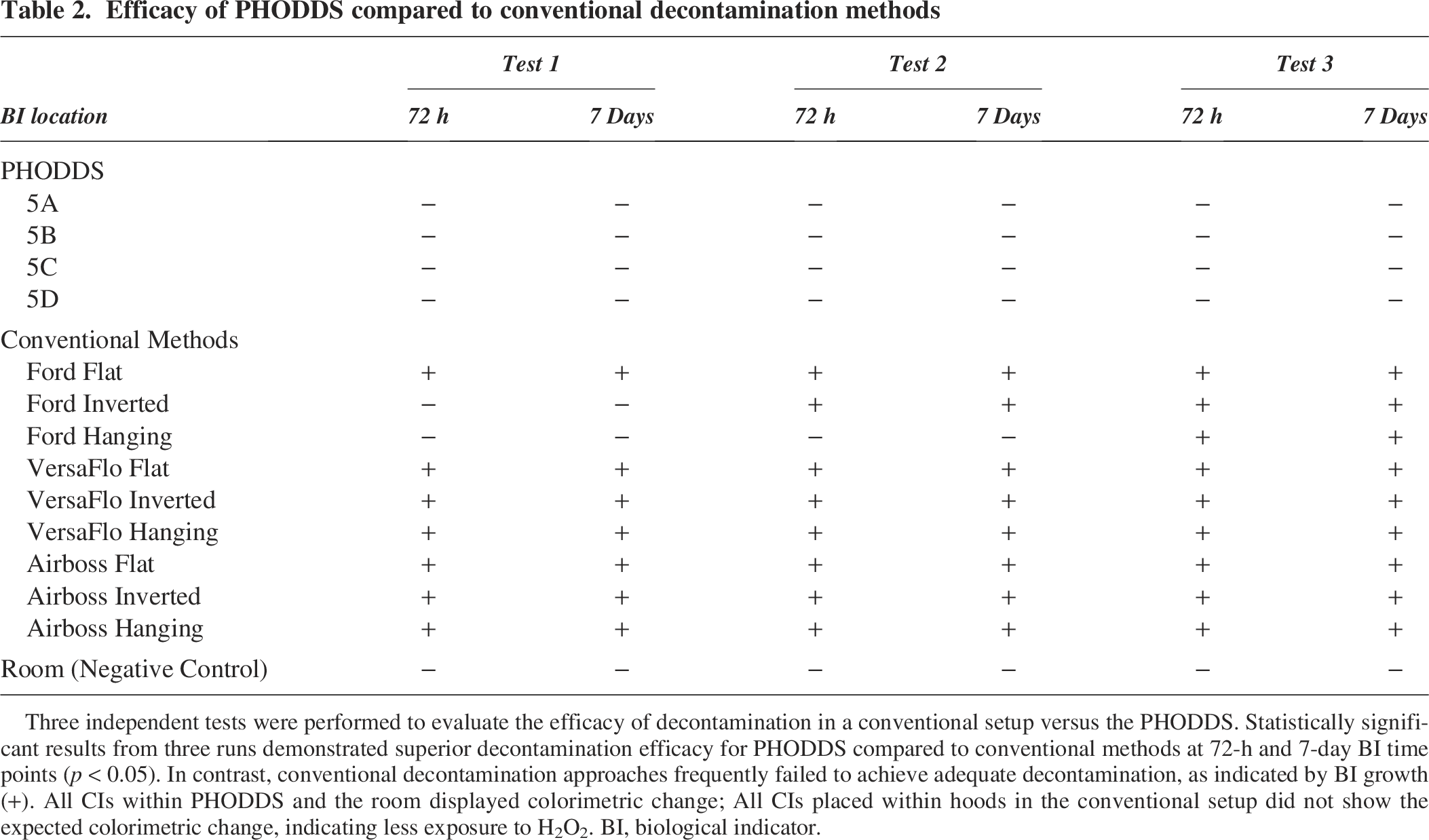
Three independent tests were performed to evaluate the efficacy of decontamination in a conventional setup versus the PHODDS. Statistically significant results from three runs demonstrated superior decontamination efficacy for PHODDS compared to conventional methods at 72-h and 7-day BI time points (p < 0.05). In contrast, conventional decontamination approaches frequently failed to achieve adequate decontamination, as indicated by BI growth (+). All CIs within PHODDS and the room displayed colorimetric change; All CIs placed within hoods in the conventional setup did not show the expected colorimetric change, indicating less exposure to H2O2. BI, biological indicator.
The decontamination cycle for PHODDS consisted of five stages (time in minutes): conditioning (3–10), pregassing (1–4), gassing (25), gassing dwell (20), and aeration (120–240), and were used according to manufacturer settings. The Bioquell® ProteQ automatically assesses the room size and distributes an optimal amount of hydrogen peroxide vapor. Peak concentration of hydrogen peroxide vapor during gassing and gassing dwell phase in our conditions ranged from 550 ppm to 750 ppm. Because the duration of each stage depends on factors such as the decontaminated area, material compatibility, and environmental conditions, prescribing fixed durations could result in ineffective decontamination. Therefore, the parameters must be set according to local conditions, and each run should be validated using biological indicators. At the end of a cycle, during the aeration stage, fresh air was introduced into the room to increase the rate of catalytic conversion of H2O2 vapor into oxygen and water, which leaves no residue. After the aeration stage, we used a PortaSens II sensor (Analytical Technology, Inc., Collegeville, PA, USA) to ensure that the H2O2 levels were below the OSHA permissible exposure limit of 1.0 ppm prior to entering the room. The PAPR hoods were flipped inside out and aerated for 72 h at room temperature to ensure complete off-gassing before further analysis. CIs were photographed and BIs were incubated immediately after the hoods were returned to the aeration room. BIs were photographed at 72 h and 7 days after aeration to assess for microbial growth.
Testing H2O2 Off-Gassing
PAPR hoods were placed into Tedlar bags (0.002” polyvinyl fluoride[(PVF] polymer resin), and hydrogen peroxide off-gassing levels were assessed using the Dräger X-am® 5100 H2O2 (Dräger) sensor. Readings were taken at t0 and at 24-h intervals for 7 days. The PAPR hoods were folded and placed inside the Tedlar bags, imitating typical packaging for reuse. If H2O2 was detected, the sensor was allowed to reset back to baseline (0.00 ppm) before testing the next bag. Tedlar bags containing the hoods were chosen for testing in random order during the week.
Results
The conventional methods of decontamination resulted in at least one BI or CI failure. BI failure was indicated by growth in the media after 72 h, and CI failure was indicated by a lack of colorimetric change after exposure to H2O2 (Table 2).
Using three models of PAPR hoods, we tested the efficacy of PHODDS in a progressive manner—1, 6, 10, and 20 hoods. All but one BI and all CIs were negative for growth and indicated colorimetric change, respectively (Tables 1 and 2). The BI results from three 20-hood runs were statistically significant when comparing the locations within the PAPR hoods on PHODDS against all other locations (room and PAPR hoods inverted, upside down, and laid flat) at both the 72 h and 7 day time points (p value = 1.473 × 10⁻⁷, 2.176 × 10⁻⁷ 72 h and 168 h, respectively; Fisher’s exact test, α = 0.05).
Readings of H2O2 of PAPR hoods, taken at t0 and every 24 h from the opening of the Tedlar bags, were primarily below the detection limit. However, in some instances, after extended time, there was detectable accumulation of H2O2 (Table 3).
Twenty-PHODDS hydrogen peroxide (H2O2) detection results (shown in ppm)

Hydrogen peroxide (H2O2) off-gassing from the decontaminated PAPR hoods was monitored using Tedlar bags and a Dräger H2O2 sensor. Most readings were below the detection limit, but occasional H2O2 accumulation was detected (shown in ppm), particularly in comfort strips. Results highlight the importance of adequate aeration or comfort strip replacement to ensure safety before reuse. BD, below detection; BI, biological indicator.
When randomly tested, comfort strips from individual PAPR hoods occasionally retained slightly elevated H2O2 levels relative to their respective hoods, with some samples measuring 0.1 to 0.2 ppm while others registered 0 ppm.
Conclusions
PAPR hoods are used frequently in the healthcare industry for protecting workers from airborne contaminants, especially while conducting aerosol-generating procedures such as bronchoscopy, intubation/extubation, sputum induction, etc. During the COVID-19 pandemic, PPE shortages were widespread. We realized PAPR hoods could be impacted by the global logistics breakdown, so we proactively assessed decontaminating and reusing PAPR hoods in case the need arose. Initially, we tried to decontaminate PAPR hoods using conventional methods such as laying the hoods on metal racks, turning them inside out, and hanging them upside down. These conventional methods did not result in adequate decontamination, as indicated by the growth of biological indicators and a lack of colorimetric change using chemical indicators (Table 2). The lack of consistent and predictable decontamination was due to the inability of hydrogen peroxide vapor to expand into the top part of the hood and the layered construction of some models of PAPR hoods. Previous studies have shown that H2O2 concentrations within decontamination chambers can vary during the various stages of the decontamination cycle. 17 Vapor-phase decontaminants, like hydrogen peroxide vapor, require additional energy to reach all surfaces uniformly. In the conventional testing methods, there is no external energy forcing hydrogen peroxide vapor into all areas of the hood. Gaseous decontaminants, such as chlorine dioxide and formaldehyde gas, would have potentially penetrated all areas of the hood but also leave residues (formaldehyde gas) and are dangerous to the end user. 18 It was evident that a practical, thorough, and safe decontamination method was needed.
We designed and built a device that would allow the decontaminating agent to efficiently permeate all areas of the PAPR hoods and aid in effective decontamination. The device, coined the PHODDS, was comprised of two hollow PVC rings arranged vertically with two 15-inch PVC side stands and a vertical 30-inch PVC tube in the center to support the top of the PAPR hood. The upper ring, dubbed “deep decon ring,” and the center tube contained multiple, equidistant decon outlet ports for circulating hydrogen peroxide vapor through the interior of the hoods, greatly improving the distribution and efficacy of the decontaminant. The “deep decon ring” allows for PAPR hoods with a double-layer shroud to be separated and deliver the decontaminant thoroughly between the layers. The statistically significant results from our experiments, where all BIs and CIs were consistently negative when using PHODDS, demonstrate that this system can achieve complete decontamination even in the most challenging spots of the PAPR hoods.
Scalability is crucial for real-world applications, especially in the healthcare industry, where work occurs 24 h a day in multiple shifts and large numbers of PAPR hoods may need to be decontaminated simultaneously during a public health emergency. Concurrently, clinical diagnostic and research laboratories might have their workloads increased to respond to the crisis and therefore need increased amounts of PPE. With this in mind, we tested 20 PHODDS in a connected manifold (Figures 2 and 3). Two BIs and one CI were placed in the hoods at the ends of the manifold branches with the assumption that if the hydrogen peroxide vapor decontaminated the end PAPR hoods (5A, 5B, 5C, and 5D in Figure 2), then all PAPR hoods between the ProteQ and the end of the manifold branch would also be decontaminated. We rigorously tested both placement of BIs and CIs in hard-to-reach places in PAPR hoods and in all PAPR hoods in a manifold branch, demonstrating that it is possible to effectively decontaminate several models of PAPR hoods simultaneously. Of note, in the initial test of 20 PHODDS, one BI was positive for growth, which prompted us to ensure that all hoods were placed onto the PHODDS free of noticeable deep folds (Table 1). This shows that PHODDS can be scaled up to meet a large facility’s needs. PHODDS could also be assembled within a trailer or a bio-bubble if the facility does not have dedicated space to use for PPE decontamination. These temporary setups could be moved to different locations within a community and used as a shared resource for community clinics or emergency responders.

Twenty-PHODDS Assembly and Testing: Twenty PHODDS were assembled together and PAPR hood decontamination tests were done simultaneously to assess the efficacy of multiple PHODDS functioning together.
There are some limitations to PHODDS, and it may not be applicable to all situations. For example, an automated hydrogen peroxide vapor generator could be cost prohibitive and not an option for all facilities. Additionally, the space necessary for setting up PHODDS must be sealed to prevent excursions of hydrogen peroxide vapor or other decontaminants, and prior to beginning decontamination, there must be robust procedures in place to test the integrity of the decontamination space, calibration of equipment, and run parameters, especially with temporary facilities, to ensure expected outcomes are achieved. Regardless of setup, appropriate controls and biological/chemical indicators should accompany each run, along with a quality assurance/quality control process. Although setup and decontamination can be completed relatively quickly (approximately 3 h), waiting for biological indicator results may delay hood turnaround times by up to 72 h. Facilities planning to implement a decontamination and reuse strategy should consider this and other logistical challenges. Key factors include obtaining regulatory approvals, training staff on proper use and disposal procedures, designating collection points, optimizing collection frequency, ensuring safe operation of the decontamination process, maintaining quality control, implementing proper packaging, and facilitating timely redistribution to end users. Our results indicated that the comfort strips retained some amount of H2O2, therefore it would be best practice if decontamination protocols accounted for this and removed the strips before the decontamination was conducted. Finally, staff perception of using decontaminated PPE is an important issue that should be addressed to allay fears, particularly during a crisis. A robust QA/QC process, safety awareness campaigns, and socialization of the concept of reusing decontaminated PPE during “peace time” will help in staff acceptance of such procedures, enabling the safe and sustainable use of precious resources during widespread shortages.
In conclusion, the development of PHODDS represents a significant advancement in the field of PPE decontamination. By ensuring that PAPR hoods can be effectively and safely reused, PHODDS not only addresses immediate shortages but also contributes to a more sustainable and resilient pandemic response. Further research and refinement of this system, including an assessment of the sustainability benefits and the return on investment, will be essential to maximize its utility and ensure the highest standards of safety for all end users.
Authors’ Contributions
A.S. Design conceptualization, device construction, experimental design, testing, results analysis, writing, editing, project administration. S.M. Device construction, testing, data collection, results analysis, writing, editing. F.K. Concept refinement, device construction, testing, editing. A.R.V. Device testing, results analysis, statistical analysis, writing, editing. M.A.S. Funding acquisition, editing.
Footnotes
Funding Information
No funding was received for this article.
Authors’ Disclosure Statement
No competing financial interests exist.