




Abstract

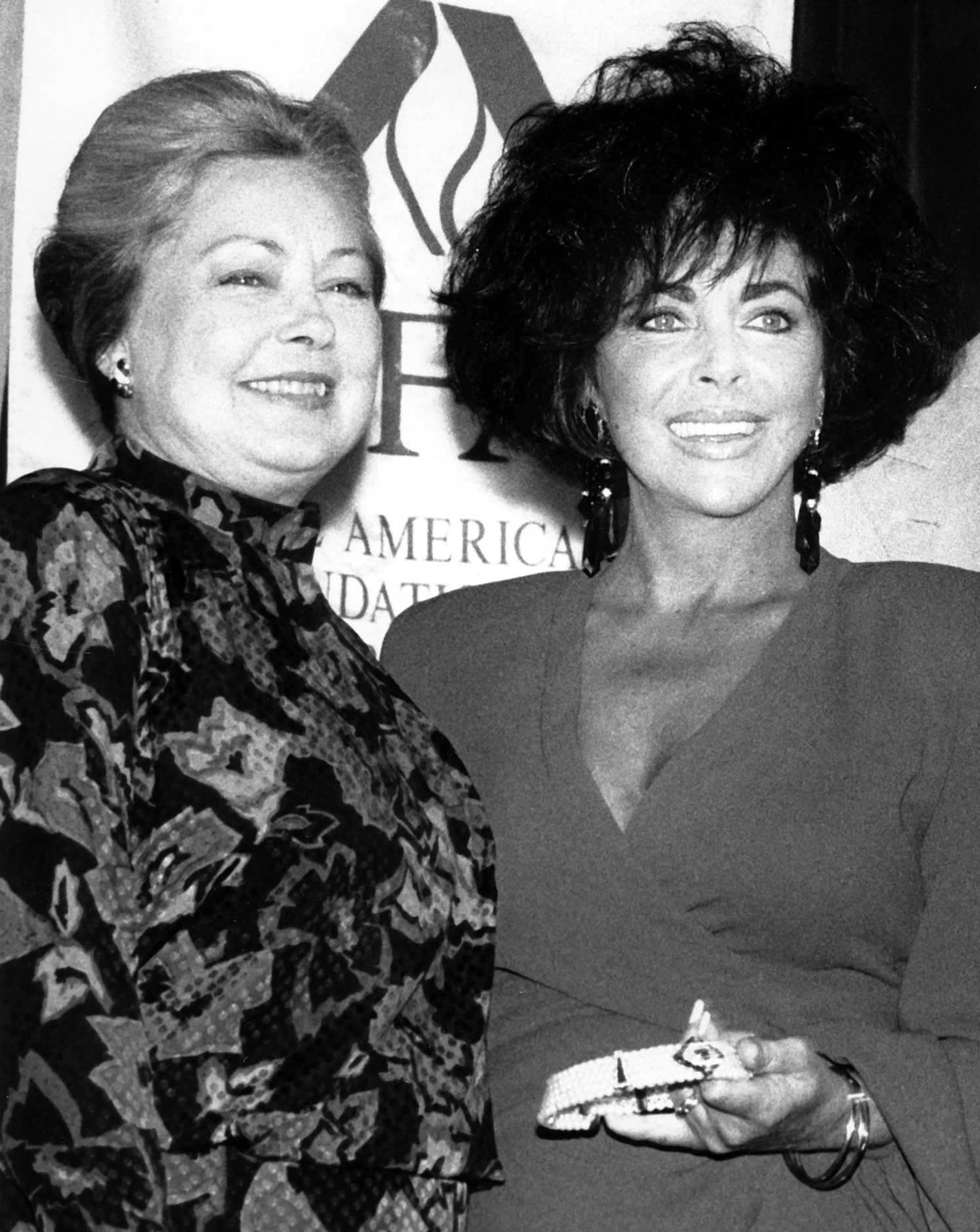
Dr. Krim with Elizabeth Taylor in September 1991 at the “Glitter and Be Giving” amfAR fundraising event.
T
And while anyone who was either directly or indirectly touched by the new disease suffered the double indignity of devastating illness and cruel humiliation, a few others began the very difficult task of providing some charitable relief to those who, in increasing numbers, desperately needed help.
Research on the mysterious condition was first undertaken by a handful of physicians and scientists with a personal sense of urgency in the face of what was, at best, widespread public indifference fed by prejudice or outright judgmental condemnation. Largely for these reasons, biomedical research got off to a slow and halting start but it soon identified HIV, a previously unknown virus, as the cause of the disease. This opened up a rational approach to its understanding and also held the promise that there would one day be a way to treat what came to be known as AIDS.
I was one of those health professionals awed by the threat of the early epidemic. A few colleagues and I had incorporated the first private foundation to get a research effort off the ground. At that time, I was a scientist working in the field of virology. I was not a young woman anymore and was the wife of a prominent and respected man, Arthur Krim, then head of the Orion Pictures film company. I realized that my personal circumstances could be put to good use for the purpose of reaching out to people who would not only be likely to hear me but would also have the means to help. I first turned to friends in the entertainment industry, including Elizabeth Taylor, whose late husband, film director Michael (Mike) Todd, had been a good friend of Arthur.
Arthur's previous company, United Artists, had distributed Todd's very successful film and Best Picture Oscar winner, Around the World in Eighty Days. Mike Todd had been Elizabeth Taylor's dearly loved husband before he was killed in 1958 in an airplane accident. In 1985, I heard that Rock Hudson was suffering from AIDS and that Elizabeth Taylor was a devoted friend of his who was visiting him daily. A telephone call to her resulted in her invitation to me and a friend to pay her a visit and talk about AIDS.
She welcomed us in the hallway of her Bel Air house in Hollywood and we were led into its living room, where the decor was plush but rather conventional in style, were it not for several stunning master paintings on the walls.
Elizabeth was gracious but almost shy. When I mentioned the name of Mike Todd she instantly turned her head away, with a sad little smile and what appeared to be a tear in her eye.
She eagerly listened to our depiction of the many challenges of the situation created by AIDS. She asked some pertinent questions and fully acknowledged the cruelties and enormous complications caused by the prejudice that had impeded the prompt awarding of sufficient funds to initiate research on AIDS and the development of appropriate and just public policies. We asked her whether she would agree to join the board of a new private national organization that was going to result from the merger of two existing but independent East and West Coast foundations, each principally promoting research on AIDS. To our delight, she accepted—eagerly, in fact.
She let us brief her on our proposed strategies and our thinking about rational public policies. She had no quarrel with any of it. She thoughtfully selected the duties she would agree to perform and whatever traveling these might require. For her public speaking appearances, we proposed that we prepare position papers and accompany her, providing whatever assistance she needed. She had us explain to her, in lay language, what our positions were on certain scientific and medical issues. The area in which she would, in time, become a master was in stating her convictions on the subject of human rights, specifically the irrefutable right to equal access to care and treatment. On this subject she was not only outspoken but vibrantly strong. The national American Foundation for AIDS Research (amfAR) was founded shortly thereafter, and she was one of its founders. From then on, Elizabeth Taylor was also a foot soldier.
Since that time, she participated in multiple gatherings, dinners, official ceremonies, hearings, and other political and social events, speaking for amfAR and its cause. Whenever she spoke at hearings, a member of amfAR's board or top staff would assist her in answering questions that required technical or managerial know-how.
There were, however, also circumstances when only Elizabeth could solve a problem. One such situation arose in 1990 when Senator Ted Kennedy agreed to introduce a bill to create (and fund) a major AIDS-related federal program, provided that 60 senators would agree to sponsor his bill. Only a fraction of this number of senators had committed themselves to doing so. Therefore, when Elizabeth Taylor went to Capitol Hill on amfAR's behalf to testify in support of this bill, amfAR's very able public policy director contrived to offer each of the still uncommitted senators the opportunity to have their photograph taken with Elizabeth Taylor if they would agree to sponsor Senator Kennedy's bill. By the next morning, 20 senators had accepted this offer, the bill had its 60 sponsors, and was passed. This vote was the one that created the very important “Ryan White Care Act” program that became, and still is, crucial to the fight against AIDS in this country.
Through our long experience in working with Elizabeth Taylor, we at amfAR came to know a wonderful but complex personality whose reactions to events were often shaped by emotions and feelings. The extent to which this was true was exemplified for me by the fact that Elizabeth came to make AIDS part of her own, very personal life. For years, Elizabeth had several young people, both men and women with AIDS, living off and on in her own home and—so it appeared to me—in some cases 24 hours a day. This must have been a cause of much stress for her as well as an inconvenience, to say the least, but she managed the situation with good humor and the authority of a mother hen.
Elizabeth proved to be a complex personality in many other ways. She gave me—and others—the impression that she could at times be strongly and genuinely independent. It seemed to me that as her public persona had been molded as a “celebrity” starting from a very early age, she had never been part of any specific group. She seemed to have learned that despite a variety of advisers, assistants, secretaries, and/or friends, in the end she always had to stand alone as a “beautiful woman” in front of cameras or crowds. Only rarely had she been able to be her true self.
It was only in very intimate settings, such as among very close friends, that she was able to candidly express herself in language and manner that revealed a real sense of humor and true joviality. This resulted in outbursts of vivacity and laughter. She thrived in such moments.
Given Elizabeth's multifaceted personality and her health condition, it was not always easy to work with her. There were limitations, for example, to her capacity to fulfill commitments such as public appearances. All of her life Elizabeth had suffered back pain that required much more than the little white pillows with which she unfailingly traveled. It was often difficult for her and those who had to accompany her to arrive in a timely fashion at scheduled events. Nevertheless, when she arrived, her make-up and hair were perfect, her jewels were on, and a breathtakingly beautiful, gracious, and smiling queen was reborn.
She must often have had to corral true courage to fulfill her duties as a spokesperson for amfAR, but she came to enjoy the prestige of her title and her role as “Founding International Chairman.”
This role took her to a number of countries. I believe that she enjoyed the travel because she had a genuine interest in people and international affairs. For a while, she had lived happily in Africa (Botswana) with Richard Burton. The plight of that continent in the time of AIDS moved her profoundly. For example, she vividly perceived the West's moral obligation to invest substantial resources in Third World countries. Her concern for more compassion and hands-on care led Elizabeth to create her own philanthropic foundation through which she personally supported charitable AIDS care and food services for indigent AIDS patients in the Los Angeles area.
Everywhere she went she was a spectacular subject for hundreds of photographers and reporters. She thus encouraged many other artists and celebrities to speak up, to fight bigotry, and promote worldwide human solidarity. In 1987, Elizabeth even managed to get President Ronald Reagan to speak publicly about AIDS for the first—and unfortunately the last—time. This occurred in front of an important crowd attending an amfAR event honoring her in Washington, D.C.
An important part of Elizabeth Taylor's life about which little has generally been known was her relationship with her family, her four children, and their progeny. It has been suggested that she had been a “bad mother,” shunning the conventional lifestyle of a parent in favor of the glamorous trappings of the life of a “star.” I have come to the opposite conclusion. I believe that Elizabeth Taylor deliberately protected her children from becoming engulfed in what can be the artificiality of a star's life.
Although her family remained mostly invisible to the public, her children not only often lived with her but, as adults, frequently visited her and attended numerous family events, including her 75th birthday celebration. The same sign of real family intimacy was for me the sight of a playroom on the upper floor of Elizabeth's home, one that she had me visit years ago. It had very obviously been much used, even recently, by several grandchildren.
In recent years, I have become convinced that among Elizabeth's many attributes, one that has been greatly underestimated has been her intelligence. She learned and developed the traits, looks, and overall persona that the public—and hence the filmmakers—wanted. (She was a very fine actress!) At the same time, she protected her privacy, maintaining complete control of matters she considered belonging to her private life, letting out only the occasional, insignificant tidbit of information for the gossip mill. All along, she pursued her own personal plans and business interests with calm determination. Her estate is thus greatly benefiting from, among other things, her own self-proclaimed “love of jewels,” the sale of perfumes bearing her name, and her collection of very valuable paintings.
Elizabeth Taylor's independence and determination are to be admired in a social context in which people have often been devoured by others' greed. It is, however, her genuine compassion and her principled and courageous defense of equal human rights everywhere and for all, that will remain most deeply engraved among my memories of her.
It has been judged that Elizabeth's prominent position with amfAR and her personal and active dedication to the foundation's research and public policy mission has, over the years, generated an enormous influx of public and private support for the overall fight against AIDS. Its worldwide total has been estimated to be of the magnitude of several hundreds of millions of dollars.
The value of her contributions to the enlightenment of the public cannot be measured because this can be done only in the future quality of all of our lives.
Thank you, Elizabeth. Rest in peace.