




Abstract

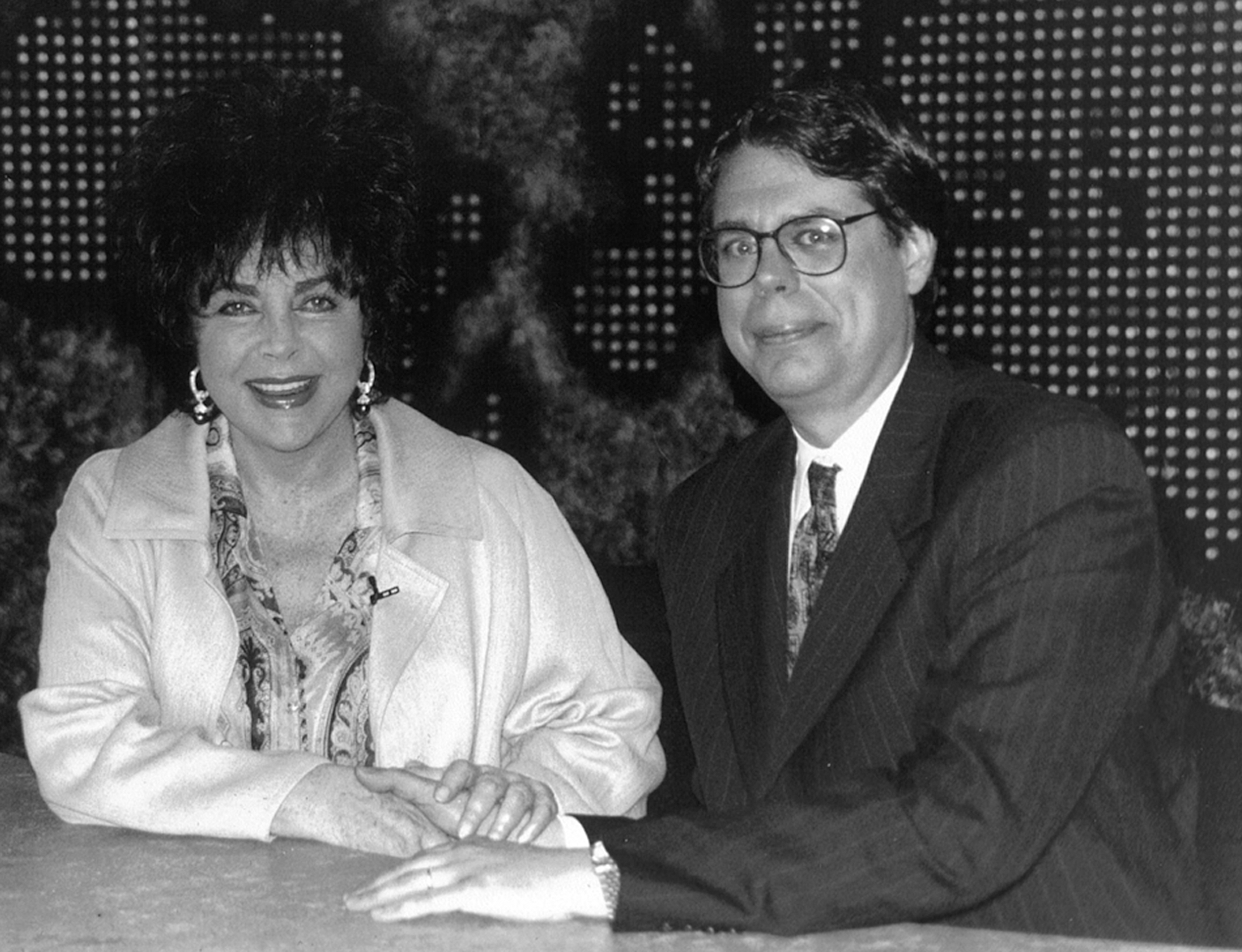
Dr. Laurence holding hands with Elizabeth Taylor on the set of an interview for Larry King Live in 1996.
I
In 1990, Dr. Krim argued in a profile in Time magazine that how wealthy societies deal with AIDS, “will measure to what extent they have the right to call themselves civilized.” In April of that year, Dame Elizabeth testified before Congress, justifiably criticizing the response to what had already become a global pandemic.
“So many people were frightened and doing so little about it. The silence was thunderous,” she observed. “I am not here in Washington to make people like me. I'm here to speak about a national scandal. A scandal of neglect, indifference, and abandonment. We must find effective treatments, and a cure. It's my life now, and will be until there is a cure.”
Despite the challenges and criticisms she hurled at our national leaders—“President Bush, Mr. [Vice President] Quayle, Senator Helms. Your policy is wrong. Dead wrong. And you know it”—she shouted at one point, she is now honored by all governments for illuminating the profound inadequacy of our initial responses to HIV/AIDS, and the ignorant treatment of the groups of people affected and stigmatized by that infection. Just 10 days after her death, the U.S. Senate passed a resolution, number 8217, honoring Dame Elizabeth's life and work.
I had the honor of knowing Dame Elizabeth since 1985, at amfAR's conception. I served as its first program consultant, and am now its Senior Scientific Consultant for Programs. Dame Elizabeth, or “ET” as we'd affectionately call her, was tremendously energetic, resourceful, and caring. Of course she would lend glamour to fundraising events. With those incredible violet eyes and smile and diamonds it was impossible to ignore her. But she would also attend day-long amfAR Board meetings, propped up on pillows because of her chronic back condition. She would punctuate discussions, ask probing and pertinent questions, and argue with the rest of us as to what had to be done against a background of very limited federal resources and interest. When an idea touched her and justified immediate action, she would often volunteer a few hundred thousand dollars or so, of her own money, to jumpstart a program.
Dame Elizabeth did not typically have patience for the intricacies of a research proposal or the specific conduct of a clinical trial. But she was passionate about international AIDS issues and human rights, participating in monthly teleconference calls exploring these concerns. And sometimes she could be very funny there.
Listening to a discussion on one teleconference of how condoms were not being used by commercial sex workers and other susceptible women in Africa and Nepal, because of their inability to convince men to use them, Dame Elizabeth proffered—through a highly explicit description—a method to get one on a man without his knowing. Or perhaps not objecting. Not often very practical, perhaps, but a welcomed respite during a discussion of a still very serious concern worldwide.
Dame Elizabeth had been personally touched by HIV/AIDS in so many ways. Her secretary, Roger Wall, committed suicide rather than suffer the complications of a disease then untreatable. Her former daughter-in-law, Aileen Getty, became infected and was comforted by Elizabeth when her own biological family appeared to abandon her. And then there was Rock Hudson, friend and twice film co-star, who announced his own AIDS diagnosis in July 1985 and helped to jumpstart amfAR.
In 1989 she personally traveled to Bangkok, and saw what AIDS was doing in the poorest regions of the world. She volunteered to help start AIDS prevention initiatives in every country in which she had made a movie, starting with Botswana (and a Richard Burton marriage there). Through her efforts for amfAR, and the Elizabeth Taylor AIDS Foundation, she raised over $270 million. Shortly before her death we came one step closer to her dream—our dream—with the recognition of the apparent cure of the “Berlin patient” through a stem cell transplant. Its scientific basis was the discovery of a critical coreceptor by which HIV infects most cells, CCR5, and the mutation, CCR5Δ32/Δ32, found in 1–5% of certain population groups, which renders cells resistant to infection by most forms of HIV. That basic work was the fruit of amfAR-funded research.
In this issue we highlight research in HIV prevention and treatment from the Caribbean, South America, Africa, Asia, and India. As noted in an editorial in the New York Times in early June, “The United Nations will hold a high-level meeting this week to chart a course of action for coming years. It needs to press donor countries, and those with high infection rates, to do more, not less, for this life-or-death fight.…[there is] the exciting prospect that the epidemic could be stopped if all of the estimated 34 million people infected with the virus could be treated. A pivotal study found that if an infected person was treated with drugs immediately, the risk of transmission to an uninfected partner was cut by 96%. The upfront costs of treating everyone would be huge, but in the long run it could well save money by greatly reducing the number of people who become infected and need treatment.”
Dame Elizabeth just missed learning of the promise of this treatment/prevention approach and the promise of a cure. But her work, and now her legacy, will help ensure that both come to pass. She will be missed terribly, by so many people, in so many disparate fields.