




Abstract

To the Editor,
T
A number of studies have shown that MSM who meet partners via the Internet have a higher risk of HIV/STI. 3,4 While a few US studies have shown that MSM meeting partners on mobile apps tend to have more partners, and condomless anal sex, 5,6 there have been no similar studies of Australian MSM. In this cross-sectional study we examined differences in age and risk practices among Australian MSM using different methods for meeting partners.
MSM attending Melbourne Sexual Health Centre (MSHC) in Australia, between July 31, 2014 and June 30, 2015 were invited to complete a short questionnaire on sexual practices and methods used to meet partners in the last 3 months. Multivariate analyses examined associations between sexual practices and methods for meeting partners, adjusting for age, using Stata version 13.1 (Stata Corp., College Station, TX). The Alfred Hospital Ethics Committee approved this study (number 324/14).
Of 6406 eligible MSM, 2599 (41%) completed the questionnaire. We excluded 697 responses: 415 were incomplete, and 282 were repeat visits, leaving 1902 MSM for analysis. Questionnaire responders were slightly younger than non-responders (median: 29 vs. 31 years, p < 0.001).
Of 1902 MSM, 58% (n = 1097) were Australian-born, 37% (n = 703) were overseas-born, and 5% (n = 102) had no information on country of birth. The median number of male partners in the last 3 months was 3 (inter quartile range: 1–5), and 47% (n = 835) reported always using condoms for anal sex.
Overall, the majority of MSM (71%; n = 1343) met their partners via mobile apps, followed by friends (46%; n = 882), Internet (41%; n = 778), gay bars (37%; n = 709), and sex on premises venues (SOPV) (35%; n = 660). A small proportion of MSM used a single method for meeting partners: 275 (14%) only used mobile apps, 73 (4%) only used the Internet, 66 (3%) only via friends, 57 (3%) only at gay bars, and none met partners only at SOPV. There was a significant association between age and the method of meeting partners. Younger MSM tended to meet their partners via mobile apps and older MSM tended to meet their partners at SOPV (Fig. 1).
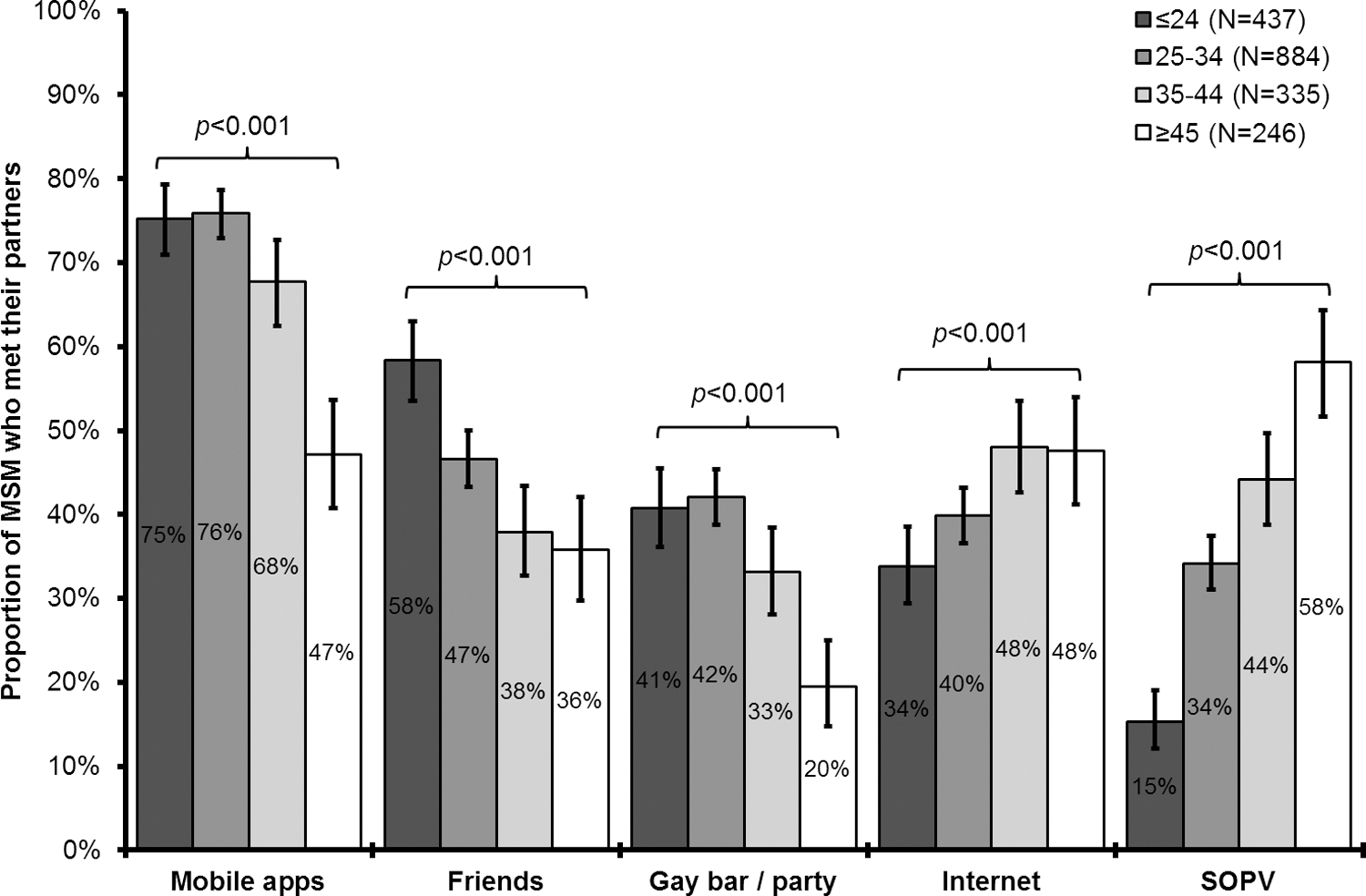
How MSM reported meeting sexual partners for the previous three months by age.
Multivariate analysis found the odds of reporting >3 partners, were highest with MSM using mobile apps (aOR: 4.96; 95% CI: 3.75–6.58), followed by those meeting partners at SOPV (aOR: 3.07; 95% CI: 2.45–3.87), gay bars (aOR: 1.94; 95% CI: 1.55–2.42), via friends (aOR: 1.73; 95% CI: 1.39–2.15), and on the Internet (aOR: 1.41; 95% CI: 1.14–1.75), after adjusting for age, and other methods of meeting partners.
Both univariate and multivariate analysis showed no significant association between method of meeting partners and condom use for anal sex (Table 1).
120 men declined to answer the question on condom use in the last 3 months; b46 men declined to answer the question on regular sex partners; c313 men declined to answer the question on casual sex partners; d28 men declined to answer the question on bisexual practices; e34 men declined to answer the question on injecting drug use; fadjusted for age and other methods for meeting partners.
MSM who used mobile apps for meeting partners had the highest odds of having casual sex partners (aOR: 5.74; 95% CI: 3.85–8.54), and were less likely to be bisexual (aOR: 0.26; 95% CI: 0.18–0.37), compared to those using other methods (Table 1).
Furthermore, MSM who met partners at SOPV were more 3.64 (95% CI: 1.67–7.92) times more likely to have injected drugs in the last 3 months. However, injecting drug use was not significantly associated with other methods for meeting partners in the multivariate analysis.
Mobile apps have now become the primary method for meeting partners for MSM attending a sexual health centre in Melbourne, Australia. Methods for meeting partners vary by age group. MSM who met their partners through mobile apps were more likely to report higher numbers of partners, sex with men only, and have casual partners, compared to those who used other methods. However, rates of condom use for anal sex did not differ by method of meeting partners.
MSM attending MSHC now appear to be using mobile apps more frequently than the Internet and gay-oriented venues, to meet partners. This is consistent with the annual Australian Gay Community Periodic Survey (GCPS), which showed the use of mobile apps for meeting sex partners in Melbourne increased from 24% in 2011 to 48% in 2015. 7 This coincides with an increase in smartphone ownership in Australia from 67% in 2011 to 89% in 2014. 8 A study in the US revealed that more than 50% of MSM using Grindr have logged on ≥5 times per day. 5 In our study younger MSM were more likely to use mobile apps than older MSM, perhaps because younger MSM adopt newer technologies faster than older MSM.
MSM who used mobile apps were five times more likely to have ≥3 partners in the last three months, consistent with a study conducted in Washington DC, 6 which did not adjust for other methods such as Internet use, and gay-oriented venues. Moreover, our study showed that there was no association between inconsistent condom use and method of meeting partners, also consistent with a previous study showing similar proportions of unprotected anal sex between Grindr users and non-Grindr users. 5
Our study has several limitations. First, we studied MSM attending a clinic in Melbourne and MSM at higher risk of infection are likely to be over-represented and methods of meeting partners may vary across Australia. However, comparisons between mobile app users and those meeting partners in other ways are likely to remain valid. Second, the 41% of MSM who completed the questionnaire were generally younger and had more sexual partners, which might have influenced the results. Previous studies suggest other risk behaviours such as group sex and non-injecting drug use are highly associated with use of mobile apps, 6,9,10 and further research is required. Finally this cross-sectional study can only describe associations and cannot establish whether the use of a mobile app actually increases the number of sexual partners.
To our knowledge, this is the first study conducted in Australian MSM investigating associations between sexual behaviours and different methods of meeting partners. We also found that 14% of MSM only used mobile apps for meeting partners, while the majority (57%) of MSM used mobile apps plus at least one other method of meeting partners. It has been shown that the majority of MSM (80%) would like to participate in HIV prevention programs through mobile apps. 11 Given that the majority of MSM use mobile apps for meeting partners, more HIV/STI prevention programmes may need to be delivered via mobile apps. 12 This could also improve access to hard-to-reach individuals such as young MSM.
Footnotes
Acknowledgment
The authors would like to acknowledge Jun Kit Sze and Afrizal Afrizal for data extraction.
Authors contributions. EPFC and CKF involved in designing the questionnaire. EPFC undertook the statistical analyses and involved in data interpretation. TRHR, JSH, SW, and CKF assisted with data interpretation. EPFC prepared the first draft of the article. All authors critically revised the article for important intellectual content, and read and approved the final version.
Funding. This work was supported by the National Health and Medical Research Council (NHMRC) programme grant (No. 568971). EPFC and TRHR are supported by the Early Career Fellowships from the Australian NHMRC (EPCF No. 1091226, TRHR No 1091536).
Author Disclosure Statement
No conflicting financial interests exist.