




Abstract

F
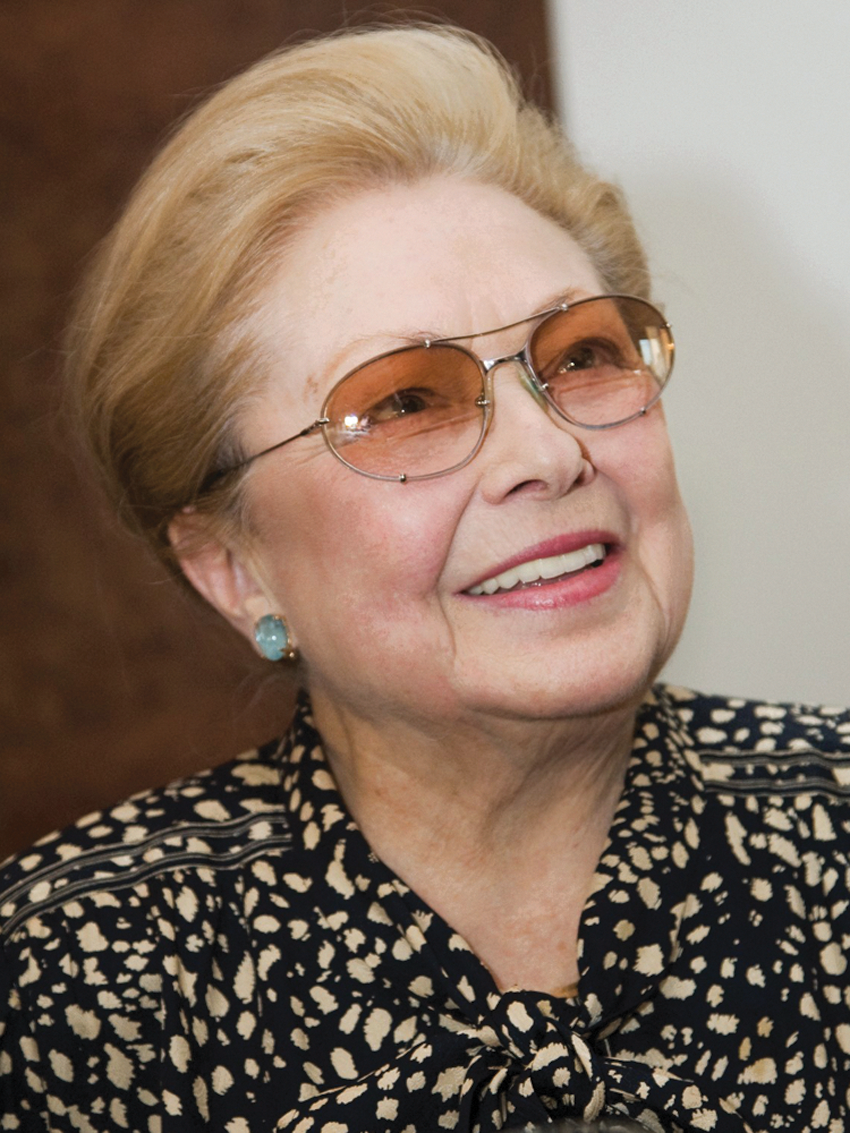
In the December 2011 issue of this journal, Dr. Krim, co-founder with Dame Elizabeth Taylor of amfAR, The Foundation for AIDS Research, wrote that the early days of AIDS “was a frightening time … of a new illness that seemed, at first, to be strictly affecting gay men. So a ‘moral’ dimension came to be attached to this medical puzzle [leading] much of the public to conclude that the condition justified condemning the afflicted on the basis of ‘morality.’” 1 This background demanded that AIDS be confronted not only as a medical issue but one intimately linked with social stigma and human rights, and that science was powerless if there was a lack of political insight and will. It was in this climate that I first met Mathilde Krim and Elizabeth Taylor, and joined in their fight.
It's been said that rather than shattering a glass ceiling, female leaders often risk slipping off a glass cliff, assuming positions of power only after the situation is dire, men are uninterested, and the likelihood of success is low. Yet, as noted in a review of “The Battle of amfAR,” a 2013 HBO documentary by Oscar-winning directors Rob Epstein and Jeffrey Friedman, two women, “a scientist and a movie star did not have to respond–but they did.” The men running governments worldwide did little, and the odds seemed daunting. But since their initial efforts, “The fight against HIV has never been the same. [This film] reveals how two powerful and very different women came together, and what their combined efforts achieved.” 2 I was thrilled to be part of that documentary and, although it apparently took a tremendous amount of persuasion to secure her participation, I can think of no better tribute to her.
I know so few people whose lives were unaffected by her life. A dozen years ago our journal also published a tribute to Dr. Krim, with commentaries from 10 scientists, activists, public health experts, and amfAR's Board Chair, Kenneth Cole. It's enlightening to revisit that issue, and savor the extraordinary achievements recognized by individuals who themselves met the AIDS challenge with fortitude and courage.
“How to whitewash a plague,” a 2013 New York Times commentary written by Hugh Ryan on an exhibition at the New York City Historical Society about the earliest days of HIV/AIDS warned that “Bad history has consequences. I'm not afraid we will forget AIDS; I am afraid we will remember it and it will mean nothing. If we cannot face the root issue—that we let people die because we did not like them—AIDS will become a blip on our moral radar, and this cycle will repeat every time we connect an unpopular group with something that scares us.” 4
Dr. Krim was indefatigable, unstoppable, a cascade of ideas. She led a life that refuses summation. Yet she has been called “politically naïve” by some in the AIDS activist community. I recall the heat she took as we both participated on a panel empowered by New York Governor Mario Cuomo, and chaired by Reverend Paul Moore Jr., Episcopal Bishop of New York, to investigate bathhouses as potential facilitators of high-risk sex, and thus HIV, among men who have sex with men. Should they be closed? Human rights in conflict with public health measures became issues. Would the benefits of educational and prevention measures that could be disseminated in bathhouses justify the health risks for those choosing to ignore those messages, or the challenges to rights of free assembly?
When the extent of several heterosexual populations at risk for HIV became known, Dr. Krim and amfAR led the fight to establish needle and syringe exchange programs, framed in the context of research, which was, and remains, amfAR's global strategy to cure HIV/AIDS. Along with childhood vaccination, needle exchange is one of those rare medical interventions that are truly cost-saving, not just cost-effective. Yet, objections from those more interested in punitive measures than harm reduction made implementation of needle exchange another exhausting challenge.
She was a unique truth-teller, more than once alienating some groups one might have thought would be more supportive. Pissing people off doesn't mean you're doing the right thing, but doing the right thing will almost invariably piss some people off. President Bill Clinton awarded her the Presidential Medal of Freedom in 2000 in recognition of her “extraordinary compassion and commitment.”
Retirement was delayed a long time for Dr. Krim. And even in retirement, with troublesome knees, but still cultivating flowers and vegetables in her garden, she would call regularly to ask questions about new research findings featured in the lay and scientific press, on topics from evolution to gene therapy to gender-based disease. I'm reminded of a quip by the soul legend James Brown, labeled the hardest working man in music, when asked how he was feeling about a period of enforced inactivity: “I'm well rested,” he said. “But I miss being tired.”
However, she was not someone who builds a world yet leaves out all the fun. She enjoyed her sister and daughter, her two grandchildren, all a frequent presence at her Kings Point, Long Island estate. She had a storied townhouse just off of Madison Avenue, then downsized to an apartment near the United Nations, and a Dallas ranch. And she moved globally, till slowed by a strong body housed in much over-stressed joints. When I would travel with her to conferences and grant meetings, and in unending quests for funds to aid amfAR, she'd speak of films and books and scholarly essays, of life with presidents and world leaders, of having Nelson Mandela stay with her on his trips to the US. She loved formal dining, and doing the cooking herself. And gin and tonics. She had a curious attachment to raccoons and to Pepito, a lovebird usually discretely hidden insight her blouse, until someone uninformed would dare to question the movement around her chest. She led a very full life.
A final, fortuitous sign of the meaning of that life: Dr. Krim died, at age 91, on January 15, 2018, Martin Luther King Jr. Day. I recall asking her several years ago, in reflecting on the challenges of the AIDS pandemic, what it was that she was proudest of. In the context of an AIDS pioneer, I thought I'd pitched a question with an obvious response. Yet, again, she surprised me. She told me it was standing with President Lyndon Johnson on a White House balcony one night before the Civil Rights Act of 1964 was scheduled for a vote. She dared suggest a role for herself and her husband, Arthur, in ensuring that Presidents Kennedy and Johnson guided that act, outlawing discrimination based on race, color, religion, sex, or national origin, into law.
In his tribute to Dr. Krim at a memorial service in New York, Rabbi Steven Greenberg, an openly gay orthodox Jew, quoted Abraham Herschel, one of the most significant Jewish theologians of the twentieth century. “Morally speaking, there is no limit to the concern one must feel for the suffering of human beings, that indifference to evil is worse than evil itself, that in a free society, some are guilty, but all are responsible.” Her life was one long discovery of what it is that's worth wanting. I miss her terribly.