




Abstract
Renowned great scientist and redox pioneer, Dr. Britton Chance, closed his 97 years of legendary life on November 16, 2010. He was the Eldridge Reeves Johnson emeritus professor of biophysics, physical chemistry, and radiologic physics at the University of Pennsylvania. He achieved fame as a prominent biophysicist and developer of highly innovative biomedical instrumentation. His scientific career stretched over almost one century and he achieved many scientific and engineering breakthroughs throughout his long prolific career. The advances that he and his colleagues achieved led to great strides in our understanding of biology and disease. He was among the first scientists to recognize the importance of free radicals and reactive oxygen species in mitochondrial metabolism and cells as well as to map pathways of redox biology and signaling. Dr. Chance served as a pioneer and inspiration to generations of researchers in the fields of redox biochemistry, metabolism, and disease. He will be missed by all of us in the research community but will live on through his monumental scientific accomplishments, the novel instrumentation he developed, as well as the many scientists whom he trained and influenced. Antioxid. Redox Signal. 15, 2815–2817.
He was in love with the ocean and enjoyed sailing as a family sport. Growing up as a brilliant teenager, he invented and patented a novel autosteering device for the sailboat at the age of 17. Later, he travelled with a 20,000-ton freighter ship between England and Australia when the British General Electric Company tested his autosteering device.
He spent his college years at the University of Pennsylvania and received his bachelor's and master's degrees of science (during the1930s) and a Ph.D. in physical chemistry and engineering in 1940. He earned a second Ph.D. in biology and physiology at Cambridge University in 1942. As a graduate student at the University of Pennsylvania, he developed a micro stop-flow apparatus, following Glenn Millikan. During World War II, he was recruited to the MIT Radiation Laboratory to direct a team consisting of many Ph.D.s, where they devised the Klystron microwave source and various types of radar.
After the war, he decided to apply his expertise in advanced electronics and instrumentation to life science, especially medical and clinical projects.
He spent 2 years at Sweden's Nobel Institute and Cambridge University studying enzymes on a Guggenheim fellowship. Dr. Chance returned to the University of Pennsylvania in 1949 and became a professor of biophysics and physical biochemistry (1949–1983) and the second director of the Johnson Foundation. He pioneered and advanced a broad range of instrumentations for bioenergetics studies. He authored a text book on electronics, which has been considered as one of the best books of electronics and is still being used today.
Using his micro-stop-flow device, he was the first to demonstrate the long-predicted enzyme–substrate complex of peroxidase as a definitive intermediate complex that can be distinguished as an independent substrate–enzyme complex (1).
He invented unique spectrophotometers, “split beam” and “double beam” (dual wavelength) systems, which are powerful enough to resolve redox states of multiple electron transfer components in turbid mitochondrial suspensions. Using these instruments, he defined various states of mitochondrial respiration, such as the states 2, 3, and 4, directly determining energy yielding efficiency by ADP/O ratio and respiratory control ratio (degree of the proton leakiness of mitochondrial membrane) (4). Utilizing a highly specific and accurate spectrophotometric method to measure [H2O2], his pioneering work discovered the first sign for the electron leak as H2O2 production during the state 4 oxidation of glutamate+malate, which accounts for about 1%–2% of the total electrons transferred through the respiratory chain to oxygen in pigeon heart mitochondria, but in state 3, H2O2 generation was negligible (6). Currently, reactive oxygen species (ROS) are known to include as singlet states (ΔO2 1 and ∑O2 1), superoxide (O2 •–), and H2O2. Further, the hydroxyl radical (OH•) and ROOH lipid-peroxide are documented ROS species as well. Of note, Dr. Chance was the first or among the first to detect and recognize the importance of these reactive oxygen species. As shown in Figure 1, he presented already in 1979 an excellent overview (3), which is very similar to the currently known antioxidants and redox signaling system.

Dr. Chance revealed for the first time that electrons can be reversed from succinate [E m7.0 (fumarate/succinate)=25 mV) to NAD+ [E m7.0 (NAD+/NADH)=−320 mV] by the addition of ATP or by the proton motive force ΔP obtained by the exergonic electron transfer (succinate→cytochrome oxidase→O2) reaction (2). He also devised a stop-flow instrument to measure very fast enzyme–substrate reaction kinetics or to prove the existence of the enzyme–substrate complex in the enzyme reactions. He further worked on bacterial photosynthesis using reaction centers and discovered the quantum mechanical tunneling effect as a basis for all biological electron transfer systems (5) and so on.
After retiring in 1983, he continued at the university as a very active emeritus professor. He went on to focus on useful biomedical and clinical applications of basic biochemistry and biophysics principles, specifically noninvasive measurements of magnetic resonance spectroscopy of the whole human body. More recently, he was interested in early cancer detection and diagnosis, using visible light, near infrared, or fluorescence methods. He had amazing broad interests and very productive collaborations with other scientists both on campus and around the world, which he pursued with tremendous energy.
In the 1990s, Dr. Chance was the director of the Institute for Biophysical and Biomedical Research, which was a part of the University City Science Center, located close to the Penn. campus, and in 1998, he became president of the Medical Diagnostic Research Foundation in Philadelphia. More recently, after turning his attention to optical diagnostics, he remained very active. Dr. Chance's research activity never slowed down. He was continuously funded, and he published several papers even during the year of his death (2010).
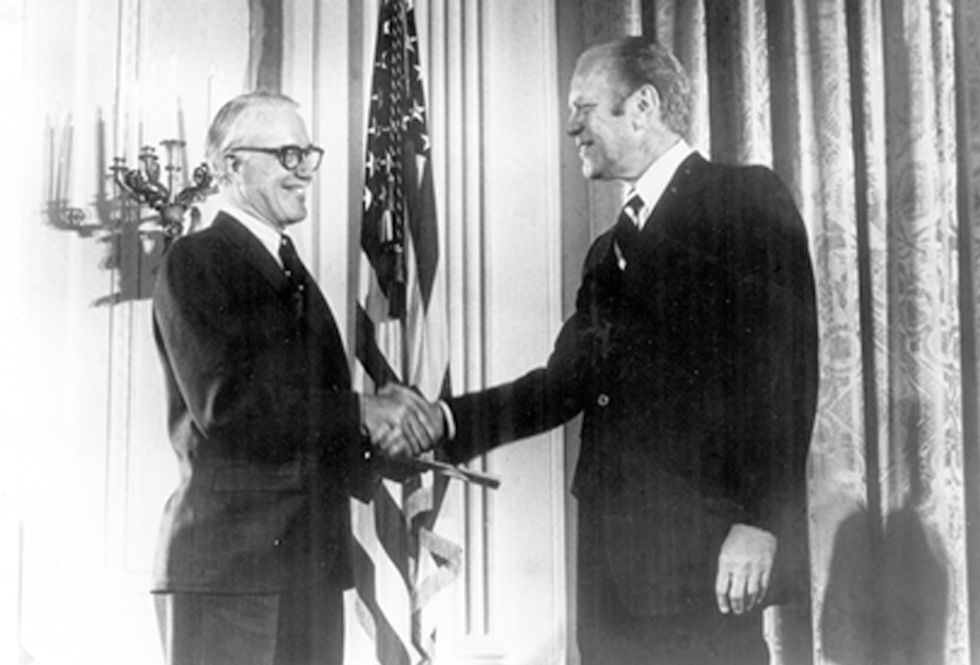
He was elected to the National Academy of Science (1954) and later received the National Medal of Science (1974) from President of the United States. In addition to foreign membership in the academies of many countries, Dr. Chance has received honorary degrees from University of Pennsylvania and several other international universities. He received the Benjamin Franklin Medal for Distinguished Achievement in Sciences given by the American Philosophical Society, among many other awards.
Dr. Chance was married to Dr. Shoko Nioka, M.D., Ph.D., who took care of his health and wellbeing for over 30 years. They worked together, published papers together, and enjoyed sailing together until he passed away. She is determined to continue Chance's work. She went back to Taiwan, where both of them used to work together, to complete an implantable micro-optical device to detect and monitor the brain function and/or cancer growth in vivo.
Dr. Chance served as a pioneer and inspiration to generations of researchers in the fields of redox biochemistry, metabolism, and disease. He will be missed by all of us in the research community but will live on through his monumental scientific accomplishments, the novel instrumentation he developed, as well as the many scientists whom he trained and influenced.
