




Abstract
There has been tremendous and rapidly growing interest in understanding intermediary metabolism as a key aspect of both normal cellular function and as a participant in the molecular pathogenesis of many different complex diseases. This area of research naturally intersects at virtually every level with the substantial and expanding body of knowledge regarding mechanisms of cellular redox balance. In this Forum, the contributing authors address specifically the union of intermediary metabolism and redox biology through detailed consideration of the biochemistry and biology of nicotine adenine dinucleotides, the cell's “redox currency.” From technical considerations of how to measure nicotine adenine dinucleotides all the way to detailed treatments of their potential roles in specific disease states, this Forum provides a thorough introduction to a topic that is positioned to be at the heart of the next wave of research in metabolism and redox biology. Antioxid. Redox Signal. 28, 165–166.
T
As research questions regarding cellular metabolism and redox biology have become more focused and nuanced, the need for a more detailed and quantitative understanding of the precise nature of the relationships between these two domains has become readily apparent. The convergence of the bioenergetic and biosynthetic functions of cellular metabolism and the electron transfer and antioxidant defense functions of redox biology can be most easily captured through investigation of nicotine adenine dinucleotides—NAD and NADP in their reduced and oxidized forms. NADH is one of the most important outputs of carbon substrate metabolism driving ATP production in mitochondria. Similarly, NAD and NADH metabolites are key regulators of signaling pathways (e.g., the sirtuin family of lysine deacetylases) that regulate cellular metabolism and a wide variety of other “mission critical” cellular functions. NADPH is the major electron donor for a huge number of intracellular redox reactions; indeed, many of the major biosynthetic reactions that take place in cells are critically dependent upon NADPH availability. Likewise, critical cellular antioxidant defenses rely on NADPH to function. G6PD deficiency, the most common inherited enzymopathy in humans and the prototype disease for understanding oxidative stress, is at its heart a disease of NADPH insufficiency.
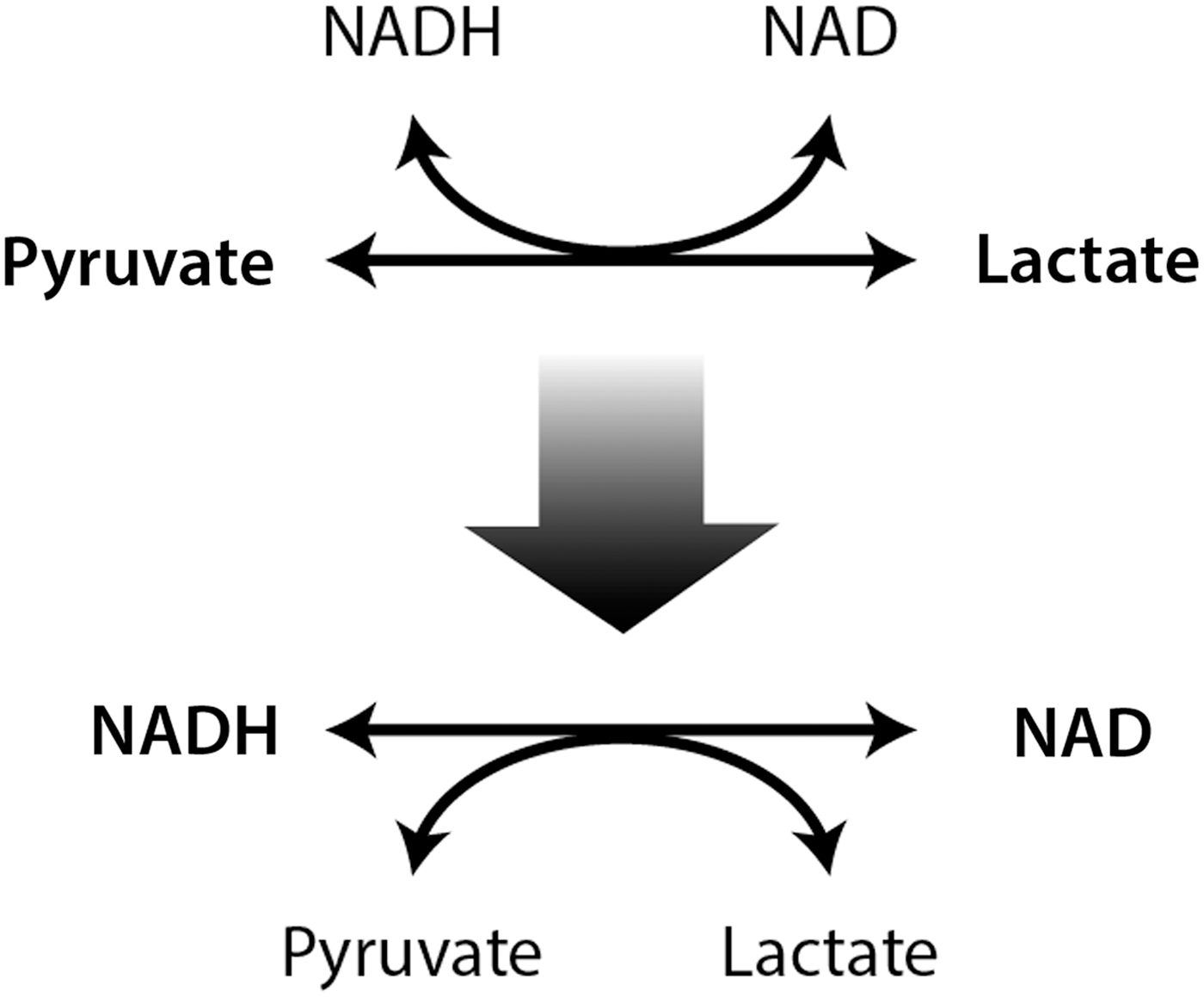
Part of the motivation for assembling this Forum was to highlight the centrality of nicotine adenine dinucleotide biology and biochemistry. Often, when reaction mechanisms are depicted schematically, the conversion of NAD(P) to NAD(P)H or vice versa is shown as something of an afterthought (Fig. 1). These critical drivers of the cellular metabolic and redox network are often shown hovering above the reaction arrow in small print (or, worse, not shown at all), with the implication being that these required participants in the reaction shown are somehow made available within the cell and often with not much more thought given to the questions of where, how, when, and under what circumstances. This Forum is meant to place these key reaction participants in the spotlight and to direct focus to questions such as where they come from, what processes are critically dependent on them, and under what circumstances are they produced, consumed, and transferred, among others.
Before any given molecule or process can be studied, methods to do so must be available that are sufficiently sensitive, specific, quantitative, cost-effective, and widely accessible. In this Forum, Yi Yang and colleagues (3) provide a comprehensive and critical review of the available genetically encoded fluorescent sensors for quantifying NAD(P)(H) in live cells with high temporal and spatial resolution. The use of fluorescent sensors has been a more recent addition to the armamentarium of techniques to quantify nicotine adenine dinucleotide species, with more traditional approaches being based upon enzymatically coupled reactions that produce visible/quantifiable products. However, other optical methods for quantifying NADs such as two-photon autofluorescence are becoming more widely available. These methods, although requiring more sophisticated instrumentation and technical expertise, provide extremely high temporal and spatial resolution as well as providing quantitative information on the biochemical environment (e.g., free vs. protein-bound) of nicotine adenine dinucleotide species.
Although optical and fluorescence-based methods have distinct advantages, they present unique challenges (e.g., fluorescence optimization, requirement for live cells in culture, and specialized equipment required) compared with more traditional enzymatic assays or chromatography-based techniques. For these more traditional techniques, the challenges that have limited quantitative analysis of nicotine adenine dinucleotides have related to stability of the various species, interconversion of reduced and oxidized forms, and of phosphorylation states between different pools/compartments in the cell, quenching of ongoing metabolic reactions that produce or consume NAD(P)(H), analyte recovery, and distinguishing particular species from one another. To address a number of these issues, the Rabinowitz laboratory reports in an Original Research Communication (4) an enhanced extraction and analysis protocol for the quantification of nicotine adenine nucleotides that minimizes interconversion and is applicable to diverse analytical platforms, including liquid chromatography-mass spectrometry (LC-MS) and more traditional enzymatic assays.
To bring together redox biology and cellular energy metabolism in a detailed way for this Forum, Xiao et al. (2) from the Loscalzo group provide a comprehensive treatment of the compartmentalized roles of nicotine adenine dinucleotide species as participants in redox reactions that influence and are influenced by energy metabolism pathways. They provide a detailed exploration of concepts such as redox couples, reductive stress, and the dual nature of NAD(P)H as both pro-oxidant and antioxidant. They also discuss strategies for rationally manipulating the redox and metabolic dimensions of nicotine adenine dinucleotide biology to improve health and disease outcomes. The Forum review from D'Alessandro et al. (1) in the Stenmark laboratory springboards from there and delves deeply into a specific disease, offering a comprehensive view of the potential roles for nicotine adenine dinucleotides in the metabolic rewiring of inflammatory and lung mesenchymal cells to drive the pathogenesis of pulmonary arterial hypertension. They give a very detailed accounting of some of the major redox and metabolic molecular changes in specific cell populations that are thought to drive the development and maintenance of pulmonary arterial hypertension, and they offer suggestions on how these pathways might be manipulated with the development of novel therapies in the not-too-distant future.
As is hopefully apparent from this Forum, the study of nicotine adenine dinucleotides as the “redox currency” of the cell is set to take a central role in the ongoing inquiry into cellular redox biology and molecular metabolism. With ever improving techniques for quantification of these species and a growing appreciation of their vast potential for powerful regulation of multiple cellular networks in specific ways, nicotine adenine dinucleotides are likely to continue to emerge as key targets for development of novel therapeutics to combat a wide array of complex human diseases.