




Abstract
Even though physical activity is known to perturb the redox homeostasis and create a pro-oxidative muscular environment, robust evidence has confirmed precise, powerful, and beneficial effects of regular physical activity on health. Physical exercise can activate redox-sensitive intracellular signaling pathways via reactive oxygen species (ROS)-related pathways leading to modification of muscle function through genomic and nongenomic mechanisms. However, ROS-mediated signaling also has deleterious effects on skeletal muscle function, which has been observed in several pathological conditions, such as cancer, obesity, and diabetes, among others. One of the most challenging issues debated on this topic is that of the levels of redox signaling that promote either beneficial or harmful effects to our bodies. This Forum discusses the latest progress in muscle redox signaling with emphasis on muscle physiology and physiopathology. Antioxid. Redox Signal. 33, 539–541.
In 1954
Considerable progress has been made in this area, and in this Forum, we intend to discuss the latest progress in redox muscle signaling in health and disease conditions. We assembled a collection of five reviews from leading top authorities in different areas of knowledge that address recent and exciting perspectives about the key role of ROS in skeletal muscle function under different physiological conditions. Figure 1 represents the different aspects addressed in the Forum: “Muscle redox signaling: engaged in sickness and in health.” Each piece of the puzzle that summarizes the topics of this Forum is described hereunder.
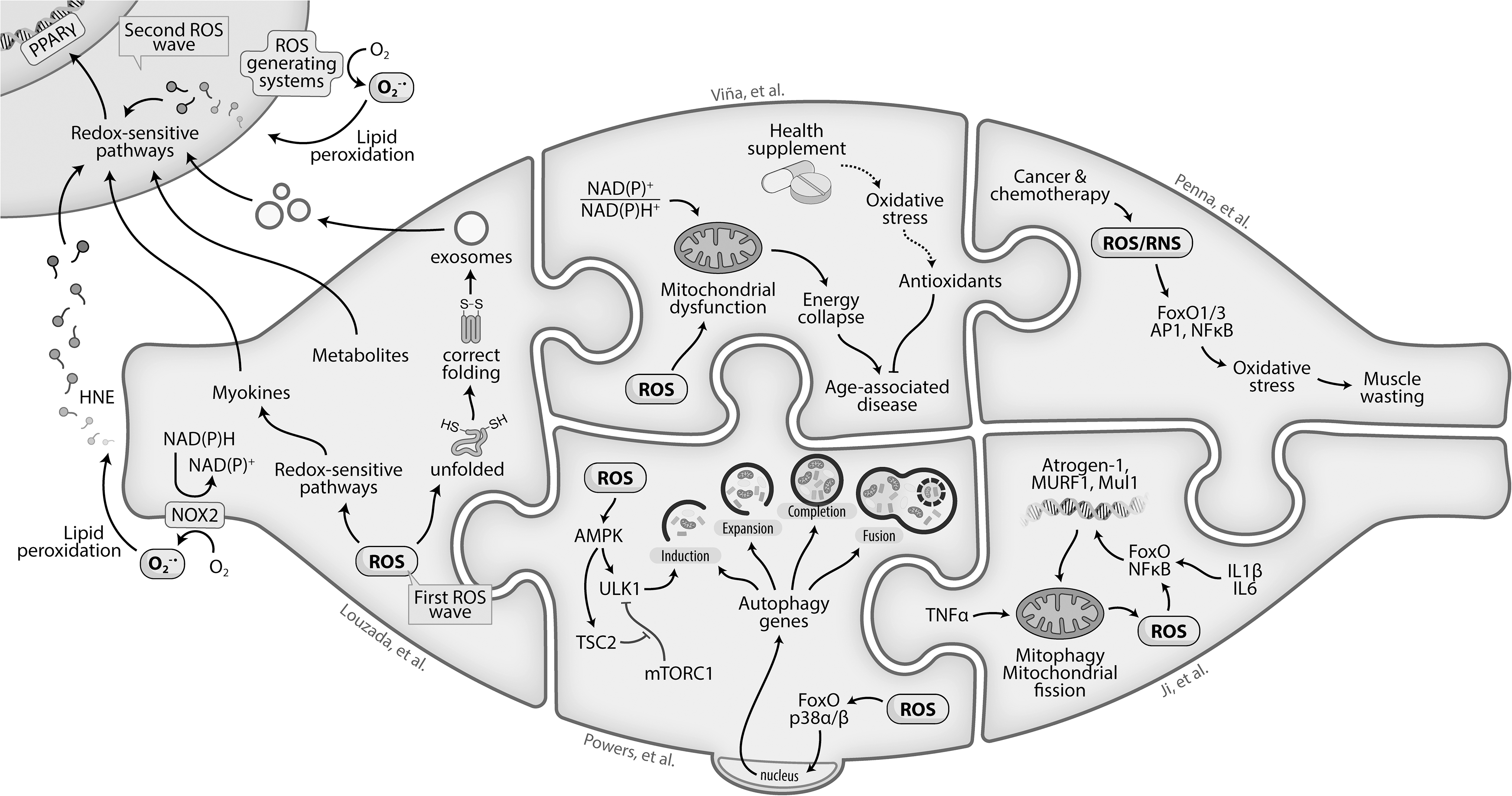
Louzada et al. discussed the communication between the contracting muscle and remote tissues through redox-mediated signaling. The concept of synchronized ROS waves with the capability of creating a transient pro-oxidative environment in remote noncontracting cells was proposed in addition to its participation in the widespread beneficial effects of physical exercise. Moreover, the involvement of redox-sensitive signaling pathways in the secretion of exosomes and myokines by skeletal muscle is also topics of debate.
Penna et al. elucidated some important pathways that have been used recently to tackle muscle wasting in cancer cachexia. These authors discuss the vicious loop in which altered mitochondrial function leads to redox unbalance that eventually results in negative changes in energy metabolism. In addition, the author discusses how nonpharmacological strategies, such as physical exercise, can be used in the treatment of muscle wasting in cancer cachexia.
Noteworthy, regular contractile activity plays a critical role in maintaining skeletal muscle morphological integrity and physiological functions. Prolonged periods of muscle inactivity lead to oxidative stress that results in skeletal muscle atrophy and weakness. Signals from misfunctioning mitochondria may initiate the cascade that leads to enhanced protein breakdown. Ji et al. revised the central position of the mitochondria in regulating both protein synthesis and degradation via redox-sensitive pathways, including peroxisome proliferator-activated receptor gamma coactivator (PGC)-1a, mitophagy, and sirtuin. The authors have advanced the idea of nutritional supplementation, including select amino acids and phytochemicals, as a promising strategy to prevent muscle disuse atrophy in addition to the overexpression of PGC-1a via transgene and in vivo DNA transfection. With regard to muscle atrophy, Powers et al. revised the role of caspain and autophagy in inactivity-induced proteolysis in skeletal muscles. They provide a detailed discussion on how ROS activates both calpain and autophagy during muscle wasting resulting from muscle disuse.
Finally, Viña et al. reviewed the role of redox imbalance in aging in addition to the use of alternative interventions to counteract some of the deleterious effects on mitochondrial function. Modulation of the oxidant levels through physiological strategies, such as physical exercise or genetic manipulations, to increase antioxidant enzyme activities is mentioned as possible tools with respect to promoting healthy aging. Moreover, the idea of replacing antioxidants with exercise mimetic supplements was also suggested.
Thus, we have grouped the invited reviews into two categories: (i) in sickness, describing the role of ROS in some muscle diseases and (ii) in health, describing the role of ROS in the beneficial adaptations induced by exercise. It is noteworthy that the same redox-sensitive signaling pathways are represented in pieces of this complex puzzle (Fig. 1). Many examples are discussed in this Form in which redox-sensitive signaling is related to muscle wasting after cancer cachexia and limb immobilization, but is also indispensable for achieving many of the beneficial effects of exercise. One of the most challenging issues debated on this topic is determining the levels of redox signaling that promote either beneficial or harmful effects to our bodies.
Footnotes
Acknowledgments
The editors thank all authors of the review articles submitted to this Forum issue. We are incredibly grateful to the various reviewers for their outstanding contributions to this Forum issue.
Author Disclosure Statement
The authors declare that the research was conducted in the absence of any commercial or financial relationships that could be construed as potential conflict of interest.
Funding Information
The study was supported by research grants from CNPq, Fundaçao Carlos Chagas Filho de Amparo a Pesquisa do Estado do Rio de Janeiro (FAPERJ), and Coordenaçao de Aperfeiçoamento de Pessoal de Nivel Superior (CAPES).