




Abstract
More than 50 stable organic molecules have been detected in the interstellar medium (ISM), from ground-based and onboard-satellite astronomical observations, in the gas and solid phases. Some of these organics may be prebiotic compounds that were delivered to early Earth by comets and meteorites and may have triggered the first chemical reactions involved in the origin of life. Ultraviolet irradiation of ices simulating photoprocesses of cold solid matter in astrophysical environments have shown that photochemistry can lead to the formation of amino acids and related compounds. In this work, we experimentally searched for other organic molecules of prebiotic interest, namely, oxidized acid labile compounds. In a setup that simulates conditions relevant to the ISM and Solar System icy bodies such as comets, a condensed CH3OH:NH3 = 1:1 ice mixture was UV irradiated at ∼80 K. The molecular constituents of the nonvolatile organic residue that remained at room temperature were separated by capillary gas chromatography and identified by mass spectrometry. Urea, glycolic acid, and glycerol were detected in this residue, as well as hydroxyacetamide, glycerolic acid, and glycerol amide. These organics are interesting target molecules to be searched for in space. Finally, tentative mechanisms of formation for these compounds under interstellar/pre-cometary conditions are proposed. Key Words: Prebiotic chemistry—Interstellar molecules—UV radiation—Ice—Laboratory simulation experiments. Astrobiology 10, 245–256.
1. Introduction
A
The exact nature of the processes that lead to the formation of small organic compounds, such as methane (CH4) and methanol (CH3OH), in the ISM is not entirely clear, since they can be produced either in the gas or in the solid phase on the surface of cold grains. However, it is believed that larger organics are mainly formed in the solid phase, from the UV photoprocessing of interstellar ice mantles that consist mainly of H2O, CO, CO2, CH4, CH3OH, and NH3 (Gibb et al., 2004; Dartois, 2005; and references therein). The formation of these complex organic molecules has been extensively studied in the laboratory (Agarwal et al., 1985; Briggs et al., 1992; Bernstein et al., 1995; Muñoz Caro and Schutte, 2003). In particular, amino acids have been detected in the hydrolyzed organic residues formed by the UV irradiation of interstellar ice analog mixtures and left over after warming up the samples under vacuum to room temperature (Bernstein et al., 2002; Muñoz Caro et al., 2002; Nuevo et al., 2007, 2008).
While it is difficult to estimate the UV fluences and the effects of UV photons in various interstellar environments, as compared to calibrated fluences measured in the laboratory, experiments involving the effects of high-energy particles such as MeV protons on ices are also known to produce similar results (Gerakines et al., 2001; Hudson et al., 2008), which suggests that cosmic rays can also trigger interstellar chemistry. Moreover, secondary UV photons produced by the interaction of cosmic rays with interstellar hydrogen gas are known to produce a residual UV photon flux in the dark and dense molecular clouds where stellar UV photons cannot penetrate (Prasad and Tarafdar, 1983). Although amino acids have not been observed in the ISM, with the detection of glycine still under debate (Kuan et al., 2003; Snyder et al., 2005), they have been detected in carbonaceous meteorites such as Murchison and Murray after hydrolysis (Cronin and Pizzarello, 1997, 1999; Engel and Macko, 1997). The presence of amino acids or, more probably, their precursors in meteorites supports the scenario of an exogenous delivery of complex organics to early Earth as well as to other planets. This scenario is strengthened by the recent radio-astronomical detection of amino acetonitrile in the molecular cloud Sgr B2(N) (Belloche et al., 2008), which is believed to be a direct precursor of glycine, the smallest amino acid.
Among the large variety of other organic compounds that could have contributed to the first prebiotic reactions, molecules such as urea (NH2CONH2), glycolic acid (HOCH2COOH), and glycerol (HOCH(CH2OH)2) are interesting because they are strongly involved in biological processes. Urea may have played an important role in prebiotic chemistry, since it was shown to favor amino acid polymerization into the formation of peptides (Sakurai and Yanagawa, 1984; Nagayama et al., 1990; Mita et al., 2005). Urea has been detected in carbonaceous meteorites such as Murchison (Cooper and Cronin, 1995), which indicates that large amounts of this compound were probably delivered to early Earth. Glycolic acid, the smallest α-hydroxy acid, is a sugar derivative found in many sugar-rich plants (Yaar and Gilchrest, 2007) and has also been detected in carbonaceous meteorites (Cronin and Chang, 1993), along with other small sugars (Briggs and Mamikunian, 1963; Cooper et al., 2001; Pizzarello, 2004). Therefore, sugars were probably present on early Earth along with amino and fatty acids, which were also detected in the Murchison meteorite (Briggs and Mamikunian, 1963; Cronin and Pizzarello, 1997, 1999; Engel and Macko, 1997). Glycerol, a sugar alcohol, is a precursor for the synthesis of triacylglycerols (a certain class of lipids) and is used as energy storage for cellular metabolism in contemporary biological systems (Boyer, 1999). Its simple structure makes glycerol a very good candidate to have been involved in the formation of the lipids that eventually formed the first cell membranes within which the first biochemical reactions took place. Moreover, glycerol has also been detected in the Murchison meteorite (Cooper et al., 2001).
Finally, these organic compounds are small enough to be easily formed and could thus be present and potentially detected in astrophysical environments as well as other extraterrestrial materials. They are expected to be present in organic residues produced in the laboratory from the UV irradiation of interstellar/pre-cometary ice analogs. In this work, two ice mixtures of compositions CH3OH:NH3 = 1:1 and H2O:CH3OH:NH3 = 1:1:1 were UV irradiated at low temperature, and the so-formed residues were analyzed with gas chromatography coupled with mass spectrometry. We report here the detection of urea, glycolic acid, and glycerol, as well as hydroxyacetamide, glycerolic acid, and glycerol amide in the organic residue formed from the photo-irradiation of the CH3OH:NH3 = 1:1 mixture. We discuss below possible mechanisms for their formation in various extraterrestrial environments.
2. Experimental Protocol
2.1. UV irradiation at 80 K
The detailed experimental setup for UV irradiation is described elsewhere (Nuevo et al., 2007). Briefly, in a high-vacuum chamber evacuated by a turbo-molecular pump (background pressure: ∼10−7 mbar), gas mixtures are deposited onto an IR-transparent MgF2 window fixed on a cold finger and cooled down to 80 K. These gas mixtures are previously prepared in a stainless steel gas line evacuated by a turbo-molecular pump (background pressure: ∼10−5 mbar). The deposited ices are then simultaneously irradiated with UV photons emitted by a microwave-powered H2-flow discharge UV lamp, which provides mainly Lyman-α (121.6 nm, i.e., 10.20 eV) photons and a continuum centered around 160 nm (7.75 eV).
In the present work, two ice mixtures of compositions 13CH3OH:NH3 = 1:1 (hereafter referred to as M1) and H2O:13CH3OH:NH3 = 1:1:1 (M2) were UV irradiated. H2O was purified to an 18.2 MΩ cm resistivity with a Millipore Direct-Q 5 system. 13CH3OH was purchased from Sigma (99% 13C purity), and NH3 from Messer (99.98% purity). These compounds were chosen because they are among the most abundant components observed in molecular cloud ices (Gibb et al., 2004; Dartois, 2005; and references therein). The relative proportions between the gases were controlled before deposition by their partial pressures in the gas mixtures. Methanol was labeled with 13C in order to rule out any biological contamination and thus analyze the contribution of the organic molecules produced from the photo-irradiation of the starting ice mixtures only.
After 44 h of UV irradiation at 80.5 K and 44.5 h of irradiation at 82 K for the M1 and M2 mixtures, respectively, the samples were warmed to room temperature at about 1 K min−1. The MgF2 windows covered with the samples were then removed from the chamber and kept under vacuum (<10−4 mbar) before analysis with chemical techniques (see Section 2.2), so that they were not exposed to air for more than a few seconds during the whole process.
Finally, in a parallel experiment, an MgF2 window with no gas deposition was also UV irradiated with the same H2 lamp and under similar conditions, which served as a blank. As illustrated in Fig. 1 (Section 3), the analysis of the blank showed no presence of organic contaminants, only by-products from the chemical analysis technique (see Section 2.2).
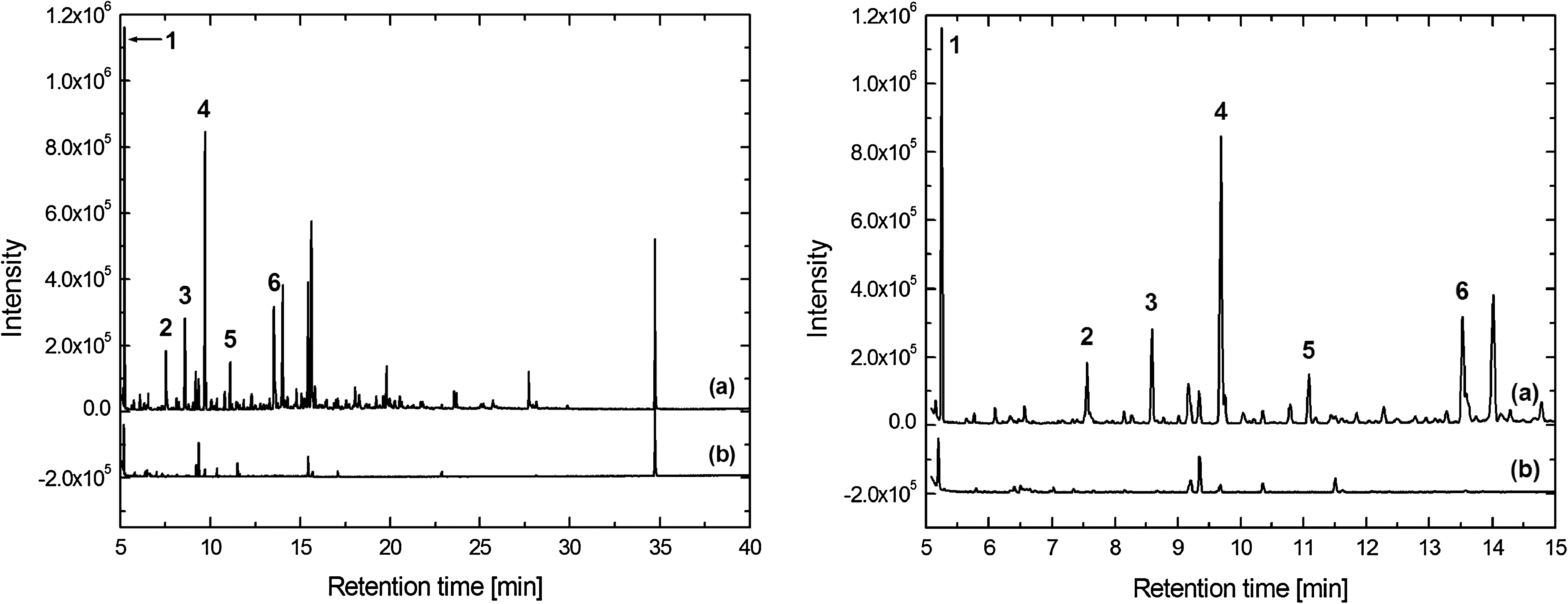
Complete chromatograms (left panel) and enlargement of the chromatograms between 5 and 15 min (right panel) of the organic residue (traces
Such UV irradiations of ice mixtures at low temperature have been routinely carried out for several years, in particular for the study of the formation of amino acids, by other groups and by our team (Bernstein et al., 2002; Muñoz Caro et al., 2002; Nuevo et al., 2007, 2008). The physico-chemical evolution of the irradiated ices in these previous works, as well as in this current study, has been monitored by IR spectroscopy, from the UV irradiation at low temperature, through the warm-up period to room temperature, and to the organic residue formation and recovery at room temperature. The IR spectra of the so-formed residues look very similar to each other, regardless of the carbon source in the starting ice mixture (CH3OH, CO, CO2, CH4, or any combination of these) and the presence of H2O in the starting mixture. This suggests that all organic residues have a very similar chemical composition, consisting of the same families of organic compounds. In the case of the study of amino acids, this results in a very similar distribution for the amino acids identified in the residues after their hydrolysis (Nuevo et al., 2008). Therefore, we assumed in this study that our starting H2O:CH3OH:NH3 and CH3OH:NH3 mixtures were representative of other mixtures so that they would produce organic residues with a similar chemical composition, and that the photo-irradiation of other mixtures of same composition would lead to the same results reported hereafter.
2.2. Analysis of the organic residue at room temperature
The organic molecules targeted in this study are compounds that are not volatile at room temperature. Thus, they must be derivatized to become volatile in order to be injected into gas chromatographic devices. An acid hydrolysis treatment with 6 M HCl, as is most often used to prepare similar organic residues for the detection of amino acids (Cronin, 1976; Bernstein et al., 2002; Muñoz Caro et al., 2002; Nuevo et al., 2007, 2008), would destroy urea and related compounds.
The residue formed from the photo-irradiation of the M1 mixture was extracted with 3 × 30 μL of pure H2O (Fluka, for organic trace analysis), and then dried over P2O5 in a desiccator (pressure: 10 torr) for 17.5 h. After total evaporation of the water, the sample was derivatized with 5 μL of N,O-bis(trimethylsilyl)trifluoroacetamide (BSTFA; Fluka, GC grade) diluted in 12.5 μL of pyridine (Fluka, 99.8% purity) at 80°C for 2 h. The residue formed from the photo-irradiation of the M2 mixture was similarly extracted before being hydrolyzed with formic acid (HCOOH; Fluka, 98% purity) at 99°C for 23 h and finally dried over P2O5 for 23 h to evaporate all the solvent. A procedural blank where only the extraction solvents were hydrolyzed and derivatized was also prepared and showed no contamination in the solvents and reactants used for the chemical analysis.
The derivatization with BSTFA was chosen after careful evaluation of silylation by BSTFA, acylation by N-methyl-bis(trifluoroacetamide) (MBTFA), and the chemical protocol for the search for amino acids in interstellar ices/meteorites that lead to ethyl-chloroformate ethyl-ester (ECEE) derivatives (Huang et al., 1993; Abe et al., 1996; Muñoz Caro et al., 2002; Nuevo et al., 2007). The derivatization with BSTFA proved to be the best choice because it reacts quickly and quantitatively with all kinds of functional hydrogen atoms (in amines, alcohols, phenols, carboxylic acids, etc.). The derivatization leads to the substitution of acidic hydrogen atoms by trimethylsilyl (TMS) groups Si(CH3)3. However, TMS groups are big, and not all hydrogen atoms of the same chemical group can be substituted due to steric hindrance (see Fig. 2).
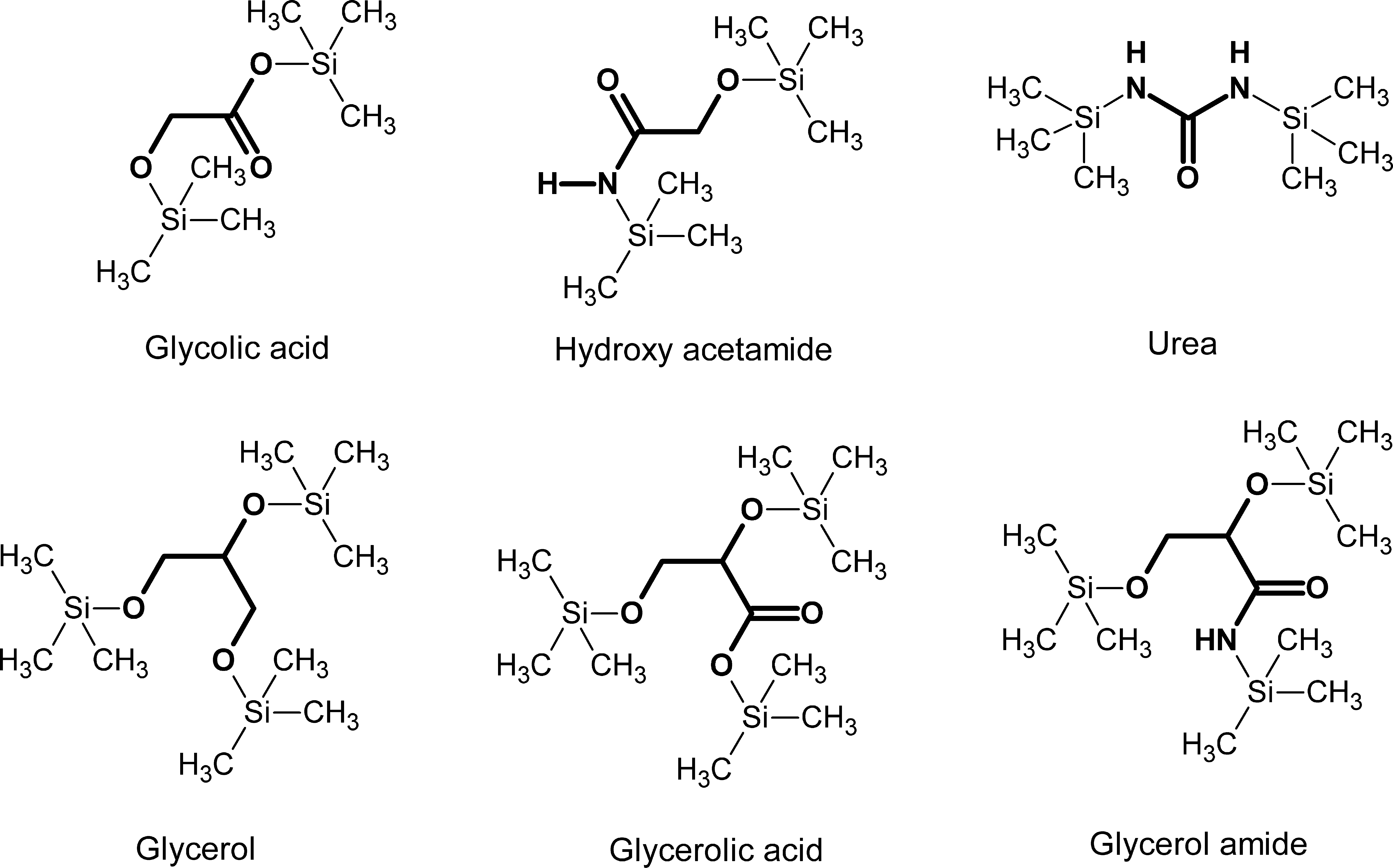
Molecular structures of the identified 13C-TMS derivatives, obtained after derivatization with BSTFA. Structures given in bold are the original molecular backbones.
The derivatized extracts of the samples were separated by capillary gas chromatography on an HP5-MS column (5% phenylsiloxane in dimethylpolysiloxane, length: 30 m) after splitless manual injection of 1 μL into an Agilent GC6890N gas chromatograph (GC) system. The temperature program started at 50°C with a ramp of 20°C min−1 to 100°C, followed by a ramp of 5°C min−1 to 280°C, all at a constant flow of 1.2 mL min−1 of He. Detection and identification were performed with an Agilent 5793N quadrupole mass spectrometer.
3. Results: Identification of the Photoproducts
No organic compound could be identified in the residue formed from the UV irradiation of the M2 mixture (H2O:13CH3OH:NH3 = 1:1:1). This lack of identifiable compounds was most likely the result of the hydrolysis step with formic acid. The addition of water to the starting gas mixture in previous experiments did not lead to a significant change of the ensuing mixture of chemical compounds (Nuevo et al., 2007), although a more detailed study of the experimental parameters, including the relative proportions of the starting components of the ices and the effect of H2O, still remains to be carried out. However, the chromatogram obtained for the residue formed from the photo-irradiation of the M1 mixture (13CH3OH:NH3 = 1:1), given in Fig. 1 (trace
The peaks labeled
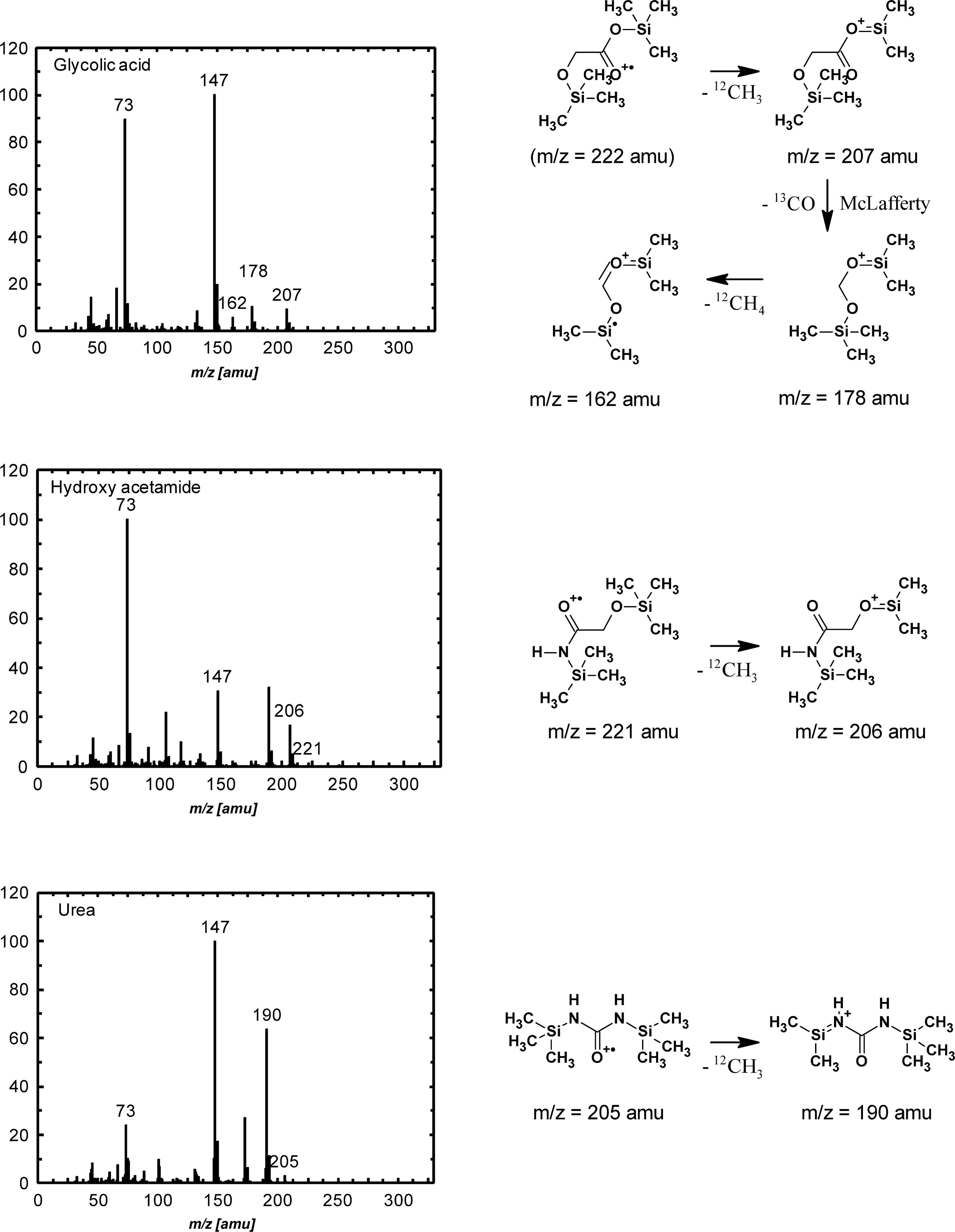
Mass spectra and fragmentation pathways for the TMS derivatives of 13C-glycolic acid (top panel), 13C-hydroxyacetamide (middle panel), and 13C-urea (bottom panel), detected in the organic residue formed from the UV irradiation of the M1 ice mixture (13CH3OH:NH3 = 1:1). The fragments with m/z = 73 amu and m/z = 147 amu are independent from the identified compounds. The ordinate axis is scaled relatively to the base peak.

Mass spectra and fragmentation pathways of the TMS derivatives of 13C-glycerol (top panel), 13C-glycerolic acid (middle panel), and 13C-glycerol amide (bottom panel), detected in the organic residue formed from the UV irradiation of the M1 ice mixture (13CH3OH:NH3 = 1:1). The ordinate axis is scaled relatively to the base peak.
The fragment with a mass of m/z = 73 amu, which corresponds to the trimethylsilyl group, is present in the mass spectra of all TMS-derivatized compounds. The peak at m/z = 147 amu stems from a rearrangement of TMS-derivatized β-hydroxy carbonyls (Vouros, 1980) (see Fig. 5, upper part). In addition to those two reactions, there are two more major fragmentation pathways observed in TMS derivatives. The first one is the reaction leading to a loss of one of the methyl groups from the TMS group, which results in the [M–CH3]+ ion that, in many cases, is much more abundant in the mass spectrum than the molecular ion [M]+ itself. The second important fragmentation pathway involves a molecular rearrangement analogous to the McLafferty rearrangement (McLafferty, 1959). In this rearrangement, a TMS group, rather than a γ-hydrogen atom, switches from one position to another within the molecule via a pseudo-ring transition state, which results in the elimination of an aldehyde from the molecule (see Fig. 5, lower part).

Formation pathways for typical fragment ions of TMS-derivatized compounds. The upper reaction schematic shows the formation of the m/z = 147 amu ion, found in many mass spectra of TMS-derivatized compounds (Figs. 3 and 4). The lower reaction schematic shows an observed molecular rearrangement reaction analogous to the McLafferty rearrangement, resulting in the elimination of an aldehyde and the shifting of a TMS group.
As a last remark, a calculation of yields could not be performed in this study. This is due to the fact that we did not have a way of precisely quantifying the number of photons at any given wavelength, nor did we know the UV absorption spectrum of our starting mixture. The exact quantification of our products was also not possible, because most of the 13C-labeled standards are not commercially available and thus cannot be run in our analysis. A rough estimate can, however, be given from comparison with previous studies. Indeed, it is reasonable to assume that the electron impact cross sections in the ionization chamber of a mass spectrometer of glycolic acid and alanine are as the corresponding ion transmissions roughly equal, which means that similar amounts of glycolic acid and alanine should yield similar peak areas in a chromatogram. The peak areas of our identified products roughly correspond to 50 to 250 ppm of amino acids in previous studies. This is orders of magnitude above the detection limit of the gas chromatograph–mass spectrometer (GC-MS) system in use, which is capable of quantifying 5 ppb of an amino acid.
4. Discussion: Astronomical Considerations
Urea, glycolic acid, and glycerol are interesting from an astrobiological point of view because they may have been involved in the first steps of the prebiotic reactions that led to the emergence of life on primitive Earth between ∼4 and ∼3.5 billion years ago. Moreover, their presence has been reported in carbonaceous chondrites such as the Murchison meteorite (Cronin and Chang, 1993; Cooper and Cronin, 1995; Cooper et al., 2001), which indicates that large quantities of these compounds must have been delivered to Earth throughout its history. Urea has been subjected to several experimental studies in the laboratory to trace its formation in the bulk of interstellar or cometary ice analogs (Bernstein et al., 2002; Cottin et al., 2002). It has also been tentatively detected in the solid phase in the IR source RAFGL 7009S by comparison with laboratory spectra (Raunier et al., 2004). Finally, acetamide (CH3CONH2), which is structurally close to urea, has recently been detected in the gas phase in Sgr B2(N) (Hollis et al., 2006).
It has been suggested that urea may be a product of the reaction between ammonium (
Another pathway to form urea from
Even though the acid-base equilibrium is strongly oriented toward the formation of the salt, only small quantities of the formed NH3 and HNCO are enough to be converted into urea, since this conversion is not an equilibrium but a high-yield reaction between the nucleophilic NH3 and the electrophilic carbon of HNCO.
HNCO, which has also been detected in ices at low temperature in laboratory simulations (Hudson et al., 2005; Chen et al., 2007), can also be formed via a photochemical pathway from NH3 and CO (carbon monoxide):
where the asterisk (*) indicates that the molecule is in an excited electronic state, and where radicals are marked with a dot ( · ). Under our experimental conditions, CO is a product of the photo-dehydrogenation of CH3OH. HNCO has been detected in the ISM and around protostars in the gas phase (radio-astronomy) (Nguyen-Q-Rieu et al., 1991; Zinchenko et al., 2000; Minh and Irvine, 2006; Bisschop et al., 2007, 2008; Martín et al., 2009). It may also condense onto cold interstellar grains along with other more abundant interstellar ices such as CH3OH (Bisschop et al., 2008; Öberg et al., 2009) but has not been detected in the solid phase (IR astronomy), probably because this species is very reactive even at low temperature and, therefore, unstable from a kinetic point of view.
There also exists another possibility to form urea via a totally photochemical pathway, proposed by Hubbard et al. (1975):
This mechanism involves short-lifetime species such as highly excited molecules and radicals, whose astronomical detection is difficult because of their very low abundances.
Regarding glycolic acid, glycerol, and the other detected compounds, which are molecules consisting of 9 to 14 atoms, no mechanisms have so far been proposed in the literature for their formation, and no astronomical observations have been able to confirm their presence in the ISM, neither in the gas phase nor in the solid phase. This is most probably due to their high molecular weight (from an astrophysical point of view), which results in a low abundance for these molecules with respect to other simpler compounds present and renders their detection difficult among the large variety of organics also present in the environments where they are likely to form.
In this work, methanol was the only source of carbon, so that glycerol could have formed from reactions involving ·CH2OH radicals and formaldehyde (H2CO), which are readily produced from the photolysis and the photo-dehydrogenation of CH3OH, respectively. A possible mechanism for the formation of glycerol could thus be
Although ·CH2OH has not been detected in the laboratory nor in the ISM, probably because it is a very reactive species, H2CO has been detected in the ISM (Minn and Lee, 1994; Jethava et al., 2007; Blair et al., 2008) and is a major compound in comets (Combes et al., 1988; Mumma and Reuter, 1989; Meier et al., 1993; Milam et al., 2006).
This formation pathway, if viable, could also account for the formation of glycolic acid and hydroxyacetamide, via radical-radical and radical-neutral reactions starting from the reaction between ·CH2OH and H2CO, similarly to the first step of the formation of glycerol (Eq. 5), followed by a recombination with HO· and NH2· radicals, respectively:
Hydroxyacetamide could also possibly form via the reaction of HNCO with CH3OH (non-photochemical mechanism). Finally, the mechanisms of formation of glycerolic acid and glycerol amide may follow the same pattern as shown in Eqs. 5 and 6.
One may think that the production of ·CH2OH radicals from CH3OH should lead to the formation of ethylene glycol (HOCH2CH2OH), via the simple recombination of two ·CH2OH radicals. However, ethylene glycol was not found in our residue, although its chromatogram peak and the mass spectrum of its 13C-TMS derivative were searched for. Ethylene glycol is an abundant molecule in the ISM (Hollis et al., 2002) and in comets (Crovisier et al., 2004; Remijan et al., 2008) that would be expected to be present in our samples, since glycerol and other 3-carbon molecules were identified. Its nondetection in our residue could be due to several factors. For example, ethylene glycol may have been destroyed at a higher rate by UV photons than the rate at which it formed in the ices at low temperature during the irradiation. It may also have been involved in the formation of larger molecules, either at low temperature during the photo-irradiation or during the warm-up to room temperature. These last processes would have needed to be fast enough so that ethylene glycol did not accumulate in the ice matrix. It cannot be excluded, however, that our analysis may have been, for some unforeseen reason, blind to ethylene glycol.
The mechanisms of formation of glycolic and glycerolic acids may involve formic acid (HCOOH) as an intermediate compound. Formic acid has been extensively observed in the ISM in molecular clouds and around protostars (Sutton et al., 1985; Turner, 1991; Cazaux et al., 2003; Bottinelli et al., 2004; Remijan et al., 2004), as well as in comets (Crovisier and Bockelée-Morvan, 1999).
The detection of these compounds in residues produced from the UV irradiation of ices adds to the detection of amino acids reported recently (Bernstein et al., 2002; Muñoz Caro et al., 2002; Nuevo et al., 2007, 2008) and broadens the suite of organic molecules that can be formed under astrophysically relevant conditions, in particular interstellar/protostellar environments and comets. The results of the present study not only expand the inventory of molecules that can be formed under such conditions, but also indicate that the photochemistry of interstellar ice analogs is very rich and diverse and produces a large variety of excited species, ions, and radicals that can react and recombine to form a large variety of organics, including molecules of prebiotic and biological interests such as amino acids, sugars, probably lipids or their precursors (Dworkin et al., 2001), and N-heterocycles, including nucleobases (Peeters et al., 2005).
The presence of urea, glycolic acid, glycerol, and other organic compounds of prebiotic interest, however, will need to be confirmed in all extraterrestrial environments, including the ISM, comets, and meteorites. A more complete inventory of such astrophysical organics and a better understanding of their origin and formation mechanisms will allow us to draw a schematic of the evolution of organic species from the environments where they are likely to form to their delivery to telluric planets via their transfer into protoplanetary disks in forming planetary systems such as our Solar System. Further studies will also allow us to better assess the link between extraterrestrial organics and the molecules that triggered the emergence of life on the early Earth ∼4 to ∼3.5 billion years ago.
5. Conclusion
Three organic molecules of primary prebiotic interest—urea, glycolic acid, and glycerol—as well as three of their derivatives, namely, hydroxyacetamide, glycerolic acid, and glycerol amide, were detected in an organic residue formed from the UV irradiation of a CH3OH:NH3 ice mixture at low temperature, under experimental conditions that simulate astrophysical environments such as the ISM and comets. These compounds cannot be found after a (comparatively mild) hydrolysis step. Such molecules may have played a non-negligible role in the prebiotic chemistry and the emergence of life on the early Earth. Although their presence in the ISM and in Solar System cold bodies is yet to be confirmed, their detection in meteorites and in our organic residues indicates clearly that those molecules can be formed under abiotic conditions and, consequently, in various astrophysical environments before they are delivered to Earth and maybe to other planets as well. These specific organic molecules constitute primary targets for an in situ detection on the surface of comet Churyumov-Gerasimenko by the ROSETTA mission, which will sample the surface of the comet nucleus in 2014 with the COSAC instrument, a GC-MS device on board the lander Philae (Thiemann and Meierhenrich, 2001; Goesmann et al., 2005, 2007). Such in situ measurements will allow us to constrain and validate possible scenarios for the formation of these molecules that have very probably taken place in the solar nebula.
Footnotes
Acknowledgments
M.N. and L.d'H. are grateful to the PCMI and CNES for financial support of the initial ice irradiation experiment (MICMOC). J.H.B. gratefully acknowledges financial support from the Royal Society and from the European Science Foundation under their “Archean Environmental Studies: The Habitat of Early Life” program. U.J.M. is grateful for GC-MS equipment funded by the Deutsche Forschungsgemeinschaft (DFG), Bonn, Germany.
Author Disclosure Statement
No competing financial interests exist.
Abbreviations
BSTFA, N,O-bis(trimethylsilyl)trifluoroacetamide; GC, gas chromatograph; ISM, interstellar medium; MS, mass spectrometer; TMS, trimethylsilyl.