




Abstract
We present and discuss the criteria for selecting potential target stars suitable for the search for Earth-like planets, with a special emphasis on the stellar aspects of habitability. Missions that search for terrestrial exoplanets will explore the presence and habitability of Earth-like exoplanets around several hundred nearby stars, mainly F, G, K, and M stars. The evaluation of the list of potential target systems is essential in order to develop mission concepts for a search for terrestrial exoplanets. Using the Darwin All Sky Star Catalogue (DASSC), we discuss the selection criteria, configuration-dependent subcatalogues, and the implication of stellar activity for habitability. Key Words: Darwin/TPF—Nearby stars—Habitability—Exoplanet search. Astrobiology 10, 103–112.
1. Introduction
Currently, 15 exoplanets, including 3 pulsar planets, are known to have a mass (times sin i, where i is the orbital inclination, for radial velocity planets) less than 10 M Earth, a somewhat arbitrary boundary that distinguishes terrestrial planets from giant planets. Accordingly, we identify masses in the range 1–10 M Earth as being super Earths, which are likely to be composed of rock, ice, and liquid (Wolszczan and Frail, 1992; Rivera et al., 2005; Beaulieu et al., 2006; Udry et al., 2007; Bennett et al., 2008; Bouchy et al., 2009; Forveille et al., 2009; Howard et al., 2009; Mayor et al., 2009; Leger et al., 2009), and we identify masses greater that 10 M Earth as being giant planets, which are likely dominated by the mass of a gaseous envelope.
In particular, Gl581 d, the first super Earth within the habitable zone (HZ) of its host star, as well as Gl581 c, which is just outside the HZ close to the inner edge of the HZ (Selsis et al., 2007; Udry et al., 2007; Kaltenegger et al., 2009), are extremely interesting objects. Nevertheless, at the time of writing, no “true terrestrial analogue,” that is, an Earth-sized body in the middle of the HZ has been reported.
We expect planets on which there is the potential for life to exist to be small and rocky—very similar to Earth. Essentially, all planned searches for such “true terrestrial analogues” focus on this so-called “habitable zone” (Kasting et al., 1993), which is very loosely defined as the region around a particular star where one would expect stable conditions for liquid water on a planetary surface. The topic is very complex, since many factors unrelated to stellar luminosity also influence habitability like the planetary environment, e.g., planetary albedo, composition, and the amount of greenhouse gases in the atmosphere. Detailed simulations for space-based missions that search for Earth-like exoplanets critically depend on correct data on the target stars.
Section 2 discusses target selection criteria in detail, and Section 3 focuses on the characteristics of the Darwin All Sky Star Catalogue (DASSC), derives sub–star catalogues based on different technical designs, and shows the influence on those target stars that can be sampled. Section 4 discusses the implication of stellar activity on habitability.
2. Target Star Selection Criteria
Several lists of nearby target stars have been compiled that are related to the topic of this paper but were intended for different purposes, for example, the SETI target star catalogue (Turnbull and Tarter, 2003) and the Terrestrial Planet Finder Coronagraph, a mission concept optimized for detection of reflected light from a planet (Brown, 2006) as well as the closest stars to the Sun (e.g., Gray et al., 2003; Porto de Mello et al., 2006). Here, we have concentrated on the DASSC, a coherent, large, 30 pc distance–limited sample of target stars based on Hipparcos data (Eiroa et al., 2003; Kaltenegger, 2004; Kaltenegger et al., 2009). Note that the DASSC was compiled to model realistic observation scenarios and facilitate a detailed revised study of the target stars.
2.1. Spectral type of the target star
2.1.1. Main sequence stars
G stars have historically been considered prime targets for the search for habitable planets. Since planets have now been found around essentially all different stellar types, however, from class F to M, recent target star samples like the DASSC reflect this. Further, considering remotely detectable habitability, it is now generally believed that the main issue is the ability of water to remain liquid on the planet's surface. This requires a relatively dense atmosphere. There is nothing a priori excluding any spectral type from the catalogue based on this requirement.
Especially interesting in this context are M dwarfs (see, e.g., Reid et al., 1995, 2004; Henry, personal communication), the most common stellar object. Nevertheless, questions have been raised as to whether they are suitable host stars for habitable planets due to their faint luminosity, which would require a planet to be very close to the star to be within the HZ. This latter aspect may force the planet to have bound rotation (Dole, 1964), which could lead to processes whereby key gases freeze out on the dark side. On the other hand, it has been demonstrated, through detailed modeling (Joshi et al., 1997; Joshi, 2003), that even rather thin atmospheres could be sustained without freezing out.
Red dwarf stars are also prone to flare activity orders of magnitude higher than anything our Sun has exhibited since the T Tauri stage prior to the epochs when life arose on Earth. Such activity could inhibit the emergence of life and its subsequent evolution if life were not protected by a layer of water or soil. Further, the high levels of particle flow associated with strong flares could strip significant amounts of atmosphere from a terrestrial planet irrespective of the strength of the planet's magnetic field. Many issues remain to be clarified, but super Earths have already been discovered orbiting red dwarfs close to, and within, the HZ (see, e.g., Udry et al., 2007; Mayor et al., 2009). For a detailed discussion of habitability of Earth-like planets around host stars of different spectral type (F, G, K, and M) and detectable biomarkers* in their atmospheres, we refer the reader to Segura et al. (2003, 2005), Selsis (2002), Scalo et al. (2007), and Kaltenegger et al. (2010). The evolution of biomarkers in Earth's atmosphere during different epochs has been investigated by Kaltenegger et al. (2007) in respect to instrument requirements.
2.1.2. Early-type stars
In any kind of unbiased survey, it is necessary to be extremely careful in the selection. In the context of missions involved with the search for worlds like our own, this has led to the application of a number of different criteria. Usually, when the goal is habitability, the studies focus on Sun-type stars, including or excluding M-dwarfs, depending on arguments for and against them (see previous section) but essentially always excluding early-type stars. The argument for this is, of course, the short main sequence lifetime, which is of the order of 500 million years for an early A-type star. The number of early-type stars within the volume that is searchable with contemplated instruments is relatively low. Statistically, nondetection of planets around early-type stars will be of little significance. On the other hand, the time span for the origin of life on Earth was possibly as short as 10 million years. This means that it would be both interesting and—due to the brightness and low numbers available within the search volume—not very time-consuming to include them in the survey.
2.2. Number of target stars
It is essential to have a certain number of target stars to derive conclusions for detections or nondetections. This is a key problem when designing an instrument that can detect and study terrestrial exoplanets. Detecting several exoplanets would allow conclusions to be drawn with respect to the boundary conditions under which rocky planets are formed in the inner parts of planetary systems, the boundary conditions for formation and evolution, and the actual evolutionary pathways—at least in a rudimentary way—which, in the end, would allow for further discussion of habitability.
Assuming a 10% planet fraction similar to the observed giant exoplanet fraction, a minimum of 150 stars would need to be observed to detect 15 terrestrial planets; if 10% of those terrestrial planets are assumed to be habitable, then one or two habitable planets would likely be detected and characterized. For the proposed space telescopes, the trade-off and limiting factor are the necessary integration time to detect a spectral feature per planet versus the overall available observation time. Even though the frequency of terrestrial exoplanets is not precisely known at present, we believe that a sample should consist of at least >150 stars in order to derive conclusions, particularly with regard to nondetections.
2.3. Metallicity and hosts of giant exoplanets
Studies of stars that host giant exoplanets have demonstrated that giant exoplanets are more frequent around stars with enhanced metallicity, but such a trend has not been seen so far for stars that host super Earths (Mayor et al., 2009). With the use of existing Strömgren photometry, spectroscopy, or both, metallicity estimates of a considerable fraction of the target stars for exoplanet search missions have been shown to be consistent with field stars (Eiroa et al., 2003).Within 30 pc, 64 1 stars are known to host giant exoplanets. Some of these systems can be used to calibrate instruments—especially for giant exoplanets with effective temperature, determined by Spitzer Space Telescope. In addition, characterizing these giant exoplanetary systems should produce interesting results, allow the understanding of planetary systems with giant planets, and thus give clues to formation and composition of giant exoplanets. Several groups are working on the dynamical stability of terrestrial planets in the HZ in those systems [see, e.g., Lunine, 2001; Raymond et al., 2006; Sándor et al., 2007; Dvorak et al., 2010 (this volume)], which will make some of the systems targets for habitable terrestrial planet search.
2.4. Stellar ages
The age of the stars, although not a primary constraint for the presence of Earth-like exoplanets, largely influences a planet's atmosphere and consequently its habitability. In general, the determination of stellar ages is a complicated problem. Fundamental age determination via radioactive element decay (as used to date rocks on Earth) is of very limited applicability in the case of stars (Cayrel et al., 2001). Thus, the use of theoretical stellar evolution models is often the only viable option, as is commonly done for stellar ensembles (i.e., clusters). However, using stellar models becomes difficult for isolated stars, especially those with masses below that of the Sun and ages less than a few Gyr due to the inherent degeneracy (i.e., slow variation of stellar properties with age). For young and intermediate-age stars, alternative methods by which to discern age have already been proposed (see Mamajek et al., 2008). Some examples of these methods are the use of lithium abundance observations (only useful for very young objects), the kinematic membership in stellar moving groups and wide binary pairs, the time dependence of activity parameters (so-called gyrochronology), and the use of asteroseismology. The latter is now emerging as one of the most promising approaches, which uses very accurate photometric time-series data from space missions (e.g., CoRoT and Kepler) that allow for a detailed study of stellar oscillations and provide a direct link to the age of the star, potentially determinable with a precision of 5–10% (Kjeldsen et al., 2009).
Since high-precision time-series photometry is not available for all stars in the solar neighborhood, it is best for now to focus attention on the use of gyrochronology since this can be used widely. In general, the activity level of low-mass stars decreases with time as they spin down from mass loss via magnetized winds. The indicators of chromospheric and coronal activity [emission in lines such as Mg II h&k, Ca II H&K, Hα, Ca II IRT, and the overall flux in the X-rays and extreme ultraviolet (EUV)] scale with the rotation period of the star (and its mass) and undergo a power-law decrease with time. Relationships of this form have been proposed by, for example, Barnes (2007) and later revised by Mamajek and Hillenbrand (2008). In general, the accuracy of the resulting age is best for the youngest stars (20–40%) and degrades severely beyond 1 Gyr. The overall decrease of the X-ray flux seems to be the most sensitive of the activity indicators. This has been exploited by Ribas (2009) to propose an age calibration that covers up to about 10 Gyr.
Figure 1 shows an age histogram of G and K target stars within 25 pc, based on their ROSAT X-ray luminosities and the employ of such preliminary calibration. The plot demonstrates that the closest stars constitute a good sample by which to study the evolution and properties of Earth-like exoplanets and their atmospheres, which is directly linked to their habitability (see, e.g., Kaltenegger et al., 2007; Lammer et al., 2009), since a variety of ages are present.
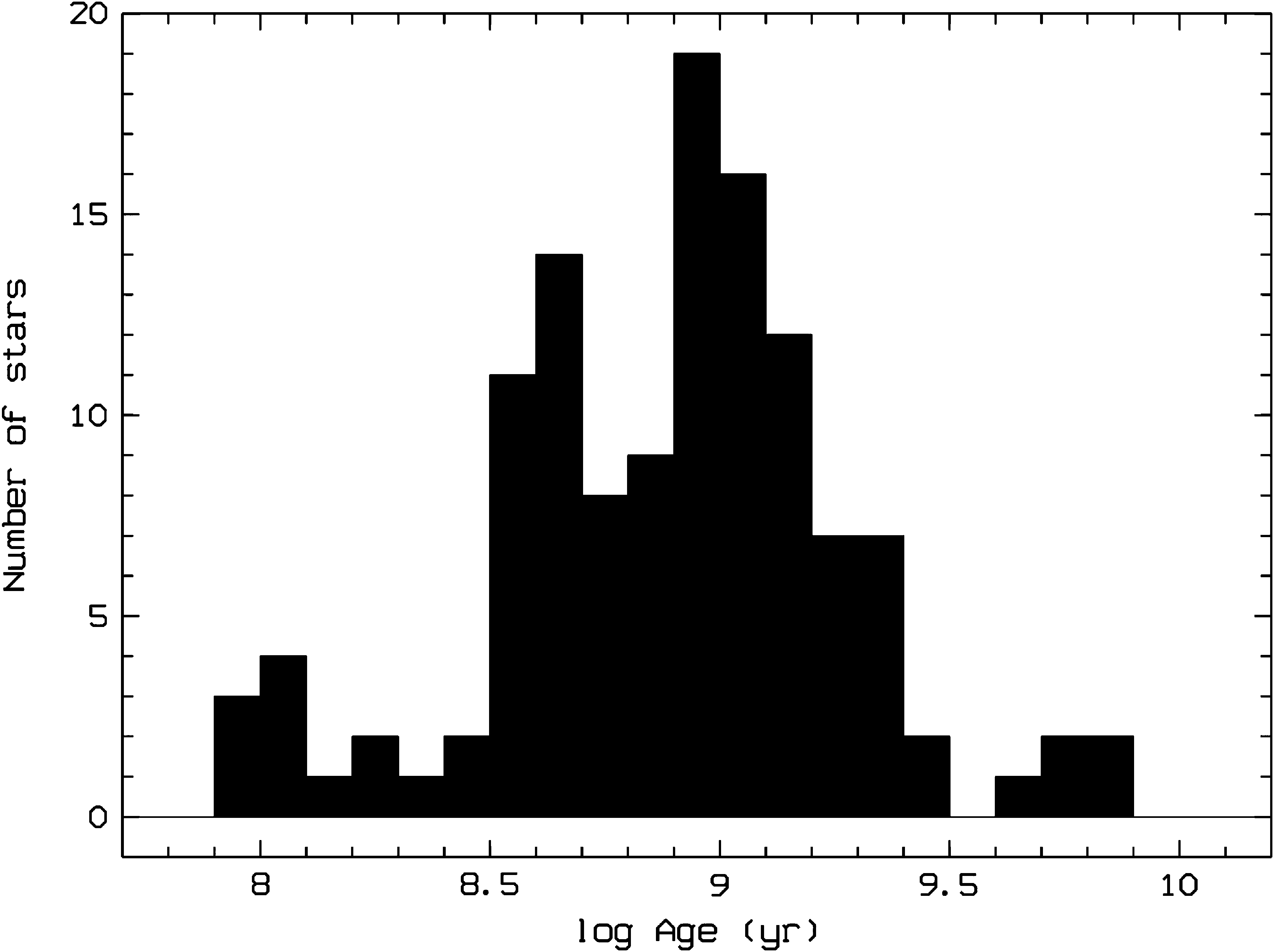
Age histogram of G and K spectral type stars within 25 pc based on their ROSAT X-ray luminosity (Ribas, 2009).
2.5. The habitable zone
For a given planet (assuming a certain atmosphere composition and albedo), the surface temperature depends on the distance from, and the luminosity of, the host star and the normalized solar flux factor S
eff that takes the wavelength-dependent intensity distribution of the spectrum of different spectral classes into account. The distance d of the HZ for Earth can be calculated as (Kasting et al., 1993)
where L is luminosity and S eff is 1.90, 1.41, 1.05, and 1.05 for F, G, K, and M stars, respectively, for the inner edge of the HZ (where runaway greenhouse occurs) and 0.46, 0.36, 0.27, and 0.27 for F, G, K, and M stars, respectively, for the outer edge of the HZ (assuming a maximum greenhouse effect in the planet's atmosphere). These calculations were originally done for F0, G2, and K0 spectra and will be updated for all spectral subclasses. The size of the HZ translates into instrument requirements such as the minimum resolution required to detect the system.
Figure 2 shows the extent of the HZ and, therefore, what subsample can be probed for habitable planets, depending on the “inner working angle” or resolution of any instrument design. The extent of the HZ does not take the effect of clouds into account. The physics is, however, still very poorly understood, but the consequences should mainly move the HZ (1) toward the star if the cooling reflective properties of the clouds are stronger than their warming effect, (2) outward if the warming effect is stronger than the cooling, or (3) potentially extending the HZ in both directions if the water clouds that form at the inner edge of the HZ have a cooling effect while the CO2 clouds that form at the outer edge of the HZ have a warming effect (see the section titled Biomarkers).
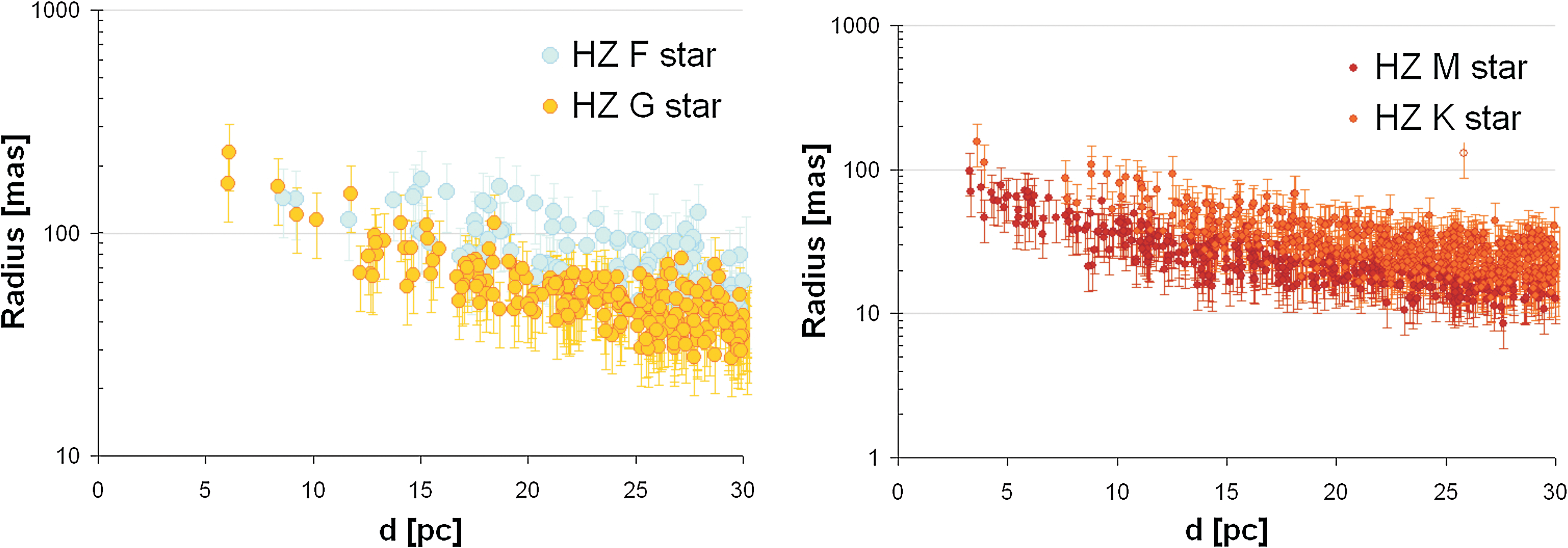
Extent of the HZ in mas for the DASSC. Color images available online at www.liebertonline.com/ast.
3. Darwin All Sky Star Catalogue
For the main DASSC 2 (Kaltenegger et al., 2009), we selected all F, G, K, and M stars within a distance of 30 pc from the Hipparcos catalogue (spectral classification of stars without an assigned spectral type is based on the B-V and V-K color index). Hipparcos data have typical parallax standard errors of about 1 milliarcsecond (mas), which allows very precise distance measurements. It also includes accurate photometry (the uncertainty in B-V is typically less than 0.02 magnitude) and proper motion data, as well as information on variability and multiplicity (Perryman et al., 1997). The DASSC combines the Hipparcos information with data from the 2MASS catalogue (Cutri et al., 2003) and the Catalogue of Components of Double and Multiple stars (CCDM) (Dommanget and Nys, 1994) and the ninth catalogue of spectroscopic binary orbits (SB9) (Pourbaix et al., 2004). Based on the combined data, characteristics such as luminosity, radius, mass, effective temperature, and the extent of the HZ were calculated for the target star sample.
The DASSC is a volume-limited sample of Hipparcos stars that is magnitude-limited to about V magnitude of 7.5 (Perryman et al., 1997) and includes stars to V magnitude 12 (the Hipparcos catalogue is, however, incomplete between V magnitude 7.5 and 12). A number of stars are flagged in the DASSC as being multiple. Systems that are given a multiple designation in the Hipparcos catalogue, but not in the CCDM list, are most probably spectroscopic binaries and introduce a bias in the data, since the derived parameters assume that the basic information is produced by a single star. Multiple systems found in the SB9 are spectroscopic binaries with orbital solutions. All multiple objects are flagged in the DASSC in order to either exclude them or treat them specially when producing configuration-dependent subcatalogues for models of flight hardware. We use a cutoff of ±1 magnitude from the main sequence to establish main sequence character (see Fig. 3). The DASSC catalogue contains 1229 single main sequence stars, of which 107 are F, 235 are G, 536 are K, and 351 are M type (including 14 M stars with no B-V index: for these stars the calculations are based on the V-K index).
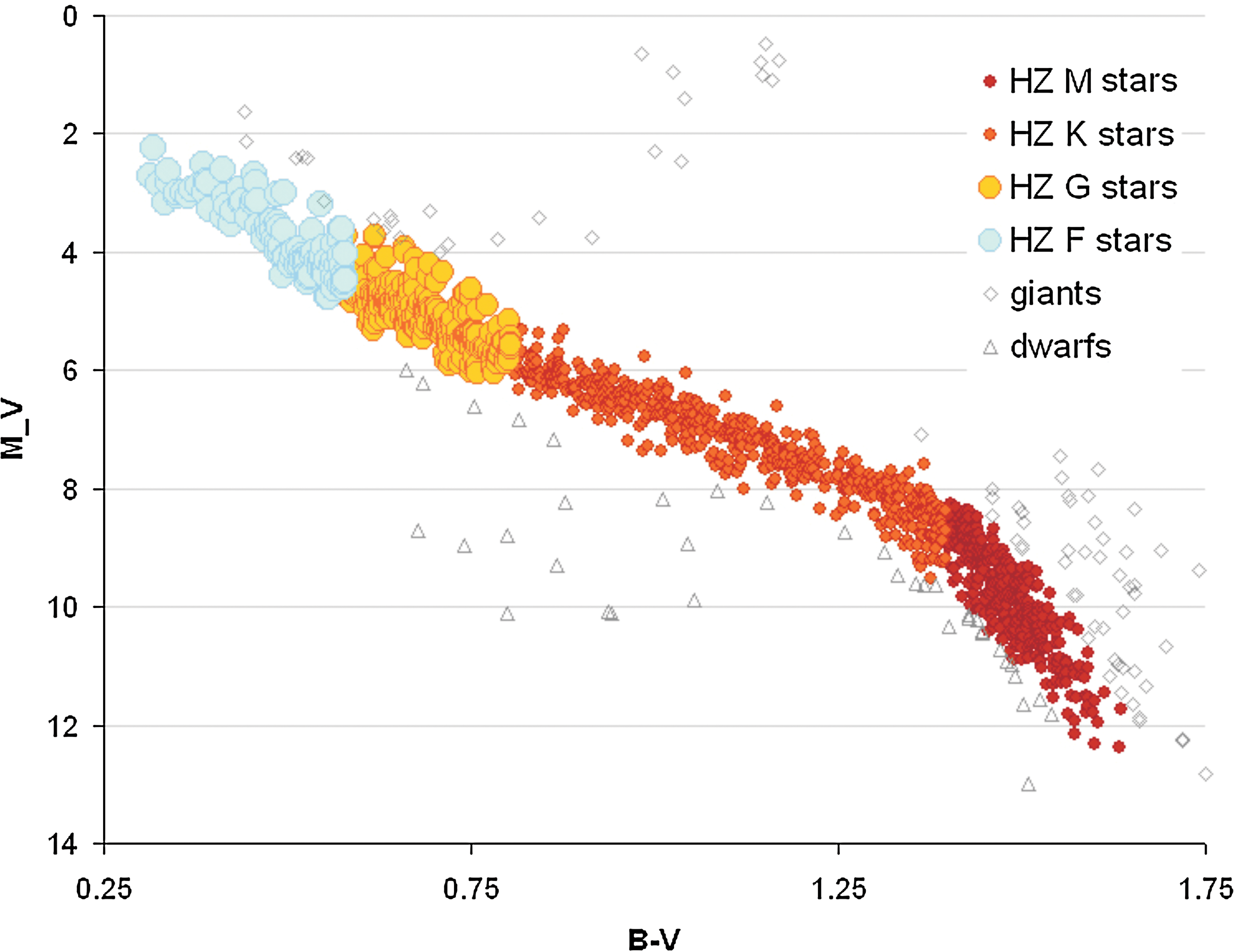
Color-magnitude diagram for the single stars of the DASSC. Color images available online at www.liebertonline.com/ast.
The DASSC target star list was used for the trade-off studies of different mission architectures for the proposed Darwin mission (see, e.g., Kaltenegger and Karlsson, 2004). Similar studies were done for the Terrestrial Planet Finder Interferometer (see, e.g., Dubovitsky and Lay, 2004; Lay et al., 2005) and the Terrestrial Planet Finder Coronagraph (Brown, 2006).
3.1. Multiplicity
Unsurprisingly, many of the preliminary targets are either spectroscopic binaries or have known resolved companions. Multiple stars are potentially interesting targets for searches for terrestrial exoplanets, since various groups have determined that stable orbits exist around multiple star systems. Further, Raghavan et al. (2006) found that about 30% of giant exoplanet host stars are multiple. What exactly the constraints are under which a given binary can or cannot be observed still remains to be investigated. A second star in the vicinity, especially within the field of view, induces a high background signal that inhibits the detection of an orbiting planet.
All known multiple systems have been removed from the DASSC in the first determination of instrument-dependent subcatalogues. We note that 949 out of the 2303 all sky target stars are members of a double or multiple system, 716 tagged by the CCDM. A further 211 additional multiple systems are flagged by Hipparcos, an additional 22 as spectroscopic binaries in the SB9, another 125 are not main sequence stars. The list of multiple systems in the DASSC is far from complete. Also, companion stars found outside the primary field of view need to be modeled in order to evaluate the effect of their light on the background level. Not all multiple systems will degrade the performance of the instrument. The apparent separation at the time of the observation will be important to determine the suitability of the multiple systems as a target.
3.2. Subcatalogues derived for specific architectures
An instrument that characterizes terrestrial planets (e.g., Darwin and Terrestrial Planet Finder) will operate best for nearby stars.
Occultation and coronagraph designs tend to have a set inner working angle based on their mask design, which favors a wider separation between planet and host star. The inner working angle translates into a minimum separation needed between a planet and its host star in order for the former to be detectable. In principle, an interferometer searching for Earth-like planets is not restricted by distance. The maximum separation between the individual telescopes of an interferometer design sets the maximum resolution and can be adapted to each individual target system. Thus, such a design can detect and characterize planets very close to their stars. However, although the baseline can be adjusted for the required resolution, the integration time will at some distance be unrealistic for a given collecting area. An Earth-sized planet located at a distance of 10 pc will have a flux of 0.34 μJy at 10 μm.
The stellar type of the host star influences the detectabilty of a terrestrial planet differently, depending on the wavelength of observation. To observe Earth-like planets in the HZ around a given star, the thermal flux will to first order be constant for a given planetary size, while the reflected stellar flux will scale with the brightness of the star and the distance of the HZ. The primary's thermal emission will, on the other hand, be progressively smaller for later and later spectral types (due to decreased temperature and area of the star), which makes to first order the detection of planets around cool stars easier at infrared wavelengths. The wider HZ around hot stars makes them better targets for optical wavelengths due to the inner working angle of coronagraph designs.
Additional selection criteria will very likely be added because of constraints caused by the design and actual flight configuration of the instrument. Depending on the specific design, different parts of the sky will be accessible, and subcatalogues need to be derived for these. The actual target star list of a given subcatalogue can also influence the choice of technical implementation, for example, all G stars within 30 pc.
As an illustrative example, we compare two designs of mission characterizing exoplanets: the current interferometer design for the Darwin study (the so-called “EMMA” architecture) and one subcatalogue that is based on an inner working angle of 75 mas, representing optical designs. The sample is significantly smaller for the design with an inner working angle because the number of stars where the HZ is inaccessible rises rapidly both with distance and with the intrinsic faintness of the later-type stars. Close as well as bright stars are the best targets if the design has an inner working angle.
3.2.1. EMMA design: subcatalogue
The EMMA interferometry configuration (Karlsson and Kaltenegger, 2003) is a design of three 3.5 m telescopes that fly in formation, with the beam combiner flying at a large distance away from the plane of the light-collecting telescopes, which allows a pointing circle of ±71.8° around the antisolar point. These technical specifications lead to a subset of DASSC stars that form the particular target list comprised of 1178 single stars, which includes 330 M stars, 514 K stars, 217 G stars, 103 F stars, and 14 stars without B-V index.
3.2.2. Effect of inner working angles
This selection shows how an inner working angle influences the star sample. Seventy-five milliarcseconds was picked as a realistic value for a coronagraph design; 50 mas was selected to demonstrate the selection effect of an inner working angle on the target star class. We used the equivalent Sun-Earth separation as the cutoff for the stars in this subcatalogue. If the whole HZ (including the inner edge of the HZ) were to be probed, that would require an inner working angle smaller than 75 or 50 mas as shown here. 89 single stars: 3 M stars, 12 K stars, 21 G stars, and 53 F stars.
An inner working angle of 50 mas would lead to a much larger sample of target stars. 276 single stars: 21 M stars, 48 K stars, 111 G stars, and 96 F stars.
4. Stellar Activity and Implications for Habitability
4.1. The Sun and its influence on Earth
Coordinated studies of extreme space weather events that affect the behavior of the upper atmosphere, ionosphere, magnetospheric environment, and thermal and nonthermal atmospheric loss processes of Earth can serve as a proxy for the influence of the active young Sun or other stars with implications for the evolution of planetary atmospheres (Solar System and exoplanets), water inventories, and habitability. The most important solar processes that influence space weather are (1) coronal mass ejections (CMEs), huge bubbles of gas that are expelled from the Sun; (2) flares, eruptive events where radiation plus energetic particles are released, and (3) solar wind, a continuous stream of charged particles.
On Earth, there are two protective mechanisms. The first is the atmosphere, which provides a shield against short-wavelength radiation that is harmful for advanced life. UV radiation is mainly absorbed in the terrestrial ozone layer at heights between 12 and 50 km, while X-rays are absorbed even higher in the atmosphere by molecular oxygen. The second protective mechanism is Earth's magnetosphere, which provides a shield against charged particles, most of which are deflected, though some enter via reconnection processes in the magnetotail near the magnetic poles and cause auroras. The solar radiation is variable by about 0.1% over an 11-year solar activity cycle. The variation strongly depends on the wavelength: the shorter the wavelength, the stronger the variation (in the visible below 0.1%, in the UV more than 10%). Increased shortwave radiation from the Sun causes the higher atmospheric layers to expand and also forms NO in the higher atmosphere that destroys part of the ozone.
At present, energetic events on the Sun are not likely to destroy habitability on our planet. The early Sun, however, was more active; therefore, the effects of flares and CMEs and solar wind were considerably stronger on early life on Earth (Hanslmeier, 2007, 2009). The evolution of planetary atmospheres and their water inventories is strongly related to the evolution of the radiation and plasma outflow of their host stars (which are much more intense compared to similar stars that are several billion years old) when the young stars arrive at the zero-age main sequence (Ayres, 1997; Wood et al., 2002, 2005; Ribas et al., 2005; Güdel, 2007).
4.2. Influence of stellar activity on planetary atmospheres
The closer the HZ is to the host star, the more effective the influence of mass ejecta and high-energy radiation outbreaks is on a planet's atmosphere. Especially at younger ages, stars emit high levels of radiation in short-wavelength ranges (X-ray, EUV, far UV, and UV). The activity phase of high-mass stars is shorter than that for low-mass stars. During this time, enhanced flaring activity is also present, as well as stellar wind and CMEs. These phenomena could endanger a planet's atmosphere, the evolution of life, or both. High-energy radiation heats the upper atmosphere of a planet and leads to enhanced atmospheric losses. Winds and CME impacts can compress the magnetosphere of planets and lead to atmospheric erosion (Khodachenko et al., 2007). The difference in the mass flux of weak and strong CMEs is not as important as the difference of weakly and strongly magnetized terrestrial exoplanets. Weakly magnetized Earth-like exoplanets in close-in HZs—for example, orbiting M stars—that are exposed to a high level of EUV radiation can potentially lose their entire atmosphere if exposed to CME plasma flow. Planets with a strong magnetic field and a high CO2 mixing ratio can sustain the erosion due to CMEs if EUV fluxes are less than 50–70 times that of the present solar EUV radiation (Lammer et al., 2007).
The activity of a star decreases with increasing age, but the timescales for this decrease depend on stellar mass, with lower-mass stars sustaining a higher level of activity for longer timescales. Active stars exhibit frequent and powerful flares (Audard et al., 2000) that scale with the quiescent X-ray luminosity. The fraction of X-ray radiation that is emitted seems to have an upper limit of log(L X/L bol) ≈−3 at which the activity is saturated (e.g., Vilhu and Walter, 1987; Fleming et al., 1993; Pizzolato et al., 2003). The evolution of the EUV flux of solar analogues of different ages shows that the flux between 0.1–120 nm scales is t− 1.23 (Ribas et al., 2005). Similar studies are being carried out for M dwarfs (Penz and Micela, 2008; Guinan and Engle, 2009), the Pleiades, and Hyades (Penz et al., 2008) (Fig. 4).
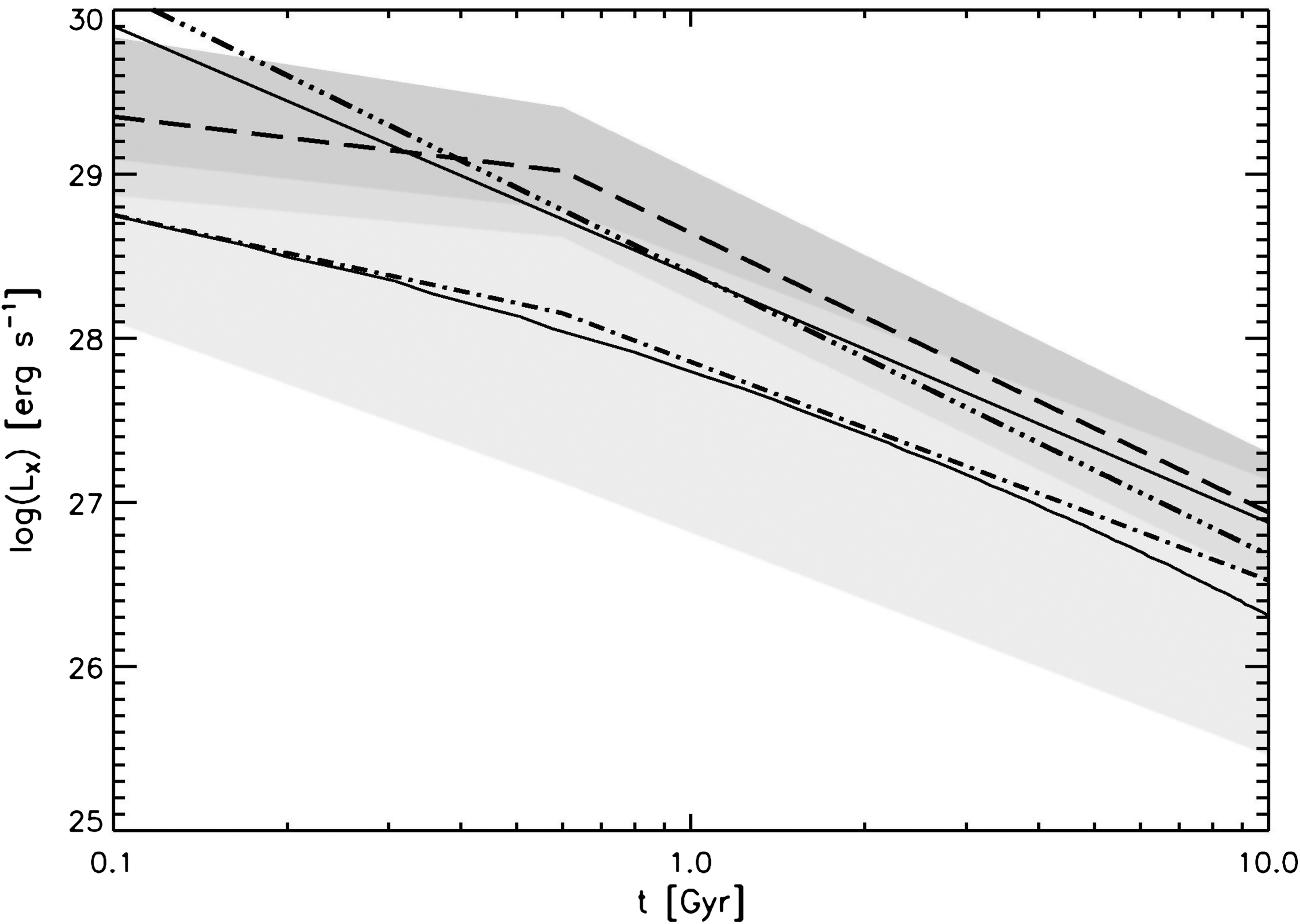
Temporal evolution of the stellar X-ray luminosity. The dashed line gives the median X-ray luminosity of G stars, the dark shaded area the 1σ equivalent of the luminosity distributions, as derived by Penz et al. (2008). The dash-dotted line and the light shaded area show the same for M dwarfs (Penz and Micela, 2008). The solid lines display (from top to bottom) the scaling law from Ribas et al. (2005) for solar analogues in the range 0.1–10 nm and the scaling from Guinan and Engle (2009) for a sample of M dwarfs, respectively. The dash-dot-dotted line displays the scaling law for G stars from Scalo et al. (2007).
The solar wind leads to a mass-loss rate of approximately 2·10−14 M Sun year−1. First estimates on the mass-loss rates of Sun-like and late-type stars, via several indirect methods (Wargelin and Drake, 2001, 2002; Wood et al., 2002, 2005), have given between <0.2 and 100 times solar, respectively. Observational data suggest the existence of stellar analogues to solar CMEs and prominences (Mullan et al., 1989; Bond et al., 2001; Jardine and Donati, 2008). Currently, stellar samples that can be used for stellar wind observations are not large enough to address these questions precisely. Further observations are required to complete the observational database to characterize the entire target star sample.
5. Conclusions
We have discussed the criteria for selecting potential target stars suitable for the search for Earth-like planets, with a special emphasis on the stellar aspects of habitability. Missions that endeavor to search for terrestrial exoplanets will explore the presence and habitability of Earth-like exoplanets around several hundred nearby stars, mainly F, G, K, and M stars. Using the DASSC, we have discussed the influence of different designs and derived configuration-dependent subcatalogues.
The detection of several terrestrial exoplanets in the HZ of stars will allow for the first opportunity, to date, to carry out real comparative planetology and relate planetary properties such as mass, size, orbit, and atmospheric physics to the astrophysical characteristics of their host stars.
Footnotes
Acknowledgments
L.K. gratefully acknowledges support from the Harvard Origins of Life Initiative. We thank ISSI. This research has made use of the SIMBAD database, operated at CDS, Strasbourg, France; NASA's Astrophysics Data System; and data products from the Two Micron All Sky Survey, which is a joint project of the UMass and IPAC, funded by NASA and NSF. M.L., P.O., and A.H. acknowledge the Austrian FWF (Wissenschaftsfond), grant P19446, for supporting this project.
Abbreviations
CCDM, Catalogue of Components of Double and Multiple stars; CMEs, coronal mass ejections; DASSC, the Darwin All Sky Star Catalogue; EUV, extreme ultraviolet; HZ, habitable zone; mas, milliarcsecond; SB9, ninth catalogue of spectroscopic binary orbits.
The term biomarker is used here to mean detectable atmospheric species or set of species whose presence at significant abundance strongly suggests a biological origin.
1
2The full DASSC catalogue can be obtained from one of the authors (L.K.) by sending an e-mail to lkaltene@cfa.harvard.edu or at