




Abstract
The clay mineral montmorillonite is a member of the phyllosilicate group of minerals, which has been detected on martian soil. Montmorillonite catalyzes the condensation of activated monomers to form RNA-like oligomers. Extent of catalysis, that is, the yield of oligomers, and the length of the longest oligomer formed in these reactions widely varies with the source of montmorillonite (i.e., the locality where the mineral is mined). This study was undertaken to establish whether there exists a correlation between the extent of catalytic property and the charge density of montmorillonites. Charge density was determined by saturating the montmorillonites with alkyl ammonium cations that contained increasing lengths of alkyl chains, [CH3-(CH2) n -NH3]+, where n = 3–16 and 18, and then measuring d(001), interlayer spacing of the resulting montmorillonite-alkyl ammonium-montmorillonite complex by X-ray diffractometry (XRD).
Results demonstrate that catalytic activity of montmorillonites with lower charge density is superior to that of higher charge density montmorillonite. They produce longer oligomers that contain 9 to 10 monomer units, while montmorillonite with high charge density catalyzes the formation of oligomers that contain only 4 monomer units.
The charge density of montmorillonites can also be calculated from the chemical composition if elemental analysis data of the pure mineral are available. In the next mission to Mars, CheMin (Chemistry and Mineralogy), a combined X-ray diffraction/X-ray fluorescence instrument, will provide information on the mineralogical and elemental analysis of the samples. Possible significance of these results for planning the future missions to Mars for the search of organic compounds and extinct or extant life is discussed. Key Words: Mars—Origin of life—Montmorillonite—Mineral catalysis—Layer charge density—X–ray diffractometry. Astrobiology 10, 743–749.
1. Introduction
I
Phyllosilicates have also been identified on Mars by orbiters, telescopes, and robotic rovers. Data acquired by OMEGA (Observatoire pour la Minéralogie, l'Eau, les Glaces, et l'Activité) on the Mars Express Orbiter reveal the presence of hydrated phyllosilicates, along with iron-bearing silicates and sulfates in the southern hemisphere (Bibring et al., 2005). They are thought to have formed early in the planet's history, 4.6 billion to 4 billion years ago when, it is believed, Mars was warmer and wet (Bibring et al., 2006). More recent data obtained by CRISM (Compact Reconnaissance Imaging Spectrometer for Mars) (Ehlmann et al., 2008) and HRSC (High Resolution Stereo Camera) (Chevrier, 2008) identified the sites of clay deposits on Mars.
Montmorillonites are hydrous aluminum silicates arranged into a layered structure that contains small amounts of sodium or calcium, or both. It may also contain other alkali and alkaline earth cations between the layers. Each layer is composed of one octahedrally coordinated alumina sheet held between two tetrahedrally coordinated silica sheets.* Theoretically, the structural formula of montmorillonite can be derived from pyrophyllite, which has the structure shown below:
[ ]IV and [ ]VI indicate the tetrahedrally and octahedrally coordinated cations, respectively. A small fraction of Si4+ in the tetrahedra and a larger fraction of Al3+ in the octahedra are replaced by cations with lower valency states, such as Al3+ and Mg2+, respectively. The charge deficiency that arises from these isomorphous substitutions is counterbalanced by the interlayer cations, mostly Na+ and Ca2+, held between the layers. The structural formula of montmorillonite after these substitutions may be represented by
The extent of substitutions is defined as layer charge ξ or χ = 0.(x + y) with x ≪ y and 0.2 ≤ χ ≤ 0.6 (Emmerich et al., 2009). Cation exchange capacity is the number of interlayer cations expressed in milliequivalent of cation per 100 grams of clay mineral.
Since the composition of montmorillonites of different sources is comparable (Table 1), the differences in catalytic activity may arise from the variations of the extent and distribution of isomorphous substitutions among them (Ertem, 2004, p 561). Isomorphous substitutions in montmorillonites are discussed in detail by Grim and Kulbicki (1961), Schultz (1969), and Wolters et al. (2009).
Clay Minerals Society Source Clays (
Early et al. (1953).
X-ray fluorescence analysis of purified montmorillonite (Steudel, 2008).
The present study was designed to establish whether a correlation exists between the extent of catalytic activity of montmorillonites collected from different localities, which exhibit varying catalytic activities, and their layer charge density. Layer charge density of clay minerals is determined by saturating them with alkyl ammonium cations of increasing chain length and measuring the d(001) spacing by X-ray diffractometry (XRD). From the change in the d(001) spacing of montmorillonite-alkyl ammonium complexes with the length of alkyl ammonium chains, the layer charge is calculated.
1.1. n-Alkyl ammonium complexes of clay minerals
The interlayer cations of phyllosilicates and other layer minerals can quantitatively be exchanged with n-alkyl ammonium cations (Lagaly and Weiss, 1970a, 1970b; Ertem and Lagaly, 1978). In the mineral-alkyl ammonium complexes thus formed, the hydrophilic [−NH3]+ end of the cations are oriented close to the mineral layer, while the hydrophobic alkyl chains stand away from the mineral surface (Lagaly and Weiss, 1970a, 1970b). The structure of the resulting orderly complex that contains alternate layers of (mineral : n-[CH3-(CH2) n -NH3]+-cation : mineral) is shown in Fig. 1. The distance between the clay mineral layers [basal spacing, d(001)] can be precisely measured by XRD. Since the distance between the layers before saturating the clay mineral with n-alkyl ammonium cations is known, the thickness of the organic layer can easily be determined.
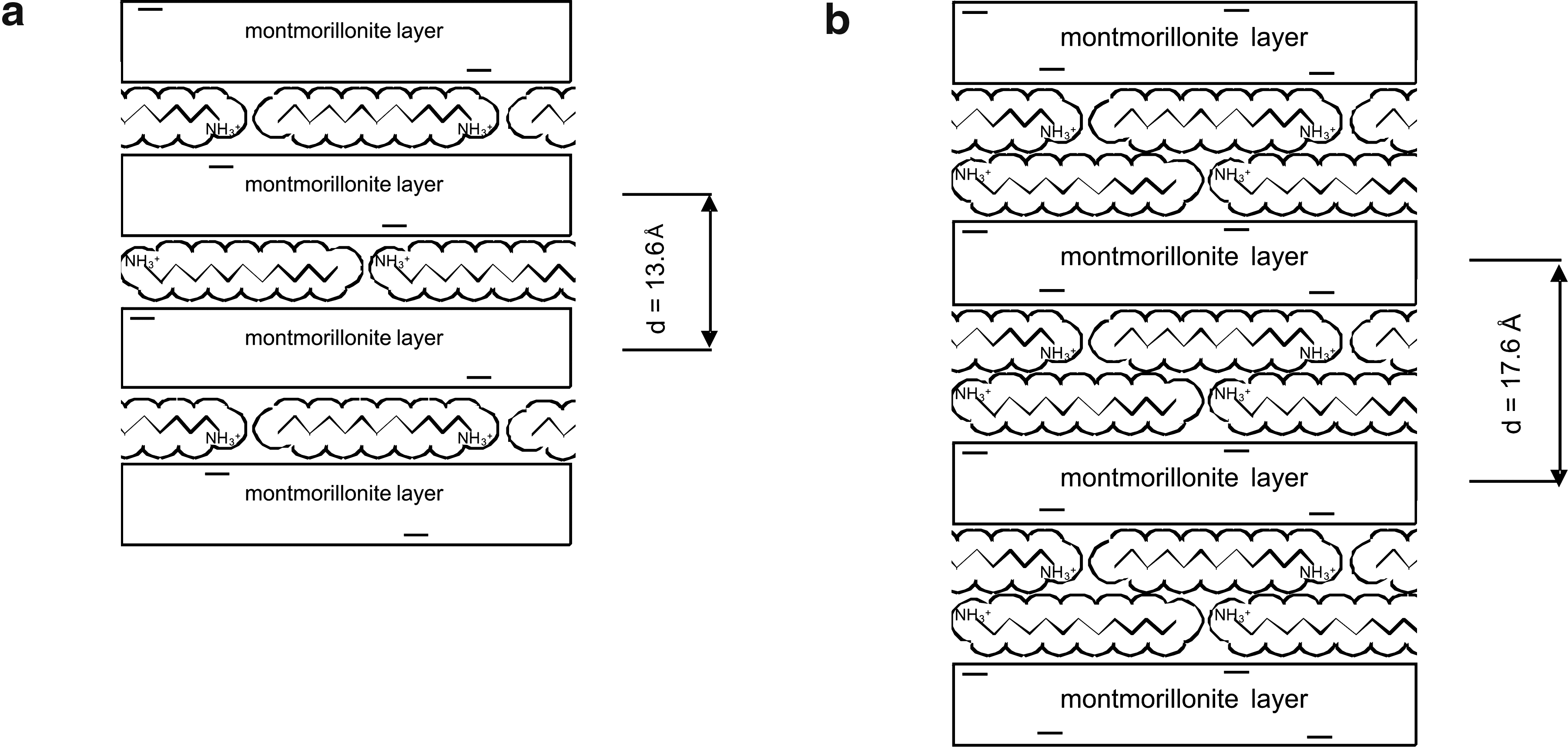
Orientation of alkyl chains as a function of layer charge density: (
Orientation of alkyl ammonium cations in the interlayer is a function of the layer charge density (Lagaly and Weiss, 1971). As the distance between the charge-deficient sites increases, the area available for each cation also increases. As a result, cations may orient themselves either parallel (monolayer or bilayer), at an angle, or perpendicular (with increasing layer charge) to the clay surface, depending upon the charge density and the size of the alkyl ammonium cation. Therefore, by measuring the interlayer spacing, the exact orientation of the alkyl ammonium cations in the interlayer and the distance between the charge-deficient sites can be calculated.
2. Experimental Section
Amines (p.a. or purum) were purchased from different suppliers (Merck, Fluka, or Aldrich). Ethanol (p.a., containing 1% methyl, ethyl ketone) and formic acid (98–100%) were from Merck. Dr. Ferris of Rensselaer Polytechnic Institute kindly provided montmorillonites from Otay (California) and Little Rock (Arkansas), which had been purchased from the Clay Minerals Society's Source Clay Repository. Japan montmorillonite, extra pure grade, was also from Dr. Ferris' collection. (Originally, it was a gift from Dr. Seiji Yuasa of Osaka University to Dr. James P. Ferris and Dr. Kunio Kawamura.) Volclay SPV-200 was a gift from the American Colloid Company, Arlington Heights, Illinois. SWy-2 montmorillonite (Wyoming) was purchased from the Source Clay Repository. While Otay and Little Rock contain >99% and 97% montmorillonite, Volclay and SWy-2 contain only 80% and 73% montmorillonite, respectively. Table 1 displays the approximate chemical composition of montmorillonites from each sample. Purification and separation of montmorillonite from bentonite is described in Steudel et al. (2009). For layer charge measurement of the raw material, separation of the montmorillonite from the accompanying bentonite was not necessary.
2.1. Reaction setup for oligomer formation
Homoionic Na-montmorillonites were prepared according to the procedure described in Banin et al. (1985), and <2μ fraction that was separated by centrifugation was used for this research. Activated mononucleotides were synthesized with a slight modification (Ferris and Ertem, 1992b, p 371) of the procedure by Joyce et al. (1984). Reactions were run in 2 mL polyethylene tubes containing 50 mg Na-montmorillonite and 1.0 mL of 0.014 M activated monomer solution in 0.1 M HEPES [N-(2-hydroxyethyl)piperazine-N′-(2-ethanesulfonic acid)], 0.2 M NaCl, and 0.075 M MgCl2 at pH 8 for 3–7 days at 25 °C. After separation by centrifugation at 4000 rpm for 20 minutes, supernatants were analyzed by high-performance liquid chromatography with anion exchange and reverse phase columns (Ertem et al., 2007 and references therein). Oligomerization reaction takes place in the interlayer of montmorillonites rather than at the edge sites (Ertem and Ferris, 1998). The effect of interlayer cations on the oligomer length and yields has been reported elsewhere (Ferris and Ertem, 1993).
2.2. Preparation of 500 mL of 0.1 M alkyl ammonium formiate solutions
n-Alkyl ammonium cations form from corresponding n-amines by the addition of formic acid solution following the published procedures, where R denotes the n-alkyl group (Lagaly and Weiss, 1971; Ruehlicke and Kohler, 1981, Lagaly, 1989, 1994):
Formic acid was substituted for hydrochloric acid used in the previous works because of the higher solubility of the alkyl ammonium formiate salts with longer alkyl chains (Wolters et al., 2009).
In a 100 mL beaker, 10 mL ethanol and 0.3 mL formic acid (98%) were added to the required amount of n-alkyl amine to give a final concentration of 0.1 M in 500 mL. For amines that contain 4–14 carbon atoms in their alkyl chain, 10 mL ethanol was used, while 20 mL ethanol was added to amines with 15, 16, and 18 carbon atoms. Mixtures were allowed to stand for 2 hours, or longer, with occasional stirring until the dissolution was complete. The solutions were quantitatively transferred into 800 mL beakers by using 400–425 mL of water. pH of the alkyl ammonium formiate solutions was adjusted to 5.6–5.8 by dropwise addition of 98% formic acid solution. pH was monitored with pH strips (Merck, pH range 5.2–7.2). Solutions were transferred into 500 mL volumetric flasks and filled to the mark. During the transfer of solutions with alkyl chains that contain 12 or more carbon atoms, extra care must be taken to prevent foaming. Alkyl formiate solutions were stored in 500 mL Schott, DURAN bottles (not tightly closed!) and kept at 60 °C. They may be used for 6 months after their preparation.
2.3. Preparation of montmorillonite-alkyl ammonium complexes
In a 10 mL polyethylene tube, 2 mL of alkyl ammonium solution was added to 200 mg of montmorillonite. The amount of solution to be added may vary with the expansion properties of montmorillonites. The mixture was vigorously vortexed to reach complete suspension of the clay and kept at 60 °C with occasional stirring. At the end of 3 days, mixtures were centrifuged at 4500 rpm for 10–20 minutes. The supernatant was carefully decanted, and the saturation procedure was repeated one more time.
2.4. Washing the montmorillonite-alkyl ammonium complex
Excess of alkyl ammonium solution was removed by prolonged washing with ethanol. After removal of the supernatant at the end of the second saturation, 5 mL of ethanol was added to the montmorillonite-alkyl ammonium complex, and the mixture was stirred for dispersal with an ultrasonic finger equipped with a microtip (UP200s, Dr. Hielscher GmbH, Ultraschallprozessor). The mixture was then shaken for 20 minutes (shaking at 60°C increases the solubility of amines) and centrifuged at 4500 rpm for 10–20 minutes. The supernatant was carefully removed, and washing with ethanol was repeated until the supernatant was free of amines, in our case 18 times. After the last washing, the montmorillonite-alkyl ammonium complex was suspended in 2 mL of ethanol to prepare the oriented films for XRD measurements.
2.5. Preparation of oriented montmorillonite-alkyl ammonium films for XRD measurements
1.0–1.5 mL of suspension was carefully pipetted onto a glass slide of 25 mm diameter and left to stand at 20–25 °C to evaporate the ethanol. The air-dry films were further dried at 60 °C for 12 hours and kept in a desiccator over phosphorus pentoxide until XRD measurements were recorded (not longer than 24 hours).
Montmorillonite-alkyl ammonium–coated slides were mounted on a Siemens D5000 diffractometer (filtered CuKα radiation) equipped with a graphite secondary monochromator. Diffractometer readings were recorded between 2θ = 2° and 12°, 2θ at 0.04°/8 s. Results were evaluated with the DiffrakPlus Program.
2.6. Calculation of layer charge density
Determination of layer charge density of phyllosilicates by measuring the d(001) spacing of alkyl ammonium-mineral complexes was investigated in detail by Lagaly and Weiss (1970a, 1970b, 1970c, 1971). In the alkyl ammonium–phyllosilicate complexes, the area covered by an n-alkyl ammonium cation is calculated according to the equation given below (Lagaly and Weiss, 1971):
where
A c is area covered by an n-alkyl ammonium cation;
n c is number of carbon atoms in the alkyl chain;
1.26 Å is the C–C and C–N bond lengths (assumed to be equal for this case); hence (n c × 1.26) Å is the length of the alkyl chain;
4.5 Å is van der Waals diameter of the alkyl chains;
14 Å2 is total area occupied by the two end groups of the n-alkyl chain, that is, −NH3 and −CH3 groups (Lagaly and Weiss, 1971).
When the monolayer of n-alkyl ammonium cations is close packed, A
c will be equal to the area of the half-unit cell,
where
A e is the area of the half-unit cell represented by one formula unit.
a and b are the unit cell dimensions. For montmorillonites, A e is 23.25 Å2.
Therefore,
In cases where A c < A e, n-alkyl ammonium cations orient themselves in a monolayer arrangement, as shown in Fig. 1a. When the size of the n-alkyl ammonium cations starts to exceed the A e, which is the area that can be occupied by one cation, that is, A c > A e, alkyl chains start to arrange themselves into bilayers, Fig. 1b. The slope of the line that represents the transition state from monolayer to bilayer gives the degree of heterogeneity of charge distribution (Mermut and Lagaly, 2001).
3. Results
The change of the d(001) spacing with length of alkyl chain is presented in Table 2. XRD traces for Volclay are shown in Fig. 2.
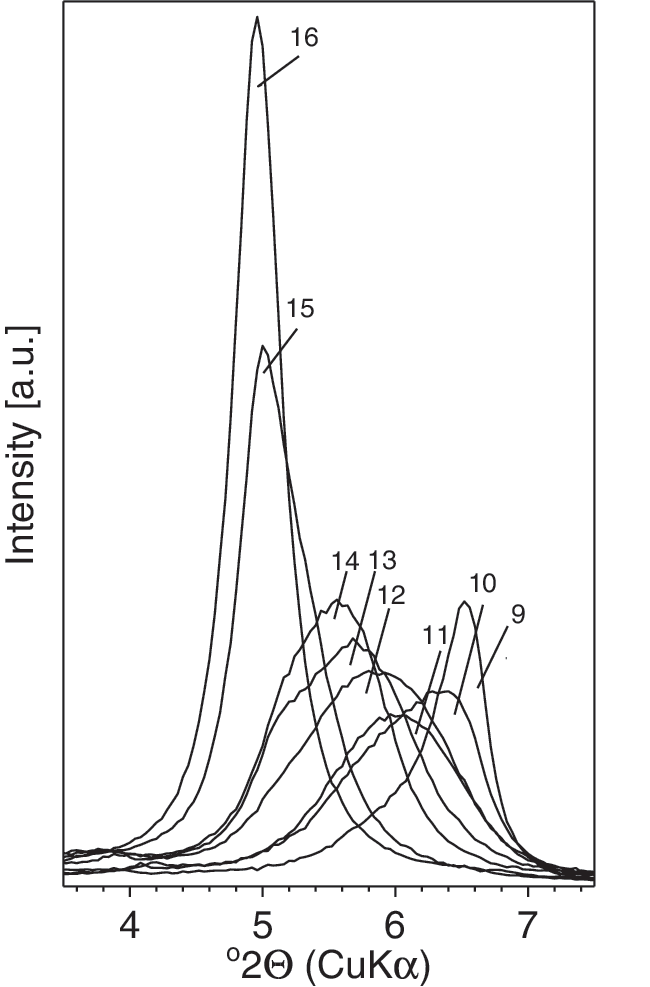
XRD traces [d(001)] of montmorillonite-alkyl ammonium intercalates for Volclay. Numbers indicate the number of carbon atoms in the alkyl chains. a.u., arbitrary units.
Figure 3 and Table 3 show the resulting layer charge distribution and mean layer charge of montmorillonites calculated from their elemental analysis results, respectively (Emmerich et al., 2009).

Layer charge distribution of montmorillonites calculated following Lagaly method (1994).
Oligomers formed in the presence of montmorillonite from Little Rock, Arkansas, χ = 0.26, had been analyzed with C-18 reverse phase column, not with an ion exchange column as was reported in an earlier publication (Ferris and Ertem, 1992b, Table IV, p 377). Yield and length of these oligomers were lower compared to those that formed with Na-Vol.
X-ray diffractometry measurements show that, with Otay montmorillonite, which does not serve as an effective catalyst for oligomerization reactions, transition from monolayer to bilayer arrangement of the alkyl ammonium cations starts with alkyl chains that contain six carbon atoms (Table 2). The longest oligomer formed in the presence of Otay montmorillonite is a 4-mer, that is, it contains only four monomer units in its chain. With montmorillonites labeled as Volclay, Japan, and SWy-2, which catalyze the formation of oligomers 9 to 10 monomer units long, the monolayer to bilayer transition occurs with alkyl chains that contain 10 or 11 carbon atoms.
Each montmorillonite is characterized by an overall charge density and charge distribution, that is, distribution of isomorphic substitutions within the layers (Emmerich et al., 2009). The charge density of Otay montmorillonite, a poor catalyst, is χ = 0.37. The charge density of Vol, Japan, and SWy-2 montmorillonites is χ = 0.29, and their catalytic activity is about the same or comparable (Table 3), while their charge distributions vary (Fig. 3).
4. Discussion
NASA's Phoenix mission to Mars is equipped with the Wet Chemistry Laboratory (WCL) and the Thermal and Evolved-Gas Analyzer (TEGA) as part of the spacecraft's Microscopy, Electrochemistry, and Conductivity Analyzer (MECA), which can analyze the chemistry and mineralogy of the soil (Boynton et al., 2009; Hecht et al., 2009; Kounaves et al., 2009; Smith et al., 2009).
NASA's next rover mission to the Red Planet, Mars Science Laboratory (MSL), will carry on board a suit of analytical and imaging instruments designed to collect martian soil and rock samples. CheMin (Chemistry and Mineralogy), a tiny X-ray diffraction/X-ray fluorescence instrument on board MSL, is capable of performing remote robotic analyses of martian surface rocks. CheMin will provide information on the mineralogical and elemental analysis of samples by combined application of X-ray diffraction and X-ray fluorescence. MSL is designed to be the first planetary mission to use precision landing techniques that will enable the spacecraft to fly to a desired location above the martian surface before final landing. NASA will select a landing site on the basis of detailed images sent to Earth by the Mars Reconnaissance Orbiter, in addition to data from earlier missions.
The Alpha Particle X-Ray Spectrometer (APXS) will measure the abundance of chemical elements in rocks and soils.
Charge density values of montmorillonites on the martian surface can be calculated from their precise elemental analysis data obtained by CheMin and APXS, following the procedures described in Köster (1977) and Emmerich et al. (2009). It is our hope, given the demonstrated correlation between the charge density and catalytic activity of montmorillonites, that our results will serve as a kind of “pathfinder” for the selection of target sites for future Mars missions in search of organic molecules (Parnell et al., 2007).
5. Conclusions
These results demonstrate that there exists a correlation between the layer charge density of montmorillonites and the extent of their ability to serve as a catalyst for the formation of RNA-like oligomers. Catalytic activity of montmorillonites with lower charge density, χ = 0.29, is superior to that of higher charge density montmorillonite. They produce longer oligomers that contain 9 to 10 monomer units, while montmorillonite with high charge density, χ = 0.37, catalyzes the formation of oligomers that contain only 4 monomer units. Possible significance of these results for planning future missions to Mars for the search of organic compounds and extinct or extant life was discussed.
We are currently investigating the correlation between the charge density of phyllosilicates and the extent of their possible protective role on the organic molecules, adsorbed on or embedded within them, against the degradation effects of gamma and UV radiation, directly or via the generation of secondary reactive species such as peroxides (Chun et al., 1978; Zent and McKay, 1994). We shall compare the results with possible protective role of other minerals identified on martian soil.
Footnotes
Acknowledgments
Gözen Ertem would like to thank Prof. Dr. W. Höll, former Director of IFG, for the opportunity to carry out this research at Forschungszentrum Karlsruhe as a Visiting Scientist. She also thanks Mrs. Durime Buqezi-Ahmeti at FZK for her kind help in the laboratory in the course of this research.
Abbreviations
APXS, Alpha Particle X-Ray Spectrometer; CheMin, Chemistry and Mineralogy; MSL, Mars Science Laboratory; XRD, X-ray diffractometry.
*
The reader is kindly referred to the figure published in Clay Mineralogy by R. Grim (1968, 2nd edition, p 79), which has been reproduced with publisher's permission in Ertem ( , p 551).