




Abstract
Europa has become a high-priority objective for exploration because it may harbor life. Strategic planning for its exploration has been predicated on an extreme model in which the expected oceanic biosphere lies under a thick ice crust, buried too deep to be reached in the foreseeable future, which would beg the question of whether other active satellites might be more realistic objectives. However, Europa's ice may in fact be permeable, with very different implications for the possibilities for life and for mission planning. A biosphere may extend up to near the surface, making life far more readily accessible to exploration while at the same time making it vulnerable to contamination. The chances of finding life on Europa are substantially improved while the need for planetary protection becomes essential. The new National Research Council planetary protection study will need to go beyond its current mandate if meaningful standards are to be put in place. Key Words: Europa—Planetary protection—Mission planning—Spacecraft—Geology. Astrobiology 11, 183–191.
1. Introduction
NASA's
Yet NASA's current long-term strategy ensures that life will not be found on Europa for the foreseeable future. The strategy, developed over a decade ago by the Europa Orbiter Science Definition Team (1999; hereafter SDT-1999), was predicated on a model in which Europa's ocean, if any, was assumed to be isolated from the surface by a thick, impermeable layer of ice. Speculation about habitability focused on conditions at hypothetical sub-oceanic volcanic vents analogous to those on Earth. Without access to the oxidants known to be at the surface, life would be very constrained (Gaidos et al., 1999).
This view of Europa was actively reinforced over the following decade (e.g., Fig. 1). Europa was frequently compared with Antarctica's Lake Vostok, where both the scientific interest and the exploration challenges came from the fact that a potential ecosystem has been kept isolated under thick impermeable ice. The comparison reinforced the image of Europa's ocean as being similarly isolated. This belief has remained at the heart of strategic planning for Europa's exploration, with the thick ice viewed as a daunting obstacle.
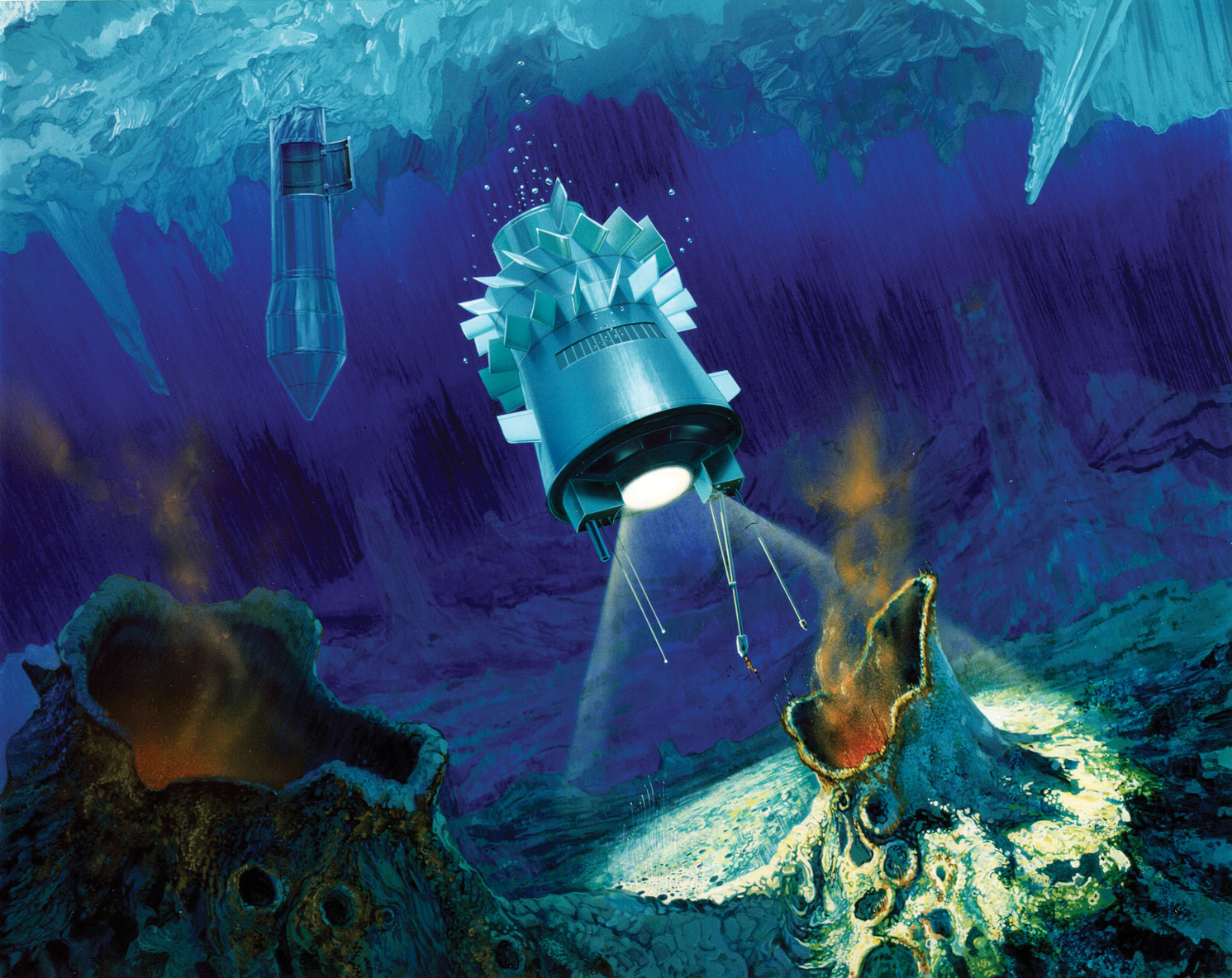
A widely disseminated artist's representation from the 1990s of exploration of Europa's ocean summarizes the vision that has guided NASA's long-range strategy. The surface ice is extremely thick (here it seems to extend to near the ocean floor). A penetrator has reached the ocean and released a robotic submarine to visit a volcanic vent, the only plausible site of astrobiological interest, given the assumption of impermeable ice (image from JPL/NASA). Color images available online at
The strategy involves a campaign of three missions to follow the multiple flybys of the Galileo mission. The SDT-1999 vision was for a Europa orbiter in the first decade of the 2000s, followed by a lander in the following decade. Finally, a decade or so later, a mission would drill down through many kilometers of surface ice to explore the ocean below. Even in that overly optimistic scenario, the one feature that makes Europa more interesting than Titan, its ocean, would not have been reached until after 2030.
The actual prospects for this long-term plan are even more discouraging. For one thing, the schedule has been stretched out enormously. The first two attempts to start an orbiter project (the first Europa Orbiter and the controversial Department of Defense Project Prometheus collaboration) were cancelled. The current version, packaged as the Europa Jupiter System Mission, will not get into Europa orbit before 2028. Moreover, the technical feasibility of the subsequent missions remains unclear. NASA has funded development of drilling methods to penetrate the ice, but none has demonstrated viability. Instead, the timetable kicks that problem ahead to future generations.
The delays give us the opportunity to revisit the long-term strategy, taking into account research since the late 1990s. Analysis of data from the Galileo mission has led to another interpretation in which Europa's surface ice is highly permeable, with direct connections between the ocean and the surface (Greenberg, 2005, 2008). The visible surface appears to be young due to continual resurfacing by tectonic and thermal processes (i.e., cracking and melting) that can briefly expose the ocean at various places and times. A variety of mechanisms may transport substances (including oxygen) vertically through the ice (Greenberg, 2010).
If Europa's ice is in fact permeable, it would have major implications for mission planning, because organisms or their markers would be readily accessible near the surface. The prospects for discovering extraterrestrial life in the foreseeable future would improve immensely. At the same time, a europan ecosystem would be highly vulnerable to contamination, so planetary protection becomes a critical issue.
The plausibility of the permeable-ice picture has gradually gained acceptance. Whereas mission planners had ignored it earlier, the recent Joint Jupiter Science Definition Team (2010; hereafter SDT-2010) identifies resolution of the “thick vs. thin” debate as a central scientific objective of Europa exploration (Fig. 2). The salient issue is the distinction between impermeable ice isolating the ocean and permeable ice connecting the ocean to the surface, with very different implications for processes and habitability. The SDT-2010 report demonstrates mainstream acceptance that permeable ice is comparably plausible to the isolated ocean model.
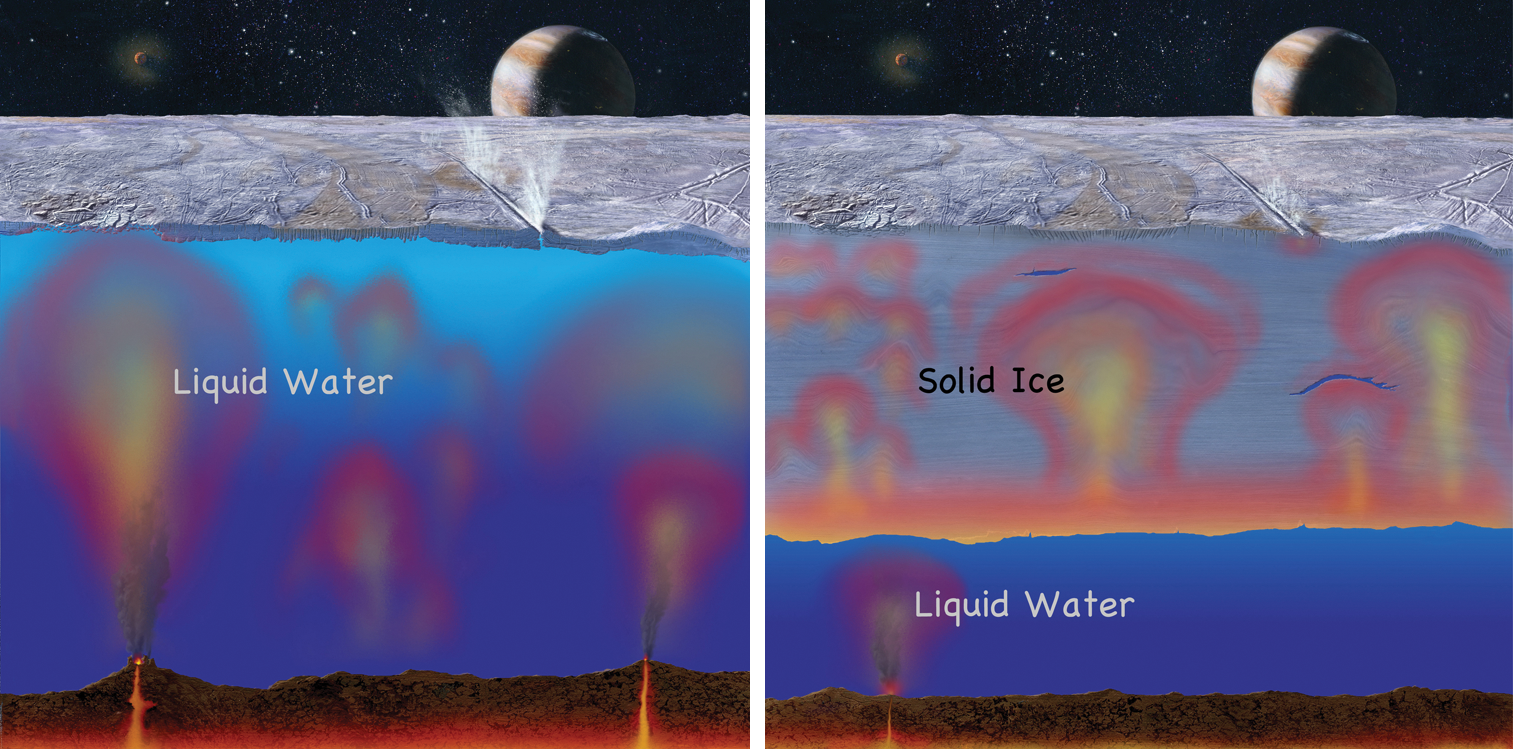
A representation of possible subsurface structures, prepared by the Jet Propulsion Laboratory for the recent Europa Orbiter Science Definition Team (SDT-2010), shows a very different picture from the version of a decade earlier (Fig. 1). According to SDT-2010, “The NASA Jupiter Europa Orbiter will address the fundamental issue of whether Europa's ice shell is ∼few km (left) or >30 km (right), with different implications for processes and habitability.” The thick ice as shown on the right extends tens of kilometers down toward the rocky interior. The model with thinner, permeable ice is now considered on par with the earlier canonical model of thick, impermeable ice. Color images available online at
Therefore, long-term planning for exploration and planetary protection should no longer be based solely on the extreme end-member model of an isolated ocean under thick impermeable ice.
Here, I discuss several ways in which the possibility of permeable ice might affect strategic planning for Europa exploration. At the heart of the issue is the question of habitability, because the possibility of finding alien life is the dominant motivation for exploration of Europa. Permeable ice makes it far more likely that the very life we hope to find exists, is accessible, and at the same time is more vulnerable to contamination.
For scientific background, the next section (2) summarizes the sequence of arguments for impermeable ice, discusses briefly why those assertions are questionable, and briefly describes the evidence for direct connections between the ocean and the surface. These issues remain controversial, but for present purposes a reader need only accept the SDT-2010 assessment that permeable and impermeable ice are comparably plausible. Then Section 3 considers the implications of permeable ice for habitability, describing how a biosphere could extend to within centimeters of Europa's surface. Section 4 discusses how this accessibility might affect strategic planning, with the real possibility of reaching the europan biosphere within the foreseeable future. Finally, in anticipation of the upcoming evaluation of planetary protection standards by the National Research Council (NRC) for NASA, the discussion emphasizes the importance of a fundamental reconsideration of how those standards are developed.
2. Permeable or Impermeable?
The idea that water on Europa would be largely liquid seemed a far-fetched, radical notion until 1979, when Peale et al.'s prediction of substantial heating of the Galilean satellites by tidal friction was immediately confirmed by Voyager images of active volcanism on Io. The same process is adequate to keep most of Europa's water in a liquid state, except for a layer of ice over the surface. To make a credible case, theorists needed to show that a liquid layer would be possible with even conservative estimates of tidal heating (Reynolds et al., 1983). Thus, up to and through the years of the Galileo mission, the literature was dominated by low-end estimates of heating, enough for plenty of liquid, but with a thick ice crust.
The heat flux from Io demonstrates the magnitude of tidal heating in rocky materials, allowing scaling to Europa's interior. Heat production balanced with conduction outward through the ice could give an equilibrium ice thickness of ∼1 km, but that is an extreme case. A mid-range heating estimate would mean proportionately thicker ice, ∼5 to 10 km thick (O'Brien et al., 2002). The same heat could be transported by a much thicker crust if the ice were convecting. Such solid-state convection would require the ice to be at least ∼20 km thick or more depending on material properties (McKinnon, 1999). Thus, the ice is probably either thicker than 20 km or thinner than 10 km.
As Galileo arrived at Jupiter, the earlier conservative estimates of tidal heating were prominent, so a common expectation was for thick ice with geology dominated by solid-state processes, relatively independent of the ocean below. Images of chaotic terrain (Fig. 3) suggested exposure of liquid water, but canonical interpretations tended to discount such explanations in favor of solid-state upwellings. Much of the early geological analysis was based on experience with solid planets, so europan features were generally interpreted in terms of the closest analogues on such bodies.
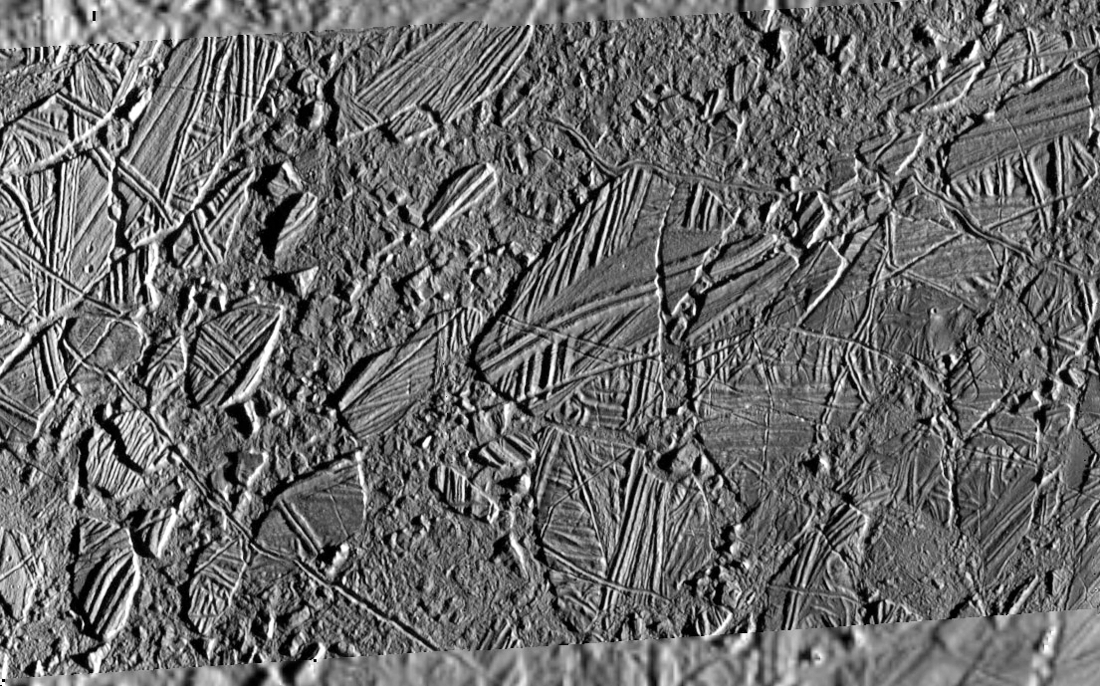
Chaotic terrain in a 60 km wide portion of Conamara Chaos. Rafts of displaced crust are embedded in lumpy refrozen ice. At least two new cracks with visible double ridges have subsequently crossed and begun the process of burying Conamara.
The first widely cited geological evidence for an ice thickness >20 km was a putative class of features known as “pits, spots, and domes” (Pappalardo et al., 1998). These features were portrayed as common, widely distributed, round, with a typical size about 10 km and spacing of about 20 km. As described, they seemed convincing evidence for solid-state convection. Thus, in the late 1990s the notion of thick ice and an isolated ocean was generally accepted as an established discovery of the Galileo mission. It constrained thinking about the prospects for habitability (e.g., Gaidos et al., 1999). And it was a premise of two significant policy studies at that time, SDT-1999 and an NRC report on planetary protection (hereafter NRC-2000, discussed in Section 4).
However, “pits, spots, and domes” were actually defined only vaguely, with only a few examples as archetypes. By definition the features in this class were about 10 km wide, and their common size was then attributed to the scale of convection cells. The defining archetypes proved to be examples of features (e.g., chaotic terrain) that come in a wide range of sizes and shapes and thus are not suggestive of underlying convection (Greenberg et al., 2003). The putative regular spacing was never confirmed. Moreover, the characteristics attributed to “pits, spots, and domes” were not consistent with numerical models of convection (Showman and Han, 2005).
By 2002, the case for thick ice had shifted to consideration of the appearance of the few craters on Europa. Some of them have been classified as central-peak craters, which form from impacts in solid material. For example, 20 km diameter central-peak craters would require the ice to have been thicker than about 12 km to have avoided breaking through to the liquid below (Turtle and Pierazzo, 2001). Schenk (2002) classified those up to 30 km diameter as central-peak craters, concluding that the ice must be more than 20 km thick. Moreover, he reported a drop in crater depths for craters larger than 30 km, analogous to a similar drop for Ganymede and Callisto (at larger diameters) that may represent a transition to penetration to liquid. Again, the evidence seemed to imply >20 km thick ice on Europa.
While seeming quantitative, that conclusion depends on subjective qualitative judgment. Crater taxonomies had been developed on the basis of experience with solid bodies, so fitting europan craters into that scheme was problematic and inconsistent. For example, while Schenk classified all 20 craters in the diameter range 3–30 km as central-peak craters, Turtle and Pierazzo judged only six of them to be central-peak craters, all smaller than 20 km. In fact, a substantial fraction of craters smaller than about 20 km actually have an appearance suggestive of breakthrough to liquid, with rafts of displaced crust set into their flat interiors, similar to Europa's chaotic terrain (Fig. 4). Thus, few craters appear to have formed at times and places where the ice was >12 km thick. Moreover, while Schenk described a downturn in crater depths above 30 km diameter, his data actually show the downturn at 10 km diameter, which is suggestive of ice thickness well under 10 km (Greenberg, 2005, p 282).
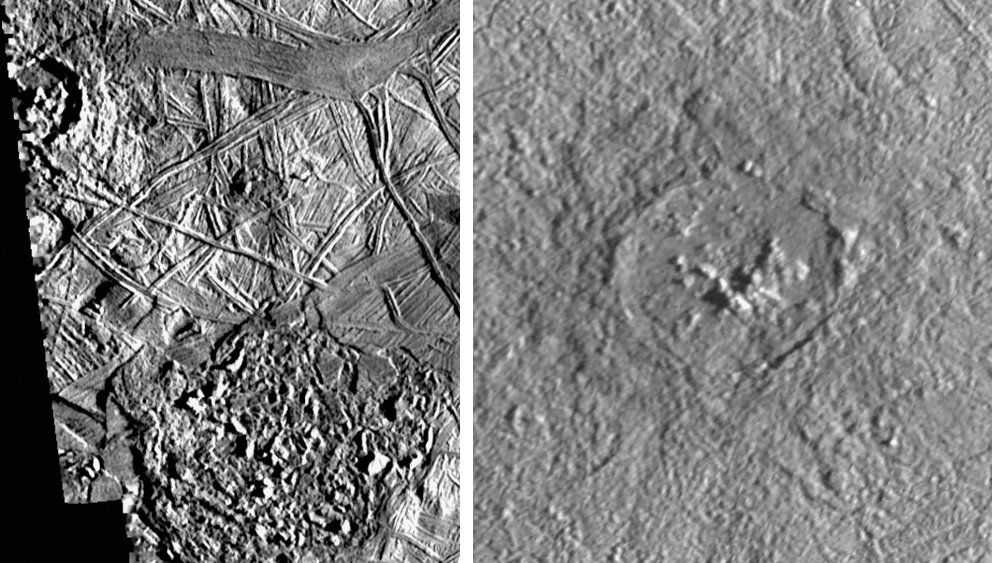
(Left) The interior of crater Amergin looks similar to the chaotic terrain in the bottom half of the image. (Right) Crater Pwyll also contains rafts and ice blocks similar to chaotic terrain. Pwyll and Amergin are each about 20 km in diameter. Their classification as “central-peak craters” is questionable.
Advocates for thick ice have most recently turned to the implications of topography. Chaotic terrain has the appearance of melt-through and temporary exposure of liquid from below, but Greenberg et al. (1999) proposed a test of that model: If chaotic terrain is systematically elevated relative to the surrounding terrain, solid-state upwelling in thick ice might be a more plausible model. Following this suggestion, Schenk and Pappalardo (2004) reported a patch of chaotic terrain near Tyre Macula to be hundreds of meters higher than the surrounding tectonic terrain.
However, a reexamination of the stereo data showed that the chaotic terrain is actually lower than the surrounding tectonic terrain (Nimmo and Giese, 2005; Greenberg et al., 2007). Moreover, the highest elevations in the region are actually outside the chaos area, although Schenk and Pappalardo mislabeled it as chaos. Thus topographic considerations remain inconclusive regarding the thickness of the ice crust.
On the other hand, evidence does suggest direct connections between the surface and the ocean below (e.g., Greenberg, 2005, 2008). The general appearance of chaotic terrain (Fig. 3) is readily explained by melt-through of the ice. These areas are distributed globally and come in a wide range of shapes and sizes, from ∼1000 km wide down to the limits imposed by image resolution (∼1 km or less), probably resulting from local and regional heating from below. Crack patterns (including cycloids) correlate well with tidal stress. The ubiquitous double ridges that line these cracks (Fig. 5) are best explained by periodic tidal working of the cracks, which squeezes crushed ice and slush to the surface, a process that requires the cracks to penetrate to the liquid. Large-scale mobility of crustal plates, involving dilation and strike-slip motion along the boundaries, indicates that the cracks extend down to the underlying liquid layer.

Densely ridged terrain covers much of Europa's surface. The large double ridge shown here is about 2 km wide and 100 m tall.
Strike-slip displacement is probably driven by a process of “tidal walking” (Hoppa et al., 1999), which requires that the cracks reach the ocean. While a model based on thick ice seemed to indicate enough tidal heating concentrated under cracks to allow tidal walking and ridge building (Nimmo and Gaidos, 2002), it assumed artificially fast shear, which is inconsistent with the high viscosity that generates the heat. Strike-slip is only seen along cracks with developed double ridges, because both processes require cracks to penetrate through to the ocean.
The history of Europa's surface has been a competing interplay of comparable amounts of resurfacing by thermal effects (chaos formation) and stress (tectonics), all of which are driven by tides and likely involve the ocean interacting with the surface. These processes have been active within the past few million years and thus likely continue to the present. While we cannot rule out the possibility that the ocean is isolated deep below the surface, the case for permeability of the ice crust is strong enough that it should not be discounted in developing policy for future exploration.
3. Europa's Biosphere
Permeable ice could provide ecological niches within the crust, as well as in the ocean below. Consider the profile of a crack, opening and closing with the daily tide (Fig. 6). The surface is supplied with a variety of exogenic substances of biological interest, including sulfur compounds from Io and organics from cometary material. Bombardment by energetic charged particles drives radiolytic chemistry at the surface, which produces oxidants (including O2) that become embedded in the ice. No organisms could survive this bombardment near the surface (nor could a spacecraft's solid-state electronics). But a few centimeters down, the ice would protect organisms from the punishing radiation.

Tidal flow through a working crack provides a potentially habitable setting. Photosynthetic organisms (tulip icon) might anchor themselves between the surface radiation danger and the deeper darkness. Other organisms (the tick icon) might hold on to exploit the flow of water or (jellyfish icon) might ride with the flow. (After artwork by Barbara Aulicino, American Scientist.) Color images available online at
Enough sunlight may penetrate a few meters below the surface to support photosynthesis, especially within an active crack where liquid water is available. Other organisms might anchor themselves in the crack and simply exploit the passing daily flow of chemicals and bits of biological debris, or be adapted to ride along with the mixing flow. With the abiotic production of oxidants at the surface, the ecosystem would not necessarily require photosynthesizers.
A given crack is likely to remain active for thousands of years, with a stable daily cycle that might allow organisms to increase in number and diversity. Eventually, as a crack seals shut, some organisms may be frozen within it while others escape into the ocean. To survive, the latter must adapt to ocean life or move to a still-active crack. Those that become frozen into the ice could survive by hibernating until a melt event occurs, probably in ∼1 million years, based on the amount of chaotic terrain. Antarctic bacteria are known to have survived such lengthy hibernation. Conditions in Europa's crust may be stable enough for life to prosper but challenging and changing enough to drive evolution.
In addition to life in the crust, the prospects for life in the ocean are enhanced by the possibility that the ice is permeable. Any extant creatures and organic debris that are squeezed downward from the crust would help feed an oceanic ecosystem. The ocean would be part of the same biosphere as the crust. And the biosphere might extend down into the sea floor, exploiting the various conditions at the hypothetical volcanic vents. But oceanic life would not be constrained by such uncertain resources, because the permeable crust could provide oxygen.
Recent calculations show that delivery of substantial amounts of oxygen from the surface to the ocean via known geological processes is quite plausible (Greenberg, 2010). First, radiolytic production quickly saturates the top ∼10 centimeters of ice with ∼1000 mol/m3 of O2 + H2O2 (Hand et al., 2007). The thickness of this oxygenated layer of ice is increased to a few meters as impact gardening mixes it below the radiation zone (e.g., Chyba and Phillips, 2001). Then the various other surface-modifying processes contribute to the delivery of oxygen into the ocean. Consider the double ridges that cover much of the surface (Fig. 5). As this material gradually piles up, it becomes oxygenated by the radiolysis and impact gardening. On average, this newly oxygenated material accumulates on top at a rate of ∼4 m/million years, because it must cover topography ∼300 m high within the ∼70-million-year surface age inferred from crater statistics (Zahnle et al., 2003). With the crust in thermal equilibrium, ice melts off the bottom at a similar rate.
Starting with no oxygen in the crust, after ∼2 billion years the oxygenated layer would be as thick as the whole crust. Thereafter, 4 m of oxygenated ice would melt off the bottom each million years, delivering ∼3 × 10¹¹ mol/year of oxygen. At this rate, the oxygen concentration in Europa's ocean would pass the saturation limit of Earth's ocean in only 10 million years. The steady-state delivery rate is comparable to the respiration requirements of 3 million tons of terrestrial fish.
The potential implications for the origin of life and ongoing habitability are significant. The ∼2-billion-year delay as the oxygen worked its way through the ice could have allowed prebiotic assembly of the molecules necessary for life in the ocean without the inhibiting presence of oxidants, similar to the origin of life on Earth. Genetic systems and protective structures could have been in place and ready to exploit the oxygen when it arrived. Then, with the steady-state oxygen delivery rate estimated above, a substantial biomass could be supported. Moreover, oxygen concentrations could have reached a point where complex macrorganisms might be possible (Hand et al., 2007).
In the isolated-ocean models, the lack of access to oxidants from the surface was the limiting constraint on europan life. However, the likely permeable nature of the crust means that Europa may have a robust and complex biosphere extending from the ocean floor to within a few centmeters of the surface.
4. Implications for Exploration
4.1. Mission strategies
As long as strategic planning is predicated on the idea of thick ice, it faces the unsolved problem of getting down through the ice to the isolated ocean below. In this context, a multi-decade multi-mission campaign, while it may get spacecraft to Europa, is really a delaying strategy, because there may be no way to reach the very objective that arguably makes Europa more attractive than Titan or Enceladus.
The situation changes entirely with the possibility that the ice crust is permeable. The prospect that there actually is life on Europa is improved, and the biosphere may be accessible. With this new realization, the strategic vision for Europa's exploration needs to be reassessed, taking into account that the thing that makes it so exciting, its potential biosphere, could be sampled far more easily than had been previously thought.
Rather than focusing on the daunting, perhaps impossible, task of drilling down to the ocean, we should consider how to take advantage of the biosphere's natural accessibility. With the rapid resurfacing, almost any europan landing site might provide oceanic samples; the issue will be how to find the freshest ones. When chaotic terrain forms, it replaces a section of crust with frozen ocean. Ridge formation squeezes out ocean material. Fresh oceanic material may be exposed at the surface as gaps open up and create the dilational bands. Any of these processes could be laying out biological samples on the surface.
Some landing sites would be better than others. If NASA makes an effort to “land smart,” choosing its landing site carefully, there may be no need to drill through the ice. The goal should be to choose a site with recent oceanic material, such as fresh chaos or young ridges. Ideally, it would be a place with active oceanic exposure. A craft landed next to an active crack might only have to wait a few hours until the ocean comes oozing up. Of course, landing with the necessary hardware and instrumentation will be a major challenge, but at least we could be planning exploration that has a chance of reaching the objective that made visiting Europa a priority in the first place.
Only with a clear continuing path to the europan biosphere can the Europa orbiter promise more fruitful discoveries than an alternative mission to one of the active saturnian satellites. In this light, an objective strategic reassessment might result in recommendations for a more ambitious Europa orbiter with a primary objective of identifying the most likely sites of recent or current oceanic exposure. A follow-up lander should be considered an integral part of the same mission, because an orbiter alone might not do much more than complete the original goals of the Galileo mission. Even better, if the orbiter mission included a lander component, or a penetrator, there would be the chance to find extraterrestrial life within decades from now.
The real possibility of accessing life at Europa's surface should lend a new urgency and excitement to strategic planning. We could discover extraterrestrial life on Europa within the lifetimes of many adults living today. In comparison, the current vision is for a holding strategy until future generations figure out how to drill through the ice.
4.2. Planetary protection
With a reasonable probability that Europa possesses a biosphere that extends to within centimeters of the surface, the possibility of forward contamination by terrestrial organisms hitchhiking on a spacecraft becomes very real. One concern of planetary protection has been that an exploration campaign might contaminate a planet before completing the objective of characterizing native life there (Sagan and Coleman, 1965). If we destroyed or modified extraterrestrial life before we could find out about it, we would fail to achieve one of the most exciting and motivating goals of planetary exploration. In addition, and perhaps more important, is the ethical concern: how far should we go to protect extraterrestrial life for its own sake and for the sake of future generations of humans?
In the late 1990s, NASA hired the National Research Council to assemble a Task Group on the Forward Contamination of Europa ( 2000; hereafter NRC-2000), which was charged with setting the standards for protecting Europa from germs that might ride along on future spacecraft. At the time, conventional wisdom still favored the isolated ocean model, so the chance of contamination of Europa's ecosystem seemed remote.
At the heart of the NRC-2000 report was a recommended quantitative standard for planetary protection: “The probability of contaminating a europan ocean with a viable terrestrial organism at any time in the future should be less than 10−4 per mission.” As the basis of this risk percentage, the report cited a 36-year-old resolution of the international Committee on Space Research (COSPAR, 1964). To understand the foundation of this result, it is enlightening to trace it to its source.
Sagan and Coleman (1965) had derived a quantitative requirement for the sterilization of spacecraft to be used in an anticipated campaign for the exploration of Mars. The basis of the calculation was that the probability of contaminating Mars during these missions should be very small for at least the duration of the specific envisioned exploration campaign. In other words, the underlying premise of that study was that the purpose of planetary protection was to protect the interests of then currently active scientists, rather than future generations of scientists or of alien organisms themselves. They arbitrarily selected a value of 0.1% as the maximum acceptable probability of contamination. On that basis, they calculated that each spacecraft launched to Mars had to be sterilized enough so that there was less than a 0.01% chance of having any organism on board. This calculation depended on specific assumptions about unknown conditions relevant to Mars and on guesses about the future exploration program.
That evaluation was adopted by COSPAR, although it rested on a rather shaky foundation. It selected the underlying level of acceptable risk arbitrarily. It relied on pre-space-age understanding of the planet Mars and on crude assumptions of how well a terrestrial organism might survive the trip and colonize the new setting. It was founded on a questionable ethical premise. And the prescription was based on a 1964 guess about the specifics of a future, finite, multi-mission campaign for exploring Mars.
Whether the standard was ever appropriate for Mars is therefore highly questionable, and there is simply no reason to expect it to apply to Europa. Nevertheless, NRC-2000 took the same 0.01% figure and applied it to Europa-bound spacecraft. Even if one accepts the result of Sagan and Coleman as being relevant despite its flaws, NRC-2000 applied it incorrectly. Remember, Sagan and Coleman's 0.01% figure was meant to represent the sterilization standard for each vehicle. For Europa, NRC-2000 applied the number in a completely different way, as an overall criterion for protecting a planetary ecosystem. Then their report left to NASA the responsibility for translating this global recommendation to actual per-spacecraft sterilization requirements, the calculation of which was the whole point of Sagan and Coleman's exercise in the context of their time and of Mars.
Although NRC-2000 cited the COSPAR (1964) resolution as the quantitative basis for its conclusion, that may have been misleading. In fact, the panel's chairman later wrote regarding the 0.01% figure, “the task group members reached a consensus on this value based on their collective experience and judgment. … The best justification is that it is the result of thoughtful deliberations of the task group members” (Esposito, 2001). Without any explanation for the quantitative dervation of the 0.01% number, it appears that it simply emerged from the subjective judgments of the members of that committee. Apparently, the COSPAR resolution was cited only to lend an appearance of objectivity.
Another flaw occurred late in the NRC-2000 process when a draft report was distributed to the scientific community with an invitation for comment. Unfortunately, when problems with the report were raised, the NRC responded that further consideration was impossible because the committee had been disbanded and NASA's payment had all been spent. Evidently the public-comment process was pro forma, with no real intent to consider corrections or improvements.
In retrospect, the lack of care in the entire process may reflect the belief at the time that any life on Europa was buried deep below an impenetrable layer of ice. The probability of contaminating the biosphere must have seemed so remote that considerations of planetary protection were more a bureaucratic obligation than a scientific issue.
Fortunately, the issue will soon be revisited. NASA has commissioned a new NRC planetary protection study (NRC-2011). Unfortunately, the charge to NRC-2011 is to develop standards for icy satellites based on the Sagan-Coleman formulation. The approach will be an improvement on NRC-2000 in one sense: the committee is instructed to select parameter values relevant to icy satellites rather than Mars. Otherwise, all the flaws discussed above in the Sagan-Coleman approach would be retained. Moreover, by focusing on the Sagan-Coleman analysis of 1965, NASA's charge to the NRC committee ignores relevant aspects of the recent deliberations of COSPAR and the Mars research community (e.g., McKay, 2009).
Therefore, a meaningful analysis will require NRC-2011 to go beyond its limited charge. Three questions about the Sagan-Coleman approach need rethinking, not just reevaluation of factors:
Do we still accept the underlying premise of Sagan-Coleman that we are only aiming to preserve Europa's biosphere long enough for the current scientific community to meet its exploration objectives? There are profound ethical issues involved in that question. The basis for any evaluation must be a moral or philosophical principle. The Sagan-Coleman formulation leaves out the interests of future researchers as well as extraterrestrial organisms. One possible solution (presented here only as an example) is a “natural contamination standard” (Greenberg and Tufts, 2001): exploration would be acceptable if the probability of humans infecting other planets with terrestrial microbes is smaller than the probability that interplanetary contamination happens naturally. Such a foundation principle would be ethically defensible and could be translated into specific, research-based, quantitative standards.
Is the Sagan-Coleman notion of a planetary protection standard based on a specific exploration campaign acceptable? If so, what number of spacecraft would be inserted into the formula? Only one spacecraft will go to Europa in the foreseeable future, while the full campaign as currently envisioned involves three (orbiter, lander, driller). Can we really anticipate the number over this long campaign? Should we ignore the changing plans of future generations? Alternatively, a formulation based on the natural contamination standard would only depend on a rate of spacecraft arrivals, because it would be compared with a natural rate of interplanetary transport.
Can the NRC panel come up with practical sterilization criteria, rather than leaving the real determination up to NASA or its contractors as NRC-2000 did? Here, NRC-2011 should follow the lead of Sagan and Coleman and translate their deliberations into enforceable standards for assembly and operations so NASA has an independent scientific basis on which to carry out its activities.
The possibility that Europa's surface ice is permeable increases the liklihood that it harbors life and that a biosphere extends to near the surface. The biosphere may be more accessible than previously assumed. Terrestrial organisms or substances inadvertently deposited on the surface would not be isolated from europan life but might readily contaminate it. With recognition of this possibility, NASA and the scientific community must grapple with these issues in a more serious and objective way than they have in the past. If planetary protection is regarded merely as a troublesome regulatory and bureaucratic procedure, there is a reasonable chance that we could contaminate Europa. If approached seriously, these problems are solvable and well worth facing, because the possibility that europan life may exist near the surface means that we really may be able to reach it. Europa may indeed prove to be the awesomest of moons.
Footnotes
Acknowledgments
This work was supported by a grant for NASA's office of Planetary Protection.
Author Disclosure Statement
The author has no conflict of interest or competing commercial association.
Abbreviations
COSPAR, Committee on Space Research; NRC, National Research Council.