




Abstract

O
Modeling Silk Fibroin
In 1962, I started to handle “classical” chemistry (Fig. 1). At that time, the silk made by the silk worm Bombyx mori was known to adopt two different conformations: the β-sheet, a water-insoluble textile form; and a water-soluble form present in the worm's gland before spinning, which is too unstable to allow the analysis of its conformation. Silk protein is made of chains of alternating glycine and alanine, with additional serine breaking the strict repetition from time to time. No chemical procedure was known to produce synthetic models long enough to adopt the desired conformations. After several tries, I finally succeeded in making an artificial protein made of the two main amino acids and long enough to mimic the properties of the natural protein. Apart from its sheet structure, the water-soluble form of silk could now be studied and deciphered, leading to a new protein conformation with a crankshaft-like geometry.
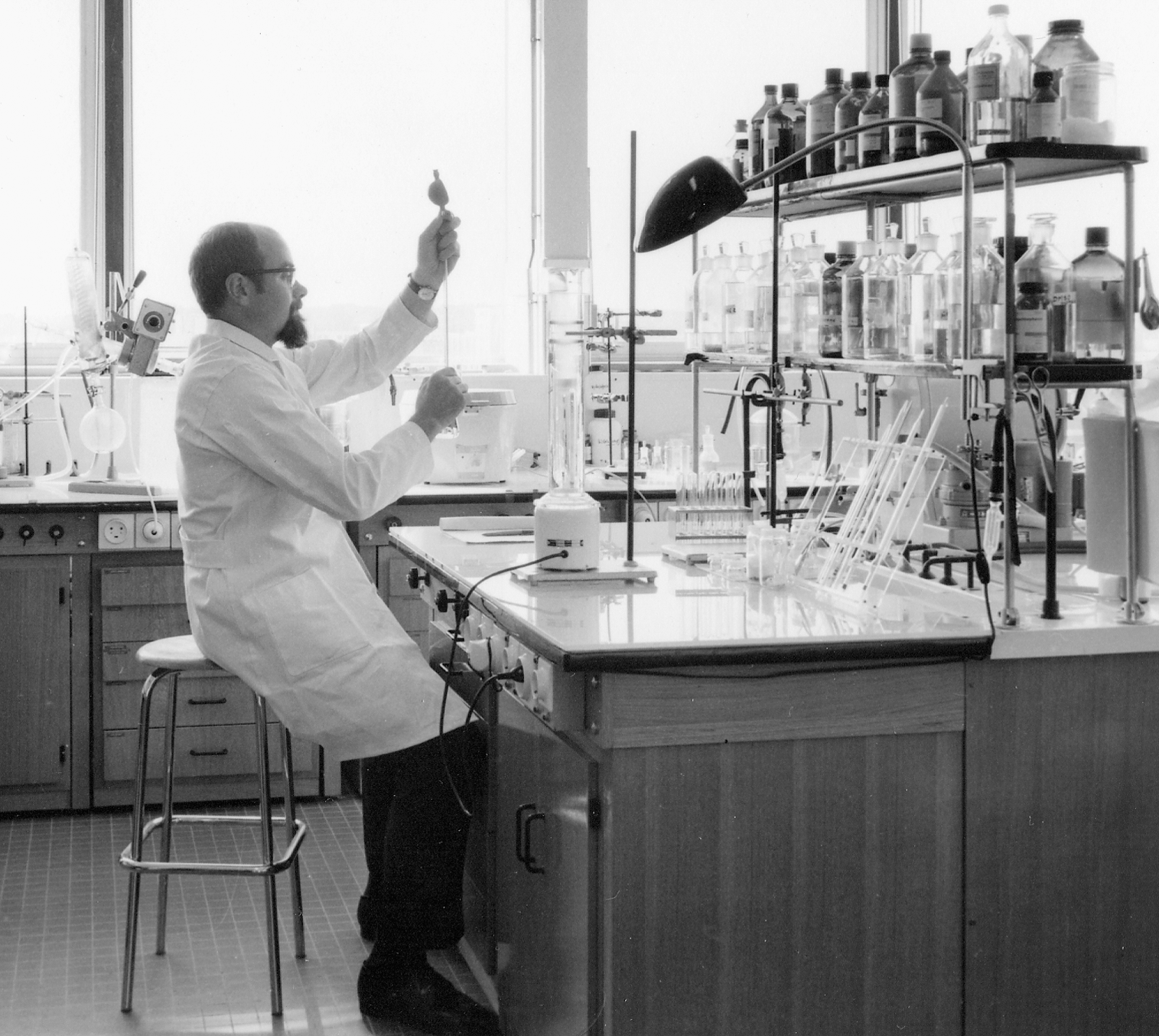
As a young chemist, at the bench.
From Silk Fibroin to Prebiotic Catalytic Peptides
After my Ph.D., and still impressed by the Miller experiment (Fig. 2), with the blessings of my mentor, Gérard Spach, and the goodwill of the successive directors of the Centre de biophysique moléculaire in Orléans, I tried to understand how simple peptides could have emerged and accumulated in the primitive oceans. At that time, exobiology was not fashionable and absolutely not welcomed by the Director of the Chemistry Department at CNRS Headquarters who tried, unsuccessfully, to drive me toward “serious” productive chemistry. Like many scientists, I am rebellious, and I have continued to run experiments for 40 years to understand the whole history of prebiotic peptides, from the delivery of amino acids to their incorporation into catalytic peptides (reviewed in Brack, 2007).
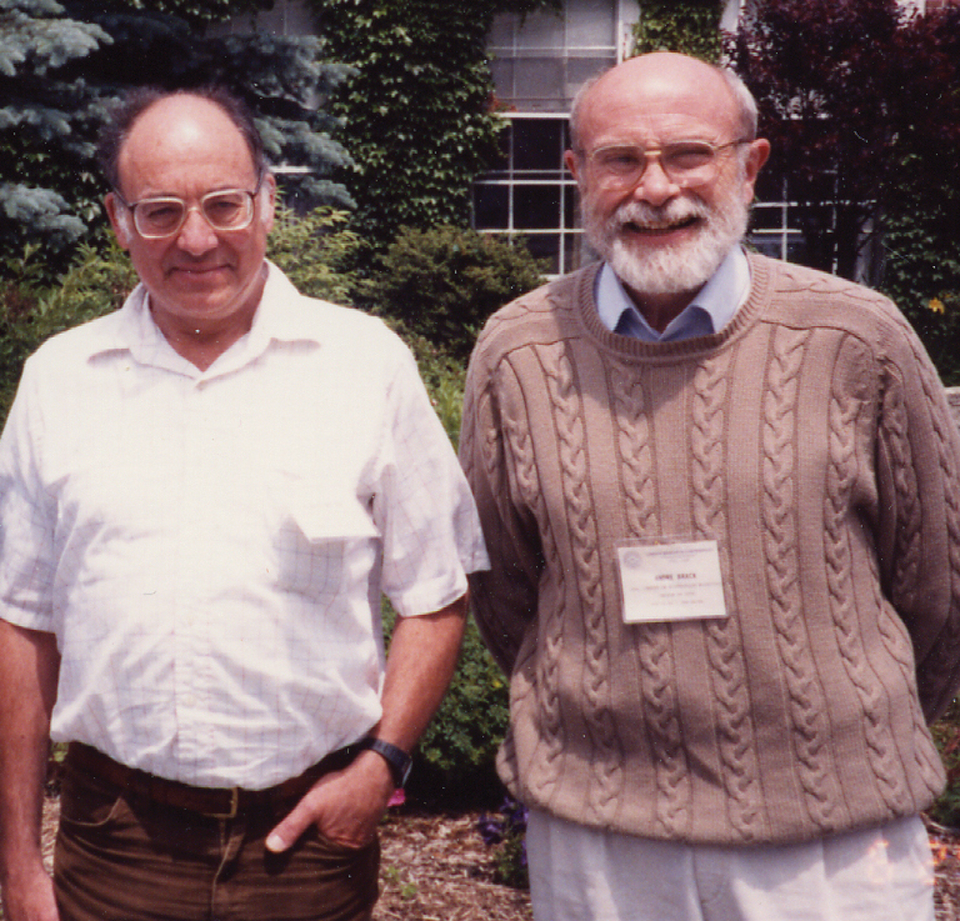
With my mentor, the late Stanley Miller. Color images available online at
Production of Primordial Amino Acids
The reducing fluids of submarine hydrothermal systems associated with their metallic sulfurs may have been an important source of amino acids on primitive Earth. During the IFREMER IRIS campaign in June 2001, I collected samples of the hydrogen-rich fluids at the Rainbow deep sea site. Amino acids were detected of the L-isomeric form, that is, as relics of living species and not chemically produced, as we had hoped.
The delivery to Earth of extraterrestrial amino acids always puzzled me. Ultraviolet irradiation of dust grains in the interstellar medium may result in the formation of complex organic molecules. To simulate this occurrence, ices of H2O, CO2, CO, CH3OH, and NH3 were deposited at 12 K under a pressure of 10−7 mbar and irradiated in a laboratory at Leiden with electromagnetic radiation representative of the interstellar medium. After the analytical steps of extraction, hydrolysis, and derivatization, 16 amino acids, including 6 protein amino acids, were identified from such samples in my laboratory in Orléans. The chiral amino acids were identified as being totally racemic. Parallel experiments performed with 13C-containing substitutes definitively excluded contamination by biological amino acids.
To demonstrate possible asymmetric photodecomposition by vacuum UV, films of racemic D,L-leucine in the solid state were irradiated with the intense and quasi-perfect circularly polarized synchrotron radiation emitted by the OPHELIE Undulator of a vacuum UV beamline at the Laboratoire d'utilisation du rayonnement electromagnetique in Orsay. After 70% photodecomposition following exposure to right-circularly polarized 182 nm wavelength radiation, the highest enantiomeric excess value gain measured was +2.6% in D-leucine.
To estimate whether amino acids could have survived a trip from the asteroid belt to Earth's surface, I devised an experiment to expose amino acids, like those detected in the Murchison meteorite, to space conditions in Earth orbit on board the unmanned Russian satellites Foton 8 and 11. The amino acids were exposed both in the free state and associated with clay minerals. Free aspartic acid and glutamic acid were partially destroyed during exposure to solar UV. However, decomposition was prevented when the amino acids were embedded in clays. Amino acids have also been subjected to solar radiation outside the Mir station for 97 days. The samples were exposed in the free state or associated with montmorillonite clay, powdered basalt, and powdered Allende meteorite. In the absence of mineral protection, about half the amino acids were destroyed by UV radiation. The main photochemical degradation process was the decarboxylation of the carboxylic acid function. Significant protection from solar radiation was observed when the thickness of the minerals added was 4–5 μm or greater.
From Amino Acids to Peptides
The synthesis of amino acid polymers appears to be simple. The condensation reaction eliminates water molecules between monomer units so that they can be linked together. However, the formation of proteins from their monomers in water is not energetically favored. In water, the peptide bond of proteins is thermodynamically unstable so energy is required to link two amino acids together in an aqueous milieu.
The most effective activated amino acid derivative for the formation of oligopeptides in aqueous solution is the N-carboxyanhydride (Leuchs anhydride). Their formation requires the derivatization of the amino group—which is known to be difficult with disubstituted amino acids due to steric hindrance—followed by a ring closure involving the α-carboxylic function. Ring closure has proven to be possible with five-membered rings (α-amino acids) and, to a lesser extent, with six-membered rings (β-alanine). It is not effective with larger rings (γ-amino-acids, γ-carboxylic group of glutamic acid, dipeptides, etc.). I successfully used N′-carbonyldiimidazole, a route to the formation of N-carboxyanhydrides, to selectively polymerize protein amino acids at the expense of the nonprotein ones. A mixture of amino acids containing both protein and nonprotein amino acids, and close to that found in the Murchison meteorite, was treated with N,N′-carbonyldiimidazole in water. The condensate was found to be enriched in protein amino acids.
Thermostable and Enantioselective Peptides
Leslie Orgel predicted that strict alternation of hydrophilic (hi) and hydrophobic (ho) amino acids should induce a β-sheet structure. As a peptide chemist, I was able to demonstrate experimentally the judiciousness of his prediction during my sabbatical year in his lab and in later work (Brack and Orgel, 1975). For example, strictly alternating homochiral poly (Val-Lys) is soluble in water. At neutral pH, the lysyl side-chain amines are ionized. Due to charge repulsion, the chain cannot adopt a regular conformation. The addition of salt to this solution produces a screening of the charges and allows the polypeptide to adopt a β-sheet structure. Even insoluble minerals, such as crystalline CdS, lead to the formation of β-sheets, whereas a tetrapeptide periodicity (-hi-hi-ho-ho-) induces an α-helix conformation.
Due to bilayer formation, strictly alternating hydrophobic-hydrophilic sequences were found to be thermostable. Non-alternating sequences form α-helices, which are thermolabile. Thus, alternating sequences are more resistant to chemical degradation than α-helical ones.
Aggregation of alternating sequences to form β-sheets is possible only with homochiral (all-L or all-D) polypeptides. For instance, racemic alternating poly (D,L-Leu - D,L-Lys) does not adopt the β-structure and remains mostly unstructured. When increasing amounts of L-residues are introduced into the racemic alternating polypeptide, the proportion of β-sheets increases, and there is a good relationship between the percentage of the β-form and the amounts of L-residues in the polymer. Those segments containing six or more homochiral residues aggregate into stable nuclei of optically pure β-sheets surrounded by the more fragile heterochiral unordered segments.
Homochiral peptides adopting β-sheet structures are protected against racemization because the β-sheet cannot accommodate heterochiral chains, contrary to the α-helical peptides, which can cope with both L- and D-amino acid residues. The kinetics of L-Asp racemization in β-sheet forming (Asp-Leu)15 and in α-helical (Leu-Asp-Asp-Leu)8-Asp were measured by Japanese colleagues (Kuge et al., 2007). The time required to reach complete racemization was estimated at 13 and 123 years, for (Leu-Asp-Asp-Leu)8-Asp and (Asp-Leu)15, respectively, indicating clearly that Asp residues racemize much faster in α-helices.
Prebiotic Catalytic Peptides
We found that peptides containing basic amino acids strongly accelerate the hydrolysis of oligoribonucleotides. Alternating poly (Leu-Lys) has been found to be the most active. For instance, the rate of hydrolysis of the oligonucleotide (Ap)9A is increased by a factor of 185 in comparison to the control run in the absence of peptides. Analysis of the hydrolysis products indicated that the polypeptide accelerates the classical base-induced hydrolysis of polyribonucleotides. The basic polypeptides form a complex with the oligoribonucleotides and adopt a β-sheet conformation. When a set of alternating poly (leucyl-lysyl) samples ranging from the racemic to the homochiral all-L polymer was tested, the hydrolytic activity followed linearly the proportion of β-sheets, indicating that the β-sheets were involved in the hydrolysis.
The Prebiotic Role of β-Sheets
These experimental studies support the idea that β-sheets could have played an important role in the origin of life. These structures are more resistant to hydrolysis than the random coil or the α-helical conformations of peptide chains. This suggests that polypeptides in β-sheet conformations would have had a longer lifetime and may have been utilized by the first life-forms. This may have resulted in the selection of only those amino acids capable of forming β-sheets. Such selectivity may have limited the number of types of amino acids in the first life-forms from the wide array of structures formed in simulation experiments or from meteoritic sources, or both.
Desperately Seeking Traces of Life on Mars
The discovery of a second genesis of life on another celestial body (Brack et al., 2010) would demonstrate the ubiquity of life and thus the relative simplicity of its emergence. Mars is a favorite target of the search for extraterrestrial life, and in September 1996 the ESA Manned Spaceflight and Microgravity Directorate asked me to convene an Exobiology Science Team to design an integrated suite of instruments dedicated to the search for life on Mars. Priority was given to the in situ organic and isotopic analysis of samples obtained by subsurface drilling (Westall et al., 2000). The basic recommendations of the Science Team are presently serving as essential guidelines for the elaboration of the ESA ExoMars mission scheduled for 2016–2018.
Because Mars had a relatively warmer and wetter past climate, it has sedimentary rocks deposited by running water within water bodies on its surface. Such consolidated sedimentary rocks ought therefore to be found among the martian meteorites. However, no such sedimentary material has been found in any SNC meteorite. It is possible that it did survive the effects of the escape acceleration from the martian surface but did not survive terrestrial atmospheric entry because of decrepitation of the cementing mineral. To study the physical and chemical modifications to sedimentary rocks during atmospheric entry from space, I initiated the STONE experiments, flown by ESA (Fig. 3). STONE is a series of experiments to test the survivability of terrestrial sedimentary rocks, analogues of martian sediments, embedded in the heat shields of Foton capsules during entry into Earth's atmosphere. At the same time, the panspermia hypothesis was tested with live endolithic cyanobacteria protected by 1–2 cm of rock thickness. A dolomite, a siltstone, a volcanic sandstone, and a basalt control sample survived entry into the atmosphere. The endolithic microorganisms did not survive. It was concluded that atmospheric transit acts as a strong biogeographical filter to the interplanetary transfer of photosynthetic microorganisms (Brack et al., 2002; Cockell et al., 2007). However, microfossils in the volcanic sandstone did survive (Foucher et al., 2010).
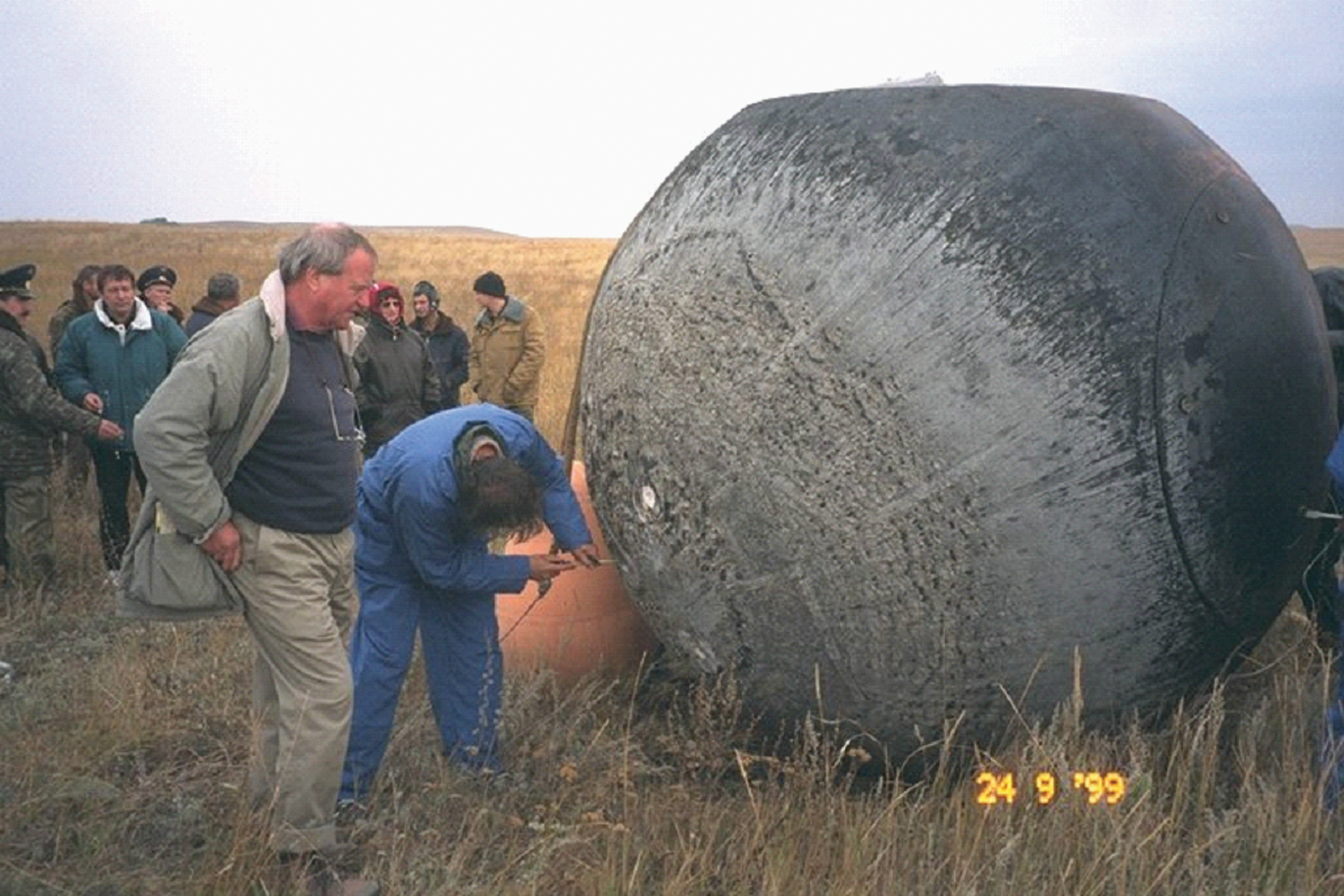
A good friend, the late Gero Kurat, watching carefully the retrieval of our STONE samples in the Kazakhstan desert. Color images available online at
Following Seneca's Recommendation
At the beginning of the Christian era, the Roman philosopher and politician Seneca wrote, “The nicest discoveries would no longer please me if I could not share them.” Following his wise recommendation, I created and chaired for over 15 years a Center for science popularization in Orléans. Eight scientific animators create and circulate exhibits on a local, national, and international level. They also organize scientific lectures and debates for the public as well as the annual “Fête de la Science.” Personally, I enjoyed the pleasure of sharing what I have learned by delivering numerous public lectures to the public and scholars, giving radio and TV interviews, and writing eight books.
At the European level, in 1999 I considered, together with Gerda Horneck, the late David Wynn-Williams, and Beda Hofmann, that there would be real interest for Europe to create a European Astrobiology Network to help European researchers developing astrobiology programs share their knowledge, to foster their cooperation, to attract young scientists to this quickly evolving interactive field of research, and to explain astrobiology to the public at large (Brack et al., 2001). Today, the network, which I had the privilege of chairing until 2005, includes 19 countries.
Conclusion
By demonstrating in 1953 that it was possible to form amino acids, the building blocks of proteins, from methane, a simple organic molecule containing only one carbon atom, Stanley Miller generated the ambitious hope that chemists will be able to create life in a test tube. Despite the tremendous efforts of chemists tackling the problem, it must be acknowledged that the dream has not yet been accomplished. The chances of success will obviously depend upon the simplicity of the chemical reactions leading to life. The discovery of a second genesis of life on another celestial body would demonstrate the ubiquity of living matter and the relative simplicity of its emergence. The quest for a second genesis is supported by the long-lasting societal questions “Is there life out there?” and “Are we alone?” already raised by Epicurus when he wrote to Herodotus “There is an infinite number of worlds and one cannot prove that they are not alive.” Today, we have the tools to make this old dream an astrobiology reality. The road has been long since we started the exobiology adventure in Europe, but now it is a well-established science recognized by space and funding agencies. The driving force was undoubtedly the goodwill of exceptional scientists from very different disciplines combining their efforts. On a more personal level, I have enjoyed a fascinating professional activity and have been able to appreciate the great pleasure of discovery. I still feel elated when I can share the happiness of understanding, following Einstein's recommendation: “Wichtig ist, dass man nicht aufhört zu fragen.” (It is essential never to stop asking questions.) The discovery of a second genesis of life, either synthetic in the lab or natural on an extraterrestrial body, is my personal ultimate astrobiology dream.
Footnotes
Acknowledgments
This is an excellent occasion to thank all the exo/astrobiologists I have met for the quality of their company while enjoying good science, good food, and good wine. They are too numerous to be quoted individually, but they know who they are, for sure.