




Abstract
Accumulation of biopolymers should have been an essential step for the emergence of life on primitive Earth. However, experimental simulations for submarine hydrothermal vent systems in which high-temperature water spouts through minerals within a short time scale have not been attempted. Here, we show that enhancement of hydrothermal oligopeptide elongation by naturally occurring minerals was successfully verified for the first time by using a mineral-mediated hydrothermal flow reactor system (MMHF). MMHF consists of a narrow tubular reactor packed with mineral particles, and the enhancement or inhibitory activities of 10 types of naturally occurring minerals were successfully evaluated for an elongation reaction from (Ala)4 to (Ala)5 and higher oligopeptides in the absence of condensation reagents. It was unexpected that calcite and dolomite facilitated the elongation from (Ala)4 to (Ala)5 and higher oligopeptides with 28% yield at pH 7, while tourmaline, galena, apatite, mica, sphalerite, quartz, chalcopyrite, and pyrite did not show enhancement activities. These facts suggest the importance of carbonate minerals for the accumulation of peptide in primitive Earth environments. Key Words: Hydrothermal reaction—Oligopeptide—Mineral—Calcite—Carbonate—Second time scale. Astrobiology 11, 461–469.
1. Introduction
S
2. Materials and Methods
2.1. Chemicals
Naturally occurring minerals were obtained and treated as follows. Calcite (1), pyrite, sphalerite, galena, aragonite, and montmorillonite were purchased from Alfer Aesar (Johnson Matthey Company, Japan). Calcite (1), sphalerite, galena, and aragonite were crushed and sieved to obtain a fraction (150–250 μm), and pyrite was sieved to obtain a fraction (75–150 μm). Calcite (1) was also sieved to obtain a fraction (40–75 μm). Montmorillonite was used without further treatment. Calcite (2) and zeolite were a gift from NFK (Nitto Funka Kogyo K.K.) Co. Ltd. Japan, which had been sieved in advance with 70 mesh (ca. 212 μm), and these were used without further treatment. Calcite (3) (Musashino, Japan) and dolomite (Cebu, Philippines) were gifts from JFK mineral Co. Ltd. Japan, and these were sieved (150–250 and 75–150 μm, respectively). Mica (C-83) and mica (CS-060DC) were a gift from Yamaguchi Mica Co. Ltd. Japan, and these were sieved to obtain a fraction (150–250 μm). Chalcopyrite (Agenosu-sawa, Takasu, Akita Prefecture, Japan) was obtained from Self Creation Inc. Japan, and it was crushed and sieved (75–150 μm). Tourmaline (Brazil) and apatite (Brazil) were obtained from Chie Co. Ltd. Japan. Tourmaline, which was sieved in advance at 325 mesh (44 μm), was used without further treatment. Apatite was grained and sieved to obtain a fraction (150–250 μm). Quartz sand was purchased from Wako Chemical Co. Ltd. Japan and sieved to obtain a fraction (250 μm<). Alanine oligopeptides, which included
The chemical formula of the minerals is as follows; the naturally occurring minerals frequently involve minor components: apatite, Ca5(PO4)3(F,Cl,OH); aragonite, CaCO3; calcite, CaCO3; chalcopyrite, CuFeS2; dolomite, CaMg(CO3)2; galena, PbS; mica (muscovite), KAl2(Si3Al)O10(OH,F)2; montmorillonite, (Na,Ca)0.3(Al,Mg)2Si4O10(OH)2·nH2O; pyrite, FeS2; quartz, SiO2; sphalerite, ZnS; tourmaline, Na(Mg,Fe,Mn,Li,Al)3Al6(BO3)3Si6O18(OH,F)4; zeolite (mordenite), (Ca,Na2,K2)Al2Si10O24·7H2O. These minerals are normally considered to form under moderate- to high-temperature hydrothermal conditions (Bunno and Aoki, 1996).
2.2. Mineral-mediated hydrothermal flow reactor
The mineral-mediated hydrothermal flow reactor (MMHF) was designed on the basis of our previous method (Kawamura, 2000) and was attached with a high-temperature tubular reactor packed with naturally occurring mineral particles (Fig. 1). MMFR consists of a water reservoir, a high-pressure pump (Shimadzu LC-10AD), a sample injector (Rheodyne 7725i), a high-temperature tubular reactor [φ 1.5 mm×150 mm (effective length 100 mm)] packed with natural mineral particles (MMHF), a temperature controller, a block heater for the high-temperature tubular reactor, a quenching bath, a pressure regulator (Upchurch Scientific, P-880), and a sampling port. The thermocouple was located such that it connects to the high-temperature tubular reactor. Regulation of the flow rate controls the residence time during which the sample is exposed to high temperatures in the presence of mineral particles. It was established that the time required for heating up the sample solution to a target temperature is sufficiently short to the residence time where the sample solution is exposed at high temperature. It was confirmed that the quenching of the sample is also sufficiently fast (Kawamura, 2000). Filters were placed at both the inflow and outflow ends of the high-temperature tubular reactor to avoid entrainment and loss of the mineral particles. Both ends of the reactor were placed outside the block heater to avoid the thermal degradation of filtering materials. Different types of filters, such as a stainless-steel filter, a Teflon filter, and a cellulose filter, were examined to establish whether these are suitable for this system. Minerals in powdered form were obtained from different sources and used without further treatment. Massive minerals were ground to powders and sieved. MMHF enables analysis of the hydrothermal products catalyzed by minerals over the short time period required to form oligopeptides within 3–210 s at temperatures up to 300°C. The temperature was controlled at ±1%, and the pressure in the reactor was regulated at 12 MPa.
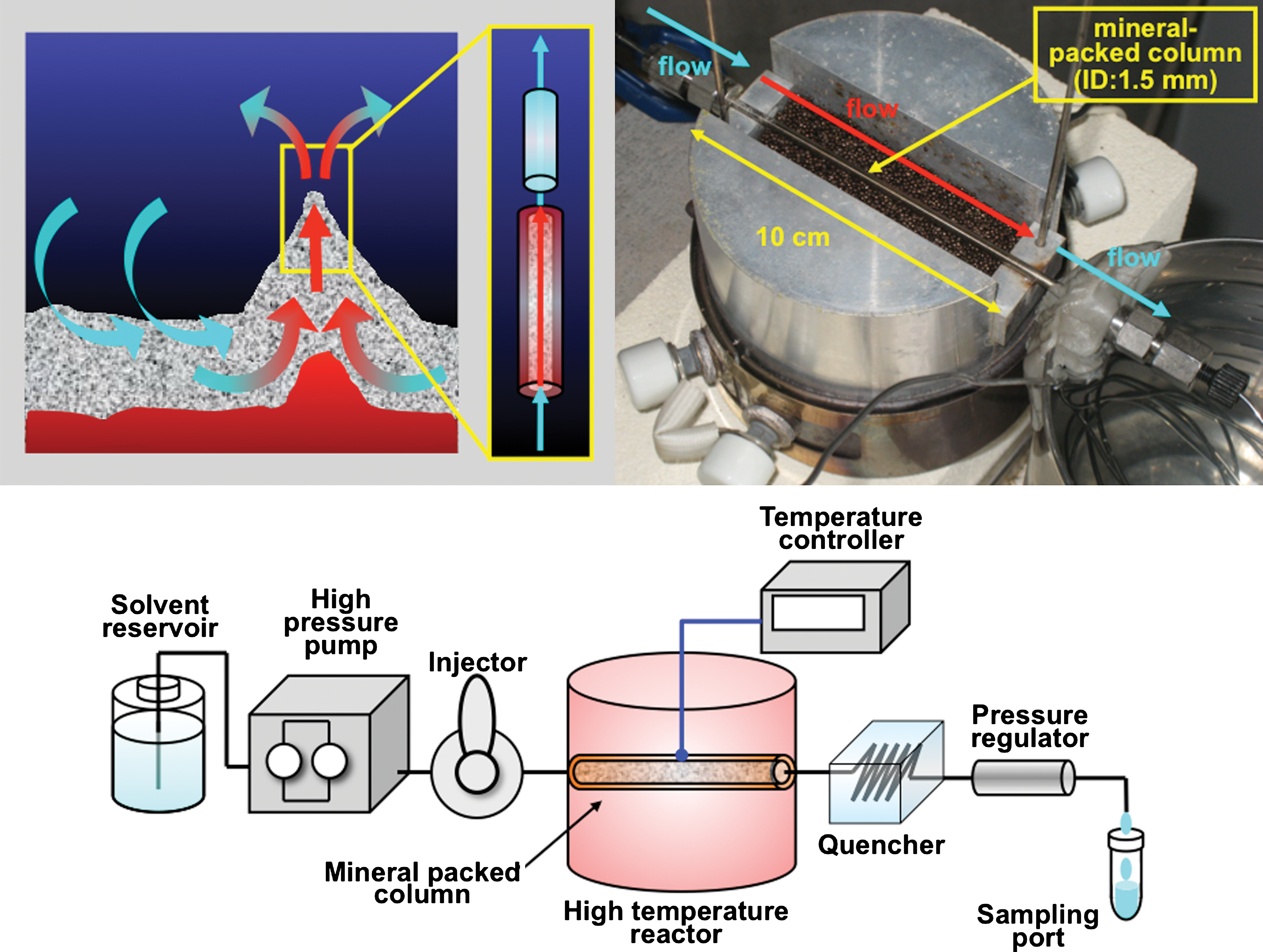
Mineral-mediated hydrothermal flow reactor system (MMHF). Top left: the simplified pathway of aqueous solution in the hydrothermal vent system in deep sea. Top right: inside of the hydrothermal flow reactor, where the narrow column is packed with mineral particles. Bottom: the flow reactor system designed for hydrothermal reaction analysis with mineral-mediated high-temperature reactor. Color images available online at
2.3. Sample preparation and high-performance liquid chromatography analysis
Samples containing NaCl, MgCl2, and (Ala)4 were injected to the MMHF system. The elongation reaction of (Ala)4 was carried out by using MMHF within 3–210 s at temperatures 225–275°C at 12 MPa. The reaction products were analyzed with high-performance liquid chromatography (HPLC). HPLC was performed by a LC10A system (Shimadzu, Japan) with a reversed-phase column [2.0 mm (inner diameter)× 10 cm (length), CAPCELLPAK C18 UG120, Shiseido] with a guard column [2.0 mm (inner diameter)×3.5 cm (length), CAPCELLPAK C18 UG120, Shiseido] with a gradient of 5 mM NaH2PO4 and 3.6 mM CH3(CH2)5SO3Na at pH 2.65 (Eluent A) mixed with 10 mM NaH2PO4 and 7.2 mM CH3(CH2)5SO3Na in 50% at pH 2.5 (Eluent B). A linear gradient of B% from 5% (0 min), 40% (15 min), 40% (25 min) was used for the analysis at the flow rate 0.2 mL/min at 35°C. All the detection was performed at 220 nm on the basis of the sensitivity and the low background.
Simulations of the reactions were carried out with Mathematica 5.2.
3. Results
3.1. Detection of mineral enhancement for oligopeptide elongation
The previous study regarding the reaction behavior of (Ala)4 at high temperatures demonstrated that the reaction of (Ala)4 at high temperatures forms mainly 3,6-dimethyldiketopiperazine (DKP) and alanine (Ala) but also results in the elongation to (Ala)5 and higher oligopeptides during the degradation of (Ala)4 (Kawamura et al., 2005). In the present study, the influence of naturally occurring minerals from different sources was verified for the elongation of (Ala)4. Montmorillonite, zeolite, aragonite, and mica (CS-060DC) were not applicable to MMHF measurements since the minerals blocked the flow in the tubular reactor. However, the influence of quartz sand, tourmaline, apatite, calcite (1), calcite (2), calcite (3), dolomite, chalcopyrite, sphalerite, galena, and mica was successfully observed within 3–210 s at 275°C. Although the reaction in the presence of pyrite was observable at 225°C and 250°C, the pressure of MMHF notably rose at 270°C so that the measurement at 275°C was not possible, presumably because of the deformation of pyrite releasing H2S.
The HPLC profile of the reaction products with minerals resembles that obtained without minerals, where the disappearance of (Ala)4 to form DKP and Ala are the main reactions and the formation of (Ala)5 is observed (Fig. 2). The HPLC peaks eluted after (Ala)5 reflect the formation of (Ala)6 and higher oligopeptides; the characterization of these products was extensively carried out in the previous study. The (Ala)5 was identified by using an authentic (Ala)5, and higher oligopeptides, including (Ala)6, were characterized with MALDI-MS analysis (Kawamura et al., 2005). In these reactions, partial racemization to form diastereomers occurs during the formation of (Ala)5. The formation of two peaks of DKP is due to the racemization during the (Ala)4 degradation. However, the peak for (Ala)4 in HPLC does not show the difference of retention time among (Ala)4 diastereomer. The HPLC profile of the reaction products of (Ala)4 with
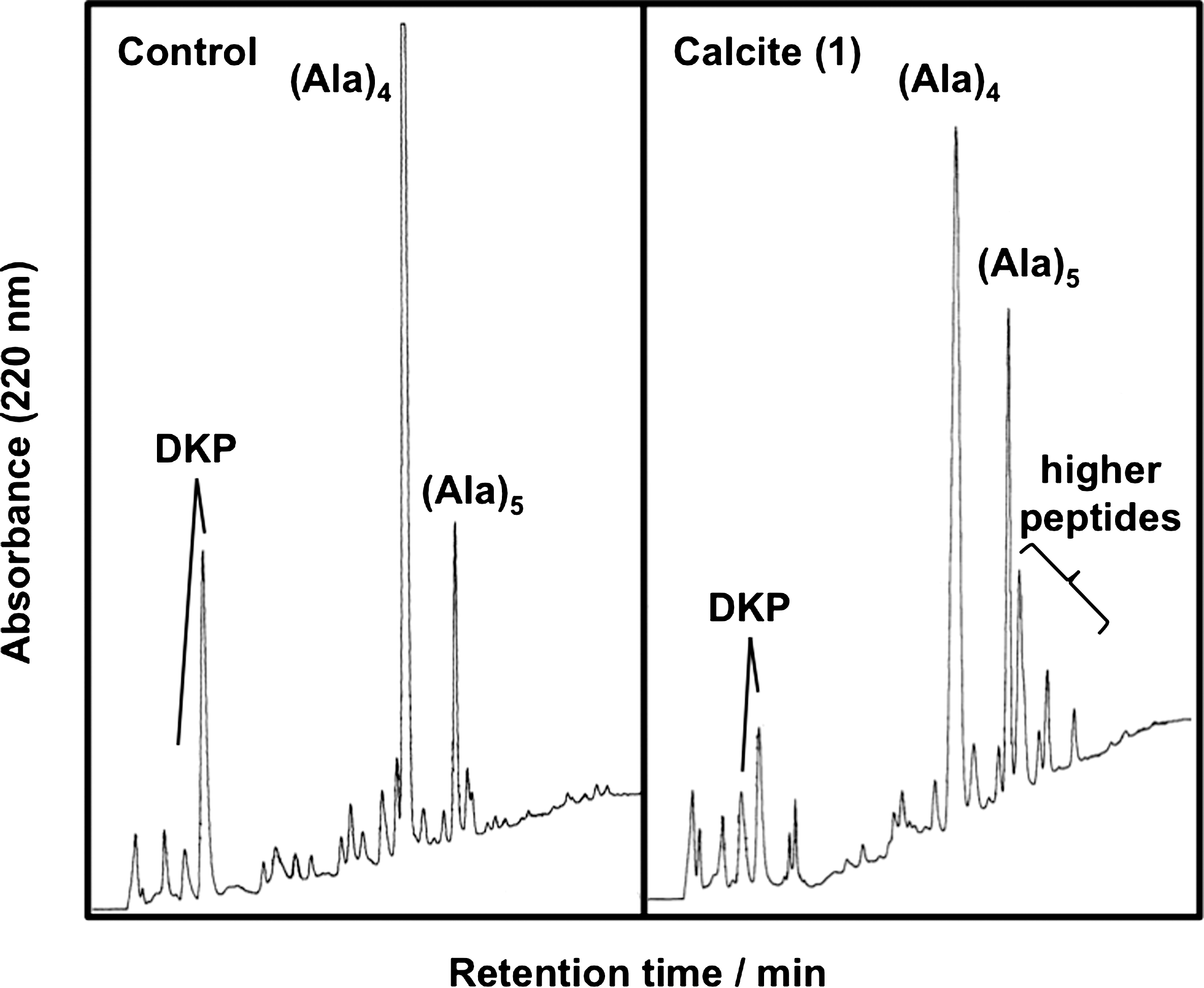
HPLC analysis of the spontaneous elongation of (Ala)4 to (Ala)5 in the absence and presence of a calcite mineral. Left: control reaction. Right: in the presence of calcite (1) from Alfer Aesar (Johnson Matthey Company, Japan). Reaction conditions: [(Ala)4]=1 mM, [NaCl]=0.1 M, [MgCl2]=0.05 M, pH=7.0, 275°C, 12 MPa, 16.4 s.
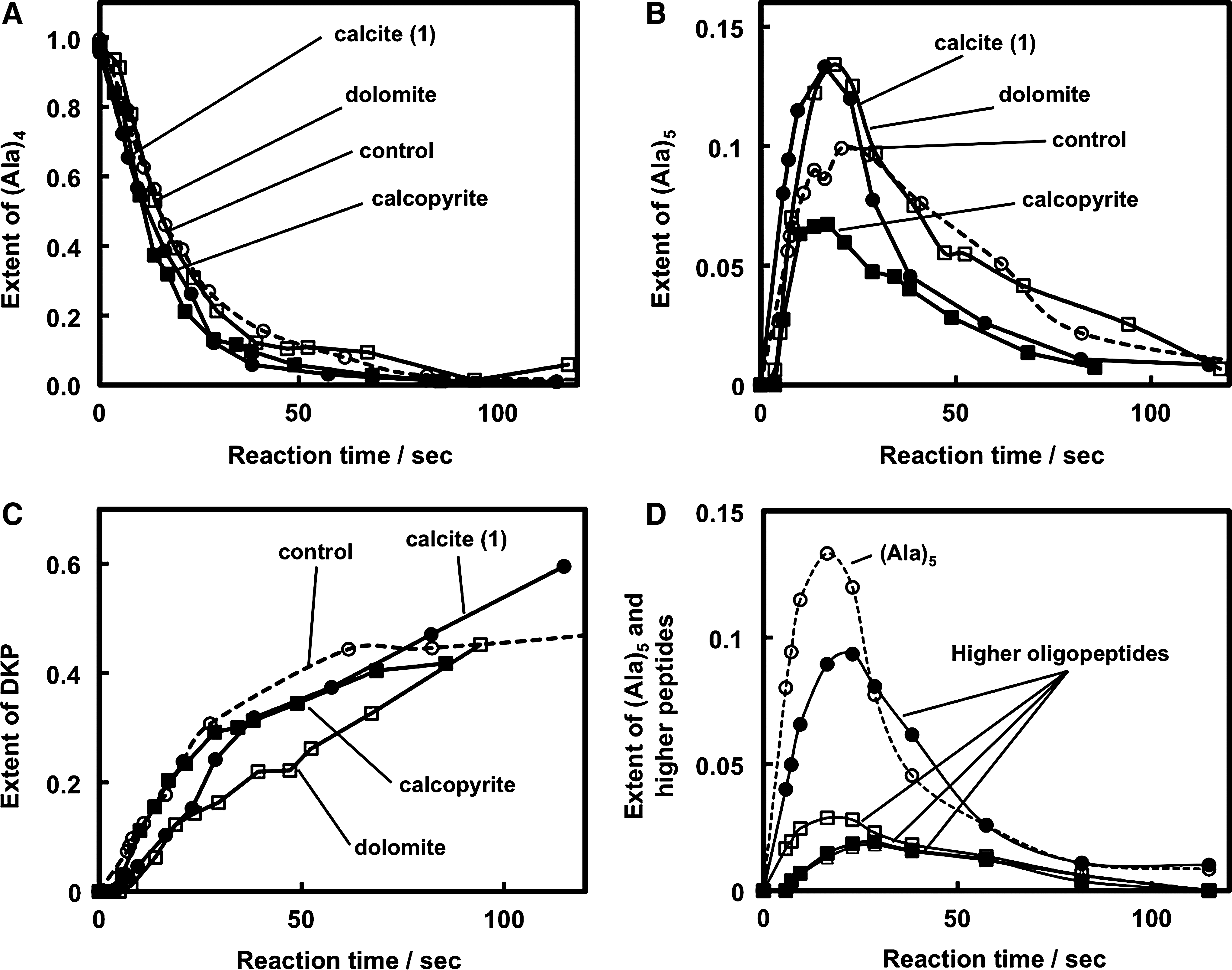
Reaction curves of the formation of (Ala)5 from (Ala)4 in the presence of several minerals during the degradation of (Ala)4 to 3,6-dimethyldiketopiperazine (DKP). (

Extent of (Ala)5 and higher peptides at the maximum yield using different naturally occurring minerals. Bars: extent of (Ala)5 and higher oligopeptides. Open squares: k app. The extent in vertical axis indicates the ratio of the products to the original (Ala)4.
Tourmaline, galena, apatite, mica (C-83), and sphalerite were less effective in the generation of (Ala)5. Quartz sand and chalcopyrite showed weak inhibitory activities for the (Ala)5 formations, where the maximum yield was reduced to 7% (Fig. 4). No enhancement of (Ala)4 formation in the presence of pyrite could be detected at 225°C and 250°C.
3.2. Influence of pH
The pH value for the elongation of (Ala)4 is an important factor since these minerals might change the pH conditions during the hydrothermal reactions. That is, the enhancement of elongation of (Ala)4 might be due to an indirect effect of the pH change of aqueous solution by minerals. Thus, the contribution of pH for the elongation of (Ala)4 was evaluated at different pH both in the absence and presence of minerals. The pH of sample solutions was adjusted at room temperature during the sample preparation. The pH values of samples shift to lower values at 275°C. In the absence of minerals, it was found that the yield of (Ala)5 increases with increasing pH (Fig. 5A). Based on the reaction curves, the disappearance rate constants (k app) of (Ala)4 were calculated at pH 2–12 (Fig. 6), where the disappearance of (Ala)4 follows the first-order kinetics.
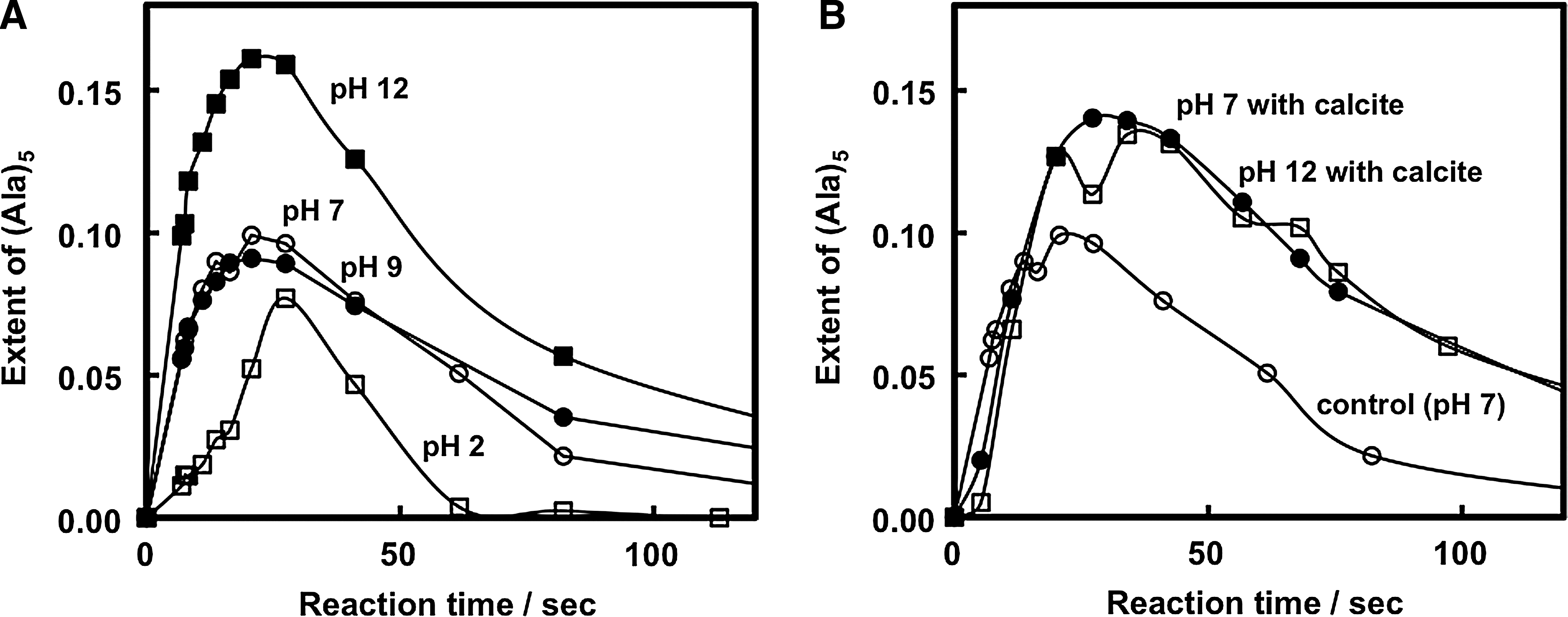
The reaction curves for the appearance of (Ala)5 from (Ala)4 at different pH in the absence and presence of calcite mineral. Reaction conditions are the same as shown in Fig. 3. (
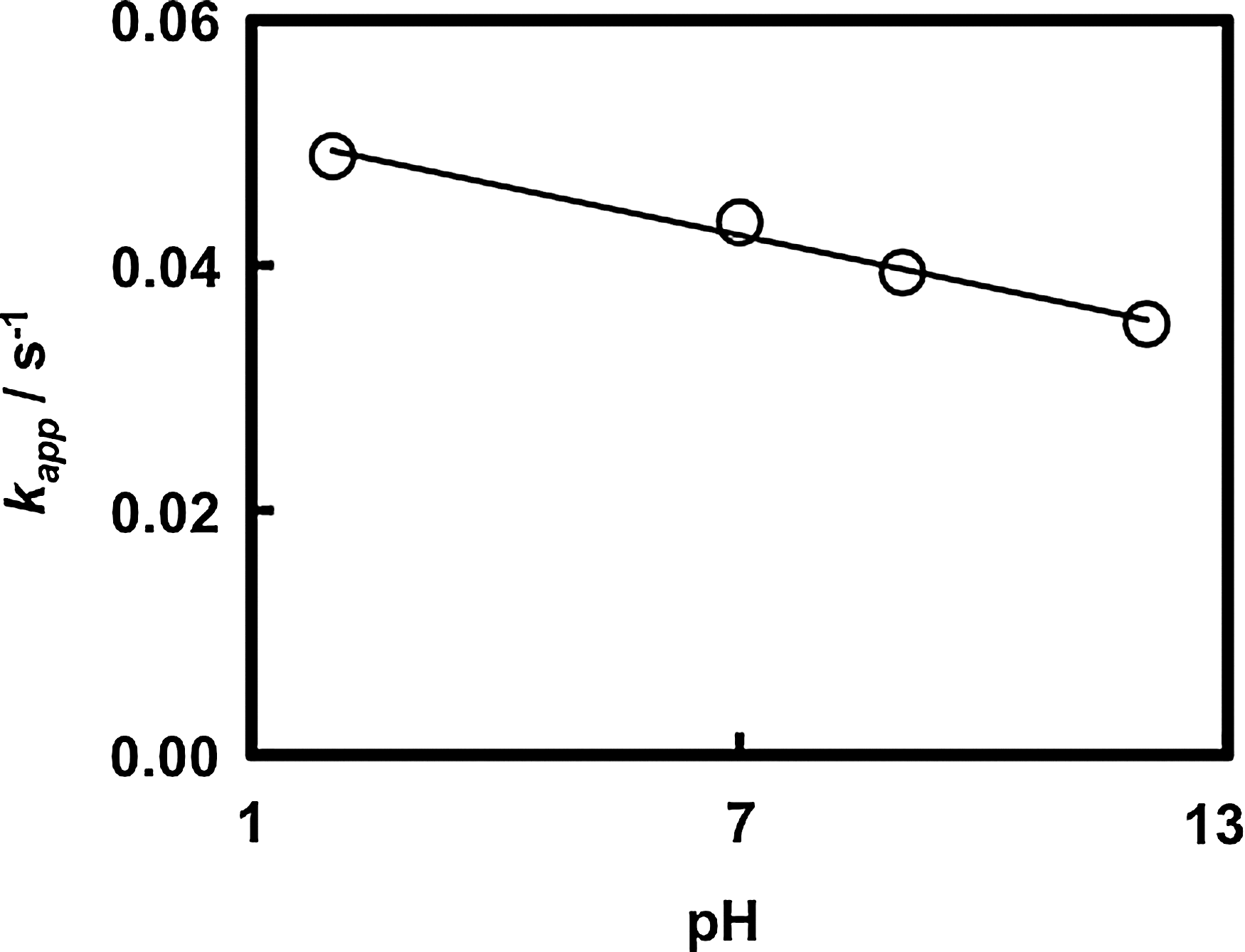
The apparent rate constants for the disappearance of (Ala)4 vs. pH.
On the other hand, the yields of (Ala)5 and the disappearance rate of (Ala)4 in the presence of calcite (2) were less dependent on pH (Fig. 5B). In addition, the pH of distilled water eluted through MMHF, which was controlled at 275°C, showed that the pH of the solution was 6.8.
4. Discussions
4.1. Reaction behavior
The total yields of (Ala)5 and higher oligopeptides from (Ala)4 in the presence of calcite (1), calcite (2), and dolomite without the use of a condensation agent are fairly high when compared to conventional hydrothermal formation pathways from amino acids or short peptides in the absence of minerals (Imai et al., 1999; Kawamura et al., 2005). Even calcite (3) showed some enhancement of activity as compared to other less-active minerals. According to our previous study, the elongation from (Ala)4 to (Ala)5 and higher oligopeptides in the absence of a mineral proceeds consecutively, so it is reasonable to assume that the elongation that occurs in the presence of minerals would be similar to elongation in the absence of minerals. However, the reaction curves of higher oligopeptides show that some of the higher oligopeptides form spontaneously with (Ala)5 from (Ala)4. This fact might indicate that some higher oligopeptides would form through different pathways rather than the simple elongation from (Ala)5 to higher oligopeptides. Two different kinds of calcite and one dolomite showed notable enhancement for the (Ala)4 elongations. This fact suggests that carbonate minerals would have facilitated the primitive oligopeptide formation on primitive Earth since carbonate minerals should have been formed under the high carbon dioxide pressure (Peter and Shanks, 1992), which is dependent on pH and temperatures (Macleod et al., 1994).
In contrast, silicate (quartz, mica, tourmaline) and phosphate (apatite) minerals showed a weak inhibition or no enhancement. In addition, it is noted that sulfide minerals (sphalerite, galena, and pyrite) did not show enhancement, and chalcopyrite showed a weak inhibitory activity. These facts are interesting in that, while further investigations for these types of mineral activities are needed, some investigators have predicted that sulfide minerals were an important factor in the chemical evolution of primitive biopolymer formation (Huber and Wächtershäuser, 1998; Huber et al., 2003).
In the absence of minerals, the pH dependence for the disappearance rate of (Ala)4 and the increase of (Ala)5 suggests that the decrease of k cleavage contributes the increase of (Ala)5 (Figs. 5A and 6). Based on thermodynamic data, it is estimated that the pH of the present solution prepared at pH 7 and 12 at 25°C changes to around pH 4 and 9 at 275°C, where (Ala)4 exist as zwitterions at pH 4 and anionic form at pH 9 at 275°C (Perrin, 1965; Helgeson, 1967; Sillen and Martell, 1971; Serjeant and Dempsey, 1979; Kawamura et al., 2005). However, the k app is not strongly dependent upon pH. This indicates that the distribution of cationic, zwitterionic, and anionic species of (Ala)4 does not strongly affect the cleavage rate of (Ala)4. On the contrary, the yield of (Ala)5 in the presence of calcite (1) is not dependent on pH at 7 and 12. Furthermore, the pH of the distilled water, which is exposed in the high-temperature flow reactor at 275°C packed with calcite, was collected from the outlet of MMHF. The pH value of the distilled water showed that the pH value was 6.8. This indicates that calcite does not affect the pH value of solutions at high temperatures. This is consistent with the fact that calcite does not readily dissolve in water at high temperatures (Segnit et al., 1962; Bischoff and Seyfried, 1978). The influence of calcite (1) for the elongation of (Ala)4 conclusively demonstrates the net influence of this mineral.
4.2. Kinetic analysis
To evaluate the mechanism for the enhancement of (Ala)4 elongations, kinetic simulations were carried out. Although the disappearance rate of (Ala)4 and the extent of the formation of (Ala)5 are dependent on the types of minerals present, the correlation between the disappearance rate and the yield of (Ala)5 was not observed. The disappearance rates of (Ala)4 follow the pseudo-first-order kinetics, and the reaction behavior in the presence of minerals is basically the same as that in the absence of minerals. Thus, the reaction mechanism proposed in the previous study (Kawamura et al., 2005) is applied to the present mineral systems. Diastereomers formed by racemization cannot be distinguished on the basis of the present HPLC analysis. Thus, the disappearance rate of (Ala)4 (k
app) is simply expressed by the combination of the cleavage rate of the peptide bonding of (Ala)4 and the formation of (Ala)5 from (Ala)4 as shown in Eq. 1.
The contribution of the degradation process of (Ala)4 and the elongation of (Ala)4 for the efficiency of (Ala)5 formations was inspected by using a computer simulation on the basis of the following model.
Here, the degradation of (Ala)4 proceeds by the cleavage of peptide bonding of (Ala)4 to form Ala,
Naturally, the extent of (Ala)5 increases with increasing magnitude of k form. Besides, the extent of (Ala)5 increases with decreasing the magnitude of k cleavage (Fig. 7). That is, the extent of (Ala)5 is determined on the basis of the relationship among the relative magnitudes of these rate constants. Where these minerals are absent, the yield of (Ala)4 increases with increasing pH, and the magnitude of k app decreases with increasing pH. Thus, the enhancement of (Ala)5 yield in the absence of minerals would be due to the decrease of k cleavage. On the contrary, based on the present data regarding the influence of minerals, there is no correlation between the disappearance rate constant of (Ala)4 (k app) and the extent of (Ala)5 (Fig. 4). Thus, the apparent influence of minerals for the extent of (Ala)5 reflects the influence for the formation of (Ala)5 by the minerals regarding k form rather than the stabilization of (Ala)4 by the minerals.
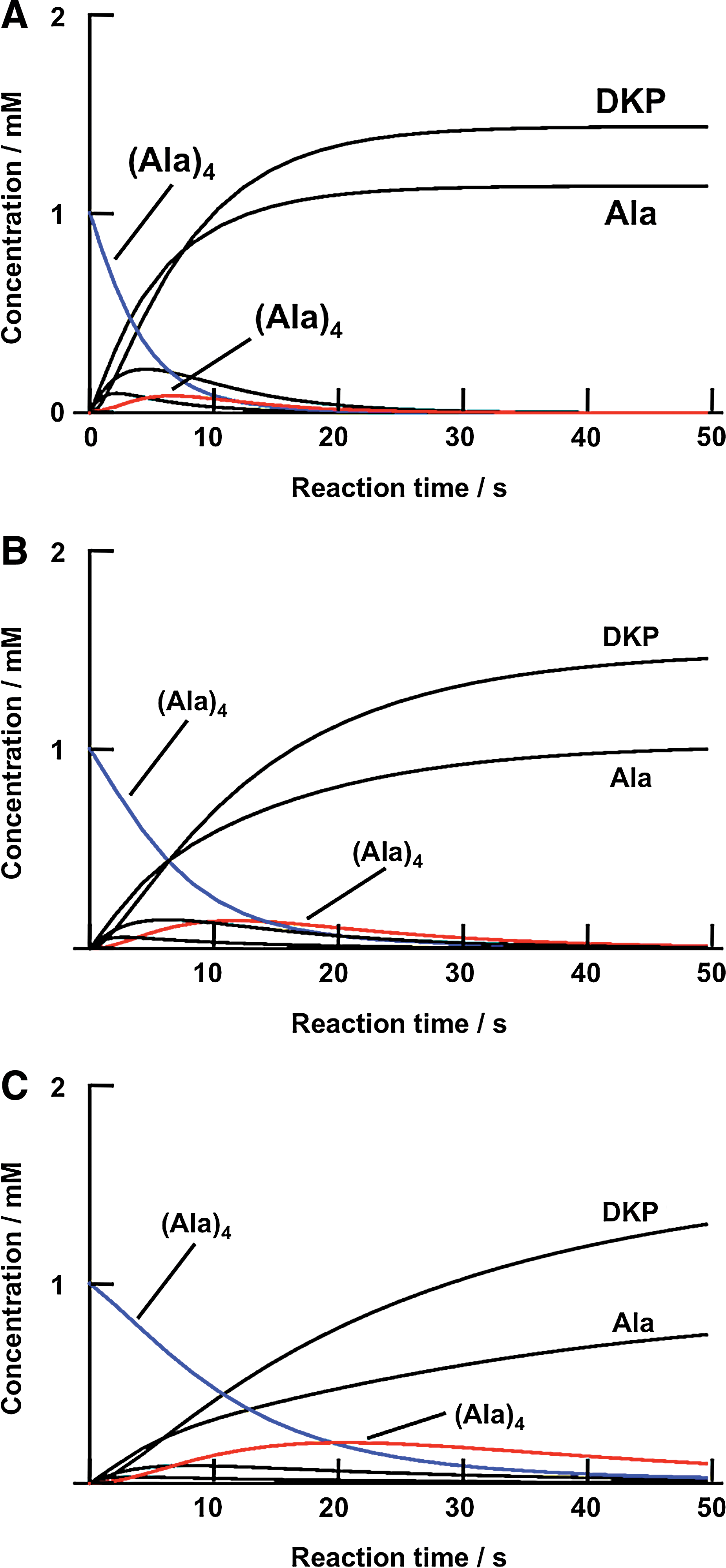
Simulation of hydrothermal reaction of (Ala)4 system. Initial concentrations: [(Ala)4]=0.001 M, [Ala]=[(Ala)2]=[(Ala)3]=[(Ala)5]=[DKP]=0 M. Rate constants: k(DKP formation from (Ala)2)=0.25 s−1, k(DKP formation from (Ala)3)=0.88 s−1, k(form of (Ala)5 from (Ala)4)=150 M
−1 s−1. (
The reaction mechanism for the enhancement by calcite and dolomite is not clear at the present time. The fact that only calcite and dolomite show enhancement indicates that the enhancement would be due to the crystal framework of alkaline metal ion and carbonate. In addition, very recently, the catalytic hydrolysis of short oligopeptides by pyrite was detected (Marshall-Bowman et al., 2010). This might be related with the inhibitory activity of sulfide minerals shown in this study. The trace amount of metal ions involved in the naturally occurring minerals might be important for the enhancement of (Ala)5 formation. In addition, the circulation time of deep-sea water through hydrothermal vent systems would be many orders of magnitude longer than the time scale used in the present study (Lalou et al., 1993; Kadko and Butterfield, 1998; Jean-Baptiste et al., 2004), something to be considered for future experimentation.
In conclusion, this study demonstrated that carbonate minerals facilitate the elongation of oligopeptides under hydrothermal conditions. This study also showed that the indirect influences of pH change and the stabilization of Ala in the presence of the minerals were not the reason for the enhancement of oligopeptide elongation. Furthermore, MMHF is a powerful tool for the kinetic investigations of the reaction behaviors in the presence of mineral particles under hydrothermal conditions. Naturally, the principle of MMHF would be applicable to a variety of fields regarding hydrothermal reactions with solid particles as well as chemical evolution of biopolymers.
Footnotes
Acknowledgments
We thank Nitto Funka Kogyo Co. Ltd. Japan, JFK mineral Co. Ltd. Japan, and Yamaguchi Mica Co. Ltd. Japan for the gift of minerals. This research was supported by Grant-in-Aid for Scientific Research in Japan, 20540476 from JSPS of Japan, a research grant from The Mazda Foundation, and Grant-in-Aid for Scientific Research 21200004 (2009-2011) on Innovative Areas from MEXT of Japan. The Engineering Laboratory and Workshop Center, Osaka Prefecture University, facilitated this work by generously preparing MMHF.
Abbreviations
Ala, alanine; DKP, dimethyldiketopiperazine; HPLC, high-performance liquid chromatography; MMHF, mineral-mediated hydrothermal flow reactor system.