




Abstract
Despite the extensive search for glycine (NH2CH2COOH) and other amino acids in molecular clouds associated with star-forming regions, only upper limits have been derived from radio observations. Nevertheless, two of glycine's precursors, formic acid and acetic acid, have been abundantly detected. Although both precursors may lead to glycine formation, the efficiency of reaction depends on their abundance and survival in the presence of a radiation field. These facts could promote some favoritism in the reaction pathways in the gas phase and solid phase (ice). Glycine and these two simplest carboxylic acids are found in many meteorites. Recently, glycine was also observed in cometary samples returned by the Stardust space probe.
The goal of this work was to perform theoretical calculations for several interstellar reactions involving the simplest carboxylic acids as well as the carboxyl radical (COOH) in both gas and solid (ice) phase to understand which reactions could be the most favorable to produce glycine in interstellar regions fully illuminated by soft X-rays and UV, such as star-forming regions. The calculations were performed at four different levels for the gas phase (B3LYP/6-31G*, B3LYP/6-31++G**, MP2/6-31G*, and MP2/6-31++G**) and at MP2/6-31++G** level for the solid phase (ice).
The current two-body reactions (thermochemical calculation) were combined with previous experimental data on the photodissociation of carboxylic acids to promote possible favoritism for glycine formation in the scenario involving formic and acetic acid in both gas and solid phase. Given that formic acid is destroyed more in the gas phase by soft X-rays than acetic acid is, we suggest that in the gas phase the most favorable reactions are acetic acid with NH or NH2OH. Another possible reaction involves NH2CH2 and COOH, one of the most-produced radicals from the photodissociation of acetic acid. In the solid phase, we suggest that the reactions of formic acid with NH2CH or NH2CH2OH are the most favorable from the thermochemical point of view. Key Words: Interstellar molecules—Interstellar environments—Abiotic organic synthesis—Extraterrestrial organic compounds—Prebiotic chemistry. Astrobiology 11, 883–893.
1. Introduction
Recent improvements of radio astronomy techniques have increased our ability to identify interstellar organic molecules. The possibility of prebiotic molecules such as amino acids, which are the building blocks of living organisms, may provide important information about the history of the Solar System and the origins of life on Earth (Charnley et al., 2002). Kuan et al. (2003) searched for glycine (NH2CH2COOH), the simplest proteinaceous amino acid, through hot molecular cores associated with the star-forming regions Sgr B2(N-LMH), Orion KL, and W51 e1/e2, but these identifications have not yet been confirmed (Snyder et al., 2005; Cunningham et al., 2007). However, more than 70 amino acids (including glycine) have been identified in meteorites, as in the case of the Murchison meteorite (Cronin and Pizzarello, 1983). In addition, Sandford et al. (2006) analyzed cometary samples returned to Earth by NASA's Stardust spacecraft and found several amines and possibly the glycine amino acid. However, the origin of these compounds could not be firmly established. Subsequently, Elsila et al. (2009) presented the stable carbon isotopic ratios of glycine identified in Stardust-returned foil samples measured by gas chromatography–mass spectrometry coupled with isotope ratio mass spectrometry. The δ 13C value for glycine of +29 ± 6% strongly suggests an extraterrestrial origin because it represents the first detection of a cometary amino acid.
Sgr B2, Orion KL, and W51 are massive star-forming regions where the presence of widespread UV and X-ray fields from young-type stars (O and B stars) illuminate large portions of the interstellar gas. Experimental and theoretical studies (e.g., Goicoechea et al., 2004; Pilling et al., 2006, 2009; Nuevo et al., 2008) have shown that complex chemistry can occur both in the gas phase and in astrophysical ices, even in dense molecular clouds where the temperatures reach 10–20 K. UV and soft X-ray photons introduce significant energy into the ice, breaking chemical bonds and generating radicals, which may recombine with other radicals to form more complex molecules. The complexity of these regions may allow a combination of different scenarios and excitation mechanisms to coexist within the whole complex (Goicoechea et al., 2004). In these interstellar regions, precursor molecules of amino acids, like formic (HCOOH) and acetic (CH3COOH) acids, are largely observed (Turner, 1991). Moreover, several other species such as NH, NH+, NH2, and NH3, as well as acetaldehyde (CH3CHO), methyl formate (CH3OCHO), and dimethyl ether (CH3OCH3), have also been detected near young stars (e.g., Wagenblast et al., 1993; Cazaux et al., 2003; Bottinelli et al., 2004; Goicoechea et al., 2004; Polehampton et al., 2007), which indicates regions with a rich organic inventory. Following Goicoechea et al. (2004), the observed abundance ratio of NH3/NH2/NH in Sgr B2 is roughly 100/10/1.
The molecular abundances of acetic acid and formic acid in some molecular clouds associated with star-forming regions are given in Table 1. The acetic acid/formic acid abundance ratio and the upper limits for glycine in some molecular clouds are also given. For comparison, the abundances (in ppm, particles per million) of these species in carbonaceous meteorites are also shown.
Remijan et al., 2002.
Mehringer et al., 1997.
Remijan et al., 2004.
Liu et al., 2001.
only upper limit, Kuan et al., 2003.
Remijan et al., 2003.
Liu et al., 2002.
ppm=particles per million, Briscoe and Moore, 1993.
Cronin et al., 1988.
average value.
For glycine, only the upper limits are shown.
The formation of amino acids from simple compounds such as CO, CO2, CH4, NH3, H2O, and H2 (and others) have been performed for at least 60 years in an attempt to simulate primitive Earth conditions (e.g., Miller, 1953, 1955; Sanchez et al., 1966; Ponnamperuma and Woeller, 1967; Zhu and Ho, 2004) or interstellar/protoplanetary grain mantles (e.g., Bernstein et al., 2002; Munõz Caro et al., 2002; Holtom et al., 2005; Elsila et al., 2007; Nuevo et al., 2008; Pilling et al., 2010; de Marcellus et al., 2011). In most of those experiments, the gas mixtures (or the frozen gas mixtures) were submitted to ionizing radiation sources (electrons, photons, ions), which trigger the chemistry that allows complex molecules to be formed. For example, Nuevo et al. (2008) performed a detailed analysis of the amino acids detected in organic residues after vacuum UV irradiation of several astrophysical ice mixtures containing H2O, CO, CO2, CH3OH, CH4, and NH3 at low temperatures (10–80 K). Pilling et al. (2010) suggested the presence of zwitterionic glycine
The formation of glycine was also the subject of several theoretical studies involving different reactions set in the gas phase (e.g., Blagojevic et al., 2003; Largo et al., 2003; Maeda and Ohno, 2004; Bossa et al., 2009; Largo et al., 2010) and in or on interstellar grain analogues (e.g., Sorrell 2001; Woon, 2002; Mendoza et al., 2004; Rimola and Ugliengo, 2009).
The main goal of this study was to investigate the thermochemistry of several glycine formation routes involving formic acid, carboxylic acid, and carboxyl radical, as well as their ionic species, with nitrogen-rich compounds that have been detected (or may occur) in space, such as NH x , NH2OH, NH2CH x , and NH2CH2OH, as well as their ionic species (e.g., Kaifu et al., 1975; Wagenblast et al., 1993; Dickens et al., 1997; Cazaux et al., 2003; Bottinelli et al., 2004; Goicoechea et al., 2004; Polehampton et al., 2007). The aim of the methodology employed was to find the most promising pathways for glycine formation involving the simplest carboxylic acids and carboxyl radical in the ISM. We analyzed the exothermic or endothermic behavior of reactions in which the products are glycine or glycine cation. Section 2 presents the experimental background on gas-phase photodissociation of carboxylic acids. The theoretical methodology, including the computational methods, is discussed in Section 3. The main results and discussion are given in Sections 4 and 5, respectively. The conclusion and final remarks are in Section 6.
2. Experimental Background on Gas-Phase Photodissociation of Carboxylic Acids
Several authors have studied experimentally and also theoretically the photodissociation routes and radiolysis of formic acid and acetic acid. Boechat-Roberty et al. (2005) showed that HCOOH is almost completely destroyed by 290 eV soft X-ray photons (around C 1s-edge), which explains the low abundance of HCOOH in the gas phase. They suggested that the preferential path for the glycine formation via formic acid might go through the solid phase (ice). Pilling et al. (2006) demonstrated that the most-produced fragment from the photodissociation of acetic acid employing soft X-rays is the carboxyl cation, COOH+.
Figure 1 shows a comparison between the partial ion yield (PIY), sometimes also called the branching ratio, of the most massive fragments from the photodissociation of formic acid (left panel) and acetic acid (right panel) due to 290 eV soft X-rays (both obtained in Brazilian Synchrotron Light Source, with use of the same equipment) and UV-like photons (70 eV electrons) taken from Boechat-Roberty et al. (2005) and Pilling et al. (2006), respectively. The PIY also indicates the percentage of the photodissociation channels involving the cationic fragments. The effect of 70 eV electrons is very similar to UV photons at 21.21 eV (He I lamp). In both cases, the main ionization occurs in a valence shell (see discussion in Lago et al., 2004). The employed energies (70 eV electrons and 290 eV photons) represent roughly the two different excitation/ionization scenarios (at the valence and at inner shells) around young stellar sources. From this figure, we observe that the presence of massive fragments at high ionizing field is drastically reduced when compared with UV, as expected.
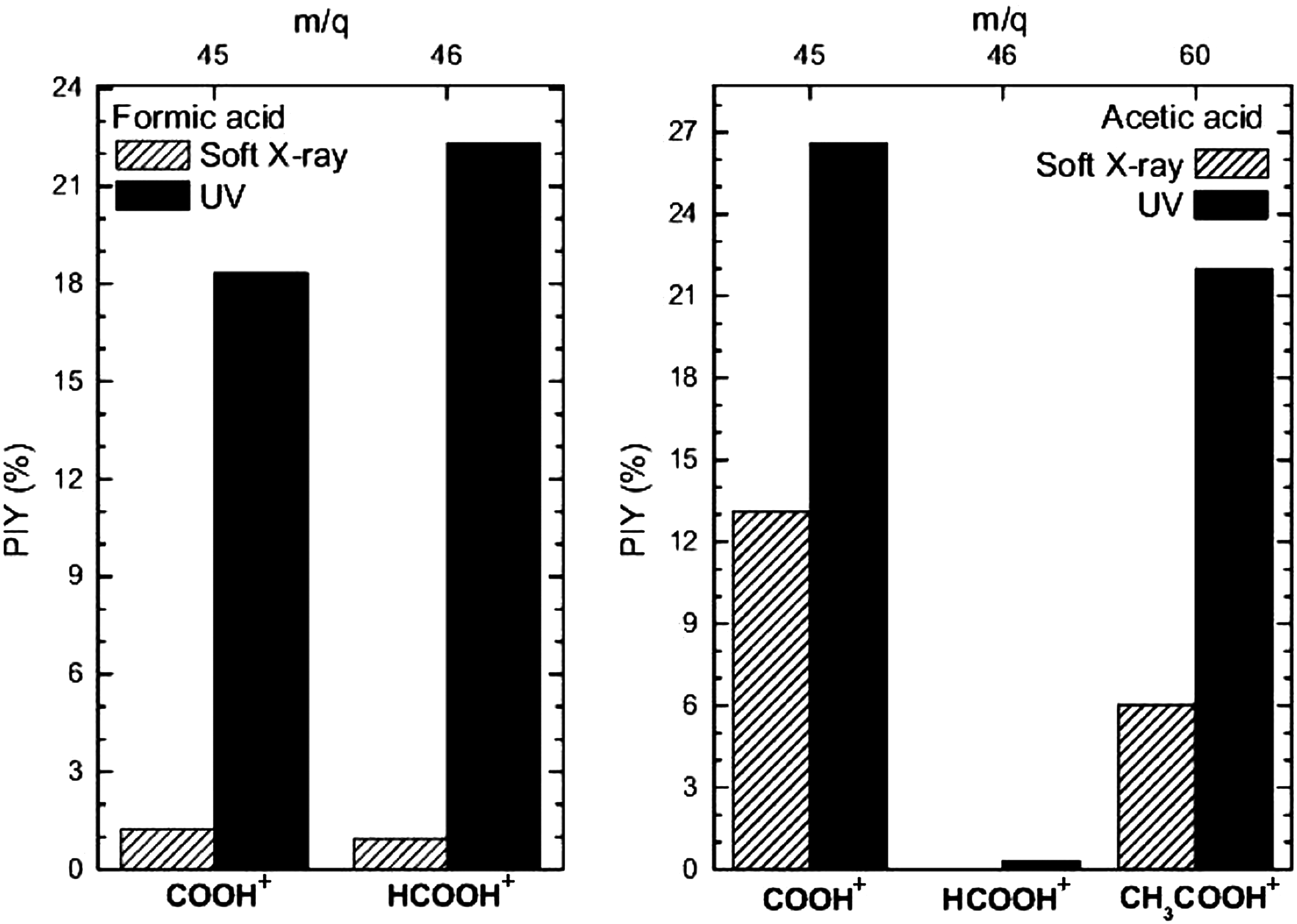
Comparison between the PIY of most-massive fragments from photodissociation of gaseous formic acid (left panel) and acetic acid (right panel) due to 290 eV soft X-rays and 70 eV electrons from NIST (UV-like photons). The PIY also indicates the percentage of the photodissociation channels involving these cationic fragments. Adapted from Boechat-Roberty et al. (2005) and Pilling et al. (2006), respectively.
The survival of acetic acid by the interaction with 290 eV photons is about 6 times higher than that observed for the formic acid. These laboratory experiments showed that the yield of HCOOH and HCOOH+ from the photodissociation of acetic acid is negligible at soft X-ray and UV photons (see Fig. 1, right panel). Thus, HCOOH+ from gaseous acetic acid in the ISM must have low abundance. Moreover, the production of CH3COOH+ and the COOH+ species represent about 19% of the dissociative channels promoted by soft X-rays and almost half the channels promoted by UV (Pilling et al., 2006).
In contrast, when 290 eV photons interact with the gaseous formic acid, only 2% of the dissociative channels involve the amino acid precursor species HCOOH+ and COOH+ (see Fig. 1, left panel). For UV-like photons, the production of the parent ion from both species has roughly the same importance among the dissociative channels (∼20%). However, if the formation of the COOH+ species is also taken into account, we observe that its formation is higher in the photodissociation of acetic acid by both UV and soft X-ray photons. Therefore, taking into account all relevant cationic species for the glycine formation produced from the photodissociation of these two simplest carboxylic acids, the gaseous acetic acid has an advantage. All this suggests that in astrophysical regions fully illuminated by UV and soft X-ray photons, the precursor species COOH+ can be efficiently produced by the photodissociation acetic acids, considering that both simplest carboxylic acids have similar abundance in the ISM (see Table 1).
Andrade et al. (2009) studied fragments released from the formic acid ice at 56 K during the irradiation with 535.1 eV soft X-ray photons (around O 1s-edge). They verified that HCOOH fragmentation releases neither COOH± nor HCOOH± into the gas phase but instead releases the (HCOOH)H+ ion cluster. They suggested that if an O 1s electron is excited, the HCOOH molecule dissociates into small or atomic fragments or into cluster form. However, the liberation of (HCOOH)H+ ions in their spectra suggests that a fraction of formic acid is desorbed intact (in cluster form), surviving the impact of the soft X-ray, going into the gas phase. A similar behavior is expected for the irradiation of solid acetic acid by soft X-rays at low temperatures. It is important to remember that time-of-flight spectra of ice show only the released ions to the gaseous phase. Nothing is known about the bulk reactions on the ice.
Due to the importance of glycine formation for the comprehension of chemical process in the ISM, a thermochemical study of the chemical reactions that lead to glycine seems to be significant. In this paper, a theoretical evaluation of the enthalpy of reactions was performed in order to investigate a possible favoritism in the formation of glycine involving two-body reactions in which one of the reactants is the simplest carboxylic acids or the carboxyl radical (and its cations). These species are the main fragments (cations) generated from the irradiation of formic and acetic acid by soft X-ray and UV photons (see Fig. 1).
3. Theoretical Methodology
In this study, we performed a theoretical approach in an attempt to investigate the thermochemistry of several pathways for glycine formation involving formic acid and acetic acid, and glycine's related ionic and radical species (observed during photo dissociation experiments). The calculations simulate both gas- and solid-phase species in interstellar conditions.
The first part of the study was done in the gas phase. Geometries of all molecules, reactants, and products were fully optimized separately without any geometric constraint at the second-order perturbation theory of Møller-Plesset (MP2) and density functional levels, with use of the hybrid functional B3LYP Becke three-parameter exchange functional and Lee-Yang-Parr correlation functional (Vosko et al., 1980; Lee et al., 1988; Becke, 1993) with bases 6-31G* and 6-31++G**. All molecules were characterized as true minima on the potential energy surface by the analysis of the harmonic vibrational frequencies. The enthalpy of reaction was obtained by the following expression: ΔH=H
product − H
reactant, where H is the enthalpy of each species calculated by the standard equations of statistical thermodynamics at 10 K (McQuarrie and Simon, 1999). The internal energy, E, is written by
where N is Avogadro's number, k
B is the Boltzmann constant, T is temperature, q is the partition function, and V means at constant volume. The individual contributions to internal energy are obtained considering the proper partition function of ideal gas, that is, considering the vibrational, rotational, translational, and electronic partition functions. The total energy (E
tot) is calculated by summing the contributions of translational, rotational, vibrational, and electronic energies. The enthalpy of each molecule is calculated in two steps. Initially, evaluation of the enthalpy correction
Next, H
corr is summed to total electronic energy (ɛ), evaluated by the quantum-chemical method
As a first approach, only a thermochemical study was conducted. We supposed that the species were formed with high energy because they were generated by X-rays. Therefore, the formed ions and radicals are expected to combine rapidly to form the most stable species due to the excess of energy.
Second, we examined the solid phase, employing the methodology proposed by Woon (2002), in which the reaction enthalpy was evaluated by using the isodensity polarized continuum model (IPCM method). This is not a rigorous method with which to study chemical reactions that proceed in the solid phase, because the polarized continuum model (Miertus and Tomasi, 1982; Miertus et al., 1982; Tomasi and Persico, 1994; Foresman et al., 1996) and its correlated methods were developed to study chemical properties in the liquid phase. The solute molecule is placed in a cavity and surrounded by dielectric medium represented by a surface of apparent charges. However, it may be used as a first approach to analyze the effect of a dielectric cavity surrounding the reactants and the stability effect due to the presence of dielectric medium. The electronic energy of all molecules was evaluated at MP2/6-31++ G** level, considering the gas-phase geometry optimized at the same level of theory. The water molecule was chosen as the solvent for the IPCM because water is the more abundant molecule in the ice mantles of interstellar grains. The difference in energy in the chemical reaction was evaluated to determine whether the proposed reaction is feasible or not. In the IPCM, the temperature is not defined, and the method does not calculate vibration frequencies. Thus, it is not possible to obtain the enthalpy. The electronic energy is lower than the enthalpy because thermal correction and zero-point energy were not considered in the calculations. For reactions occurring at low temperatures, the vibration and temperature contributions are expected to be small.
We analyzed the exothermic or endothermic behavior of reactions in which the products are glycine or glycine cation. Kinetics and intermediate states of reactions were not investigated. Because the evaluation of enthalpy of reaction does not depend on intermediate species but depends only on the initial and final state, the enthalpy evaluation helps to discard the reactions that do not contribute to glycine formation. The most promising reactions will be studied thoroughly (e.g., kinetics and intermediate states) in further works. All calculations were performed in the Gaussian 03 package (Frisch et al., 2003).
4. Results
The calculated enthalpy of reaction for the studied interstellar molecules that may react and produce glycine (or glycine cation) at different levels is shown in Table 2. This table includes the results obtained in the gas phase and solid phase (ice). Indeed, several different gases and ices are mixed together in the ISM; consequently, other products different from glycine are expected. However, only reactions with glycine (or glycine cation) as the final product are considered here.
Difference of electronic energy evaluated at solid phase (ice) at MP2/6-31++G** level, considering the geometries optimized in the gas phase at the same level.
4.1. Reactions involving COOH+ or COOH (I1–I10)
The first set of reactions considered included those that involve carboxyl radical COOH and its cationic species, COOH+. Reactions with NH2CH2 and its cation (Reactions I1–I3) were the only exothermic (ΔH < 0) reaction found. For Reaction I3, the recombination of two radicals is more efficient and has a lower enthalpy than other reactions involving ions, because radical-radical reactions have virtually no activation barriers. By comparing the set of reactions involving the NH2CH2 molecule or its ion, it is possible to see that Reactions I1–I3 produce one neutral molecule or a glycine cation. Methylamine (NH2CH3) has been detected in the massive star-forming region of Sagittarius B2 (Kaifu et al., 1975), and CH2NH (methanimine) has been detected in the ISM (Dickens et al., 1997). Although NH2CH2 and its cation have not been observed in interstellar space, several theoretical studies have obtained a stable singlet state for the planar
On the other hand, Reactions I4–I10 produce two different species, including ions, radicals, and neutral molecules. It is also possible that the reaction between two neutral radicals (Reaction I3) is more favorable than reactions involving an ionic and radical species. In the case of Reaction I2, the carbon in the COOH+ ion is highly electron-deficient and favors the acid-base reaction with the NH2CH2 molecule, which leads to an exothermic process.
In Reactions I4–I7, contrary to the first case, the methylamine (NH2CH3) tends to add on carbon in the carboxyl radical via amino group, because this group has a basic character. Due to inductive effect, the carbon atom of the COOH+ ion may have a lower electron density in comparison with other atoms (more positive character). The inductive effect occurs, for instance, when an electronegative atom in close proximity to an R–H bond makes a molecule more acidic than its counterpart lacking the electronegative atoms. Because nitrogen is more electronegative than carbon, the amino group, which is preferentially bound to the carbon atom, is expected to lead to a C–N bond. This reaction should be exothermic. The formation of the C–C bond is observed when a carbon atom shows a high electron density, which increases the basic character of the carbon atom. The carbon atoms of the analyzed compounds do not have this basic character, which justifies the positive value for reaction enthalpy (Smith and March, 2001).
As expected, the enthalpies of Reactions I4–I10 were positive. The formation of a neutral molecule or a glycine cation on Reactions I1–I3 made the process favorable because the reactants are small ions or radicals. The same pattern of reactions was also observed in the solid phase calculation. Reactions I8–I10 have another favorable pathway of reaction that was not investigated in this study: the attack of hydroxyl group in COOH+. This last mechanism may lead to three different competition reaction channels that will generate different products than glycine and OH radical. Although methanolamine (NH2CH2OH) and its cation have not yet been identified in the ISM, a model of grain-surface atom addition reactions showed that sequential hydrogenation of HNCO leads to NH2CH2OH formation (Charnley and Rodgers, 2005). The change of MP2/6-31G* to MP2/6-31++ G** level lowers the exothermic behavior of the first set of reactions. The exothermic reaction presents the same behavior when the basis set is improved. The reactions are less exothermic at B3LYP/6-31++ G** level. However, the sign of enthalpies at gas phase does not alter with the theory level.
4.2. Reactions involving HCOOH+ or HCOOH (II1–II12)
The second set of reactions considered involves formic acid or its cationic species. The II1–II3 reactions are favorable from the thermodynamic point of view for glycine formation. By analyzing this set of reactions, it is possible to see again that the negative value of ΔH is directly related to the formation of most stable molecules. A reaction involving HCOOH with NH2CH2 (cation or neutral) or NH2CH3 (cation or neutral), in which the products are a glycine molecule (or its cation) plus a neutral species, such as atomic or molecular hydrogen, leads to an endothermic process (II4, II6, II7, II9). On the other hand, similar reactions involving cationic formic acid are favorable (e.g., II5, II8). Another favorable pathway, from the thermochemical point of view, involves HCOOH+ with NH2CH2OH producing cationic glycine and water (II11).
Maeda and Ohno (2006) studied theoretically (B3LYP/6-311++ G**) the formation route of glycine via reactions of closed-shell species such as ammonium ylide (CH2NH3), an isomer of methylamine, with CO2, HOCO+, HCHO, and HNCO. They observed that the reaction between CO2 + CH2NH3 is very exothermic for the formation of glycine. They suggest that, when CH2NH3 comes into contact with frozen CO2 in space, a glycine molecule is promptly created without further decomposition because of the energy-dissipating medium of the ice. This is also expected in the case of glycine formation in ice phase from the pathways described by Reactions I2 and I3 involving carboxyl radical (and its cation) and Reactions II2 and II3 involving formic acid (and its cation). According to these authors, protonated glycine can be formed in another very exothermic reaction between HOCO+ + CH2NH3. However, CH2NH3 is very reactive, and as soon as it is created in the ISM it is very efficiently converted into methylamine (CH3NH2) during collisions with the abundant molecular hydrogen. The enthalpy evaluated for the second set of reactions does not present a regular pattern with the level of theory used. Reactions II1, II2, II5, and II8 are less exothermic when the basis set is improved at both methods. Reactions II3, II11, and II12 are more exothermic when the basis set is improved at both methods. The level of theory does not modify the ΔH sign, as observed in the previous set of reactions.
4.3. Reactions involving CH3COOH+ or CH3COOH (III1–III12)
In the last reaction groups (III1–III9), the decrease in the number of hydrogen atoms binding in the nitrogen tends to increase the ΔH of reaction. Thus, the glycine formation from acetic acid with NH, NH2, or NH3 is more difficult as the number of N–H bonds increases. Because N is a species with high electronegativity, and the molecules in the III1–III9 reactions have an electron deficiency, the reactivity increases as the electrons are removed from the reactants. Reaction III10–III12 may be a favorable route to glycine formation. In addition, as expected, ion-molecule type reactions involving acetic acid cation (III2, III5, III8, III11) are more favorable from the thermodynamic point of view. This fact may be due to the formation of a molecule that is capable of stabilizing the electron charge better than formic acid. The III10–III12 reactions involve the hydroxylamine (NH2OH) and its cation. Although these species have not yet been observed in the ISM, ice mixtures of water and ammonia, under simulated interstellar conditions, produced NH2OH (Largo et al., 2010).
Largo et al. (2010) showed that the reaction between
5. Discussion
Glycine formation has been discussed by several authors with regard to different astrophysical environments. Bossa et al. (2009) used IR spectroscopy and mass spectrometry to monitor the evolution of the H2O:CO2:CH3NH2 and CO2:CH3NH2 ice mixtures during both warming processes and vacuum UV photolysis to show that methylammonium methylcarbamate
Maeda and Ohno (2004) studied routes for the synthesis of glycine from simple molecules such as NH3, CH2, and CO2 via carboxylation of ammonium ylide (NH3CH2). The reaction route NH3 + CH2 + CO2 → H2NCH2COOH is composed of two steps: NH3 + CH2 → NH3CH2 followed by NH3CH2 + CO2 → H2NCH2COOH. Both of these steps have no activation barriers, which are significant in connection with molecular evolution and generation of amino acids in interstellar clouds. Although NH3CH2 has neither been isolated in the laboratory nor detected in space, it can be isomerized into methylamine NH2CH3 (NH3CH2 → NH2CH3) or decomposed into NHCH2 and H2 (NH3CH2 → NHCH2 + H2) (Maeda and Ohno, 2004). Both NH2CH3 and NHCH2 have been observed in the ISM (Kaifu et al., 1975; Dickens et al., 1997).
The formation of interstellar glycine in and on interstellar grains was also investigated theoretically in the literature (e.g., Sorrell 2001; Woon, 2002; Mendoza et al., 2004). Quantum chemical calculations were employed by Woon (2002) to evaluate the viability of various pathways to the formation of glycine, alanine, and serine in dilute H2O ice containing CH3OH and HCN. Sorrell (2001) also proposed a theoretical model for the formation of interstellar glycine based on radical-radical reactions triggered by UV photoprocessing of water, methane, ammonia, and carbon monoxide mixtures within the ice mantles. Mendoza et al. (2004), employing semi-empirical, quantum-chemistry calculations, described the formation of (pristine) amino acids such as glycine catalyzed by surfaces of interstellar grain analogues such as carbon-rich surfaces (polycyclic aromatic hydrocarbons). They also observed that the stability of the carboxyl group (COOH) may be enhanced by the chemisorption process. Rimola and Ugliengo (2009) showed by quantum mechanical calculations that the silica-rich surface of interstellar grain analogues promotes stability of adsorbed glycine in the presence of interstellar processes, such as reactions with isolated H2O and NH3 molecules or the exposure to cosmic rays and UV radiation.
Combining the theoretical studied pathways with experimental data on the photodissociation of gaseous simplest carboxylic acids (Boechat-Roberty et al., 2005; Pilling et al., 2006), we suggest a possible favoritism among reactions in the different phases. In the gas phase, the most favorable pathways to glycine formation are reactions involving CH3COOH + NH+ and NH2OH + CH3COOH+, because formic acid is destroyed more in the gas phase than acetic acid. Another possible reaction involves COOH+ + NH2CH2. As discussed previously, COOH+ is one of the most-produced radicals from the photodissociation of acetic acid by soft X-rays. In the solid phase, we suggest that the reactions between formic acid cation and NH2CH or NH2CH2OH are the most favorable from the thermochemical point of view. A schematic design with these possible glycine pathway formations via carboxylic acids inside star-forming regions illuminated by UV and soft X-rays is shown in Fig. 2.
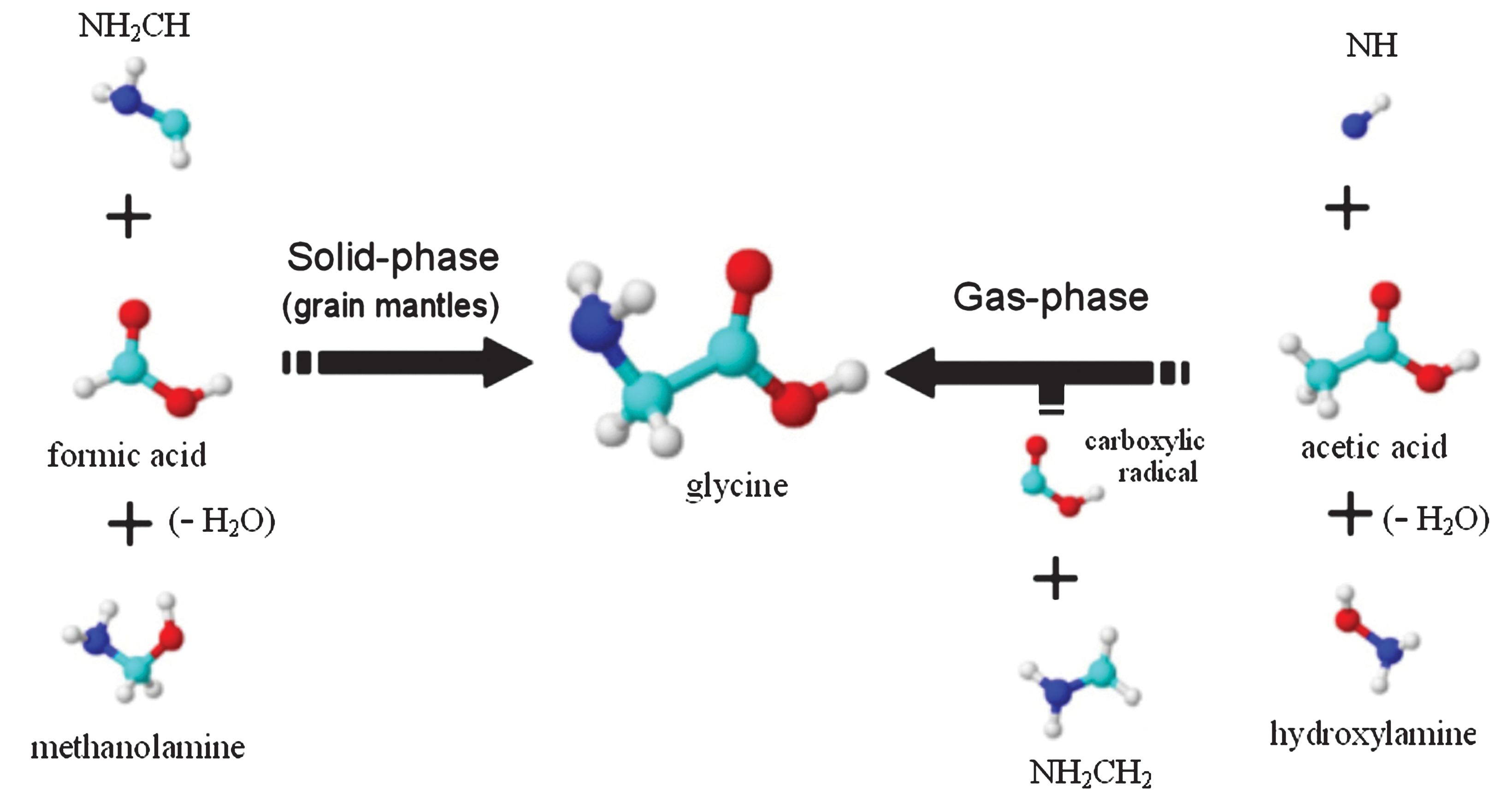
Suggested scenarios for glycine formation via carboxylic acids inside star-forming regions illuminated by UV and soft X-rays (for the purpose of clarity only neutral species are illustrated). See details in the text. Color images available online at
As expected in the major results for the gas phase and solid phase, a similar pattern was observed due to the simplifications of our theoretical model. In general, the inclusion of a dielectric medium only stabilizes the ionic species that lead to less exothermic reactions. However, it is important to point that in four reactions (I1, II1, II10, and III8) the inclusion of the dielectric medium changes the sign of ΔH. Reactions I1 and II1 form glycine cation, while Reactions II10 and III8 form glycine cation H2. Those reactions are exothermic in the gas phase and are endothermic in the solid phase. The most significant case is Reaction III8, in which ΔH changes abruptly in the solid phase (−6.72 kcal mol−1 in the gas phase and +31.06 kcal mol−1 in the solid phase).
In an additional approach, the specific interactions between the cavity and reactants may be evaluated to investigate the catalysis effect on glycine formation. The reaction mechanism may involve several reaction steps, including a diffusive process. A diffusive process over the surface or in the bulk of ice is necessary for the chemical reactions to occur, and diffusion processes generally are associated with a significant activation barrier (Sorrell, 2001). The diffusion rate may be evaluated by empirical equations or by employing molecular dynamical simulations. However, the diffusive process is important to evaluate kinetic parameters, which are beyond the scope of the present study. The simple model applied here provides insights about the influence of an external electric field in the thermochemical parameters. Further improvement of the model applied to describe the solid phase seems to be important. Catalytic effects, which may improve the reactivity of the considered ions and molecules, were not studied in our model. Acidic or basic species present in the solid phase may also modify the formed products and increase the reaction rates due to catalytic effects. Selecting the most promising pathways for glycine formation, a future study explicitly considering the solid phase on the calculations should be conducted. The inclusion of specific interactions is important to test whether the reactions produce only glycine or other different molecules.
Although the formation of glycine by several pathways seems to be favorable from the thermochemical point of view, this does not mean that the reaction must occur. Some reactions may be slow due to the kinetic properties of the reaction mechanisms, which make the process unfeasible. It is important to note that the reaction in the solid phase resembles the same thermodynamic properties evaluated in the gas phase. This indicates that the presence of a dielectric medium alone, such as water ice, does not change the preferential pathways of glycine formation. However, the presence of other compounds such as ammonia, methane, and CO in the ice, as well as the ice temperature itself, may modify the reactivity of the studied compounds. More experiments and theoretical calculations are needed in attempt to verify these issues on the formation routes for glycine in reactions involving carboxyl radical and simple carboxylic acids.
As observed by Maeda and Ohno (2006), the reactions involving the methylamine isomer, ammonium ylide (CH2NH3), with other species such as HCHO and HNCO are very exothermic for the production of glycine analogues such as glycinol (H2NCH2CHOH) and glycinamide (H2NCH2CONH2). Therefore, if we consider different reaction pathways (from a geometric point of view), the formation of products other than neutral glycine and glycine cation is also expected involving the reactants employed in this study.
6. Conclusions
Despite the extensive search for glycine and other amino acids in molecular clouds associated with star-forming regions, only upper limits were derived from the radio observations in these regions. Nevertheless, two of glycine's precursors, formic acid and acetic acid, have been abundantly detected. Although both precursors may lead to glycine formation, the efficiency of reaction depends on the precursor's abundance and survival in the presence of a radiation field. These facts could promote favoritism in the reaction pathways in gas and solid phase (ice).
The energy distribution of young stellar sources includes IR to X-rays, but for O and B stars the maximum occurs around UV and soft X-rays. The main excitation/ionization processes induced by UV occur at valence levels, while in the case of soft X-rays the processes occur at inner shell levels. Thus, in the present study, a theoretical evaluation of the reaction enthalpy of various reactions was performed to investigate the main pathway for the formation of glycine, or its precursors, in the gas phase from ionic species that may be encountered in the ISM. The pathways involve the main fragments generated in the laboratory by soft X-ray and UV photons from gaseous formic acid and acetic acid.
We calculated enthalpies from several reactions in the gas phase and the difference of electronic energy at solid phase involving formic or acetic acid with ammonia derivatives that together could lead to glycine formation. Some reactions were very exothermic in the gas phase, such as NH+ + CH3COOH → NH2CH2COOH+, and in the solid phase (ice), such as NH + CH3COOH+ → NH2CH2COOH+. The reaction NH2CH + HCOOH+ → NH2CH2COOH+ is very exothermic in gas and solid phase involving the formic acid cation. The theory levels applied in the present study result in similar patterns: the sign of theoretical ΔH is not affected by changes in methods and basis set.
From our results, we observe that the presence of a dielectric medium alone, such as water ice, does not significantly change the enthalpy of glycine formation routes. If a given reaction is possible, from the thermochemical point of view, in the gas phase, it will also be possible at solid phase (inside water ice). However, by combining this issue with experimental data on the photodissociation of gaseous simplest carboxylic acids (Boechat-Roberty et al., 2005; Pilling et al., 2006), we suggest a possible favoritism among reactions in the different phases. In the gas phase, the most favorable pathways to glycine formation are reactions involving CH3COOH + NH+ and NH2OH + CH3COOH+, because formic acid is destroyed more in the gas phase than acetic acid is. In spite of the fact that NH2OH (and its cation or radicals) has not been detected in the ISM, the occurrence of such species has been predicted (Boulet et al., 1999; Charnley et al., 2001; Blagojevic et al., 2003). Another possible reaction involves COOH+ + NH2CH2. COOH+ is one of the most-produced radicals from the photodissociation of acetic acid by soft X-rays. In the solid phase, we suggest that the reactions between formic acid cation and NH2CH or NH2CH2OH are the most favorable from the thermochemical point of view.
Although the formation of glycine from acetic and formic acids is interesting from an astrophysical and astrobiological point of view, theoretical studies suggest that pathway reactions involving “not so small” molecules (such as acetic or formic acids) may be secondary compared with pathways involving smaller species. However, regarding the reactions that might occur in the gas phase, the two-body reactions proposed in this work probably occur more often than reactions involving three or more species proposed elsewhere (e.g., Woon, 2002; Maeda and Ohno, 2004). In addition, a comparison involving the gas phase abundances of carboxylic acids and glycine (upper limit) in star-forming regions with our results on glycine formation via carboxylic acids and carboxyl radical (and also its cations) suggests an upper limit of about <3×1014 cm−2 for NH2CH, NH2CH2, hydroxylamine (NH2OH), and methanolamine (NH2CH2OH) in these regions.
Footnotes
Acknowledgments
This work supported by LNLS, CNPq, CAPES, and FAPERJ. The authors thank the Grupo de Cinética e Dinâmica Aplicada a Química atmosférica of the Physical Chemistry Department of UFRJ. We also thank Ms. Alene Alder-Rangel for editing the English in this manuscript.
Abbreviations
B3LYP, Becke three-parameter exchange functional and Lee-Yang-Parr correlation functional; IPCM, isodensity polarized continuum model; ISM, interstellar medium; MP2, second-order perturbation theory of Møller-Plesset; PIY, partial ion yield.