




Abstract
M stars comprise 80% of main sequence stars, so their planetary systems provide the best chance for finding habitable planets, that is, those with surface liquid water. We have modeled the broadband albedo or reflectivity of water ice and snow for simulated planetary surfaces orbiting two observed red dwarf stars (or M stars), using spectrally resolved data of Earth's cryosphere. The gradual reduction of the albedos of snow and ice at wavelengths greater than 1 μm, combined with M stars emitting a significant fraction of their radiation at these same longer wavelengths, means that the albedos of ice and snow on planets orbiting M stars are much lower than their values on Earth. Our results imply that the ice/snow albedo climate feedback is significantly weaker for planets orbiting M stars than for planets orbiting G-type stars such as the Sun. In addition, planets with significant ice and snow cover will have significantly higher surface temperatures for a given stellar flux if the spectral variation of cryospheric albedo is considered, which in turn implies that the outer edge of the habitable zone around M stars may be 10–30% farther away from the parent star than previously thought. Key Words: M stars—Habitable zone—Climate—Albedo—Habitability. Astrobiology 12, 3–8.
1. Introduction
T
The so-called habitable zone, or the loci of orbits where liquid water is stable around a range of different stars, has been investigated by several authors (e.g., Huang, 1959; Dole, 1964; Kasting et al., 1993). They pointed out that tidal locking—the phenomenon whereby one side always faces the parent star—could present a barrier to the habitability of planets orbiting M stars. However, this issue has been addressed in models ranging in complexity from simple energy-balance systems (Haberle et al., 1996) to complex three-dimensional global circulation models (Joshi et al., 1997). More recently, climate models that include radiative processes such as clouds and water vapor have been employed to examine the problem both in general (Joshi, 2003) and for specific planets orbiting specific stars such as Gliese 581 (Pierrehumbert, 2011). The issues of M stars emitting flares (sudden releases of energy such as X-rays or UV radiation) and the chemical composition of planets orbiting M stars have also been addressed recently (Scalo et al., 2007; Segura et al., 2010). Elsewhere, the habitability of planets orbiting M stars has been examined in a comprehensive review paper (Tarter et al., 2007).
In the present work, we address a property of water ice and snow that has significant implications for the M-star habitability question, and that is the dependence of ice and snow albedo on wavelength. The spectral dependence of snow and ice albedo has been observed and reported upon in previous work (e.g., Ebert and Curry, 1993; Brandt et al., 2005; Hudson et al., 2006), and some global circulation models do incorporate such effects by splitting up the shortwave radiation into two components separated at 0.7–0.9 μm (e.g., Dickinson et al., 1986). However, this dependence is small for wavelengths shorter than 1 μm, where the vast majority of the Sun's energy is emitted, so the effect on terrestrial climate is small.
M stars are much smaller and cooler than G stars, such as the Sun, and as a consequence emit a far greater fraction of their radiation at wavelengths longer than 1 μm. Figure 1 (top panel) shows black-body spectra for the Sun (shown in black), for an idealized black body emitting at 3300 K (red), and for two actual M stars (purple and orange). The two M stars emit a large fraction of radiation at wavelengths longer than 1 μm where the snow and ice albedos are smaller than in the visible. This implies that, because of the spectral dependence of ice and snow albedo on wavelength, a disproportionate amount of the long-wave radiation emitted by such M stars will be absorbed rather than reflected from an icy or snowy surface, which would thus lower the average albedo of such a surface.
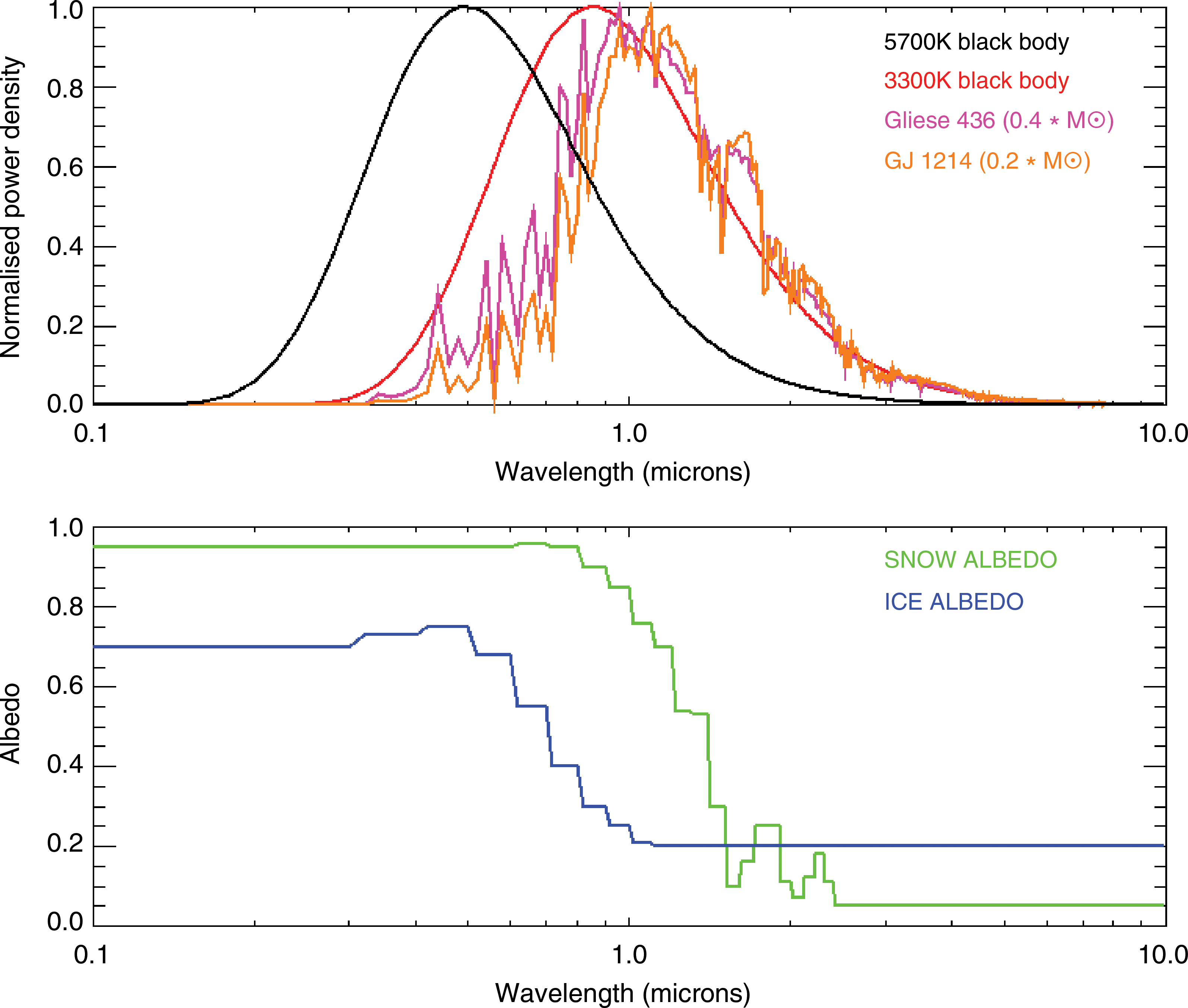
Top panel: the spectral distribution of energy for differing emitters of radiation, normalized by the peak value. The curves correspond to the following: black, 5700 K black body, similar to the Sun; red, 3300 K black body, which is an idealized representation of an M dwarf that is approximately 40% as massive as the Sun; purple, Gliese 436, which is approximately 40% as massive as the Sun; orange, GJ 1214, which is approximately 20% as massive as the Sun. The non-Planckian behavior of the M-star spectra is because of absorption by species such as titanium oxide (TiO) at visible wavelengths and windows where upwelling radiation is coming from deeper in the stellar interior where temperatures are higher at near-IR wavelengths. Bottom panel: the spectral distribution of snow (green) and ice (blue) bond albedos employed in the model. Color images available online at
Spectra of M stars have been obtained from the “NextGen” stellar atmospheres grid of Hauschildt et al. (1999). The spectra are significantly non-Planckian, as shown by the purple and orange curves in Fig. 1 (top panel): Gliese 436 and GJ 1214 emit significantly more radiation in the 3–10 μm region than would be expected from black bodies having the same temperatures as these stars. In the next section, we quantify how the spectral variation of ice and snow albedo affects the mean bolometric values.
2. Results
We examined the effect described above by asking the question, “What would be the average albedo of snow and ice receiving radiation having the spectral characteristics of the red, purple, and orange curves in Figure 1 (top panel)?” We used data for water ice from Fig. 1 of Brandt et al. (2005) and snow data from Fig. 5 of Hudson et al. (2006). The data as used in our model is shown in Fig. 1 (bottom panel).
Using the albedo information above and the spectral emission functions shown in Fig. 1 (top panel), we calculated broadband albedos as shown in Fig. 2. The values for snow and ice for a planetary surface orbiting the Sun are 0.8 and 0.5, respectively, which are broadly consistent with the values used in climate models. Fresh snow and ice albedos on a planet receiving black-body radiation from an object at 3300 K are 0.6 and 0.3, respectively, which are significant reductions from the “solar” values.
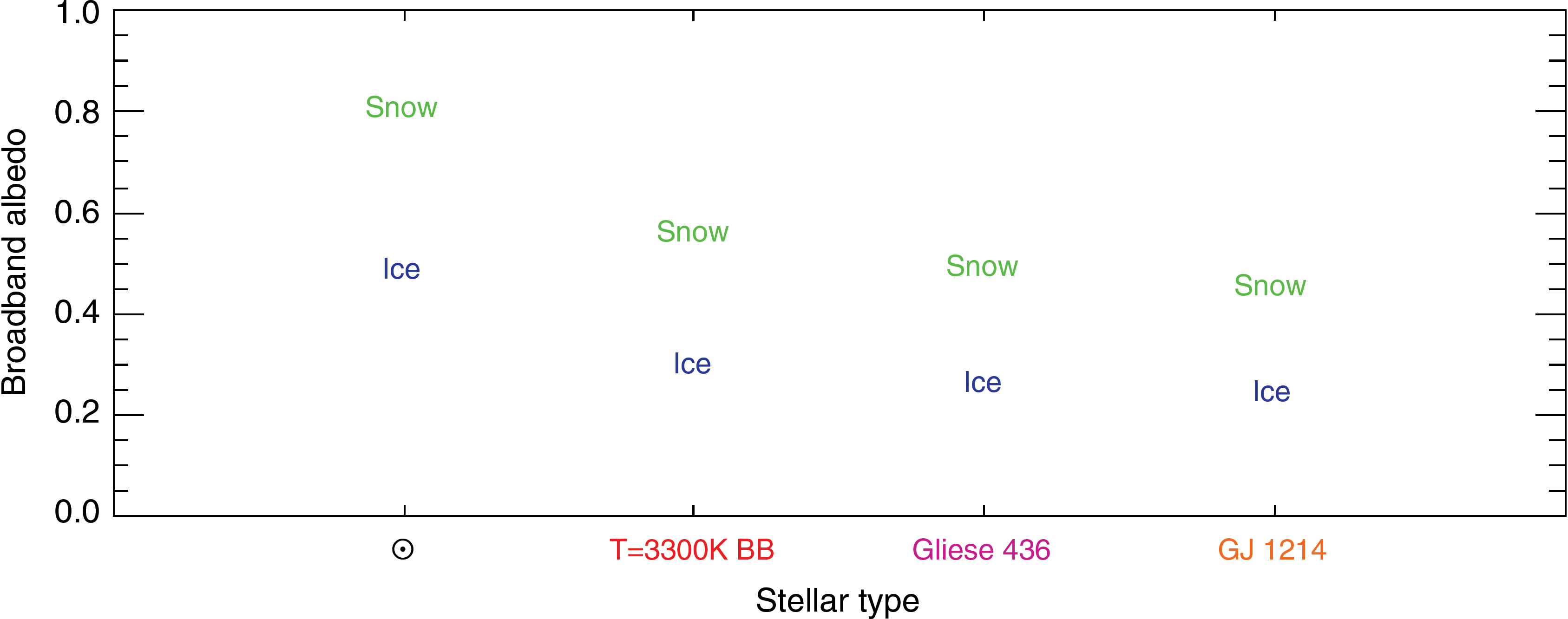
The snow and ice broadband albedos for the four stellar types shown in Fig. 1 (top panel), assuming 100% snow or ice cover. Broadband albedos are calculated by weighting the spectrally varying snow and ice albedos in Fig. 1 (bottom panel) with use of the normalized spectral energy distributions of Fig. 1 (top panel). The colors of the spectral types are consistent with Fig. 1 (top panel). Color images available online at
When broadband albedos are calculated for fresh snow and ice for surfaces receiving radiation from the two stars Gliese 436 and GJ 1214, the snow albedos are lowered significantly to 0.47 and 0.43, respectively; the ice albedos are also lowered significantly more to 0.24 and 0.23, respectively.
3. Discussion—Climate Feedbacks
The lowering of average water ice and snow albedos has implications for the climates of planets orbiting M stars. For instance, consider a planet similar to the example of Pierrehumbert (2011) but which orbits Gliese 436 and has half the stellar radiation incident on open ocean with an albedo of 0.1 and half incident on ice. The average surface albedo of the planet will be changed from (0.1+0.50)/2.0 or 0.30, to (0.1+0.24)/2.0 or 0.17 if the spectral dependence of ice albedo is considered. As another example, if the same planet were to have 50% land cover that had a bare-ground albedo of 0.2 and the same distribution of ice and snow as in the previous example, the average surface albedo of the planet would be changed from (0.10+0.50+0.2+0.8)/4.0 or 0.40 to (0.10+0.24+0.2+0.47)/4.0 or 0.25.
The reduction in albedo weakens the strength of the snow/ice albedo feedback, which is a mechanism whereby a perturbation to snow or ice coverage associated with a climate forcing results in a change in the amount of stellar radiation absorbed by the surface due to the large difference between the albedos of snow or ice and the albedos of the underlying ground or ocean. The snow/ice albedo feedback is a positive feedback, because any change to snow or ice cover amplifies the climatic forcing that caused the change in the snow/ice cover in the first place. For instance, a forcing that warms a planet will cause some snow or ice to melt, which will reduce planetary albedo and result in additional warming (and vice versa).
While the exact change in the snow/ice albedo feedback will depend on the specific nature of the planetary climate system being studied, an approximate number can be calculated by using the common terminology for climate feedbacks in Earth's atmosphere (Colman, 2003; Gregory et al., 2009):
In this terminology, the temperature response dT to a radiative forcing dF is given by the black-body response B (3.3 W m−2 K−1) modulated by a number of terms, which are negative if they are positive feedbacks. These terms are the water vapor feedback W (≈−1.5 W m−2 K−1), the cloud feedback C (−0.75 to+0.75 W m−2 K−1), and the ice albedo feedback I (≈−0.3 W m−2 K−1). If the changes in albedo above mean that I is small, then the clear-sky feedback parameter (B+W+I) changes from 1.5 W m−2 K−1 to ≈1.8 W m−2 K−1, which thus reduces the total climate response to a given perturbation.
While the reduction of ice albedo has a small effect on the climate sensitivity of a planetary climate that has similar characteristics to present-day Earth, its effect may be expected to be more profound on planets that are largely ice-covered, in a similar manner to the so-called “snowball Earth” period (e.g., Kirschvink, 1992). Previous studies suggest that the snowball Earth scenario might be indicative of a bistable state (Budyko, 1969), where a planet on the cusp of a runaway glaciation can be pushed into an ice-covered state by a small climatic perturbation and a strong ice/snow albedo feedback. The lowering of snow and ice albedo to near bare-ground or open-ocean values therefore makes runaway glaciation and “snowball planet” episodes much less likely.
4. Discussion—Habitable Zone
We estimate the effect of albedo variation on the width of the habitable zone by calculating downward top-of-atmosphere (TOA) stellar flux F versus albedo for a planetary surface temperature of 200 K. This is the temperature at which a bar of CO2 condenses, and it is often considered a proxy to the outer edge of the habitable zone (Kasting et al., 1993). We consider the black-body relationship:
where F is the downward top-of-atmosphere stellar flux, σ is the Stefan-Boltzmann constant, ɛ is the emissivity, a is surface albedo, and T is surface temperature. We assume that at a surface temperature of 200 K the amount of water vapor in the atmosphere is negligible, so any deviation of ɛ from unity is due to CO2. We assume that ɛ=0.8, consistent with a bar of CO2 having a gray optical depth of approximately unity (Joshi et al., 1997). We neglect clouds and assume that Rayleigh scattering can be ignored to leading order as its effects on planets receiving radiation from M dwarfs is small (Kasting et al., 1993).
Figure 3 (left panel) shows albedo versus downward TOA stellar flux for the above simple model when T=200 K. Consideration of the spectral dependence of ice albedo considerably changes the TOA flux at which surface temperature equals 200 K (our proxy for the habitable zone edge). Figure 3 (right panel) shows the same result as Fig. 3 (left panel), but it is expressed in terms of orbital distance in astronomical units away from the parent star, which enables a quantification of the effect of the spectral variation in ice/snow albedo on habitable zone width. For instance, considering the example of partially ice-covered planets in the previous section, decreasing albedo from 0.30 to 0.17 increases the orbital distance at which CO2 condensation happens from 1.8 to 1.98 AU, or 10%, while decreasing albedo on planets covered by 50% snow and 50% ice from 0.65 to 0.33 increases the same orbital distance from 1.3 to 1.75 AU, or over 30%.
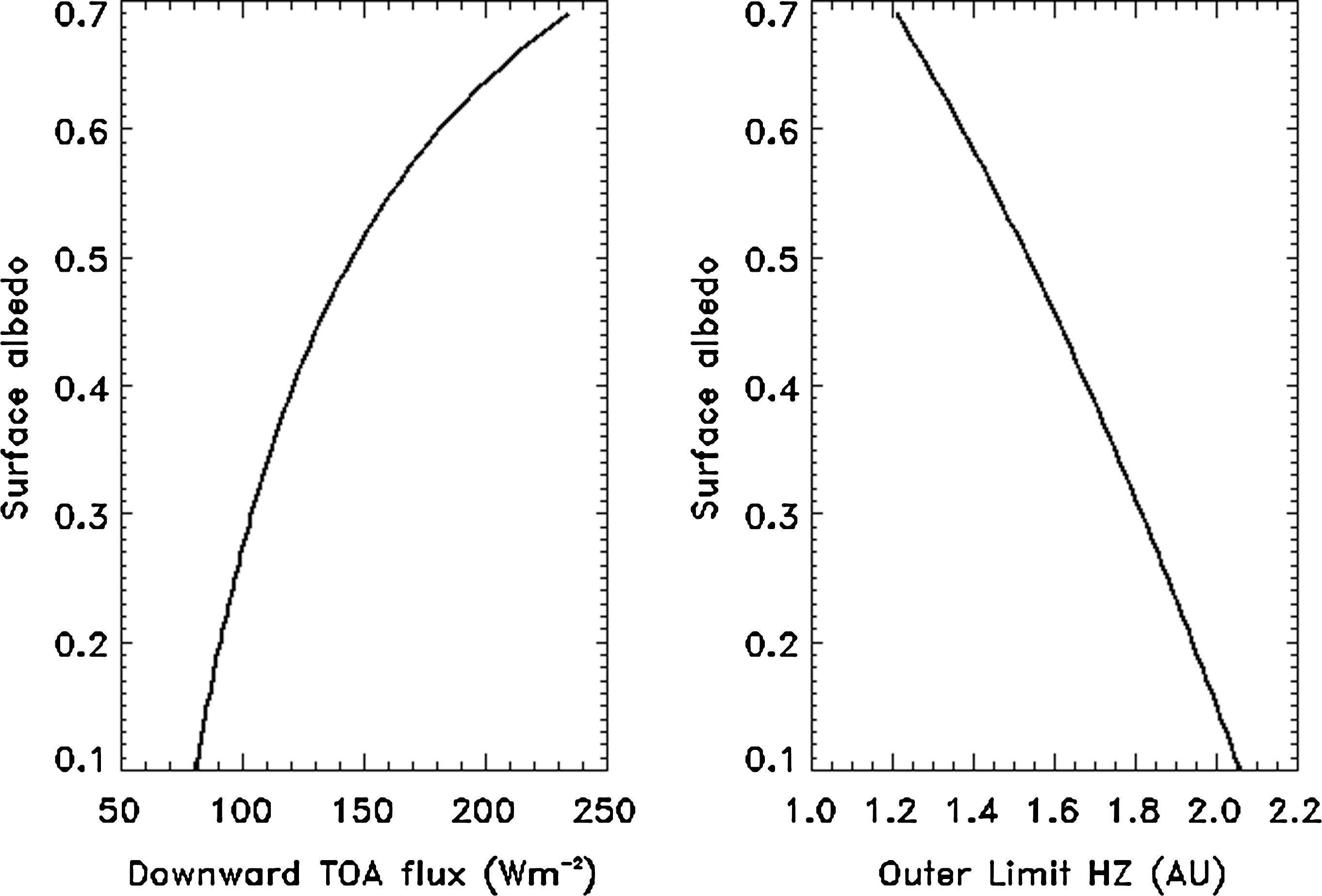
Left panel: Downward TOA stellar flux at which a gray atmosphere with an emissivity ɛ of 0.8 has a surface temperature of 200 K vs. surface albedo assuming no atmospheric absorption. Right panel: As left panel but x axis is the distance from the parent star in astronomical units assuming a stellar flux of 342 W m−2 at 1 AU and stellar flux is proportional to (orbital distance)−2.
The above calculations all assume two ice and snow types from the works of Brandt et al. (2005) and Hudson et al. (2006), respectively. However, different ice and snow types have different albedos. For instance, glacier ice albedo decreases from ≈0.9 at 0.5 μm to ≈0.1 at 1 μm (Warren et al., 2002). Pure water-ice formed from fresh water, as occurs on freshwater lakes, can have a very low albedo that is almost independent of wavelength (e.g., Bolsenga, 1969). Such ice would eliminate the presence of the ice-albedo feedback completely. Indeed, at very low temperatures approaching 200 K, cubic crystalline water ice can form as opposed to common hexagonal crystalline water ice, which might have implications for ice albedo on the outer edge of the habitable zone. Only with observations of the surfaces of exoplanets could investigators discern the type of ice or snow that exists on them.
The above calculations assume an ocean-covered planet and no clouds. CO2 and water vapor have absorption bands between 1 and 10 μm and decrease the fraction of incoming radiation that reaches the surface of a planet orbiting an M star at these wavelengths. We approximately quantify such effects by repeating our calculations but multiplying the amplitude of the spectral distribution function in Fig. 1 (top panel) by half at wavelengths above 1.5 μm. The effects on ice albedo are small, perhaps unsurprisingly, since Fig. 2 indicates that the albedo of ice drops to low values below 1 μm. The effect on snow albedo is more significant and raises the weighted snow albedo in the Gliese 436 and GJ 1214 cases by 0.1.
In the future, more detailed calculations will have to be carried out by using three-dimensional models of planets orbiting specific stars, such as that of Pierrehumbert (2011). Such models are able to take account of the above effects, as well as the variation of stellar zenith angle, and the effect of different atmospheric gaseous absorbers. Nevertheless, we believe the above result, which is that the outer edge of the habitable zone moves outward when the spectral dependence of ice and snow albedo is taken into account, is robust.
Carbon dioxide clouds can potentially provide an effective scattering greenhouse effect (e.g., Forget and Pierrehumbert, 1997) and could be present on a planet near the outer edge of the habitable zone. The potential effects of such clouds overlying ice or snow with spectrally varying albedos would depend on atmospheric and microphysical parameters, and as such these effects are beyond the scope of this paper. We suggest quantifying such impacts as another source for future research.
The effect considered here should not move the inner edge of the habitable zone, usually considered as the locus of orbits where loss rates of water become significant to dry a planet on geological timescales (Kasting et al., 1993), away from the parent M star. This is because when a planet is at the inner edge of the habitable zone, surface temperatures should be high enough to ensure that ice cover is small. For a tidally locked planet, this implies that ice is confined to the dark side that perpetually faces away from the parent star; such ice receives no stellar radiation, which renders albedo effects unimportant.
It has been suggested that methane (CH4) and nitrous oxide (N2O) are more stable in planetary atmospheres orbiting M stars than they are on Earth due to the very low amount of UV radiation emitted by such stars that leads to low photolysis rates (Segura et al., 2005). Very high concentrations of CH4 and N2O could, in principle, push the outer edge of the habitable zone past the CO2 condensation limit, in which case the spectral dependence of the frozen phases of CO2, N2O, and even CH4 might be important for determining the actual outer edge of the habitable zone around M stars. We suggest that this could be a source for future research.
5. Conclusions
We have shown that considering the large reduction in water ice and snow albedo at wavelengths longer than 1 μm significantly lowers the mean albedos of ice and snow on planetary surfaces orbiting M stars. The effect is because M stars emit a significant fraction of radiation at these longer wavelengths (see Fig. 1). The effect of such spectral dependence can move the habitable zones of planets orbiting M stars outward by 10–30% in terms of distance from the star and increase the chance of finding habitable planets orbiting M stars.
More detailed calculations of the effect will have to take into account spatially varying clouds and emissivity (because of water vapor, especially if there are large thermal contrasts on the planet) and employ three-dimensional climate models. However, that does not change the conclusion that any terrestrial planets that orbit the large majority of main sequence stars will not have bright ice or snow caps, as is the case on Earth, and as such will not exhibit any significant snow/ice albedo climate feedback.
Footnotes
Acknowledgments
M.J. is supported by the UK National Centres of Atmospheric Science (NCAS) Climate. The authors would like to thank Jonathan Fortney for the M-star spectral data as well as Laurance Doyle for his helpful comments. We acknowledge the extremely useful comments of Stephen Warren and the other reviewers of the submitted manuscript.
Author Disclosure Statement
No competing financial interests exist for either M. Joshi or R. Haberle.
Abbreviation
TOA, top-of-atmosphere.