




Abstract
The delivery of extraterrestrial organic materials to primitive Earth from meteorites or micrometeorites has long been postulated to be one of the origins of the prebiotic molecules involved in the subsequent apparition of life. Here, we report on experiments in which vacuum UV photo-irradiation of interstellar/circumstellar ice analogues containing H2O, CH3OH, and NH3 led to the production of several molecules of prebiotic interest. These were recovered at room temperature in the semi-refractory, water-soluble residues after evaporation of the ice. In particular, we detected small quantities of hydantoin (2,4-imidazolidinedione), a species suspected to play an important role in the formation of poly- and oligopeptides. In addition, hydantoin is known to form under extraterrestrial, abiotic conditions, since it has been detected, along with various other derivatives, in the soluble part of organic matter of primitive carbonaceous meteorites. This result, together with other related experiments reported recently, points to the potential importance of the photochemistry of interstellar “dirty” ices in the formation of organics in Solar System materials. Such molecules could then have been delivered to the surface of primitive Earth, as well as other telluric (exo-) planets, to help trigger first prebiotic reactions with the capacity to lead to some form of primitive biomolecular activity. Key Words: Interstellar molecules—Ice—UV radiation—Organic matter—Prebiotic chemistry. Astrobiology 11, 847–854.
1. Introduction
Laboratory experiments in which the chemical evolution of bulk ices is simulated with techniques of matrix isolation spectroscopy (d'Hendecourt and Dartois, 2001) have proven to be very useful for the interpretation of astronomical IR data related to the composition and structure of astrophysically relevant ices. The global composition of these ices has been well established and may currently serve as a template for further laboratory simulations.
Extraterrestrial ices are subjected to various energetic processes. Among them, UV photochemistry leads to the formation of new, more complex species that stem from the recombination of the radicals produced by energetic photons (d'Hendecourt et al., 1982). Solid-state molecules, such as carbon dioxide (d'Hendecourt and Jourdain de Muizon, 1989), formaldehyde (Schutte et al., 1996), formamide and urea (Raunier et al., 2004), and ammonium cyanate (Schutte and Khanna, 2003), which are routinely produced in UV irradiation experiments, have indeed been detected in space. In dense clouds, the amount of molecular materials condensed on the surface of grains is significantly larger than that in the gas phase because volatile compounds condense easily on grains at these low temperatures. Solid grains may therefore be considered as small chemical reactors that will enhance the complexity of organic materials, owing to the high density they locally offer to potential reactants and the shielding they provide to newly formed species. Some relative complexity is indeed observed principally in the gas phase of hot molecular cores (Bottinelli et al., 2007) because complex molecules are extremely difficult to observe in the solid phase. However, chemical models show that complex molecules in the gas phase mostly come from the sublimation of the icy mantles where they are formed (Garrod et al., 2008).
In the laboratory, simulations of photo- and thermochemistry always lead to the formation of a semi-refractory organic residue after warming up the sample to room temperature (Agarwal et al., 1985). This residue presumably also remains on interstellar grains when they are heated to such temperatures, in particular in hot cores (van der Tak, 2004). Laboratory residues exhibit an IR spectrum that displays many interesting features assigned to chemical functional groups such as alcohols, carboxylic acids, amines, amides, esters, and aliphatic chains (Muñoz Caro and Schutte, 2003; Nuevo et al., 2006), and are almost totally soluble in water because of their high degree of chemical functionalization. Extraction and acid hydrolysis of these laboratory residues have produced a variety of amino acids as well as other complex organic molecules (Bernstein et al., 2002; Muñoz Caro et al., 2002; Nuevo et al., 2008). Although the organic residue's spectrum has not been directly observed in astronomical spectra because of its weak and congested IR signatures masked by those due to ices, these residues may well be comparable with extraterrestrial matter and may thus serve as templates for further analytical investigations.
The presence of amino acids in meteorites has long been known (see, e.g., Kvenvolden et al., 1970; Cronin and Pizzarello, 1983; Martins et al., 2007), and extraterrestrial glycine has been recently detected in the aerogel cell frame of the NASA Stardust spacecraft, which returned samples from Comet Wild 2 (Elsila et al., 2009). In addition, the pyrimidine uracil and a few purines, which are the informal units of RNA and DNA, have also been detected in meteorites (see, e.g., Folsome et al., 1971; van der Velden and Schwartz, 1977; Stoks and Schwartz, 1979; Martins et al., 2008). The presence of such compounds in meteorites provides strong support for the original idea of Oró (1961), which is that, very early in its history, Earth was seeded with organics, including prebiotic materials, that were delivered by comets and asteroids.
In this paper, we present experiments that extend recent results from Nuevo et al. (2010), who detected urea, glycolic acid, and glycerol in similar organic residues produced from the UV irradiation of astrophysical ice analogues containing H2O, CH3OH, and NH3. As reported by Ware (1950), the condensation of urea and glycolic acid leads to the formation of hydantoin (C3H4N2O2), an important intermediate molecule in the production of oligopeptides in the schemes proposed by Commeyras et al. (2004) and Danger et al. (2006). We thus decided to search specifically for this molecule in our laboratory residues, which were speculatively identified by Bernstein et al. (2002), and discuss the astrobiological implications of its potential detection in our residues.
2. Experimental protocol
2.1. Ultraviolet irradiation of the ice analogues
The experimental setup (vacuum system, cryostat, and Fourier transform infrared spectrometer) used to simulate the ices is conventional and described in detail in the literature (see, e.g., Nuevo et al., 2007, 2010). Two ice mixtures, namely, H2O:CH3OH:NH3 (2:1:1) and CH3OH:NH3 (1:1), were chosen to determine the importance of H2O in the formation of organics. Moreover, the first mixture is assumed to be a good compromise between a representative molecular composition of interstellar ices and experimental constraints that produce enough organic matter to allow a significant analysis. The relative abundances of CH3OH and NH3 are thus slightly overestimated regarding the interstellar abundances (Dartois, 2005). H2O (water, liquid) was purified by using a Millipore Direct Q5 system, CH3OH (methanol, liquid) was purchased from Aldrich (99.9% purity), and NH3 (ammonia, gas) from Messer (99.98% purity). Mixtures were prepared under vacuum in a stainless steel line, which was evacuated to a pressure of a few 10−6 mbar by a turbomolecular pump prior to the introduction of gases. The ratios between the components were determined by their partial pressures in the gas line, measured by an absolute pressure gauge (Baratron). Mixtures were then transferred to a glass bottle, which was subsequently connected to the vacuum system. They were deposited onto a cold (80 K) substrate (MgF2 window) and simultaneously irradiated by UV photons with a microwave-powered H2 lamp for about 48 h. After irradiation, samples were warmed to room temperature, and the residues covering the substrate were carefully conserved in vacuum prior to analysis with a gas chromatograph–mass spectrometer (GC-MS).
Additionally, a mixture in which methanol, the only source of carbon, was isotopically labeled with 13C was prepared and irradiated by UV under the same experimental conditions as the other samples and controls. The main purpose for studying the organic residue that forms from the irradiation of such a mixture was to verify that organic compounds that formed during our experiments originated only from the starting ice mixture and not from any other contaminating source of carbon.
2.2. Gas chromatography–mass spectrometry analyses of the organic residues
The residues were first extracted from their substrates with 100 μL of pure water. For each sample, a tenth of the solution was dried by speed vacuum and then derivatized by silylation with 30 μL of MTBSTFA (N-tert-butyldimethylsilyl-N-methyltrifluoroacetamide) containing 1% of TBDMSCl (tert-butyldimethylchlorosilane) (Fluka) and 70 μL of acetonitrile (Merck, 99.8% purity) (see reaction in Fig. 1). The derivatized solutions were shaken by sonication for 15 min and then placed in an oven at 60°C for 1 h. Finally, 1 μL of each solution was injected into an Agilent 6890 gas chromatograph equipped with a CP-Sil 19 CB fused-silica capillary column from Varian (length 30 m, i.d. 0.25 mm, film thickness 0.2 μm) coupled with an Agilent 5973 mass spectrometer as the detector (electron ionization at 70 eV). GC-MS chromatogram acquisition and data processing were performed with the Agilent MSD ChemStation software. Helium was used as the carrier gas (inlet pressure 178 kPa), and splitless injection mode was used. The injector temperature was set to 250°C, the mass spectrometer source to 150°C, and the mass spectrometer quadrupole to 230°C. Finally, the oven temperature was set to 125°C for 5 min and then programmed to reach 250°C at a rate of 5°C min−1.
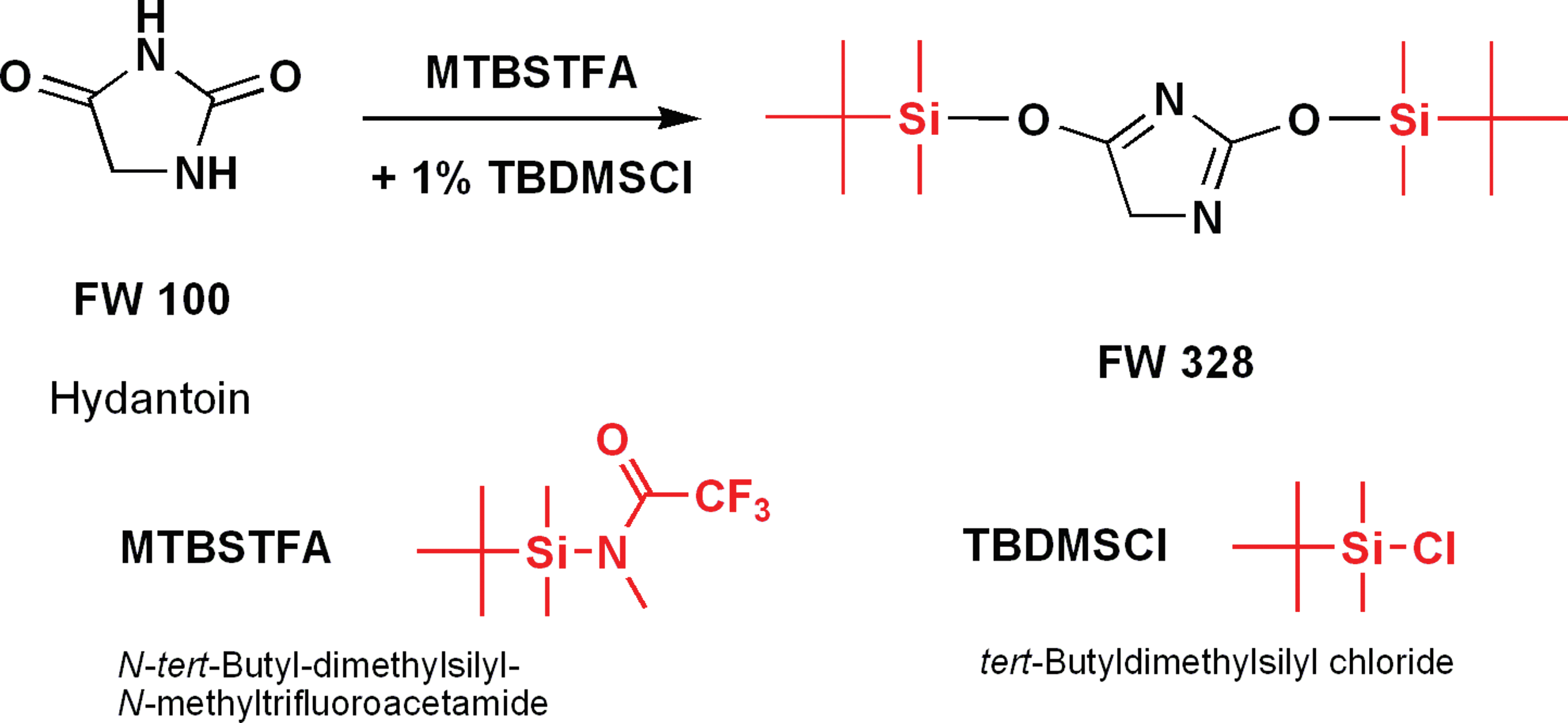
Reaction of hydantoin silylation with MTBSTFA with 1% TBDMSCl (adapted from Schummer et al., 2009). Color graphics can be found online at
Identification of hydantoin was performed by comparing the retention times of peaks in the sample chromatograms and their mass spectra with those of a standard of hydantoin (Sigma-Aldrich, 99% purity) derivatized following the same protocol as for the samples.
3. Results: Identification of Hydantoin
Urea, glycolic acid, glycerol, and hydantoin were detected in all synthesized samples. Since the detection and astrobiological implications of urea, glycolic acid, and glycerol in similar experiments have already been discussed in detail in Nuevo et al. (2010), here we focus our attention on the detection of hydantoin.
The hydantoin tert-butyldimethylsilyl derivative is characterized by a chromatographic peak eluting at a retention time of about 18.25 min (Fig. 2) and a mass spectrum in which the most intense fragment has a mass-to-charge ratio (m/z) of 271 amu, corresponding to the molecular ion (328 amu) that has lost a tert-butyl group (57 amu) and is referred to as the [M–57]+ fragment (Casal et al., 2004; Schummer et al., 2009). Each sample was analyzed by mass spectrometry in both the total ion chromatogram (TIC) and selected ion monitoring (SIM) acquisition modes. In a TIC, the y axis corresponds to the sum of all detected ion currents for each scan, while the SIM mode is a data acquisition technique in which only the currents of a small range of selected ion fragments are monitored in order to maximize the sensitivity. Hydantoin is produced in small quantities in our residues, which makes it difficult to be detected in the TIC mode. For this reason, we concentrated on the SIM mode for m/z=271 (for regular 12C samples) and m/z=274 amu (for the 13C sample).
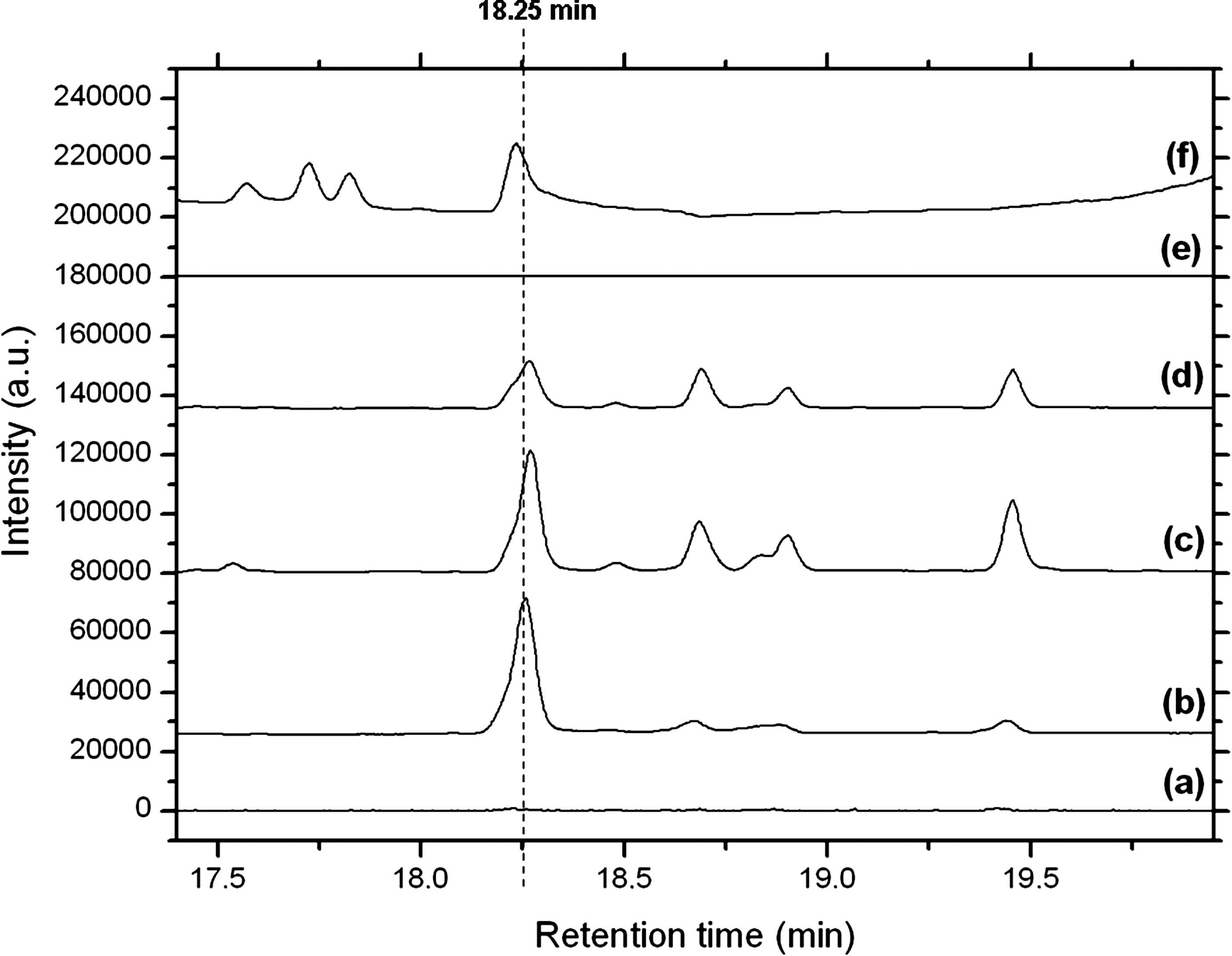
Selected ion monitoring chromatograms for (
Figure 2 shows the SIM chromatograms of a control sample, which corresponds to a blank window (ice mixture deposited) that was not irradiated, for ions of m/z=271 amu (trace
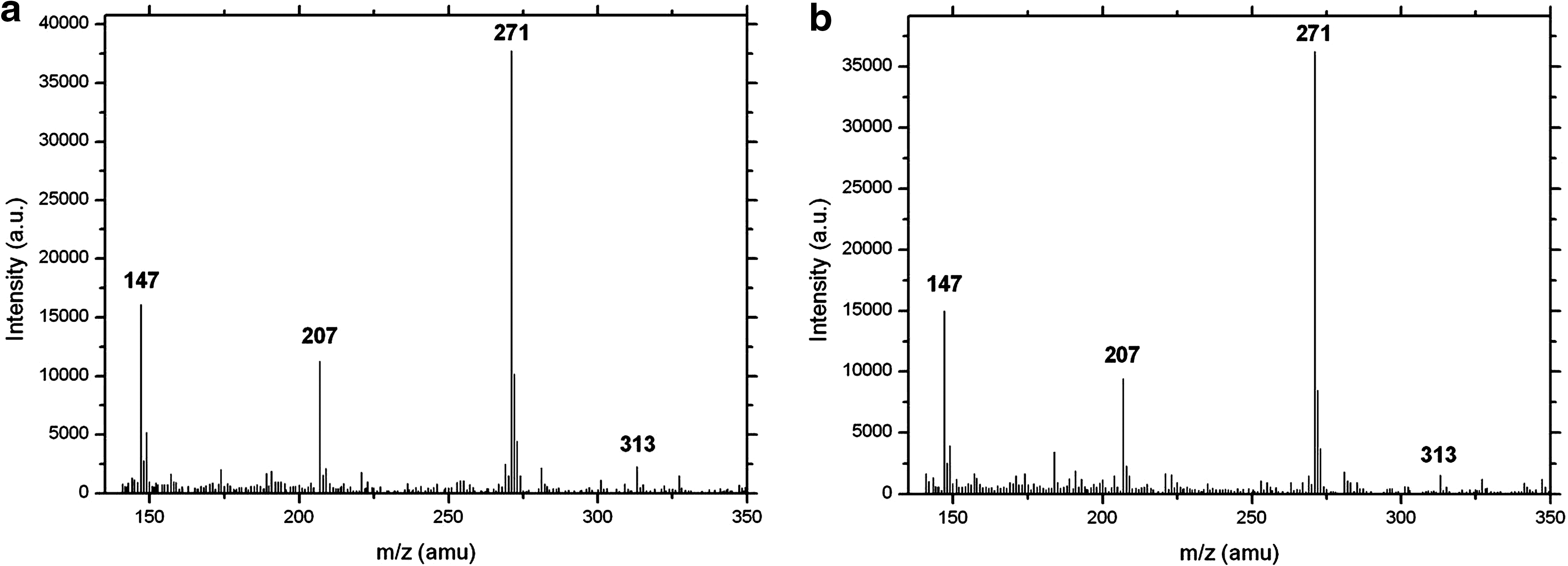
Mass spectra of the peaks eluting at about 18.25 min assigned to hydantoin for (
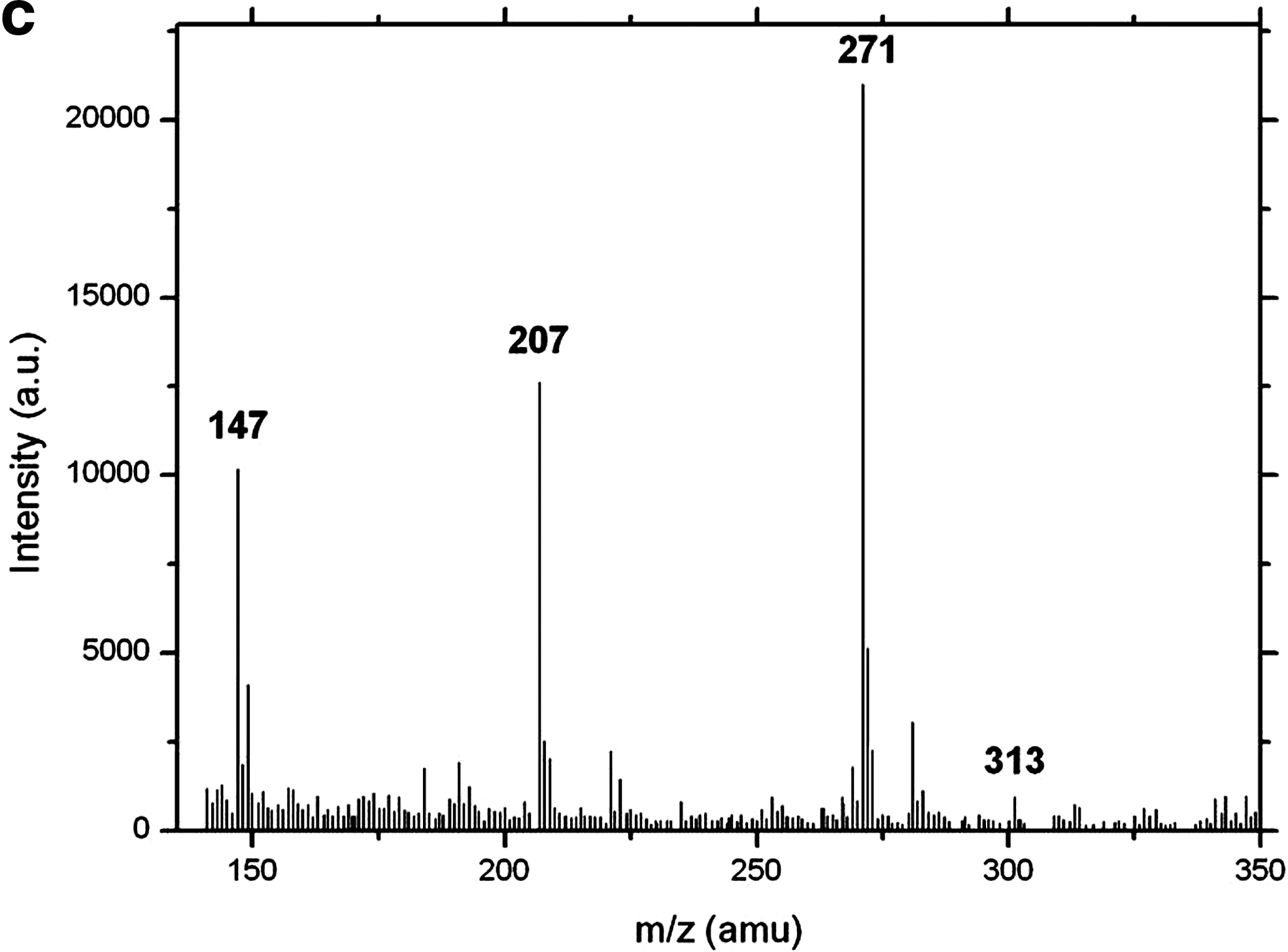
Several remarks must be made regarding the detection of hydantoin in our samples. First of all, we chose not to record m/z smaller than 130 amu since no other characteristic peaks are present in this range. Thus, the comparison between the mass spectra is only made in the 130–350 amu range, in which only two of the characteristic fragments of the hydantoin derivative are displayed at m/z=271 and 313 amu. Furthermore, we verified that hydantoin was actually produced during photo-irradiation of the ices at low temperature and not formed at room temperature after extraction of the residues with H2O or during the derivatization process, because residues contain urea and glycolic acid, which are known to react to form hydantoin (Ware, 1950). This was checked by derivatizing a concentrated mixture composed of urea and glycolic acid following the same protocol as for the hydantoin standard and the residues (see Section 2.2) and by injecting it into the GC-MS. No hydantoin was detected in this mixture. Finally, note that in our study hydantoin was recovered from residues that had not been hydrolyzed in an acidic medium, unlike residues in which amino acids have been detected, so that hydantoin forms and remains in a “free” form in the samples.
The absolute amounts of hydantoin measured in these residues are small, less than 1 μg. Compared with the quantities of other molecules detected in residues produced under similar experimental conditions, these abundances correspond to less than 1% of the amount measured for hexamethylenetetramine, a molecule whose presence in the residues accounts for around 50% in mass as accurately derived from the IR spectrum of typical residues (Bernstein et al., 1995; de Marcellus, 2010). An interesting result is that the quantity of hydantoin measured in the H2O:CH3OH:NH3 sample is significantly higher than that measured in the residue formed from the mixture that did not contain H2O. Moreover, the total quantities of CH3OH and NH3 deposited are twice lower in the H2O:CH3OH:NH3 sample, which results in a relative quantity of hydantoin about 4 times higher in this last sample than in the one without water. Although such a result should be repeated to be accurately quantified, it suggests that water ice behaves as a protective and active matrix in which the formation of hydantoin and other organics is catalyzed and/or favored. This property of H2O ice has already been observed in previous laboratory simulations and quantum calculations for the study of the formation of uracil from the UV irradiation of H2O:pyrimidine mixtures, in which the presence of water was essential in the final, stable deprotonation of the intermediate compounds that led to the formation of the final photoproducts (Bera et al., 2010). However, in the present study, we focused on the detection of hydantoin in organic residues and its astrobiological implications (see Section 4) but did not study its mechanism of formation. The quantities of 13C-hydantoin shown in Fig. 2 cannot be directly compared with those for 12C because these chromatograms do not correspond to the same injected quantities of sample. Note that the 13C-hydantoin experiment is reported only to show that the detection of hydantoin in our initial samples was not the result of any sort of contamination.
4. Astrobiological Implications
Astronomical observations and laboratory experiments simulating energetic processes of ices in astrophysical environments have shown that ice photochemistry is an efficient process that always leads, after evaporation of the ices, to the formation of a semi-refractory residue that consists mainly of complex organics (Bernstein et al., 1995; Muñoz Caro and Schutte, 2003). Although astrophysical ices are also subjected to other energetic radiation such as cosmic rays, we chose to focus our study on the effect of UV photons because they are present in interstellar clouds regardless of the UV extinction (Prasad and Tarafdar, 1983; Shen et al., 2004). Furthermore, direct comparison between astronomical data and laboratory simulations, in which a suite of new molecules are formed and can be searched for in astrophysical environments (d'Hendecourt et al., 1996), clearly indicates that the experimental approach is a powerful and necessary step to study the evolution of ices and organic matter in astrophysical environments.
Recent ice photochemistry experiments showed that UV circularly polarized light may be the mechanism at the origin of the enantiomeric excesses measured in some meteoritic amino acids (de Marcellus et al., 2011), which supports the scenario that suggests part of the soluble organic matter from primitive chondrites is the result of photochemical processes of interstellar/circumstellar ices. Thus, the detection of hydantoin among a large suite of organic molecules of potential prebiotic interest in laboratory organic residues constitutes an additional favorable point of comparison between laboratory experiments and the organic composition of extraterrestrial matter. Indeed, hydantoin and its derivatives have been detected in Murchison and Yamato-791198 meteorites (Cooper and Cronin, 1995; Shimoyama and Ogasawara, 2002). Such nondirected experiments simulate extraterrestrial conditions in the sense that the evolution of the laboratory ices follows that of a natural astrophysical ice. The organic composition of the so-formed residue constitutes a plausible match with extraterrestrial matter, in particular the meteoritic soluble organic matter for which more precise data are constantly provided.
As with amino acids, also present in hydrolyzed organic residues (Bernstein et al., 2002; Muñoz Caro et al., 2002; Nuevo et al., 2008), the presence of hydantoin has a strong astrobiological implication. Indeed, from a prebiotic point of view, hydantoin plays an important role as an intermediate compound in the formation of poly- and oligopeptides, via selective catalytic processes in an aqueous medium (Fig. 4). Considering a scenario in which prebiotic compounds have been delivered to primitive oceans by exogenous sources (see, e.g., Oró, 1961), one can reasonably assume that molecules such as hydantoin, urea, and α-amino acids seeded the oceans of primitive Earth. Such a scenario was already strongly supported by the detection of a large number of amino acids (Kvenvolden et al., 1970; Cronin and Pizzarello, 1983; Martins et al., 2007) and a small number of nucleobases (Folsome et al., 1971; van der Velden and Schwartz, 1977; Martins et al., 2008) in meteorites and in organic residues produced in UV irradiation experiments comparable to those described in the present study (Bernstein et al., 2002; Muñoz Caro et al., 2002; Nuevo et al., 2008, 2009).
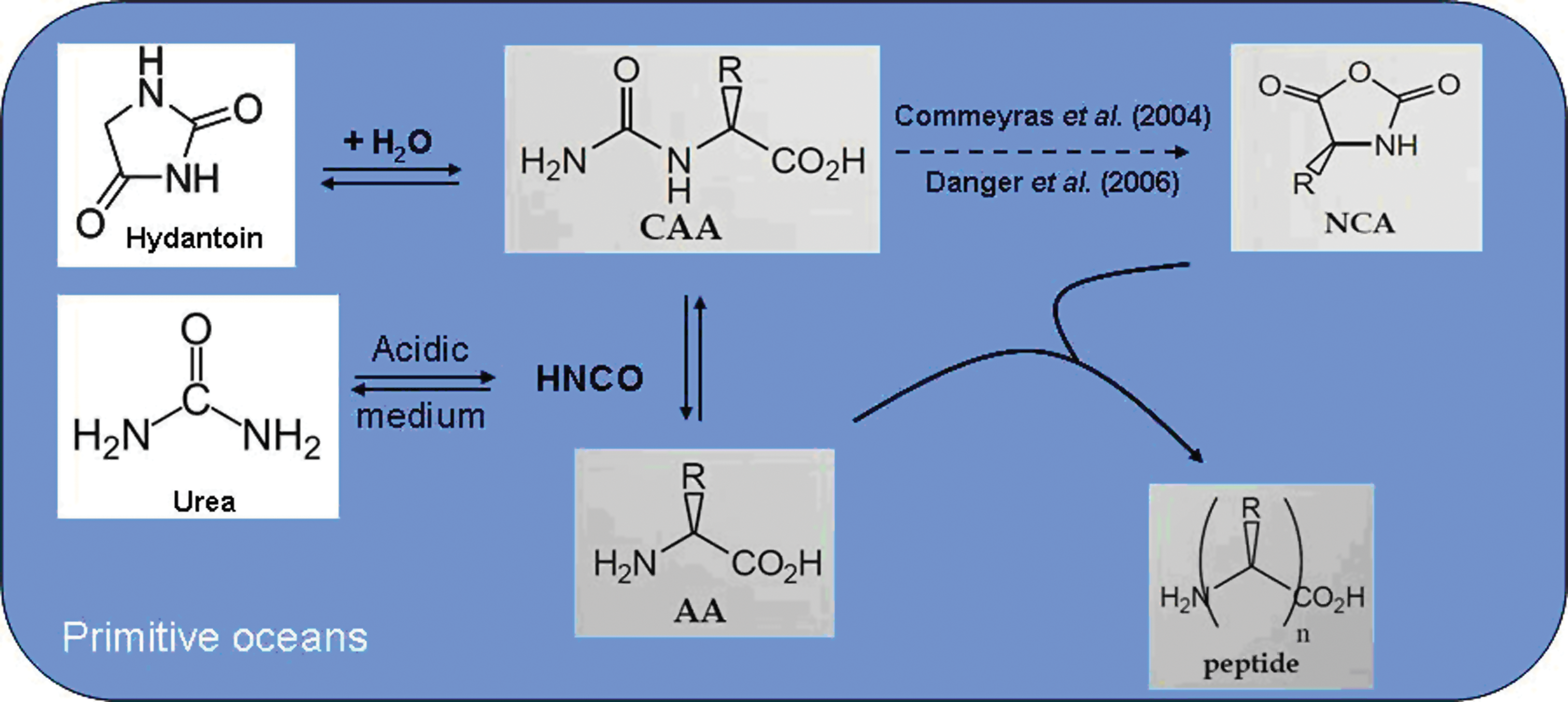
Prebiotic significance of hydantoin. In an aqueous medium such as primitive oceans, hydantoin can lead to the formation of carbamoyl amino acids (CAAs) and subsequently to N-carboxyanhydride amino acids (NCAs). In the presence of α-amino acids (AAs), NCAs will produce poly- and oligopeptides, according to the schemes proposed by Commeyras et al. (2004) and Danger et al. (2006), which may be the precursors of primitive proteins on early Earth. Color graphics can be found online at
Hydrolysis of hydantoin could then easily form carbamoyl amino acids (CAAs). Such CAAs could also form by addition of isocyanic acid (HNCO) to α-amino acids (Taillades et al., 2001). In this reaction, isocyanic acid would be a product of decomposition of urea, also detected in our residues and in previous studies (Nuevo et al., 2010), together with NH3, which must take place in an acidic medium such as terrestrial primitive oceans (Mojzsis et al., 1999). Once CAAs are formed, they may lead to the formation of N-carboxyanhydride amino acids (NCAs) via two different and efficient pathways. The first one takes place in a mildly acidic aqueous phase and involves the loss of NH3 to form isocyanate derivatives of amino acids, which, by cyclization, will lead to NCAs (Danger et al., 2006). The second pathway requires the nitrosation of the urea group of the CAAs in an oxidizing atmosphere, followed by an identical cyclization (Commeyras et al., 2004). Finally, NCAs, activated derivatives of amino acids, will polymerize into poly- and oligopeptides due to the condensation of amino acids (Fig. 4). Repeated amino acid activation and elongation leads to the formation of longer peptides. Therefore, this scenario is a possible pathway for the formation of primitive proteins in a prebiotic chemical environment such as early Earth.
5. Conclusions
Ultraviolet photo-irradiation of representative interstellar ice analogues containing CH3OH and NH3 with or without the presence of H2O has been shown to lead to the formation of a large suite of organic molecules, including the heterocyclic compound hydantoin. Although the quantities measured for this compound by gas chromatography–mass spectrometry are small compared with the full inventory of compounds formed during such experiments, the detection of hydantoin is of major prebiotic interest because it plays an important role as an intermediate for the formation of poly- and oligopeptides, according to the schemes proposed by Commeyras et al. (2004) and Danger et al. (2006), and may thus be a precursor of primitive proteins. Moreover, this molecule is also detected in primitive chondrites such as Murchison so that its presence in organic residues produced in the laboratory, together with other organic compounds such as amino acids and nucleic acid bases, supports the astrophysical and prebiotic relevance of interstellar ice photochemistry and the scenario in which the potential biomolecules that triggered the emergence of life were of extraterrestrial origin.
Footnotes
Acknowledgments
We are indebted to Dr. G. Danger for enlightening discussions on the role of hydantoin in a prebiotic environment. This experiment was supported by the French program from CNRS, PCMI, and the CNES “Exobiology Department” (MICMOC Experiment). L.L.S.H. is grateful to Dr. Kensei Kobayashi for attracting our attention on the hydantoin molecule. Anonymous referees have been helpful to improve the quality of the manuscript.
Author Disclosure Statement
No competing financial interests exist.
Abbreviations
CAAs, carbamoyl amino acids; GC-MS, gas chromatograph–mass spectrometer; m/z, mass-to-charge ratio; NCAs, N-carboxyanhydride amino acids; SIM, selected ion monitoring; TIC, total ion chromatogram.