




Abstract
The Cuatro Ciénegas Basin (CCB) has been identified as a center of endemism for many life-forms. Nearly half the bacterial species found in the spring systems have their closest relatives in the ocean. This raises the question of whether the high diversity observed today is the product of an adaptive radiation similar to that of the Galapagos Islands or whether the bacterial groups are “survivors” of an ancient sea, which would be of interest for astrobiology.
To help answer this question, we focused on Firmicutes from Cuatro Ciénegas (mainly Bacillus and Exiguobacterium). We reconstructed the phylogenetic relationships of Firmicutes with 28 housekeeping genes and dated the resulting tree using geological events as calibration points.
Our results show that marine Bacillus diverged from other Bacillus strains 838 Ma, while Bacillus from Cuatro Ciénegas have divergence dates that range from 770 to 202 Ma. The members of Exiguobacterium from the CCB conform to a much younger group that diverged from the Andes strain 60 Ma and from the one in Yellowstone 183 Ma. Therefore, the diversity of Firmicutes in Cuatro Ciénegas is not the product of a recent radiation but the product of the isolation of lineages from an ancient ocean. Hence, Cuatro Ciénegas is not a Galapagos Archipelago for bacteria but is more like an astrobiological “time machine” in which bacterial lineages survived in an oligotrophic environment that may be very similar to that of the Precambrian. Key Words: Firmicutes—Cuatro Ciénegas—Precambrian—Molecular dating—Western Interior Seaway. Astrobiology 12, 674–684.
1. Introduction
Is the CCB, then, of astrobiological interest or simply a microbial Galapagos where a few marine lineages recently diverged? To examine this, we reviewed the geological data, using comparative genomics and a molecular clock. The oldest sediments of the CCB date back to the late Permian (Minckley, 1969); however, Coahuila was on the southwestern shore of the North American Craton for a longer time, possibly since the Precambrian (Fig. 1Ai, 1Bi). Later, the paleocontinent Pangea fragmented into Laurassia and Gondwana in the Jurassic (Fig. 1Aii; Golonka, 2007). We presume that, after the Pangea breakup, what is now the CCB became part of the Panthalassa shoreline (Fig. 1Aii). Later, the Coahuila block, which comprised a portion of the Pacific shores, became part of the shore of the Central Atlantic Ocean (Fig. 1Aiii; Anderson and Schmidt, 1983). Hence, during the late Paleozoic and all through the Mesozoic this area was covered by a shallow sea, the Western Interior Seaway (WIS; Fig. 1Bii), which began to regress in the late Cretaceous due to the uplift caused by the Laramide Orogeny (Minckley, 1969; Ferrusquía-Villafranca, 1998; Lehmann et al., 1999). The complete isolation of the CCB from the Gulf of Mexico happened with the uplift of the Sierra Madre Oriental in the mid Eocene (Ferrusquía-Villafranca, 1998; Fig. 1Biii). From this geological evidence, we have concluded that the CCB was a shallow marine environment for most of Earth's history, and when the CCB became isolated due to the uplift of the Coahuila block, the bacteria that remained became relics of the diversity from the ancient sea. Thus, the high diversity of the CCB would be a product of two things: the diversity already present at the time of isolation and the new community assemblages that arose in this unique aquatic environment (Souza et al., 2006; Moreno-Letelier et al., 2011).
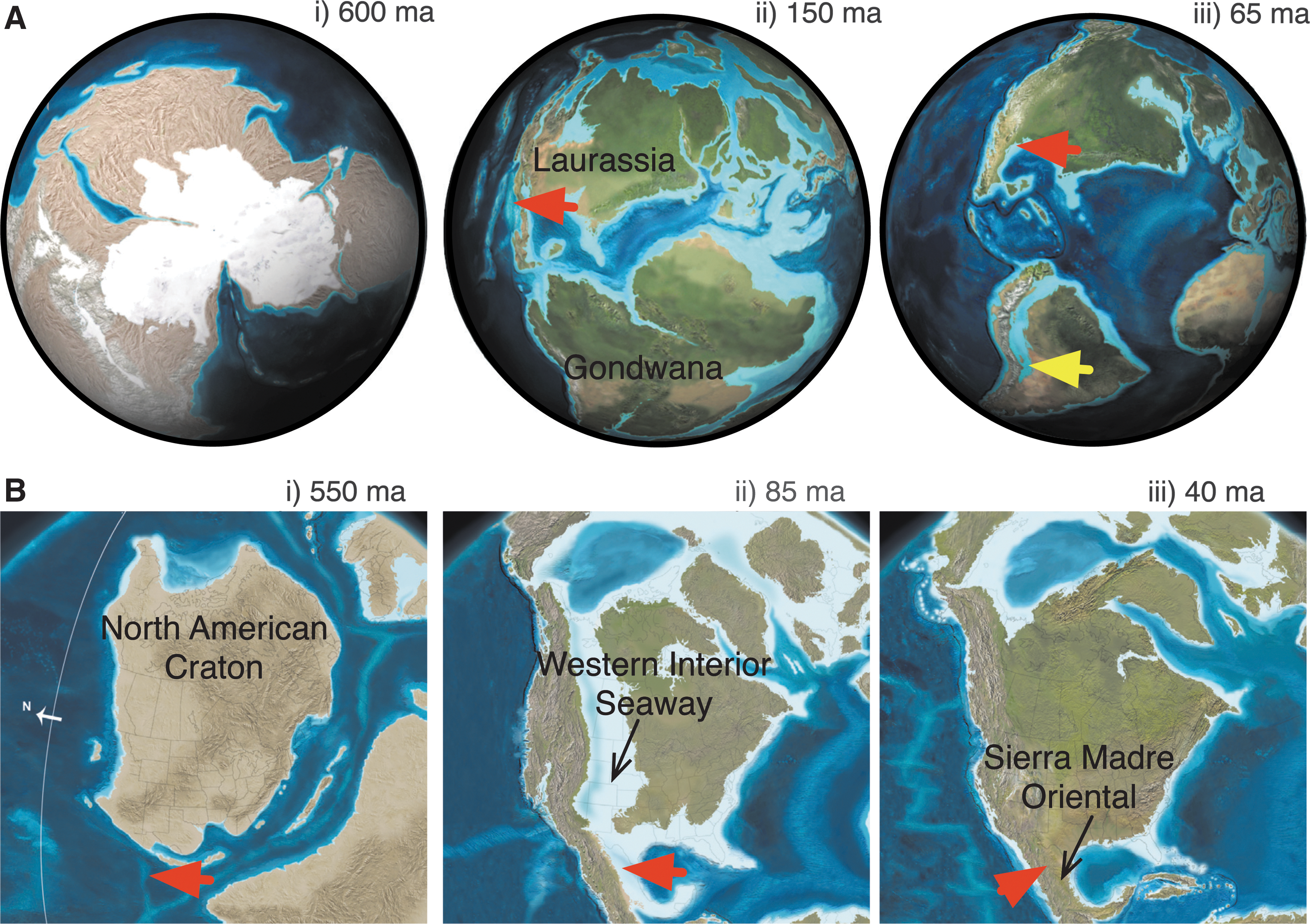
Landmass distribution at different stages of Earth's history. (
Another possible scenario is that the CCB marine biota migrated from actual oceans and radiated in their isolated ponds, which became a microbial “Galapagos Archipelago,” where adaptive radiation to a new environment caused the observed diversity (Taylor and Minckley, 1966). Under this assumption, many lineages would be monophyletic, as expected under a model of diversification after the isolation from the sea. In this study we decided to contrast both hypotheses using comparative genomics and a molecular clock.
Firmicutes, an abundant and widespread group within the CCB (Souza et al., 2007; Alcaraz et al., 2008, 2010; Cerritos et al., 2011), is the focus of this study, in part because there are several endemic species within the site, and because their whole genome has been sequenced for both Bacillus and Exiguobacterium (Bacillus coahuilensis m4-4; Alcaraz et al., 2008; Bacillus sp. s m3-13; Alcaraz et al., 2010; and several unpublished data from drafts Bacillus sp. p15.4, Exiguobacterium EPVM and 11–28) and a still-unidentified strain from the Puna Altiplano from Argentina, Exiguobacterium sp. N39, which was found in a similar isolated aquatic environment (Ordoñez et al., 2009).
In this study, we reconstructed the phylogenetic relationships and estimated the divergence times of aerobic Firmicutes, with emphasis on Exiguobacterium and Bacillus from the CCB and other similar habitats, to determine whether the diversity of the basin is a “Galapagos Archipelago” or a window to the past.
2. Material and Methods
2.1. Phylogenetic reconstruction
The phylogenetic relationships of Firmicutes were reconstructed by using a concatenated data set of 28 orthologous genes. The criteria used for gene selection were as follows: (1) presence in most lineages of Firmicutes, both aerobic and anaerobic; (2) no obvious signal of horizontal gene transfer (evaluated by the congruence of single-gene tree topologies); (3) no accelerated substitution rate.
Eighteen of the genes used are universally conserved, as described by Ciccarelli et al. (2006) and Bapteste et al. (2008). These genes have already been identified as phylogenetically congruent for the major bacterial groups (recA, dnaK, ruvA, rplNA, rplE, rpsE, rplV, rpsI, ksgA, dnaG, rplR, rpsB, rplI, leuS, serS, gcp, pheS, and rpsL). Aside from the universally conserved genes mentioned before, we added another 10 genes identified by Maughan (2007) and Alcaraz et al. (2010) as being present in most lineages of Firmicutes (ligA, dnaN, pyrH, dnaJ, metK, typA/bipA, MutL, MutS, ddl, and proH). The later genes were added to increase the resolution of particular groups.
To ensure a good phylogenetic sampling, species were selected from the main groups of the phylum Firmicutes that are represented by complete genomes in GenBank. From the class Clostridia (anaerobic Firmicutes), we included the orders Thermoanaerobacterales (1 taxon) and Clostridiales (7 taxa). The class Bacilli (aerobic Firmicutes) was represented by families that belong to the order Bacillales: Bacillaceae, Alicyclobacillaceae, Listeriaceae, Paenibacillaceae, Staphylococcaceae, and a yet-unplaced family that includes the genus Exiguobacterium (Ludwig et al., 2009). The order Lactobacillales was represented by Lactobacillus, Enterococcus, and Streptococcus. Special emphasis was made to include as many representatives of marine Bacillus and Exiguobacterium as possible, including sequences from CCB strains (EPVM and 11–28) and a strain from the Andes (N39), which are still in draft (unpublished data). Also, the Mycoplasma group was excluded from the phylogeny because the accelerated substitution rates of its genes would produce artifacts in the molecular dating (Sanderson, 2001). Outgroups were selected among the phyla Cyanobacteria and Chloroflexi. Other phyla related to Firmicutes (such as Actinobacteria or Fusobacteria) were not included because not all orthologous genes could be found. Genome accession numbers and lists of all species names can be found in the Supplementary Material (Supplementary Data are available online at
Phylogenetic reconstruction was done by using a maximum likelihood approach with RaxML ver. 7.2.7 (Stamatakis et al., 2005, 2008), implemented by the Cipres Science Gateway (
One of our aims in this study was to gain insight into the divergence of the genus Exiguobacterium in the CCB; however, only two complete genomes have been published, in addition to the draft genomes reported in this study. For this reason, another phylogenetic reconstruction was performed by using three housekeeping genes (citC, dnaK, and recA) that are available in GenBank for other Exiguobacterium species (Exiguobacterium sibiricum, Exiguobacterium antarcticum, Exiguobacterium undae, Exiguobacterium acetylicum, Exiguobacterium aurantiacum, and Exiguobacterium sp. AT1b) and the taxa from the CCB mentioned above. Additionally, partial sequences of these three genes were included from two strains of Exiguobacterium isolated from the CCB (Exiguobacterium sp. EF3 and Exiguobacterium sp. EF2). For this phylogenetic reconstruction, only partial sequences were used; they were translated to amino acids and concatenated in a data set of 730 characters. The phylogenetic analysis was performed as described above. Gene accession numbers can be found in the Supplementary Material (
2.2. Molecular dating
Molecular dating was performed by using a Bayesian MCMC method implemented by BEAST 1.6.2 with the consensus tree topology obtained with the methods described in the previous section as a constraint, and a Yule speciation model (Drummond and Rambaut, 2007). This method allows for rates to vary independently in each lineage, which thus relaxes the assumptions of a molecular clock. The clock model was set as uncorrelated lognormal to accommodate rate heterogeneity. This scenario is likely due to the deep divergence times expected in a phylum-wide phylogeny. Calibration points were obtained from geological events: origin of life, the rise in atmospheric O2 and the uplift of the Coahuila block, and isolation of the CCB from the ocean. This was done because of the low reliability of bacterial fossils and biomarkers (Gérard et al., 2009) and the intrinsic difficulty of assigning any given fossil to a particular node. Therefore, even if geological events span several million years, they can still serve as calibration points for specific nodes in the phylogeny and set lower and upper bounds (Ho and Phillips, 2009). This would inevitably lead to wider confidence intervals, but given the poor fossil record for bacteria, it is one of the few options available to estimate absolute divergence dates.
The maximum age of the tree could not exceed the estimate of the origin of life on Earth (Nisbet and Sleep, 2001), so a maximum bound was set to 4000 Ma. A maximum date for the total tree is absolutely necessary to avoid artifacts caused by among-lineage rate heterogeneity (Ho and Phillips, 2009; Sauquet et al., 2012). The maximum date set to the tree then serves as a conservative upper bound but allows estimated ages to be younger by using a lognormal distribution. A lognormal distribution sets a hard age constraint but gives higher probability to ages slightly older or younger than this constraint, so it is adequate for calibrating the root of the tree (Sauquet et al., 2012). The node of aerobic Firmicutes was set to have an age between 2300 and 2500 Ma with a uniform prior distribution. This date corresponds to the Great Oxidation Event (Battistuzzi et al., 2004; Papineau, 2010). A terminal node of CCB bacteria (Bacillus sp. p15.4) and its sister species was also constrained to have a minimum age of 35 Ma. This age corresponds to the final retreat of the WIS and the uplift of the Sierra Madre Oriental that finally isolated Cuatro Ciénegas from the ocean (Ferrusquía-Villafranca, 1998; Vega et al., 2006). This constraint represents a minimum age, so for older dates to be possible the calibration prior was set to a lognormal distribution. The node that separates Exiguobacterium sp. N39 from the Puna Altiplano in South America from its sister species from the CCB (EPVM and 11–28) was left unconstrained. The use of these three calibration points, one in the root and two in the ingroup, ensures a better estimate of rates of variation and prevents disparate age estimates (Ho and Phillips, 2009).
3. Results
3.1. Phylogenetic reconstruction
The final alignment consisted of 9428 amino acids from 28 genes, where all the gaps and ambiguous positions were removed. An initial reconstruction performed with only the 18 universally conserved orthologues mentioned in the methods did not resolve the relationships among several families of Bacillales (data not shown), so another 10 genes, conserved in Firmicutes, were added to the alignment. The genes rpoB and ileS, reported by Bapteste et al. (2008), were not included in the analysis because the first had poor phylogenetic signal for the aerobic Firmicutes and the latter showed evidence of horizontal gene transfer.
The phylogenetic reconstruction performed with the complete data set of 28 genes yielded a highly resolved tree of Firmicutes (Fig. 2). Most clades were highly supported, with the exception of the clade that places Clostridium and Thermoanaerobacter tengcongensis as sister group to aerobic Firmicutes. Aerobic Firmicutes were recovered as a monophyletic group, which is consistent with the taxonomy (class Bacilli). Bacillus tusciae and Alicyclobacillus acidocaldarius subsp. acidocaldarius DSM 446 form an early divergent group that is sister to the rest of the other members of class Bacilli. The taxonomy of the class is clearly artificial, since Bacillales is a paraphyletic group that should include Lactobacillales.

Phylogenetic reconstruction of the phylum Firmicutes based on a concatenated matrix of 28 genes and a ML method. Green branches correspond to Cyanobacteria as an outgroup. Blue branches correspond to aerobic Firmicutes. Asterisks indicate bootstrap values of 100 (out of 100 replicates), and red numbers indicate low bootstrap values that were not used in molecular dating. The boxes highlight those clades with taxa from the CCB. Color images available online at
The genus Bacillus, as traditionally defined, is polyphyletic in this reconstruction. A group of alkaliphilic Bacillus, which includes Bacillus halodurans and Bacillus clausii, is early divergent and the sister group of the clade that includes members of Exiguobacterium and other genera of Bacillales, Lactobacillales. Also, the marine taxon Bacillus sp. B14905 is closely related to Lysinibacillus sphaericus (formerly Bacillus sphaericus) and more closely related to Staphylococcus than to other Bacillus.
The genus Exiguobacterium is monophyletic and, with Oceanobacillus iheyensis, forms a clade sister to Listeriaceae, Staphylococcaceae, and Bacillus, but with a low support value (Fig. 2). The rest of the members of Bacillus (B. cereus group, the marine and B. subtilis group) appear to be monophyletic and sister to a group that includes Geobacillus spp. and Anoxybacillus flavithermus, but with a low support value.
Within Bacillus, there are three major monophyletic groups with high support values (Fig. 2): the Bacillus cereus group, the Bacillus subtilis group (both described as soil taxa), and another group with mostly marine taxa. Another clade that is closely related to B. subtilis group includes B. sp. m3-13 and Bacillus megaterium. B. coahuilensis str. m4-4 and B. sp. 15.4 from the CCB are found in the marine Bacillus clade but do not form a monophyletic group by themselves.
The phylogenetic reconstruction of the relationships within genus Exiguobacterium yielded two highly supported monophyletic groups, one with mostly psychrophilic taxa and another with thermophilic taxa (Fig. 3). The two taxa from the CCB are found in the thermophilic clade, but they are not monophyletic. Three strains cluster with the strain from the Puna Altiplano, and this later clade is sister to strain Exiguobacterium aurantiacum. However, the relationships within this CCB-Puna clade are not clear, as shown by the low bootstrap values and very short branches. This contrasts with the results from the 28-gene reconstruction (Fig. 2), where relationships of the species within the genus Exiguobacterium are well resolved, but the taxon sampling is incomplete. An early divergent clade within the thermophilic clade is formed by a strain from Yellowstone National Park (AT1b) and a strain from the CCB (EF2) that is not closely related to any of the other strains from the CCB (EF3, EPVM, and 11–28).
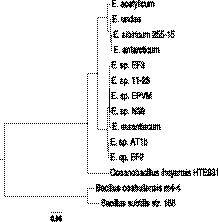
Phylogenetic reconstruction of the genus Exiguobacterium, performed with partial amino acid sequences of genes citC, dnaK, and recA. Reconstructions were done with a ML method with 100 bootstrap replicates. *Isolates from the CCB. **Isolate from Puna Altiplano. §Isolate from Yellowstone National Park.
3.2. Molecular dating
As the starting tree for the molecular dating was highly resolved, most of the divergence times of the nodes could be estimated with confidence intervals, but only those of particular interest are reported (Fig. 4). The nodes with bootstrap values lower than 80 were not considered, as those relationships remain uncertain.
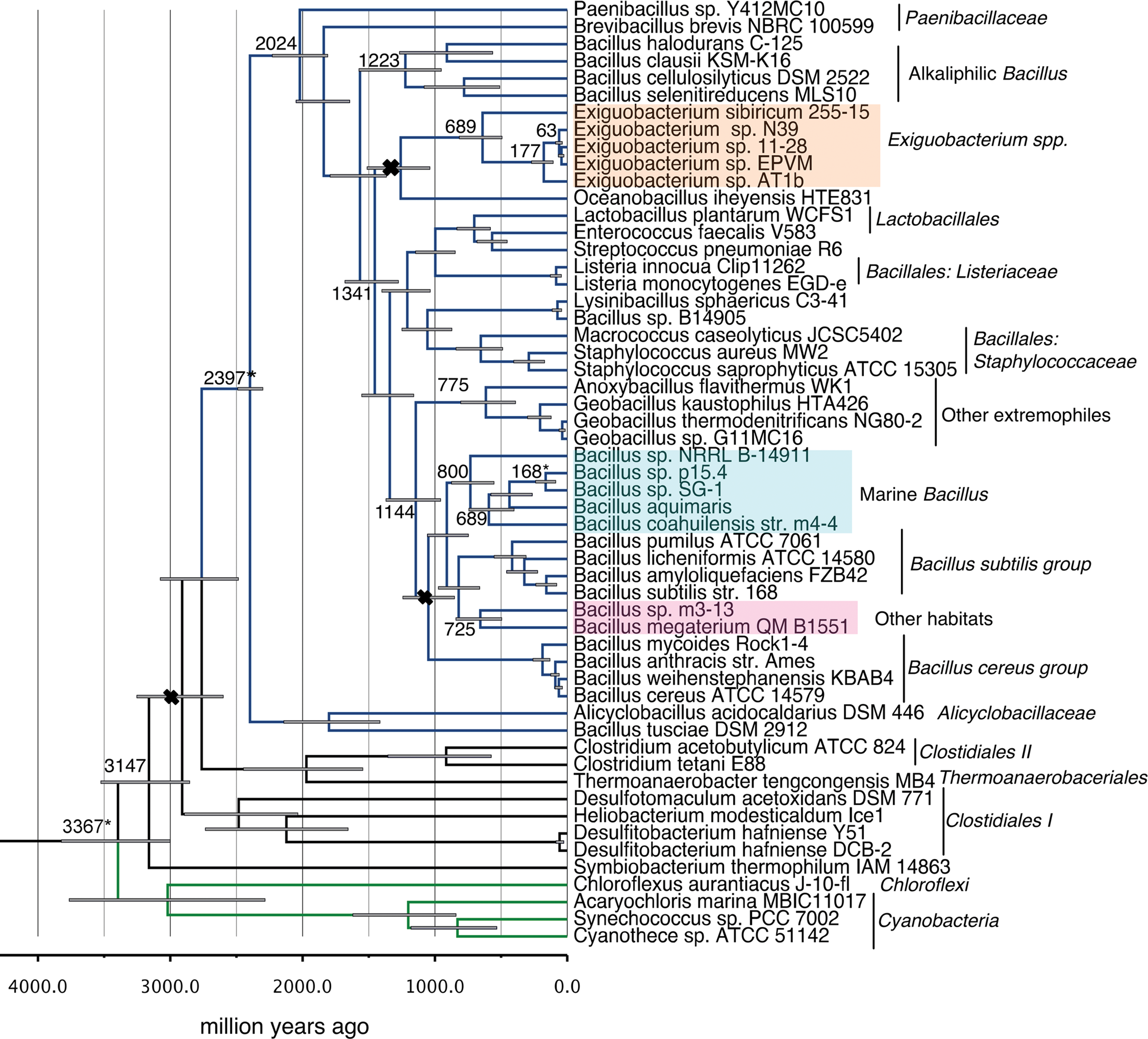
Dated phylogenetic tree of the phylum Firmicutes, dates in million years in selected nodes. Green branches correspond to Cyanobacteria as an outgroup. Blue branches correspond to aerobic Firmicutes. Black crosses mark those nodes that were not dated. Asterisks mark the nodes that were constrained for the age estimates. The gray bars indicate 95% confidence intervals for the age estimate. Color images available online at
The taxa from the CCB do not form a monophyletic group among themselves in each of their phylogenetic groups. The Bacillus strains from the CCB present very old divergences, 168 Ma (Jurassic) for B. sp. 15.4 from its closest relative from the Gulf of Mexico (Bacillus sp. SG-1). B. coahuilensis str. m4-4 diverged 654 Ma from another clade that includes other marine Bacillus strains from the Sea of Korea, Bacillus aquimaris (Cryogenian; Fig. 4).
An interesting case is Bacillus sp. m3-13, a strain that was isolated from CCB sediment and does not cluster with the marine clade but with Bacillus megaterium, from which it split 725 Ma. In all, marine Bacillus diverged around 800 Ma. As the Bacillus clade had a low support value, the divergence time estimate will not be considered, but a clade we call Bacillus sensu lato, which includes Anoxybacillus and Geobacillus, has an estimated age of 1144 Ma (Fig. 4). This date is very close in time to the divergence of the rest of the Bacillales (plus Lactobacillales), which was to be expected given the short internal branches in these nodes (Fig. 2). Also noteworthy are the very old dates of some clades of taxa that were traditionally placed within the Bacillales, such as Alicyclobacillaceae, which is a very early divergent, and Paenibacillaceae, where the two samples included in the study are also not monophyletic (Figs. 1 and 3). The alkaliphilic Bacillus, traditionally placed in Bacillaceae, diverged around 1000 Ma from its sister clade, which is earlier than the rest of the members of the class Bacilli.
4. Discussion
4.1. Phylogenetic reconstruction
The initial phylogenetic reconstruction, performed with only the genes reported in Ciccarelli et al. (2006) and Bapteste et al. (2008), did not resolve the relationships among and within the families Bacillaceae, Listeriaceae, Staphylococcaceae, and Lactobacillaceae (data not shown). Much has been argued about the validity of increasing the number of concatenated genes for phylogenetic reconstruction because of the topological incongruences caused by horizontal gene transfer (Bapteste et al., 2008; Philippe et al., 2011). In this study, the increase in the number of genes did in fact improve the support of several nodes.
Our results are consistent with other multigene reconstructions (Ciccarelli et al., 2006; Maughan, 2007), except for the placement of the clade of alkaliphilic Bacillus, which is sister to the rest of the genus Bacillus; in our reconstruction, it is early divergent to the rest of Bacillales, with the exception of families Paenibacillaceae and Alicyclobacillaceae (Fig. 2). However, none of the previous multigene analyses (Ciccarelli et al., 2006; Maughan, 2007) have a wide taxon sampling; in particular, they do not include the genus Exiguobacterium nor members of the family Paenibacillaceae, which can account for this topological incongruence. A good taxon sampling is key to detect homoplasy and adds phylogenetic signal to the data set (Philippe et al., 2011); it also allows for a better estimation of divergence times and rates of molecular evolution (Heath et al., 2008). Since only a fraction of the true bacterial diversity is known, it is important to include as many taxa as possible in phylogenetic analyses to avoid a much higher bias than that which is already inevitable.
Another topological incongruence with previous studies with a similar taxon sampling is the placement of the Bacillus cereus group. Our results place this group inside a clade with the marine and other soil Bacillus, but in another reconstruction, performed with only a subset of the genes used in this work, the Bacillus cereus group was sister to Geobacillus and Anoxybacillus (Moreno-Letelier et al., 2011). However, the support value of that node was low. The support value of the node that makes the marine and soil Bacillus monophyletic is also low (Fig. 2); thus, the relationships within core Bacillaceae are still equivocal. One cause of this inconsistency could be the low phylogenetic signal of the markers used, which was a result of rapid speciation (Philippe et al., 2011). This rapid speciation can be inferred by the short internal branches of core Bacillaceae (Fig. 2). Thus, taxon-specific genes that are more phylogenetically informative are needed.
The relationships of the other members of Bacillales are congruent with the results reported by Maughan (2007), where Lactobacillales is sister to Listeriaceae, which makes the order Bacillales paraphiletic. The position of Lactobacillales within the Bacillales clade is not recovered in the analysis of Ciccarelli et al. (2006); we attribute this topological difference to the fact that we used only 20 of the 31 genes used in that reconstruction.
There are phylogenies of Firmicutes with a more complete taxon sampling in which one or a few genes were used, but they are highly incongruent and/or have poor resolution (Wolf et al., 2004; Yakoubou et al., 2010). So the approach for highly resolved, congruent, and true bacterial phylogenies has to be good taxon sampling and a careful selection of genes.
For the specific case of CCB taxa, only two of the Bacillus strains in our sample grouped with other marine Bacillus (Fig. 2; Souza et al., 2006; Cerritos et al., 2008). However, Bacillus sp. m3-13 appeared more closely related to B. megaterium and other soil Bacillus from the B. subtilis group, which was unexpected, given that it clustered with marine Bacillus in a 16S gene and 814 concatenated genes phylogeny (Alcaraz et al., 2010). Thus, given the good support values of our reconstruction (Fig. 2) and that B. sp. m3-13 was isolated in a shallow desiccation lagoon, it is plausible that this taxon is indeed closely related to other Bacillus.
In this 28-gene tree, E. sp. N39 from the Andes is sister to a clade formed by CCB strains E. sp 11–29 and E. sp. EPVM. To focus more carefully on the Exiguobacterium lineage, we reconstructed the phylogenetic tree by using only three genes (Fig. 3) but with a better taxon sampling. This tree is congruent with the 16S rRNA gene phylogeny of the genus (Vishnivetskaya et al., 2009), and all our samples fell into the thermophilic clade. However, the relationships of the CCB taxa with their sister species change. In this tree, E. sp N39 from the Andes is sister to E. sp. EPVM from the CCB, while E. sp. EF2 also from the CCB is related to a strain from a Yellowstone hot spring (E. sp. AT1b;
4.2. Molecular dating
The molecular dates of basal nodes inferred in this work are congruent with those reported in previous studies (absolute ages of relevant nodes and confidence intervals in the Supplementary Material). Our estimation of the divergence of Firmicutes is 3147 Ma (Fig. 3), while Battistuzzi et al. (2004) reported 2750 Ma. The difference lies within the confidence intervals and could also be affected by taxon sampling. In the present study, we used several taxa of anaerobic Firmicutes, while Battistuzzi et al. (2004) only used Clostridium and Thermoanaerobacter tengcongensis. In our analysis, these taxa are not early divergent, and the age of the node that marks the divergence between Clostridiales II and the aerobic Firmicutes (Fig. 4) has an estimated age of ca. 2700 Ma. However, since that node has a low support value, the date was not considered. The divergence of aerobic Firmicutes is 2397 Ma and congruent with that reported in other studies (Battistuzzi et al., 2004; Moreno-Letelier et al., 2011).
The divergence of the main representatives of Bacillales (Listeriaceae, Staphylococcaceae, and core Bacillaceae) is also congruent with dates already reported (1300 Ma; Battistuzzi et al., 2004) but slightly younger than the 1500 Ma obtained by Moreno-Letelier et al. (2011). In general, the dates of the present study are younger than those reported in a previous work by Moreno-Letelier et al. (2011). This is because we included several early divergent aerobic Firmicutes (Alicyclobacillus acidocaldarius and Bacillus tusciae) that had not yet been included in any phylogeny of the phylum, and this yielded younger dates in the nodes of more derived aerobic Firmicutes (Fig. 4; Moreno-Letelier et al., 2011). We believe that these new dates are more accurate, because with the presence of more taxa for the aerobic Firmicutes, we have a better estimation of branch lengths needed for more precise dating (Sanderson, 2001; Philippe et al., 2011).
As was already mentioned, neither CCB Bacillus nor Exiguobacterium exhibited a monophyletic origin among them. The divergence date of the clade that includes CCB Exiguobacterium was younger than that of CCB Bacillus (63 and 654 Ma, respectively; Fig. 4), but both clades tell a story of a divergence that predates the isolation of the CCB from the ocean (Minckley, 1969). The only case of possible diversification within the CCB after the uplift of Coahuila is that of strains of Exiguobacterium. sp. EPVM, E. sp. EF3, and E. sp. 11–28, but a more detailed study with more informative markers and a larger sample size is still needed to estimate those dates. The same applies to the estimation of the divergence of CCB E. sp. EF2 and the Yellowstone E. sp. AT1b, as this date would yield information about the relationships of the microbial biota of two distant sites that were influenced by the Laramide Orogeny (Wilson and Pitts, 2010).
The evolution of life on Earth is closely linked to the evolution of the planet itself, and possibly we can correlate the diversification events in Firmicutes with Earth's history (Fig. 5). Firmicutes is a very ancient lineage that diverged in the Archean not long before the first main glaciation event that left geological evidence (Kasting, 2008). During this time, the concentration of oxygen in the atmosphere was low (Kasting and Siefert, 2002) but fluctuating, which is consistent with the basal position of anaerobic Firmicutes in the tree. The divergence of aerobic Firmicutes is consistent with the Great Oxidation Event (Papineau, 2010), but due to the nature of our dating methods, it could also be slightly older. However, the absence of more accurate fossil data for microbes makes it difficult to have a more precise date. The divergence of Bacillales and core Bacillaceae (Fig. 4) occurred in the mid Proterozoic, around the time when the paleocontinent Rodinia was formed (Fig. 5). The breakup of Rodinia was followed by a series of snowball Earth glaciations in the Cryogenian (Papineau, 2010) and coincides with the divergence of marine Bacillus, including B. coahuilensis and B. sp. m3-13 from B. megaterium (Fig. 4), and with the age obtained for filamentous cyanobacteria from the same site (Domínguez-Escobar et al., 2011). This implies the presence of very ancient photosynthetic bacteria that survived all the geological changes around the site.
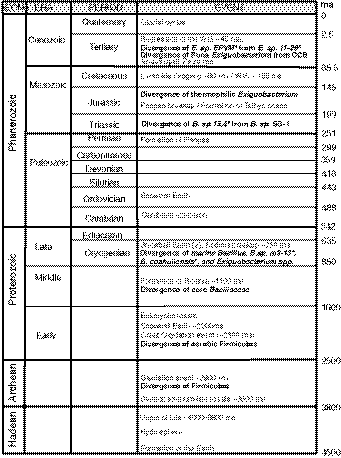
Modified geological timescale with major geological events related to the evolution of life. Divergence events of Firmicutes are indicated in bold letters. Taxon names with an asterisk (*) are taxa from the CCB.
The divergence of the genus Exiguobacterium probably occurred during the Cryogenian, before the Cambrian explosion (Fig. 5). However, it seems that the divergence of the thermophilic Exiguobacterium and of CCB B. sp. 15.4 from the marine Bacillus sp. SG-1 occurred around the time of the Pangea breakup and the formation of the Tethys Ocean (Bird and Burke, 2006). At that time, the region that is now the CCB was at the shore of the Central Atlantic Ocean (Anderson and Schmidt, 1983). Furthermore, the uplift of the Andes in the late Cretaceous, which lasted until the early Miocene (Fig. 4Aiii and Fig. 5), isolated the Puna Altiplano from the sea and caused the divergence of its exiguobacteria from its sister clade. In an independent event, the divergence of the other lineage of Exiguobacterium within the CCB that is closely related to E. sp. AT1b (E. sp. EF2; Fig. 3) could have been influenced by the retreat of the WIS and the uplift of western North America due to the Laramide Orogeny, which also occurred in the late Cretaceous.
The estimation of absolute dates in a phylogeny has an inherent associated error and large confidence intervals (Ho and Phillips, 2009), especially in the case of a bacterial phylogeny with few calibration points due to a poor fossil record. In the case of CCB Firmicutes, however, it is clear that this site comprises not only an ecology similar to the Precambrian (low phosphorous and high sulfate), with shallow waters and high solar radiation, but also very old bacterial lineages, one of them dating from the Precambrian (B. sp. m3-13, diverged 725 Ma) and another dating from when the Panthalassa ocean entered the site (B. sp. p15.4, diverged 264 Ma). Yet other lineages are more recent (Exiguobacterium from the CCB diverged from the Puna Altiplano strain 63 Ma). The CCB, nevertheless, represents a kind of time machine. However, all these unique life forms are now endangered as demand for water continues to grow in this fragile desert ecosystem.
5. Conclusions
Our results show that the diversity of Firmicutes in Cuatro Ciénegas is not the product of a recent adaptive radiation, as suggested by the “Galapagos Archipelago” hypothesis. Instead, what we found resembles more a time machine, where ancient lineages became isolated and continued their own evolutionary path. This is especially true for the representatives of Bacillus, where the different taxa have diverged from their sister species at different times: B. coahuilensis and B. sp. m3-13 in the Precambrian, B. sp. p15.4 in the Triassic. The same is true, to some extent, for the genus Exiguobacterium. However, all CCB taxa belong to the thermophilic clade and have a more recent divergence; thermophilic Exiguobacterium diverged in the Mesozoic, and E. sp. EPVM and 11–28 in the early Tertiary. By analyzing the population genetics of clades within the CCB clades of Exiguobacterium, we obtain evidence for clonal expansion and recent radiation within the site (E. Rebollar, personal communication), which suggests that radiations have taken place at lower taxonomic levels, after the main lineages of Firmicutes were established. In their genomes, genetic signals of ancient times can be found, in some cases from as far back as Precambrian times. Other traits can be found as well, such as those that have arisen to ensure survival in this endangered, extreme, and unique environment.
Overall, the CCB reinforces its astrobiological importance, since it is not only an analogue of Mars but also the only known refuge of ancient bacterial lineages. Moreover, the CCB has retained an ancient ecology where the food webs are based on microbial mats, so it represents a unique site within which to test ideas about Earth's biological evolution.
Footnotes
Acknowledgments
This project was funded by CONACYT-SEP grant no. 57507 and CONACyT-Semarnat 2006-C01-23459 and OL039 WWF-Alianza Carlos Slim awarded to V. Souza and by Cinvestav Multidisciplinary project awarded to G. Olmedo. V. Souza and L.E. Eguiarte worked on this paper during a sabbatical leave supported by DGAPA and UC-Mexus. Thanks to L.D. Alcaraz, G. Bonilla-Rosso, V. López, Z. Gómez, A. Gutiérrez-Preciado, I. Hernández, E. Rebollar, A. Vázquez-Lobo, D. Piñero, and K. Price for all their insights and comments. We thank Morena Avitia, Maria Eugenia Farrias, and Omar Ordoñez for strains used in this study.
Author Disclosure Statement
No competing financial interests exist.
Abbreviations
CCB, Cuatro Ciénegas Basin; WIS, Western Interior Seaway.
References
Supplementary Material
Please find the following supplemental material available below.
For Open Access articles published under a Creative Commons License, all supplemental material carries the same license as the article it is associated with.
For non-Open Access articles published, all supplemental material carries a non-exclusive license, and permission requests for re-use of supplemental material or any part of supplemental material shall be sent directly to the copyright owner as specified in the copyright notice associated with the article.
