




Abstract
The astrobiological significance of certain environment types on Mars strongly depends on the temperature, duration, and chemistry of liquid water that was present there in the past. Recent works have focused on the identification of signs of ancient water on Mars, as it is more difficult to estimate the above-mentioned parameters. In this paper, two important factors are reviewed, the duration and the volume of water at different environment types on past and present Mars. Using currently available information, we can only roughly estimate these values, but as environment types show characteristic differences in this respect, it is worth comparing them and the result may have importance for research in astrobiology.
Impact-induced and geothermal hydrothermal systems, lakes, and valley networks were in existence on Mars over the course of from 102 to 106 years, although they would have experienced substantially different temperature regimes. Ancient oceans, as well as water in outflow channels and gullies, and at the microscopic scale as interfacial water layers, would have had inherently different times of duration and overall volume: oceans may have endured from 104 to 106 years, while interfacial water would have had the smallest volume and residence time of liquid phase on Mars. Martian wet environments with longer residence times of liquid water are believed to have existed for that amount of time necessary for life to develop on Earth between the Late Heavy Bombardment and the age of the earliest fossil record. The results of this review show the necessity for more detailed analysis of conditions within geothermal heat-induced systems to reconstruct the conditions during weathering and mineral alteration, as well as to search for signs of reoccurring wet periods in ancient crater lakes. Key Words: Mars—Water—Life. Astrobiology 12, 586–600.
1. Introduction
Here, we characterize and compare wet environment types that may have existed on Mars. The likely periodicity, durations, and volumetric characteristics are summarized with regard to environments where liquid water may have been present and available for metabolic activity. A review and estimation of the volume of liquid water involved and temporal behavior of wet environments on Mars is an important, but crucial, first step toward detailed analyses of these environments. The presented topics also comprise a portion of an educational project on the integration of astrobiology and planetary science at the university level (Kereszturi and Horvai, 2009; Kereszturi, 2010a) in Hungary.
There are several other factors to consider with regard to wet environments, such as chemical conditions, water activity (Möhlmann, 2009b), and available energy sources (Hoehler et al., 2007), all of which are essential to estimation of the astrobiological significance of wet environment types. A full summarization of all these issues is beyond the scope of this paper and is only briefly considered in the Discussion and Conclusion sections. It should also be noted that detailed case studies have been realized at only a few locations on Mars, and model computations form an important part of this work. As model computations are parameter-dependent, a certain level of uncertainty is present in these estimations.
2. Methods
To estimate water-related ancient environmental conditions on Mars, observational evidence (De Hon, 1999) and theoretical assumptions on the stability of liquid phase (Hecht, 2002) should be synthesized. In this work, published results were used to estimate the duration and volumetric characteristics of wet environments; measurements of depth and volume of different surface features that were once filled with liquid water were taken into consideration, as this component was often missing in the original publications. I used Mars Orbiter Laser Altimeter (on board Mars Global Surveyor)–based topographic data sets with processing version L (Smith et al., 1999). These data use IAU2000 planetocentric coordinates, incorporate crossover analysis of individual profiles, and are referenced to the latest Mars gravity model.
The volume of liquid water of a given feature can be estimated by the eroded volume of channels with average estimated discharge; and with regard to the lakes, the capacity of lake basins can be used. To identify the valleys and ancient crater lakes, the following were used: MOC images acquired by the Mars Global Surveyor, HRSC images acquired by Mars Express, and CTX and HiRISE images acquired by the Mars Reconnaissance Orbiter. For the topographic analysis, Mars Orbiter Laser Altimeter data were used. The volume values for channels were determined by using the area of cross-sectional profiles and the length of valleys, while the volume of crater lake basins were estimated by characteristic depth and area. The measurements have errors from manual pointing and a limited accuracy in the original data, which results in an error level of up to 10%. As the acquired data were used for statistical purposes and to compare only the scales, the errors do not significantly influence the conclusions.
The volumetric estimation is probably more accurate in the case of standing water bodies (although their water content might have changed in time, and the total water volume circulated there might have been larger than the volumetric capacity of the basin) but may have even larger errors in the case of fluvial systems (see details in Section 3.5). Here, the estimated cumulative amount of water that flowed through any channel strongly depends on the estimated duration of the channel's active period. To estimate the duration of this active period, the volume of deposited sediments helps (where they exist; see details in Section 3.4) establish sediment transport rates. But case studies from Earth show that a large part of such sediments was laid down during a shorter period than the total active duration of flows, which makes the computation even more difficult. As a result, the volumetric error is even larger in the case of fluvial systems, and though the analyzed wet environment types differ to a great degree from one another, volumetric comparisons still offer a number of points of interest.
The duration and existence of liquid water bodies could be estimated by modeling the freezing process and the accumulation time of fluvial sediments, taking into consideration a model-based estimation of the cooling rate of magmatic bodies. Here, published parameters were used from other authors. The duration of the presence of interfacial water is also a model-based estimation. Chemical-based estimations were also realized by using physicochemical models on the dissolution and alteration of various minerals. It should be noted that, while volumetric estimations are mostly based on observations, estimations on the duration are mostly derived from model calculations that can introduce a significant degree of uncertainty.
The probable durations mentioned here are either general estimations or durations based on the analysis of certain surface features. As a result, there are cases where different methods of analysis indicate different durations of wet conditions for the same or similar features, although liquid water was probably present within such features for the same duration. For example, many valley networks, deltas, and lakes may have formed together and were active for the same duration, but here different durations are indicated, as certain analyzed surface features point to different durations. All the above-mentioned approaches offer only rough estimations with certain error values. But they are still useful, as the aim here is to compare different wet environment types and not to gain exact parameters.
3. Results
In this section, different types of morphological, physical, and chemical indicators are listed that suggest the existence of ancient wet conditions and their varying characteristics (Fig. 1.). Also, the basic parameters (Sections 3.1, 3.2, etc.), such as liquid water volume, duration, cause of melting, and the position of certain features in the planetary evolution of Mars are summarized. Beyond the analyzed parameters, there are other important factors with regard to astrobiology that are beyond the scope of this paper, such as the area of wetted mineral surfaces, pH, dissolved chemical ingredients, and so on. I include a brief overview, however, of these astrobiological factors. The numbers for the volume of liquids and their duration show the higher and lower end of the probable range, as indicated on the order of magnitude by the power of 10 on a logarithmic scale in years. Below, a general overview is presented first on the approach of how the water volumetric and temporal characteristics plus other environmental parameters were determined and, later, detailed descriptions of each environment type are included.
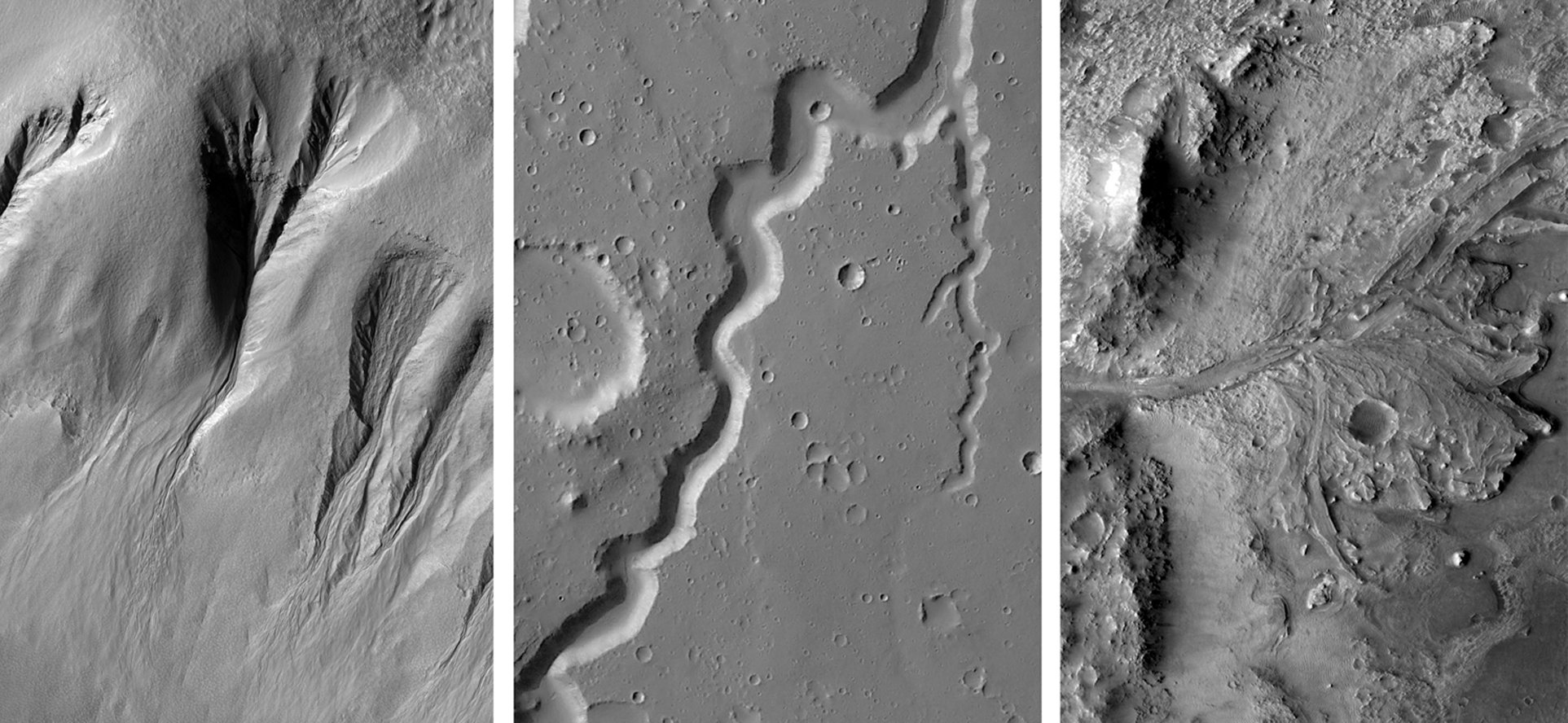
Different examples for wet environments on Mars (width of the subset images in parentheses). From left to right: a gully (ESP_011822_1275 HiRISE image, 1 km), a section of the Nanedi Vallis (H0894_000_ND3 HRSC image, 30 km), and a delta deposit where an ancient channel entered into Jezero Crater filled by a lake previously (P04_002664_1988 CTX image, 6 km) (NASA, ESA).
To understand the duration of wet periods on Mars with regard to astrobiology, two types of timescales can be taken into account: the theoretical scale for the formation of organisms (prebiotic processes) and the scale for the reactivation of extremophiles. The abiogenesis on Earth, based on the findings of Maher and Stevenson (1988), might have happened in deep marine hydrothermal systems around 4.2–4.0 billion years ago, and on the surface 4.0–3.7 billion years ago. No firm estimation has been offered for the duration required for the formation of the first protocells, but it must have been shorter than about 700 million years (Stern and Jedrzejas, 2008) and could have been on the order of 100 million years. This duration would have to have occurred within those periods between sterilizing, large impact events or subsequent to the Late Heavy Bombardment at 4.1–3.8 billion years ago. At the same time, it is also possible that the first protocells formed earlier than the Late Heavy Bombardment, as zircon mineral studies suggest the presence of liquid water and possibly a very early Hadean ocean 4.4–4.2 billion years ago (Harrison, 2009). Because all the necessary steps toward the appearance of the first protocell are unknown, laboratory data could not be used for estimation of the necessary period.
The other time-related parameter is the reactivation period of dormant organisms. Based on several works, many bacteria become active (Potts and Friedmann, 1981; Garcia-Pichel and Belnap, 1996) within minutes of rewetting, and there are several terrestrial organisms in the Atacama Desert and Antarctica that survive with only the seasonal presence of liquid water (Rothschild and Mancinelli, 2001; McKay et al., 2003; Hock, 2008; Davila et al., 2010). Another period that is also related to the reactivation of possible extremophiles is the endurable dormant phase. Based on some ancient microbes on Earth and theoretical arguments, the limiting factor with regard to the length of the dormant phase is the degradation of DNA and not the duration itself, that is, a shorter but more radiation-exposed period is more difficult to tolerate than a longer period under radiation-shielded conditions, especially at low temperature (Gilichinsky et al., 2007). On Mars, solar UV produces strong damage at the surface and a few millimeters below it, while the particle radiation is dangerous in the upper meter of the subsurface.
Regarding temporal characteristics, two timescales could be analyzed: the continuous and the cumulative duration of wet conditions. For prebiotic processes, the possibility for chemical alteration and combination of organic molecules is larger if the cumulative wet period is longer. For possible extremophiles, the cumulative duration is also interesting, as the organisms may be able to reactivate themselves shortly after even a long dormant phase (Garcia-Pichel and Belnap, 1996) and resume metabolic activity and cell repair during the short active period.
It is worth noting that, with regard to analogues from Earth, there are many organisms that flourish in wet conditions but cannot survive desiccation (Olendzenski, 1999), or their ability to survive depends on several factors, as is the case for Klebsormidium strains, which have been isolated from various Antarctic and Arctic habitats and did not survive desiccation at +4°C but managed to survive at a certain rate when desiccation occurred after freezing (Elster et al., 2008). Mars-relevant examples show great variety of desiccation tolerance (Peeters et al., 2010).
3.1. Other important parameters
Various other parameters, such as chemistry and energy sources, are also relevant for analysis of the astrobiological potential of any location on Mars. The effect of chemistry on the origin of life (that is, life as we know it on Earth) could be estimated from observations of the oldest minerals from early Earth, laboratory tests, and theoretical models. Based on recent publications, the indispensable chemical components for biogenesis and their possible presence on Mars are briefly summarized in Table 1, in which the supposed and simplified conditions (1st column), their presence on Earth (2nd column), and the possibility on Mars (3rd column) are presented. Only a few important issues are listed here. The deeper analysis of this topic is beyond the focus of this work, but this summary should be helpful, for example, to orient future research in that significant advances could be made if the wet environment types listed here were analyzed according to these parameters.
In general, it can be said that many chemical ingredients necessary for biogenesis may have been, or are, present on Mars. During the early periods of Mars, phyllosilicates point to the presence of neutral pH, when the neutralization effect of the prolonged presence of liquid water helped the formation of this neutral condition (Zolotov and Mironenko, 2007), while later, during ephemeral water outbreaks and dry periods (smaller quantity of water), and due to volcanic sulfur release, the low water/rock ratio and shorter dilution period of the alteration would have produced more acidic surface conditions (Bibring et al., 2005). The average salt content of water would also have increased over the course of planetary evolution, according to theoretical arguments supported by the observation of salts on the martian surface.
Radiation issues should also be considered for UV and for solar and galactic ionizing particle radiation at the surface and in the shallow subsurface. In the Noachian and Noachian/Hesperian, the supposed denser (Pollack et al., 1987) atmosphere provided better shielding, and the faint young Sun's UV output was smaller, both of which reduced the surface UV radiation. The nature of the greenhouse warming of this early atmosphere, however, is still not clear (Jakosky and Phillips, 2001). It is also reasonable to assume that during wet (and partly warmer) periods, the mass of the atmosphere and its vapor content was greater (both volcano-tectonic activity or orbital changes induced climate changes), and as a result the UV flux that reached the surface was substantially lower. On Mars, the wet periods may have often coincided with enhanced volcanic activity and gas release. Calculating only with reasonable volcanic SO2 release, the atmosphere could have provided roughly similar levels of UV shielding as is the case for present-day Earth (Córdoba-Jabonero et al., 2003). Migrating H2O ice also might have provided better shielding at certain locations for the shallow subsurface, that is, if past climate favored the enhanced deposition (Córdoba-Jabonero et al., 2005) there. In general it can be said that the early martian UV radiation environment was probably not harsher than that of Earth during the development of life (Cockell et al., 2000).
With regard to the energetic galactic and solar protons, a roughly 1 m thick regolith layer would have provided enough shielding to eliminate all lethal effects of the radiation (Dartnell et al., 2007). Also, variation in atmospheric thickness would not have significantly influenced ionizing radiation. The thickness, composition, and density of the material overlying the earlier surface would have been far more important in terms of shielding radiation; for example, the climate change induced by an expanding polar cap, several meters' thick ice might have decreased the flux on previously exposed terrains. Shielding with regard to the surface flux of particle radiation would have been better in the early eras of Mars because of the proposed early global dynamo (Solomon et al., 2005), which would have decreased the surface bombardment of the solar and galactic particle radiation (Lillis et al., 2008) during the Noachian. It is worth noting that ionizing radiation may also be beneficial for activating chemistry and driving prebiotic synthesis (Dartnell, 2011).
Below, those martian surface features that factor in when estimating the ancient presence and characteristics of liquid water on Mars are listed roughly from the larger liquid volumes to the smaller.
3.2. Largest standing water bodies: seas and oceans
Large seas or oceans may have been present on Mars. At the topographic height of -2540 m (Di Achille and Hynek, 2010), several lakes and deltas were present in the past around the globe of Mars. This level coincides with the Arabia shoreline level at −2684 m, and theoretical calculations (Clifford and Parker, 2001) also suggest that, in the Noachian, the global water level of Mars was close to this level. The volume of the ocean may have changed over time, as several separated ocean periods could have occurred by way of episodic water outbursts. A rough estimation for the volume of these oceans is on the order of 106 to 108 km3 (Carr and Head, 2003; Boyce et al., 2005).
With regard to analyzing the duration of wet periods, the lifetime of these ancient oceans would have depended on more factors than simply the freezing process, as these oceans would have influenced the climate (e.g., by releasing vapor into the atmosphere and of the outflow events that might have accompanied volcano-tectonic heat release). For early oceans, the martian climate might have been substantially warmer as well. Based on rough estimation, the lifetime of such oceans might have been around 104 to 106 years (Carr and Head, 2003), or substantially longer in the case of any early Noachian ocean.
3.3. Short release of large water mass: outflow events
During the formation of outflow channels, it is believed that subsurface aquifers broke out at chaotic terrains and faults during volcano-tectonic events. Such great floods could also have occurred due to closed lakes (in Valles Marineris) and resulted in the sudden release of a large water mass. These kinds of events likely formed the great outflow channels (Carr, 1987) and included a duration of fluvial activity over the course of weeks or months (Baker et al., 1991; Kleinhans, 2005), although the released water could have ponded for more extended periods as well, possibly under an ice cover. For example, in the case of Maja Vallis, four months would have been required to empty the source lake that existed in Juventae Chasma, and another 10 months or more would have been required to drain the ponded secondary lake in the northern part of Lunae Planum (de Hon and Pani, 1993). In the case of Ravi Vallis (Harald et al., 2006), the estimated duration, according to calculations based on sediment-carrying capacity and peak discharge values, was between 2 and 10 weeks, and the total water amount was around 11,000–65,000 km3. The model for Mangala Vallis (Leask et al., 2007) suggests duration of the flow in 14–46 days and a total volume of 15,000–40,000 km3.
In the case of ponding, oceanlike bodies in the northern hemisphere were produced by water outbreaks. Kreslavsky and Head (2002) estimated that, for an ocean with an initial temperature of 10 K above freezing, the body of water begins to freeze in a few years, but in the case of cold outflow (that is more probable), the water would begin to freeze immediately after its emplacement. The total freezing time would be roughly 103 to 104 years for such an ocean.
3.4. Smaller standing water bodies: lakes
Various observations point to the former presence of lakes on Mars, which include deltas, inflow and outlet fluvial valleys around basins, sedimentary plains that exhibit mineralogical signatures, as well as polygonal cracks in some cases (El Maarry et al., 2010; Kereszturi, 2010b). The lakes on Mars could have formed both by surface runoff and subsurface inflow, and they could have been fed by precipitation and ice melting. The volume of valley network-fed lakes is estimated to have been around 104 to 105 km3; these values are comparable to small seas on Earth, while the smallest martian lakes could have had 0.02 km3 volume (Fassett and Head, 2008a, 2008b). The surface area of the lakes would have spanned between 5 and 200,000 km2. Although most observed lake signatures show evidence that several lacustrine periods occurred during the earlier part of planetary evolution, some of them may have been active within the last 0.5 billion years. The lifetime of a lake depends on the balance between the volume of the water released into the lake (by inflow or by in situ ice melting) and the loss by outflow or freezing. Using the Antarctic subglacial lakes as an analogy, McKay et al. (1985) estimated that ice-covered lakes' surface sublimation rate is on the order of 1 cm/year (McKay et al., 1985), which suggests a possible 30,000–40,000 year (Moore et al., 1995) lifetime in the case of a lake that receives continuous water input on Earth. If similar cases were present on Mars, the lakes there might have had a lifetime of around 104 to 105 years (Cabrol and Grin, 2002).
3.5. Water-laid sediments: deltas
The presence of an ancient water flow could be studied by way of its capacity to carry sediments and deposit them. At the terminus of several fluvial valleys and channels on Mars, sedimentary deposits are present. The most interesting among them are those that resemble Gilbert-type deltas on Earth and likely formed when an ancient flow entered into a standing body of water. Deltas could be identified by their characteristic top- and foreset beds, and they could show the maximal water level of the ancient lake (see the related parameters in the lake section). Observations of the 150 m thick lacustrine delta deposit in Holden Crater indicate that the channel fed the ancient lake with around a dozen different avulsion episodes, which suggests liquid water might have been present there for about 150,000 years (Bhattacharya et al., 2005) with a volume of several 1000 km3. Jerolmack et al. (2004) estimated the minimal duration for the formation of a delta in Holden Crater to have been around 50–100 years.
3.6. Widespread flows: valley networks and sapping channels
The most frequent features produced by liquid water on the martian surface are various valley networks and sapping channels on plains and on volcanic cones. The characteristics of valley networks suggest that, during the Noachian era, precipitation-fed surface runoff was present on the planet (Craddock and Howard, 2002), and hot impact ejecta that had fallen to the surface might have produced ice melting and surface runoff (Segura et al., 2002). Some individual valleys with theater-shaped heads might have formed by subsurface sapping. Various estimations have been published as to the active duration of these fluvial valleys, which were inferred from the estimated erosion or from the accumulation of deposits. In the case of Lybia Montes, the fluvial activity (cumulative duration of possible separated events) lasted for about 800 million years until 3.3 Ga (Late Hesperian) (Erkeling et al., 2009), although these ancient rivers were probably not continuously active for such a long period. In another work on the valleys of Lybia Montes, discharges of 15,000–430,000 m3/s were calculated (Jaumann et al., 2010), such that, in the case of bankfull discharge, the formation times would have been around 50–200 years, which suggests 1012 m3 of water was involved in their formation.
Terrestrial rivers reach substantial erosion power only during about 20% of their activity, so the above-mentioned durations could be a minimum of 50 to around 250–12,500 years (Kleinhans, 2005). The area and excavated volume of the Lybia Montes valleys are around 103 to 104 km2 and 102 to 103 km3, respectively. For the formation of Nili Fossae, the accumulation of ancient crater lake sediment would have required a minimum of 10–20 years (Fassett and Head, 2005) with a water volume of 350 km3, while in Holden Crater the formation of the northeast-situated deposit would also have required a minimum of about 50 years to form (Jerolmack et al., 2004) with 900 km3 volume of water. As a rough approach, it can be said that formation of valley networks may have involved 101 to 104 km3 (1010 to 1013 m3) volume of liquid water.
The lack of a signature of overflow in martian craters (Howard and Moore, 2011) and some other morphological observations (Barnhart et al., 2009) suggest that the water activity was periodic or episodic rather than continuous, as is the case in arid and semiarid regions on Earth, and even certain valleys (beside the outflow channels) could have been carved by short catastrophic flooding. This argumentation favors the lower end of the predicted range of active periods.
There is one general problematic issue that arises with more emphasis here than with regard to other features. There are many valley networks, and they were probably active simultaneously, although we do not know this for sure. The volumes of liquid water mentioned here have to do with one individual feature under each type and not all of them (except for a few cases, which are marked with an asterisk in Table 2). For example, in the case of valley networks, each of them held roughly 101 to 104 km3 of liquid water, but at the same time several (or nearly all) of them could have been active, and the volume of liquid water involved in their formation would have been larger by several orders of magnitude. This is also true for lakes, as several of them might have been active simultaneously. It would be advantageous to reconstruct how many lakes were active simultaneously, but to date this has not been determined. To determine the duration and volume of individual lakes is an important step in that it could help identify those processes relevant for astrobiology that might occur in any given lake. Of importance here is that the possible reactions, produced molecules, and even biological activity in a variety of lakes and in different wet locations could be in correlation with the volume of water and its duration.
The durations mentioned here are estimations based on certain surface features where such values have been calculated. As a result there are cases where different features point to different duration of wet conditions, although several of them probably have the same duration. For example, valley networks, deltas, and lakes all may have formed together and were active probably for the same duration, but here they are indicated as different durations, as certain calculations are presented.
Data that are relevant for only one gully or one melting event of magmatic intrusion for geothermal systems.
The duration of interfacial water, where the annual duration in each year under the present climate is presented with cumulative volume values for one hemisphere.
Fluvial valleys where several recent papers suggest that the lower end of the active period's range is more probable.
Oceans, which might not exist at all—although several models and observations show their ancient presence.
3.7. Melted ice: impact craters and hydrothermal systems
Impact-released heat may melt ice even under current climatic conditions on Mars and mobilize various chemicals. The impact process produces a depression for sediment accumulation, and it fragments the rocks and increases reactive mineral surfaces. The impact releases heat by the central uplift and by the melt sheet formation. Several martian craters show evidence of a lobate ejecta blanket, which suggests the surface rocks contained water ice during the impact event (Wohletz and Sheridan, 1983). The cumulative impact heat may have exceeded the volcanic heat released during the period of the Late Heavy Bombardment (Kring, 2000). The estimated lifetime of such impact heat-produced hydrothermal systems for a 20–200 km diameter crater is 103 to 106 years based on Daubar and Kring (2001). Abramov and Kring (2004) estimated 104 to 106 years for a crater with a diameter of 30 and 180 km.
With regard to craters, the heated regions can produce a lake in the depression by melting ice from the surrounding region, similarly to the above-mentioned lakes, although the lake's lifetime would be longer due to subsurface heat input. Immediately after impact, only those regions some distance from the crater, where temperatures were low enough, could potentially harbor life, while later, the entire terrain would begin to cool but keep the water in liquid form for a substantial period of time. The affected volume of rock heated above the original temperature would be around 104 km3 in the case of a 180 km diameter impact crater on Mars (Abramov and Kring, 2004) and one order smaller for a 30–40 km crater, which is around the estimated lower limit of impact-induced hydrothermal activity. The volume of liquid water in impact-induced hydrothermal systems is smaller than the heated rock volume. Taking 20% porosity for the regolith, the water volume would be around 0.2 times the values mentioned above.
3.8. Heat and water from below: geothermal activity
The presence of geothermal heat sources is suggested by volcanoes on Mars. Such magmatic and volcanic heat may also produce hydrothermal systems with extended periods of liquid water in the case of available water ice. Beyond theoretical arguments, several volcanoes show channels on their flanks, and in the case of Ceranius Tholus, one channel appears to have terminated in a crater and formed a depositional delta there (Yamaguchi et al., 2010). On Alba Patera, some channels could be as young as a few 100 million years (Gulick and Baker, 1990). Another group of water-related signatures are hydrothermal alterations produced in minerals. In the case of Nili Patera, hydrated silica minerals have been found on the flanks of a volcanic cone inside the Syrtis Mayor caldera complex (Skok et al., 2010). In the case of Ascraeus Mons, the observed meltwater channels may have been produced by an intrusion of a 102 km3 sill with related activity of 102 years (Scott and Wilson, 1998), while in the case of Elysium Mons, 30–40 km3 of fresh lava was produced during one typical eruption (Wilson and Mouginis-Mark, 2001).
With regard to magmatic intrusions on Mars, they could have supported near-surface ice melting for 101 to 102 years (Head and Wilson, 2002). Assuming eruption characteristics on Mars resemble that which has occurred on Earth (Smellie and Chapman, 2002), one eruption could have lasted for 100 to 104 years (Robinson et al., 1993), melted around 101 to 103 km3 of ice, and exhibited recurring activity on the timescale of 1–10 million years. On Mars, the latest volcanic activity took place not more than 40–100 million years ago (Hartmann et al., 1999).
3.9. Short episodic water flows: gullies
Gullies in the middle- and high-latitude region of the planet are present on steep slopes (Reiss et al., 2010), but they appear in shallow slopes at certain locations as well (Heldmann and Mellon, 2004). They probably formed by the melting of snow packs accumulated via orbital change that forced climate changes on tilted slopes with favorable orientation (Christensen, 2003). The melting of this solid H2O could have been the result of solar insolation on a seasonal or daily basis. Similar features in the Antarctic Dry Valleys on Earth show evidence of melting 8 h/day during the warm season (Marchant and Head, 2007). When considering, for example, a 1 h period of melting around noon during 100 sols over the course of 1 martian year, a conservative estimate, a cumulative period of 100 h (1.1×10⁻² years) is obtained for the period of liquid phase annually. Assuming long daylight hours at higher latitude or a larger tilt of the rotational axis, or both, insolation could be favorable for several continuous martian sols, and the cumulative duration could be 10–50 times higher (1.1–5.5×10⁻¹ years) for the presence of liquid phase.
In the case of a gully, the volume of meltwater would be equal roughly to the volume of the accumulated snow packs, that is, of the order of 103 m3 (10−7 km3) (Malin and Edgett, 2000) for each gully, although the entire volume of “one” ice pack may not be in liquid phase at the same time for the above-mentioned period. The involved liquid water would be 102 to 103 m3 (or 10−8 to 10−7 km3) for one gully. Another approach to calculate the duration of liquid phase would be to estimate the proposed flow period from the volume and discharge. Using this approach, the results suggest that the movement (and probably the existence) of liquid phase occurs, in this case, on an approximately hourly scale (Heldmann et al., 2005).
3.10. Chemical signatures of water: altered minerals
Mineral alterations also point to the occurrence of liquid water on Mars. Olivine and its alteration products have been identified on the planet's surface and inside martian meteorites. For the dissolution of olivine in wet environments, for a fayalite- or Fe-rich composition, smaller particle size, higher temperature, and acidic pH are favorable parameters. With regard to the various parameters, varying residence times of water result in the observed alterations. For example, above zero Celsius a particle with a radius of 0.1 cm could completely dissolve in several 100 years, while under low temperature the same particle might last 102 to 104 times longer (Stopar et al., 2006). In physical contact with low-temperature brines, olivine might not dissolve for several million years under neutral to slightly acidic pH conditions, while decomposition in the proposed strongly acidic periods could be faster.
The observed survival of olivine minerals in several terrains on Mars suggests that wet periods were short and/or accompanied by low temperature (Stopar et al., 2006). The available data are not enough to constrain the duration of wet periods based on such chemical analysis; most model computations assume that, for acidic pH and temperatures near zero Celsius, the duration of liquid water might be between 101 and 103 years, and for subzero brine around 105 to 106 years. The volume of these liquid water bodies is even more difficult to estimate, as alteration could happen both in contact with microscopic-scale water and inside oceans as well. As a result, the estimated volume here shows a wide range from 10−9 up to 106 km3.
3.11. The smallest wet environments: microscopic-scale liquid water
Thin, microscopic liquid water films may exist even today on Mars if the temperature is above about 180 K and water ice is in physical contact with mineral surfaces (Möhlmann, 2004). Mainly, van der Waals forces keep this so-called interfacial water in liquid phase at below zero Celsius. Besides the temperature and areal distribution of H2O ice on the mineral surfaces, the presence of interfacial water is influenced by various salts, too. By using the approximation of Möhlmann (2009a, 2010) for the required temperature, the distribution of seasonal water-ice cover was measured at the southern hemisphere in the region of the dark dune spots. Inside these spots, water ice is present without CO2 ice cover between Ls=210 and 220 at 72°S (Kereszturi et al., 2011). Taking an average diameter of 50 m and area of 2000 m2 for one spot (Horváth et al., 2009), and a spot density of 10/km2 on dark dunes that cover roughly 80,000 km2 in the southern circumpolar region, we calculated an area of 1000–2000 km2 that could have undercooled interfacial water coverage. The latter value, if 1 nm of liquid layer is used, gives altogether around 1 m3 volume (10−9 km3). In the northern hemisphere, a H2O ring follows the receding edge of the seasonal CO2 cap (Kieffer and Titus, 2001; Boynton et al., 2002; Bibring et al., 2005; Schmitt et al., 2005). It is present at the 65°N, 70°N, 75°N latitude region for 10, 15, 20 degrees in Ls, respectively (Kuzmin et al., 2009). The area possibly covered by this thin interfacial layer is roughly 106 km2 for each of the dates of Ls=20, 35, 50 in the northern hemisphere. The water-ice layer covers the surface there for periods of about 14, 23, and 30 sols at the above-mentioned latitude bands, respectively.
Assuming that the springtime insolation increases the temperature above 180 K in the water-ice–covered dark dune spots, 106 km2 area of interfacial water could be present under the present climate for periods between 14 and 30 martian sols at the north—but the temperature is probably high enough for this to occur only in the warmer part of the day, around 0.5–0.1 times the above-mentioned duration. Summarizing the estimations of interfacial water may be present for a 10−4 or 10−2 year duration with a cumulative volume of around 100 to 103 m3 (or 10−9 to 10−6 km3) on Mars annually.
It is worth mentioning that in the polar terrains liquid water or brine was present recently or even could be there currently based on the observations of the Phoenix probe (Rennó et al., 2009), and some observations suggest the existence of a springtime flow of liquid brine on dunes (Kereszturi et al., 2010), while studies have proposed only dry mass movements (Hansen et al., 2011). At the landing site of the Phoenix probe, water ice was present at depths of 5–10 cm along with perchlorate salt and potential nutrients under tolerable pH. Based on these ingredients and using climate change models, there could be barely tolerable conditions at 2–4 cm depth with the occurrence of ephemeral liquid water in the past 7–10 million years (Zent, 2008). During high obliquity, the polar terrain gets stronger and longer insolation. Based on calculations by Zent (2008), the length of a growing season with temperature above 273 K is up to 6×10⁶ s, for example, 10–12 sols annually, while temperature above 258 K is up to 107 s, for example, of the order of 100 sols annually. While these values are favorable for extremophiles, the duration of stable H2O presence during these “growing seasons” is unknown.
The stability of surface and shallow subsurface water ice has changed over the course of 1–10 million years due to climate changes as a result, above all, of quasiperiodic modification in the tilt of the rotational axis, which could have resulted in the formation of thin liquid water films at several location types where ice had accumulated: • glacier-like structures: based on theoretical calculations and observations of moraine-like structures at the northwestern slopes of large Tharsis volcanoes (Forget et al., 2006), glaciers were active there during the upper Amazonian period, when interfacial water layers may have formed around the surface grains. Such liquid could be roughly similar in volume and duration to the above-mentioned seasonal water film layer present on Mars today. • mantling (pasted-on) water ice layer: in the midlatitude, a meter-thick H2O-containing layer called a pasted-on layer is present probably in connection with the formation of gullies, polygons, and arcuate ridges in craters (Berman et al., 2005). This layer shows signatures of degradation at some areas, probably formed by cryocarstic processes, but the ephemeral appearance of liquid water cannot be ruled out, especially in connection with gullies (Dickson and Head, 2009). Ice was also observed at 0.5–1 m depth, which had been exhumed by fresh impact craters (Byrne et al., 2009; Kossacki et al., 2011; Schaefer et al., 2011) in the middle-latitude band, where interfacial water may have also appeared in the past. • frost patches: low-latitude carbon dioxide frost patches were detected occasionally under the present climate in the southern hemisphere at polar-facing cold slopes in wintertime (Schorghofer and Edgett, 2006). These patches may trap H2O from the atmosphere by their extremely low temperature, and water ice might stay there for a longer period than CO2 ice due to its higher frost point. The duration and volume of these possible liquid water films are smaller than the above-mentioned seasonal thin water layer at the receding polar cap.
4. Discussion
In the proceeding section, various environment types are listed where liquid water could be present on Mars. While the determination of the exact timing of the occurrence at any location will require extensive investigation in the future, a general comparison now may offer useful information. In Table 2, the environment types are compared regarding the volume (1st column) and duration (2nd column) of liquid water, the certain period in the history of planetary evolution (3rd column), and other relevant parameters (4th column).
The summary of these parameters can be seen in the table, where the total volume of liquid water is indicated as the maximal volume that may have been present at a certain time during the representative period for that feature or process. In the cases marked with an asterisk (*), the data are relevant for only one gully or one melting event of magmatic intrusion for geothermal systems. Two asterisks (**) mark the duration of interfacial water's existence, where the annual duration in each year under the current climate is presented, together with cumulative volume values for one hemisphere. Three asterisks (***) mark the fluvial valleys where, several recent papers have suggested, the lower end of the active period's range is more probable, and four asterisks (****) mark the oceans, which may not have existed at all, though several models and observations have indicated their ancient presence.
The results are presented in Fig. 2, where the volume versus the duration of various wet environment types is shown. The rationality of this figure is threefold. First, it is useful to visualize the different scales of water volumes and wet periods in that, during the analysis of various other geological processes on Mars (such as duration of volcanic activity or warmer climatic periods that melt ice), a comparison with timescales and liquid volumes can reveal possible associations and offer avenues for future research. Second, the information in Fig. 2 may also reflect characteristic global changes that have occurred as a result of planetary evolution beyond certain surface structures. Third, Fig. 2 shows the difference of uncertainty between various estimation methods and helps focus on fields where more work and more accurate data are needed.
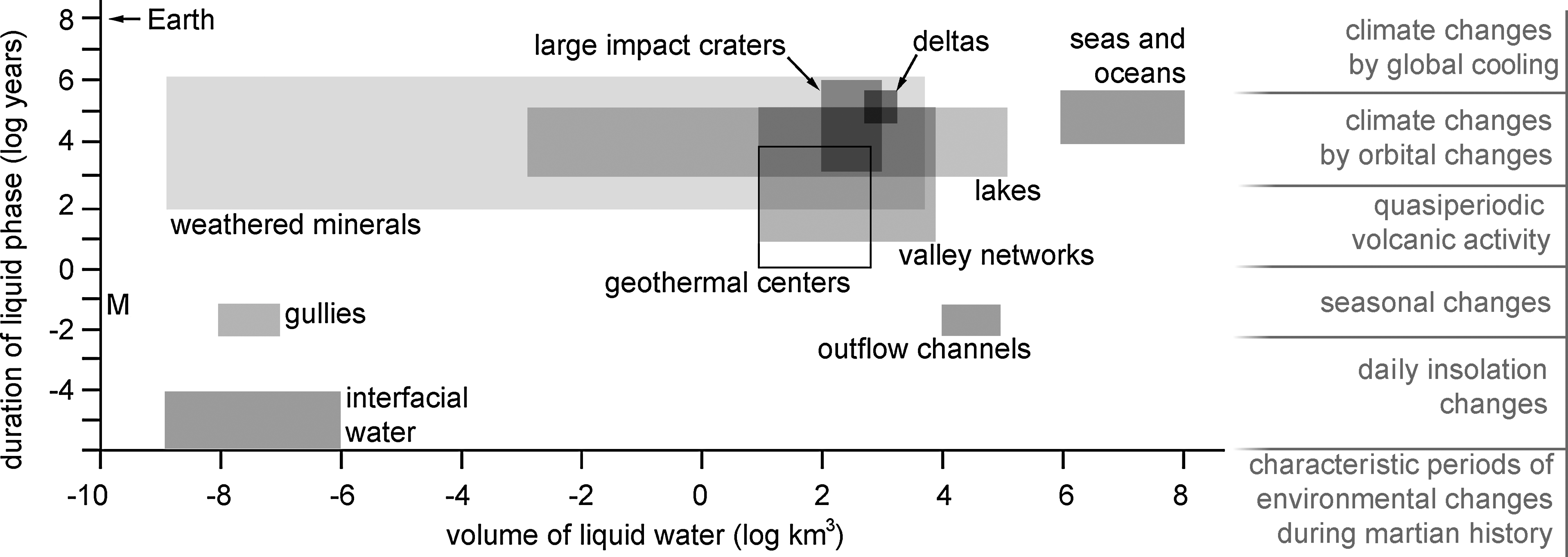
Volume (horizontal axis) versus duration (vertical axis) range of wet environment types on Mars. The letter M marks the parameters of Miller's famous experiment, while at the top left Earth indicates the maximal duration that the formation of life required on Earth, between the end of the Late Heavy Bombardment and the oldest fossils—indicated only to visualize the scales. The different gray shading of the boxes is only to separate them from each other, and the larger boxes may reflect only the larger uncertainty of parameters. The box geothermal centers is marked with a black outline to separate it from the other boxes in a crowded region of the diagram. At the right-hand side of the diagram, characteristic geological process–related timescales (daily, annual, longer changes) are indicated. In the future, wet environment types may be correlated to certain periods during the planetary evolution.
The size of the boxes in Fig. 2 are not of concern here in that a larger box reflects a larger degree of uncertainty. The location of the boxes in the diagram, however, is more important. The largest uncertainties and/or largest range of values are present in the case of weathered mineral signatures. This group is probably comprised of different environments with more diverse conditions than outlined here. Next to the left-hand side of the vertical axis, the period of 400 million years is also indicated with a horizontal arrow and the word Earth. It is the maximal period that spans between the end of the Late Heavy Bombardment (3.9 billion years ago) and one of the earliest fossils from Western Australia (3.5 billion years ago). Miller's first experiment's parameters (Miller, 1953), which are indicated with the letter M, were included only because of comparison regarding the experiment's liquid volume and duration, as this experiment is relevant for prebiotic synthesis. The location indicated in the diagram is included to help visualize scales.
The durations mentioned in this paper are estimations based on the observations of certain surface features where such values have been calculated. As a result, there are cases where different features point to a different duration of wet conditions, although several of them probably have the same value. For example, valley networks, deltas, and lakes may have all formed together and were active probably for the same duration, but here different values are indicated, as certain calculations did not give the same value.
Regarding the presence of liquid water, water activity (e.g., relative humidity) is an important limiting factor in microbial activity in thin films and brine environments (Gunde-Cimmerman et al., 2003). The value of water activity (a w) mainly depends on the temperature and the salt (or other dissolved material) content of the water, where the decrease of temperature and the increase of dissolved salts decrease the water activity. As a result, it can be said in general that freezing- and evaporation-reduced brine bodies show increasing salt content and decreasing water activity, and these conditions become worse as time passes by regarding the water uptake for an organism. It is not possible to determine precisely the water activity of the wet environment types discussed in this paper; only rough estimates, in fact, could be made. According to the general trend of the geological evolution of Mars from warmer, wetter conditions toward colder, dryer conditions, brines have likely become more concentrated and water activity has decreased over time. A similar temporal trend has likely influenced as well certain freezing and evaporating smaller water bodies. As a result, a temporal sequence and a specific stratigraphy in depositing salts (Milliken et al., 2010) may reflect episodes or long-term trends of evaporation. It should be noted that, toward the end of a wet period, potentially extant organisms would likely have lived under high salt content conditions, and there are several interesting biological candidates on Earth that exhibit a tolerance for high salt concentration environments (Peeters et al., 2010).
Where water ice deposited as pure H2O from the atmosphere, it would have a very low salt concentration. Increased temperature may occur within this pure ice due to the result of solar insolation (Möhlmann, 2009b), where melting occurs preferentially along ice-mineral contact surfaces. If salts are present in the regolith and become dissolved, they result in concentrated brines (Möhlmann, 2008; Möhlmann and Kereszturi, 2010). Inside a pure interfacial water layer, water activity could be around 1 (Möhlmann, personal communication) despite the low temperature on Mars. At the eutectic temperatures of Mars-relevant brines, water activity is around 0.4–0.6 (Möhlmann and Thomsen, 2011), which is somewhat below the probable threshold level of the water uptake by organisms. It can be said in general that, based on these estimations, salinity on Mars may often exceed the tolerance level of known terrestrial organisms (Tosca et al., 2008).
5. Conclusion
By using the available published results, ancient and recent wet environment types on Mars were classified in the present study according to their temporal and volumetric characteristics. Below, the conclusions of the analyzed parameters are presented, along with other parameters such as temperature, radiation, and chemical conditions. The occurrence and types of these wet environments are then discussed in the context of planetary evolution.
When comparing the liquid volume of different environment types, the smallest (10−8 to 10−6 km3) and shortest (10−4 to 10−1 years/each active period) duration of liquid phase are found to have occurred at gullies and interfacial water layers. A large group of wet environments, such as valley networks, lakes, and geothermal or impact-induced hydrothermal systems, all appear to have had similar parameters (101 to 105 km3, 104 to 106 years). The largest and longest wet environments may have been the ancient northern oceanic or episodic seas (106 to 108 km3, 104 to 106 years), while in the case of outflow channels, reasonably large volumes of water (104 to 105 km3) likely occurred for relatively short periods of time (10−2 to 10−1 years).
Analysis of the duration of liquid environments revealed that two approaches could be considered: the continuous duration of liquid water at a particular location and the cumulative duration of liquid water at a particular location. One location may have been wet and provided favorable conditions for several different periods of time, and may have shown characteristic temporal (quasiperiodic) behavior. The impact-induced hydrothermal systems were activated only once (immediately after impact), and the outflow channels may have been active only once or perhaps a few times. Lakes, valley networks, and seas, however, may have been active several times throughout the planet's history. Hydrothermal systems at volcanic centers may also have shown quasiperiodic activity, as well as location of gullies, in accordance with climate changes of the order of 1–10 million years. The interfacial water-wetted surface locations may have produced favorable conditions seasonally.
There are several important conditions to consider beyond the duration and volume of liquid water, such as temperature, radiation, and chemistry. With regard to terrestrial observation, the lower limit of sustainable metabolic activity is around −20°C (Junge et al., 2004), although there are various models and observations that suggest the absolute limit may be even lower (Price and Sowers, 2004). To estimate the temperature during wet periods on Mars, the presence of liquid water is not a valid constraint, as various melting point decreasers are present on Mars and may keep brines in liquid phase down to as low as 205 K (Chevrier and Altheide, 2008). The hottest wet environments on Mars are expected to have occurred at hydrothermal systems, while other wet environments were probably cold, with the exception of those that occurred very near the beginning of planetary evolution (valley networks, some early lakes and oceans). Low-temperature lacustrine environments later but likely formed by ponding of cold waters released suddenly by outflows from subsurface aquifers. Thin interfacial water occurred under cold conditions and may exist at present as well.
Beyond the volumetric and temporal characteristics, radiation must be considered as well. Cumulative UV radiation and cosmic rays may decompose organic materials in the top 1–2 mm and 1–2 m thick subsurface layer, respectively. In this aspect, shallow subsurface wet environments would have been favorable, while possible surface-forming ice layers may have provided shielding against radiation on the surface. In the circumpolar region, episodic expansion of the permanent polar ice caps may have provided such protection as the periodic changes in the tilt of the martian rotational axis triggered climate changes. There would be less protection against radiation in gullies and interfacial water layers, though for other liquid bodies, such as ice-covered lakes, layers of ice a meter or more thick would offer some shielding. The formation of these lakes may have coincided with the occurrence of a warmer climate, a denser atmosphere, and somewhat lower UV radiation at the surface.
With regard to astrobiology, the occurrence of nutrients and chemical catalyzers is of great importance. Such locations may be favorable in that many small particles are often present as are large mineral surfaces in contact with water. Such conditions exist, in particular, in hydrothermal systems where water circulates along faults and around rock fragments. For early Mars, the best locations would have been within water-laid sediments and shallow subsurface locations into which water percolated. Surface water was present during later periods of Mars under cold climates, but in these cases the ponds were likely covered by ice layers that had formed from the top, though ice layers may also have formed in physical contact with cold rocks at the pond bottoms. No similar phenomena have been observed on Earth. One group of special ice, however, called anchor ice may in part share some attributes of ancient Mars ponds, but anchor ice forms by the mixing of waters of different temperature and salt content, or by storms at low temperature or even supercooling (Dayton et al., 1969; Reimnitz et al., 1987; Stickler and Alfredsen, 2009). On Mars, water could have frozen at the bottom of ponds where it flowed onto very cold regolith. In these cases, the water would have kept its liquid phase for the longest period between the top roofing and the bottom-lying ice layers, where the possibilities for mineral-liquid contact are smallest.
Because the martian environment changed throughout planetary evolution, conditions shifted from larger water volumes over broad geographic regions to smaller volumes of shorter duration in more concentrated locations. In Fig. 2 this trend can be seen as the position of wet environments shifted from the top right toward the lower left. This trend may have impact on research strategies regarding laboratory simulations or even landing site selection with the aim of chemical analysis, as water-related chemical processes and end products depend strongly on the duration and chemistry of liquid bodies. The above-presented summary also suggests that, with regard to the duration and volume of wet environments, hydrothermal systems, valley networks, and lakes overlap one another, although they would have occurred in different periods and under different conditions. Gullies and interfacial water represent the smallest analyzed volume and duration and are observable only as recent features, although they may have been present on early Mars as well.
In reviewing different environment types, the results presented here may help in targeting future research with regard to water volume and duration on Mars. More detailed analysis of weathering conditions will be needed, however, as the uncertainty in the duration of liquid water is significant in these cases. A long lifetime and recurring activity is expected in geothermal centers, but little research has been done in this area on observational possibilities, such as potential surface signatures that would help elucidate subsurface conditions. In the case of ancient lakes, those that are characterized by recurrence will require more study and analyses with regard to the characteristic dynamics that underlie their active periods. There are no tested methods as to how to detect or correlate related detailed research such that different wet periods at the same location can be fully understood. Wet environments such as valleys, lakes, impact and geothermal hydrothermal systems exhibit somewhat similar liquid water volume and duration parameters, but their characteristic temperatures are different. The comparison of chemical alteration products at these sites could provide information on the differences in their evolutionary tracts and indicate processes and various issues of astrobiological relevance. The volumetric and temporal approach of analyzing wet locations presented in this article may prove useful for comparison of remote and in situ observations, in that differences in water volume and duration are likely to generate varying signatures with regard to chemical alteration.
Footnotes
Acknowledgments
The Bolyai János Kutatási Ösztöndíj by the Hungarian Academy of Sciences supported the research in connection with the valley-related issues, while the polar terrain–related part of this work was supported earlier by ESA under the PECS agreement no. 98076 (Co 4000105406).