




Abstract
We report the first observation of indigenous carbonaceous matter in the martian meteorite Yamato 000593. The carbonaceous phases are heterogeneously distributed within secondary iddingsite alteration veins and present in a range of morphologies including areas composed of carbon-rich spheroidal assemblages encased in multiple layers of iddingsite. We also observed microtubular features emanating from iddingsite veins penetrating into the host olivine comparable in shape to those interpreted to have formed by bioerosion in terrestrial basalts. Key Words: Meteorite—Yamato 000593—Mars—Carbon. Astrobiology 14, 170–181.
1. Introduction
T
Yamato 000593 (henceforth Y000593) was discovered in 2000 at the Yamato Glacier in Antarctica by the Japanese Antarctic Research Expedition. Based on oxygen isotope data (Imae et al., 2002) and mineralogy (Mikouchi et al., 2002, 2003; Imae et al., 2003a, 2003b; Misawa et al., 2003a, 2003b), it belongs to the nakhlite subgroup of the martian meteorites. The meteorite represents a fragment of a larger fall and has been paired with the Yamato 000749 and Yamato 000802 meteorites (Misawa et al., 2003a). Together, these meteorites compose a whole rock mass of ∼15 kg (Meyers, 2003; Misawa et al., 2003a). Mineralogically, Y000593 is an unbrecciated igneous rock consisting mainly of coarse-grained crystals of augite and olivine with minor plagioclase, pyrrhotite, apatite, fayalite, tridymite, and magnetite (Imae et al., 2003b; Mikouchi et al., 2003). Evidence of interaction with aqueous fluids is substantiated by carbonate phases and clay-rich iddingsite veins containing amorphous silica-rich material, possibly a gel or opaline-like phase, also present in the matrix (Spencer et al., 2008a, 2008b). Because iddingsite alteration veins in Y000593 are truncated at the fusion crust, it appears likely that they formed prior to atmospheric entry and hence have a martian origin (Treiman and Goodrich, 2002). Additional evidence of interaction of Y000593 with aqueous fluids includes the presence of microtubular features or microtunnels emanating from iddingsite veins and penetrating into the surrounding olivine crystals. Because olivine is a reactive mineral, exposure to aqueous fluids results in the epitactic and/or topotactic nucleation of iddingsite within wedge-shaped etch channels, which results in a typical lamellar structure observed in partly altered olivine grains (Eggleton, 1984; Smith et al., 1987). The observed microtunnels, however, display curved, undulating shapes consistent with bioalteration textures observed in basaltic glasses (Fisk et al., 1998, 2006; Furnes et al., 2001; Preston et al., 2011).
Previous reports describe tunnel features and their associated mineralogy in Nakhla. However, no investigation has yet been reported for similar features in Y000593 and compared to Nakhla. For the first time, we describe features called microtunnels associated with iddingsite veins in Y000593. Additionally, we also report the presence of indigenous organic matter occurring as heterogeneous carbon-rich areas in iddingsite veins and carbon-bearing spheroidal features interleaved between layers of iddingsite.
2. Methods
Optical identification of secondary phases in a 25.4 mm round polished thin section of Y000593 was performed by using a Nikon 120 microscope equipped with a digital camera. Series of images were taken over a range of focal distances and combined with ImageJ 1 software to give extended depth-of-field images through the depth of the section. After optical imaging, a conductive carbon surface coating <1 nm thick was applied to the thin section to enable chemical characterization with a JEOL 6340F field emission scanning electron microscope (FE-SEM) equipped with an IXRF System energy-dispersive X-ray spectrometer (EDS) that allows detection of light elements including carbon. A range of acceleration voltages and beam currents were used to determine the optimum conditions for imaging and analysis. The optimum voltage and current for backscatter, secondary electron, and lower secondary imaging were determined to be 15 kV at 10 μA. Individual (point) spectra were collected by using 6.5, 10, and 15 kV with an analysis spot size ranging from ∼0.1 to 1 μm.
A polished petrographic thin section of LEW87051, an Antarctic achondrite recovered from the ice by a US team in 1987 (Mason, 1989), was prepared under identical conditions to that of Y000593 to serve as a control. While the provenance of LEW87051 is uncertain (Warren and Kallemeyn, 1990), the oxygen isotopic ratios exclude a martian origin. This meteorite is classified as an angrite 2 composed predominantly of large magnesium-containing olivine grains (∼Fo80) embedded within a fine-grained groundmass of euhedral laths of anorthite intergrown with clinopyroxene and magnesium-poor olivine crystals (up to∼Fo100) (McKay et al., 1990). Its terrestrial residence time based on 14C radiochronology is estimated to be ∼50 thousand years (Eugster et al., 1991), which is nearly identical to that for Y000593 (Nishiizumi and Hillegonds, 2004). LEW87051 weighs ∼0.6 g (Eugster et al., 1991), only ∼0.004% of that of Y000593 at ∼13.7 kg. The difference in weights between the two meteorites and consequently greater surface area to volume of LEW87051 implies effects of terrestrial contamination 3 or weathering 4 are likely to be more pronounced in LEW87051. While not recovered from the same blue ice field, LEW87051 provides a useful means to evaluate whether our observations of Y000593 could be a product of its residence time in Antarctica.
A chip of Y000593 (from allocated split Y000593,80) ∼2 mm in size was attached to a 12.7 mm aluminum pin mount with conductive carbon tape before being sputter-coated with a thin (<1 nm) layer of platinum to enable charge dissipation during FE-SEM/EDS analysis. Imaging was performed at 15 kV, while EDS analyses were performed at 6.5 and 10 kV; the lower kilovolt value allows for improved detection of light elements (Z<9).
3. Results
Optical images of the Y000593 thin section show an extensive network of brown/orange iddingsite veins hundreds of microns in length that cross-cut fractured olivine crystals. Extending out approximately perpendicular from a large fraction of the veins are iddingsite-filled tunnels typically ≥0.5 μm in width and tens of microns in length (Fig. 1). In addition to the large-width (≥0.5 μm) tunnels, approximately a third of the veins show threadlike microtunnels of iddingsite that range from ∼100 to 200 nm in width and ∼<1 to 4 μm in length (Figs. 1 and 2). The majority of microtunnels display curved and/or sigmodal (S-shaped) morphologies (Fig. 2). EDS spectra show that the host olivine contains approximately equimolar ∼Si:Fe, while the adjacent iddingsite is strongly iron-enriched with respect to silicon (Fig. 3). A layer of silica ∼2 μm in width rims a portion of the iddingsite vein (Fig. 1). EDS spectrum of silica shows Si >Fe compared to that for both olivine and iddingsite (Fig. 3). Two representative EDS spectra of iddingsite show its heterogeneous nature at the submicron scale; one contains major carbon, calcium, and manganese consistent with the presence of mixed cation carbonate (Fig. 3), while the other contains major carbon with little to no calcium or manganese, indicating the carbon may be independent of carbonate.
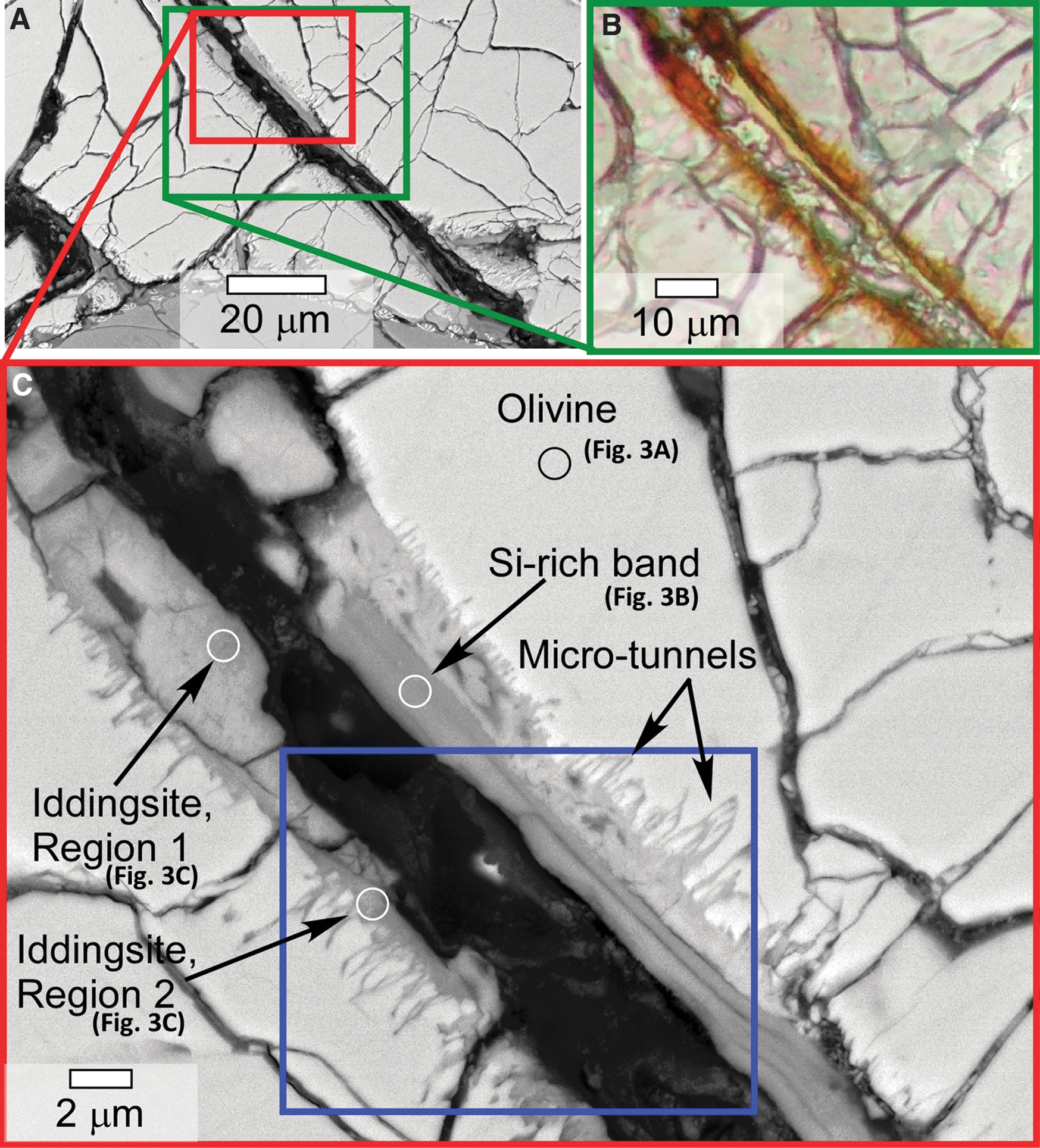
(
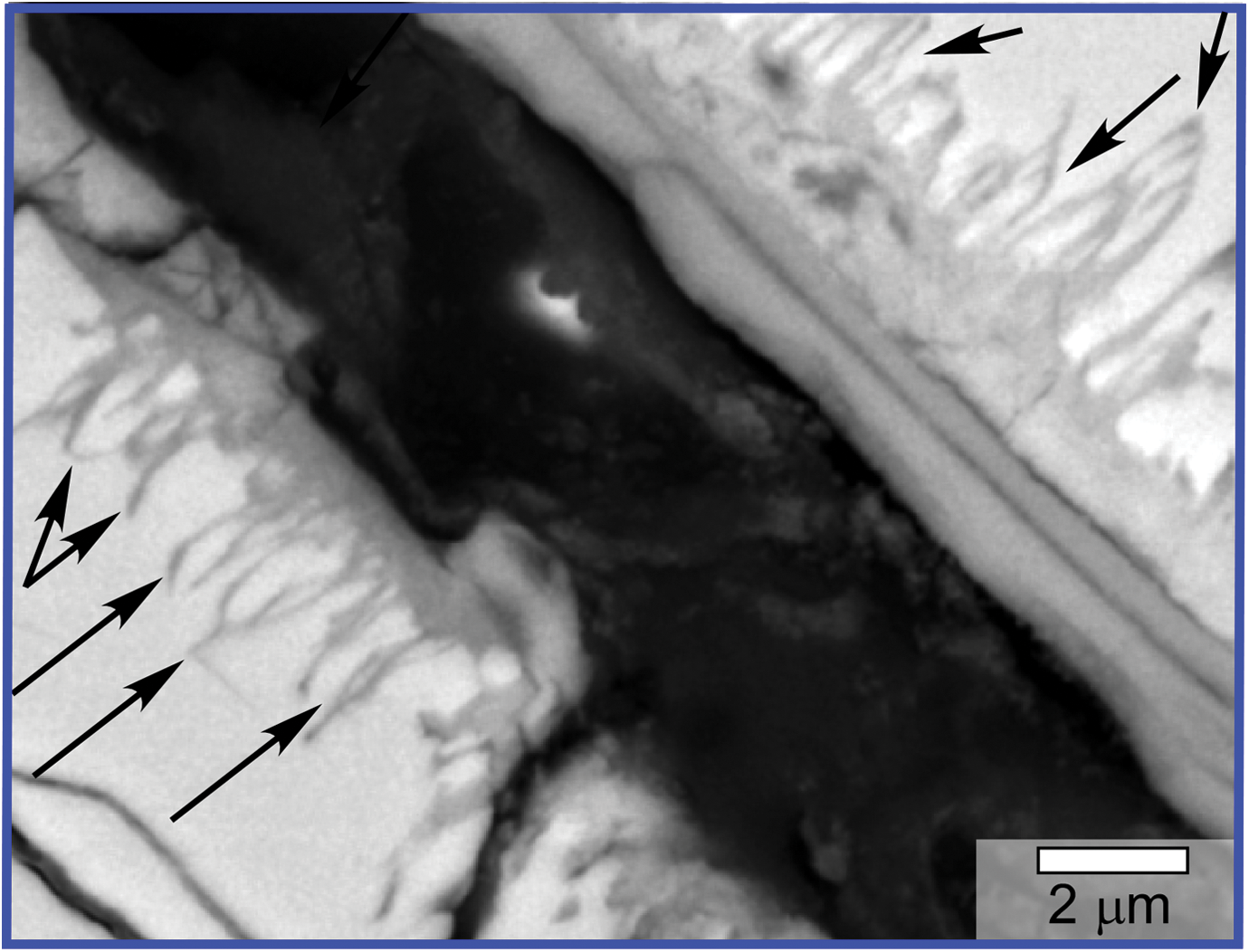
High-magnification SEM/BSE view of the region in the blue box shown in Fig. 1C. Undulating, sigmoid-shaped microtunnels emanate from the iddingsite vein and penetrate into olivine. They are filled with iddingsite and range from ∼1 to 3 μm in length and ∼0.1 to 0.2 μm in width.

SEM/EDS spectra of select regions shown by green circles in Fig. 1. (
Y000593 chips revealed close-packed spheroidal structures encased within and surrounded by multiple layers of iddingsite-like compositions (Fig. 4). Structures ranged in diameter from ∼100 to 500 nm and are enriched in carbon relative to the underlying host mineral phases and surrounding iddingsite (Fig. 4).
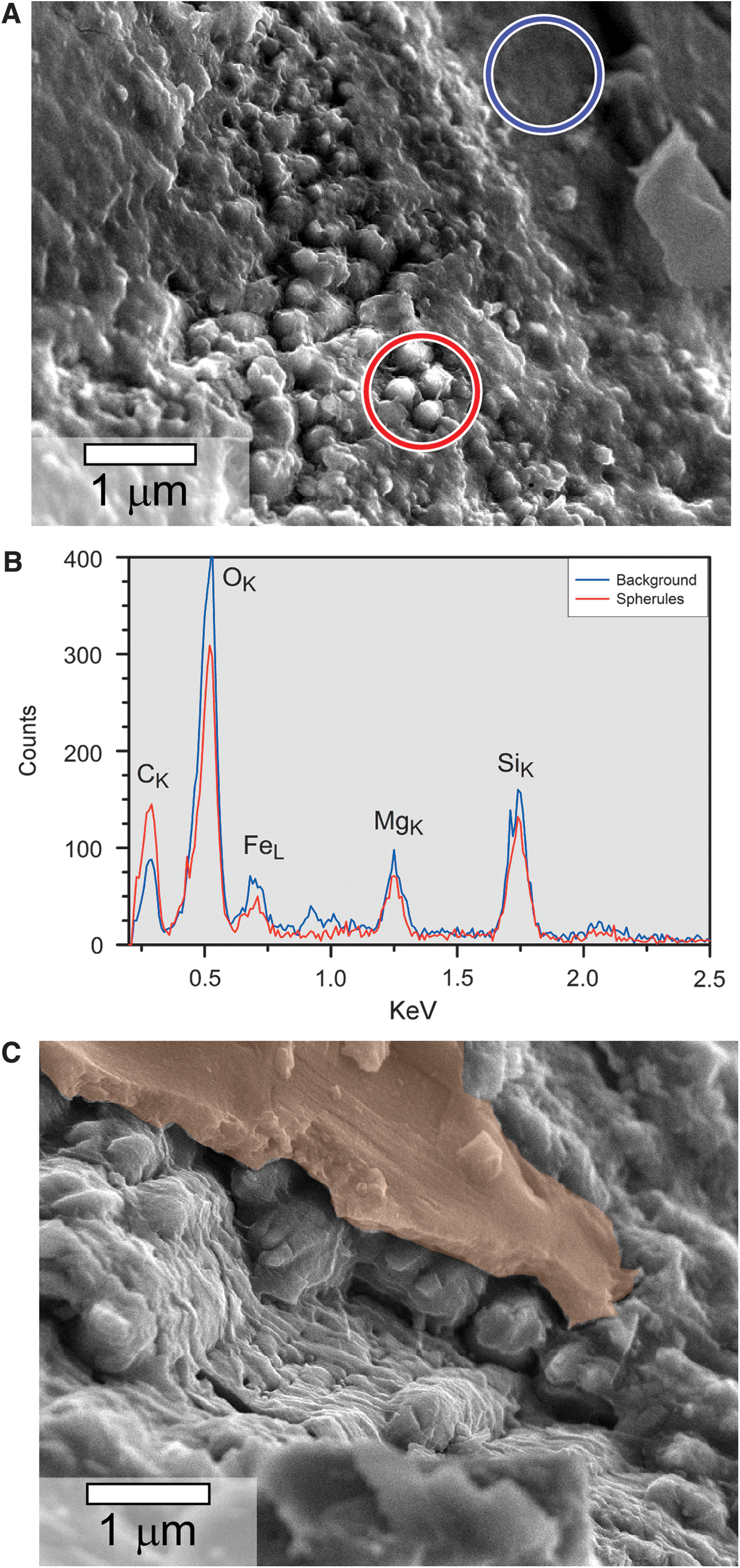
(
LEW87051 was characterized by identical techniques and instrumentation used for Y000593. Minor rusty or oxidized phases are present, presumably as a consequence of Antarctic weathering, while LEW87051 showed no evidence of iddingsite or silica alteration phases. Furthermore, there were no observations of microtunnels extending from fractures and veins (Fig. 5).

(
4. Discussion
Terrestrial iddingsite was first described in 1893 as a mixture of hydrous non-aluminous silicates of iron, magnesia, and soda pseudomorphous with olivine phenocrysts having a bright orange-yellow color (Lawson, 1893). Its composition and mineralogy has remained imprecise, since it lacks a definite chemical composition and therefore cannot be regarded as a simple submicroscopic intergrowth of two or more well-characterized minerals. It is best defined as a complex mineral assemblage 5 where it can be envisioned to represent the continuous transformation of an iron-bearing olivine crystal as it passes through various stages of structural and chemical change in the presence of liquid water at both elevated (300–450 K; Tomasson and Kristmannsdottir, 1972) and lower temperatures (<300 K) given sufficiently long time frames (Zolensky et al., 1988). Typical iddingsite veins show regular etching in the form of lamellar fissures formed during the opening of fractures and cleavage planes in olivine; these fissures display a pattern of wedge-shaped or sawtooth borders resulting from the crystallographically controlled dissolution of the olivine crystal structure (Eggleton, 1984; Smith et al., 1987). Smectite produced by weathering of olivine contains aluminum and potassium introduced from another source.
Iddingsite in the nakhlites has long been interpreted as pre-terrestrial (Wentworth and Gooding, 1989; Gooding et al., 1991; Romanek et al., 1998; Treiman, 2005) and provided the first laboratory evidence for indigenous liquid water and a martian hydrosphere (Wentworth and Gooding, 1988a, 1989; Gooding et al., 1991; Karlsson et al., 1992; Treiman et al., 1993; Romanek et al., 1998). Isotopic dating suggests the iddingsite formation in Nakhla iddingsite occurred ∼600 million years ago (Swindle et al., 2000), either in a single event or through episodic aqueous exposure over a short time interval (Swindle and Olson, 2004). Iddingsite veins in Y000593 appear to be consistent in both composition and mineralogy to veins in other nakhlites (Wentworth and McKay, 1999; Treiman, 2005; Fisk et al., 2006; McKay et al., 2006). Observations from Y000593 show microtunnels radiating from the edges of iddingsite vein into host olivine (Figs. 1 and 2). Unlike typical sawtooth etch fissures in the alteration zone, undulating microtunnels display curved and/or sigmoid-shaped threadlike morphologies similar in size and shape to those in terrestrial silicates interpreted as being formed by bioweathering processes (Fisk et al., 1998, 2006; Furnes et al., 2004; Fisk and McLoughlin, 2013). Microtunnels may have initially been hollow but now are filled with iddingsite. It is noteworthy that similar microtunnels emanating from iddingsite veins have also been described within Nakhla (Gooding et al., 1991; Fisk et al., 2006). Features are also consistent with a recently reported library of bioerosion textures in terrestrial basalts (Fisk and McLoughlin, 2013).
The surface of Mars has received a significant contribution of abiotic organic matter derived from exogenous sources (Bland and Smith, 2000) and through planetary processes (Chang, 1993). However, current robotic in loco parentis investigations of martian surface regolith have yet to provide any definitive evidence for carbonaceous matter. Nevertheless, it is worth remembering that only the Viking 1 and 2 lander missions carried molecular analysis packages specifically designed to detect organic matter (Biemann et al., 1976, 1977; Biemann, 1979). The failure of the Viking landers to conclusively identify the presence of any simple organic species in surface soils (Biemann et al., 1976, 1977; Biemann, 1979) is now generally, although not necessarily satisfactorily, explained as the result of UV photocatalytic oxidation combined with an unusual and highly oxidizing surface soil chemistry (Oro and Holzer, 1979; Zent and McKay, 1992; Yen et al., 2000). The 2012 Mars Science Laboratory Curiosity has a suite of analytical tools associated with the Sample Analysis at Mars (SAM) instrument, which can measure the nature of organic matter within the near-surface of Mars. To date, the results from the SAM analyses show that indigenous organic content on Mars is yet to be determined (Leshin et al., 2013; Ming et al., 2013).
In contrast, many of the martian meteorites contain detectable organic compounds with measured abundances typically between 10 and 200 ppm (Wright et al., 1986; Grady et al., 1994; Romanek et al., 1994; Bada et al., 1998; Jull et al., 2000; Sephton et al., 2002; Steele et al., 2012). The problem is that each studied martian meteorite also contains some terrestrial organic compounds or contaminants, so the challenge is to discriminate the terrestrial organics from those purported to be martian. Spatial association (McKay et al., 2011) and isotopic analyses (Jull et al., 2000) have been used previously to establish a martian heritage for some of these organics. For example, in a recent report by McKay et al. (2011), regions of carbon-rich matter in Nakhla were encased within iddingsite and salt crystals and interpreted as having a martian origin. Investigations by Jull et al. (2000) of Nakhla in which δ 13C and δ 14C isotope analysis procedures were used discovered that a significant amount (70–80%) of both the acid-soluble and insoluble carbonaceous matter in this meteorite was indigenous. Sephton et al. (2000, 2002) have subsequently reported the presence of indigenous high-molecular-weight organic matter in Nakhla by using solvent extraction in combination with flash-pyrolysis gas chromatography–mass spectrometry; they observed a suite of isotopically distinct (δ 13C) aromatic and Cn -alkyl aromatic hydrocarbons.
The Y000593 iddingsite assemblage displays chemical and mineral heterogeneity at the submicron scale (Fig. 3C; Iddingsite Regions 1 and 2), consistent with previous observations of martian iddingsite (e.g., Wentworth and Gooding, 1988b, 1989; Gooding et al., 1991; Treiman, 2005). Iddingsite spectrum of Region 1 (Fig. 3C; also see Fig. 1) shows Fe≥Si with minor calcium, magnesium, manganese, and carbon, indicating the presence of abundant iron oxides and mixed cation carbonate. By comparison, an iddingsite spectrum of Region 2 (Fig. 3C; also see Fig. 1) shows Si>Fe and major carbon with very minor calcium and magnesium, indicating the presence of few iron oxides and little, if any, carbonate. The presence of major carbon and lack of corresponding cations is consistent with the occurrence of organic matter embedded in iddingsite. EDS analysis of the polished thin section of Y000593 revealed some carbon-rich areas heterogeneously distributed throughout the iddingsite veins. These carbon-rich areas do not appear to be spatially associated with specific morphological or mineralogical features.
In contrast, analysis of Y000593 chips revealed submicrometer-sized spheroids enriched in carbon relative to the underlying host olivine and some regions of iddingsite (Fig. 4). Preliminary selected area electron diffraction analysis of the underlying layer revealed only silicate compositions; therefore, the carbon enrichment is not likely bound to carbonate. These structures were observed embedded in between multiple layers of iddingsite (Fig. 4); and the spatial association of carbon-rich areas and spheroids with the iddingsite indicates these features formed either prior to, or contemporaneously with, the iddingsite in which they are encapsulated. This suggests that, like the iddingsite, they also formed on Mars. We note that indigenous organic matter in martian samples has been arguably confirmed from multiple meteorites by numerous independent research groups (Jull et al., 1999, 2000; Sephton et al., 2000, 2002), with the most recent report in 2011 describing carbon-rich features spatially associated with iddingsite and salt crystals in the martian meteorite Nakhla (McKay et al., 2011).
Martian meteorites Y000593 and Nakhla have experienced strikingly different environmental conditions after their impact with Earth. The former was collected as a find in Antarctica after a ∼50-thousand-year residence time and the latter as a sighted fall in Egypt recovered and quickly placed in a museum after its fall. The observation that these two meteorites exhibit similar microtunnel features despite the very different terrestrial landing environments and post-recovery histories strongly argues that the microtunnels are not the result of terrestrial contamination and instead were formed during an aqueous alteration on Mars. For example, while some contact with wet ground cannot be excluded for Nakhla, its terrestrial exposure history was many orders of magnitude less than that of Y000593. While Antarctic meteorites undergo some terrestrial weathering, non-martian Antarctic meteorite LEW87051 showed no evidence of iddingsite or silica alteration phases, nor were any of the microtunnels observed extending from fractures and veins (Fig. 5A). Again, the presence of these microtunnels and iddingsite veins in Y000593 (Fig. 5B) and their absence in LEW87051, coupled with the presence of similar iddingsite veins and microtunnels in Nakhla, is strong evidence that they were not formed during terrestrial weathering but were formed on Mars.
This is the first report of purported indigenous carbonaceous matter in martian meteorite Y000593. This matter is embedded within spherules encased in layers of iddingsite compositions and embedded within iddingsite veins presumably formed by the action of liquid aqueous fluids on Mars (Gooding et al., 1991). Both the spherules and microtunnel features formed either prior to, or contemporaneously with, iddingsite and hence have a martian origin. It is possible the carbonaceous matter has an abiotic origin or origins derived from exogenous (cometary/asteroidal/interplanetary dust) sources (Flynn and McKay, 1989, 1990; Flynn, 1993, 1996) and/or through planetary process including magmatic and impact-generated gases (Zolotov and Shock, 1998, 1999). Alternatively, the spherules and associated carbonaceous matter may have biogenic origins because spherulitic features are similar in both size (∼0.1–0.5 μm) and shape to known terrestrial fossilized microbes reported in the range of 0.13–0.55 μm (Folk and Chafetz, 2000; Brigmon et al., 2008). The presence and distribution of carbon-rich areas with tunnel erosion patterns in iddingsite imply this matter is relatively insoluble, consistent with the geopolymer kerogen (Kim et al., 2006). While detailed analyses of carbonaceous matter are outside the scope of this paper, given abundant sample amounts, future analysis in which techniques more destructive to the sample are used (e.g., mass spectrometry) may provide deeper insight into the nature of the carbon.
The Y000593 microtunnels are remarkably similar in morphology to bioerosion textures found in terrestrial Fe-Mg silicates described by Fisk et al. (2006), Preston et al. (2011), and Furnes et al. (2004). The microtunnels are inconsistent with alteration channels produced by the crystallographically controlled abiotic dissolution of olivine (Eggleton, 1984; Smith et al., 1987). Fisk et al. (2006) suggested common features of biotic alteration include the following: tunnels that emerge from a glass or mineral surface that has been in contact with water, a host mineral or glass replaced with hydrous minerals, dark brown to black boundary between the glass and fracture-filling clay, uniform tunnel size and shape in a single sample, uniform tunnel diameter along the length of the individual tunnel, and localized, nonuniform distribution of tunnels along fractures or mineral edges. We suggest that the microtunnels in Y000593 display all the aforementioned characteristics.
Previous studies of terrestrial glass and olivine samples interpreted the presence of tunnels and microtunnels to be of biogenic origin (Fisk et al., 1998, 2006; Furnes et al., 2004; Preston et al., 2011). This interpretation is greatly strengthened by the presence of DNA in some of these terrestrial features (Fisk et al., 1998, 2006). Similar DNA fluorescence experiments performed by Fisk et al. (2006) on microtunnels in Nakhla did not detect DNA. As noted earlier, however, the nakhlites appear to have been subjected to aqueous alteration during a period as old as 600 million years ago. Therefore, if martian DNA were introduced into the tunnel structure of nakhlites at that time, its instability during weathering and aging would likely preclude its survival in present-day samples.
Previous studies reveal that a combination of SEM and EDS can be used to differentiate between mineralized carbonate and organic matter by analyzing composition and texture (Toporski et al., 2000; Toporski and Steele, 2007; McKay et al., 2011). Specifically, the composition of carbonate requires the presence of cations (e.g., Mg, Ca, Mn, or Fe) to balance the
5. Summary and Conclusions
The martian meteorite Y000593 contains two distinctive sets of features associated with the martian-derived iddingsite. The tunnel and microtunnel structures are typically found in olivine along the margins of mineralogically complex iddingsite veins. These microtunnels contain areas of enhanced carbon abundance that, in some cases, are not associated with common carbonate cations and therefore are interpreted as carbonaceous material, perhaps similar to kerogen. The second set of features consists of nanometer- to micrometer-sized spherules sandwiched between layers of indigenous iddingsite and distinct from carbonate and the underlying silicate layer. Similar spherules have also been described in Nakhla (Gibson et al., 2001). EDS spectra of the Y000593 spherules show that they are significantly enriched in carbon compared to the nearby surrounding iddingsite layers. A striking observation is that these two sets of features in Y000593, recovered from Antarctica after about ∼50-thousand-year residence time, are similar to features found in Nakhla, an observed fall collected shortly after landing. We cannot exclude the possibility that the carbon-rich regions in both sets of features may be the product of abiotic mechanisms; however, textural and compositional similarities to features in terrestrial samples, which have been interpreted as biogenic, imply the intriguing possibility that the martian features were formed by biotic activity.
Footnotes
Acknowledgments
We gratefully acknowledge the allocation of Yamato 000593 by the Polar Institute of Japan. This research was conducted at NASA Johnson Space Center while the first author (L. White) was under contract with Jacobs Engineering (Jacobs Engineering, ESCG, 2400 Bay Area Blvd, Houston, TX). Part of this work was also conducted at Jet Propulsion Laboratory, California, Institute of Technology, under contract with National Aeronautics and Space Administration. This manuscript is dedicated to our colleague David S. McKay, who died on February 19, 2013. Dave's guidance and perception of the important features within martian materials will long be remembered.
Author Disclosure Statement
For all authors listed, no competing financial interests exist
Abbreviations
BSE, backscattered electron; EDS, energy-dispersive X-ray spectrometer or spectrometry; FE-SEM, field emission scanning electron microscope or microscopy; SAM, Sample Analysis at Mars; SEM, scanning electron microscope or microscopy; Y000593, Yamato 000593.
1
ImageJ is a public domain, Java-based image processing program developed at the National Institutes of Health.
2
3
Terrestrial contamination of meteorites can be of anthropogenic and/or naturogenic origin and occurs after impact and during subsequent handling and storage.
4
Weathering includes in situ physical, chemical, and/or biological alteration of original meteorite components.
5
Iddingsite consists of a matrix composed of coarse and fine-grained smectite-type phyllosilicates with heterogeneously distributed fine-grained crystalline and amorphous components. The crystalline grains include hematite, goethite, maghemite, ferrihydrite, carbonates, and sulfates; the amorphous phases include silica and carbonaceous matter, as described herein. Iddingsite has been proposed to form by aqueous weathering of basalt in which the olivine crystal structure is diffused with water resulting in the dissolution and oxidation of structural components and concomitant leaching of elements. The phyllosilicate matrix is formed through the incorporation of Al and Na introduced from outside the olivine. Mg is dissolved out of the olivine structure and is replaced by H+, resulting in a distorted olivine structure with weakened inter-element bonds resulting in the slow release of Si and Fe. Diffusion of O may be a limiting factor for Fe-oxide formation because it may control the formation of soluble species ; Taylor, 1987).