




Abstract
Atmospheric gaseous constituents play an important role in determining the surface temperatures and habitability of a planet. Using a global climate model and a parameterization of the carbonate-silicate cycle, we explored the effect of the location of the substellar point on the atmospheric CO2 concentration and temperatures of a tidally locked terrestrial planet, using the present Earth continental distribution as an example. We found that the substellar point's location relative to the continents is an important factor in determining weathering and the equilibrium atmospheric CO2 level. Placing the substellar point over the Atlantic Ocean results in an atmospheric CO2 concentration of 7 ppmv and a global mean surface air temperature of 247 K, making ∼30% of the planet's surface habitable, whereas placing it over the Pacific Ocean results in a CO2 concentration of 60,311 ppmv and a global temperature of 282 K, making ∼55% of the surface habitable. Key Words: Planetary habitability—Terrestrial atmospheres—Low-mass stars. Astrobiology 12, 562–571.
1. Introduction
Here, we consider the effects of assuming more Earth-like topography and allowing the amount of carbon dioxide in the atmosphere to vary. Once again, we focus on only a small piece of parameter space, namely, tidally locked planets that receive the same amount of solar insolation as does present Earth. In reality, potentially habitable extrasolar planets could be located either closer in or farther out in the habitable zone than is present Earth. Their surface temperatures should then depend both on their distance from the parent star and on the greenhouse gas concentrations in their atmospheres. Planets located farther out in the habitable zone would be expected to accumulate more CO2 in their atmospheres because their surfaces would be colder (other things being equal), so the rate of removal of CO2 by weathering of silicates should be slower (Walker et al., 1981; Kasting et al., 1993). Conversely, planets located closer in within the habitable zone can be expected to have lower atmospheric CO2 concentrations for this same reason. A more complete study would require examination of this whole range of planetary location and corresponding stellar insolation.
Our more limited goal in this study was to demonstrate that geography is important because the silicate weathering rate depends on the details of the land/ocean distribution and particularly on runoff (the amount of rainfall falling on the continents that is removed by streams and rivers). Increasing runoff acts to increase the silicate weathering rate and thereby lower the atmospheric carbon dioxide concentration and the corresponding global surface temperature. Lowering runoff has just the opposite effect: it increases atmospheric carbon dioxide and raises the atmospheric surface temperature. In the present study, we used a three-dimensional general circulation model (GCM) with a parameterized carbonate-silicate cycle to estimate the magnitude of this effect and explore the range of climates expected for planets located at Earth's position in the habitable zones like those of late-K and M stars. To allow for the greatest variation in CO2 concentration, the GCM was run in snapshots with the prescribed CO2 level iteratively varying until a balance was found between global C-weathering-removal and an assumed (constant) volcanic outgassing C-input.
2. Methods
2.1. Model description
For this study, we used the GENESIS version 3.0 GCM (Alder et al., 2011), which has updated CO2 absorption coefficients and atmospheric radiative transfer treatments from CCM3 (Kiehl et al., 1998), as compared to GENESIS version 2.3 in Paper 1. These updated absorption coefficients allow for the atmospheric CO2 concentrations to be varied over a much greater range, from 0 to 0.1 bars, without impacting the accuracy of the radiative transfer calculations. The GENESIS GCM consists of a spectral atmospheric general circulation model coupled to multilayer surface models of vegetation, soil, snow, ice, and ocean (Thompson and Pollard, 1997; Alder et al., 2011). The GCM grid for this study is spectral T31 resolution (∼3.75°), for both the atmosphere and surface models.
The multilayer soil model (Pollard and Thompson, 1995) extends from the surface to a depth of 4.25 m, with layer thicknesses increasing from 5 cm at the top to 2.5 m at the bottom. Vertical diffusion of heat and soil moisture are included, with diffusion coefficients depending on soil texture and moisture. For this study, the soil is assumed to consist of 33% sand, 33% silt, and 33% clay. The surface module also includes a 50 m slab ocean. This ocean does not circulate but includes linear horizontal heat diffusion, with the coefficient chosen to best fit modern Earth climate. Any sea ice that forms is advected by atmospheric surface winds. The atmospheric model predicts water vapor, cloud amounts, precipitation, and surface evaporation, and the land surface models include variable soil moisture, soil ice, and snow cover. The standard GENESIS v3.0 GCM was adapted for this study by adding the ability (i) to set the inertial rotation rate in the Coriolis terms for atmospheric and sea-ice dynamics, (ii) to set the day length for solar radiation, including an option for no temporal variation (tidal locking), and (iii) optionally to initialize the atmosphere and soil to completely dry conditions.
2.2. Atmospheric constituents
For all our simulations, the concentrations of trace greenhouse gases other than CO2 were set to present Earth levels: CH4 1.7 ppmv, N2O 0.31 ppm, CFC11 0.28 pptv, and CFC12 0.50 ppt. This choice of parameters was made to allow for the closest comparison between present Earth weathering rates and those of the model planets. The water vapor concentration is determined by the model. The atmospheric carbon dioxide concentration was set to 355 ppm for the control simulations, described first, and was then varied over wide ranges in binary searches with interactive carbonate-silicate cycle simulations.
2.3. Geography and weathering rates
The surface topography used for this study was the present Earth land and ocean distribution scaled to T31 resolution (∼3.75°). We used an Earth-like distribution of continent and ocean areas to illustrate the fact that the silicate weathering rate is affected by both the total land area coverage and their geographic distribution. Comparable knowledge of extrasolar planets will likely not be available in the next few decades, if ever. That said, fractional land-ocean coverage may eventually be obtained from color photometry of such planets (Cowan et al., 2009), so somewhat cruder models of the type described here could eventually be applied to them.
For the variable CO2 simulations, we used a standard binary-search algorithm to find the CO2 concentration that balances the carbonate-silicate cycle for a given solar insolation and substellar point. Each search was initiated by performing a pair of GCM simulations with extreme CO2 amounts of 1 ppm and 1,000,000 ppm, bracketing all possible final values, and performing a third simulation with the “current” CO2 amount set to the geometric mean of 1 ppm and 1,000,000 ppm, that is, (1×1,000,000)1/2, to allow for the logarithmic effect of CO2 on radiative fluxes. Each GCM simulation with a given CO2 amount was run for 10 Earth years, and the final average (here and elsewhere, annual averages are taken over the last 365 concurrent Earth days of the simulation) surface air temperature and runoff distribution was used to calculate silicate weathering rates using Eq. 1 below. The CO2 outgassed from volcanoes is set to the present Earth value of 6.8×10¹² mol C/year (Donnadieu et al., 2006). Land areas that have average surface temperatures between 0°C and 35°C are assumed to weather at the ambient surface temperature. Any land below 0°C is assumed to have zero runoff and, hence, zero weathering. Any land for which the local average surface temperature is above 35°C is assumed to have the same weathering rate as land at 35°C. This qualification ensures that the land will not weather chemically faster than it can weather physically. (Tropical soils today are already heavily chemically weathered, which suggests that physical weathering becomes limiting at surface temperatures at or below those in the present tropics.) Then, the CO2 output from the volcanoes (which is set to a constant) and the CO2 drawdown rate (calculated from the surface temperature and runoff) are compared. The CO2 weathering rate is calculated from the following equation, modified from Walker et al. (1981):
Here, S (8.4543×10⁻¹⁰ C s−1 m−2) is the present Earth silicate weathering rate per unit area; runoff is the annual mean runoff rate at a grid point; dA represents the surface area in a grid box that is weatherable; T is the annual mean surface air temperature at a grid point; T 0 is the reference temperature for the silicate weathering rate (here, 288 K); [CO2] is the atmospheric concentration of carbon dioxide; runoff0 is a reference globally averaged runoff amount (0.665 mm d−1) determined from running GENESIS under present Earth conditions; and [CO2]0 is the CO2 concentration (355 ppm) used for determining the reference runoff amount. The global integral of the product is halved because only half the CO2 used in the reaction goes into carbonates, while the rest is lost back to the atmosphere when calcium carbonate is precipitated. In the exponential, the 17.7 appearing in the denominator is the approximate Arrhenius temperature dependence for the dissolution of albite and adularia. Busenberg and Clemency (1976) showed “that calcium-bearing silicate minerals exhibit the same dissolution kinetics as sodium and potassium silicates as a function of time.” So, this temperature dependence for silicate weathering was adopted by Walker et al. (1981) and by us. If outgassing is greater than weathering, the CO2 concentration for the next GCM simulation is chosen to be the geometric mean of the current value and the high value of the previous bracketing pair, and the current value becomes the new lower member of the pair. Conversely, if outgassing is less than weathering, the next CO2 concentration is chosen to be the geometric mean of the current value and the low value of the previous bracketing pair, and the current value becomes the new upper member of the pair (i.e., a standard binary search). When the change in CO2 between one run and the next is less than 10% of the previous value, we conclude that the carbonate silicate cycle is nearly balanced, and so we have found the equilibrium CO2 level for that configuration.
2.4. Numerical experiments
We performed a suite of experiments with tidal locking and perfectly circular orbits, and a constant orbital period of 240 h (10 days). The 240 h orbital period was chosen for comparison with the work of Joshi (2003). In that paper, the planets were in one of three configurations: land covered, water covered, and half-land, half-water (Northern Continent configuration). In the present study, we extended the configurations to the present Earth continental distribution to examine the role of continentality in weather patterns and habitability. Two different substellar points were chosen, one at 0° latitude and 0° longitude (hereafter referred to as the Atlantic Basin simulation) (Fig. 1a) and the other at 0° latitude and 180° longitude (hereafter referred to as the Pacific Basin simulation) (Fig. 1b). The top-of-atmosphere solar insolation was set equal to that of present Earth (1365 W m−2). As control runs, a tidally locked planet with an invariant atmospheric CO2 concentration of 355 ppm was chosen for each of the two substellar points. Both control simulations were spun up from rest and integrated for 10 years. For these simulations, the solar spectrum was used, as opposed to the spectra of the appropriate M star. This was done to isolate the changes in the simulations to just the substellar points while maintaining the capability of comparison with present Earth temperatures.
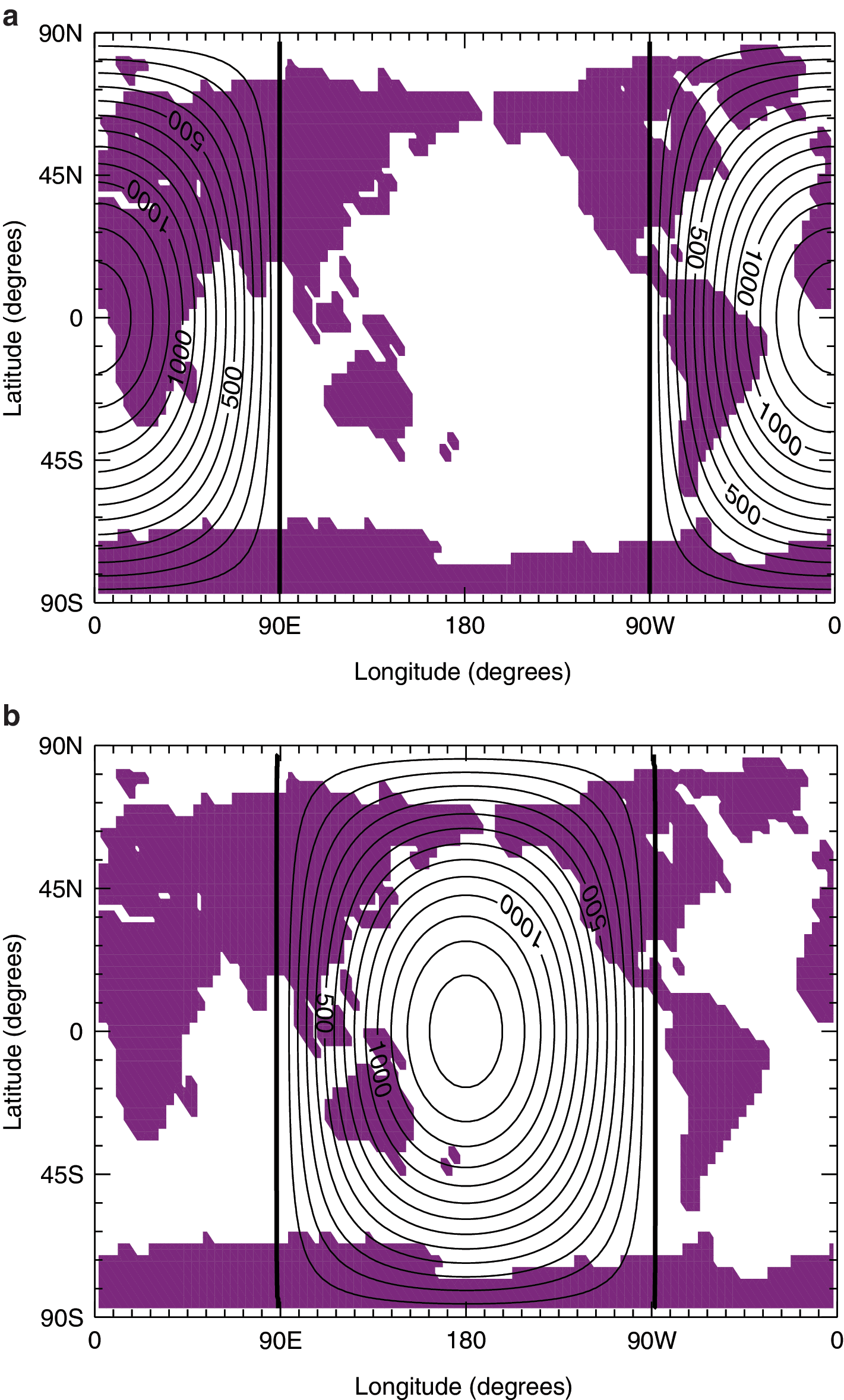
The distribution of insolation for the (
3. Results
3.1. Constant CO2 simulations
For both the Atlantic Basin simulation and the Pacific Basin simulation, the upper-level atmospheric circulations resemble the 240 h orbiter simulations for both the dry planet and the aquaplanet of Paper 1. Those atmospheres showed a strong westerly equatorial jet stream with a central area of low pressure on the sunlit side that corresponded to the location of the substellar point and two high-pressure vortices on the dark side near 60° latitude. So the overall circulation is not affected greatly by the presence of topography. However, some small stationary Rossby waves are seen in mountainous areas over the continents.
Figure 2 shows the mean annual surface temperature for both the Atlantic Basin simulation (Fig. 2a) and the Pacific Basin simulation (Fig. 2b). In Paper 1, the area with mean surface temperatures between 0°C and 50°C was a circular region centered on the subsolar point. Here, because of the topography, this region is not entirely circular; however, the basic geometry of the habitable region is similar. Also, in Paper 1, the lowest surface temperatures were collocated with the upper-level vortices in both the dry planet and the aquaplanet cases (−117°C and −62°C, respectively). The current simulations show that the temperature distribution depends on the topography below the vortices. In the Atlantic Basin simulation, the coldest temperature in the Northern Hemisphere (−63°C) is located west of the Northern Hemisphere vortex near Kamchatka. In the Pacific Basin simulation, the coldest temperature (−36°C) is located in Europe. In Paper 1, the hottest temperatures for both the dry planet and the aquaplanet were located at the substellar point (80°C and 40°C for dry planet and aquaplanet runs, respectively). In the Atlantic Basin simulation shown here, the hottest temperature (41°C) is in South America, not at the substellar point. This shift westward from the substellar point is caused by the lack of water vapor in the air coming over the Andes from the unlit side of the planet. This prevents clouds from forming over South America and thereby allows the stellar insolation to penetrate to the surface. The substellar point is located over the Atlantic Ocean, which allows water to evaporate and form clouds that block the incoming stellar insolation. In the Pacific Basin simulation, the hottest surface temperature is in Australia (44°C), not at the substellar point. Again, the surface temperatures are hottest over land areas, although in this case there are no mountains near the substellar point to further decrease the water vapor. Both the Atlantic Basin and Pacific Basin cases have average temperatures (254 and 260 K, respectively) between that dry planet and aquaplanet from Paper 1 (242 and 268 K, respectively). Even though these planets more closely resemble present Earth than the planets in Paper 1, the simulations are still significantly colder than present Earth. This difference in average surface temperature between the control planets and present Earth is due to the higher planetary albedos in the control planets. The higher albedos are a result of the cloud reflection from the substellar point updraft. Although the surface features in these two simulations are different from both the dry planet and the aquaplanet cases previously studied, the atmospheric circulations closely resemble those cases. Some minor differences are present: the contoured 200 hPa geopotential heights and the 200 hPa wind vectors show topographically forced waves from the landforms present (not shown). Specifically, the location of the Andes and the Rocky Mountains can be seen as waves in the upper levels over South America and North America. Also, there are waves in the vortices in the Southern Hemisphere as the contours cross from ocean to land near Antarctica. In the Pacific Basin simulation, waves can be seen over South America and North America, respectively, in both simulations. Also in both simulations, waves may be seen over Asia, denoting the presence of the Himalayas.
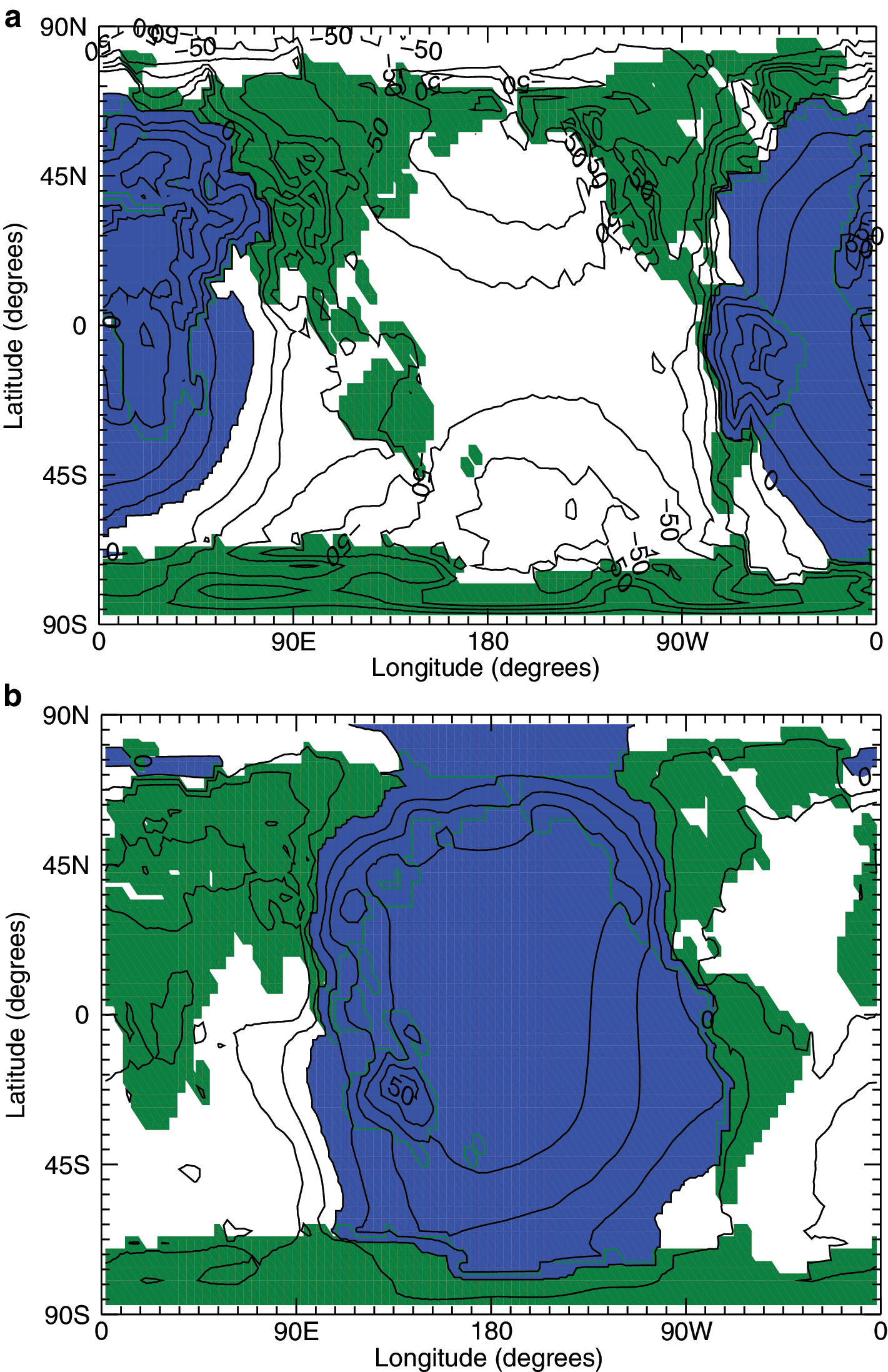
The average annual GCM surface air temperatures for (
Comparing the Pacific Basin case with the Atlantic Basin case, the different availability of open ocean for evaporation and latent heat transport to the dark side of the planet can be seen in the difference in the low temperatures. The Pacific Basin case, with its greater expanse of open water, has more potential for latent heat transport to the dark side of the planet, which increases the average surface temperature. In the Atlantic Basin case, the transport is much less than in the Pacific Basin case, lowering the average surface temperature.
For each simulation, the Habitable Area (HA), the Continuously Habitable Area (CHA), the Land Habitable Area (LHA), and the Land Continuously Habitable Area (LCHA) are calculated. The HA is defined as the surface area where the average surface temperature is greater than or equal to 0°C and less than or equal to 50°C. This corresponds to temperate areas on present Earth where only hardier organisms may reside. The LHA is the part of the HA that includes land. The CHA is the surface area where the minimum temperature is greater than or equal to 0°C and the maximum temperature is less than or equal to 50°C. This corresponds to the tropical areas of present Earth where many organisms can readily survive. Areas in the LCHA include continental tropical climes that are ideal for the development of animal life and civilizations. If civilizations were to develop in these warm areas, they could spread to the LHA. The 50°C constraint was suggested by Ward and Brownlee (2000) as the limit for multicellular life. This seems like a reasonable estimate. Tansey and Brock (1972) showed that eukaryotic life in general can survive at temperatures up to 60°C, but the high end of this range applies to fungi, not to plants and animals. Like Ward and Brownlee, we are interested in the latter organisms here. As may be seen in Table 1, although the temperatures are warmer in the Pacific Basin case, the HA and CHA are quite similar between the two cases. Even more interesting is that the Pacific Basin case has less total habitable land area (LHA and LCHA) than the Atlantic Basin case. This difference is due to the lack of sunlight reaching exposed land areas in the Pacific Basin case. So even though the Pacific Basin case is warmer overall, the amount of habitable land surface area is smaller than that in the Atlantic Basin case. As can be seen in Fig. 3, some of the HA is located on the dark side of the planet. Although these locations are not viable for photoautotrophs (like green plants on Earth), these temperate locations could be viable for chemoautotrophic multicellular life-forms. The Atlantic Basin case planetary albedo is slightly lower than the Pacific Basin case due to the lack of large continents on the starlit side of the planet in the Pacific Basin case. Even though much of the planets' surfaces are below the freezing point of water, these areas are most prevalent on the nightside of the planet, which keeps these ice-covered areas from affecting the albedo.
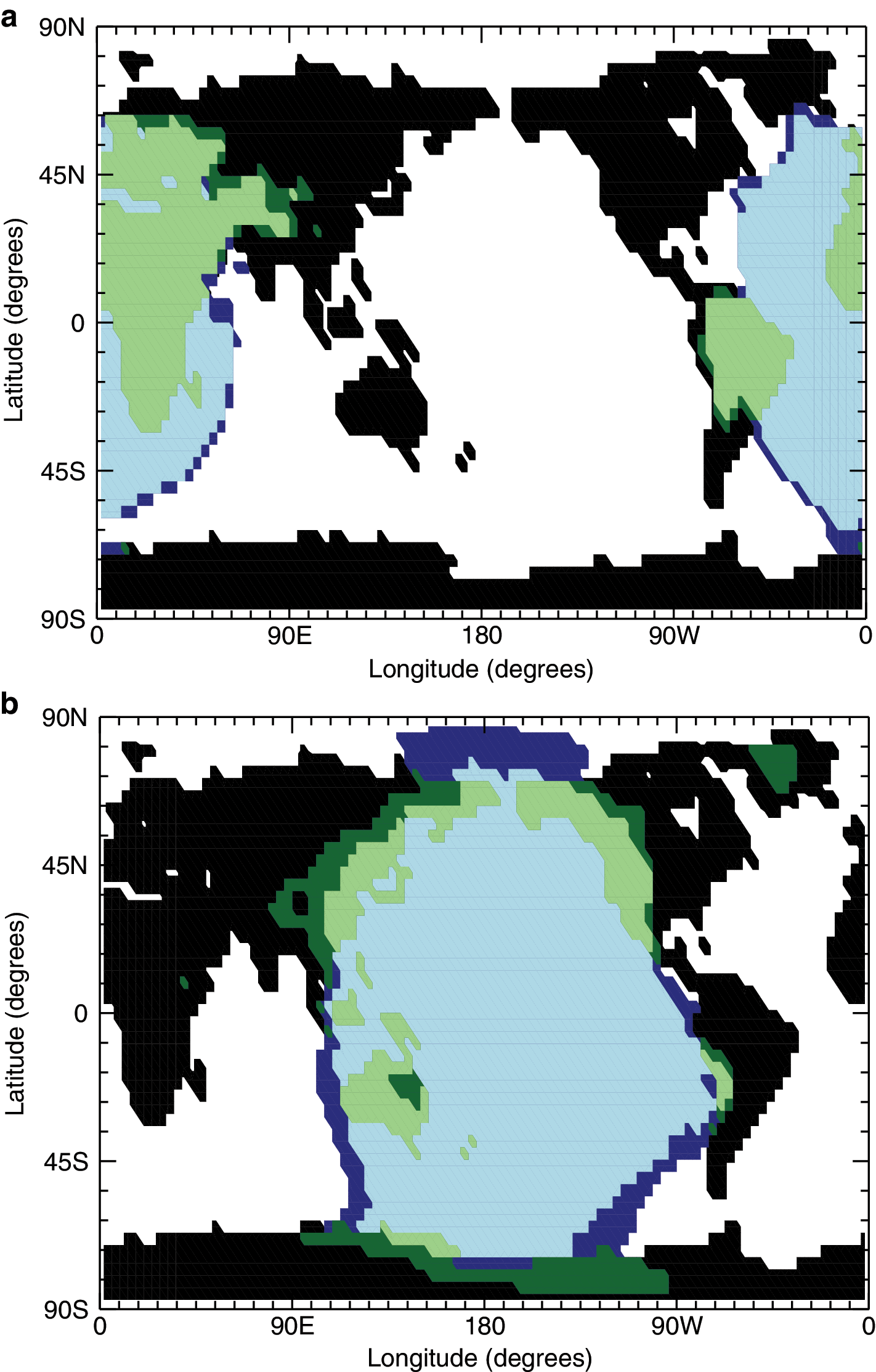
The HA (dark blue), the CHA (light blue), the LHA (dark green), and the LCHA (light green) for the (
The percentage of HA and CHA are calculated against the total surface area while the percentages of LHA and LCHA are calculated against the total land surface area.
3.2. Variable CO2 simulations
We next performed a series of simulations in which we balanced the carbonate-silicate cycle, expressed by Eq. 1, by iteratively adjusting atmospheric CO2. In the Atlantic Basin simulation, the carbonate-silicate cycle balanced at a CO2 concentration between 7 and 12 ppm. The simulation shown here corresponds to a CO2 concentration of 7 ppm. This is only ∼2% of present Earth atmospheric concentration. This level of atmospheric carbon dioxide is below the limit at which terrestrial plants can photosynthesize [10 ppm CO2 for the hardiest C4 plants (Caldeira and Kasting, 1992)]; hence, this planet would be uninhabitable for any photosynthetic life present on Earth today. The reason the CO2 concentration is so low is because the substellar point is over the Atlantic Basin (Fig. 1a). With the substellar point in this location, a large amount of land area is illuminated, and consequently surface temperatures and weathering rates are very high. Note that major mountain ranges, like the Himalayas and the Andes, are illuminated in this simulation. The insolation warms the surface such that when it rains the silicate rocks are easily weathered, which draws down the CO2 concentration in the atmosphere.
In the Pacific Basin simulation, by contrast, the carbonate-silicate cycle balanced at a CO2 concentration between 59,068 ppm and 60,311 ppm, which corresponds to a CO2 partial pressure of ∼0.060 bar. The actual CO2 concentration in this simulation is 60,311 ppm. This is nearly 200 times higher than the atmospheric CO2 concentration on present Earth. The reason is that the substellar point is over the middle of the Pacific Ocean, so there is little continental landmass in the region where the solar insolation is high (as seen in Fig. 1b). This lack of landmass leads to a need for larger atmospheric CO2 concentrations to keep the landmasses on the dark side of the planet warm enough for rain to fall there and to thereby weather the continents. In reality, the atmospheric CO2 concentration on a planet like this one might be limited by seafloor weathering, rather than by continental weathering (Sleep and Zahnle, 2001), so the CO2 partial pressure calculated here may be too high. Quantifying this effect is difficult, though. The present calculations simply show that the same tidally locked planet could end up with greatly different atmospheric CO2 concentrations, depending on which side of the planet is sunlit.
The annually averaged surface temperature fields for these variable-CO2 simulations are shown in Fig. 4a, 4b. Areas in blue have average temperatures above 0°C, which makes these areas more likely to have liquid water present. The locations of the warmest and coldest areas on each planet are approximately the same for these planets and their respective controls, discussed above. However, the global average surface temperatures and the global temperature ranges are different (Table 1). The Atlantic Basin simulation was significantly cooler on a global average (7°) than the control run, largely as a result of its much lower CO2 concentration and smaller greenhouse effect. As a consequence of the lowered temperatures, the HA, CHA, LHA, and LCHA all decreased, but not drastically. By contrast, the Pacific Basin simulation was much hotter than the corresponding control run (21°) because of its very high CO2 concentration and large greenhouse effect. The amount of habitable surface area increased in all categories except temperature range when compared to the 355 ppm control simulation. The warmer temperatures are especially evident on the dark side of the planet, where the lowest temperatures are much higher (−16°C) than in any of the other simulations (−36°C for the warmest of the other cases). This can be seen as a lack of isotherms on the unlit portion of the planet in Fig. 4b when compared with Fig. 4a. The temperature range decreased because the increased greenhouse effect (or, equivalently, the increased radiative time constant of the atmosphere) allowed warm air to be advected around to the dark side of the planet without cooling as much. Because of the increased temperatures, the HA, CHA, LHA, and LCHA all increased, with the LCHA and LHA doubling compared to the fixed-CO2 simulation (Table 1).
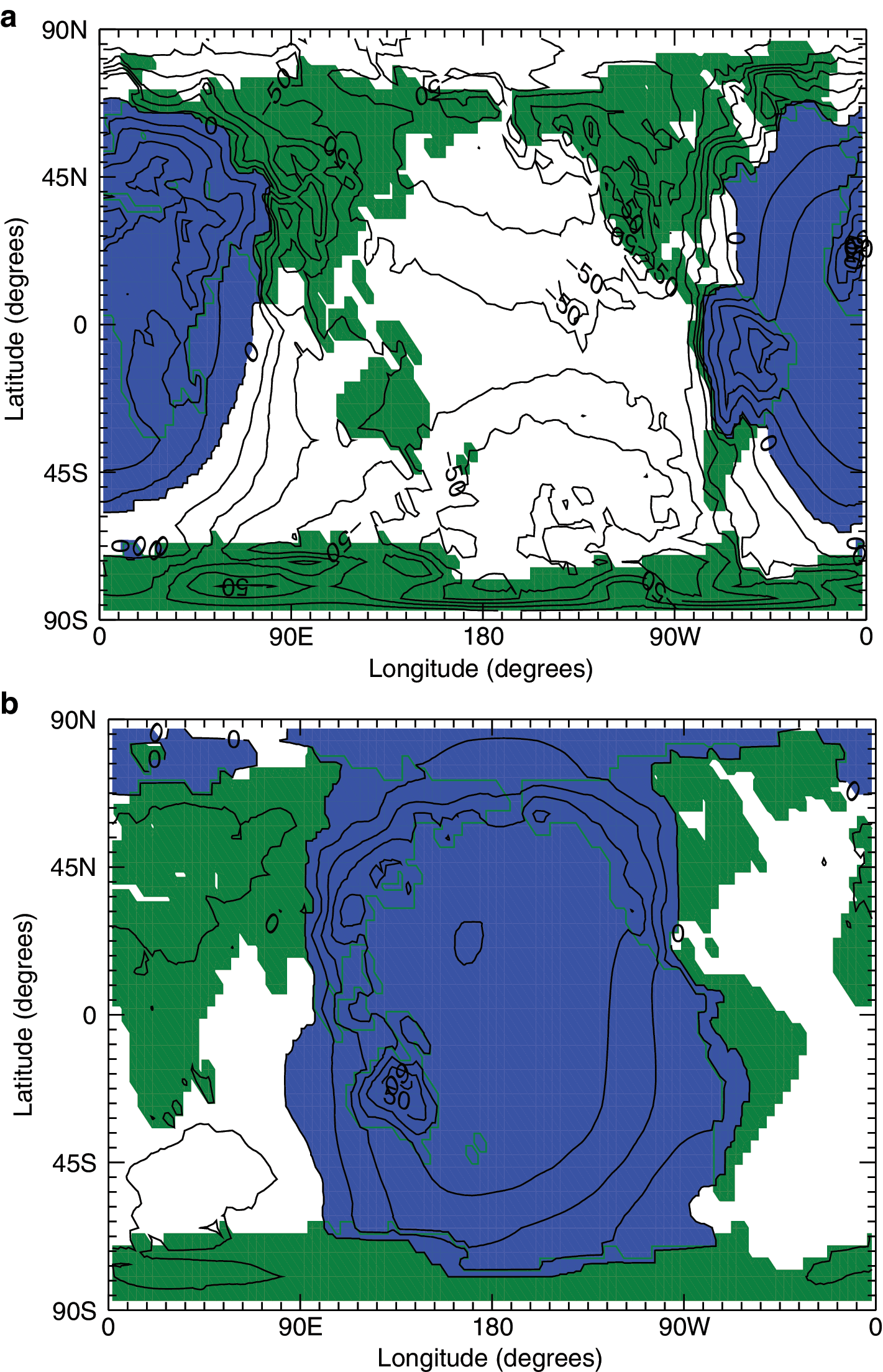
The average annual surface air temperature in degrees Celsius for the (
The HA, CHA, LHA, and LCHA are shown in Fig. 5a, 5b for their respective simulations. For the Atlantic Basin simulation, the HA, CHA, LHA, and LCHA have all decreased compared to the control. Notable differences include the Northern Atlantic Ocean, the HA on the South American continent, and the Ural Mountains on the Eurasian continent. For the Pacific Basin simulation, the HA, CHA, LHA, and LCHA have all increased compared to the control. The HA expands to include all of Australia (where only a portion of the continent was habitable in the Atlantic Basin simulation) and much larger chunks of the Eurasian, North American, and South American continents. The Antarctic and Arctic regions also become partially habitable. Even Africa, which is nearly at the antistellar point, gains some habitability.
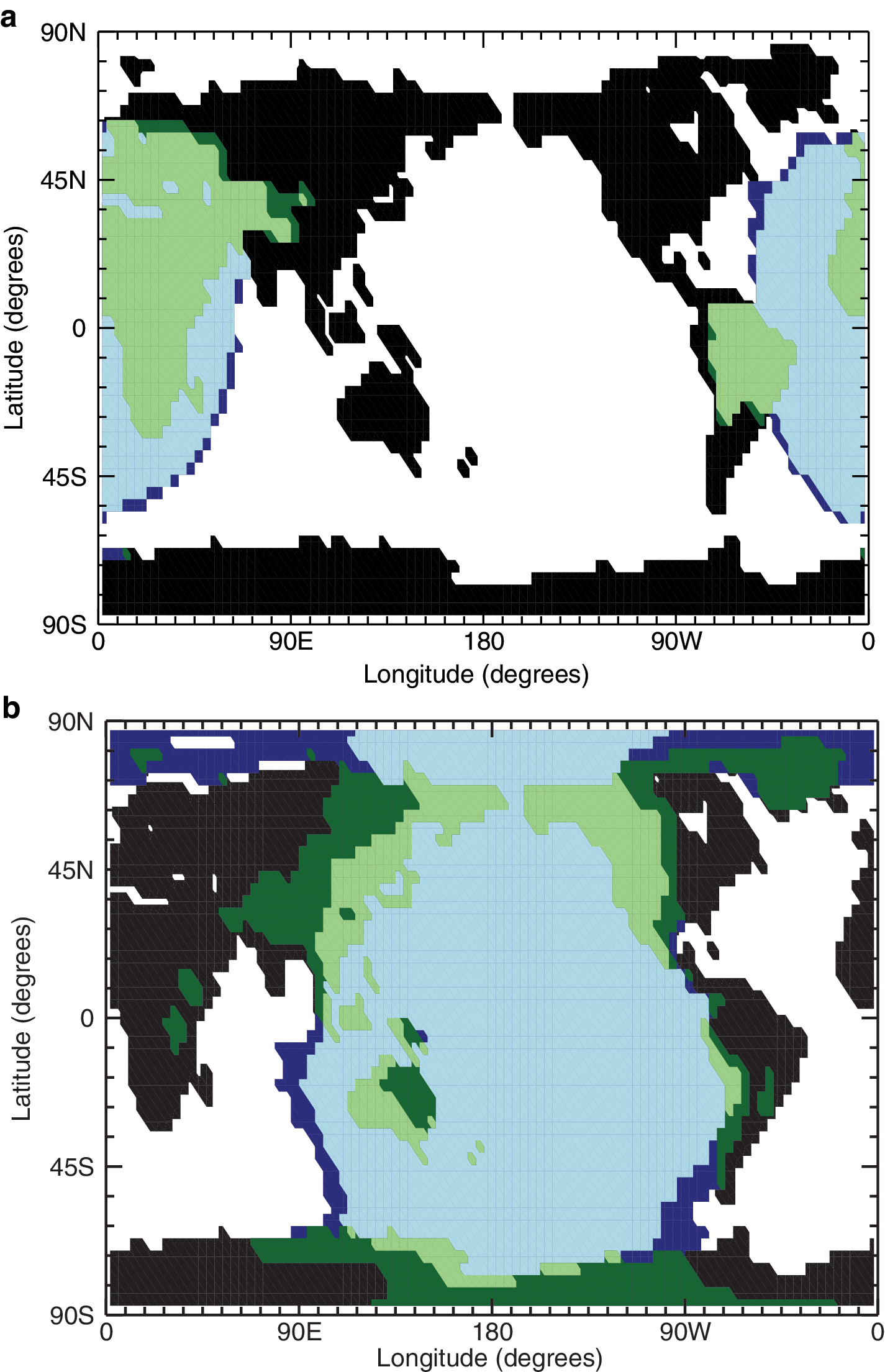
The HA (dark blue), the CHA (light blue), the LHA (dark green), and the LCHA (light green) for the (
Although the calculations shown here were all done at 1 AU equivalent distance from the star (i.e., present Earth insolation), the conclusions can be generalized to planets orbiting elsewhere within the habitable zone of their parent star. The farther away a planet is from its star, the higher atmospheric CO2 would need to be to balance the carbonate-silicate cycle (assuming Earth-like rates of volcanism). High atmospheric CO2 tends to moderate surface temperatures around the planet by increasing the radiative time constant of the atmosphere. So, if all other factors are equal, a tidally locked planet orbiting near the outer edge of the habitable zone should be more temperate than a planet orbiting near the inner edge. Conversely, larger planets, with more active volcanism, should have higher CO2 partial pressures and higher mean surface temperatures than similarly located Earth-sized planets. Provided they are not too hot on their daysides, such large planets should also have warmer nightsides and greater habitable areas than smaller planets.
4. Conclusions
If a planet resembling present Earth was in a tidally locked orbit around a star, the habitable surface area would depend on the location of the substellar point. If the substellar point is near or over a continent, then the carbon dioxide concentration in the atmosphere should decrease because silicate weathering should be fast. Lowering the atmospheric carbon dioxide concentration decreases the greenhouse effect, which lowers the surface temperature globally. For a planet receiving present Earth insolation, this global decrease in surface temperature results in a decrease in the habitable surface area, as all the modeled planets are already cold, on average, compared to modern Earth. Moving the substellar point away from continental areas increases the carbon dioxide concentration, which results in an increase in the average surface temperature. This increase in average surface temperature may or may not increase the habitable surface area, depending on the planet's location in the habitable zone of its star. If the planet is far out in the habitable zone, then increasing the CO2 concentration should increase the habitable surface area through increasing surface temperatures. However, if the planet is close to the star in the habitable zone, then increasing the CO2 concentration may actually decrease the habitable surface area. In all cases, higher atmospheric CO2 concentrations decrease surface temperature contrasts between the dayside and nightside of the planet by slowing the rate at which advected air masses can cool off.
Future work could concentrate on performing calculations at different stellar insolations, allowing the oceans to circulate, studying the effect of planetary eccentricity and obliquity, changing land mass amounts, and allowing for the process of seafloor weathering. Such simulations will become more interesting in the future when candidate habitable planets are found.
Footnotes
Acknowledgments
The authors would like to thank Charles Anderson for his help in displaying the circulations in three dimensions, as it helped greatly with the description of the circulations.
Author Disclosure Statement
No competing financial interests exist.
Abbreviations
CHA, Continuously Habitable Area; GCM, general circulation model; HA, Habitable Area; LCHA, Land Continuously Habitable Area; LHA, Land Habitable Area.