




Abstract
The aim of this article is to show how, and in which context, astrobiological reasoning was employed before the establishment of astrobiology as a scientific discipline. By way of an example, I will discuss a popular science book published in 1931 by the Hungarian journalist Desiderius Papp. The author claims that this book represents an innovation in astrobiological reasoning, as it draws on contemporary biological research to conduct thought experiments, thereby coming up with concrete forms of possible extraterrestrial life. One of the most interesting of these forms was crystalline life. After a short overview on the history of this concept, this article will show how Papp drew on recent research by Otto Lehmann on liquid crystals to convey the idea that life may be based on other elements than carbon. The author concludes by arguing that popular science did not only make specialist knowledge accessible to a general public but also served to probe the limits of knowledge and point toward the situatedness of established categories and definitions. Key Words: History of astrobiology—Non-carbon-based life—Liquid crystals—Papp, Desiderius—Lehmann, Otto. Astrobiology 12, 951–957.
Introduction
T
I would like to propose supplementing the perspective on the history of ideas with another perspective with a much narrower scope, namely, one that aims at clarifying the place of astrobiological reasoning in local historical contexts. From this perspective, speculations about extraterrestrial life would not be regarded so much as part of an over-arching and slowly unfolding line of thought, culminating in what is today a more or less established scientific discipline. Instead, their meaning and purpose would be investigated in their own right. In which institutional or discursive framework did people debate about the plurality of worlds and life on other planets? Which theoretical and literary means did they employ to draw up examples of extraterrestrial life? Did they appropriate data and theories from contemporary science, and if so, why did they choose these specific data and theories instead of others? What was the significance of the resulting figure of thought, and what purposes did it serve?
In the following short article, I can only hope to give an example of what such an approach might look like. After a short overview on the idea of silicon-based and crystalline life, I concentrate on one case study: a book published by the Austrian-Hungarian science popularizer Desiderius Papp in 1931. His work represents a milestone in the history of astrobiology insofar as he appropriated contemporary findings from biology and crystallography and used them to conduct innovative thought experiments. In contrast to most other authors, he did not confine himself to discussing whether other planets would in principle support life as we know it but constructed concrete examples of life-forms possibly dwelling there.
I will show how the theses proposed by Papp were rooted in the local context of interwar Vienna, where he worked as a science editor for a newspaper. His extraterrestrials were the brainchildren of contemporary philosophical ideas such as monism, as well as local styles of experimental biology such as Lamarckism. For him, however, the role of popular science was not confined to translating scientific findings into a language laypersons could understand. Rather, he actively scrutinized established biological categories and orthodox definitions of life. Extraterrestrials, and especially crystalline extraterrestrials, served as figures of reflection, as a means to probe the limits of contemporary knowledge.
1. The Origins of Crystalline Life
Today, research on non-carbon-based life is an increasingly important part of experimental work in astrobiology. The main candidates for an alternative basis of life are nitrogen, phosphorus, and silicon. 1 While the former two have only recently attracted attention, the idea that silicon might provide the material fundament for processes that are identifiable as living harks back to the late 19th century. At the time, it was often used together with the idea of “crystalline” life, meaning life made up of mineral compounds in general. Two sources for this notion can be ascertained.
The first was an experimental tradition, which started in the mid-19th century, when the pioneers of cell theory argued by analogy from crystal growth so as to advocate a mechanistic view of life. Crystals and structures like the so-called “arbor dianae,” a dendritic structure formed by the precipitation of silver nitrate, were invoked to rebuke vitalistic interpretations of cell formation and growth (Schwann, 1847, p 214; Brandstetter, 2011). Creating artificial structures that imitated certain features of living beings, such as form, growth, or even the osmotic exchange of fluids, rapidly became a research program in its own right, attracting biologists inclined toward a materialist worldview. Some authors argued that mineral structures such as these might represent the origin of life on earth, since they may have been able to sustain the high temperatures and harsh environmental conditions of the planets in their nascent stages (Preyer, 1877). When the astronomer Julius Scheiner published an article concerning life on other planets in the popular science magazine Himmel und Erde in 1891, he invoked objects like artificial cells and the “arbor dianae” to convey the idea that life might, under different circumstances, in fact, develop from the combination of mineral compounds (Scheiner, 1891). Life, he argued, is always based on “organized matter,” but the nature of this matter may change—it does not necessarily have to be the carbon-based compound we know on Earth. The notion of living matter, he argued, is relative to our knowledge and may change in light of new insights.
The second source of the idea of “crystalline life” is a philosophical tradition called monism. Monism was conceived of by the German zoologist Ernst Haeckel, who argued that there is no divide between body and soul, or between the realms of the material and the spiritual. The whole of nature is governed by the same immutable laws of physics and biology, and especially by the principle of evolution. According to Haeckel, all matter has a psychic dimension and can therefore be called living. There is no absolute division between living beings and mineral structures; crystals, although in a very primitive state, may be termed alive (Haeckel, 1866, Vol. 1, pp 159–164; Kleeberg, 2005).
This philosophy, which Haeckel claimed had overcome a vulgar materialism while not succumbing to vitalistic or religious worldviews, became very powerful and influential in Germany at the beginning of the 20th century. It not only influenced the research programs of scientists, but also—and even more—the popularization of science. In 1886, Ernst Krause (writing under the pen name Carus Sterne) published a popular exposition of Haeckel's Natürliche Schöpfungsgeschichte (Natural History of Creation), in which he presented a comprehensive tableau of natural phenomena from the history of Earth and the development of life to recent fauna and flora. Discussing minerals, he argued that crystals have something akin to a “soul” as they constitute the most primitive expression of individuation in nature (Sterne, 1886, p 85ff.). He not only mentioned the “arbor dianae” and similar structures to convey their lifelikeness but also went on to speculate on life on other planets based on silicon. Conditions on Earth are not favorable to such a “silicon life-world,” he conceded, but the harsher conditions on other planets may make carbon-based life impossible and therefore favor silicon-based beings: “Why shouldn't we conceive of a silicon lineage somewhere else, which is endowed with tougher nerves and endures higher temperatures with an indifference akin to the mythical salamander?” (Sterne, 1886, p 98).
During the first third of the 20th century, a number of authors continued to speculate on the possibility of silicon forms of life (Benedikt, 1904, p 95; Doelter, 1906, p 29; Branca, 1913; Samojloff, 1924, p 598; Dekker, 1926, p 84; Andrenko, 1931; Isbert, 1931; Papp, 1931, p 285 and p 292ff.), while others voiced critical objections to this idea, arguing that life on other planets must be similar to the one we know on Earth (Müller, 1902, from a theological background; Arrhenius, 1907, p 207, from the perspective of panspermia, which argues that all life is related; Hurwitz, 1925, from the perspective of chemistry). Many of the proponents drew on monist themes, as in monism “life” was a loose concept. Its definition was based on the notion of individuality, the defining characteristic of organisms existing as closed spatial forms. Furthermore, life was defined as an activity rather than the property of a specific substance, therefore inviting speculations on other material substrates. In some cases, such a philosophical foundation for the belief in crystalline aliens could border upon spiritualism, as in the work of the Russian astronomer Leonid Andrenko (Andrenko, 1936). 2
In other cases, speculations on silicon-based life became downright science fiction. The most famous example was H.G. Wells, who in 1894 already conjured up “visions of silicon-aluminium organisms—why not silicon-aluminium men at once?—wandering through an atmosphere of gaseous sulphur, let us say, by the shores of a sea of liquid iron some thousands degrees or so above the temperature of a blast furnace” (Wells, 1975, p 146.). 3 In a similarly fantastic way, the writer Stanley Weinbaum featured different kinds of silicon-based life-forms in his science fiction stories “A Martian Odyssey” (1934) and “The Red Peri” (1935) (Weinbaum, 2006). In the German-speaking world, two authors explored this topic: Carl Grunert, one of the pioneers of German science fiction, and Annie Francé-Harrar, the wife of botanist and science popularizer Raoul Francé (Grunert, 1922; Francé-Harrar, 1948). Both drew on contemporary scientific research, especially synthetic biology and the work on liquid crystals by the physicist Otto Lehmann. Via her husband, Francé-Harrar was also firmly rooted in the monist tradition.
This short overview demonstrates that the idea of crystalline life presents the convergence of an experimental approach with a specific philosophical tradition. The resulting figure of thought was invoked to overcome impasses in debates about the origin of life and to spell out an implication of the monist worldview, namely, the existence of life in the entirety of the cosmos, possibly in forms hitherto inconceivable. Apart from science fiction writers, most authors merely stated the possibility of crystalline life in principle without going into any detail. There is, however, one exception: the 1931 book Was lebt auf den Sternen? (What Lives on the Stars?) by Desiderius Papp.
2. Desiderius Papp, an Architect of Popular Science
Desiderius Papp (1895–1993), a Hungarian by birth, had acquired a Ph.D. in philology from the University of Budapest when he moved to Vienna after the First World War. 4 Working as a science editor at the daily Neues Wiener Journal, he regularly covered new developments in science in an entertaining and sometimes sensationalist style. He was also active in the Wissenschaftliche Gesellschaft für Höhenforschung (Scientific Society for High Altitude Research), which, similar to the German Verein für Raumschiffahrt (Society for Space Travel), performed experiments in rocketry and spaceflight, and he worked as a Privatdozent (lecturer) at the University of Vienna. Furthermore, he participated in the rich cultural life of Vienna, befriending writers and artists, among them celebrities like Egon Friedell and Franz Werfel. After the National Socialist occupation of Austria in 1938, he left the country for Switzerland, France, and, in 1942, Argentina, where he went on to become a distinguished historian of science, holding a professorship and helping to establish the discipline in South American countries.
I want to concentrate solely on the interwar period in Vienna, as Papp published three of his books in popular science during this time, one of them being the aforementioned book on extraterrestrial life. The other books dealt with the history of the idea of artificial humans from the homunculus to 18th century materialism, and the distant future of the planet Earth and its inhabitants (Papp, 1925, 1932). All three books have to be seen in the context of the popularization of science, which was a prospering field in the 1920s and 1930s. Astronomy was central to diverse efforts in communicating science to the public. It easily provided an opportunity to mix education with entertainment, as in the public observatories and lectures organized by institutions such as Urania (Felt, 1996; Schembor, 2010). Amateur astronomy was on the rise, and when Mars was at opposition in January 1931, newspapers brought images of a new map of Mars made by Antoniadi, which charted areas of vegetation (Dolezal, 1931). Furthermore, astronomy constituted a site where amateurs and interested laypeople could observe controversies first-hand and, if so inclined, participate in the debates. For example, the so-called Welteislehre, a pseudoscientific cosmology propagated by the engineer Hanns Hörbiger, was enthusiastically discussed, as was the theory of relativity by Einstein (Wessely, 2007; Wazeck, 2009). The possibility of extraterrestrial life was also a widely debated topic, and as science fiction had become a popular genre, people were familiar with the main tropes. Since experts obviously did not agree on the subject, everybody felt entitled to voice his own opinion on the question; followers of Hörbiger denied the existence of extraterrestrial life, while some theologians called for caution, arguing that this question cannot be answered and has no practical relevance (Fischer, 1924, p 147; Lenz, 1935, p 88f.). Other theologians, however, like Joseph Pohle, as well as a number of widely read astronomers like Svante Arrhenius and Knut Lundmark, advocated the possibility of extraterrestrials (Arrhenius, 1907; Pohle, 1922; Lundmark, 1930).
Papp, while defending science against what he perceived to be pseudoscientific pretensions such as the Welteislehre and the diverse criticisms of Albert Einstein, nevertheless subscribed to a rather generous view when it came to evaluating claims made by scientists. He considered the existence of artificial canals on Mars as possible and was excited about observations made by the astronomer William Pickering, who claimed to have evidence about swarms of insects on the Moon (Pickering, 1924; Papp, 1931, pp 193–229 for Mars and p 166 for the Moon). His rationale for this openness was the special role he assigned to imagination in science. He argued that when empirical research is impossible, probabilities have to be discussed, and this can only be done by employing the imagination. However, he claimed that in contrast to a novel, his book presented scenarios that were possible in accordance with the findings of modern science (Papp, 1931, p 10).
True to these deliberations, Papp went on to speculate on the forms extraterrestrial life could take in different worlds. This was an innovative approach, as up to this time, most discussions of extraterrestrials in scientific literature confined themselves to pondering the question in principle, listing the known environmental conditions of other planets and assaying if life as we know it could exist there. Apart from science fiction, there was no speculation on what such life would in fact look like. Papp, in contrast, presented concrete images of possible inhabitants of other planets. True to his own creed, he based his deliberations on scientific theorems. These, however, were not so much drawn from astronomy as from biology, especially from the theory of Lamarckian evolution.
One of the main theses of Lamarckism was the existence of a direct relationship between a given environment and the physiology of its inhabitants. As Papp stated it: “to survive and become dominant, each organism has to be aligned to its environment like a key to its lock” (Papp, 1931, p 79). This premise provided a powerful tool for thought experiments; controlled use of the imagination could construct beings that conformed to a specific environment, however strange it might be. In contemporary biology, Lamarckism was still a legitimate theoretical option and was very present in the Viennese context. The local Biologische Versuchsanstalt (Biological Laboratory), one of the most modern biological laboratories of the day, was an internationally renowned center of Lamarckist biology, where experiments on the adaptability of organisms and on the inheritability of acquired characteristics were performed (Reiter, 1999). The scientists of the Vivarium, as it was called, actively communicated their results to a broad public, publishing papers in popular science journals and lecturing to lay audiences. It is possible that Papp met some of these biologists personally, especially through his friendship with Franz Werfel, whose wife, Alma Mahler-Werfel, worked for some time as an assistant to Paul Kammerer, who was later accused of having forged evidence for Lamarckian evolution (Gliboff, 2006). Be that as it may, we can be sure that he read works by Kammerer and Przibram, the director of the Vivarium, as they are mentioned in the bibliography of his 1931 book.
How did Papp proceed with the imaginative creation of extraterrestrials? Possible inhabitants of Mars were an especially promising example, as readers probably had encountered hypothetical Martians in the works of science fiction authors such as H.G. Wells or Kurd Lasswitz. By proposing his own version of martian life (Fig. 1), Papp could hope to show how a scientific approach differed from a literary flight of fancy. He enumerated a series of features such creatures would have, substantiating each feature with reference to the corresponding environmental condition. For example, Martians would probably be quite big, as gravity on Mars is much weaker. They would have a thick fur, as the temperature is low, and they would lack vocal chords, as the thin air does not allow for sound to travel far (Papp, 1931, pp 219–225). Papp stressed how the figure emerging from this thought experiment differs from the Martians of H.G. Wells, so as to demarcate his approach from those of the novelists. This is an interesting case of “boundary work” (Gieryn, 1983): Papp established his own approach as a scientific one by contrasting it with another approach that represented the nonscientific, literary flight of fancy. 5 The criticism of the novelists' version of Martians served as a means to sanction his own innovative and daring method of thought experimentation as a legitimate and scientific way of reasoning.

A Martian according to Papp.
3. From Liquid Crystals to Crystalline Life
In the eighth chapter of his book, when he discussed forms of life on planets around other stars than our sun, Papp first mentioned the idea of extraterrestrials made up of silicon or titanium and then went on to discuss the possibility of crystalline beings in detail. He bolstered his speculations by drawing on another contemporary source, the work of physicist Otto Lehmann.
In 1888, Lehmann discovered what he termed “liquid crystals” (Fig. 2). Although crystallographers were initially skeptical, biologists showed considerable interest in his work. At the time, crystals had become a preferred model for mechanist biologists as they served as arguments in the controversy between a mechanist and a neo-vitalist research program (Brandstetter, 2009). Neo-vitalists like Hans Driesch argued that properties exhibited by living beings such as regeneration cannot be explained in mechanical terms and turned to controlling “vital forces” as an explanation for the purposeful behavior of organisms. As an answer, some mechanists started to experiment with crystals, showing that they indeed grow, regenerate, and even reproduce. Therefore, the argument went, these activities could be explained on chemical and physical grounds alone, without a need to invoke vital forces.
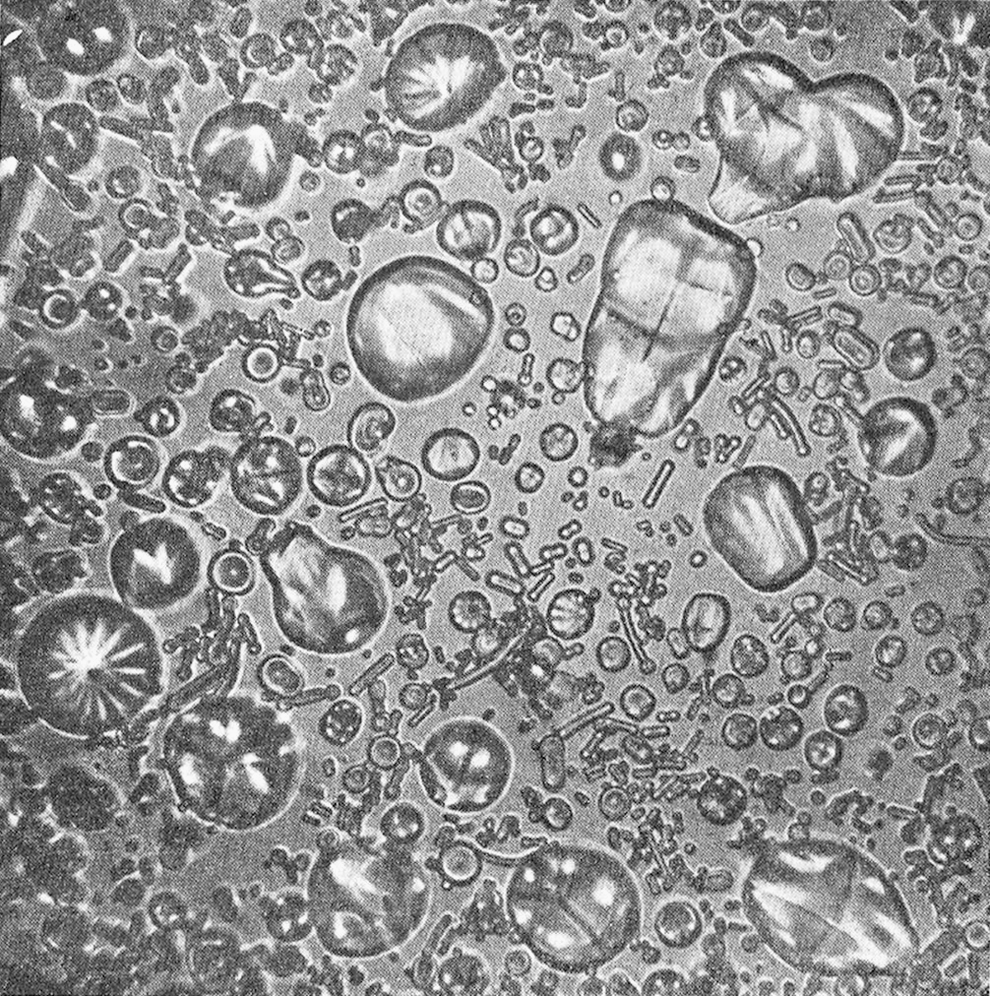
Liquid crystals photographed by Lehmann.
Lehmann was not the only person calling attention to the significance of crystals for a mechanistic biology. At the Viennese Biological Laboratory, Hans Przibram and Paul Kammerer performed experiments on crystals and employed them as models to explain regeneration in animals. Both published several papers on the subject, and Przibram visited Lehmann in Karlsruhe (Kammerer, 1926; Przibram, 1926). However, Lehmann was the most prolific advocate of liquid crystals as models for organisms, publishing in scholarly as well as in popular science journals, organizing exhibitions and lectures, and even producing a short movie on the subject.
It is important to note that, for Lehmann and other biologists, crystals were models; they were considered to be lifelike, not to be alive in their own right. Crystals were a provocation to the vitalists' claims that certain features like regeneration were unique to organisms and could only be explained by invoking specific forces not reducible to the laws of physics or chemistry. Their behavior, as shown in experiments conducted by Lehmann and Przibram, called into question the established definitions of life and deconstructed the rigid demarcation of living and nonliving.
The appropriation of crystals by Papp shows again the influence of a local scientific context upon his work on extraterrestrials. His speculations were modeled closely upon knowledge produced by researchers like Lehmann and Przibram as well as on the monist conviction that there is no insurmountable gap between the living and the dead (cf. Haeckel, 1917). By taking the lifelikeness of crystals literally and speculating upon the possibilities of crystalline life on other planets, he joined the biologists in questioning the established categories of life. But he did not do this in a deconstructive way only. His thought experiments led him to envisioned worlds where crystals were the dominant life-form:
Why shouldn't these beings live? Of the two billion inhabited planets of the universe, shouldn't there be one star where the dominant species did not spring from animals, nor from plants, but from crystalline ancestors that have evolved to the highest level? Nature is versatile and exhaustive in the utilisation of all creative possibilities; it is inconceivable that such a vast realm as the crystalline should have been excluded from the ascending order of living beings. (Papp, 1931, p 295)
4. Challenging Boundaries
It comes as no surprise that his contemporaries responded to claims such as these with considerable skepticism. As I have already mentioned, Papp practiced a novel and innovative form of astrobiological reasoning. His 1931 book was one of the first attempts to bring biological data and theories to bear on the question of extraterrestrial life. He did so by employing thought experiments that fleshed out possible forms life on other planets could take. However, the price he paid was that his speculations occupied a precarious place. On one hand, he had to steer clear of unscientific and disreputable flights of fancy. Novelists might be permitted such but thereby lost any claims to scientificity. On the other hand, he had to take liberties with scientific findings. Scientists usually confined themselves to pondering whether other planets might support life as we know it on principle and stopped short of speculating on its concrete forms.
Judging from contemporary reviews, the reception of Papp's book was rather critical. One reviewer bemoaned the “journalistic handiwork” which lacks “scientific sobriety,” likening the book to a novel by Jules Verne (Anonymus, 1931a). The astronomer Johannes Riem was even more outspoken, proclaiming “How is it possible to write such a book?!” and chastising the wild phantasy of Papp (Riem, 1931). 6 Even a positive review had trouble with the “imaginative style,” as it made it difficult to discern fact from fiction (Anonymus, 1931b).
One reaction, however, stood out. It was not a review in the proper sense of the word but rather a satire that utilized the reception of Papp's work to poke fun at the narrow-mindedness of academic science. Under the title “Is Earth inhabited?” the cultural historian Egon Friedell, a personal friend of Papp, published a short piece narrating the story of a meeting of scientists on a planet orbiting β Cygni (Friedell, 1985). Discussing the eponymous question, they come to the conclusion that Earth cannot be inhabited, listing several reasons for their conviction: experience shows that only planets of double stars are inhabitable; oxygen, which is known to be poisonous, has been found in Earth's atmosphere; the temperature is much too low to support life, while the gravity is much too strong; and so on. They declared that “[t]he imperishable laws of nature which science has uncovered… encompass adamantly the whole of the cosmos, and therefore idle speculations on the inhabitability of our neighbouring miniature sun and its dead planets should be left to novelists” (Friedell, 1985, p 224). One lonely Privatdozent, however, challenges this verdict, arguing that all celestial bodies are inhabited, even if the inhabitants may not always look like “professors of cygnian astronomy.” But this defiance does him no good, as it results in him being forbidden to teach on account of having brought ridicule to the faculty.
One should be careful not to read the piece by Friedell as a realistic representation of the true reasons for the critical stance toward Papp. It does, however, point toward how the astrobiological reasoning of this author probed the limits of knowledge in a twofold way: not only in the sense that he went beyond the astronomical and biological knowledge of the time by employing thought experiments but also that by doing so he drew attention to the myopic view of established categories and definitions. Stretching contemporary theories like Lamarckian evolution to their very limits and introducing ever-stranger forms of extraterrestrial life, like silicon-based and crystalline beings, he put familiar notions of life and the living into perspective. By exhibiting the situatedness of their position, he warned scientists lest they be too assured of their own convictions.
Conclusion
I have shown how the astrobiological speculations of Desiderius Papp were rooted in their local scientific context; they were not just flights of fancy but elaborate thought experiments utilizing experimental data and theories that were discussed in contemporary biology, for example, in the Viennese Biologische Versuchsanstalt. Papp, however, not only translated these findings into a language appropriate for laypersons, he also actively challenged established notions of life and the living and drew attention to the limits of contemporary knowledge.
At that time, there was no established disciplinary space where such astrobiological speculations could legitimately be conducted. To be sure, debating the plurality of worlds had a firm tradition in theology and philosophy, and astronomy had attained the right to ponder the conditions for life on other planets. However, by presenting concrete examples of the forms in which organisms might develop on other planets, Papp departed from the conventions of contemporary science and deliberately walked a thin line between scientifically grounded thought experiments and outright science fiction. He could do this because he himself was not a representative of a scientific discipline. As a full-time popular scientist, he had no other choice than to plunge himself into the contested and volatile market for books aimed at a curious public eager to be entertained with scientific findings. At the same time, he was able to turn this precarious status into an opportunity for experimenting with new ways of thinking about life on other planets. His literary use of thought experiments introduced an ingenious technique for making biological reasoning productive for speculations about extraterrestrials.
My article has shown how popular science could play an innovative and productive role in the development of astrobiological reasoning. Popularization is not only useful for translating highly specialized knowledge into a language accessible to a general public but can also serve to probe the limits of knowledge playfully and point toward the situatedness of established categories and definitions.
Footnotes
Acknowledgments
I would like to thank the organizers of the conference, The History and Philosophy of Astrobiology, for their hospitality and their comments. Furthermore, I want to thank Johannes Leitner for insights into contemporary research on non-carbon-based life, Klaus Taschwer for important information on biology in interwar Vienna, and Malina Maskarinec for linguistic corrections.
Author Disclosure Statement
No competing financial interests exist.
1
For insights on the subject, I am grateful to Johannes Leitner, who works on the subject in conjunction with the research platform ExoLife at the University of Vienna (
2
Andrenko, who was also influenced by the French astronomer Camille Flammarion as well as a genuine Russian school of thought called “cosmism,” belonged to an international network of researchers that blended socialist and anarchist political ideas, experimental work on the imitation of living structures, and monist theories about the nature of life and the unity of the cosmos.
3

4
5
To be sure, Wells also drew on the theory of evolution for the design of his Martians; however, his creatures were largely conceived of as the result of Darwinian evolution, stressing the effects of the struggle for existence, while Papp's creatures were productions of Lamarckian evolution, stressing the impact of the environment.
6
It is not without interest to note that Riem was not only one of the critics of Einstein Papp loathed but also a member of the Christian Keplerbund which vehemently opposed monism.