




Abstract
I summarize the early developments of the more quantitative aspects of exoplanet detection. After a brief overview of the observational methods currently applied to exoplanet searches and a summary of the first true exoplanet detections resulting from these various techniques, the more relevant historical background is organized according to the observational techniques that are currently most relevant. Key Words: Exoplanets—History of astronomy. Astrobiology 12, 928–939.
1. Introduction
1.1. Search methods
T
Shining by reflected starlight, exoplanets comparable to Solar System planets will be billions of times fainter than their host stars and, depending on their distance, at angular separations from their accompanying star of, at most, a few seconds of arc. This combination makes direct detection extraordinarily demanding, particularly at optical wavelengths where the star/planet intensity ratio is large, and especially from the ground given the perturbing effect of Earth's atmosphere.
Alternative detection methods, based on the dynamical perturbation of the star by the orbiting planet, delivered the first tangible results in the early 1990s. Radio pulsar timing achieved the first convincing detection of planetary-mass bodies beyond the Solar System in 1992. High-accuracy radial velocity (Doppler) measurements yielded the earliest suggestions of planetary-mass objects surrounding main sequence stars in 1988, with the first explicitly claimed and essentially unambiguous detection reported in 1995. The resulting surge in activity has resulted in nearly 800 exoplanets as of August 2012 and (as compiled from the Astrophysics Data System) more than 5000 papers (refereed and conference papers) in the past 15 years.
Figure 1 summarizes the various detection techniques that are central to the detection of exoplanets at the present time. To provide a context for the earlier developments of exoplanet searches, Table 1 tabulates some of the first exoplanet discoveries resulting from these various search methods. These, and the historical aspects considered in this article, are covered in more detail by Perryman (2011).
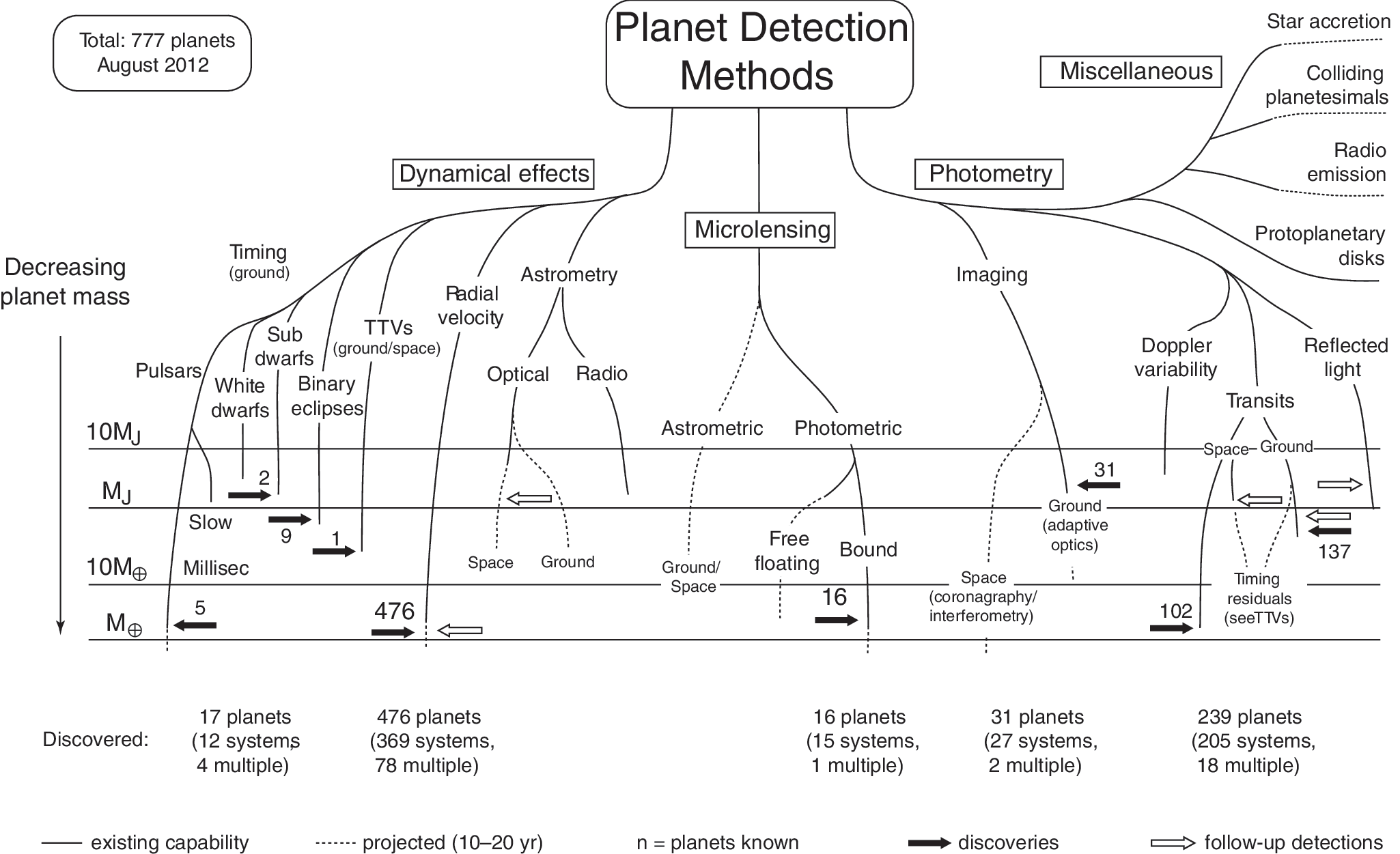
Detection methods for exoplanets. The lower limits of the lines indicate the detectable masses that are in principle within reach of present measurements (solid lines) and those that might be expected within the next 10–20 years (dashed). The (logarithmic) mass scale is shown at left. The miscellaneous signatures to the upper right are less well quantified in mass terms. Solid arrows indicate detections according to approximate mass. Open arrows indicate that relevant measurements of previously detected systems have been made. The figure takes no account of the numbers of planets that may ultimately be detectable by each method, and presents the status as of August 2012.
A more complete listing is given in Table 1.1 of Perryman (2011).
1.2. Definition
In 2006 the International Astronomical Union (IAU) classified Solar System bodies into three distinct categories: planets, dwarf planets, and small Solar System bodies. Their classification excluded Pluto as a planet for reasons related to object shape and orbital clearing, arguments which admittedly leave the definition of a planet as somewhat ambiguous. Exoplanet classification is facilitated by the fact that a distinction in mass between planets and smaller bodies is not yet relevant, although it is complicated at higher masses due to the difficulty of distinguishing high-mass planets from low-mass brown dwarfs. Very broadly, an IAU 2003 recommendation designates as planets those objects with masses below that of the thermonuclear fusion of deuterium (around 12 Jupiter masses) and that orbit stars or stellar remnants, no matter how they formed.
In practice, attempts to formulate a precise definition of an exoplanet are confronted by a number of difficulties, summarized by Basri and Brown (2006). A definition dispensing with upper and lower mass limits is offered, and further quantified, by Soter (2006): “A planet is an end product of disk accretion around a primary star or substar.”
2. Some History
The following sections describe some of the earlier efforts that were focused on exoplanet detection, organized according to method.
2.1. Radial velocity
This is one of the first methods to have been developed and successfully applied to exoplanet searches, and it is still the most numerically successful. Long-term accuracies of the host star radial motions of a few meters per second are needed: for example, the effect of Jupiter is ∼12.5 m s−1; for Earth, ∼0.09 m s−1.
Nevertheless, there seems to have been only limited early speculation that exoplanets could, even in principle, be detected by using such radial velocity measurements, although in a short qualitative paper, Struve (1952) mentioned the merits of planet searches using radial velocities, transit photometry, and astrometry, stating that “one of the burning questions of astronomy deals with the frequency of planet-like bodies in the Galaxy which belong to stars other than the Sun.”
Accurate wavelength calibration is a prerequisite for reaching high radial velocity accuracy. In the early 1970s, accuracies of around 1 km s−1 were limited by photographic plate technology and by guiding errors at the spectrograph slit which introduced shifts in the stellar spectrum relative to comparison arc lines. Presumably, the fact that observational accuracies were so far from those required for planet detection restricted speculation on this as a practical discovery technique.
Wavelength calibration was significantly improved by the use of telluric (atmospheric) water vapor lines (Griffin, 1973; Griffin and Griffin, 1973; Walker et al., 1973), largely eliminating errors caused by the different optical paths of the stellar beam and the calibration lamp. The use of captive gases to provide a dense and accurate wavelength reference, superimposed on the stellar spectral lines, started with the use of hydrogen fluoride (HF). Although toxic and corrosive, its 3–0 vibration band gave a well-spaced line distribution, with no isotopic confusion, and of similar natural width to those in typical stellar spectra (Campbell and Walker, 1979).
An alternative, iodine (I2), also mononuclidic, was used by Beckers (1976) and Koch and Woehl (1984) for solar observations, and later by Marcy and Butler (1992) for their precision radial velocity program at the Lick Observatory 3-m telescope [a retrospective is given by Beckers (2005)]. It has a strong line absorption coefficient and requires a path length of only a few centimeters. Accuracies improved accordingly, to around 25 m s−1 by the early 1990s and to some 3 m s−1 just a few years later (Butler et al., 1996).
For the most part, the published justifications for these early radial velocity surveys, on a relatively small number of stars, were primarily aimed at characterizing the substellar/brown dwarf mass function by searching for binary companions of main sequence stars with masses below 1 solar mass (Campbell et al., 1988; Marcy and Benitz, 1989; Marcy and Moore, 1989; McMillan et al., 1990; Duquennoy and Mayor, 1991; Tokovinin, 1992). Some were part of programs to establish improved radial velocity standards for the IAU (Latham et al., 1989).
Exoplanet detection appears to have been rarely mentioned as a justification for this work. For example, given the number and quality of the exoplanet discoveries made in the past few years by Keck–HIRES, it is interesting to note that among the first-light science originally foreseen (including quasar absorption lines, beryllium in the early Universe, lithium abundances, and asteroseismology), exoplanet detection and characterization did not figure, even 1 year before the first exoplanet discoveries (Vogt et al., 1994). But it was in the thinking of a very different approach to the problem of measuring accurate stellar radial velocities with absolute accelerometry (Connes 1985a, 1985b), an instrumental approach which has not, however, been intensively pursued to date.
As accuracies improved toward plausible planetary signals of around 10–20 m s−1, existing groups intensified their efforts, and others started new observing programs, leading to the monitoring of many more stars over a number of years.
Presumably, with one eye on the numerous historical claims of exoplanet detections subsequently retracted (see below), and another on the radical nature of such claims, the first radial velocity detections were announced somewhat cautiously, some almost buried within the publication, and only substantively confirmed some years later. Three papers merit explicit attention: Campbell et al. (1988) identified a possible P=2.7 yr, 1.7 M J object around γ Cep, parameters which were subsequently questioned (Walker et al., 1992) but were eventually confirmed by the 1981–2002 study of Hatzes et al. (2003). Soon afterward, Latham et al. (1989) reported a P=84 d, 11 M J companion to HD 114762, which they suggested was a probable brown dwarf. These values were confirmed by Cochran et al. (1991) and further refined by Butler et al. (2006). Finally, Hatzes and Cochran (1993) reported a possible P=558 d, 2.9 M J companion to the K giant HD 62509 (β Gem), parameters again substantially confirmed in the 25-year baseline study by Hatzes et al. (2006). The negative results of Walker et al. (1995) nevertheless contributed to the development of detection “roadmaps” around that time.
The discovery of a very short-period P=4.2 d (a=0.05 AU) 0.47 M J planet surrounding the star 51 Peg was announced by Mayor and Queloz (1995). Although alternative explanations were quickly forthcoming, and the reality of the detection correctly subject to some critical debate [e.g., Gray (1997) argued for an explanation involving stellar pulsations], the discovery was promptly confirmed by the Lick Observatory group, who were also quickly able to report two new planets around stars they had been monitoring: 70 Vir (Marcy and Butler, 1996) and 47 UMa (Butler and Marcy, 1996). The compelling realization that planetary-mass objects existed around main sequence stars marked the start of a substantive and worldwide acceleration in exoplanet research.
In view of the surprisingly close-in orbit of the first radial velocity planet of only P=4 d for 51 Peg, widely considered to have been totally unexpected (e.g., Boss, 1995), it is interesting to read the comments of Struve (1952) half a century before: “It is not unreasonable that a planet might exist at a distance of 0.02 AU…Its period around a star of solar mass would then be about 1 day.” Struve appears to have made this prescient comment through analogy with tight stellar binaries, although in situ planet formation at that separation seems improbable and inward migration had not been invoked as a mechanism to bring planets formed further out in their protoplanetary disk into such close proximity to their host star. Indeed, one of the main reasons that short-period planets were initially missed is that the early exoplanet surveys were aiming for >10-year baselines, assuming that Jupiter analogues would only be found beyond the “snow line.”
2.2. Astrometry
Essentially the oldest branch of astronomy, astrometric measurement errors caused by Earth's atmosphere probably explain the complex residuals attributed to accompanying planets by various workers before (and since) the 1980s.
Of early investigations of the astrometric manifestations of planets, Holmberg (1938) was one of the first. His abstract reads
In the present paper modern trigonometric parallax observations are investigated. It appears that the residuals of these observations are not always distributed at random. Many parallax stars show periodic displacements. These effects probably are to be explained as perturbations caused by invisible companions. Since the amplitudes of the orbital motions are very small, the masses of the companions will generally be very small, too. Thus Proxima Centauri probably has a companion, the mass of which is only some few times larger than the mass of Jupiter. A preliminary investigation gives the result that 25% of the total number of parallax stars may have invisible companions.
Two discoveries of planetlike companions from astrometric measurements of long-term time-series photographic plates were announced in 1943: companions of 10 M J for 70 Oph by Reuyl and Holmberg (1943), and 16 M J for 61 Cyg by Strand (1943). Strand was unequivocal: “The only solution which will satisfy the observed motions gives the remarkably small mass of…16 times that of Jupiter…Thus planetary motion has been found outside the solar system.” The results were interpreted as supporting theories of the origin of the Solar System (Alfven, 1943) and speculations on the frequency of planetary systems (Jeans, 1943). As noted already, Struve (1952) had again simply mentioned the merits of planet searches for which radial velocities, transit photometry, and astrometry were used.
In fact, 70 Oph had been studied, and anomalies in its orbit reported, in various studies over the preceding century. In 1855 Captain W.S. Jacob, at the East India Company's Madras Observatory, reported that orbital anomalies made it “highly probable” that there was a “planetary body” in this system (Jacob, 1855). Subsequently, the American astronomer Thomas Jefferson Jackson See was involved in measuring binary star orbits at the Lowell 24-inch telescope, which had been cited near Mexico City, in the 1890s. In a series of papers (See, 1895, 1896a, 1896b, 1897), he inferred the presence of a dark body in orbit around it. Although See did not explicitly claim the companion to be a planet, he remarked (See, 1895)
Since August 20, when I first announced to you the existence of peculiar anomalies in the motion of the companion of [70 Oph], I have succeeded in showing conclusively that the system is perturbed by an unseen body…I find that the dark body has a period of approximately forty years.
The orbit was criticized by Moulton (1899), who showed it to be unstable. Further details of this controversy, and the unusual career of See, are given by Sherrill (1999). The presence of planets around 61 Cyg and 70 Oph was eventually excluded by Heintz (1978).
Lengthy disputes also surrounded the extensive ground-based observations of Barnard's star, for which two planetary-mass bodies (0.7 and 0.5 M J) with periods of 12 and 20 years, respectively, were proposed (e.g., van de Kamp, 1963, 1982; Gatewood and Eichhorn, 1973; Croswell, 1988), and Lalande 21185 (e.g., Lippincott, 1960; Hershey and Lippincott, 1982; Gatewood et al., 1992; Gatewood, 1996). Early discussions of ground-based optical observations related to planet detection are given by Black and Scargle (1982) and Gatewood (1987).
The “tradition” of false astrometric planet detections has continued with the Palomar survey, STEPS. The instrument's first proposed planet mass detection around the nearby (6 pc) low-mass cool M8 V star, VB 10, was reported by Pravdo and Shaklan (2009), the most recent of the claimed astrometric discoveries. From a simultaneous fit of the astrometry and low-precision radial velocity data, they derived M p∼6.4 M J, P=0.744 yr, a=0.36 AU (62 mas), i=96.°9, and a resulting astrometric signature α∼5 mas. The existence of the planet was weakly supported by 300 ms−1 precision near-infrared radial velocities from Keck II–NIRSPEC (Zapatero Osorio et al., 2009), but such a high-inclination orbit was ruled out by 10 m s−1 near-infrared measurements from VLT–CRIRES (Bean et al., 2010) and probably from independent 200 m s−1 accuracy data (Anglada-Escude et al., 2010).
These results demonstrate the continued difficulty of the astrometric measurements at stake and the problems brought to them by Earth's atmosphere. Nevertheless, even in the 1930s, some scientists understood the issues and made efforts to find exoplanets.
Even today, the predicted astrometric shifts of known exoplanets detected by radial velocity and transit methods are typically well below the 1 milliarcsec state of the art, showing why current astrometric accuracies have limited impact on exoplanet research to date. The situation should soon be transformed by the second-generation ESA astrometry mission Gaia.
In the context of space astrometry, in what must have been among the earliest discussions, Couteau and Pecker (1964) considered both double stars and the search for planetary systems, although exoplanet detection did not figure in the subsequent scientific justification for the resulting Hipparcos space astrometry mission. An astrometric search for Jupiter-like companions to nearby stars for which the Hipparcos data was used was nevertheless suggested by Gliese (1982), again some years before the first exoplanet discoveries.
Dedicated astrometric measurements by the HST Fine Guidance Sensors initially led to some uncertainty about the existence of a companion to Proxima Centauri (Benedict et al., 1993; Golimowski and Schroder, 1998; Schultz et al., 1998; Benedict et al., 1999; Kürster et al., 1999) but have since convincingly tracked the astrometric displacements of host stars due to a number of known planets, with important results on the coplanarity of multiple planets particularly well illustrated in the case of υ And (McArthur et al., 2010).
2.3. Transit photometry
Given a suitable alignment geometry, light from the host star is attenuated by the transit of a planet across its disk, with the effect repeating at the orbital period. The phenomenon is precisely the same as that seen in the transits of Mercury and Venus as observed from Earth.
The probability of observing such a transit for any given star, seen from a random direction and at a random time, is extremely small. The effect being sought is also small: a planet with R∼R J transiting a star of 1R8 results in a drop of the star flux of (ΔF/F)∼1.1×10−2, or around 0.01 mag. For planets of Earth or Mars radius, ΔF∼8.4×10⁻⁵ and 3×10⁻⁵, respectively. Depths of up to 7% might occur for M dwarfs (Haghighipour et al., 2010) and significantly more for planets around white dwarfs (Drake et al., 2010; Agol, 2011; Faedi et al., 2011).
The first exoplanet transit, HD 209458, was observed by Henry et al. (1999, 2000) and independently by Charbonneau et al. (2000). The latter observed two transits, of duration 2.5 hours and a depth of 1.5%, at an interval consistent with the known orbit. It gave the first confirmation that Jupiter-mass planets in close orbits about their host stars have radii and densities comparable to the gas giants of our own Solar System.
Since then, the number of known transiting planets has grown. A few of the brightest have been found in the same way as HD 209458 b, by photometric follow-up of known Doppler planets at times of inferior conjunction as estimated from the spectroscopic orbit (Kane, 2007; Kane et al., 2009). More are now being found with small-aperture, wide-field imaging systems based on commercial optics of modest cost, surveying the entire sky for prominent transits of the brightest stars.
Ground-based searches are able to discover transits with depths up to about (ΔF/F)∼1%, revealing gas-giant planets around stars frequently bright enough for radial-velocity confirmation and mass measurements with 2-m-class telescopes or for study of their atmospheric transmission and emission spectra from space-based observations, notably by HST and Spitzer. Surveys from space (specifically CoRoT and Kepler), beyond the effects of atmospheric seeing and scintillation, are discovering planets with transit depths of a few times 10−4, extending detectable exoplanet masses to below 1 M ⊕, and in some cases allowing their confirmation by the method of “transit timing variations.”
Among the early considerations of this method, Lardner (1858) noted that “Periodical disappearance or total obscuration of stars may arise from transits of the star by its attending planets,” while detection of an exoplanet by measuring the photometric signature of the planetary transit across the face of the star was mentioned by Struve (1952). The possibility was developed by Rosenblatt (1971), who proposed detecting the event's color signature as a result of limb darkening and who considered the effects of stellar noise sources (intrinsic stellar variations, flares, coronal effects, sun spots, etc.) and Earth atmospheric effects (air mass, absorption bands, seeing, and scintillation). Further developments were brought by Borucki and Summers (1984) and Borucki et al. (1985).
Even before the first explicitly claimed exoplanet detected around a main sequence star in 1995, and before the detection of the first transiting planet in 1999, the method was considered as one of the most promising means of detecting planets with masses significantly below that of Jupiter, with the detection of Earth-class (and hence habitable) planets quickly seen as being within its capabilities (Schneider and Chevreton, 1990; Hale and Doyle, 1994; Schneider, 1994, 1996; Heacox, 1996; Janes, 1996; Deeg, 1998; Sartoretti and Schneider, 1999). The first proposal to search for Earth-like transiting planets around M dwarfs was made by Schneider et al. (1990), with the importance of habitability of planetary systems around M dwarfs noted by Ksanfomality (1986). Other photometric methods considered planetary light echoes from flare stares (Bromley, 1992).
2.4. Gravitational microlensing
In General Relativity, the presence of matter (energy density) distorts space-time, and the path of electromagnetic radiation is deflected as a result. Under certain conditions, light rays from a distant background object (the source) are bent by the gravitational potential of a foreground object (the lens) to create images of the source which are distorted (and possibly multiple) and may be highly focused and hence significantly amplified. Its manifestation depends upon the fortuitous alignment of the background source, the intervening lens, and the observer.
By the end of 2011, 13 exoplanets in 12 systems had been discovered through gravitational microlensing, with statistical analyses suggesting that exoplanets are truly ubiquitous throughout the Galaxy (Cassan et al., 2012). The first unambiguous detection of a 4 M J planet with a projected separation of ∼4 AU was reported in 2004, and the discovery of a 5 M ⊕ planet in 2006. With the characterization of a two-planet system somewhat analogous to Jupiter and Saturn in 2008, in which the orbital motion of the outer planet could be detected and measured during the lensing event, these discoveries marked the emergence of the technique as a powerful and independent exoplanet probe over an important region of planetary mass and orbital radius.
The development of exoplanet detection by gravitational lensing has its foundations around the time of the development of the theory of General Relativity almost a century ago. The first observational confirmation of general relativistic light bending, based on the 1919 solar eclipse observed in Brazil, was reported by Dyson et al. (1920). The term “lensing” in the context of light deflection was used, pejoratively, by Lodge (1919), who argued that “it is not permissible to say that the solar gravitational field acts like a lens, for it has no focal length.” The term has nevertheless persisted as a description of the phenomenon.
The possibility that gravitational lensing by a foreground object could result in two distinct images of a background star was first pointed out by Eddington (1920). A qualitative description, and the possibility of a ring-shaped image, were suggested in a short communication by Russian physicist Orest Chwolson (1924) who noted “Whether the case of a fictitious double star actually occurs, I cannot judge.”
The problem was first considered more quantitatively by Einstein (1936) and Link (1936). Einstein's paper starts “Some time ago, R.W. Mandl paid me a visit and asked me to publish the results of a little calculation, which I had made at his request.” Later he comments “Of course, there is no hope of observing this phenomenon directly. First, we shall scarcely ever approach closely enough to such a central line. Second, [the angles] will defy the resolving power of our instruments.” Prescient papers by Zwicky (1937a, 1937b) later argued that “extragalactic nebulae offer a much better chance than stars for the observation of gravitational lens effects.”
After a lapse of almost three decades, the subject was reopened with the independent work of Klimov (1963), Liebes (1964), and Refsdal (1964). Liebes (1964) first considered gravitational lensing as a method to detect planets around other stars, concluding that the primary effect would be to “slightly perturb the lens action of these stars.” He also considered the detectability of unbound planet-sized bodies “floating about the Galaxy,” but also concluded that the “associated pulses would be so weak and infrequent and of such fleeting duration—perhaps a few hours—as to defy detection.”
Walsh et al. (1979) discovered the first case of strong lensing, a double image of the distant quasar Q0957+561. The discovery marked the start of a substantial body of both theoretical and observational work, and more than a hundred multiple images of galaxy-lensed systems are now known. Arc-like images of extended galaxies were first reported by Lynds and Petrosian (1986) and Soucail et al. (1987). Mainly through subsequent HST observations, many examples are now known.
The first incomplete Einstein ring was reported by Hewitt et al. (1988), and a complete example, a little less than 1 arcsec in diameter around the radio source B1938+666, in which both lens and source are galaxies, was imaged in the near-infrared by HST–NICMOS (King et al., 1998). Again, dozens of examples of more-or-less complete Einstein rings are now known, both in the optical, in the near-infrared, and in the radio.
Microlensing studies of Galactic structure, and the associated search for exoplanets, were launched by the work of Paczynski (1986a, 1986b, 1991) and Mao and Paczynski (1991). These first microlensing surveys were, in practice, motivated by the search for evidence of dark matter in galaxy halos probed by quasars (Gott, 1981; Paczynski, 1986b). Even for such “normal” microlensing—that is, before accounting for the still smaller probabilities of detecting planetary perturbations—the alignment required for a detectable brightening is so precise that the chance of substantial microlensing magnification is extremely small. It is of order ∼10−6 for background stars even in the denser directions of the Galactic bulge, nearby Magellanic Clouds, or nearby spiral galaxy M31, even if all the unseen Galactic dark matter were composed of compact macroscopic objects capable of lensing.
Only since 1993, when massive observational programs capable of surveying millions of stars got underway, was photometric microlensing observed by the Expérience de Recherche d'Objets Sombres (EROS, Aubourg et al., 1993), Optical Gravitational Microlensing (OGLE, Udalski et al., 1993), Massive Compact Halo Objects (MACHO, Alcock et al., 1993), Disk Unseen Objects (DUO, Alard, 1996), and Microlensing Observations in Astrophysics (MOA, Muraki et al., 1999) projects. Early reviews of these results were given by Paczynski (1996) and Gould (1996). By using the achromatic nature of the microlensing events to assist distinguishing them from intrinsic source variability, several thousand microlensing events have now been detected in the Galaxy (with some 10% showing binary lens structure), and many individual events and statistical results have been published.
These impressively vast monitoring programs have demonstrated that the excess microlensing seen toward the Large Magellanic Cloud by the MACHO group (Alcock et al., 2000) requires at most 20% of the Galaxy's dark matter in the form of stellar mass objects, while the results of the EROS group (Tisserand et al., 2007) suggest that much of the excess may be caused by stars within the LMC itself.
With the microlensing constraints on dark matter largely resolved, the emphasis of observations over the last decade has focused on the detection of exoplanets.
2.5. Timing
Radio pulsars (rapidly spinning, highly magnetized neutron stars) provide short-period and extremely stable timing signals. Monitoring of their normally highly stable and extremely tiny spin-down rates led to the first convincing exoplanet discovery, around PSR B1257+12 (Wolszczan and Frail, 1992) and later PSR B1620–26 (Backer, 1993; Backer et al., 1993). This led to the realization that planets could exist around stars in their final evolutionary stages, although these objects may have been formed from fallback accretion matter, rather than representing classical planetary objects which have survived the supernova explosion. At the same time, the process cannot be common: only these two planet systems are known from the precision timing of Galactic millisecond pulsars (Lorimer, 2005).
Before the announcement of PSR B1275+12 in 1992, there had been two pulsar-planet false alarms. Evidence for a long-period planet around the slow pulsar PSR B0329+54 (spin period 0.71 s) had been reported by Demianski and Proszynski (1979), based on large second time derivatives of the spin frequency, although alternative explanations were also given. The planetary interpretation was supported by Shabanova (1995), who gave P=16.9 yr, M p>2 M ⊕, e=0.23 and a=7.3 AU. Both groups reported an additional 3-year periodicity in pulse arrival times. The planetary hypothesis was questioned by Konacki et al. (1999) based on further observations, with variations in the timing residuals for this relatively young neutron star attributed to spin irregularities or precession of the pulsar spin axis.
For PSR B1829–10, Bailes et al. (1991) announced a possible 10 M ⊕ companion, which was also subsequently retracted (Lyne and Bailes, 1992).
For the radio quiet pulsar Geminga, Mattox et al. (1998) reported evidence for a companion (a=3.3 AU and M p sin i=1.7 M ⊕) from γ-ray observations, although this may have been an artifact of the spin period.
Other classes of object are now being subject to similar (if somewhat lower accuracy) timing analyses, specifically pulsating stars and eclipsing binaries, with planetary-mass objects discovered around a number of them over the past few years (e.g., Hessman et al., 2011; Qian et al., 2011).
2.6. Direct imaging
2.6.1. Optical wavelengths
Although the most intuitive approach to exoplanet detection, direct imaging remains essentially the most elusive. As noted in the introduction, exoplanets comparable to Solar System planets are billions of times fainter than their host stars and at angular separations from their host star of at most a few arcseconds, a combination that makes direct imaging extraordinarily demanding, especially from the ground. This difficulty appears to have been appreciated by Huygens (1698), who drew attention to the impossibility of directly detecting exoplanets with telescopes of the time.
As a result of major refinements in imaging techniques over the past two decades, including that of active optics, the first planets were imaged from 2004 onward (notably β Pic, Fomalhaut, and HR 8799). Studies of β Pic played a historical role, with its early hints of light variations attributed to planets (Lecavelier des Etangs et al., 1995, 1997; Lagrange et al., 2008) and even comets (Lecavelier des Etangs et al., 1999). Nevertheless, these remain planets around low-mass brown dwarfs or planets very far out from their respective suns. Direct imaging of Earth-like objects (i.e., Earth-mass objects in Earth-like orbits), as targeted by the now-dormant NASA TPF and ESA Darwin interferometry and/or coronagraphy studies, remains some way in the future.
Resolved imaging: resolved imaging of an exoplanet surface, as opposed to simply detecting the planet as a pointlike source, remains but a distant dream. A plausible planet “imager” would, for example, demand 50–100 Life Finder telescopes, themselves post-TPF interferometric concepts, used together in an interferometric array. Woolf (2001) concluded that “the scientific benefit from this monstrously difficult task does not seem commensurate with the difficulty.”
Bender and Stebbins (1996) also undertook a partial design of a separated spacecraft interferometer that could achieve visible light images with 10×10 resolution elements across an Earth-like planet at 10 pc. This called for 15–25 telescopes of 10-m aperture, spread over 200 km baselines. Reaching 100×100 resolution elements would require 150–200 spacecraft distributed over 2000 km baselines and an observation time of 10 years per planet. The effects of planetary rotation on the time variability of the spectral features complicates the imaging task, while more erratic time variability (climatic, cloud coverage, etc.) will further exacerbate any imaging attempts. They noted that the resources identified would dwarf those of the Apollo Program or the Space Station, concluding that it was “difficult to see how such a program could be justified.”
These grand concepts, and our present exoplanet imaging capabilities, again have their roots in various studies made some 30 years ago. Among the early ideas for exoplanet imaging from space, for example, Bonneau et al. (1975) considered Lyot filtering to decrease the brightness of the Airy rings in what was then the Large Space Telescope, while KenKnight (1977) suggested an analogue of phase-contrast microscopy to attenuate scattered light arising from the imperfect figure of a 2-m space telescope. Elliot (1978) proposed a space telescope, in an orbit yielding a stationary lunar occultation of any star lasting 2 hours, that would use the black limb of the Moon as an occulting edge to reduce the background light from the planet's star.
Bracewell (1978) and Bracewell and MacPhie (1979) noted that with Sun/Jupiter temperatures of 6000 K and 128 K, detection of thermal emission in the Rayleigh–Jeans regime longward of ∼20 μm (where the emission from the planet is strongest) would result in a factor of 105 improvement in contrast. They also introduced the principle of nulling interferometry to enhance the planet/star signal. The choice of optimum wavelength region for such imaging studies is not, however, straightforward; for example, although the physical contrast is more favorable in the thermal infrared, the nulling efficiency is better in the visible.
Ideas for improved space missions (Angel et al., 1986; Korechoff et al., 1994) or balloon experiments above altitudes of 30 km (Terrile and Ftaclas, 1997) were subsequently developed. It was shown that multi-element arrays can provide a deep central null with high-resolution fringes that can be used for mapping. These were predicted to yield full constructive interference for a close-in planet even in the presence of a resolved stellar disk or dust cloud (Angel and Woolf, 1996, 1997; Woolf and Angel, 1997). Until their suspension, nulling interferometry remained the baseline for the NASA TPF–I and ESA Darwin studies, although different approaches, such as pupil apodization (Nisenson and Papaliolios, 2001) and pupil densification (Riaud et al., 2002), have been proposed as alternatives.
2.6.2. Radio wavelengths
Imaging, or perhaps astrometric detection, is also a possibility at radio wavelengths, through emission arising from their magnetospheric interaction with their host stellar wind, as observed for the radio-emitting planets in the Solar System. This is analogous to direct optical imaging but facilitated by the absence of significant nonthermal radio emission from the host star.
Even before detection of the first exoplanets, a number of radio searches had been conducted. Yantis et al. (1977) reported a search for Jupiter-like exoplanets for which the Clark Lake Radio Observatory at 26.3 MHz was used, aiming to distinguish planetary bursts from stellar bursts by the presence of a high-frequency cutoff, and possibly modulation associated with planetary rotation. Winglee et al. (1986) used the VLA at 1.4 and 0.33 GHz to search six nearby stars.
Subsequent low-frequency radio surveys, many of which have been applied to exoplanet searches, include the Cambridge 6C (151 MHz, Hales et al., 1993), 7C (151 MHz, Riley et al., 1999) and 8C (38 MHz, Hales et al., 1995) surveys, the Ukrainian UTR–2 (Braude et al., 2006), the VLA Low-Frequency Sky Survey VLSS (74 MHz, Lane et al., 2008) and the Giant Metrewave Radio Telescope GMRT (Ananthakrishnan, 1995). Searches for which very long baseline interferometry was used were reported by Lestrade et al. (1996).
Since the first exoplanet discoveries, radio detections have been attempted numerous times, with various telescopes and at different (mostly low) frequencies. Although there are significant uncertainties in predicting which exoplanets are most likely to be the strongest radio emitters, searches to date have focused on the short-period planets but with more speculative observations of wider orbital separations also being pursued.
In the context of the development of life, and analogous with the situation on Earth, magnetic fields may be important in providing protection from the energetic particles arising from stellar winds, stellar flares, and cosmic rays. Accordingly, the presence of radio emission may be one possible proxy for habitability.
3. A Retrospective
We have witnessed a transformation in exoplanet research, which has evolved from fringe science to mainstream research within a decade. The first discoveries certainly precipitated a changing mindset: among the astronomical community, the search for planets, and their characterization, rapidly became a respectable domain for scientific research, and one equally quickly supported by funding authorities.
For many entering the field now, the fact that exoplanet research was widely perceived as being somewhat suspect less than 20 years ago may seem surprising. But, in a recent perspective on the radial velocity exoplanet searches carried out in the 1970s–1980s, Walker (2008) himself stated “It is quite hard nowadays to realise the atmosphere of scepticism and indifference in the 1980s to proposed searches for extra-solar planets. Some people felt that such an undertaking was not even a legitimate part of astronomy.”
There is a message here for all scientists, and especially for younger scientists setting out on the problematic task of challenging any accepted “wisdom.” It will be an uphill effort to secure the necessary support and funding, but this is how major revolutions in thinking have probably always advanced.
A contemporary parallel linked to this symposium is likely to be SETI research. Within the past year, I applied for funding to pursue a specific, and I believe logical, approach to advance SETI research. My proposal was unsuccessful. There may have been a variety of reasons for its rejection. But, like exoplanet research two decades before, even mentioning SETI may be sufficient grounds for such a proposal to be simply considered as suspect. One difference is that there were various hints that exoplanets should exist (e.g., the infrared excess and circumstellar disk of β Pic and the developing theories of planet formation), although I would still maintain that the established wisdom of the time generally viewed exoplanet research with suspicion.
As I said in my popular account of the Hipparcos project (Perryman, 2010):
Pursued by some with passionate conviction, a research subject viewed by others with disdain, SETI is perhaps a topic roughly where planet detection was in the early 1990s, but with the odds stacked far higher against it. The more so since I happen to believe that, as intelligent life goes, we are quite alone in the unsettling vastness of the Universe. But if a definitive extraterrestrial signal were to be detected tomorrow—admittedly unlikely but which we most certainly cannot exclude—the stampede to join the race can barely be imagined.
Footnotes
Acknowledgments
I thank the two anonymous referees for several suggestions which helped to make this first attempt at surveying the history of exoplanet detection more complete.
Author Disclosure Statement
No competing financial interests exist.
Abbreviations
DUO, Disk Unseen Objects; EROS, Expérience de Recherche d'Objets Sombres; IAU, International Astronomical Union; MACHO, Massive Compact Halo Objects; MOA, Microlensing Observations in Astrophysics; OGLE, Optical Gravitational Microlensing.