




Abstract
Fifty years after serious scientific research began in the field of exobiology, and forty years after serious historical research began on the subject of extraterrestrial life, this paper identifies and examines some of the most important issues in the history, philosophy, and sociology of what is today known as astrobiology. As in the philosophy of science in general, and in the philosophies of particular sciences, critical issues in the philosophy and sociology of astrobiology are both stimulated and illuminated by history. Among those issues are (1) epistemological issues such as the status of astrobiology as a science, the problematic nature of evidence and inference, and the limits of science; (2) metaphysical/scientific issues, including the question of defining the fundamental concepts of life, mind, intelligence, and culture in a universal context; the role of contingency and necessity in the origin of these fundamental phenomena; and whether or not the universe is in some sense fine-tuned for life and perhaps biocentric; (3) societal issues such as the theological, ethical, and worldview impacts of the discovery of microbial or intelligent life; and the question of whether the search for extraterrestrial life should be pursued at all, and with what precautions; and (4) issues related to the sociology of scientific knowledge, including the diverse attitudes and assumptions of different scientific communities and different cultures to the problem of life beyond Earth, the public “will to believe,” and the formation of the discipline of astrobiology. All these overlapping issues are framed by the concept of cosmic evolution—the 13.7 billion year Master Narrative of the Universe—which may result in a physical, biological, or postbiological universe and determine the long-term destiny of humanity. Key Words: Bioastronomy—Astrobiology—Intelligence—Life—SETI. Astrobiology 12, 906–927.
Introduction
M
The cumulative effect of these historical studies, which in many ways constitute only a preliminary reconnaissance, has been to show that the extraterrestrial life debate has a robust history very much connected to science, or “natural philosophy” as it was known prior to the mid-19th century when William Whewell coined the term “scientist.” The belief in, or rejection of, other inhabited worlds was part and parcel of the cosmologies of the ancient Greek atomists, Aristotle, Copernicus, Descartes, and Newton, and a substantial tradition developed based on the ideas of these early thinkers (Dick, 1982). In what historians of science today label the early modern era, Copernicus made Earth a planet, and the planets potential Earths; to what degree they are Earth-like is a theme still playing out today within and beyond our solar system. Descartes with his vortex cosmology believed every star was a Sun surrounded by planets, a Brunonian idea popularized by the French litterateur Bernard le Bovier de Fontenelle in one of the bestselling works of the 17th century (Fontenelle, 1686). Cartesian physics thus graphically carried the subject beyond Earth but was soon replaced by Newtonian physics, which made no immediate pronouncements on the subject from a scientific point of view but provided the foundation for future progress on the development of planetary systems—again a theme that reached fruition only in the last few decades. Newton himself believed the universe was populated, providing an argument from natural theology that kept god in a universe that no longer needed divine assistance in perpetuating planetary motion. A similar pattern of connections to scientific ideas is found in the 19th century, with clear and substantive connections to science, philosophy, and intellectual thought in general, too numerous to mention here but discussed at length in Crowe (1986). The same is true of the 20th century (Dick, 1996, 1998), which finally injected a robust empiricism into the debate, including in situ observations of the planets with the beginning of the Space Age. In a controversy stretching back to the historian Arthur O. Lovejoy (1936), a major historiographic point of contention has been the relative role of philosophical versus more properly scientific components in the debate. As we shall see, however, science and philosophy are inseparable, especially in the form of epistemology and metaphysics.
This progress in historical studies of the debate has not been paralleled by deep philosophical studies. In 1971, about the same time as serious historical studies were beginning, the president of the Eastern Division of the American Philosophical Association drew attention to the need for philosophers to consider the subject (Beck, 1985). Admitting that “our Association is not hospitable to cosmological speculations,” Lewis White Beck remarked that had he not been president, his subject would likely have been rejected by the Program Committee. “There are new sciences like exobiology whose foundations are in need of philosophical scrutiny,” he wrote, but “when the National Academy of Sciences explicitly calls attention to the philosophical dimensions and ramifications of the problem, it seems to me we philosophers should relax our ban on cosmological speculation and think about possible worlds that may actually exist” (Space Science Board, 1962; Beck, 1985). The intervening 40 years, however, have drawn only sporadic interest from a few philosophers (Regis, 1985; Rescher, 1985; Ruse, 1985; Leslie, 1998; Cleland, 2001, 2002; Cleland and Chyba, 2007; Bedau, 2010). This neglect is surprising considering the well-developed field of philosophy of science (Curd and Cover, 1998; Rosenberg, 2000), and doubly so because the philosophy of biology is a well-established field (e.g., Hull, 1974; Mayr, 1988; Ruse, 1989; Hull and Ruse, 2007; Ayala and Arp, 2009), boasting at least three journals and a well-organized international society. It would not seem too large a leap from biology to astrobiology, but even philosophers of biology have yet to make that leap, thus leaving wide open an entire field of study, the efforts of a few scientists notwithstanding (Jakosky, 2000; Grinspoon, 2003; Ćirković, 2012).
In what follows we use the term “astrobiology” in the sense first developed in the late 1990s in the Astrobiology Roadmap and subsequent versions (Des Marais et al., 2008), to include the past, present, and future of life, embracing elements of planetary science, planetary systems science, origins of life, and SETI, the Search for Extraterrestrial Intelligence (Fig. 1). (Although SETI is not a programmatic part of astrobiology, the NASA program having been terminated by Congress in 1993, it is certainly an intellectual part and so is discussed in this paper.) Earlier uses of the term “astrobiology” were sporadic (Lafleur, 1941; Struve, 1955; Wilson, 1958; Strughold, 1959), and when the study of life beyond Earth began as a serious endeavor with the dawn of the Space Age, the term “exobiology” (Lederberg, 1960), still in use today both as a NASA program and a field of study, denoted a much narrower field substantially limited largely to origins of life studies, especially in the laboratory. This was mostly a matter of operational capabilities at NASA at the time, and the development of the broader field of astrobiology more than three decades later was also a matter of organizational and intellectual currents within NASA (Dick and Strick, 2004). Thanks to the NASA Astrobiology Institute (Blumberg, 2003) and independent efforts in other countries (Committee on the Origins and Evolution of Life, 2003), astrobiology is now a flourishing endeavor, even if one may still argue whether it is, or should be, a true discipline (Dick, 1996; Strick, 2004). The term “bioastronomy,” while little used at funding agencies like NASA, is the name given to one of the Commissions of the International Astronomical Union and is favored by many astronomers, who see their subject as a branch of astronomy rather than biology. This is an interesting example of different perspectives by different scientific communities, not surprising since the commission is dominated by astronomers interested in planetary systems rather than biologists interested in origins of life. Even so, meetings organized by astrobiologists and bioastronomers alike draw substantial numbers of both biologists and astronomers as well as those from the other natural sciences and a few from the social sciences, all of whom patiently struggle to understand each other in their common interest of shedding light on one of the most profound issues in the history of science.
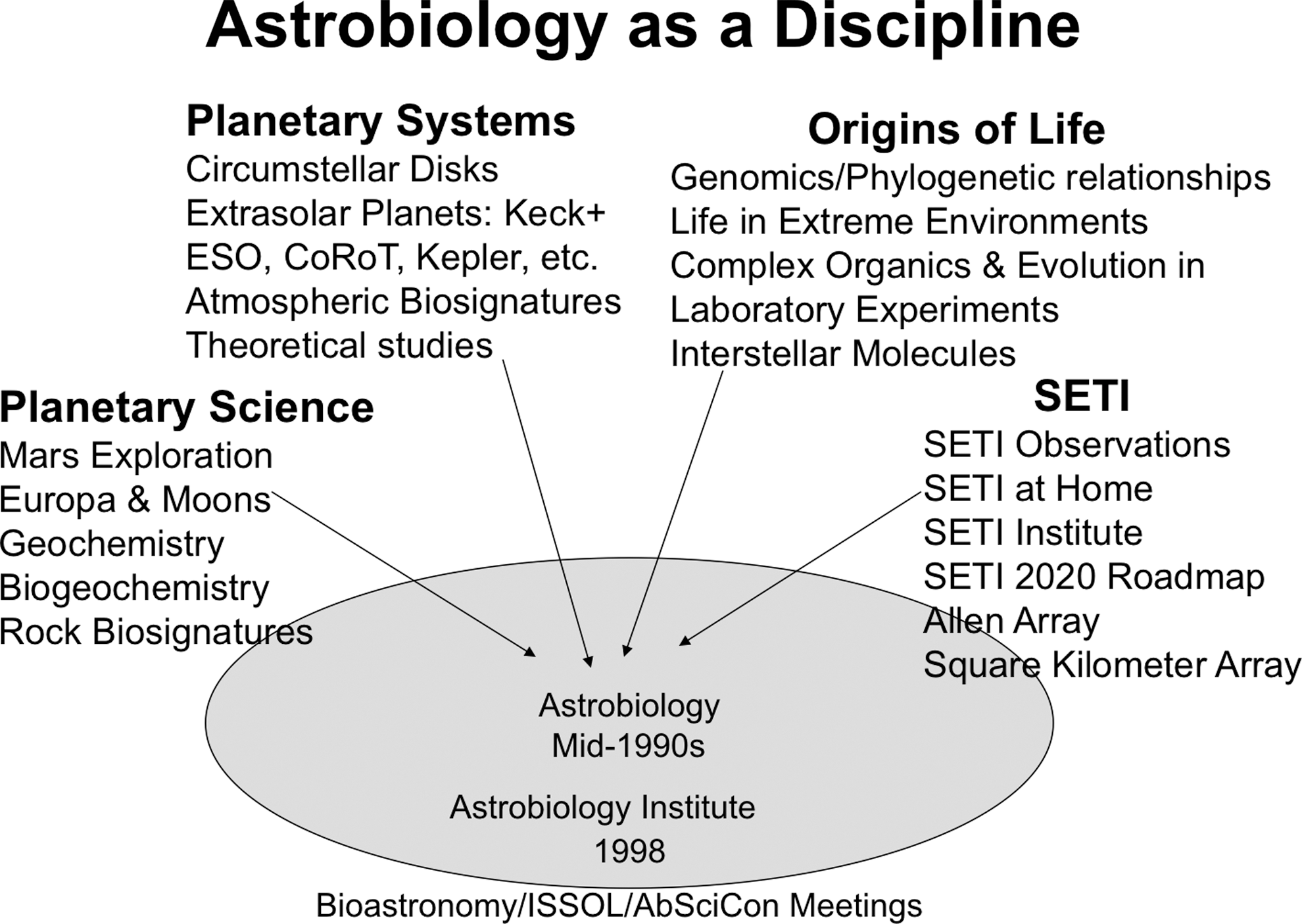
Astrobiology as a discipline. Astrobiology as it developed in the mid-1990s at NASA was much broader than exobiology as practiced over the previous 50 years. In addition to origins of life studies, astrobiology embraced planetary science and planetary systems science. While SETI was not a programmatic element of astrobiology at NASA, it remains a central intellectual element of the field. Whether astrobiology is, or should be, a separate discipline is open to discussion.
As in similar efforts in other areas (Claggett, 1957; Dick and Launius, 2006), “critical issues” as defined here represent a limited number of problematic issues in the field of astrobiology and differ in character from the much larger domain of “historical themes” that have been, and could be, elaborated in historical studies of the debate. Here we combine history, philosophy, and sociology to engage in a deeper study than any of them alone could achieve. As in the philosophy of science in general, and in the philosophies of particular sciences, critical issues in the philosophy of astrobiology are best illuminated by history. Here we lay out a historically informed philosophy of astrobiology, drawing on the philosophy of biology and other sciences and informed by real-world issues, rather than the esoteric approach philosophers are sometimes accused of employing. We proceed under four main headings: epistemology, metaphysics, astrobiology and society, and sociology of scientific knowledge.
Epistemological Issues
Epistemology is the theory of knowledge, including its nature, extent, and justification; its practitioners undertake to determine “the standards to which genuine knowledge should conform” (Harré, 1971). Empiricism, the idea that experience and observation justify knowledge, emerged substantially with the Scientific Revolution of the 17th century; was analyzed by philosophers such as John Locke, George Berkeley, and David Hume in the 18th century; and served as the undisputed epistemology of science through much of the 20th century, supplemented by advances in logic, probability theory, and statistical inference (Rosenberg, 2000). Thomas Kuhn's work on scientific revolutions (Kuhn, 1962, 1977) introduced into epistemology aspects of psychology, sociology, and history, and led some to question the objectivity of science, with overzealous Kuhnians carrying his ideas to postmodern relativist extremes that Kuhn himself decried. But Kuhn did raise fundamental questions about the status of scientific knowledge, questions strikingly relevant to astrobiology in many ways. If it is the job of the epistemologist “to show how knowledge can be distinguished from true belief, and certainty from probability” (Harré, 1971, p 5), the extraterrestrial life debate is fertile ground for epistemologists, especially where extraterrestrial intelligence is concerned. I will discuss two issues under epistemology: the status of astrobiology as a science, and the problematic nature of evidence and inference, reserving for the next section the question of objective knowledge in an extraterrestrial context.
Just as the status of the extraterrestrial life debate as a valid subject for historical research was questioned 40 years ago, its status as a science—and before that as a part of natural philosophy—was also questioned, most notably by scientists themselves. This skepticism extends to the period 50 years ago when exobiology was born. In 1964 the evolutionary biologist George Gaylord Simpson, pointing to the long history of the debate, wrote that “There is even increasing recognition of a new science of extraterrestrial life, sometimes called exobiology—a curious development in view of the fact that this ‘science’ has yet to demonstrate that its subject matter exists!” Simpson noted that this supposed new science was very expensive and called exobiology “a gamble at the most adverse odds in history,” resembling “more a wild spree more than a sober scientific program” (Simpson, 1964). Simpson concluded with a plea “that we invest just a bit more of our money and manpower, say one-tenth of that now being gambled on the expanding space program,” on studying the systematic and evolution of earthly organisms—that is to say, his own field! An interesting case of the rhetoric of science (Gross, 2006), clearly Simpson had an ulterior motive in declaring that exobiology was not a science. But with Isaac Asimov's article in the New York Times Magazine the following year entitled “A Science in Search of a Subject” (Asimov, 1965), the phrase was too good to ignore as a kind of mindless meme deployed innumerable times in the following decades, despite the article's positive assessment of exobiology (Strick, 2004).
Even a minimal consideration of this idea suffices to show it is a misrepresentation of science, even if admittedly a catchy phrase. One could say the search for gravitational waves, or the Higgs boson, or planetary systems, are, or were, “sciences without a subject.” But this hardly seems a productive way of approaching the problem. Every science is looking for a subject until it finds it (planetary systems), thinks it may have found it (the Higgs boson), or does not find it (gravitational waves, at least so far). From an epistemological point of view, the methods of astrobiology are as empirical as in any historical science such as astronomy or geology (Jakosky, 2000; Cleland, 2001, 2002), though it is true that astrobiological observations and experiments are often especially difficult, and the inferences more tenuous. Therefore, it is in my view long past time to retire the “science without a subject” meme, and long overdue to study the issue in a more nuanced way. We frame this as
Critical Issue #1: What is the status of astrobiology as a science? How have its problems and methods compared to other sciences in historical context?
Although Simpson criticized the pioneer in the field, Joshua Lederberg, by claiming that exobiology was not strictly biology because its techniques differed (Wolfe, 2002), certainly astrobiologists today would be surprised to learn they are not doing science; from their point of view their endeavors constitute not only science but cutting-edge science. Related to this issue, but not coextensive with it, is the formation of astrobiology as a discipline (Wells et al., 2007), for it is difficult to admit a scientific discipline as long as it is not considered a science. While more than one practitioner early on heralded astrobiology or its equivalent as a new scientific discipline (Shklovskii, 1965; Billingham, 1981), these claims may have been premature (Dick, 1996, pp 475–478). Moreover, being labeled a discipline may be good or bad in terms of “Balkanization” and isolation from broader parent fields, such as was contemplated, but did not happen, in the case of radio astronomy in relation to astronomy as a whole (Sullivan, 2009, pp 435–438). A historical comparison of discipline formation in other fields such as biochemistry (Kohler, 1982), molecular biology (Abir-Am, 1992), and geophysics (Good, 2000) would help illuminate the problem for astrobiology.
This brings us to the second, related, epistemological issue: the problematic nature of evidence and inference. This is true whether dealing with the nearest planets of the solar system, the search for more distant planetary systems, or theories and experiments about the origin and evolution of life. And it is true whether using ground-based telescopes or spacecraft that actually land and undertake in situ observations. It applies equally to the visual, photographic, electronic, photometric, and spectroscopic techniques of astronomy, as well as to the variety of techniques employed in studies of the origin and evolution of life. There is no lack of exemplars. In planetary science the most notorious historical case is the canals of Mars, which cannot simply be chalked up to the imagination of Percival Lowell himself, since many other astronomers claimed to have seen them (Crowe, 1986; Dick, 1996; Strauss, 2001). In the modern era the problematic nature of evidence and inference was on stark display when the Viking spacecraft landed on Mars in 1976 and yielded different interpretations of the experimental results, with one of the Principal Investigators insisting life had been found (Levin and Straat, 1976; DiGregorio et al., 1997). Though a consensus seemed to be reached for several decades that life (indeed even organics) had not been found, the issue was reopened especially after the Phoenix lander discovered perchlorates on Mars in 2008, and it remains open among prominent researchers today (Navarro-González et al., 2010), with Levin more than ever convinced he discovered life on Mars (Levin, private communication 2011). Problems are not confined to remote sensing but are present even when the evidence is in hand and all the analytical techniques available to terrestrial laboratories can be applied to the problem, as in the case of the claims for microfossils in the martian rock ALH84001 (McKay et al., 1996), known with certainty to be from Mars but now believed unlikely to harbor such fossils (Dick and Strick, 2004; Sawyer, 2006). That conclusion also remains very much open for some researchers, including the original investigators. The more recent debate over the possible discovery of arsenic life on Earth, in the sense of arsenate replacing phosphate in the nucleic acids and proteins of the GFAJ-1 Halomonadaceae bacterium, continues the pattern (Wolfe-Simon et al., 2010, 2011).
Problems of evidence and inference are redoubled in the elusive search for planetary systems beyond our own; there is a long history in the 20th century of observational claims for such extrasolar planets, most notoriously in the case of Peter van de Kamp and Barnard's star, announced in 1963 (van de Kamp, 1963; Dick, 1996) (Fig. 2). It would be more than three decades before more definitive claims were made for planets around Sun-like stars, not with van de Kamp's astrometric technique measuring mere microns of stellar perturbations on photographic plates but with the spectacular application of radial velocity techniques measuring a few meters per second variation in stellar line-of-sight motion as a planet tugged on its parent star (Mayor and Queloz, 1995; Marcy and Butler, 1996). This method, too, has its pitfalls, as evidenced by its own occasionally spurious claims as astronomers attempt to separate the signal from the noise. In any case, more than 400 extrasolar planets were known before the launch of the Kepler spacecraft in 2009; that spacecraft has now added more than 1200 additional candidates, using yet another technique, the photometric measurement of the dimming of starlight as a planet transits in front of it.
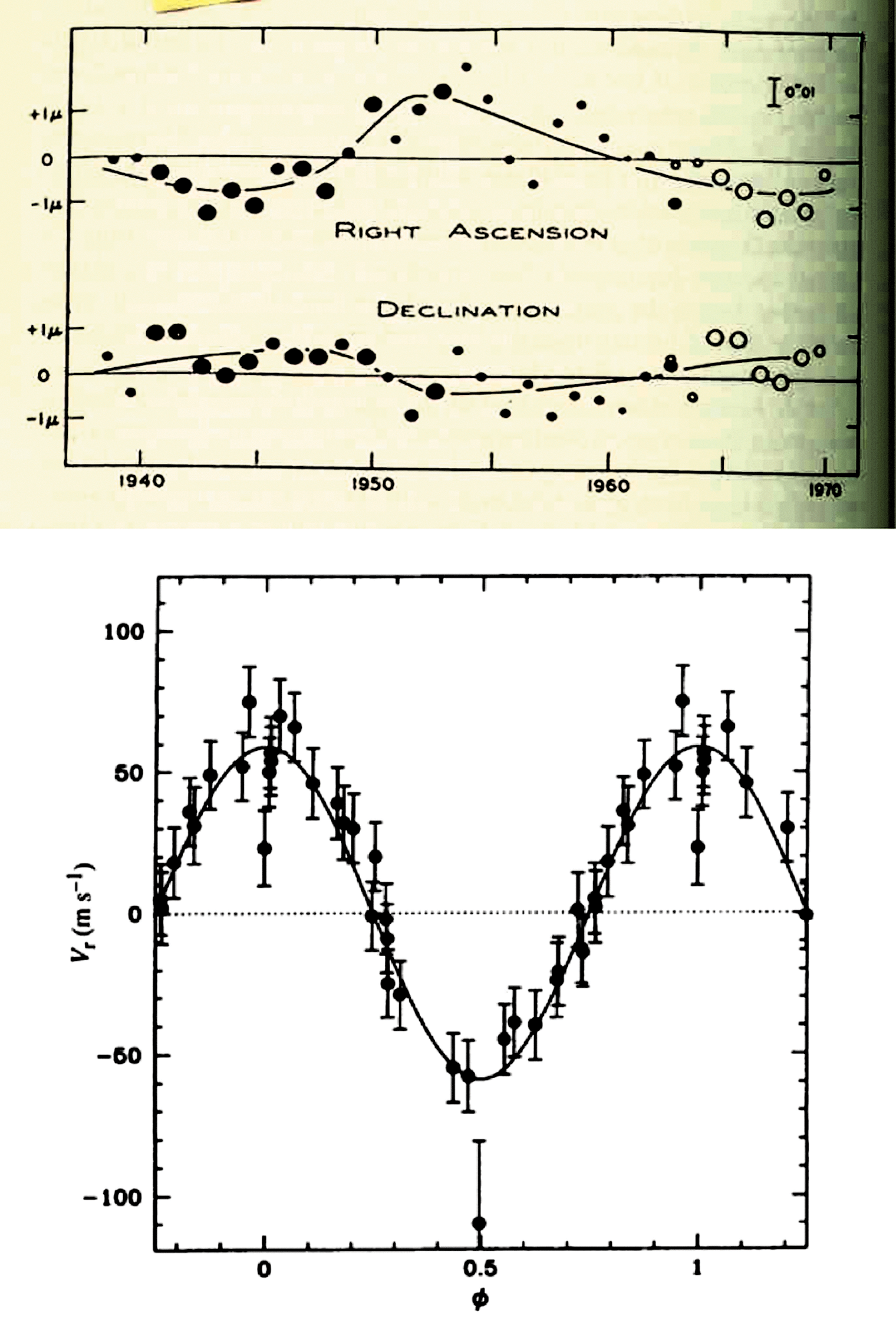
Problematic nature of evidence and inference. (Top) Peter van de Kamp's astrometric evidence for a planet around Barnard's star, 1963. The data plotted represent measurements of the minute gravitational perturbations of the star by the supposed planet, amounting to a few hundredths of an arcsecond over a period of decades. The scale is±one micron as measured on photographic plates taken with a long-focus refractor. This data was proven spurious, but only after several decades. From van de Kamp (1963), reproduced by permission of the American Astronomical Society. (Bottom) Radial velocity variations of the star 51 Peg, interpreted to be caused by the planet 51 Peg b, amounting to±59 m/s. The period is 4.2 days, indicating the planet orbits very close to its parent star. This data was real and marked the beginning of the era of extrasolar planet discoveries around Sun-like stars. From Mayor and Queloz (1995) [Reprinted with permission from Macmillan Publishers, Ltd.]. A previous announcement by Latham et al. (1989) remains controversial. Color images available online at
Thus the vast majority of extrasolar planets are not directly observed but only inferred from their gravitational or photometric effect on their parent star. Fomalhaut b is one notable exception among about a dozen companion planets detected by direct imaging, in this case with the Hubble Space Telescope, and in other cases with the VLT, Keck-Gemini, and a few other instruments (Perryman, 2011, p 168). But even when directly observed there often remains the question of the true planetary mass, as is also the case in the radial velocity method, where only “msin i” is empirically determined, where m is the mass and i is the inclination of the planet's orbit to our line of sight. When the planetary orbit is edge on, the full radial velocity signal is measured; but when it is face on, no radial signal is measured. What is measured is therefore the minimum mass, and because of this issue the first extrasolar planet discovered around a Sun-like star may not have been 51 Peg b in 1995 but HD 114762 b, discovered by Latham and his colleagues in 1989. In that case the minimum mass is 11 times the mass of Jupiter, and a higher mass would make it a brown dwarf substellar object or a low-mass red dwarf star. The authors were equivocal in their conclusions, reflecting the ambiguities of the data, which they stated “leads to the suggestion that the companion is probably a brown dwarf, and may even be a giant planet. However, because the inclination of the orbit to the line of sight is unknown, the mass of the companion may be considerably larger than this lower limit” (Latham et al., 1989). The question of how to separate brown dwarfs from planets at the high-mass end of planets is no less interesting than the problem of how to separate planets from dwarf planets at the low-mass end. The latter gave rise to the infamous Pluto issue (Tyson, 2009; Brown, 2010), a revealing classification problem in the history and philosophy of astronomy, analogous to classification issues prominent in the history of biology (Mayr, 1988). All these issues of observation and inference may also be discussed in relation to the philosophical problem of epistemological realism and antirealism (Kosso, 2006).
The epistemological questions extend also to the nature of the arguments for and against extraterrestrial life. In the case of the martian rock, do four independent but (critics say) weak arguments—from the morphology of the nanostructures, carbonate globules, the presence of magnetite and polycyclic aromatic hydrocarbons—add up to a strong argument for biogenesis? The authors of the discovery paper thought so, ending their paper with the argument “Although there are alternative explanations for each of these phenomena taken individually, when they are considered collectively, particularly in view of their spatial association, we conclude that they are evidence for primitive life on early Mars” (McKay et al., 1996). Critics, including paleobiologist J. William Schopf, thought not, arguing that “spatial association” held no persuasive value at all, and citing Carl Sagan's dictum “extraordinary claims require extraordinary evidence” (Dick and Strick, 2004). In another arena we may question the role of statistical arguments, for example, the epistemological status of the Drake equation, SETI's central icon, in which probabilities are piled on probabilities. Drake himself has repeatedly stated the equation was, and is, merely a heuristic device, created as an agenda at the pioneering Green Bank meeting on interstellar communication in 1961. But others invested it with more meaning, updating the parameters as more data became available, for example, on extrasolar planet frequency, and making it the central icon of cosmic evolution (Dick, 1996). On the reverse side of the coin, just how strong is SETI's supposed nemesis, the Fermi paradox argument (Hart, 1975; Dick, 1996; Webb, 2002), which states that if extraterrestrials exist, given the vast scale of time they should be here—but they are not, therefore they do not exist, therefore why waste money looking? These are not purely academic questions; the U.S. Congress was impressed enough with the Fermi paradox argument to terminate NASA's SETI program in 1993. As a final example, in astrobiology's classical arena, just how relevant are experiments on the origins of life to the problem of extraterrestrial life? The famous Miller-Urey experiment was conducted under supposed primitive Earth conditions; but those conditions may not in fact have prevailed on early Earth, calling into question their relevance not only for other planets but even for Earth. While such experiments may well continue to be relevant (Wills and Bada, 2000), the broader philosophical question is to what extent experiments on Earth can be transferred to conclusions about other planets.
The profusion of questions is no cause for despair. To the contrary, such problems of evidence, inference, and objectivity are not limited to astrobiology but are well known in the history of science (Daston and Galison, 2010). Nevertheless, it is true that astrobiology has remained at the very limits of science in the sense that the required techniques have been barely sufficient to the task, leading to problematic evidence and stretching the normal principles of scientific inference, propelled by public interest in one of the greatest remaining questions in science. All these ruminations may be summarized as
Critical Issue #2: How have observation, evidence, and inference been deployed in arguments in astrobiology, and how does this deployment compare to their use in other sciences?
This remains a rich area for further research and can be further pursued through many avenues, including historical analogues, the philosopher's penchant for logical analysis, and the sociologist's attention to human factors.
Metaphysical/Scientific Issues
While epistemology deals with the theory of knowledge, metaphysics traditionally sought to describe basic entities, including the nature of matter, the existence of god and his attributes, and the existence of the soul. Philosophers were convinced that human reason is capable of getting answers to ontological questions, what exists independently of us. Empiricists, notably Hume, called into question the possibility of knowing what is not based in principle on our experience. Logical positivism at the end of the 19th century and the beginning of the 20th century went further in repudiating metaphysics. But metaphysics and science are logically placed under the same heading here because almost a century ago the American philosopher Edwin Arthur Burtt showed how science and metaphysics were inseparable in the transition from the medieval world to the scientific revolution of the 17th century, when the prevailing conceptions of reality and causality, and the relation of the human mind to nature, were forever transformed (Burtt, 1924; Daston, 1991). Indeed, Burtt insisted such metaphysical changes in these conceptions were the core of the scientific revolution. Today, this close connection between metaphysics and science is widely accepted by philosophers, if not always made explicit in scientific work. Philosophers investigate the most basic concepts in science, including space, time, and cause in physics (Lange, 2006); number, proof, and logic in mathematics (Brown, 1999); and atom, element, and bond in chemistry (Baird et al., 2006). Just as the cosmologist G.F.R. Ellis has recently insisted that philosophical choices necessarily underlie cosmological theory and that unexamined philosophical standpoints are still philosophical standpoints (Ellis, 2006), so it is in astrobiology.
If we apply such questions to the life sciences, it means examining the changes in our core conceptions of life, mind, and intelligence, among other categories such as “species,” and methods such as those used in systematics. For astrobiology it means putting these venerable questions in a cosmic context. The question “What is Life?” is an old one, contemplated by biologists, biochemists, and even physicists (Schrodinger, 1944) over several centuries (Fry, 2000; Tirard et al., 2010). In the most general sense, the overarching theme of vitalism versus mechanism echoes through biological history and was still very much alive at the beginning of the 20th century, influencing not only the origins of life issue but also many other aspects of biology. For mechanists such as T.H. Huxley and E.B. Wilson, who believed life could be reduced to physics and chemistry, the problem was to determine the physical basis of life (Dick, 1996, pp 332–337). The concept of protoplasm as the unit of life held sway until almost the turn of the 20th century, when the rise of colloidal biochemistry and the discovery of viruses turned the focus to smaller entities. Attention turned successively to the protein enzyme, the virus, the gene, and the cell as the unit of life. By 1939 the British biologist Norman W. Pirie, in a widely cited article, reviewed the definitions of life and argued that the terms “life” and “living” were meaningless and that the transition from nonliving to living was like the transition from green to yellow in the spectrum or from acid to alkaline in chemistry (Pirie, 1939).
Today the debate about the origin of life (Shapiro, 1987; Deamer and Fleischaker, 1994; Davies, 1998; Fry, 2000; Bedau and Cleland, 2010) is at the level of the molecular assembly of life. Experiments on Darwinian evolution in the laboratory at the level of nucleic acids were first carried out in the 1960s by Sol Spiegelman and his colleagues at the University of Illinois, using Qβ virus RNA carried through repeated cycles of replication, mutation, and selection (Spiegelman, 1967). Such abiotic “evolution in a test tube” has proven to be an illuminating technique, and by 1994 a committee assembled by NASA defined life as a “self-sustaining chemical system capable of Darwinian evolution,” where Darwinian evolution at the molecular level refers to descent with modification by natural selection in a replicating genetic system such as DNA on Earth (Joyce, 1994). Under this definition a major task has been to identify the origin of the first replicable molecules, with some favoring the “RNA world” (Fig. 3) in which RNA is able to both store information and catalyze reactions, acting as an enzyme (Gilbert, 1986). The “self-sustaining” part of the NASA definition is one of many difficulties remaining, as well as detailed knowledge of the nature of primitive Earth conditions.

The RNA world and transition to the current DNA-RNA-protein world. (Left) In this scenario, RNA synthesized on primordial Earth functioned as both a carrier of information and an enzyme that catalyzed its own replication and the synthesis of proteins. (Center) Proteins previously synthesized with the help of RNA enzymes catalyzed the transition from RNA to DNA. (Right) In life as we know it, protein enzymes catalyze the replication of DNA. They also catalyze the transcription of DNA into RNA and the transcription of messenger RNA into proteins. Reprinted by permission from Fry (2000), p 139.
Other definitions of life are possible, none totally satisfactory, and among the few philosophers who have entered the fray, attention has turned again to the question of whether life can be defined at all. Some philosophers have concluded the answer is no, that all attempts to define life are fundamentally misguided in the absence of a general theory of living systems (Cleland and Chyba, 2007). Scientists are hardly satisfied with this answer, since an operational definition of life is a very practical problem, as in the search for life on Mars; the Viking landers in 1976 embodied implicit ideas about the nature of life as a metabolic process in order to build and undertake the biology experiments. Attempts to define life will therefore continue, whether in terms of Darwinian processes, metabolism, energy and thermodynamics, complexity theory, cybernetics, or some new insight (Benner, 2009, 2010; Bedau, 2010; Deamer, 2010; Tsokolov, 2009, 2010). We thus arrive at a cluster of questions that constitute
Critical Issue #3: What is life when considered in the universal context of astrobiology? How does astrobiology change our core conceptions of life? Is there a general theory of living systems, a universal biology as there is a universal physics? What is the origin of replicating systems, under what conditions will life arise, and what is the role of chance and necessity in the origin of life in the universe? What are the metaphysical assumptions that underlie our concepts of life?
One helpful approach to highlighting how our conceptions of life have been shaped by history and metaphysics is to study not only how they have changed through various periods (Farley, 1977; Kamminga, 1980; Fry, 2000; Wills and Bada, 2000; Strick, 2002, 2010) but also how they have been affected by political and scientific worldviews, such as Oparin's pioneering origins-of-life work in the Soviet Union, which germinated in the midst of the philosophy of dialectical materialism (Graham, 1989). Our changing concepts of the evolution of life can be illuminated further by considering how new perspectives and discoveries such as extremophiles have resulted in a massive rethinking of the categories of classification, as exemplified in the debate over the Five Kingdoms of macrobiology versus the Three Domains of molecular biology (Sapp, 2009; Margulis and Chapman, 2010). The search for “shadow life” on Earth gives an added dimension to the problem (Davies, 2011). But these aspects are only the beginning, for the conditions in the solar system, much less the rest of the universe, give vast scope for natural selection to work its will on the universal scale, broadening even further the scope of what “life” may mean, both inside and outside the carbon-based paradigm (Ward, 2005; Ward and Benner, 2007). It is for this reason that the search for life on Mars has proven so stimulating to the previously Earthbound problem of defining life, and why the search for life on jovian and saturnian moons and exoplanet environments will continue to enrich research in this area in the future.
The role of chance and necessity in the origin of life is at the core of the extraterrestrial life debate. Does life arise wherever conditions are favorable? Or is life a fluke, a chance occurrence or happy accident in which Earth was lucky (Davies, 2007)? The two points of view are classically represented by the French biologist and Nobelist Jacques Monod on the one hand and the Belgian-American biochemist and Nobelist Christian de Duve on the other. In his classic work Chance and Necessity, Monod (1971) argued “the universe was not pregnant with life, nor the biosphere with man. Our number came up in the Monte Carlo game.” Nor was Monod the only one to favor chance; the astronomer Fred Hoyle agreed that the chance of a random shuffling of amino acids producing a workable set of enzymes was miniscule, and went one step further in asserting that life must have been assembled by a “cosmic intelligence,” though not necessarily the supernatural intelligence of Christianity (Hoyle, 1983). De Duve, on the other hand, argued just the opposite, declaring Monod wrong and viewing life as a “cosmic imperative,” while Richard Dawkins argued that “climbing Mt. Improbable” was not impossible (de Duve, 1995; Dawkins, 1997).
This debate, of course, opens an entire range of theological and philosophical issues, with intense public input fueled by vested religious interests. As Fry (2000, 2010) has emphasized, a historical perspective is essential to any discussion of these metaphysical issues. She insists the question involves not only empirical knowledge but also philosophical considerations, but denies the origin of life was a happy accident, a miracle, or a supernatural production as favored by creationists. Rather, she argues that
In agreement with most researchers in the origin-of-life field today, it is my contention that within the realistic confines of space and time of our universe, the emergence of life could not have been the result of chance, nor was it a miracle fostered by a supernatural power. Rather it involved the working of physical and chemical mechanisms responsible for the self-organization of matter into living systems. Such mechanisms, given the appropriate environmental conditions, could have produced similar results elsewhere in the universe. (Fry, 2000)
In other words, she opts for a naturalistic, evolutionary worldview “that denies the separation of living systems and inanimate matter into two unbridgeable categories,” an evolutionary worldview that “provides an implicit guideline for origin-of-life research.” Though many unanswered questions remain, she argues, this is no reason “to forsake the naturalistic worldview for the creationist one.” Indeed even most theologians have given up on the idea of a “God of the gaps,” a supernatural deus ex machina that supplies the answer to anything that remains unexplained, thus explaining nothing. As Fry points out, the historical perspective is required to see the different epistemological status of empirical statements, scientific theory, and philosophical commitment (Fry, 2000, p 212). It follows that history and philosophy should play a leading role in any attempt to define life.
All these questions in the origin-of-life arena are multiplied when it comes to the nature of consciousness, mind, and intelligence, subjects on which Darwin and A.R. Wallace, the co-discoverers of natural selection, parted company (Shermer, 2002a). Our understanding of the relationship among these three concepts, and their relation to the brain, has been problematic throughout history. The mind-body problem, for example, is one of the long-standing issues in philosophy, dating back at least to Cartesian dualism, which most of the general public in the Western world still accept, as well as a few scientists—notably Nobelist John Eccles (Eccles, 1989). The concept of consciousness is clouded by definitional problems, with some ascribing lower consciousness to animals, and the evolution of a higher-order consciousness, perhaps with higher primates, still a subject of great debate (Dennett, 1991). One philosopher quipped that “a newborn is barely conscious, if that; a philosopher is fully conscious—too much so, sometimes” (Ruse, 2006). What is certain is that the concepts of mind and consciousness are increasingly amenable to research by neuroscientists, paleobiologists, anthropologists, and psychologists studying both animals and humans. Today almost without exception, professional experts in philosophy, psychology, cognitive science, neurobiology, and artificial intelligence accept some version of Darwinian materialism, the “astonishing hypothesis” whereby consciousness and intelligence are seen to arise from the workings of the brain, itself a product of natural selection, even if the mechanism is still under dispute (Donald, 1991; Crick, 1994; Parker and McKinney, 1999; Edelman, 2004; Searle, 2004). It is here that even Wallace could not fathom the brain as a product of natural selection, as Darwin insisted, producing perhaps his greatest scientific heresy among many others (Smith and Beccaloni, 2008). Still, in many ways defining “intelligence” remains more problematic than defining “life,” with many different possible approaches undertaken in a very large literature (Sternberg, 2000, 2002). To frame it another way, there is no “general theory of intelligence” or even of human brain function, much less a general theory of intelligence in a cosmic context. Moreover, all the problems of chance and necessity that apply to the origin-of-life debate also apply to the debate over the origin and evolution of intelligence.
Most of the discussion of intelligence has understandably been confined to the origin and evolution of intelligence on Earth. Carl Sagan's Pulitzer Prize–winning book The Dragons of Eden (Sagan, 1977), updated by John Skoyles and Dorion Sagan (2002), was one widely read attempt to synthesize what was known about the evolution of intelligence on Earth, featuring the triune brain consisting of the primal reptilian R-complex, the mammalian limbic system, and the primate neocortex. Mithen (1996) offered a more influential scenario grounded in paleoanthropology, in which a variety of specialized intelligences, which he terms social, technical, and natural history intelligences, were integrated over millions of years, giving rise to a “cognitive fluidity” that allowed for language and a more generalized intelligence leading to tools, religion, art, and the modern mind less than 100,000 years ago (Fig. 4). Other scenarios exist from the point of evolutionary psychology (Barkow et al., 1992; Pinker, 2002), mapping the mind (Hampden-Turner, 1981), climate and brain-cooling (Falk, 2004), the computational metaphor (Turing, 1950), and the memory and pattern analysis employed in the neocortex of the human brain as understood by neurobiology (Hawkins and Blakeslee, 2004), among others. None of these have as yet proven definitive, but all have in common the Darwinian concept that intelligence is a product of cognitive evolution brought about by natural selection acting on the environment. It may be that some combination of these approaches will eventually result in a general theory of intelligence.
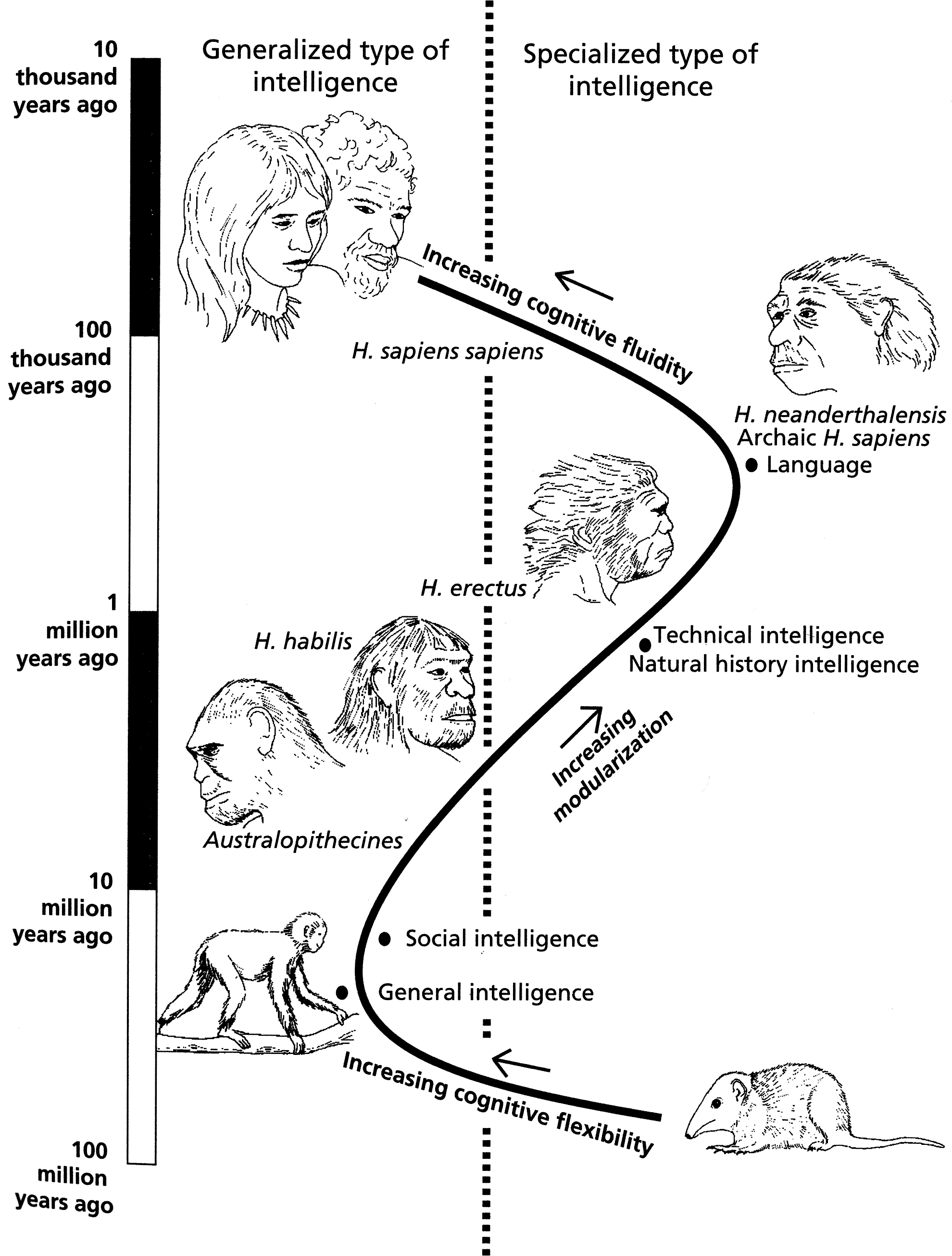
One paleoanthropological scenario for the evolution of intelligence on Earth, in which a variety of specialized intelligences, such as social, technical, and natural history intelligences, were integrated over millions of years, giving rise to a “cognitive fluidity” that allowed for language and a more generalized intelligence leading to tools, religion, art, and the modern mind less than 100,000 years ago. Many other scenarios are possible. Reprinted with permission from Mithen (1996).
How does this research apply in the cosmic context, in other words, to the concerns of astrobiology? As might be predicted, the problems become more complicated, but not intractable. One of Sagan's motivations for writing Dragons of Eden was to gain “hints or insights” into extraterrestrial intelligence; he concluded that
once life has started in a relatively benign environment and billions of years of evolutionary time are available, the expectation of many of us is that intelligent beings would develop. The evolutionary path would, of course, be different from that taken on Earth…But there should be many functionally equivalent pathways to a similar end result. The entire evolutionary record on our planet, particularly the record contained in fossil endocasts, illustrates a progressive tendency toward intelligence. (Sagan, 1977, p 230)
That conclusion embodies many assumptions questioned by others. Evolutionists such as Simpson (1964) and Dobzhansky (1972), for example, had already argued just the opposite; and Harvard evolutionist Ernst Mayr also differed strongly with Sagan, arguing that intelligence (by his definition) had emerged only once on Earth (Mayr, 1985, 1988). Outspoken Harvard evolutionist Stephen Jay Gould agreed with the nonprevalence of humanoid intelligence, arguing in an entire book on the Burgess Shale fossils of the Cambrian explosion that if we “Wind back the tape of life to the early days of the Burgess Shale; let it play again from an identical starting point, and the chance becomes vanishingly small that anything like human intelligence would grace the replay.” (Gould, 1989) By contrast, evolutionary paleobiologist Simon Conway Morris (Conway Morris, 1998, 2003) has argued from the same evidence, and others, that evolutionary convergence applies not only to morphology but also to intelligence, if only the conditions are present. He is, however, skeptical that the proper conditions often obtain, summarizing his position in the subtitle of his 2003 book Life's Solution: Inevitable Humans in a Lonely Universe. In this he reached the same conclusion as had Ward and Brownlee (2000), who argued, Wallace-like, that complex life and thus intelligence in the universe will be rare, not from a lack of convergence but because so many factors must come together in order for it to exist.
Given the number of extrasolar planets now known, admittedly mostly gas giants sprinkled with super-Earths, but with Earths likely still to come, what is obviously needed is more knowledge of conditions on those planets, conditions on which natural selection might act in producing not only life but also intelligence. Work on biosignatures, either in planetary materials or in the atmospheres of extrasolar planets, is a step in this direction (Pilcher, 2003; Des Marais et al., 2008; Ohmoto et al., 2008; Kaltenegger et al., 2010). Lacking this knowledge at present, Bogonovich (2011) emphasized that one way forward in studying the problem of intelligence is to understand the evolution of intelligence on Earth in the most general sense. Indeed, while most research has focused on the evolution of intelligence in hominids on Earth over the last 5–7 million years, for astrobiology the evolution of intelligence in a more general sense is of primary importance. Such research has been undertaken especially on dolphins and other mammals (e.g., Marino, 2002; Reiss, 2011), and some of the results have been sporadically summarized and applied in an extraterrestrial context at astrobiology meetings, particularly in terms of dolphin communication (Reiss, 1988); brain encephalization, a normalized measure of brain size in a variety of animals evolved over the last 500 million years (Marino, 1995; Jerison, 2000); convergent brain evolution on Earth (Falk, 1995); and progressive trends in the history of life (Russell, 1983, 1995). Bogonovich outlines ten hypotheses related to both human intelligence and a broader definition of intelligence in animals, and calls for a research program to determine what might be relevant to the evolution of a more generalized intelligence in the astrobiological context.
One thing seems likely: evolutionary convergence notwithstanding, the specific sequence of events seen on Earth will not reappear on another planet, and natural selection will accordingly affect both morphology and forms of intelligence. Loren Eiseley's famously poetic dictum “In the nature of life and in the principles of evolution we have had our answer. Of men elsewhere, and beyond, there will be none forever” (Eiseley, 1957) may be true in a specific sense. But the jury is still out in the most general sense of whether intelligence is a trait selected for competitive advantage that would lead to its widespread existence in the Cosmos and whether such intelligence once formed would be similar to ours or vastly different in its physical foundation, internal workings, sensory output, and ability to communicate. This cluster of issues may be summarized as
Critical Issue #4: What is intelligence and its relationship to consciousness and mind when considered in the universal context of astrobiology? How does astrobiology change our core conceptions of intelligence? Under what conditions does intelligence develop, and what is the role of chance and necessity in the origin and evolution of intelligence? What are the metaphysical assumptions that underlie our concepts of intelligence? Is it possible that other minds and other intelligences are so different from ours so as to be incommensurable, and thus to preclude communication?
The relationship of consciousness and intelligence to communication again opens a wide field for philosophical and scientific study. The role of human language, for example, was problematized long ago by the philosopher Ludwig Wittgenstein and is widely recognized today as a critical problem in philosophy (Rosenberg, 2000; Coleman and Welty, 2010). Attempts have been made at studying these relationships by using animals, with some concluding that communication among animals is a window into their cognition and consciousness (Griffin, 2001). Reiss (1988) suggested “there may be a convergence or continuity in the communication and cognitive abilities in animals from different evolutionary paths,” and Conway Morris (2003, p 252) cited this idea favorably as fitting in with his work on convergence. But a great deal more research needs to be done before such far-reaching conclusions can be accepted.
In the extraterrestrial realm, the questions run even deeper, for problems of language and communication depend on the possible domains of mental structure. As Dunér has pointed out, a theory of situated cognition holds that the environment has an active role in driving cognitive processes, producing what has been called “the extended mind” (Clark and Chalmers, 1998): “Aliens, developed in and adapted to an entirely different physical and cultural environment would probably have very different modes of thinking. Thinking in the universe could be very different from what we are used to in our westernised, anthropocentric and earthbound human culture” (Dunér, 2011, p 123). Following this line of thinking, in the coarsest sense we may envision three cases when comparing terrestrial and extraterrestrial minds (Fig. 5). In Case 1 our mental structures and modes of perceiving and thinking may overlap entirely, in which case dialogue may be relatively “easy.” In Case 2 they may overlap only partially, yielding some common basis for dialogue. In Case 3 there is no overlap at all, in which case there is no dialogue. But all hope is not lost, for in Case 4 a “dialogue chain” of partially overlapping mental structures may eventually enable dialogue (Billingham, 2000a, 2000b; Dick, 2000a). These Venn diagrams of “mental structures” at the physiological level, or “modes of thinking” at the output level, embody many problems and require more research in many areas before any conclusions can be reached about their effect on communication. Meanwhile, from the point of view of artificial intelligence, Marvin Minsky concluded that communication will be possible because we will think in similar ways (our Case 1 or 2), because “all intelligent problem-solvers are subject to the same ultimate constraints—limitations on space, time and materials” (Minsky, 1985). His arguments, however, apply “only to those stages of mental evolution in which beings are still concerned with surviving, communicating, and expanding their control of the physical world. Beyond that, we may be unable to sympathize with what they come to regard as important,” perhaps leading to our Cases 3 and 4. In any event, contact with extraterrestrials holds open the possibility of solving one of the longest standing epistemological problems of philosophy: the problem of objective knowledge (Popper, 1979). For by comparing knowledge derived from many independently evolved mental structures, what remains would surely constitute objective knowledge on a higher level than fathomable by terrestrial standards alone.
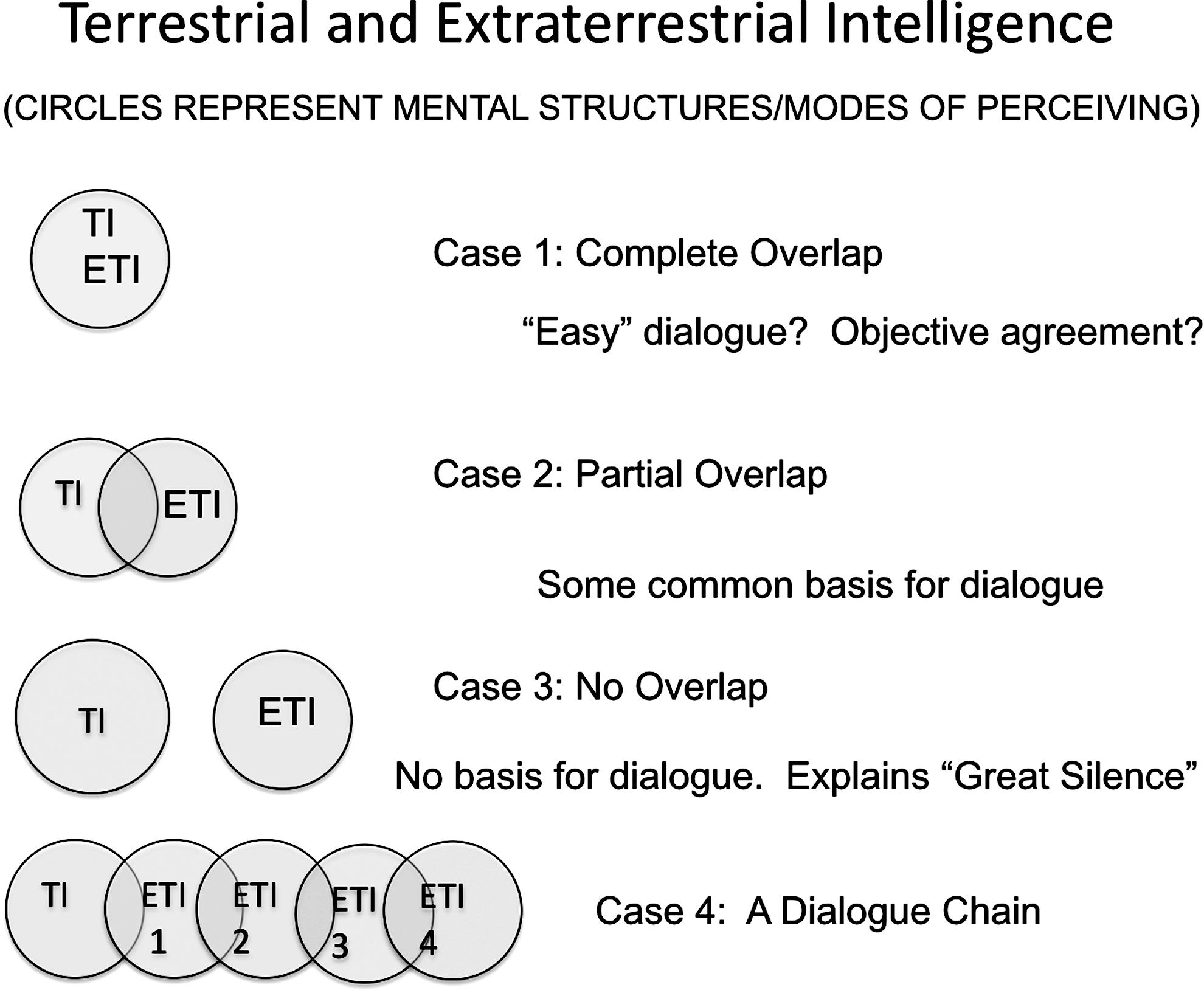
Possible scenarios in the relationship between extraterrestrial intelligence (ETI) and terrestrial intelligence (TI). The Venn diagrams may be taken as mental structure or modes of perceiving and thinking. In Case 1 these overlap entirely, in which case dialogue may be relatively “easy.” In Case 2 they may overlap only partially, yielding some common basis for dialogue. In Case 3 there is no overlap at all, in which case there is no dialogue. In Case 4 a “dialogue chain” of partially overlapping mental structures may eventually enable dialogue.
From an operational point of view, psychologist Douglas Vakoch has pioneered the field of possible methods of encoding communications with extraterrestrial intelligence. Reaching beyond the usual scientific and mathematical approaches, he suggests ways of communicating our altruism, our music, even our aspirations, arguing that if the principles of science are universal, extraterrestrials will already know about science and mathematics, and probably much more if they are more advanced (Vakoch, 1998, 1999). Extraterrestrial historians and anthropologists, however, will be interested in our level of science and mathematics, and Vakoch also recommends communicating our understanding of cosmic evolution in interstellar messages (Vakoch, 2009). His work has inspired others to enter the field of extraterrestrial communications and semiotics (Vakoch and Harrison, 2011).
No critical history of ideas of the origin and evolution of intelligence exists analogous to Fry's detailed and nuanced analysis of issues in the origins-of-life debate (Fry, 2000); this constitutes a fundamental lacuna in the field, all the more so because SETI practitioners typically fail to consider the nature of intelligence in their work. In fact, they skirt the idea by talking about searching for extraterrestrial technology rather than intelligence. As SETI pioneer Jill Tarter puts it,
SETI is a misnomer because there is no known way to detect intelligence directly across interstellar distances. Even on Earth we argue about exactly what constitutes intelligence, and we have no reliable way of measuring it at a distance (either spatial or temporal). In the case of extraterrestrial intelligence, the best we can do is to search for some manifestation of another technology. (Tarter, 2007)
Such technologies could take many forms (Dyson, 1966; Ćirković, 2006), but it is not surprising that for operational purposes radio astronomers search for radio signals, observing the effects of technology, not the intelligence behind the technology. But this begs another question: does intelligence necessarily lead to technology?
The issues surrounding the relationship between intelligence and technology are in reality problems of cultural evolution, a realm in which historians, anthropologists, and other social scientists dominate rather than paleobiologists and neurobiologists (Basalla, 1988). These issues were broached already in an astrobiological context when NASA was forming its SETI program and Nobelist Joshua Lederberg led a two-day “Workshop on Cultural Evolution,” focused more specifically on “evolution of intelligent species and technological civilizations” (Morrison et al., 1977). They are occasionally found in subsequent SETI literature (Harrison et al., 2000; Basalla, 2006; Dick, 2006; Denning, 2011) and most recently were highlighted in an entire volume, Cosmos and Culture: Cultural Evolution in a Cosmic Context (Dick and Lupisella, 2009). Such studies, however, have been hampered by our understanding of cultural evolution on Earth, which can only be described as rudimentary by comparison with our knowledge of astronomical and biological evolution. As with “life” and “intelligence,” the idea of “culture” is difficult to define; nevertheless anthropologists and others have spent a great deal of time attempting to do so. Fifty years ago two anthropologists collapsed 164 distinct definitions of culture into one: “[C]ulture is a product; is historical; includes ideas, pattern, and values; is selective; is learned; is based upon symbols; and is an abstraction from behavior and the products of behavior” (Kroeber and Kluckhohn, 1952). Anthropologist Clifford Geertz defined culture more intuitively as “an historically transmitted pattern of meanings embedded in symbolic forms by means of which men [people] communicate, perpetuate and develop their knowledge about and attitudes toward life” (Geertz, 1973; Kuper, 1999). If, as Harvard biologist E.O. Wilson logically asserted (Wilson, 1998), each society creates culture and is created by it, the idea of “culture” is a moving target, evolving with time and in space. Astrobiology vastly expands that possible cultural space. In the cosmic context, our terrestrial ideas of culture will surely be broadened if we discover cosmic civilizations, in which case the natural history of culture and its theoretical underpinnings will be taken to a new level.
The same holds true for cultural evolution. Social scientists have in general judged as too simplistic Spencerian models of cultural evolution, based on the 19th century work of Herbert Spencer, which view society as evolving through well-defined stages from simple to complex. Darwinian models have proliferated in recent decades but have been highly controversial. Attempts to Darwinize culture include sociobiology (Wilson, 1975), gene-culture co-evolution (Boyd and Richerson, 1985; Richerson and Boyd, 2005), universal Darwinism (Dennett, 1996), and memetics (Blackmore, 1999; Aunger, 2000). All these models have considerable problems, and some social scientists still resist evolutionary models of culture altogether (Lalande and Brown, 2002). A more robust knowledge of the idea of culture, and the mechanisms of cultural evolution, is nevertheless central to the SETI endeavor (Denning, 2009), arguably more central than SETI practitioners realize.
One example will suffice to indicate the power and relevance of cultural evolution to astrobiology. It has recently been argued that the laws of physics may prevent the human brain from increasing its intelligence even over long timescales (Fox, 2011). Long-lived technical civilizations, for whom the improvement of intelligence may be a driving force of cultural evolution (Dick, 2003), may therefore seek to increase intelligence through other means. One scenario is that, given the long timescales in the universe, on the order of billions of years since life has been possible after the creation of heavy elements and rocky planets, cultural evolution may have given rise to artificial intelligence. This is an event that some see as happening in a few generations on Earth (Moravec, 1988, 1999; Kurzweil, 1999, 2005); if so, it might have already happened long ago elsewhere in the universe, perhaps yielding a postbiological universe (Dick, 2003) rather than a biological universe. While this may seem like science fiction, the concept arises and is given force by taking cultural evolution no less seriously than physical and biological evolution in the course of cosmic evolution. Aside from the broader implications of this scenario, a postbiological universe would likely affect the nature of the signal and the methods of communication, important considerations for SETI. On the one hand, as an extrapolation of a contemporary terrestrial theme, the greatest weakness of the postbiological scenario is that it is not bold enough and perhaps a failure of imagination. Other means may exist to advance intelligence rather than through artificial intelligence. On the other hand, all of this presupposes that, when all is said and done, science and technology progress over long timescales, an Enlightenment idea that is itself problematic, even in the terrestrial context (Laudan, 1977; Nisbet, 1980; Billings, 2007; Dark, 2007).
This complex of technology, culture, and cultural evolution form another critical issue, for in order to have technology, culture must arise (though the converse—that every culture must have technology, especially radio communicative technology, is not necessarily true, unless one defines culture by its tool-making capacity). This cluster of issues may be summarized as
Critical Issue #5: What is the relationship among intelligence, technology, and culture? What are the mechanisms in the evolution of culture, and what are the possible outcomes, including postbiological? Are there universal aspects to the evolution of culture? What are the metaphysical assumptions underlying our concepts of culture? And how does the evolution of culture affect methods of communication with extraterrestrial intelligence and ultimately our chances of successful communication?
As with the concepts of life and intelligence, this critical issue is likely to constitute a long and complex research program, with results that are both useful and enriching if cultures are found beyond Earth. Along with the literature on culture and cultural evolution, and the literature on the history of technology, culture in a cosmic context stands to learn much from work in the philosophy of technology, which among other aspects probes the foundational concepts of technology and its relation to culture (Dusek, 2006).
Finally, under the purview of metaphysics we may consider the universe itself—“all that is or ever was or ever will be” (Sagan, 1980)—as a mental and scientific category. One is immediately led in this direction when asking the clearly astrobiological question whether or not the universe is in some sense fine-tuned for life and perhaps even biocentric, implying a link between biology and cosmology. Over the last four decades, some scientists have come to question why the laws of nature and the physical constants appear to be “biofriendly,” giving rise to what has been termed the “anthropic principle.” The principle has many variants, all having to do with the apparent fine-tuning of the physical constants for life (Carter, 1974; Barrow and Tipler, 1986; Carr, 2007). The phrase is a spectacular misnomer, and the term “biocentric principle” is much preferred, since in the context of astrobiology the universe appears to be friendly to life, and the very question to be answered is whether humans are the only intelligent life (Davies, 2007). The prospect of a fine-tuned universe has given rise to the idea of an ensemble of universes, termed a “multiverse,” as an explanation for why we happen to be in a universe particularly suited for life (Carr, 2007). In this case, pace Sagan, the universe would not constitute “all that is or ever was or ever will be.”
Whether or not we invoke the multiverse, the physicist Freeman Dyson has suggested that the prospects are bright for a future-oriented science, joining together in a disciplined fashion the resources of biology and cosmology (Dyson, 1988). In such a “cosmic ecology,” life and intelligence would play a central role in the evolution of the universe, no less than its physical laws. In two provocative books, complexity theorist James Gardner (2003, 2007) evokes a cosmological worldview that places life and intelligence at the center of cosmology, specifically arguing that “the ongoing process of biological and technological emergence, governed by still largely unknown laws of complexity, could function as a von Neumann controller and that a cosmologically extended biosphere could serve as a von Neumann duplicating machine in a conjectured process of cosmological replication.” Gardner speculated that the replication process could occur through the fabrication of baby universes by a highly evolved intelligence, in which case physical laws and constants would serve as a kind of cosmological DNA, providing a recipe for the birth and evolution of intelligent life (Gardner, 2009). In such a “selfish biocosm” scenario, it is logical that the physical laws and constants would be rigged in favor of the emergence of life. Gardner offers three falsifiable tests of his hypothesis: SETI research, artificial life evolution, and the emergence of computer intelligence. His conjectures render relatively tame physicist Lee Smolin's idea of collapsing black holes birthing new universes, which then undergo natural selection based on their ability to reproduce; for unlike Gardner (and Hoyle), Smolin invokes no celestial intelligence (Harrison, 1995; Smolin, 1997, 2007). These speculations lead to
Critical Issue #6: Is there a link between biology and cosmology? Is the universe indeed finely tuned for life? Is the universe in some sense biocentric, and if so, why?
We should hasten to add that some consider the anthropic principle and the idea of the multiverse not to be science (Pagels, 1985; Smolin, 2007), while others consider the arguments to be completely misguided (Stenger, 2011). If the sole epistemological method for science is empiricism, there is some justification for this skepticism, for the anthropic principle is clearly not empirical, at least at this stage and perhaps in principle, and the multiverse by definition can most likely never be observed. In Popperian terms, it is thus unfalsifiable. One might counter that empiricism is no longer the sole criterion for science, which accepts the atom, elementary particles, dark matter, and dark energy as real based on their effects but without actually seeing them. And there are theoretical reasons, from the inflationary theory of Big Bang cosmology to black hole generation, string theory, and the many worlds interpretation of quantum mechanics, to believe that many universes are possible. Still, the multiverse idea is problematic as science, since, unlike atomic theory and dark matter theory, the multiverse has no observable “effect” and may not be confirmed even in principle. As Ellis (2007) put it,
There can be no direct evidence for the existence of other universes in a true multiverse, as there is no possibility of even an indirect causal connection. The universes are completely disjoint and nothing that happens in one can affect what happens in another. Since there can be no direct or indirect evidence for such systems, what weight does the claim for their existence carry?
Ellis concludes that the concept of the multiverse has explanatory power but is a metaphysical concept. From this point of view the multiverse may exist, but we will never know; thus we will never know whether our universe is “all that is or ever was or ever will be.” Others are not so sure that it is completely unfalsifiable (Aguirre, 2007; Page, 2007; Stoeger, 2007), and even Smolin offers his theory of cosmological natural selection of universes as falsifiable in the case the ensemble of universes is not randomly sprinkled in parameter space and has certain other properties (Smolin, 2007). The topic has been discussed now for more than three decades (Dick, 1996, 2008), is being robustly debated by both seasoned scientists and young scholars entering the field (Carr, 2007; Vidal, 2010; Lanza and Berman, 2009; Ćirković, 2012), and shows no signs of disappearing.
It should be clear by now that one of the advantages of the extraterrestrial life debate is that it forces us to think in broader categories than usual about these fundamental issues of life, mind, intelligence, and culture, in other words, to contemplate the metaphysical and epistemological foundations of knowledge. Even if extraterrestrial life is not found, the debate will have been worth it for this fundamental reevaluation alone.
Astrobiology and Society: Ethical and Impact Issues
In the first article of the new journal Astrobiology, published at the opening of the new millennium in 2001, astronomer David Morrison wrote
Astrobiology research has implications that are felt beyond the confines of the laboratory. As our understanding of living systems and the physical universe increases, we will confront the implications of this knowledge in more than just the scientific and technical realms…Together we will explore the ethical and philosophical questions related to the existence of life elsewhere, the potential for cross-contamination between ecosystems on different worlds, and the implications of future long-term planetary habitation and engineering. (Morrison, 2001)
The theme of astrobiology and society covers an enormous area and has recently developed its own roadmap (Race et al., 2012). While too broad to explore here in its entirety, at least two issues may be categorized as explicitly philosophical: the societal impact of the discovery of extraterrestrial life, and the ethical/public policy questions surrounding the search for microbial life and communication with extraterrestrial intelligence. The first of these can be formulated simply as
Critical Issue #7: What are the theological, ethical, philosophical and worldview impacts of the discovery of microbial or intelligent life? What are the most productive approaches to addressing these impacts?
The issue of cultural impacts of astrobiology has received increasing attention since John Billingham, the head of NASA's SETI program at the time, convened a series of workshops on “The Cultural Aspects of SETI” (CASETI) on the eve of the inauguration of the NASA SETI program in 1992 (Dick, 1995; Billingham et al., 1999). During the formulation and initiation of the first Astrobiology Roadmap in 1998, calls were made for the study of cultural impacts of astrobiology (Dick, 2000b), and in 1999 NASA Ames Research Center organized a workshop on societal implications (Harrison and Connell, 2001). Other organizations, including the Templeton Foundation and the Foundation for the Future, organized meetings on the subject at about the same time (Dick, 2000c; Harrison and Dick, 2000; Tough, 2000). Interest has increased in the last decade, notably with the American Association for the Advancement of Science (AAAS) series of workshops sponsored by its program on Dialogue on Science, Ethics and Religion (Bertka, 2010) and several meetings at The Royal Society (Dominik and Zarnecki, 2011). While most of the attention has focused on the impact of the discovery of extraterrestrial intelligence, the AAAS volume also addresses the quite different scenario of the impact of discovery of microbial life. Most recently Race et al. (2012) took the lead in marshalling the astrobiology, social sciences, and humanities communities to address these issues in the context of the latest Astrobiology Roadmap, with the support of the NASA Astrobiology Institute. There have also been individual studies concentrating on different aspects of the problem (White, 1990; Almar, 1995; Davies, 1995; Randolph et al., 1997; Achenbach, 1999; Harrison et al., 2000; Vakoch, 2000; Michaud, 2007; Arnould, 2008), including a comparison to the impact of other scientific endeavors such as biotechnology (Race, 2007). Issues of theological impact have received particular attention, with some concluding that Abrahamic religions with a godhead might be more affected by contact with extraterrestrials than Eastern religions (Dick, 1996, 2000c; Crowe, 1997; Vakoch, 2000; Bertka, 2010).
The results of these studies have been to demonstrate the serious impact that the discovery of extraterrestrial life could have on society, especially in the case of extraterrestrial intelligence. These studies have also demonstrated the number of approaches that might be taken in studying possible impacts of extraterrestrial life. These include the study of historical analogues to the impact of new worldviews, to historical culture contact on Earth, and to the transmission of new ideas among cultures through time. One notable finding is that physical cultural contacts, typically disastrous in the history of Earth, are not good analogues, since contact with extraterrestrial intelligence is unlikely to be physical, science fiction notwithstanding. Rather, those studying the impact of astrobiology on society would do better to concentrate on analogues of the transmission of new ideas, such as the transmission of Greek knowledge to the Latin West by way of Islamic civilization in the 11th and 12th centuries (Dick, 1995; Billingham et al., 1999). The impact of new worldviews such as the Copernican and Darwinian could also yield insights based on history. This is true particularly because the “biological universe” has achieved the status of a worldview, a “biophysical cosmology” that asserts the importance of both the physical and biological components of the universe (Dick, 1989, 1996, 1997). The construction of worldviews and their influence on our thinking is a deep philosophical problem (Vidal, 2007, 2012), and this particular worldview of the biophysical cosmology is increasingly testable; indeed, it is the long-term goal of astrobiology.
Related to this issue of impacts is the question of how philosophy itself would change if we confirm the existence of extraterrestrial intelligence. A historical approach to this question might ask how philosophers viewed the possibility of extraterrestrial life in the context of their philosophy, or conversely how a belief in extraterrestrial life has historically affected philosophy. The first major work of Immanuel Kant, for example, was not his critical philosophy but his Allgemeine Naturgeschicte und Theorie des Himmels [“Universal Natural History and Theory of the Heavens,” 1755], in which extraterrestrials played a central role (Kant, 1981; Shea, 1986). Could this “extraterrestrial perspective” have affected Kant's unusually generalized yet deeply critical philosophy? (Crowe, 1986, pp 54–55). Similar historical questions may be asked of other philosophers who have also tackled the question, especially in the 19th century (Crowe, 1986). A more future-oriented study would ask how venerable philosophical questions such as objective knowledge and the mind-body problem would be expanded by an extraterrestrial perspective.
A second quite different critical issue in the domain of Astrobiology and Society may be formulated as
Critical Issue #8: What are the ethical issues in pursuing the search for extraterrestrial life and communication with extraterrestrial intelligence? How do we balance planetary protection and stewardship with the human exploration imperative, of which astrobiology is a significant part?
Here we come face-to-face with planetary protection issues, which gave birth to exobiology 50 years ago (Dick and Strick, 2004). In part because NASA has for decades had a Planetary Protection Officer, these issues have been at the forefront of both human and space science missions, and the subject of numerous studies and technical conferences (Meltzer, 2011). This is no surprise, for when it came to the search for extraterrestrial life, there was the real possibility that contamination would destroy the very object of the search, or result in ambiguity at the very least. Still, because the details of planetary protection are mission-specific, the problems are far from resolved and will be the subject of more studies in the future. Though historically a source of friction between scientists, engineers, and cost-cutters in the past, the gravity of these issues can hardly be overemphasized, not only because of the real prospect of forward contamination but also because a single “Andromeda Strain” scenario would be enough to jeopardize the terrestrial biosphere through back contamination.
In quite a different arena we come to a real-world issue that has percolated at a low level throughout the extraterrestrial intelligence debate and has recently heated up in the SETI community and the media with Stephen Hawking's pronouncement that messaging to extraterrestrials could be dangerous (BBC News, 2010). In venues such as The Royal Society and the Permanent SETI Committee of the International Academy of Astronautics, this subject has also played a contentious role, with arguments from both sides well represented (Brin, 2011; Zaitsev, 2011). Opponents of messaging argue that history demonstrates “shouting in the jungle” can be dangerous; and protestations that it is too late for action because our military, radio, and TV signals are inexorably spreading among the stars are met by arguments that these signals are unlikely to be decipherable. Others counter that the carrier signal of such information-laden transmissions would be quite enough to reveal our presence, and they point out that in any case directed radar beams mapping the asteroids could be intercepted at interstellar distances and are much stronger in signal strength than any messages sent or contemplated. Questions such as who speaks for Earth, with what message, and toward what end, are likely to be overwhelmed by practicalities such as lack of international enforcement power.
More broadly the question arises “should mankind hide?” from the Cosmos, cowering in fear of what may lie in wait in reaction to any message. This question was raised by the New York Times in the wake of Nobelist Martin Ryle's negative reaction to the first deliberate interstellar radio message, sent in 1974 with the Arecibo telescope to the 300,000 stars of the globular cluster M 13 by Frank Drake and his colleagues (New York Times, 1976; Dick, 1996). It is here that one must weigh the balance between planetary protection writ large and human exploration. Admittedly, human exploration on Earth has not always been a pretty picture, especially with respect to culture contacts. Certainly we would not wish to be treated as we have treated ourselves. But as Nobelist and former Astrobiology Institute Director Baruch Blumberg liked to emphasize in comparing astrobiology to the Lewis and Clark expedition, our exploration imperative is strong and likely unquenchable. Whether extraterrestrials would have learned altruism we cannot know; Hawking and others are skeptical.
Such questions as posed in this section have no easy answers but are properly placed in the ethical domain of philosophy, where they deserve close scrutiny considering the potential consequences for humanity.
Sociology of Scientific Knowledge
A final set of issues, distinguishable from ethical issues or the impact of astrobiology on society, stems from the sociology of scientific knowledge, the study of science as a social activity. Historians and social scientists have called attention to the fact that most astronomers seem to be much more optimistic about the chances of extraterrestrial life, while biologists, especially evolutionary biologists such as George Gaylord Simpson, Ernst Mayr, and Theodosius Dobzhansky, are much more critical (Barrow and Tipler, 1986, pp 132–133; Dick, 1996; Harrison and Connell, 2001). Is this difference to be found in their training, in their different approaches to science, or in the cognitive content of their respective sciences? Others have called attention to the fact that the extraterrestrial life debate has been largely the purview of the Western world, stretching from Leucippus, Democritus, Epicurus, and Aristotle in Greece to Lucretius in the Roman world, entering the Latin West by way of commentaries on Aristotle, and then embarking on its remarkably robust career described in the now standard histories of the debate. Other cultures have had only sporadic interest or no interest at all in the debate through most of history (Schneider, 2010). This leads to
Critical Issue #9: What are the sources of the diverse attitudes and assumptions of different scientific communities to the problem of life beyond Earth? And why is the debate more prominent in some cultures than others?
There is, of course, a great deal of variation of belief among individuals on the subject, although it must be said that, in the Western world at least, the vast majority of people (at least 60%) believe that extraterrestrial life could exist (Bainbridge, 2011). That is a rather astonishing fact and very different from belief in Darwinian evolution in the sense that many people reject the latter despite a large body of evidence, while many people believe in the existence of extraterrestrial life even without strong evidence. Why? Are extraterrestrials any less threatening to core religious beliefs than Darwinian evolution is perceived to be? Is it simply the power of suggestion because of the popularization of extraterrestrials in science fiction and film? Or are alien science fiction and film popular for some deeper reason? Perhaps, as some have suggested, humans are prone to belief in imaginary beings (Planck, 1968). Or, as others have suggested, are extraterrestrials surrogate “deities for atheists” (Shermer, 2002b, 2006; Basalla, 2006)? Or is our search for life the most exciting part of the exploration of space, and in the end a search for ourselves (Jakosky, 2000)? Such musings give rise to
Critical Issue #10: What is the source of the public “will to believe” in extraterrestrial life, at least in the Western world, and how does it compare to other cultures?
These critical issues in the sociology of scientific knowledge are related to a larger question central to the “culture wars” over the last few decades: to what extent are our beliefs socially constructed? Despite the metaphysical foundations of modern science, the epistemology of modern science seems very different from the epistemology of theology, and the epistemic status of the results is therefore very different. But the concept of social construction takes on new meaning in an extraterrestrial context, where mental structures may be very different. One thing is certain: if there are extraterrestrials, and science is socially constructed, it will be revealing to see what their science is like; at least one philosopher concludes it will be nothing like ours (Rescher, 1985). And if their science is different, does that mean their technology is different (Basalla, 2006), and what does that imply for communication (see Issues 4 and 5)?
Cosmic Evolution: The Master Narrative of the Universe
Finally, this reconnaissance would be incomplete without emphasizing that many of the critical issues of astrobiology—the evolution of life, intelligence, and culture—are embedded in the larger process of cosmic evolution, the 13.7 billion year Master Narrative of the Universe (Fig. 6). The concept has its roots in the 18th and 19th centuries but only became widely accepted and a major driver for research programs in the last half of the 20th century (Dick, 2009; Zakariya, 2010). I have argued elsewhere (Dick, 2004) that the outcome of cosmic evolution may result in a physical, biological, or postbiological universe, in other words, a physical universe composed of planets, stars, and galaxies in which life is a fluke; a biological universe full of carbon-based life; or a postbiological universe in which cultural evolution has resulted in a universe full of artificial intelligence. These outcomes determine the long-term destiny of humanity, and because the scope of astrobiology as set down in the Astrobiology Roadmap applies not only to the past and present but also the future, the destiny of humanity falls within the purview of the philosophy of astrobiology.
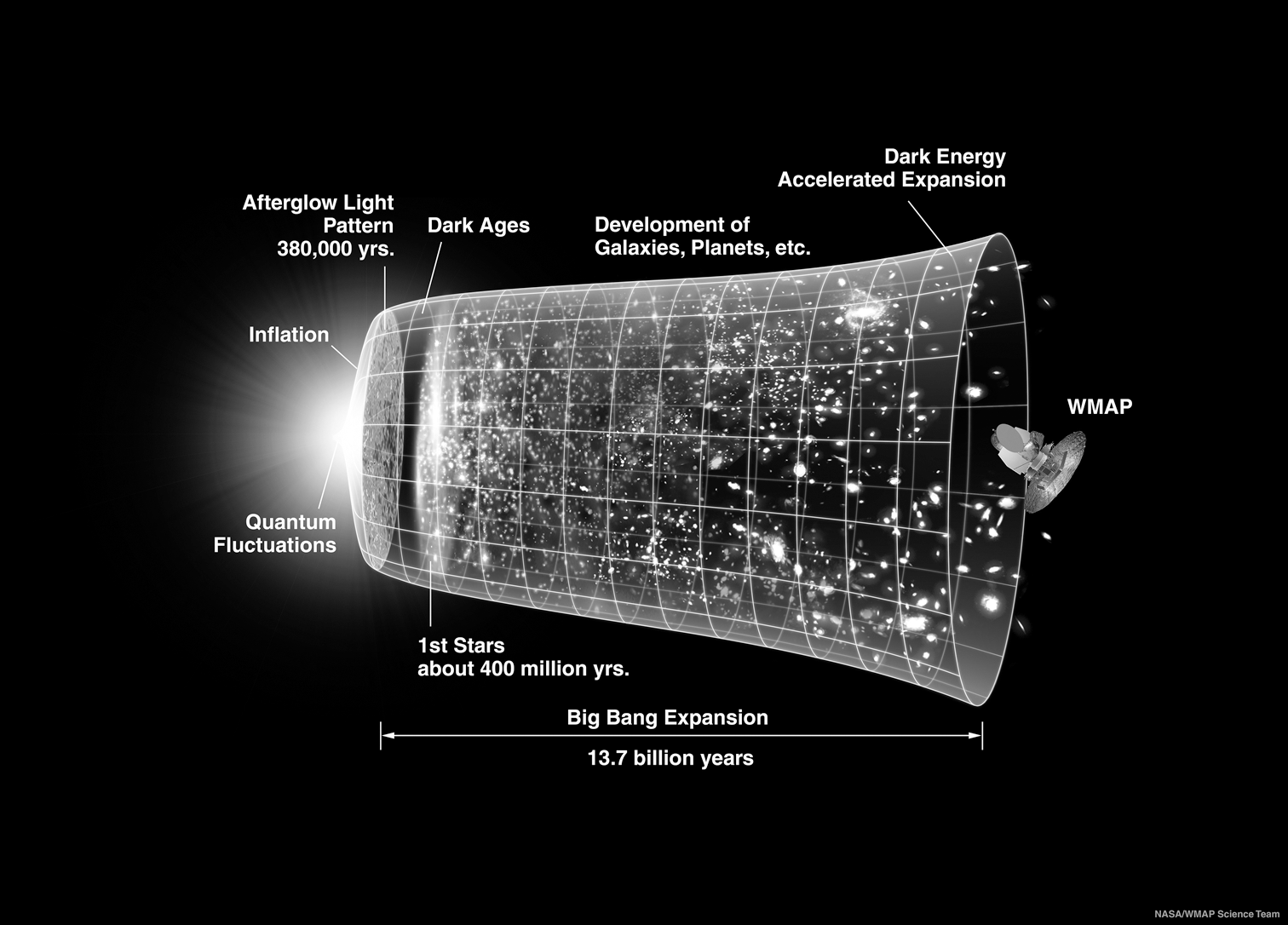
Cosmic evolution: the Master Narrative of the universe is now known to have occurred over the last 13.7 billion years±100 million years. The current model has the universe beginning with the Big Bang, stars forming within the first few hundred million years, followed by the development of galaxies, planets, and life. The COBE and WMAP spacecraft have observed the radiation remnants of the Big Bang some 380,000 years after its occurrence. In the wake of the Big Bang the universe rapidly expanded, slowed down, and is now accelerating driven by the mysterious “dark energy.” Courtesy of NASA/WMAP Science Team.
This expansive view of the universe as an evolving process also has its issues. For example, is physical, biological, and cultural evolution really a continuum, despite very different evolutionary mechanisms? The philosopher Karl Popper held that the problem of the origin of life was “an impenetrable barrier to science and a residue to all attempts to reduce biology to chemistry and physics” (Popper, 1974; Ruse, 2006). That a substantive continuum does in fact exist is what Iris Fry calls the “continuity thesis” in the context of the origin of life and the transition from the physical to the biological (Fry, 1995). But it applies even more to intelligence and culture, where our ideas are even less robust than in the origins of life debate. I frame this issue as the Cosmic Evolution Continuity thesis:
Critical Issue #11: Despite the very different mechanisms of physical, biological, and cultural evolution, can and should cosmic evolution be seen as a single, coherent, scientific, and productive concept?
Astronomer Eric Chaisson has argued in the affirmative, postulating that all these forms of evolution are united by the concept of energy flow, more specifically quantified as the “energy rate density,” the energy rate per unit time per unit mass calculated for a variety of open, organized, non-equilibrium systems (Fig. 7). He finds this concept of an energy rate density to be “a single, measurable, and unambiguous quantity uniformly characterizing Nature's many varied complex systems, potentially dictating their natural selection on vast spatial and temporal scales” (Chaisson, 2001, 2010, 2011).
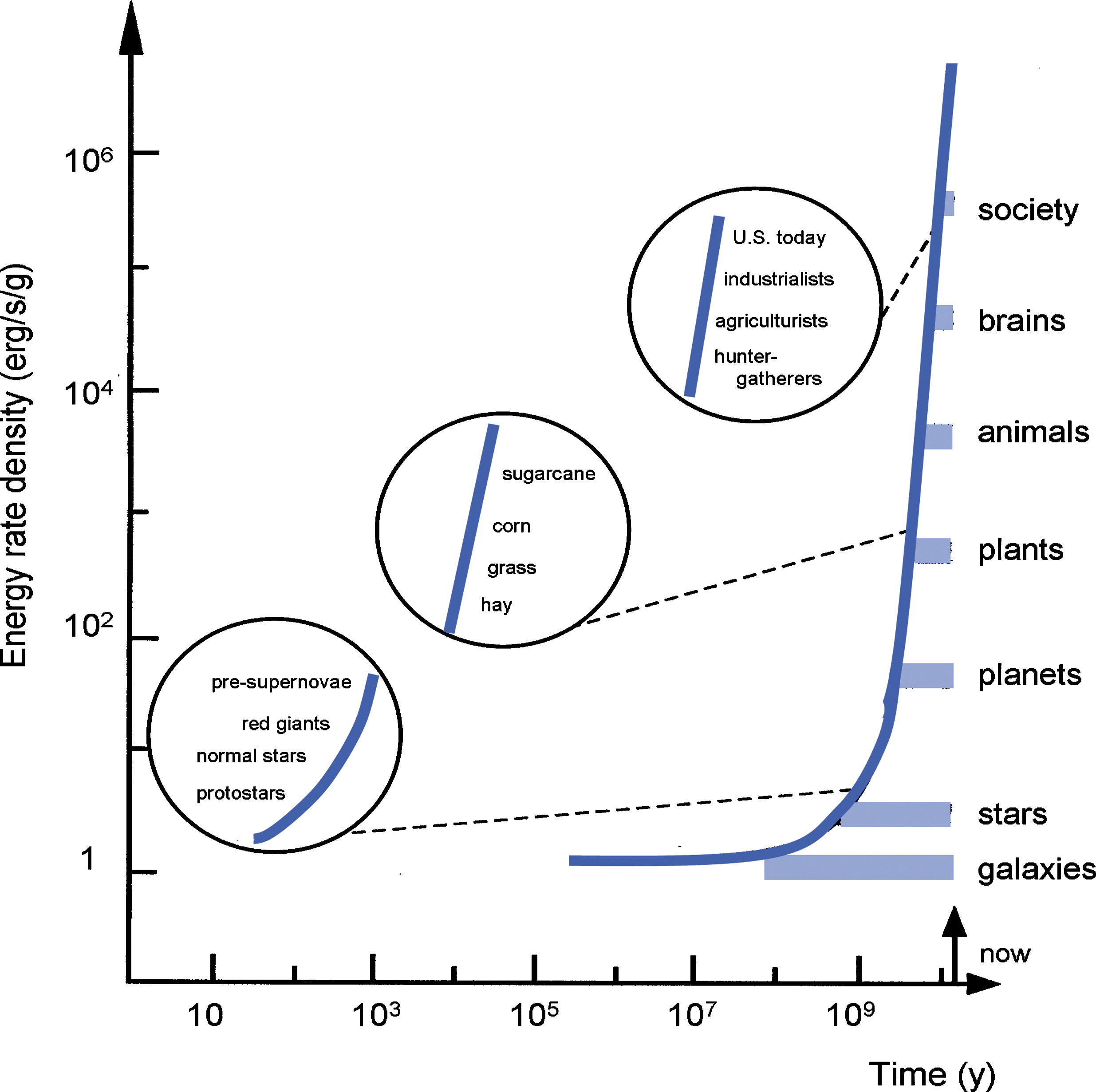
The evolution of complexity and the unification of cosmic evolution. According to the “ cosmic continuity thesis,” all forms of cosmic evolution—physical, biological and cultural—are united, in this formulation by the concept of energy flow, more specifically quantified as the “energy rate density,” the energy rate per unit time per unit mass calculated for a variety of open, organized, non-equilibrium systems. Here the increase in energy rate density is plotted as histograms starting at those times when various open structures dominantly emerged in nature. The increase has been especially rapid in the last billion years. By permission from Chaisson (2009, p 17, Fig. 5). Color images available online at
The questions do not end there. An evolutionary universe need not have a purpose, but inquiring minds want to know: Is the universe “evolving in the direction of greater complexity, consciousness, and culture” (Lupisella, 2009; Vakoch and Harrison, 2011)? If so, is there a teleological goal, as the biocentric principle implies, as Gardner implies when he proposes that the cosmic utility function (the outcome being maximized) is “the propagation of baby universes exhibiting the same life-friendly physical qualities as their parent universes” (Gardner, 2003, 2007), and as Dyson implies when he muses that “As we look out into the universe and identify the many accidents of physics and astronomy that have worked together to our benefit, it almost seems as if the universe must in some sense have known that we were coming” (Dyson, 1979, p 250)?
This leads to a final, science-fiction-like set of questions:
Critical Issue #12: Are cosmic evolution and cosmic natural selection goal-oriented, giving a teleological aspect to the universe? If so, what is the goal? Is cosmic evolution really linear as usually depicted, “merely” the unfolding of cosmic time from 13.7 billion years ago to the present? Or is there some more complex structure, involving the very nature of space-time, the creation of baby universes via black holes, perhaps by way of some cosmic natural selection of universes and their constants, if not by a cosmic natural intelligence?
In the 20th century, philosophers such as Henri Bergson, Alfred North Whitehead, and Teilhard de Chardin proposed philosophical systems infused with teleology (Barrow and Tipler, 1986, pp 123–218). And though teleology has long been anathema to biology and science in general for centuries, philosophers of biology have emphasized that it is far from totally excised (Hull, 1974). Harvard evolutionary biologist Ernst Mayr concluded that “the use of so-called teleological language by biologists is legitimate; it neither implies a rejection of physicochemical explanation nor does it imply noncausal explanation” (Mayr, 1988). But Mayr found that for biology “it is illegitimate to describe evolutionary process or trends as goal-directed,” a conclusion with which most biologists would agree. The question remains whether cosmic evolution can be teleological, as some have suggested (see Issue 6). Although scientists are naturally reluctant to pose teleological questions, which may seem to border on the precepts of the Intelligent Design Movement (Gonzalez and Richards, 2004), there is a critical difference between the supernatural intelligence of religion and natural laws that guide events toward an ultimate goal, or even the actions of a natural intelligence that may be the product of natural selection over very long periods of time. Only natural law and a natural intelligence are within the province of science. Here we come full circle to Critical Issues 1 and 2, for the biocentric principle, the multiverse, and cosmic teleology represent the ultimate in the problematic nature of evidence and inference. If universe, life, and mind are in some deep cosmological sense connected, the subject of Critical Issue 6, human minds naturally want to know the goal and our role in that connection. It seems the stuff of science fiction, but work is being done on the subject.
At a time when it is clear there is a great deal we do not know about the universe at a deep level, it would seem prudent to keep an open mind on the great questions of cosmology and life. As Richard Feynmann, Carl Sagan, and others have emphasized, however, our minds should not be so open that our brains fall out. Or, as Sagan has more eloquently said, “what is called for is an exquisite balance between two conflicting needs: the most skeptical scrutiny of all hypotheses that are served up to us and at the same time a great openness to new ideas” (Sagan, 1987).
The twelve critical issues in astrobiology enunciated here comprise a long-term research program leading in many directions. And—because it encompasses physical, biological, and cultural evolution—it is a research program that must be robustly informed by history, philosophy, and the social sciences, as well as the natural sciences. It should also be informed by the well-developed field of the philosophy of biology and by the philosophy of astronomy, a field that still exists only in embryonic form except for a few promising forays into philosophy of cosmology (Leslie, 1998; Ellis, 2006). In short, as Nobelist Baruch Blumberg never tired of saying, astrobiology counters the usual academic trends by drawing in numerous disciplines rather than compartmentalizing knowledge and increasing specialization. Wide as our scope has been in this overview, we have yet undoubtedly failed to enunciate some critical issues, perhaps even entire categories, and have certainly not exhausted the possibilities even in the issues enumerated here. But perhaps we have provided a framework, enough to glimpse how rich a field the history, philosophy, and sociology of astrobiology can be.
Footnotes
Acknowledgments
This article is dedicated to the memory of Baruch Blumberg, founding Director of the NASA Astrobiology Institute and an inspiration for the breadth and depth of his thinking. I wish to thank Michael Crowe, Gregory Dick, Iris Fry, and Clément Vidal for comments, as well as David Dunér and the organizers of the conference “The History and Philosophy of Astrobiology,” held on Tycho Brahe's island of Hven in September, 2011.