




Abstract
The contributions of Svante Arrhenius, William Thomson, Hermann von Helmholtz, Hermann Richter, and Ferdinand Cohn to the development of the Panspermia theory have extensively been reviewed by Arrhenius himself (1908), Oparin (1938), and Kamminga (1982). Reading the original publications reveals the pivotal role that Charles Darwin must have played in shaping their ideas—an aspect that has not been highlighted before. It is argued that The Origin of Species not only kick-started the scientific development of the Panspermia theory in the 19th century but that biological evolution was an integral building block of it. Key Words: Panspermia—Charles Darwin—Evolution. Astrobiology 12, 946–950.
Introduction
P
Richter's Publications in Schmidt's Jahrbücher
Hermann Eberhard Friedrich Richter (1808–1876) was a physician, working in Dresden as professor at the Medical-Surgical Academy and as director of the affiliated Polyclinic. In 1850 he and Adolf Winter, also a physician, became editors in chief of Schmidt's Jahrbücher der in- und ausländischen gesammten Medizin, an annual book series that covered all aspects of medical science as well as some physics, chemistry, and biology. The name Schmidt's referred to Carl Christian Schmidt, who had started the series in 1834. As if the combination of professor, head of the hospital, and editor of Schmidt's was not enough, Richter established in 1872 the German Association of Physicians and coordinated that association's journal. Schmidt's Jahrbücher contained summary reviews of international scientific papers that had recently been published and was written in Hochdeutsch (standard German), in those days a prominent, internationally understood scientific language. Jahrbücher (yearbooks) is plural, and rightly so, because each year a full quartet of Schmidt's Jahrbücher was published with each tome covering no less than 400 pages. Richter and Winter oversaw this massive project, which included numerous assistants. The Schmidt's series was a Saxonian enterprise: Hermann Richter came from Dresden, his partner Adolf Winter from Leipzig, and publishing and printing were in the hands of Otto Wigand, also from Leipzig. The kingdom of Saxony (Sachsen) became part of the German Empire in 1871.
Richter is known as the author of the first scientific paper about Panspermia (Arrhenius, 1908; Oparin, 1938; Kamminga, 1982). Entitled Zur Darwin'schen Lehre (“About Darwin's Theory”), it was published in Schmidt's Jahrbücher (Richter, 1865) six years after The Origin of Species was issued in London (Darwin, 1859). Richter had waited to write about The Origin until international experts had published their comments and until the first integral German edition became available (Darwin, 1864). Structured as a summary of other people's reviews on The Origin of Species, it was not until the last two pages that Richter unfolded his personal view by stating that Darwin's evolution theory was not complete because it did not explain how life on Earth had begun. Where did that initial, primordial life come from? Richter provided an answer: from space. To corroborate this audacious concept, Richter referred to three scientific ideas that already existed:
(1) Life on Earth has developed from a simple, common ancestor;
(2) Microscopic life can be found in the highest layers of our atmosphere;
(3) Carbon-containing meteorites have hosted living organisms.
The first idea was, of course, taken from The Origin of Species. The second idea was developed by Christian Ehrenberg (1795–1876), a renowned biologist from Berlin (Krumbein, 1995) who had collected evidence that microbes soaring in air currents could travel from Africa to Central Europe, thereby crossing the Alps. The source of the third idea was Camille Flammarion's book La Pluralité des Mondes Habités (The Plurality of Habitable Worlds), which, translated into German, had just been published in Leipzig (Flammarion, 1865, pp 121–122). It was printed by Otto Wigand, who also took care of Schmidt's Jahrbücher. A complementary source may have been Stanislas Cloez (1817–1883), a French chemist who one year earlier investigated the Orgueil meteorite. Cloez detected carbon compounds and concluded that this material was similar to brown coal and peat (Cloez, 1864).
The remarkable feat of Richter was that, by synthesizing the inputs from Darwin, Ehrenberg, and Flammarion he created one grand picture: our common ancestors, consisting of microscopic life, may have arrived on Earth on a meteorite that came from space. Conversely, terrestrial microbes may be removed from our atmosphere by meteoroids or comets passing by, to be deposited on another, uninhabited celestial body to initiate a new biosphere. In 1865 Richter published this theory in Schmidt's. In a later issue of that same journal he briefly referred to it, adding that the orbiting Earth perhaps leaks plumes of air containing dust and microbes from its wake side—another possible way that terrestrial life might end up in space (Richter, 1870, p 60). Richter kept working for Schmidt's Jahrbücher until his death in 1876 and was still alive when other scientists proudly presented ideas very similar to his pioneering hypothesis.
Lectures and Publications by Helmholtz, Thomson, and Cohn
During his lifetime Hermann Richter was undoubtedly a well-known physician and publicist. There is no comparison, however, with the three celebrities that followed in his steps advocating the idea that life could be transported through space: Hermann von Helmholtz (physicist/physician), William Thomson (physicist), and Ferdinand Cohn (biologist). Somewhat younger than Richter (Fig. 1), they were internationally acclaimed leading scientists, employed as professor at the universities of Berlin (Helmholtz), Glasgow (Thomson), and Breslau (Cohn). This trio conveyed their ideas about Panspermia separately, but almost in synchrony, in three now-famous lectures. In each one, the topic of Panspermia was embedded in a much broader, general scientific theme: Helmholtz discussed the origin of planetary systems, Thompson addressed recent advances in natural science, while Cohn spoke about discoveries in bacteriology. Although the timing (Fig. 1) and contents of these lectures suggest they were inspired by Richter, the latter's name was not referred to. It is still unlikely that Helmholtz, Thomson, and Cohn were not aware of Richter's writings, in particular Helmholtz: as physicist-cum-physician from Berlin he must have had ready access to Schmidt's Jahrbücher as a prime source of medical information. Besides, there is a good chance that Richter, through his network that resulted in the German Association of Physicians (see above), was in direct contact with Helmholtz.
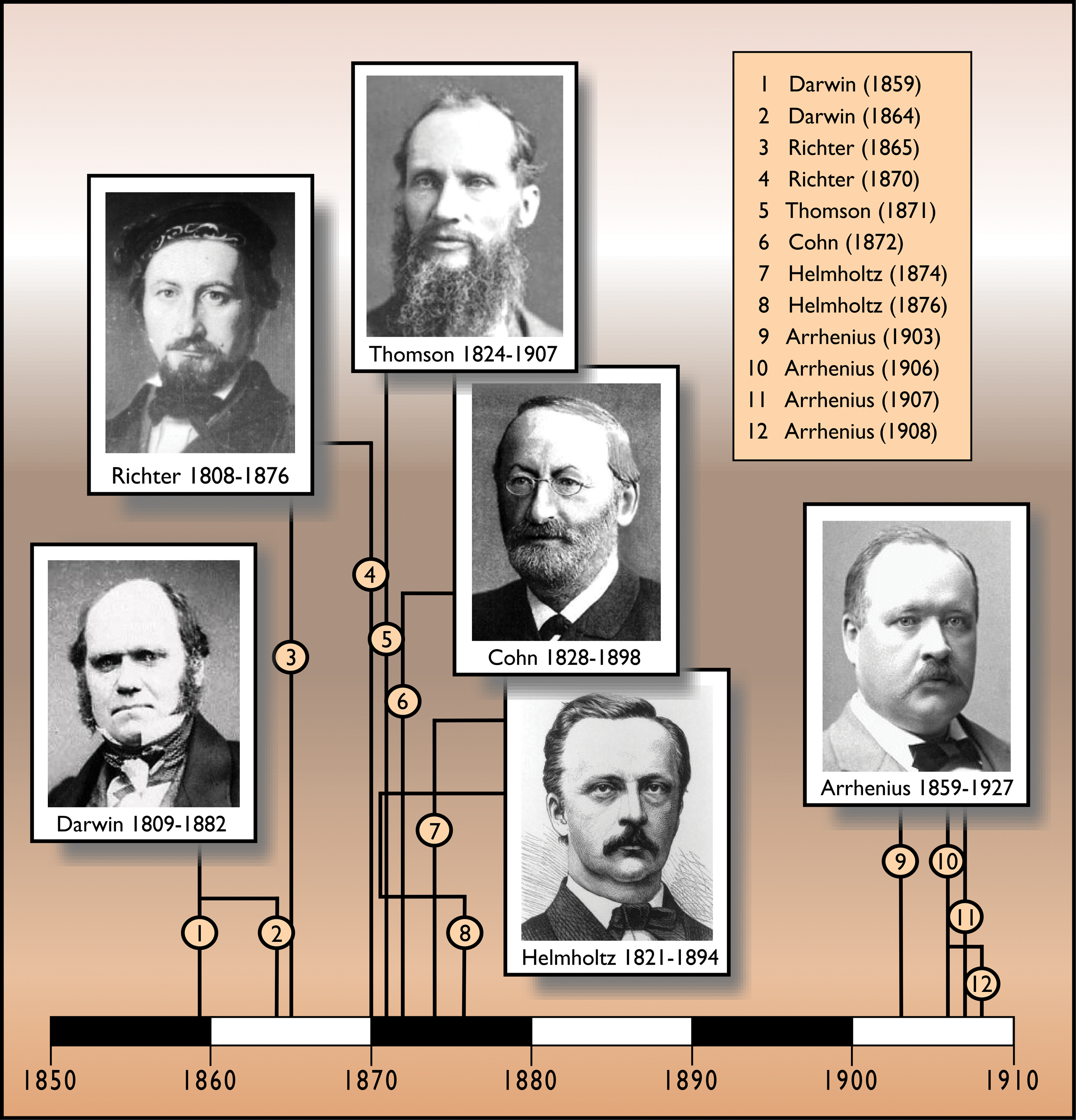
Chronology of publications by Darwin, Richter, Thomson, Cohn, Helmholtz, and Arrhenius. Helmholtz had his lecture from 1871 published in 1876 (number 8). Color images available online at
Hermann von Helmholtz delivered his speech twice in the spring of 1871, in Cologne and Heidelberg. The text was published five years later in a compilation of popular scientific lectures (Helmholtz, 1876). What Helmholtz said was quite similar to what Richter had proposed, and so were the constituting ingredients: meteorites sometimes contain carbon; carbon is a signature for life; meteoroids may contain the seeds of life; such meteoroids could inseminate an uninhabited planet where life can further propagate to develop into a planet-specific biosphere. Absent from Helmholtz's lecture was Richter's speculation about meteoroids picking up microbes from the atmosphere. Not offering an alternative view either, Helmholtz left the question open as to why some meteoroids might contain life.
William Thomson gave his address in Edinburgh on Wednesday 2 August 1871, just a few months after Helmholtz. Thomson and Helmholtz were close colleagues, even friends, who stayed in touch through correspondence and meetings, sometimes on Thomson's yacht (Thompson, 1910, pp 612–617 and pp 938–939). The text of Thomson's lecture was published the very next day in the weekly science journal Nature, which had come into existence two years earlier (Thomson, 1871). In contrast to Helmholtz, Thomson introduced a powerful fresh element in the discussion by stipulating that life-hosting meteoroids could readily emerge if an inhabited planet collides with another celestial body and breaks into pieces. Apart from that, Thomson's perspective deviated little from those of Richter and Helmholtz. In short
It is probable that there are countless seed-bearing meteoritic stones moving about through space…if no life existed upon this earth, one such stone falling upon it might lead to its becoming covered with vegetation…all creatures now living on earth have proceeded by orderly evolution from some such origin. (Thomson, 1871, p 270)
Ferdinand Cohn's lecture was presented in 1872 and appeared in print that same year (Cohn, 1872). Cohn repeated that life on Earth could have started by simple organisms that came from space. To explain how these organisms were imported Cohn offered two different theories. The first one was purely Thomson's, as fully acknowledged by Cohn: the transport vehicle could be a fragment from another planet where life had already begun. Cohn added as a caveat that entry into our atmosphere may have catastrophic effects on survival owing to the friction heat. As a second theory, Cohn proposed that the mass of a single bacterium is so minute that some can possibly escape from a planet's gravitational pull, move out of the atmosphere, wander away in space, to be later attracted and captured by another planet. The subzero temperatures in space would pose no problem because, according to Cohn's own experimental results, bacteria can cope with long-duration exposure to freezing. Cohn's second theory, with microscopic life reaching the top layers of the atmosphere and leaving Earth from there, appears to have been influenced by Richter/Ehrenberg (see above). Note that Cohn had studied biology in Berlin, where Christian Ehrenberg had been his professor.
In 1874 Hermann von Helmholtz recapitulated what he had said in 1871, but this time he also addressed the problems of atmospheric entry (Helmholtz, 1874). More optimistic than Cohn, Helmholtz pointed out that only the outer surface of large meteorites turns hot during entry. The inner part does not. Therefore, life located within the crevices of a meteoritic rock does not necessarily have to perish. In addition, any life present at the outer surface would be blown away by the air stream before the temperature started to rise to hazardous levels. In short, Helmholtz felt that organisms on the inside and outside of a meteoroid both have a chance to survive when crossing the atmosphere. Concerning the reason why such extraterrestrial rocks might host life, two mechanisms were considered by Helmholtz: it could be a fragment of an inhabited planet, or the rock may have captured living organisms when grazing the atmosphere of an inhabited planet. The former concept was Thomson's (acknowledged by Helmholtz) whereas the latter was earlier proposed by Richter (not acknowledged by Helmholtz).
As shown above, the chronology of oral lectures was Helmholtz-Thomson-Cohn, while the sequence changes to Thomson-Cohn-Helmholtz when it comes to publications (Fig.1). Helmholtz therefore stressed on two occasions that he was earlier than Thomson in speaking about life coming from space (Helmholtz, 1874, p XI; Helmholtz, 1876, p 138). Interestingly, Helmholtz (1874) was the Vorrede (Introduction) to a handbook of physics that Helmholtz had translated from English. That British handbook was coauthored by William Thomson.
After 1876 there was for decades no significant development in the scientific thoughts about Panspermia (Fig. 1). The main reason must have been that the search for extraterrestrial life in meteorites did not produce positive results and that the other parts of the proposed theories could not be put to the test.
A Bestseller by Arrhenius
At the beginning of the 20th century the Panspermia theory returned to the spotlight. The promoter was Svante Arrhenius (1859–1927), professor of physics at the University of Stockholm and winner of the Nobel Prize in chemistry in 1903. That same year he wrote an essay in Die Umschau (Arrhenius, 1903), a weekly magazine from Frankfurt-am-Main about science, technology, literature, and art, where he connected the recently demonstrated phenomenon of radiation pressure (Lebedew, 1901) with the existing ideas about Panspermia. Light can provide pressure on an irradiated object and can even push it away as long as the mass of that object is extremely small. Extrapolating this phenomenon to Panspermia, Arrhenius arrived at a novel concept whereby terrestrial microbes, delivered high up in the atmosphere by air currents, would reach a point where light pressure could win against gravitational attraction. From that moment, these microbes would be pushed away from Earth into space heading to a new destination where life could develop further. Following that line of thought, Arrhenius aimed to improve Thomson's proposition (Arrhenius, 1903, p 483), but what he actually did was add more body to Cohn's second theory (see above). Arrhenius met Thomson at least one time, in 1890 in England (Jaffe, 1976, pp 174–175). After his ennoblement in 1892, William Thomson also became known as Lord Kelvin, and that is how he is referred to in Arrhenius (1903). When this paper was published, Thomson alias Kelvin was still alive, surviving Richter, Helmholtz, and Cohn (Fig. 1).
Three years later Arrhenius produced a bestseller in Sweden, a book about the development of the universe (Arrhenius, 1906). An overwhelming success (G. Holmberg, personal communication), it was translated into English and published in London and New York (Arrhenius, 1908). The final chapter, called “The Spreading of Life through the Universe,” was entirely devoted to the Panspermia theory. It offered much more information than the earlier Umschau article and contained a historical overview of the 19th-century contributions made by Richter, Helmholtz, Thomson, and Cohn. In 1907 Arrhenius published a short paper in Scientific American about Panspermia (Arrhenius, 1907), again with the emphasis on pressure exerted by light. Remarkably for a nonbiologist, Arrhenius paid a lot of attention to the survival chances of microbes in transit from one planet to another, exposed for a prolonged period to a combination of desiccation, extreme temperatures, and solar light. This issue was not explored by his predecessors Richter, Helmholtz, and Thomson, and only partly by Cohn. Biological tolerance to extreme environmental conditions is now an important part of astrobiological research, with experiments being conducted on ground and in space (for a recent overview, see Horneck et al., 2010).
Discussion and Conclusions
The very concept that life arrives from the sky is much older than Hermann Richter's 1865 paper in Schmidt's. It started out as a metaphysical idea—in the sense that it was not based on observations, knowledge, or facts—that can be traced back to ancient cultures (Temple, 2007; O'Leary, 2008). Not taken into account was the possibility of a natural transformation from simple to complex life or from homogeneity to diversity. Only after Charles Darwin (and Alfred Russell Wallace) had collected sufficient information to present biological evolution as a powerful scientific theory did it become clear that life on Earth as we know it, in every shape, size, and variety, could in principle have originated from a restricted quantity of simple organisms that were carried from space to Earth a long time ago. Exploration of the idea that all terrestrial life is derived from one common ancestor is part of today's science (Steel and Penny, 2010; Theobald, 2010).
Richter did not explain how life could originate from nonlife; this would have been an alternative way to make Darwin's theory complete. Richter just proposed that existing life from elsewhere could be transferred through space to Earth. As such, it filled a void in scientific thinking that was left in the mid-19th century by Louis Pasteur, whose sterilization experiments debunked the widespread idea that living organisms could spontaneously emerge (for details see Oparin, 1938, and Kamminga, 1982). By shutting the door toward autogeneration of life on Earth, Pasteur facilitated the development of Richter's theory. But there was more: Richter, Thomson, Cohn, Helmholtz, and Arrhenius all believed in the eternity of life (Richter, 1865, pp 248–249; Thomson, 1871, p 269; Cohn, 1872, pp 31–32; Helmholtz, 1876, pp 138–139; Arrhenius, 1908, pp xiii–xiv). Like matter and energy, life had always been an integral part of the universe, and the universe itself was eternal, without a beginning or an end. Accordingly, for the pioneers of Panspermia the origin of life was not a burning issue because in their view there possibly was no such origin. Once our planet had cooled down, it was ready to host extraterrestrial colonists that had been present in the universe since eternity. The first scientific theory to cover the transition from nonlife to life, now called chemical evolution, was developed only decades later by Aleksandr Oparin (1924).
The theory proposed by Richter forked in two directions once Helmholtz, Thomson, Cohn, and Arrhenius entered the stage. One was promoted by Thomson and Helmholtz, whose vision was centered on meteoroids and asteroids as transport vehicles of life. The other direction was embraced by Cohn and Arrhenius, whereby microbes could move through space as lonely travelers without a transport vehicle, possibly propelled by natural forces that acted from a distance. In contrast, Helmholtz, Thomson, Cohn, and Arrhenius never disagreed about the gradual transformation of simple life into a complete flora and fauna, in spite of the fact that Thomson felt that evolution was not governed by natural selection (Thomson, 1871, p 270). Evolution remained a steady and essential component in any of the varieties of the Panspermia theory they came up with, and Darwin was explicitly mentioned and cited in their publications.
The significance of Darwin becomes clear if one tries to imagine what the Panspermia theory would look like if biological evolution is assumed not to exist. In that case, transport of simple life by natural means from one planet to another is still possible, but after delivery the transported life can never adapt itself to develop into a complex biosphere tailored to the new planet. Transfer of life through space without ensuing evolution then becomes futile and irrelevant. Alternatively, if biological evolution is part of the plan, the impact of Panspermia is potentially enormous. It was undoubtedly the latter consideration that made nonbiologists like Richter, Helmholtz, Thomson, and Arrhenius so deeply interested. If Pasteur's conclusions are ever experimentally refuted by de novo synthesis of a simple form of life in the lab, or under natural conditions on Earth or another celestial body, the Panspermia theory would still stand as a valid theory about the distribution of life in the universe. If Darwin's theory is ever proved to be false, if simple life could never evolve into an advanced biosphere, the Panspermia theory as we know it would lose most of its quality. Paradoxically, although Charles Darwin never wrote a word about Panspermia, his contribution must be considered as formidable.
Footnotes
Acknowledgments
This work would have been impossible without Erik van Ginkel and Dawning Fung from the ESTEC library who tirelessly fulfilled even the most difficult document requests.
Author Disclosure Statement
No competing financial interests exist.