




Abstract
Proposals to address present-day global warming through the large-scale application of technology to the climate system, known as geoengineering, raise questions of environmental ethics relevant to the broader issue of planetary engineering. These questions have also arisen in the scientific literature as discussions of how to terraform a planet such as Mars or Venus in order to make it more Earth-like and habitable. Here we draw on insights from terraforming and environmental ethics to develop a two-axis comparative tool for ethical frameworks that considers the intrinsic or instrumental value placed upon organisms, environments, planetary systems, or space. We apply this analysis to the realm of planetary engineering, such as terraforming on Mars or geoengineering on present-day Earth, as well as to questions of planetary protection and space exploration. Key Words: Terraforming—Geoengineering—Environmental ethics—Planetary protection—Space exploration. Astrobiology 12, 985–997.
1. Introduction
T
Historically, ethical frameworks have tended to focus on the human species and the interaction between humans in society. Traditional approaches often follow the philosophical approach of dualism, which applies a criterion such as reason or rationality to identify organisms worthy of moral consideration (e.g., Smith, 2007, 2009). Some ethicists have extended this consideration to organisms that feel pain or pleasure or otherwise show signs of suffering (Bentham, 1789; Singer, 1993), while others have given further moral status to trees (Attfield, 1981) and even nature itself to some degree (Leopold, 1949; Naess, 1973; Taylor, 1986; Callicott, 1986, 1989; Rolston, 1988; Hargrove, 1989). Many of these ethicists stop short of the consideration of microbial life, or they inaccurately characterize microorganisms as a subtype of plants. Nevertheless, the moral status of microbial communities has been discussed in scientific communities concerned with human space exploration because these activities could potentially impact any organisms that might exist on other planetary systems (Lupisella, 1997; Cockell, 2005a). Human activities have the potential to interact with the complete spectrum of life, so it is important to understand how the valuation of nature corresponds to ethical decisions.
In this paper we develop a two-axis system for comparing environmental ethical frameworks. The goal of this system is to provide a visual method for analyzing how different ethical frameworks value organisms, environments, planetary systems, and space. We begin by constructing a spectrum to represent the continuum of life on Earth (and perhaps beyond) that ranges from intelligent beings (such as humans) to the vacuum of space. We then discuss two types of value, intrinsic value and instrumental value, and describe how these different types of value can help us assign moral status to other organisms. These principles allow us to construct a two-axis system we call an “ecological compass” to compare how value changes in different ethical frameworks with respect to various components of nature. We then apply this system to issues of planetary engineering and draw on the ethical insights discussed in the terraforming literature. This in turn can help us examine prospects of geoengineering on present-day Earth as well as future projections of space colonization. Through this process we will show that consideration to all forms of life is relevant to any environmental ethical framework.
2. The Biospheric Spectrum
Life on Earth today encompasses a wide range of ecological settings, which has allowed the uninterrupted persistence of the biosphere over the past 4 billion years. Evolutionary selection operating on populations over geological timescales contributes to this diversity of life on Earth and protects the community of life from total extinction. This is because any particular global catastrophe (e.g., volcanic eruption, asteroid impact) will likely affect only some ecosystems and leave others relatively intact; thus, even if particular species were to go extinct, other ecosystems would recover from catastrophe and allow life on Earth to continue. This process of diversification underlies a fundamental result of evolutionary selection: the generation of diversity helps protect the community of life from extinction. Although evolution is sometimes colloquially invoked to imply the transition from simple to complex forms of life, the development of complexity (e.g., multicellularity, motility, or intelligence) can be understood as one of several mechanisms for generating diversity of life. One example of this is the use of technology by human civilization to survive in otherwise uninhabitable environments, such as Arctic tundra or Saharan desert; however, humans are a relatively recent biological phenomenon on Earth and susceptible to extinction threats, such as a pandemic (Bostrom and Cirkovic, 2008). Fortunately, genetic diversity has also accumulated over billions of years in the microbial world, where highly adapted extremophiles are able to survive in harsh conditions that include acidic rivers, frozen lakes, hot springs, and even nuclear reactors (Rothschild and Mancinelli, 2001). Ecosystems built around these specialized microorganisms would survive nearly any threat to human or animal survival, so the continuity of life on Earth will be preserved even in the wake of mass extinction events.
In a genetic sense humans are quite similar to other macroscopic creatures on Earth. The genetic diversity of life on Earth is often classified into three domains: bacteria, archaea, and eukaryotes. The first two of these domains (bacteria and archaea) consist entirely of microscopic organisms, while only the third (eukaryotes) includes macroscopic life such as plants and animals. Indeed, the three-domain system is meant to emphasize the genetic diversity among the broad spectrum of organisms on Earth while also highlighting the genetic similarity among seemingly diverse macroscopic creatures (see, e.g., Pace, 1997). The genetic similarity of organisms can also be seen across evolutionary timescales. For example, the most recent common ancestor between humans and cats lived about 100 million years ago, while the most recent common ancestor between humans and methanogenic archaea stretches back to over 3800 million years ago (Hedges et al., 2006). Critical analyses of environmental ethics often focus on the differences between humans and other animals, but others have emphasized this close relationship between humans and nonhumans in practice, such as the Great Ape Project (Cavalieri and Singer, 1993) to extend basic legal rights to nonhuman hominids. By the standards of genetic diversity, humans are actually quite similar to other macroscopic forms of life.
While humans may be genetically similar to many other forms of life, the human animal has managed to survive in harsh and diverse environments by developing technological tools, abstract thinking, and collective problem solving. The evolution of the hominid brain led to inventions such as language, art, and social structure, but it also gave rise to the hominid as a moral agent. Although it is beyond the scope of this paper to speculate as to the particular definitions or types of intelligence, we will assume that some combination of intelligent or similar traits are required for an organism to be able to make a moral decision. It is certainly the case that many human beings possess this capability to make moral decisions. Other primates and even some cetaceans also may be able to assess moral situations (Bekoff, 2004), although the majority of life on Earth seems to lack this ability. Thus, while it may not be biologically accurate to portray humans as the most complex or diverse result of evolution, we can at least say that humans are one of the species on Earth capable of making moral decisions.
In a general sense, we can view the diversity of life on Earth according to qualities such as intelligence by considering the opposite of intelligence to be empty space. This biospheric spectrum is shown in Fig. 1 with intelligence as the rightmost limit and space as the leftmost limit. The divide along the middle shows the approximate transition between microscopic and macroscopic life. Intelligent forms of life are grouped on the right side of this spectrum, while abiotic systems such as stars, planets, and molecules occur on the left side. This axis is intentionally kept unbounded at both ends of the spectrum. Although humans may be the only moral agent on Earth today, it would be arrogant to assume that we have reached the pinnacle of intelligence that could be achieved through evolutionary processes (Bostrom, 2005; Haqq-Misra, 2007). In other words, it is certainly possible that future life-forms (whether the descendants of humans, primates, cetaceans, or other organisms) could have greater cognitive capabilities than modern humans. (We note that intelligence may be a necessary but insufficient condition for moral agency. For example, hypothetical extraterrestrial creatures might lack the ability to act as moral agents even if they are otherwise highly intelligent. We also note that artificial intelligence, and perhaps even contemporary computers, could be placed along this spectrum according to cognitive capabilities.) The leftmost extreme of the spectrum shows that the transition to the complete vacuum of space is gradual; even in the vast distances between stars, there are usually at least a few atoms occupying a given region in space. In our rather loose spectrum from space to intelligence, it seems that a perfect vacuum devoid of all content epitomizes a system incapable of making a moral decision.

The biospheric spectrum from intelligence (far right) to empty space (far left). The divide along the middle indicates the transition from macroscopic to microscopic life. Abiotic systems occupy a transition region between microscopic life and space, while animal life falls along the transition between macroscopic life and intelligence.
A caveat should be added here about the relative value of individuals versus communities or species. Human ethics often focuses on rights or obligations of individual humans toward others, and extensions of human ethics to animal life can follow a similar approach that considers individual organisms. However, communities of microbial organisms are less identifiable as individuals, and the destruction of an individual microbial cell may raise fewer ethical concerns than the destruction of an entire microbial species. In the analysis that follows, we will compare how different ethical frameworks assign value across the biospheric spectrum to examine the impact of certain ideas on life as a whole. With this in mind, our comparative system will focus on the assignment of value to particular species or communities, rather than individual organisms.
We have presented this biospheric spectrum in order to fully appreciate the diversity of life on Earth in the discussion that follows. Previous analyses often focus exclusively on human ethics, while others that focus on environmental ethics may often give preferential weight to macroscopic life and neglect consideration of the diverse microbial world. We thus intend to use our generalized spectrum from space to intelligence as a tool to discuss various ethical frameworks when applied to different forms of life.
3. Intrinsic and Instrumental Value
Different components of the natural world provide various types of value to humans. We distinguish here between two general types of value: instrumental value and intrinsic value. We consider an object, individual, species, or system to have instrumental value (sometimes known as extrinsic value) if there is some practical use or purpose that brings about a desirable or useful consequence. For example, instrumental value may describe iron ore because of its capabilities as a material for construction, while the value of oxen and other work animals may also be classified as such. By contrast, objects, individuals, species, or systems that have intrinsic value (sometimes known as inherent value) are considered to have qualities that are worthy of value for their own sake. Human life is often viewed as intrinsically valuable on the grounds that human existence is sacred or unique; by contrast, human labor is instrumentally valuable and depends on traits such as particular skills or the ability to work. Likewise, we may assign intrinsic value to the aesthetic beauty of a wildlife preserve or emotional experiences such as happiness or love. Although this dichotomy between instrumental and intrinsic value may oversimplify the complex ways in which humans interact with the world, we can at least use it to frame our thinking about general attitudes toward nature (Taylor, 1986; Elliot, 1992; Katz, 1997; Marshall, 1993).
In our analysis that follows, we will consider that organisms, environments, planetary systems, and space can be characterized according to intrinsic or instrumental value. We will adopt a vocabulary throughout the rest of the paper that assumes value is bestowed by a moral agent and is therefore a construct of cognitive thought rather than a fundamental property of the universe itself (analogous to a metaethics theory of antirealism). However, the analysis developed in this paper does not necessarily depend on any particular metaethics theory and can be applied to many different ethical frameworks, such as those based on the duties of humans toward environment (Rolston, 1986, 1988), the aesthetic or experiential value of environment (Hargrove, 1989), or the independent existence of value in environment apart from human valuations (Callicott, 1986, 1989; O'Neill, 1992). Furthermore, we will not restrict our scope to any particular ethical theory and consider our analysis robust enough to describe ethical frameworks that emerge from normative theories of consequentialism (e.g., Broome, 1991), deontology and other rights-based theories (e.g., Nash, 1989), pragmatism (e.g., Light and Katz, 1996), or virtue ethics (e.g., Hill, 1983). Noting that various authors have used all these and other normative theories as a basis for developing environmental ethics, the remainder of the paper will not analyze the differences between these approaches and instead will focus on value theory.
It is possible that an object, individual, species, or system could be assigned both instrumental and intrinsic value by a moral agent and also possible that these valuations might vary across different moral agents. A forest, for example, can provide intrinsic value through its aesthetic beauty and instrumental value as a source of lumber, but individuals may disagree about which of these is more important. For the purposes of our analysis, we will assume that the moral agent for each ethical framework is a single individual (or a group of homogenous individuals) that makes consistent evaluations of value in nature. This allows us to contrast the moral position of individuals by comparing different ethical frameworks. It is difficult to quantify an explicit amount of value in this context, and for our purposes we will refrain from using any metamathematical methods for comparing values. Instead, we will assume that moral agents will describe the value of a subject primarily according to one type of value, either intrinsic or instrumental, depending on their ethical framework. For example, one ethical framework may prioritize the instrumental value of lumber over the intrinsic value of a wooded landscape, while a different ethical framework may imply the opposite. In addition, instrumental value potentially can be quantified according to economic considerations or other tangible benefits (Broome, 1991), but intrinsic value may not be quantifiable in numerical terms at all (Smith, 2007, 2009). There is also disagreement among ethicists as to whether or not there are varying degrees of intrinsic value (see, e.g., Taylor, 1986; Rolston, 1988; Hargrove, 1989; Smith, 2007, 2009). However, the comparative tool described in this paper can be applied to a wide range of these interpretations and only assumes that we limit our consideration to the dichotomy between intrinsic and instrumental value. This gives us a general, albeit simplified, way to assess overall value of organisms, environments, planetary systems, and space.
4. An Ecological Compass
Moral decisions about human interactions with the environment depend on qualities of both intelligence and value. For example, we may choose to act morally toward fellow human beings while assigning only instrumental value to trees, mushrooms, or rocks. Using our biospheric spectrum above in combination with our scale of intrinsic versus instrumental value, we can describe this parameter space with a two-axis quadrant system that we call an “ecological compass.” This ecological compass is shown in Fig. 2 with the biospheric axis along the abscissa and a scale of value along the ordinate. The upward direction above the abscissa describes a region where organisms or systems are given intrinsic value. Likewise, the downward direction below the abscissa describes where instrumental value is used to guide decisions. By constructing this ecological compass, we can examine the way that value toward nature changes as a function of the biospheric spectrum.

A two-axis ecological compass with the biospheric axis along the abscissa and a scale of value along the ordinate, where intrinsic value increases above the abscissa and instrumental value increases below the abscissa.
The four quadrants in Fig. 2 are given general names to help clarify the space covered by this ecological compass. We consider ethical frameworks that are limited to the consideration of humans as anthropocentric. Likewise, ethical frameworks that give consideration to entire planetary systems and the space beyond can be considered cosmocentric. In between these extremes, we define macrocentric and microcentric as ethical frameworks that give respective consideration to macroscopic and microscopic organisms. The upper right of Fig. 2 (quadrant one) includes macrocentric intrinsic value toward the origin and anthropocentric intrinsic value as intelligence increases. The upper left (quadrant two) likewise includes microcentric intrinsic value that transitions into cosmocentric intrinsic value in the limit toward increasing space. Below this in the lower left (quadrant three), we correspondingly follow microcentric or cosmocentric instrumental value, while the lower right (quadrant four) includes macrocentric and anthropocentric instrumental value.
We have constructed our ecological compass in order to amplify the fact that humans make moral judgments about all parts of the biospheric spectrum under any ethical framework. Even if we apply different values to microorganisms or planetary systems, for example, than to animals or human civilization, we can still use this ecological compass to describe various ethical frameworks with value as a function of the biospheric spectrum. Examples of some common ethical frameworks are shown in Fig. 3. We can see from this figure that an ethical framework of cosmocentrism places intrinsic value on everything in the universe, which includes all forms of life as well as ecosystems, planets, stars, and atoms. This strict cosmocentric ethical framework is reminiscent of the philosophy of deep ecology (Naess, 1973) that emphasizes the interdependence between organisms, ecosystems, and their biosphere. Paul Taylor also develops a similar ethical framework in his theory of biocentric egalitarianism that gives moral consideration to all life on Earth (Taylor, 1986). At the other extreme, a framework of anthropocentrism places instrumental value on everything in the universe except for humans. Examples of this include utilitarian or consequentialist ethical frameworks that simultaneously maintain the intrinsic value of human life. (Strictly speaking, a framework that assigns only instrumental value to everything is also possible, although this may be an infrequent view.) In between these extrema are macrocentric ethical frameworks that tend toward intrinsic value for macroscopic organisms and instrumental value for microscopic organisms. Likewise, a microcentric framework places intrinsic value on microorganisms (Cockell, 2005b) but instrumental value on abiotic systems. Other ethical frameworks emphasize the intrinsic value of animal life, such as zoocentrism (MacNiven, 1995; Fogg, 2000), or rational life, such as ratiocentrism (Smith, 2007, 2009). These are probably more frequent ethical frameworks because they give intrinsic value to a subset of nonhuman organisms while still assigning instrumental value to some natural resources.

Examples of some common ethical frameworks on the two-axis ecological compass.
Another philosophical position with some prominence in environmental ethics is that of non-interference with nonhuman systems. Barry Commoner's third law of ecology may best exemplify this view with the axiom “nature knows best” (Commoner, 1974). This idea is also reflected in Leopold's (1949) arguments to limit the management of resources or White's (1967) criticism of the religious attitude of dominion over the environment. In other words, this position of non-interference argues that there may be circumstances in which humans can act morally toward nature. This idea that non-interference with nature is morally preferable has also emerged in discussions of geoengineering, where the direct consequences of human action on other organisms or the Earth system could cause indirect harm to human civilization (Jamieson, 2010; Preston, 2011). In general, these positions of non-interference with nature can be characterized on our ecological compass as cosmocentric or perhaps microcentric ethical frameworks. The motivations behind a philosophy of non-interference may differ from other arguments for cosmocentrism; however, in our simplified two-axis system any position of respect or non-interference with regard to nature is consistent with assigning intrinsic value to these natural systems.
Although any mapping from value onto our biospheric spectrum should constitute a legitimate ethical framework, some of these frameworks may be less frequent among people than others. As an example of an infrequent ethical framework, consider the path in Fig. 4 from cosmocentric intrinsic value in quadrant two to anthropocentric instrumental value in quadrant four. Such an ethical framework assigns intrinsic value to atoms, stars, planets, and perhaps ecosystems, but this intrinsic value decreases across the biospheric spectrum so that humans are valued only according to their instrumental capabilities. There is certainly precedent for this type of antihumanism ethical framework among groups that advocate voluntary human extinction as a way of addressing environmental issues (Linkola, 2009); however, this is probably not the majority view among people today.

An example of an infrequent ethical framework on the two-axis ecological compass.
One additional ethical framework deserves consideration on the ecological compass. This framework is shown in Fig. 5 and assumes cosmocentric intrinsic value and anthropocentric intrinsic value at the extremes of the biospheric spectrum. However, this framework also places instrumental value on most microscopic and macroscopic organisms. At first it may seem contradictory to assign intrinsic value to humans (anthropocentrism) and planetary systems (planetocentrism) but not to any particular species. Nevertheless, such a view may resonate with many people who see intrinsic value in complex biological systems but do not require moral consideration of all organisms in order to preserve the integrity of these systems.
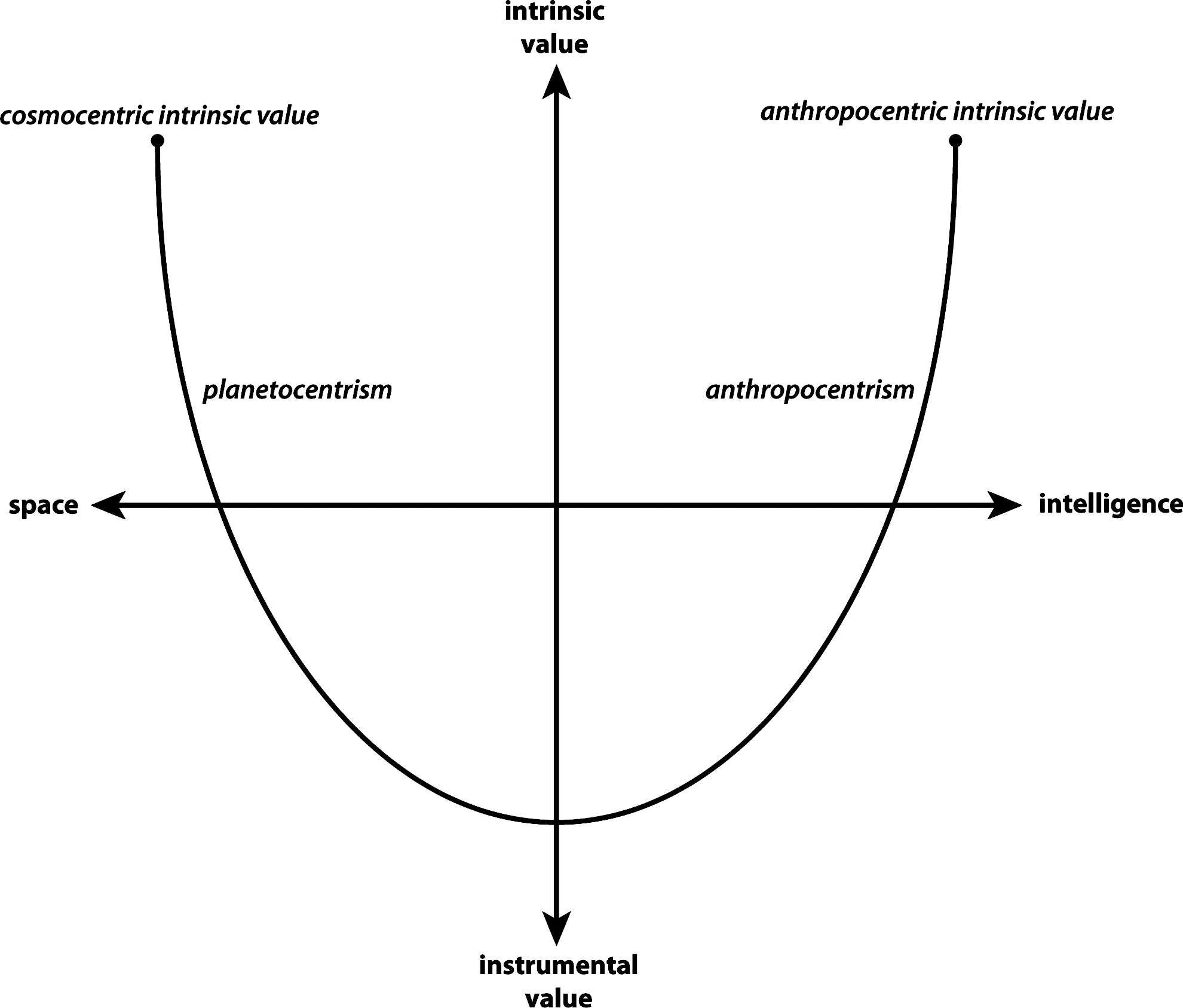
An ethical framework that gives cosmocentric intrinsic value and anthropocentric intrinsic value to the extremes of the biospheric spectrum and instrumental value to the rest of life on Earth.
This ecological compass provides a means for us to describe various ethical frameworks with regard to the environment. As a tool, the ecological compass cannot tell us how we should act toward the environment, but it can help us evaluate a series of ethical frameworks in order to assess a range of possible decisions. In the section below, we apply this system for evaluating ethical frameworks to the issues of climate engineering, planetary protection, and space exploration. The ecological compass may also be useful for analyzing other contemporary issues in environmental ethics, but such a task is beyond our present scope.
5. Discussion
Human growth and development have been affecting the Earth system at least since the Neolithic Revolution around 10 thousand years ago, but recent technological developments have made it possible for humans to deliberately manipulate their surroundings. Furthermore, human technology provides the first mechanism in Earth history for living organisms to intentionally leave their home planet and travel to another. These possibilities raise a number of moral issues for how humans should interact with environmental systems. In this section we use our ecological compass to explore some of these implications as they apply to climate engineering, planetary protection, and space exploration.
5.1. Climate engineering
Climate engineering describes any technological process that deliberately manipulates a planetary atmosphere. The concept of modifying a planetary atmosphere into one more suitable for life first appears in Olaf Stapledon's 1930 novel Last and First Men, which is later given the name terraforming by Jack Williamson in a 1942 science fiction story. Carl Sagan later raises this possibility in the scientific literature that humans might someday engineer Venus (Sagan, 1961) or Mars (Sagan, 1973) to make these planets suitable for colonization. A particular focus on the promise of terraforming Mars was raised in part due to the work of Chris McKay who, along with others, provides a compelling case for how we might live in an engineered martian climate (McKay, 1982, 2007, 2009; Freitas, 1983; Allaby and Lovelock, 1984; McKay et al., 1991; Birch, 1992; Mole, 1995; Zubrin and Wagner, 1996; Zubrin and McKay, 1997; McKay and Marinova, 2001; Graham, 2004). The most complete reviews of this body of research are provided by Martyn Fogg, who describes the various technological processes available for climate engineering and how they might apply to other planets as well as our own (Fogg, 1995, 1998). As a concept, terraforming appears technically feasible, although success would require unprecedented intergenerational cooperation among humans.
Climate engineering on Earth, also known as geoengineering, has some precedent in the atmospheric research into weather control mechanisms that occurred during the 1950s and 1960s. The term geoengineering does not appear in the scientific literature until the late 1970s, when it is used to describe the mitigation of climate change by injecting carbon dioxide into the deep ocean (Marchetti, 1977). However, prior scientific interest in weather control includes attention to local phenomenon, such as cloud seeding, as well as concern over anthropogenic carbon dioxide emissions (Keith, 2000; Fleming, 2010). As international cooperation to mitigate climate impacts seems to be breaking down, geoengineering has been receiving increased attention as a way of countering some of the effects of climate change. These possibilities include the very costly endeavor of reflecting sunlight with a space-based mirror or cloud of spacecraft (Early, 1989; Angel, 2006) to the rather inexpensive solution of injecting aerosol into the stratosphere to offset warming by greenhouse gases (Keith, 2000; Crutzen, 2006; Wigley, 2006; Keith et al., 2010). None of these geoengineering concepts have been deployed on a large scale yet, but ongoing research will probably lead to this capability in the near future.
Whether or not we should geoengineer the environment of Earth raises some similar concerns to prospects of terraforming another planet. While much attention has been focused on the impact of geoengineering on human ethics (e.g., Jamieson, 1996; Goes et al., 2009; Morrow et al., 2009; Gardiner, 2010, 2011; Jamieson, 2010; Svoboda et al., 2011), less has been said about its impact on environmental ethics (Jamieson, 1996, 2010; Preston, 2011). Yet consideration has been given to the ethics of terraforming other worlds (MacNiven, 1995; Sparrow, 1999; Fogg, 2000; McKay and Marinova, 2001 McKay, 2007, 2009), which is concerned almost entirely with how humans should interact with other planets, ecosystems, and organisms. In the following text we review the environmental ethics of terraforming in the context of our ecological compass and then apply some of these principles to the contemporary issue of geoengineering.
5.1.1. Terraforming
The starting point for most analyses of terraforming ethics is to assess the differences between anthropocentric (human-centered), zoocentric (animal-centered), and biocentric (life-centered) theories because the decision for humans to embark on a terraforming project depends on the value given to nature. MacNiven (1995) and Fogg (2000) evaluate these broad categories of environmental ethics by considering whether or not humans ought to terraform Mars. In an anthropocentric framework, where intrinsic value is limited only to humans, it would be permissible to terraform Mars because this would presumably preserve respect for humans and cause no harm to humanity. In fact, some utilitarian ethical frameworks that seek to maximize the total sum of utility may even require that we terraform Mars, if cost-effective, in order to better utilize the resources in our Solar System. An example of this ethical framework is shown as the anthropocentrism curve in Fig. 3. A macrocentric ethical framework that requires we assign intrinsic value to nonhuman animals would also permit terraforming. After all, Mars today is devoid of any sort of animal-like life, so the only consideration is with respect to Earth animal life-forms that take part in the terraforming process. So long as these efforts further the interest of intelligent, rational, or animal life as a whole, they would be consistent with a macrocentric framework. Such an ethical framework can be described by the macrocentrism diagonal line in Fig. 3 that assigns intrinsic value to visible nature and instrumental value to the rest of nature. Likewise, a biocentric ethical framework that assigns intrinsic value to microorganisms as well (as in the microcentrism curve of Fig. 3) is consistent with a policy to terraform Mars because, so far as we know today, Mars is uninhabited. If, however, we were to discover extant microbial life in the martian subsurface, then this may pose a significant ethical barrier to further human exploration (Lupisella, 1997), particularly if continued exploration would result in the destruction of martian life-forms (Cockell, 2005a, 2005c). Finally, MacNiven (1995) and Fogg (2000) mention that a cosmocentric ethical framework, rooted in the sanctity of existence, could prohibit terraforming Mars because such a theory extends intrinsic value to rocks, planets, stars, atoms, and space. We illustrate such an ethical framework as the cosmocentrism curve in Fig. 3. Such a cosmocentric ethical framework may not appeal to the majority of humans, perhaps because strict adherence to cosmocentrism might require abandoning some of the machinery of civilization. Still, the problem of terraforming is ethically relevant because it raises the possibility of cosmocentrism and forces us to consider the value we place upon planetary systems.
As an extension of these ideas, McKay and Marinova (2001) develops a three-dimensional system of environmental ethics based on three normative axioms that can be applied to the issue of terraforming. The first axis on this system is antihumanism (or preservationism), which describes the position that humans should not use their technology to alter Earth or the cosmos. In the framework of our ecological compass, this would be analogous to the cosmocentrism curve in Fig. 3 that places intrinsic value on everything in the universe. An even more extreme example of this antihumanism ethical framework is shown in Fig. 4, where the cosmos is given intrinsic value but humans and animals are only valued instrumentally. The second axis in McKay and Marinova's (2001) system is wise stewardship [or what McKay and Marinova (2001) refers to as utilitarianism], which rightfully permits the use or control of natural systems by humans so long as it maximizes long-term benefits. In our ecological compass, this view is consistent with the anthropocentrism curve in Fig. 3 that values humans intrinsically and the rest of nature instrumentally. The final axis in McKay and Marinova's (2001) three-dimensional system is intrinsic worth, which maintains that nonhuman living systems have their own value that is independent of human utility. This is shown in Fig. 3 as any of the ethical frameworks that give intrinsic value to some or most of the biospheric spectrum, which includes the curves labeled macroscopism, microscopism, and zoocentrism/ratiocentrism. These and other ethical frameworks indicate various degrees of the value of living systems, based on the continuum from intelligence to space (as in Fig. 1).
This three-dimensional system for describing ethical frameworks (McKay and Marinova, 2001) does raise some additional concerns compared with previous analyses (MacNiven, 1995; Fogg, 2000); however, it is not entirely clear that these three axes are independent from one another. For instance, if an environment is given a high degree of intrinsic worth, then does it make sense for it to also have a high degree of utilitarianism? Or to what extent does an antihumanism view correlate with placing intrinsic worth on nature? It is not entirely clear from McKay and Marinova's (2001) analysis what the implications are for combinations of these axioms. To this end, we are putting forth the system of our ecological compass in order to encapsulate these axioms and others in a way that can visually communicate the differences between environmental ethical frameworks.
The decision whether or not to embark on terraforming another world may depend on the life-forms already inhabiting the target planet. Mars and Venus, the most likely candidates for near-term human terraforming, appear to be barren and lifeless, so a project of terraforming would not infringe upon the intrinsic value of any extant life-forms. In fact, only an ethical framework of strict cosmocentrism would prohibit terraforming of a lifeless planet because such an ethical framework assigns intrinsic value to planets themselves or to abiotic properties of planets. Although terraforming Mars or Venus may eventually occur without regard to cosmocentrism, it is at least worth considering such a framework as a caution against interfering with another planetary system before we fully understand the complexities of our own. Aside from this possibility of cosmocentrism, the rest of the ethical frameworks described by our ecological compass would not necessarily prohibit terraforming of a lifeless planet, whether this be Mars, Venus, a jovian satellite, or an extrasolar planet.
If, however, a planet is inhabited with some form of life, then additional considerations apply to the problem of terraforming. As discussed above and by others (MacNiven, 1995; Fogg, 2000), the decision to terraform an inhabited planet will depend on the value given to the inhabitants. For example, a framework of ratiocentrism may raise no moral objection to terraforming a planet inhabited by squirrel-like extraterrestrial organisms (Haqq-Misra, 2009), while a framework of microcentrism may completely refrain from terraforming a planet that contains extant microbial life. Likewise, if remote human exploration of Mars eventually revealed a system of living microorganisms on the brink of extinction, these various ethical frameworks might lead us to different courses of action. A framework of strict cosmocentrism would maintain that Mars itself is intrinsically valuable and should be left alone to the martians; the corollary of such a view would be the immediate cessation of any Mars exploration program [such a view was echoed by Carl Sagan, who wrote that “Mars then belongs to the Martians, even if they are only microbes” (Sagan, 1980)]. On the other hand, any ethical framework that treats microorganisms according to their instrumental value may find little objection to colonizing and terraforming a planet for human use.
Another interesting possibility raised by McKay (2007, 2009) is that humans may value the existence of this novel form of life and subsequently use technology in order to help this struggling organism survive. Such an ethical framework places some amount of intrinsic value on biological diversity, ecosystems, or other traits while also allowing for deliberate human modification of planetary systems (Cockell, 2005c). This may be described on our ecological compass by the parabolic pattern of Fig. 5 if we think of the cosmocentrism limit to imply consideration for diversity or planetary systems. Even though most individual life-forms are valued only according to their instrumental value, this ethical framework maintains intrinsic value for human beings (and perhaps other intelligent creatures) as well as at least some complex systems. Such a framework would not necessarily prohibit terraforming of an inhabited world but would require that humans take care to ensure that the value of the biological system is preserved in the wake of human settlement.
In summary, environmental ethical frameworks allow us to evaluate how the actions of human colonization and terraforming of other worlds will affect other living creatures. Because terraforming involves the widespread alteration of a planetary biosphere, it is almost certain to impact any extant forms of life. Ethical frameworks that place intrinsic value on intelligence may refrain from terraforming any planet inhabited by creatures that exhibit such traits. Likewise, these ethical frameworks may find no objection to terraforming a barren planet or a planet that contains microbial life because the resources of this planet would be better utilized by humans. It may be hundreds, if not thousands, of years before humans can seriously begin to consider terraforming nearby planets. Nevertheless, the ethical considerations involved in thinking about terraforming can help us evaluate the ways in which we might engineer our own climate.
5.1.2. Geoengineering
Present-day options for geoengineering in response to anthropogenic climate change would require far less modification of the planetary system than terraforming. Proposals currently under consideration to cool Earth include altering the amount of sunlight reaching the surface, such as by the injection of reflective aerosol particles into the stratosphere (Keith, 2000; Crutzen, 2006; Wigley, 2006; Keith et al., 2010) or the brightening of clouds (Rasch et al., 2009; Jones et al., 2011), as well as suggestions to capture carbon dioxide directly from the air (Herzog, 2001; Shaffer, 2010). Although the injection of aerosol particles into the atmosphere may have different environmental consequences than direct carbon capture, any large-scale, intentional modification of the Earth system will inadvertently affect at least some aspects of the biosphere, which brings into question the value of nonhuman life and planetary systems. We can therefore use our preceding discussion of the environmental ethics of terraforming to examine the issue of geoengineering across a range of ethical frameworks.
Climate change itself is expected to cause some unintended consequences on the environment. For example, increased emission of carbon dioxide leads to greater ocean acidity, which contributes to the destruction of coral reef systems (Hoegh-Guldberg et al., 2007; Doney et al., 2009). This could be an undesirable outcome if we assign intrinsic value to coral, but it is also undesirable for those who value coral instrumentally because of its direct economic benefits to humans. Thus both the cosmocentrism and anthropocentrism frameworks in Fig. 3 might find moral objections to the environmental impact of climate change, albeit for different reasons. On the other hand, an ethical framework of macrocentrism might consider the impact of climate change on other mammals, such as polar bears, while an ethical framework biased toward ratiocentrism may be less concerned with the welfare of creatures that provide no direct economic benefit. There appears to be some tension between the intrinsic and instrumental value of animal life that is often brought to light in the political arena (e.g., controversy over endangered species). Although there does not appear to be an obvious way to harmonize these two views, it is important to realize that all ethical frameworks must at least acknowledge the consequences of climate change on nonhuman life.
Geoengineering likewise is expected to cause unintended consequences on the Earth system. Attempts to manage solar radiation, such as through aerosol injection or cloud brightening, do not alter the atmospheric carbon dioxide budget and therefore will only exacerbate the problem of increasing acidity in the oceans. Furthermore, solar radiation management geoengineering requires a long-term commitment because the abrupt cessation of geoengineering is likely to cause more rapid warming than business as usual (Goes et al., 2009). These geoengineering strategies can also choose to target either global temperature or global sea level, either of which will differently affect human systems and ecosystems (Irvine et al., 2012) such as by changes in global precipitation patterns (Bala et al., 2008; Ricke et al., 2010; Moreno-Cruz et al., 2011). Geoengineering through carbon capture and sequestration also faces similar environmental concerns. The removal of carbon dioxide from the atmosphere will indeed reduce the greenhouse effect and avoid directly increasing ocean acidity; however, the challenge for carbon removal geoengineering is the storage of carbon dioxide underground or in the deep oceans. Even if the direct environmental impacts of carbon storage were negligible, the slow leakage of stored carbon into the environment would eventually result in delayed warming, oxygen depletion, and increased ocean acidity (Shaffer, 2010). These environmental consequences may be sufficient reason for some ethical frameworks to reject geoengineering entirely. Concerns such as these even led the United Nations Convention on Biological Diversity to enact a moratorium on geoengineering deployment “until there is an adequate scientific basis on which to justify such activities” at the 10th meeting of the Conference of the Parties in 2010. However, the prospect that geoengineering could be used to offset some of the harmful consequences of climate change for human civilization has kept geoengineering as a topic of current theoretical research and debate.
One opposing argument to geoengineering proposals is the idea that nature ought to be left alone by humans, at least whenever possible. This idea has been described recently as the presumptive argument against geoengineering, which is “bolstered by recognition of the extraordinary complexity of Earth's ecological system and often a deep skepticism about scientists' ability to manage it” (Preston, 2011). This view has even been defended on the grounds that “unless a duty of respect for nature is widely recognized and acknowledged, there will be little hope of successfully addressing the problem of climate change” (Jamieson, 2010). Even if there is a sense of urgency to develop geoengineering options in case of a climate emergency (Keith et al., 2010), many people, including scientists and ethicists, believe in some moral obligation toward limiting human interference with nature. Preston (2011) criticizes this presumptive argument because geoengineering may be the lesser of two evils and preferable to inaction, especially if geoengineering is used to avert a crisis today, although others have suggested that geoengineering may lead to moral corruption and place an unjust burden on future generations (Gardiner, 2010). Whether or not the presumptive argument can be substantiated, it at least describes a position of opposition to geoengineering that many people hold. In the analysis below, we will describe the range of positions that invoke variants of the presumptive argument (or non-interference) as a cosmocentric framework that places intrinsic value on all nature.
While many geoengineering strategies may have a negative impact on animals and plants, it is less likely that the global community of microorganisms will be threatened by any human efforts. Proposed changes to the Earth system are too small in magnitude to significantly alter the subterranean habitats of microorganisms, and the most radical projections of climate change impacts would scarcely be noticed by highly adapted extremophiles. Even mass extinction events, such as the impactor that led to the demise of the dinosaurs, would have little chance at sterilizing the planet, so life on Earth is likely to continue until the Sun expands into a red giant several billion years from now. Because human efforts at geoengineering Earth will have little effect on the microbial community, the value of microorganisms may be largely irrelevant in this case. Whereas the issue of terraforming raises the real possibility of disrupting or destroying an extant microbial community, geoengineering on present-day Earth carries none of this threat. Thus, while it is important to consider how geoengineering will impact macroscopic forms of life, this may be less of a concern for the impact on microscopic life.
The question still remains as to the intrinsic value of planetary systems with regard to geoengineering. Under a framework of anthropocentrism, as in Fig. 3, concern over planetary systems is limited to principles that weigh consequences such as loss of biodiversity against their instrumental value to humans. On the other hand, a framework of strict cosmocentrism in Fig. 3 may oppose any attempt to geoengineer Earth because of the harm to all life-forms. (The same could be said of the infrequent framework shown in Fig. 4.) In a way, these two attitudes toward geoengineering embody the opposite ends of the antihumanism spectrum described by McKay and Marinova (2001). However, we can also conceive of an ethical framework along the lines of Fig. 5 where intrinsic value is given to both humans and to planetary systems but not necessarily to the totality of life on Earth. This type of ethical framework may not be outright opposed to geoengineering but would seek to maintain some aspects of ecological integrity such as biodiversity, net primary productivity, or other biological indicators. The impact of climate change on ecosystems is certainly of importance to human civilization, so perhaps thinking about the intrinsic value of planetary systems may be relevant for the issue of geoengineering.
This type of analysis cannot determine whether or not we should geoengineer the climate. Instead we have intended to show that any ethical framework must consider the impact of a particular strategy or decision on the spectrum of life on Earth. Even a strongly anthropocentric framework places instrumental value on the natural resources required for civilization, so some thought must be given to how these systems will be impacted. Geoengineering proposals currently under consideration are unlikely to impact the Earth system as drastically as terraforming and may exert little or no effect on microscopic organisms. Thus for geoengineering, concerns over our ethical obligations to microorganisms may be outweighed by the damage we could cause to planetary systems or macroscopic organisms.
5.2. Planetary protection
Even if large-scale efforts to technologically manipulate a planetary system never occur, human exploration of the Solar System and beyond retains the potential to contaminate other worlds. Planetary protection standards for space missions specify sterility requirements for objects leaving Earth in order to avoid the accidental introduction of microbial life elsewhere, particularly on potentially habitable worlds such as Mars, Titan, or Europa (Perek, 2004; Rummel and Billings, 2004). Even though extreme care is taken in these situations, some Bacillus spores and other organisms manage to survive the sterilization process and the voyage into space (Horneck et al., 2001; Clark, 2004; Nellen et al., 2006; Sancho et al., 2007), although these appear to have extremely short lifetimes once they are exposed to sunlight on the surface of a barren planet (Crawford, 2005). The potential that contamination by Earth life could disrupt an extraterrestrial ecosystem to either destroy extant forms of life or disrupt the geological record is given serious consideration by space agencies worldwide.
It is also possible that microbial life could inadvertently contaminate another planet. This process, known as panspermia, could occur if an asteroid collided with Earth to eject rocks that would shield any microorganisms contained within from the dangers of space (Horneck et al., 2001). In principle, this process could allow the transfer of viable microorganisms from Earth to Mars or vice versa (Mileikowsky et al., 2000). The question of reverse contamination, such as from a Mars sample return mission, is also of concern if extraterrestrial material could negatively impact the Earth system. In addition, there is some speculation as to mechanisms that could allow for interstellar panspermia, that is, the inadvertent transfer of life between stars (Melosh, 2003; Napier, 2004; Wallis and Wickramasinghe, 2004), but the probability is low that a small object drifting through interstellar space would land on a habitable planet. Nevertheless, the possibility remains that panspermia within the Solar System could cause contamination between ecosystems. Fogg (2000) points out that because microorganisms are not moral agents, inadvertent contamination via panspermia would be ethically neutral. Whether or not humans can or should do much to prevent panspermia is unclear, although efforts to avoid catastrophic impacts (Bostrom and Cirkovic, 2008) will probably also act to reduce the inadvertent transfer of life.
Discussions regarding planetary protection tend to focus on the intrinsic value of microorganisms. After all, microbial life seems to be the most likely form of life that could occur elsewhere in the Solar System. The instrumental value of microorganisms seems apparent from their role in basic mechanisms in the Earth system (such as the nitrogen cycle or the carbon cycle), so it is reasonable to consider microcentric instrumental value (in the third quadrant of Fig. 2) to guide human interactions with microbial communities. It is less obvious, though, what it would mean to treat microorganisms according to intrinsic value (as in the third quadrant of Fig. 2). Common activities such as driving a car or constructing a building may kill individual microorganisms while still causing little harm to the species or community. Cockell (2005a, 2005b) concludes from this that to intrinsically value microorganisms is to protect the integrity of biotic communities from destruction. The protection of individual microbial organisms is indeed almost a theoretical consideration because of the collective nature of microbial communities; it may not be identical to speak of the “death of a bacterial cell” in the same way as the “death of a dog,” even under a framework of cosmocentrism. This attitude of respect for microbial communities is given the name teloempathy by Cockell (2005c) and can be compared to the microcentrism curve of Fig. 3. Although an ethical framework of strict cosmocentrism may advise against interfering even with a lifeless planet, a framework that instead emphasizes the intrinsic value of life may find no objection in treading lightly on a planet inhabited by microorganisms.
5.3. Space exploration
Finally, these issues of environmental ethics can be applied to the general topic of human space exploration by focusing on our cosmocentric ethical frameworks. The majority of space exploration in the near and distant future is likely to consist of interactions between humans and lifeless planetary bodies. These activities may begin with preliminary investigation to explore uncharted regions of space and may be followed by scientific examination of these discoveries, as evidenced by Solar System exploration programs today. However, human civilization is also starting to see a rise in commercial space agencies that provide services ranging from private payload delivery into orbit to space adventure tourism, and reasonable projections of space ventures include the possibility of establishing permanent space colonies. How we decide to engage in any of these activities will depend on a number of social and economic factors, but fundamentally these decisions are related to the way in which humans value the cosmos.
In the absence of nonhuman organisms, the distinction between instrumental versus intrinsic value for objects in space becomes important. The instrumental value of space seems evident from the use of satellite technology and the potential to harness the mineralogical resources of the Solar System. Under a framework of anthropocentrism, primary concerns would include the protection of Earth orbits from unnecessary debris, management of commercial and scientific utilization of space, and protection of planetary surfaces that may be of use to future scientific or commercial enterprise (Williamson, 2003). Additional concerns may arise, though, if any intrinsic value is assigned to objects in space, as under the cosmocentrism ethical framework. These include the maintenance of historical artifacts such as the Apollo landing sites (Spennemann, 2004), the preservation of space systems for aesthetic purposes (analogous to national parks on Earth), the regulation of space tourism to protect space environments from wear and destruction, and the limitation of space-based advertising that could hamper astronomical observations (Williamson, 2003). These examples as well as other possibilities illustrate the complexities in how humans value the resources of space. Although human civilization may not choose to rule out space exploration on the grounds of strict cosmocentrism, the aesthetics and mysteries of space may at least give consideration to some of the intrinsic properties of space that humans have always found valuable.
6. Conclusion
We have presented our two-axis ecological compass system as a way of emphasizing the range of interactions that can occur between humans and the community of life. Human actions can affect life or planetary systems at all scales, and the way in which humans make decisions about how to impact nature will depend on how value changes across the biospheric spectrum. This ecological compass can therefore be seen as a tool to evaluate ethical frameworks and compare some of the possible consequences that may result from differing views.
The decision to engineer a climate, whether on Earth or beyond, brings into question the intrinsic value of nonhuman life. Present-day prospects to geoengineer Earth's climate as a way of offsetting anthropogenic climate change will certainly affect several macroscopic species as well as many diverse ecosystems across the globe. Yet geoengineering may also have little effect on microorganisms and is unlikely to cause a climate catastrophe, so that the greatest obligations (if any) may be toward animals and the Earth system. Terraforming, on the other hand, proposes to enact planetary-scale changes that could disrupt the integrity of a microbial community, so additional concern may need to be given to the intrinsic value of any extraterrestrial microorganisms humans may encounter. In any case, climate engineering is guaranteed to interact with the greater community of life, so it is crucial to consider the value of nature before human civilization begins modifying a planetary system.
Human space exploration also highlights the need to consider the value given to the cosmos. Even if humans only consider the instrumental value of the resources of space, there are still some important ethical issues to be resolved if space exploration is to be a peaceful, beneficial, and cost-effective venture. However, perhaps the greatest uncertainty lies in how humans intrinsically value the cosmos, whether for its aesthetic beauty, its unending mystery, or its potential for possibility. It may be difficult to quantify the value of an unobstructed view of the cosmos, but as human civilization continues exploration into space, perhaps the ceaseless discoveries will allow humanity to view its own planet with the wonder and humility that strikes when gazing up at the night sky.
Footnotes
Acknowledgments
I thank Nancy Tuana, Klaus Keller, James Kasting, Ravi Kumar Kopparapu, Mike Zugger, Peter Irvine, and Lee Miller for helpful discussions. I also thank David Dunér, Erik Persson, Seth Baum, and three anonymous reviewers for providing comments that improved the ideas in this paper.
Author Disclosure Statement
No competing financial interests exist.