




Abstract

H
Gliese 581 g, unfortunately, may not even exist. The planet was discovered by the Lick-Carnegie Exoplanet Survey—a ground-based radial velocity survey carried out by researchers at those two institutions. The radial velocity, or RV, method is a search technique that uses the Doppler shift of a star's absorption lines to detect the presence of an unseen planet. As soon as this planet was announced, researchers associated with the Swiss team of Michel Mayor quickly doused cold water on the discovery, announcing that the planet does not appear in their more accurate RV data. They suggested that the assumption of circular orbits for the entire Gliese family of planets by Vogt et al. may have led to an erroneous result. Planets, of course, reside on elliptical orbits, which may be circularized if they happened to form that way or if tidal forces are strong enough to damp their eccentricities. According to the Swiss group, both Gliese 581 g and a seventh planet, “f,” disappear when the orbits are allowed to have finite eccentricities.
Whether or not this particular planet is real should not be a major issue. Its existence, or lack thereof, will undoubtedly be tested by continued measurements by both research groups. If Gliese 581 g does not exist, it is only a matter of time before another potentially habitable planet will be found. Indeed, five such candidates were announced just recently by the Kepler team (Borucki et al., 2011). Kepler is a NASA space telescope that has been in operation for just under 2 years. Kepler observes a field of ∼160,000 stars in the constellation Cygnus, looking for evidence of planetary transits. A transit is when a planet passes in front of a star during part of its orbit, blocking out some of the star's light. Earth's diameter is about 1% that of the Sun, so it would block about 1 part in 104 of the Sun's light if observed in transit from afar (because the area of a disk equals πr 2). Kepler can measure stellar brightnesses to 1 part in 105, so it can identify Earth-sized planets around Sun-like stars, given enough time. It takes a minimum of three transits to produce a reliable signal, so this process takes about 3 years for an exo-Earth orbiting a star like the Sun. But planets orbiting within the habitable zones of smaller stars (late K or M dwarfs) have shorter orbital periods, so this is what the Kepler scientists have reported.
When we talk about five new, potentially habitable planets, we should bear in mind that these represent only a small fraction of the planet candidates that Kepler has reported. In their February 2011 data release (Borucki et al., 2011), the Kepler team described 1235 planet candidates orbiting 997 host stars. The team calls these “planet candidates,” rather than planets, because some of them, like Gliese 581g, may not be real. Background eclipsing binary stars and other “false positives” that mimic planetary transit signatures mean that some of these 1235 planet candidates will likely go away with time. Nonetheless, Kepler may still triple the number of known exoplanets, which had just recently surpassed 500 prior to the February announcement. Of the 1235 new planet candidates, 54 are within their host star's habitable zone or the Kepler team's definition thereof. (Their published definition includes planets with effective radiating temperatures as high as 373 K, or 100°C. This is almost certainly too high, as such planets would receive more stellar radiation than does Venus.) Forty-nine of these planets, though, have estimated radii more than twice that of Earth and, hence, are probably either warm Neptunes or warm Jupiters—gas giant planets that orbit relatively close to their parent stars. Such planets are not very interesting astrobiologically, for reasons mentioned above. Indeed, dozens of gas giant planets within stellar habitable zones were already known from prior RV surveys. Life could still exist within these systems if these planets have large moons (Williams et al., 1997); however, the prospects for detecting life on such moons are extremely slim. (One would need to separate the light from the giant planet from that of the star and then observe the moon in transit in front of the giant planet. Doing these things simultaneously would be nearly impossible.)
Astrobiologists should be thrilled by the new Kepler results. (If any of you aren't, come closer, and I will knock you on the head!) We are now finding direct evidence that potentially habitable planets exist around stars other than our own. That's the first step in finding out if there are little green men out there with whom we might one day converse. This was a dream of the late Carl Sagan, and it is one that I share. But if you actually go talk to an astrobiologist—you are probably one yourself, as you are reading this article—you may find that the excitement is a bit tempered. It's tempered because, when asked at the Kepler news conference what we actually know about any of the new planets, Principal Investigator Bill Borucki stammered for a moment and then stated the obvious: “Well, to tell the truth, absolutely nothing.” That's partly because nearly all the Kepler target stars, including the ones around which the five potentially habitable planets orbit, are hundreds of light-years away. Furthermore, the Kepler telescope is incapable of characterizing any of these planets, other than to say how big they are. Indeed, one doesn't even get the size absolutely, because it is only determined relative to the size of the parent star. Fortunately, astronomers have built pretty good theoretical models of stars, so they can estimate a star's size reasonably well based on its spectrum. For some of the larger Kepler planets, the mass can also be determined from ground-based RV measurements. For such planets, the combination of mass and radius gives the planet's density. But the mass is difficult or impossible to measure for an Earth-sized planet because it is small and because the Kepler target stars are relatively faint, making it more difficult to obtain good RV statistics.
What about the other planets, like the putative Gliese 581g, which have been discovered by the RV method? These planets are more interesting because they are much closer, hence more amenable to future study. Gliese 581, at 20 light-years' distance, is one of our closest neighbors. If we built the right kind of space telescope—more on this below—we might be able to observe this planetary system directly someday. Right now, if asked what we know about this planet, assuming it exists, the correct answer would be Borucki's: absolutely nothing. This, of course, did not prevent Steve Vogt from famously announcing that it was “100 percent sure to be inhabited” when asked about this possibility at the Gliese 581g press conference. He probably regretted saying that immediately afterwards. With the RV planets, we actually know even less than we do about the Kepler planets, because the orbital inclination (the tilt of the planetary system with respect to the plane of the sky) is generally not known. Thus, we get only a minimum estimate for the planet's mass, not the true mass. Most of the time, statistically speaking, the two values are not that different; however, sometimes this means that we do not know whether the planet is rocky or a gas giant. Gliese 581d, for example, has a minimum mass of 5.6 Earth masses. The true mass is the observed mass divided by sin i, where i is the inclination. Thus, if i is <30 degrees, then sin i is <0.5, and the planet is over the 10 Earth-mass value considered as the upper limit for a rocky planet. If the planet is bigger than this, it is likely to capture gas from the surrounding nebula during its formation and turn into a gas giant. According to models (Wordsworth et al., 2010), Gliese 581d is just inside the outer edge of its star's habitable zone; thus, if it is indeed a rocky planet, it is currently the closest known potentially habitable exoplanet.
How can we lift the veil of mystery and generate results that will cause even the most staid astrobiologist to sit up and take note? There are at least three ways. The first is relatively short term (4–5 years), but it is also pretty “iffy.” Four years from now is when the James Webb Space Telescope (JWST) is scheduled to launch. JWST is a 6.5 m diameter IR telescope that should be capable of taking spectra of transiting exoplanets. Unlike Kepler, which only counts photons, JWST can sort photons by wavelength. It also has a much bigger collecting area—Kepler was only 0.95 m in diameter—so it should be able to obtain relatively high signal-to-noise data. Those who follow the exoplanet field will know that astronomers have already been obtaining transit spectra of exoplanets from the Hubble and Spitzer space telescopes. Hubble is a 2.4 m diameter optical/UV telescope, and Spitzer is a 0.85 m IR telescope. Both Hubble and Spitzer have obtained low-resolution spectra of so-called “hot Jupiters”—Jupiter-sized planets with very small orbital radii, typically 1/10th that of Mercury. The atmospheres of such planets are extended because they are hydrogen rich and because they are strongly heated by the star. JWST, with its larger collecting area, will do much better than either of these existing telescopes. So, the good news is that we will hopefully obtain higher-resolution data of transiting hot Jupiters, hot Neptunes, and maybe hot super-Earths, as well. (A “super-Earth” is a rocky planet with a mass between 2 and 10 times that of Earth.) The bad news is that JWST is currently thought to be incapable of taking spectra of transiting planets within the habitable zones of their stars. Actually, I'm told that if we happen to find a new transiting M-star system close to the Sun, JWST just might be able to obtain spectrum of a habitable zone planet. It is extremely difficult to do so, however, because such planets are, by definition, small and cool, so their atmospheres are too thin to produce a strong transit signature.
A second way of generating data on exoplanet atmospheres is to use ground-based telescopes. Astronomers have gotten very good at the technique of “adaptive optics,” whereby they are able to cancel out most of the distortion caused by Earth's atmosphere. Recently, Bean et al. (2010) used one of the four 8.2 m telescopes (part of the Very Large Telescope array at Cerro Paranal, Chile) to take a spectrum of the super-Earth GJ 1214b. That's the good news. The bad news is that they saw—you guessed it—absolutely nothing. (It seems that this is a consistent result in the exoplanet characterization business!) But there is potentially more good news on the way. Sometime after JWST launches, hopefully in the early part of the next decade, new 30 or 40 m class ground-based telescopes are expected to come into operation. Again, it is thought to be unlikely that such instruments will be able to take spectra of Earth-sized planets in the habitable zones of their parent stars. But, like JWST, they will undoubtedly open up new horizons in exoplanet research.
How, then, do we finally get to the answer? Can we eventually characterize Earth-like planets and search their atmospheres for signs of life? The answer is yes; indeed, we already know how to do it—almost. What we need is yet another space telescope, like Hubble, only bigger—somewhere between 4 and 8 m in diameter. Like Hubble, this telescope would operate at visible wavelengths, perhaps with capability in the UV and near-IR, as well. Recall that JWST will operate at longer IR wavelengths, so its spatial resolution will not be as large. (The spatial resolution of a telescope is proportional to λ/D, the wavelength divided by the telescope diameter.) Another key difference from JWST is that the new telescope, dubbed Terrestrial Planet Finder, or TPF, in NASA's planning, will include some way of blocking out the light from a star and looking for the much dimmer planets around it. This is quite different from the transit spectroscopy approach used so far, in which the spectrum of the planet must be extracted from that of the star because the two objects are not separated. The Hubble Space Telescope actually has such a capability. The Hubble instrument is called a coronagraph, and it is capable of suppressing starlight to about 1 part in 105. An Earth seen in reflected light, however, is dimmer than its parent star by a factor of ∼1010. Hence, a TPF telescope would need a much better coronagraph than the one that flew aboard Hubble, and designing such an instrument is something that we still do not quite know how to do. Alternatively, the starlight could be blocked by using an external occulter—a large (roughly 50 m diameter) flower-shaped disk flying at ∼50,000 km from the telescope. That sounds difficult, but it may actually be easier than designing an efficient internal coronagraph. Two preliminary mission concept studies have already been done: Figure 1 shows a concept called New Worlds Observer, which was designed by a group led by Webster Cash of the University of Colorado. NASA's ExoPlanet Program Analysis Group has just embarked on a 5-year plan to study coronagraph and occulter mission designs and try to ensure that at least one of them is well enough understood in time to be selected for a flagship mission sometime in the 2020–2030 decade. If such a mission can be flown, perhaps we will learn the answer to one of the most fundamental questions asked by astrobiologists, living or dead: Is life unique to Earth, or does it exist elsewhere in the Universe? TPF is a good way to find out.
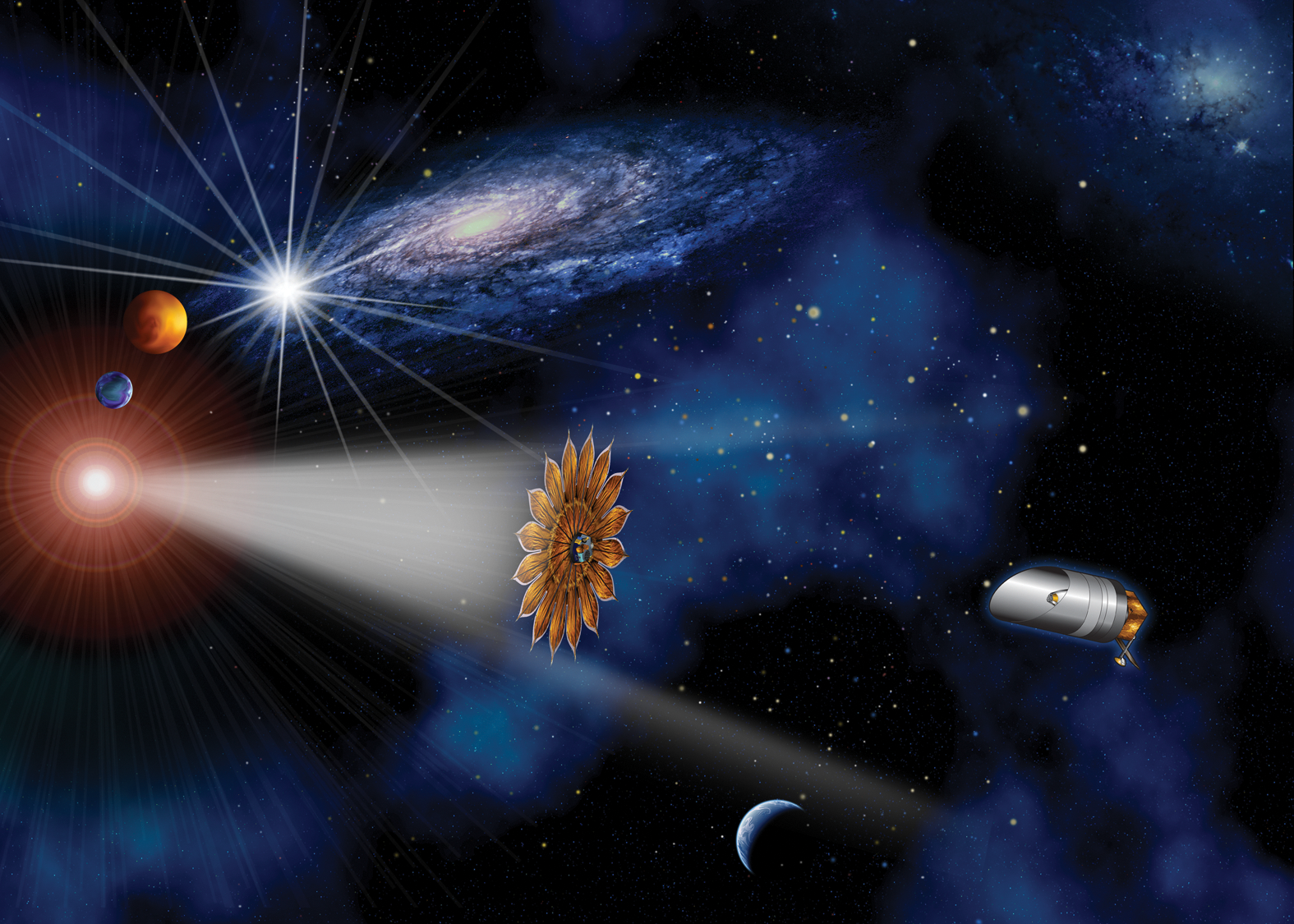
An artist's conception of the New Worlds Observer, one possible form of a future Terrestrial Planet Finder mission. The flower-shaped disk in the center of the picture is an occulter that flies roughly 50,000 km from the telescope on the right. The goal is to block out the light from the star and retain light reflected from any surrounding planets. (Photo courtesy of Aki Roberge.) Color images available online at
Abbreviations
JWST, James Webb Space Telescope; RV, radial velocity; TPF, Terrestrial Planet Finder.