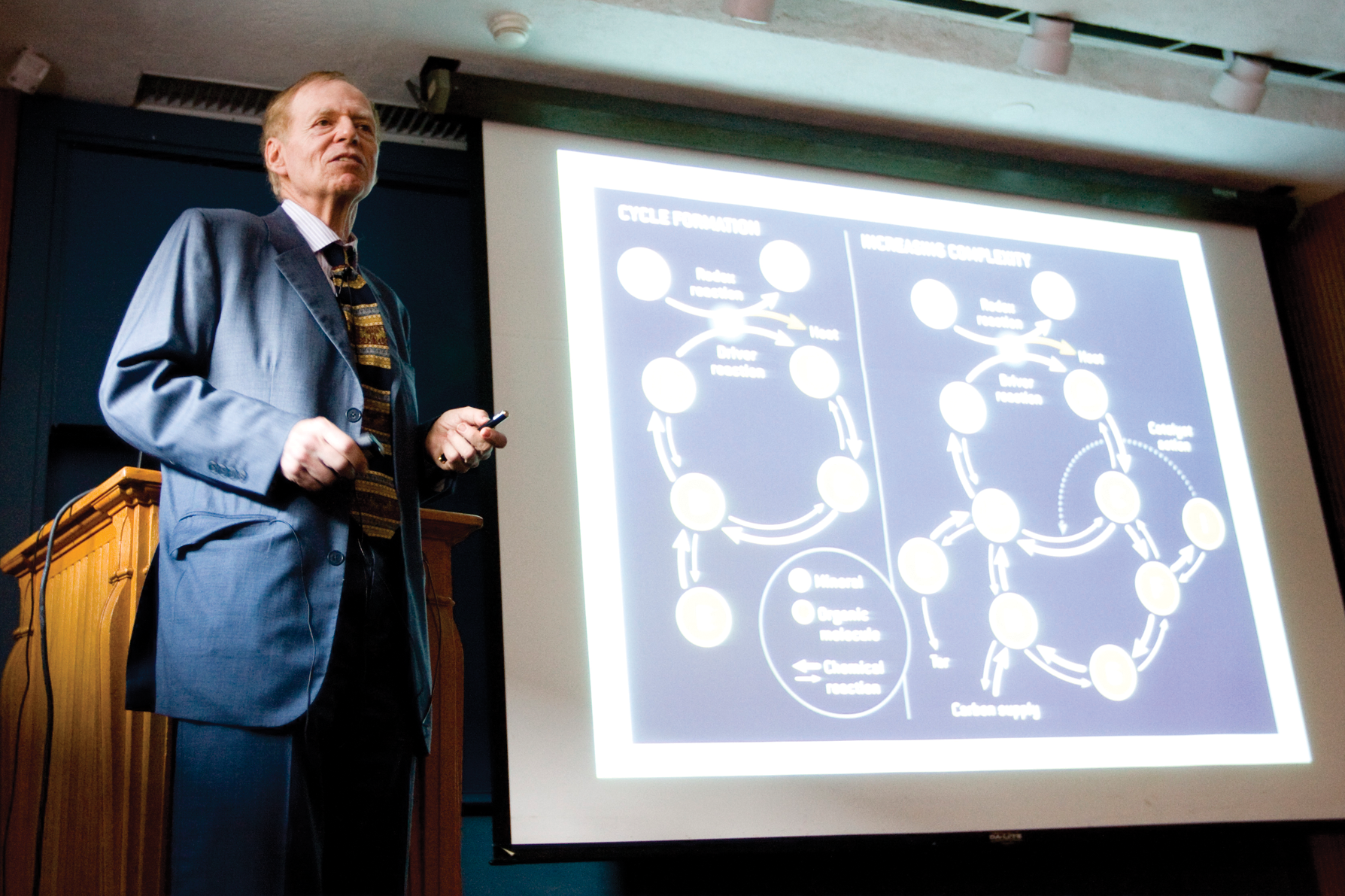
Bob Shapiro, presenting his “small-molecule paradigm” at Harvard in 2008. Photo reproduced with permission from Rose Lincoln, Harvard News Office; Harvard Gazette, Thursday, October 23, 2008. Online at http://news.harvard.edu/gazette/story/2008/10/nyu-chemist-robert-shapiro-decries-rna-first-possibility. Color images available online at www.liebertonline.com/ast
Doctor Robert Shapiro, affectionately known as Dr. No in the astrobiology community for his unrelenting opposition to the “RNA world first scenario,” died in the city of his birth, New York, on June 15, 2011. Bob gained a BS in chemistry from the City College of New York and a PhD in organic chemistry from Harvard before going on to research DNA chemistry at Cambridge, England. He returned to the US to join New York University's Department of Chemistry, where he spent the rest of his life, finally as Professor Emeritus. There, he studied the mechanisms by which chemicals damaged our DNA in ways that led to cancer before becoming the scourge of partakers of “nucleotide soup”; opining that “any abiotically prepared replicator before the start of life is a fantasy,” calling it “a form of molecular vitalism”. He used simple mass balance arguments to show how unlikely it was for solutions of putative nucleotides to be evaporated without loss from the largest of lagoons to the smallest of puddles to satisfy what he took to be special pleas for so-called “pre-biotic molecules” to be concentrated to some kind of critical mass. Using intuition gained from his extensive research on nucleic acid polymers, Bob argued that, “while skilled chemists might prepare nucleotides in well-equipped laboratories and link them to form RNA,” nature alone “has no inclination to prepare RNA.” He was no kinder to the simpler original soup hypotheses, pointing out that hydrogen-poor tars were the main components of spark discharge experiments, along with tiny amounts of 80 or so assorted amino acids, only two of which were found in life itself. Bob proclaimed the Murchison meteorite to be no more bountiful. Moreover, he felt that such views encouraged Monod's idea that life was an unlikely accident—a “one-off” in a gloomy and lonely Universe and inimical to astrobiology's more deterministic expectations.
In reaction to the soups, he promoted his more optimistic “small-molecule paradigm” and claimed that life began with energy-driven networks of small building blocks, pointing out that monomers themselves have the ability to support heredity and catalysis as mutually catalyzing sets. The key requirement is that a suitable energy source be available to assist them in the processes of self-organization. A demonstration of the principle involved in the origin of life would require only that a suitable mixture of monomers be exposed to an appropriate energy source in a simple apparatus. We could then observe the very first steps in evolution.
Such an evolving process was, he considered, likely to be repeated throughout the Universe, giving the pursuit of astrobiology its optimism and its raison d'être. His arguments are summed up in two books: Origins, a Skeptic's Guide to the Creation of Life on Earth (1986) and Planetary Dreams (1999). The astrobiological case is best made in Life Beyond Earth, coauthored with Gerald Feinberg (1980).
Bob's epitaph could be taken from his last written words, posthumously published on August 4 of this year in Nature: “We should let nature inform us, rather than pasting our ideas onto her.”