




Abstract
Understanding the processes involved in the evolution of organic matter in the early Solar System requires extensive experimental work. The scientifically valuable carbonaceous chondrites are principal targets for organic analyses, but these meteorites are rare. Meteoritic analog materials available in larger quantities, on which experiments can be performed, would be highly beneficial. The bulk of the organic inventory of carbonaceous chondrites is made up of solvent-insoluble macromolecular material. This high-molecular-weight entity provides a record of thermal and aqueous parent-body alteration of precursor organic structures present at the birth of the Solar System. To identify an effective analogue for this macromolecular material, we analyzed a series of terrestrial kerogens by pyrolysis–gas chromatography–mass spectrometry. Type I and II kerogens are unsuitable analogues owing to their highly aliphatic nature. Type III kerogens show some similarities to meteoritic macromolecular materials but display a substantial biological heritage. Type IV kerogens, in this study derived from Mesozoic paleosols and produced by the reworking and oxidation of organic matter, represent an effective analogue. Some isomeric differences exist between meteoritic macromolecular materials and type IV kerogens, and stepped pyrolysis indicates variations in thermal stability. In addition to being a suitable material for novel experimentation, type IV kerogens also have the potential to aid in the optimization of instruments for deployment on Mars. Key Words: Carbonaceous chondrite—Meteorite—Macromolecular—Analogue—Type IV kerogen. Astrobiology 13, 324–333.
1. Introduction
1.1. Macromolecular carbon in carbonaceous chondrites
M
1.2. Analytical techniques
There have been numerous techniques applied to the study of meteoritic macromolecular material, including nondestructive techniques such as Raman spectroscopy (e.g., Quirico et al., 2003; Bonal et al., 2007; Busemann et al., 2007), infrared spectroscopy (e.g., Ehrenfreund et al., 1991; Murae, 1994), high-resolution transmission electron microscopy (e.g., Harris et al., 2000; Garvie and Buseck, 2004; Remusat et al., 2008), electron paramagnetic resonance spectroscopy (Binet et al., 2002, 2004a, 2004b), and nuclear magnetic resonance spectroscopy (e.g., Cronin et al., 1987; Gardinier et al., 2000; Cody et al., 2002; Cody and Alexander, 2005; Yabuta et al., 2005, 2010). Destructive techniques include chemical oxidation (Hayatsu et al., 1977; Remusat et al., 2005a; Huang et al., 2007), hydrous pyrolysis (Sephton et al., 1998, 1999, 2000, 2003; Yabuta et al., 2007; Oba and Naraoka, 2009), and pyrolysis–gas chromatography–mass spectrometry (py-GC-MS; full list of abbreviations used is in Appendix A1) (Simmonds et al., 1969; Studier et al., 1972; Levy et al., 1973; Bandurski and Nagy, 1976; Komiya et al., 1993; Sephton and Gilmour, 2001; Kitajima et al., 2002; Sephton et al., 2004a; Remusat et al., 2005b; Wang et al., 2005; Yabuta et al., 2010). The history of pyrolysis techniques applied to meteorite samples has been recently reviewed (Sephton, 2012). Py-GC-MS, which is the focus of this study, provides advantages over other techniques in speed of sample preparation, excellent compound discrimination, and reproducibility.
1.3. The need for analogues
The relative scarcity and high importance of the carbonaceous chondrites means that they are not available in large quantities for experimental work. Such experimental work includes the training of analysts; the development of new extraction, preparation, and analysis techniques; the monitoring of contamination mechanisms by the use of “witness” materials whose compositions are seen to change following addition of the most prevalent contaminants; and the optimization of instruments under development for in situ analyses on space missions. Examples of the latter are provided by equipment being developed for the flotilla of spacecraft destined to land on Mars in the next two decades, including the recently operational Mars Science Laboratory and its Curiosity rover (Mahaffy, 2009). One way to circumvent the restrictions placed on sample availability by the scarcity of meteorite samples is to use terrestrial materials that can act as analogues to meteoritic organic assemblages. An ideal analogue would be easy to prepare or acquire, available in large amounts, and standardized for application in different laboratories; most importantly, it would provide a close chemical match to its meteoritic counterpart. As such, substantial attention has been paid to naturally occurring terrestrial macromolecular organic materials.
1.4. Kerogens as analogues
Meteoritic macromolecular materials are the products of random organic synthesis, undirected at any stage by biological enzymes. Multiple isomeric configurations exist, and additional complexity is generated by physical alteration by heat and water after the organic matter is incorporated into forming planetesimals. By contrast, kerogen is formed as a combination of original biopolymers and condensation of smaller units into geopolymers as sedimentary organic matter undergoes burial and heating over geological timescales (Tegelaar et al., 1989).
Kerogens are classified into four types, I–IV, depending on the relative proportions of the different organic materials contained within (Killops and Killops, 2005). Broadly, type I kerogen originates from lacustrine algal-rich deposits, type II from marine sediments with mixed source materials, type III from terrestrial higher plant material, and type IV is heavily reworked material, often terrestrial in origin. Since type IV kerogen has no hydrocarbon potential, it is often overlooked. It is important to note that previous studies have concentrated on particular types of kerogen for meteoritic macromolecular material analogues and have not explored the full range available. The focus has been on type III kerogens and coals (e.g., Hayatsu et al., 1977, 1983; Ehrenfreund et al., 1991; Murae, 1994, 1997; Quirico et al., 2003, 2009); however, it is apparent that these materials compare poorly with meteoritic carbon. The unsatisfactory match between type III kerogens and meteoritic organic materials exists because the two types of material are formed in very different ways. Type III kerogens have a structure that is primarily inherited from resistant lignin phenylpropane networks and additional aliphatic biopolymers from cuticular materials.
The poor quality of current analogues and the incomplete assessment of all kerogen types invite further investigation. Here, several kerogen types were analyzed by py-GC-MS and compared with the macromolecular material within the CM2 chondrite Murchison. The macromolecular material in Murchison is a reasonable representative of that in other carbonaceous chondrites.
2. Experimental Method
2.1. Samples
In this investigation, an example each of type I and II kerogens was analyzed along with a series of type III coals of various thermal maturity or “rank” (Table 1). We also studied organic matter from three paleosol beds from the Purbeck Limestone Group in southern England, using py-GC-MS. Working upward stratigraphically, the units are termed the Basal Dirt Bed (BDB), the Lower Dirt Bed (LDB), and the Great Dirt Bed (GDB) and contain ideal examples of type IV kerogen. The Purbeck Limestone Group is a sequence of limestones deposited in shallow waters varying from fresh to hypersaline during a semi-arid climatic period in the late Jurassic, outcropping extensively in southern England (West, 1975; Francis, 1983, 1984, 1986). Emergence during cyclic changes in relative sea level allowed the formation of three distinct soils, which enjoyed favorable preservation due to subsequent rapid flooding and growth of microbial mats, with the sudden flooding likely caused by fault movements (Underhill, 2002). The beds are noted for the exceptionally well-preserved silicified remains of conifers. Four samples from the GDB and one each from the LDB and BDB were analyzed (Table 1). The carbonaceous chondrite selected for comparison was the CM2 Murchison. A type 2 chondrite was chosen as the target meteorite because the type 2 chondrites show a great variety and abundance of organic compounds. Murchison was selected because it is a well-characterized and representative example of an aqueously altered carbonaceous chondrite. All samples were first solvent extracted by sonication in dichloromethane/methanol (DCM/MeOH) 93:7 v/v followed by centrifugation and decanting of the supernatant solvent. The extraction procedure was performed three times.
The type IV kerogen samples are those being assessed for suitability as a meteoritic macromolecular carbon analogue, by comparison with Murchison (CM2).
2.2. Pyrolysis–gas chromatography–mass spectrometry
Pyrolysis–gas chromatography–mass spectrometry was carried out on dried solid samples after solvent extraction with the following parameters: Pyrolysis: Chemical Data Systems AS2500 autosampler; 600°C for 15 s at 20°C/ms, interface held at 290–300°C. Gas chromatograph: Agilent 6890N; 30 m DB-5 MS column; splitless injection; inlet 280°C; He carrier gas, 1.1 mL/min flow; temperature program of 35°C for 2 min immediately followed by a ramp of 4°C/min to 310°C, where the temperature was held for 10 or 15 min. Mass spectrometer: Agilent 5973 inert; m/z 50–550 scan range. For the high yields of pyrolysis products associated with some kerogen samples, the GC inlet was operated in split mode (25:1 or 50:1). Regular blank runs ensured that no sample carry-over or contamination was contributing to the data.
Multistep pyrolysis (sequential steps of 350°C, 450°C, 600°C, and 750°C; all conditions otherwise as above) was performed on the Murchison meteorite and Fossil Forest GDB (Table 1). Multistep pyrolysis provides information about labile and refractory portions of the macromolecule (Bandurski and Nagy, 1976; Horsfield, 1989; Kitajima et al., 2002; Sephton et al., 2003, 2004b).
2.3. X-ray diffraction
The composition of the mineral matrices of two solvent-extracted paleosols, Fossil Forest GDB and Wakeham East GDB, was determined by X-ray diffraction (XRD). The samples were ground gently before being side-packed into cavity mounts where they were identified by XRD with the use of a Philips PW1830 diffractometer with Cu Kα radiation. The generator settings were 45 kV, 40 mA, and the samples were scanned from 2.5–70°2θ.
3. Results
3.1. Type I and II kerogens
Pyrolysis chromatograms of the four principal kerogen types are shown in Fig. 1. The type I kerogen is almost totally aliphatic in nature, and mainly n-alkenes and n-alkanes are released following pyrolysis. The type II kerogen is also highly aliphatic but with some aromatic character and a high proportion of sulfur-bearing units. These aliphatic features represent the biological heritage of the type I and II kerogens and immediately discount these kerogen types as suitable analogues for macromolecular material in chondrites. Examples of type III and IV kerogens are shown alongside types I and II in Fig. 1 for comparison and are discussed further below.
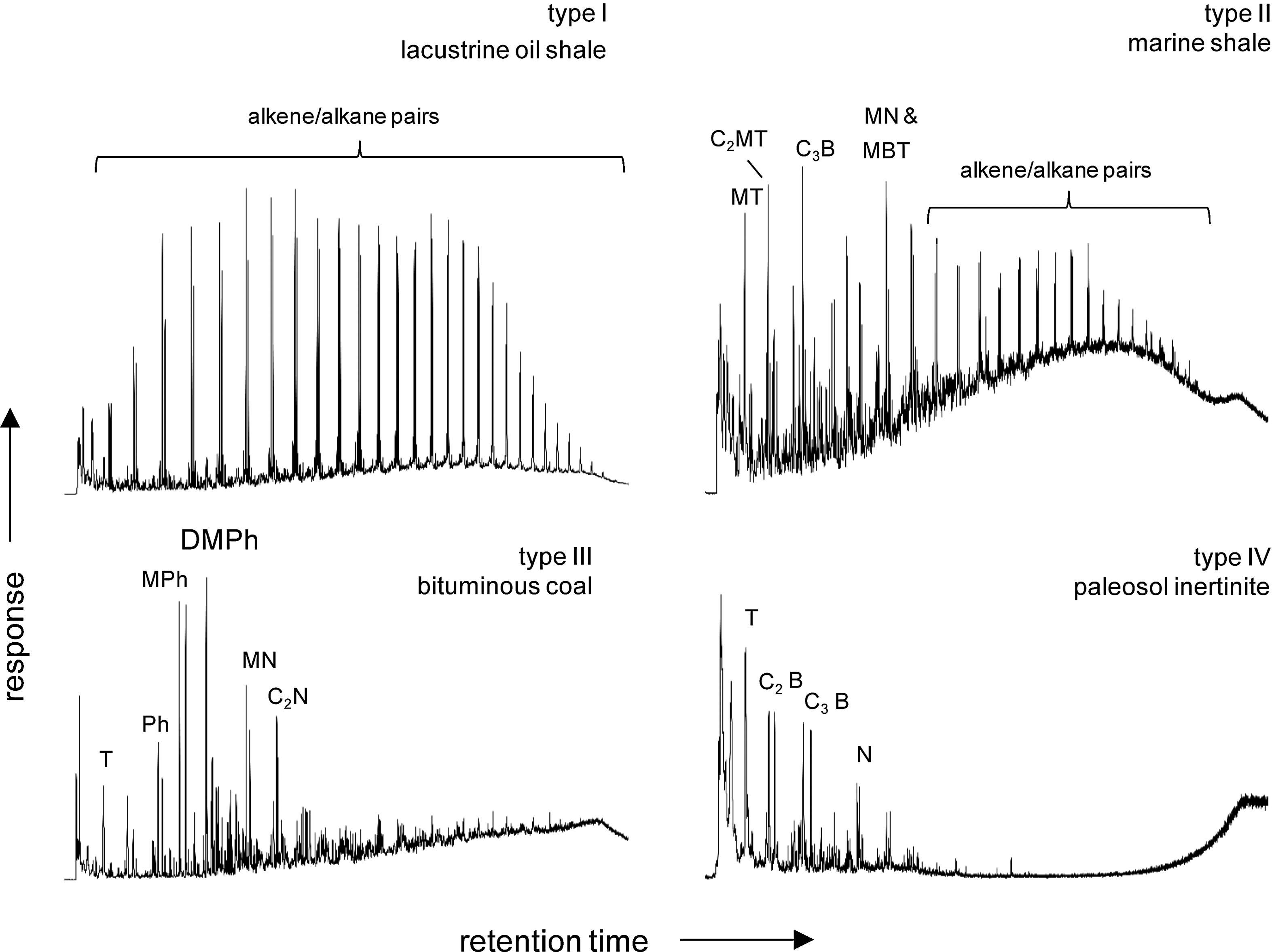
Total ion current pyrolysis chromatograms for the four main kerogen types. Type I, as represented by a West Lothian Oil Shale from Point Edgar in the Midland Valley of Scotland, was originally deposited in a lacustrine environment and is dominated by responses for n-alkenes and n-alkanes, which originate from lipids in freshwater algae. Type I kerogen is very poor in aromatic compounds. Type II, as illustrated by Kimmeridge Clay from Dorset in southern England, is often formed in marine environments, and as well as a high proportion of aliphatic material, also contains some aromatic units and large amounts of sulfur. Type III kerogen is formed mainly from higher plant material, and the large phenol responses as seen in the low volatile bituminous (LVB) coal example originate from lignin. Type IV kerogen is formed from heavily reworked higher plant material and, as shown by the results from Wakeham East GDB, has very limited aliphatic character and produces mainly simple aromatic compounds upon pyrolysis. The biogenic character of kerogen types I, II, and III immediately discounts them from further consideration as an analog material. The results from type IV kerogen, however, show many similarities to some types of carbonaceous chondrite. T, toluene; MT, methylthiophene; C2MT, C2-alkylthiophene; C2B, C2-alkylbenzenes; C3B, C3-alkylbenzenes; Ph, phenol; MPh, methylphenol; DMPh, dimethylphenol; N, naphthalene; MN, methylnaphthalene; MBT, methylbenzothiophene; C2N, C2-alkylnaphthalenes; Cn, alkene/alkane where n is carbon number.
3.2. Type III kerogens
Pyrolysis chromatograms of the type III kerogens represented by the four coals are shown in Fig. 2. Progressive thermal metamorphism increases the rank of coals in the order lignite<high volatile bituminous coal<low volatile bituminous coal<anthracite. The lignite pyrogram is dominated by phenol and methylphenols, which are derived from the remnants of lignin structural units within the biopolymer. Coals of high volatile bituminous and low volatile bituminous rank (HVB coal and LVB coal) produce pyrolysis chromatograms broadly similar to each other. They are dominated by phenolic components, with benzene and naphthalene occurring as relatively minor components. The HVB and LVB coals display significant aliphatic character, illustrated by the regularly spaced series of n-alkene/n-alkane doublets in the chromatogram, particularly for the HVB coal. The LVB and HVB coals also have an unresolved complex mixture (UCM) of coeluting compounds. The anthracite is almost entirely graphitic in nature and produces very few products upon pyrolysis at 600°C. Identified products include toluene, naphthalene, biphenyl, and phenanthrene.
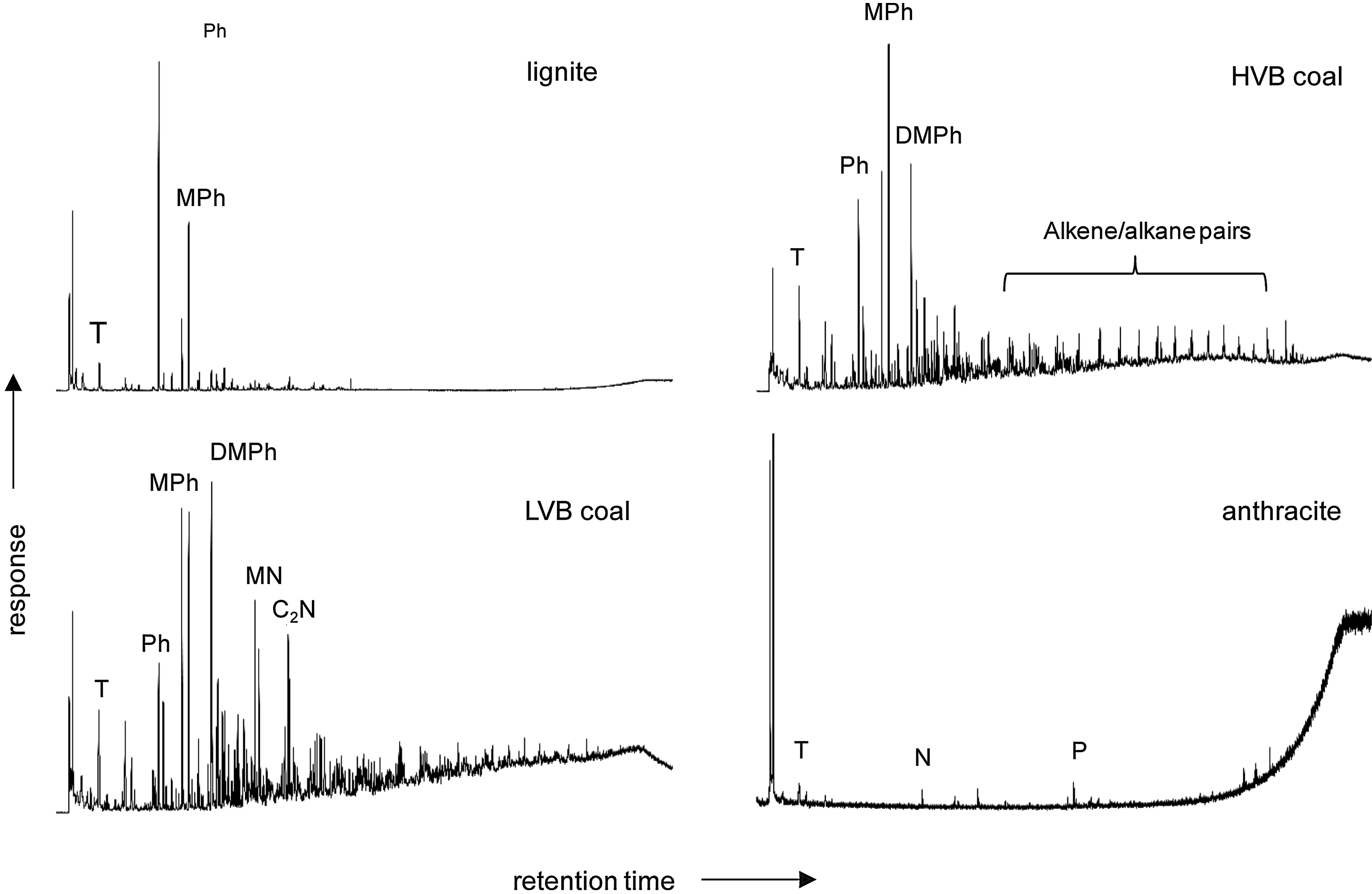
Total ion current pyrolysis chromatograms for lignite, HVB coal, LVB coal, and anthracite. All of these are type III kerogen, which has often been used as an analogue for meteoritic macromolecular organic material. The lignite, HVB coal, and LVB coal chromatograms are dominated by phenols, and the HVB and LVB coals have significant aliphatic character. These features are not found in meteoritic material. The anthracite is the most thermally metamorphosed and displays poor responses for simple aromatic compounds. T, toluene; Ph, phenol; MPh, methylphenol; DMPh, dimethylphenol; N, naphthalene; MN, methylnaphthalene; C2N, C2-alkylnaphthalenes.
3.3. Type IV kerogens
A comprehensive previous analysis of the Purbeck Dirt Bed paleosols indicates that they contain two varieties of organic material (Matthewman et al., 2012). One variety is disseminated refractory inertinite. When pyrolyzed, this material produces simple aromatic compounds and is most likely derived from degraded woody tissues and oxidized resins, as well as degraded microbial contributions. The other category is fusain (fossil charcoal), which is a subcategory of inertinite and identifiable by optical microscopy. Py-GC-MS of isolated fragments showed that the fusain was in some cases highly condensed and aromatic, having lost the functionalized and branched groups present in partially charred material to the subsequent effects of oxidation and microbial breakdown. The fusain is a carrier of nitrogen-containing groups that appear as benzonitrile after analytical pyrolysis. It is probable that these were formed by heating in the wildfire, which transformed proteins to benzonitrile precursors. n-Alkenes and n-alkanes form a greater part of the total pyrolysates for the LDB and BDB when compared to the GDB. A series of chromatograms illustrating the pyrolysis products observed from a number of Dirt Bed samples was presented by Matthewman et al. (2012). Although total organic carbon contents of the Dirt Beds can be quite significant, the extractable contents are low, and the GDB is the only one of the series that contains substantial amounts of extractable aromatic hydrocarbons. These organic compounds are most likely relics of Mesozoic processes (Matthewman et al., 2012). Lateral variations in the GDB are minimal.
3.4. Murchison meteorite
Pyrolysis–gas chromatography–mass spectrometry of CM2 meteoritic material releases a suite of low-molecular-weight aromatic hydrocarbons, with a significant response for naphthalene. Three- and four-ring polycyclic aromatic hydrocarbons (PAHs) are produced in much smaller amounts, showing a general decrease in response with increasing molecular weight. Alkylated benzenes and naphthalenes are the principal pyrolysis products, along with heteroatom-containing compounds, including benzonitrile, thiophenes, and phenols. The results are consistent with theories of macromolecular material structure that imply condensed aromatic units with carbonyl and other functional groups attached, all linked and decorated by short, branched aliphatic groups (Sephton, 2002).
3.5. Comparison of type III and IV kerogens with Murchison
When contrasting the pyrolysis responses for the type III kerogens (lignite, HVB coal, LVB coal, and anthracite; Figs. 1 and 2) and Murchison meteorite (Fig. 3), the type III kerogens produce a much wider diversity of aromatic compounds. The molecular weight of compounds from coals extends beyond the range typically detected for meteorites (Sephton, 2012). In addition, the UCM of coeluting compounds in the coals is not a feature of meteoritic pyrolysis chromatograms.
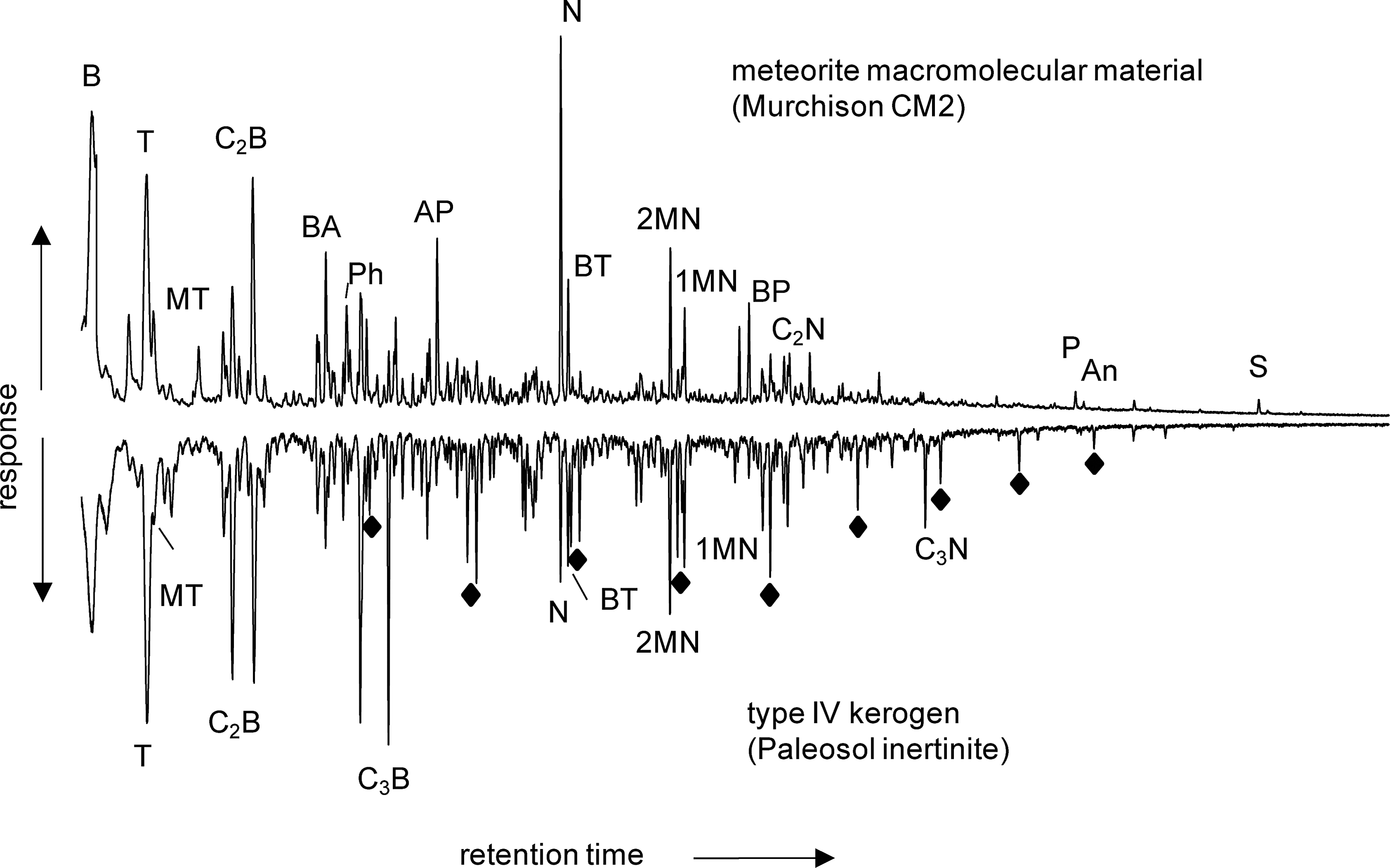
Detailed side-by-side comparison of total ion current pyrolysis chromatograms (600°C, single step) of Fossil Forest GDB, which contains type IV kerogen, and Murchison, a type CM2 carbonaceous chondrite. The relative responses of all samples have been scaled to allow comparison. It can be seen that the key responses from the meteorite are also present in the pyrolysis chromatogram of the type IV kerogen. Some biogenic character still remains in the type IV kerogen, evidenced by the exaggerated responses for certain C2- and C3-alkylbenzenes (C2B and C3B) and the alkene/alkane pairs (filled diamonds). The pyrolysis products and responses of this proposed analog material, a type IV kerogen, are a much closer match to the meteorite than type III kerogens (cf. Figs. 1 and 2). B, benzene; T, toluene; MT, methylthiophene; C2B, C2-alkylbenzenes; BA, benzaldehyde; Ph, phenol; C3B, C3-alkylbenzenes; AP, acetophenone; N, naphthalene; BT, benzothiophene; 2MN, 2-methylnaphthalene; 1MN, 1-methylnaphthalene; BP, biphenyl; C2N, C2-alkylnaphthalenes; C3N, C3-alkylnaphthalenes; P, phenanthrene; An, anthracene; S, sulfur; filled diamonds, alkene/alkane pairs. The response axes have been scaled to allow easier comparison.
The lignite, HVB coal, and LVB coal pyrolysis chromatograms display strong responses for methylphenols (Fig. 3). The lack of these compounds in the paleosols shows that the lignin macromolecule in the type IV kerogen is now almost completely degraded (Fig. 1). Phenol responses are readily detectable in the Murchison pyrolysis products (Fig. 3).
For a best possible source of type IV kerogen, Fossil Forest GDB was chosen from the three Purbeck paleosols as being most similar to meteoritic organic material. Pyrolysis chromatograms of both Tout Quarry LDB and Tout Quarry BDB had appreciable responses for aliphatic compounds. Moreover, from the four samples taken from the Great Dirt Bed (Fossil Forest GDB, Wakeham East GDB, Kingsbarrow GDB, Tout Quarry GDB), Fossil Forest GDB was chosen as the proposed analogue since it produced the strongest responses and hence best signal-to-noise ratio for individual organic compounds. Detailed pyrolysis chromatograms of Fossil Forest GDB and Murchison are shown side by side in Fig. 4. It can be seen that the two macromolecular materials produce qualitatively similar pyrograms. Key differences include the slightly aliphatic nature of the kerogen and the distributions of particular aromatic isomers. However, low-molecular-weight aromatic compounds are still the dominant components in both pyrolysates. A trimethylbenzene pair (1,2,4- and 1,2,3-trimethylbenzene) is notably enhanced in the paleosol signal compared to the Murchison meteorite. These may derive from compounds used in photosynthesis and carotenoids from microbes (Hartgers et al., 1994). Naphthalene forms the dominant response for the Murchison meteorite, but this is not the case for the paleosol. Both macromolecules release thiophenes, including benzothiophene, which elutes immediately after naphthalene.
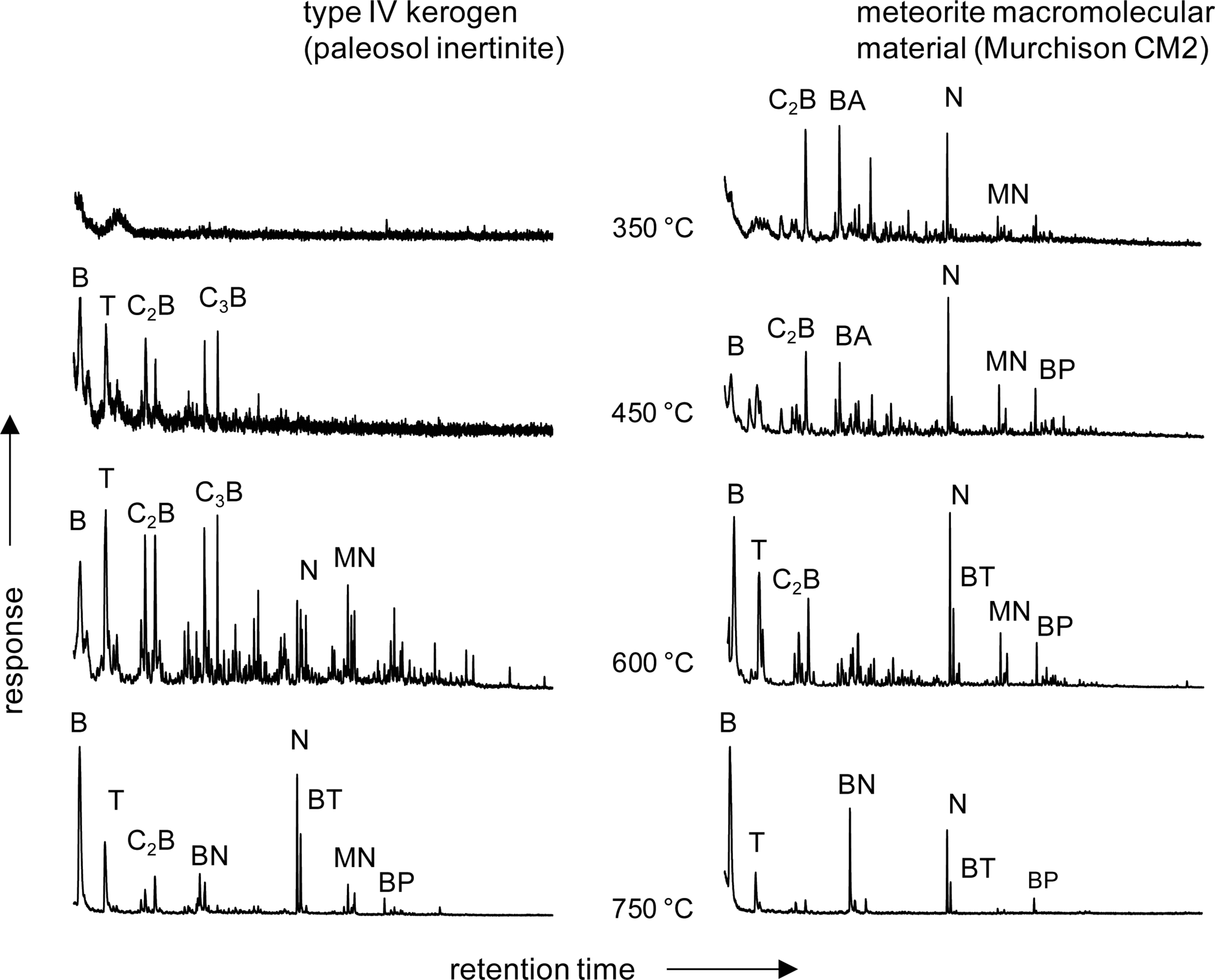
Total ion current pyrolysis chromatograms for sequential multistep pyrolysis analysis. Fossil Forest GDB, a type IV kerogen, is a proposed macromolecular organic material analogue for aqueously altered carbonaceous chondrites, represented here by the Murchison (CM2) meteorite. Compounds begin to be released at a lower temperature for Murchison compared to Fossil Forest GDB, and there are also some differences between the types of compounds released at 450°C. However, at 600°C the types of compounds released and responses are similar. B, benzene; T, toluene; C2B, C2-alkylbenzenes; C3B, C3-alkylbenzenes; BA, benzaldehyde; BN, benzonitrile; N, naphthalene; BT, benzothiophene; MN, methylnaphthalene; BP, biphenyl. Horizontal axis scales (retention time) are equivalent; vertical scales between chromatograms not equivalent.
3.6. Multistep pyrolysis
After a potential analogue in the paleosols was identified, the Fossil Forest GDB sample was subjected to sequential multistep pyrolysis alongside Murchison (Fig. 4). The data reveal both relative thermal stability and heterogeneity for the two macromolecular samples. It can be seen that meteoritic material is more susceptible to break-down at lower temperatures. At 350°C, there are no compounds released from the Fossil Forest GDB kerogen, while a small labile fraction of the macromolecular material in Murchison is cleaved, producing C2-alkylbenzenes, benzaldehyde, and naphthalene as the main responses. At 450°C, the paleosol releases benzene and C1-C4-alkylbenzenes, while Murchison releases a wide range of products, including C4-alkylbenzenes, benzaldehyde, naphthalene, and biphenyl. The 600°C step in both cases is sufficient to cleave the C–C bonds in the macromolecular material, and a wide range of organic compounds are released, primarily alkylated benzenes and naphthalenes from both samples (cf. Fig. 3). A further step at 750°C shows that both samples have a core refractory macromolecular component indicated by dominant benzene and naphthalene responses.
3.7. X-ray diffraction
X-ray diffraction spectrometry showed Fossil Forest GDB and Wakeham East GDB to be composed mainly of calcium carbonate, silica, and clay. This is greatly different to the matrix of aqueously altered type 2 chondrites, which is mainly serpentine clay (e.g., Howard et al., 2009).
4. Discussion
4.1. Type IV kerogens as analogues
It cannot be expected that a terrestrial analog material that formed in a different environment than an asteroid parent body will provide a perfect match for meteoritic organic matter. For instance, biases in the distribution of particular structural isomers will continue to reflect a biological origin in the terrestrial material. Despite this, the paleosol-derived type IV kerogen investigated here can reproduce many of the key compound classes present in the meteoritic material and provide a useful alternative for certain experimental procedures. Benzene, naphthalene, and their alkylated derivatives along with sulfur, nitrogen, and oxygen-containing aromatic compounds are present in both type IV kerogen and meteoritic macromolecular material. Importantly, the key biomarker molecules present in other kerogen types (e.g., alkanes and methyl phenols) have largely been removed and lost during the reworking and oxidation that lead to the production of type IV kerogen.
Multistep pyrolysis highlights the structural differences between the kerogen and meteoritic macromolecular material (Fig. 4). The meteoritic macromolecular material has a labile fraction that is accessed at a lower temperature (350°C) than its counterpart in the type IV kerogen (450°C). The first-released products also differ between the two materials; benzene and C1-C3-alkylbenzenes are the only significant responses from the type IV kerogen, while Murchison is dominated by C2-alkylbenzenes, benzaldehyde, and naphthalene. At 600°C, pyrolysates are similar between the two materials. Importantly, the 750°C heating step shows that both macromolecules have similar core components, including nitrogen-containing precursors bound in the structure that are manifested as benzonitrile after analytical pyrolysis. The distribution of pyrolysis products in Murchison is not consistent through all the temperature steps of the multistep analysis (Table 2). This illustrates the heterogeneity of the macromolecular organic components in Murchison, which have thermally sensitive assemblages alongside more robust fractions, possibly reflecting an agglomeration of materials from different environments. The type IV kerogen on the other hand has experienced a systematic alteration pathway from original vegetation, through to oxidation at the surface, burial, diagenesis, and subsequent re-exposure at the surface outcrop.
Filled boxes indicate firm detection and identification of the compound. Fossil Forest GDB (type IV kerogen) shows a systematic release of compounds with increasing temperature of pyrolysis. This feature is not shared by the meteorite, which shows varying release of compounds reflecting the non-equilibrium nature of the organic components in the rock.
4.2. Limitations of the analogues
A notable drawback of using paleosol type IV kerogens as a meteorite analogue is that the rock matrix has a very different mineral makeup than that of meteorites. CM chondrites such as Murchison are largely made up of serpentine-type minerals, with smaller amounts of pyroxenes and olivine (e.g., Howard et al., 2009). The paleosols analyzed in this study consist of calcium carbonate, silica, and clay. Different mineral suites have the potential to cause varying matrix effects during analysis. In the case of pyrolysis–gas chromatography–mass spectrometry, certain clays have a catalytic effect on the thermal decomposition of organic matter (Horsfield and Douglas, 1980; Espitalié et al., 1984; Faure et al., 2006). Kerogen isolation by sequential HF-HCl acid digestion of the minerals can be applied to remove matrix effects. The absence of particular compounds of interest or the presence of undesirable entities in the analog material compared with the meteoritic macromolecular materials may be addressed by examining a wider range of type IV kerogens. The type IV kerogen analyzed here represents one particular depositional environment and sequence of diagenetic conditions. The work serves to draw attention to the potential for type IV kerogens as analogues and promote the identification of other type IV kerogens with features desirable for particular applications.
4.3. Astrobiological applications of analog materials
Hydrocarbons are extremely valuable astrobiological tools because structural information within this broad compound class can help distinguish between materials of biotic or abiotic origin. Hydrocarbons, particularly aromatic compounds, also have the advantage of being robust and can persist in environments that would quickly destroy fragile amino acids and other biomarkers. The martian surface represents one such harsh environment, with oxidizing soils and intense radiation destroying organic materials in the surface layers. In such a locality, refractory aromatic macromolecular material might be the only material that can survive for any significant length of time (McDonald et al., 1998).
The next generation of rovers and science platforms are currently under development and will be sent to Mars within the next two decades. The role of type IV kerogen analog materials in preparing for these missions could be twofold: firstly, as a suitable experimental substitute for abiotic materials, principally from carbonaceous chondrites, which will have been accumulating on the martian surface over geological time; and secondly as a fossil biological analogue for ancient organic material that may lie preserved in martian sediments. Determining structural biological signatures in heavily degraded terrestrial kerogens could aid in the identification of relict signatures in any discovered martian macromolecular material.
5. Conclusions
Type IV kerogens in Jurassic paleosols, formed from reworked and oxidized plant materials, provide good analogues for macromolecular carbon in carbonaceous chondrites, as assessed by py-GC-MS. This study has shown the close correspondence between pyrolysis products of type IV kerogens and aqueously altered carbonaceous chondrites. The analogues can be used for the training of researchers; the development of new extraction, preparation, and analysis techniques; the monitoring of contamination mechanisms by the use of “witness” materials; and the optimization of instruments developed for in situ analysis on space missions. Because of their terrestrial source, sample supply is not a concern, and large amounts of material can be collected and distributed for use by a range of scientists.
Footnotes
Acknowledgments
The authors wish to thank the Science and Technology Facilities Council and the Royal Society for financial support, Martin Gill for performing XRD analysis, and Amer Syed for providing coal samples.
Author Disclosure Statement
The authors state that no competing financial interests exist.