




Abstract
Extrasolar Earth and super-Earth planets orbiting within the habitable zone of M dwarf host stars may play a significant role in the discovery of habitable environments beyond Earth. Spectroscopic characterization of these exoplanets with respect to habitability requires the determination of habitability parameters with respect to remote sensing. The habitable zone of dwarf stars is located in close proximity to the host star, such that exoplanets orbiting within this zone will likely be tidally locked. On terrestrial planets with an icy shell, this may produce a liquid water ocean at the substellar point, one particular “Eyeball Earth” state. In this research proposal, HABEBEE: exploring the HABitability of Eyeball-Exo-Earths, we define the parameters necessary to achieve a stable icy Eyeball Earth capable of supporting life. Astronomical and geochemical research will define parameters needed to simulate potentially habitable environments on an icy Eyeball Earth planet. Biological requirements will be based on detailed studies of microbial communities within Earth analog environments. Using the interdisciplinary results of both the physical and biological teams, we will set up a simulation chamber to expose a cold- and UV-tolerant microbial community to the theoretically derived Eyeball Earth climate states, simulating the composition, atmosphere, physical parameters, and stellar irradiation. Combining the results of both studies will enable us to derive observable parameters as well as target decision guidance and feasibility analysis for upcoming astronomical platforms. Key Words: Bioastronomy—Extrasolar planets—Extreme environments—Extremophiles—Habitable zone. Astrobiology 13, 309–314.
1. Introduction
However, planets close enough to M dwarf stars to be located within the habitable zone are likely to be tidally locked (Joshi, 2003; Joshi et al., 1997). Warmer, tidally locked planets orbiting late-type hosts have been previously studied, for example, Joshi (2003) and Joshi et al. (1997) and Edson et al. (2011). Here, we propose to study the habitability of tidally locked planets with a focus on one particular possible habitable configuration for such a planet at the outer, colder edge of the habitable zone: an Eyeball Earth (Fig. 1). An Eyeball Earth will exist where water is present in a large enough fraction to produce an icy shell with a liquid ocean at a substellar point (Pierrehumbert, 2011; Pierrehumbert and Gaidos, 2011). The Eyeball state is one possible climate scenario for the recently confirmed exoplanet GJ 581g (Vogt et al., 2010; Pierrehumbert, 2011). Maintaining a stable Eyeball Earth requires the lack of significant heat exchange between the near side and far side of the planet so that the heat produced by high solar flux at the substellar point is not evenly distributed. As Eyeball Earths in this configuration can maintain liquid water combined with relatively strong observable differences between their day- and nightside, they are potentially the easiest habitable terrestrial planets to detect and distinguish from other possible configurations by using a combination of transit, eclipse, and phase curve observations. However, little is known about the detection limits and habitability conditions of Eyeball Earths.
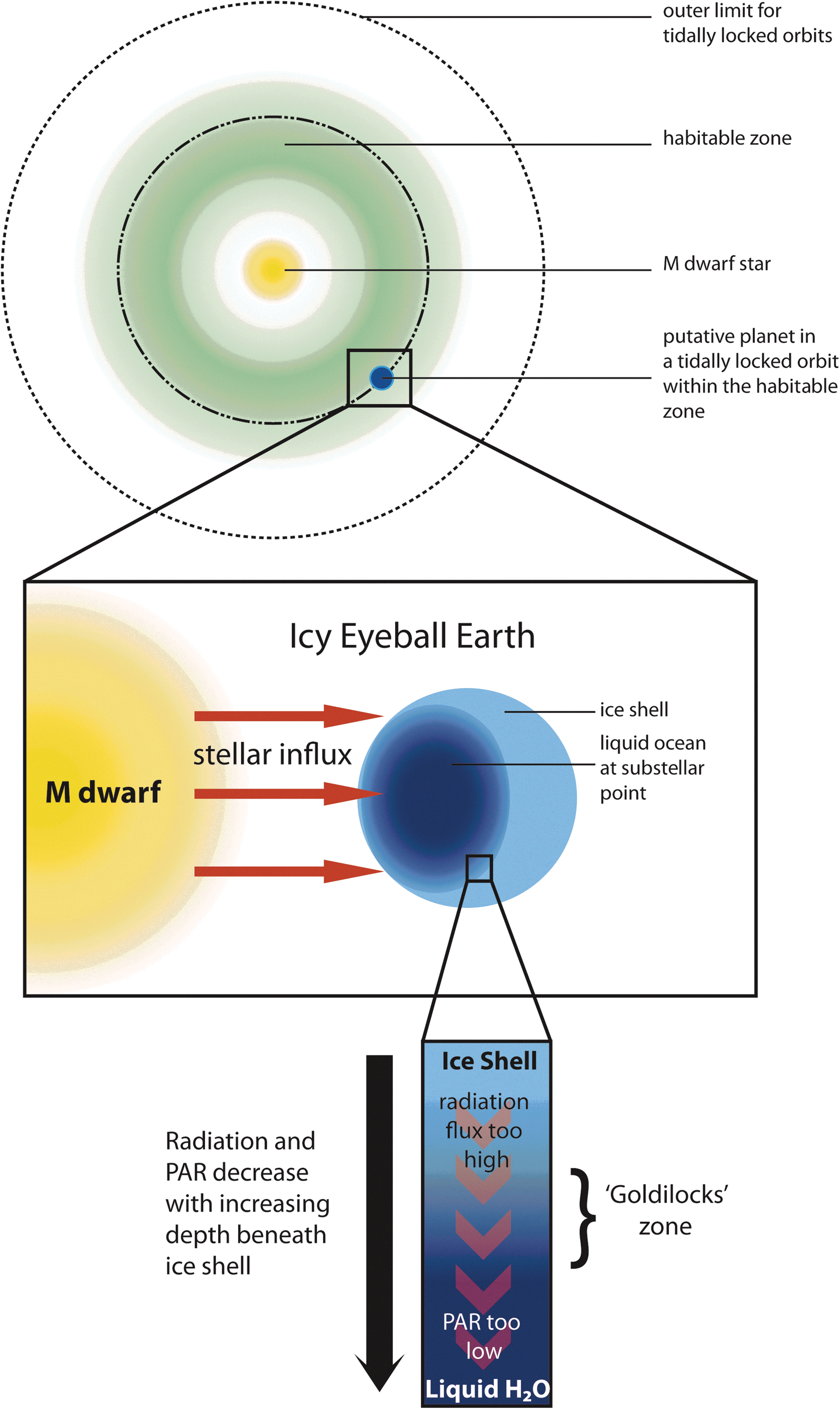
Schematic of idealized icy Eyeball Earth. Top: Putative M dwarf planetary system. Any planet orbiting within the habitable zone surrounding an M dwarf star will also be tidally locked. Inset 1: Icy Eyeball Earth. An icy Eyeball Earth orbiting at the right distance may have a liquid water ocean at the substellar point surrounded by an icy shell. Inset 2: The interface between the ice shell and the liquid water ocean may be potentially habitable. Characterization experiments conducted with analog microbial communities from the Antarctic ice shelf will determine the optimal distance within the water column that will provide adequate protection from stellar radiation yet allow enough PAR through the ice layer to allow for photosynthetic metabolism and temperatures consistent with metabolically active life as we know it on Earth. (Color images available online at
Here, we present a summary of a 3-year research proposal drafted at the São Paulo Advanced School for Astrobiology to prepare for upcoming observations of Eyeball Earths. Our proposal requires an interdisciplinary approach to determine the detection limits and habitability potential of Eyeball Earths. In the first phase, an astrophysics team will determine the detection limits for various parameters of Eyeball Earths that define the habitability potential of these objects. The astrophysics team will define the range of conditions around M dwarf stars where planets can exist in Eyeball states and, based on these models, derive the most probable set of astronomical, geological, and chemical parameters to describe the planet's climate (atmosphere, soil composition, stellar irradiation, etc.). Using these results, in the second phase of our proposal, a biology team will determine the habitability potential for putative organisms in Eyeball Earth environments. The primary biological experimental goal (see Section 3.3) is to modify an existing planetary/space simulation chamber to reproduce the modeled parameters that reflect the environmental conditions of an icy Eyeball Earth. An Antarctic expedition will observe organisms on an ice/water interface. Combined, our results will determine the detection limits for various parameters of Eyeball Earths that define the habitability potential of these objects.
2. Astronomical Characterization of Eyeball Earth Environments
In Phase 1 of our proposed research, an astronomy team will determine the stability limits of Eyeball Earths, define the radiation environment at the surface of stable Eyeball Earths, and determine the formation and destruction rates for molecules in ice at the surface of Eyeball Earths. The biology team will use these results to determine the potential habitability of Eyeball Earths.
2.1. Potential limits of a stable Eyeball state
A stable Eyeball Earth consists of an ice shell over a rocky interior and a stable liquid water ocean at the substellar point. If the planet has an atmosphere or surface/ocean that effectively transports heat from the substellar point, the formation of an Eyeball Earth state is less likely to occur than would a completely frozen Snowball Earth state (Lucarini et al., 2010). We will construct various models of Eyeball Earth temperature distributions based on the planetary conditions, such as mass, distance from star, and incoming stellar radiative flux, to determine the range of conditions where Eyeball Earth states are stable. These calculations will determine the mass, orbital distance, and stellar types where Eyeball Earths can exist in either a stable or transient state and will produce surface temperature distributions for these states that will be used in later analyses. We will determine potential Eyeball Earth candidates in the current catalogue of extrasolar planets and in future survey results. Our work will provide general and extreme cases for potential stable Eyeball Earths that we can use to predict observable limits for their detection and characterization.
2.2.1. M dwarf emission spectra/activity
Early-type M dwarfs are rarely active (a few percent in the field) in contrast to the very active mid- to late-type M dwarfs (maximum at around spectral type M7; Browning et al., 2009). Studies of X-ray, UV, and radio emission from active low-mass stars show that a large amount of energy is released at non-optical wavelengths. However, the small sample sizes of characterized M dwarfs and incomplete spectral coverage limit our ability to understand the prevalence and duration of the non-optical radiation. With regard to the activity of M dwarf stars, the main goal of the observational astronomy proposal is to close this knowledge gap by (1) collecting all known characteristics of M dwarf star radiation and the parameters of their bursts and flares; (2) conducting optical and IR spectroscopic survey observations of M dwarf stars to determine the spectral distribution of their continuous radiation as well as stellar parameters such as metallicity, radius, or age; and (3) conducting multiband time-series observations of M dwarf activity bursts to determine their frequency, intensity, and spectral distribution. The results of this literature review together with an observational campaign will enable us to define the incoming radiation as well as temporal changes in particular wavelength bands. The collected data will be used to simulate the energy emission of M dwarf stars in the habitability chamber.
2.3. Astrochemical implications due to the action of ionizing agents in the surface of an eyeball planet
To understand the radiation environment on an M dwarf planet, the flux of energetic electrons, protons, ions, stellar photons, and meteoroids must be considered (Vasyliunas and Siscoe, 1976). The surface of the planet could be modified as a consequence of an environment that would cause sputtering (physical changes caused by erosion of the surface from incoming energetic particles) and chemical changes, caused by the impact of ionizing radiation such as stellar wind, cosmic rays, and so on (e.g., Plainaki et al., 2010). Dissociation and chemical reactions produced by ionizing radiation (radiolysis and photolysis) could also release energy that can cause the ejection of chemically unstable atoms or molecules. The existence of such an ionizing environment would increase the chemical complexity of the system over time.
We propose to determine the formation and destruction rates of molecules in ice by ionizing agents by utilizing the Brazilian National Synchrotron Light Source (LNLS,
3. Biological Significance of Eyeball-Earth Exoplanets
The primary biological experimental goal (see Section 3.4) is to carry out simulation experiments with a genetically characterized cold- and UV-tolerant microbial community from a terrestrial analog environment in a modified Mars chamber that reflects the modeled parameters for an icy Eyeball Earth. The astronomical parameters that define the conditions on these planets, which would have been derived in phase 1, are needed to feed the construction and parameters of this chamber.
3.1. Remote sensing of biosignatures
In general terms, a biosignature is a feature that is interpreted to have formed through a biological mechanism and cannot be explained nor generated through abiotic processes. For a biosignature to be detectable, it must (1) have a biological generation rate greater than any abiotic sources and greater than decomposition mechanisms allowing atmospheric accumulation: (2) be detectable through spectral observations (spectral signature in a wavelength region accessible to instrumentation, concentration such that there is a significantly large signal-to-noise ratio, and a unique signature distinguishable from other atmospheric components; after Domagal-Goldman et al., 2011).
The metabolic activity of microorganisms on Earth produces several disequilibrium gasses that would constitute spectrally observed biosignatures (e.g., Seager et al., 2012; see Berkner and Marshall, 1965, for a discussion of the rise of O2 on Earth as a consequence of biological activity). Observations of Earth's spectrum reflected off the dark side of the Moon (Earthshine) allow Earth to be viewed as an extrasolar planet. Turnbull et al. (2006) concluded that the “simultaneous presence of oxygen and methane [is a] strong indicator of biological activity.” As such, the microbial biomass on Earth is sufficient to produce metabolic by-products that can be detected spectrally and interpreted as biosignatures when Earth is viewed as an extrasolar planet through “earthshine” observations (Turnbull et al., 2006; Seager et al., 2012, and references therein). Important Earth-based biosignature gasses include O2 (and O3), N2O, and CH4 (Seager et al., 2012). There are several remotely observable biosignatures, including spectral observations of disequilibrium gas phases produced by photosynthesis such as CO2, in addition to O2. The detection of atmospheric oxygen is an important biosignature (Léger et al., 2011) particularly if the astronomical study can exclude hydrogen escape as a possible abiotic source of oxygen. Presently, only CO2, O2, O3, and H2O would be detectable on an Earth-like exoplanet (Selsis, 2004; Selsis et al., 2008).
Despite the ability to recognize Earth-based biosignature gasses and predict the presence of out-of-equilibrium gasses that may be interpreted as biosignatures on extrasolar planets, the detection, spectroscopic observation, and subsequent characterization of such biosignatures from exoplanets is currently out of technological reach (Seager et al., 2012, and references therein). In this proposal, we aim to develop a set of criteria to identify potentially habitable Eyeball Earth exoplanets for further spectroscopic observation. Questions of specific biosignature gasses and the active geological processes required to allow for the buildup and persistence of atmospheric biosignatures on putatively habitable Eyeball Earths are problems to be tackled as technology advances. The data sets generated by HABEBEE will provide the fundamental framework for directed observational studies of potentially habitable tidally locked exoplanets around M dwarf stars.
3.2. Assessing the habitability potential of photosynthetic organisms
A habitable Eyeball Earth must thermodynamically support active microbial metabolism. Photosynthetic organisms are limited by the thermostability of chlorophyll, and survivability rapidly declines at temperatures over 75°C (Pikuta et al., 2007). To assess the plausibility of photosynthesis as a viable metabolism, the putative limits of photosynthetically active radiation (PAR) available to a photosynthetic community on an Eyeball Earth must be determined. We propose to study PAR through the hypothetical ice cap on a habitable Eyeball Earth. Using the models and observations from our astronomical teams, we will establish depth limits of a putative photosynthetic community living in the ice shelves of an Eyeball Earth. Part of our analysis will involve testing the capacity of ice as a protective shield against UV radiation. This will lead to further microbial survivability studies that will constrain the UV shielding effects of ice as well as the depth to which PAR is available (Fig. 1). Since tidally locked planets do not have day/night cycles, our experiment will also test continuous exposure to incoming radiation.
The absence of sufficient PAR, however, does not preclude the existence of life on Eyeball Earths. Assuming a geologically active planet, active submarine hydrothermal systems such as those on Earth may theoretically support chemolithoautotrophic microbial communities. Additionally, given the distribution of elements in the Solar System, where basalt is the dominant rock type, and the potential that this can be extrapolated to other planetary systems, it is hypothesized that chemoautotrophic metabolisms based on basaltic minerals (e.g., olivine and serpentine) may exist within the lithosphere or at the lithosphere-atmosphere boundary of an Eyeball Earth exoplanet. The potential of alternative metabolic systems will also be tested within the simulation chamber constrained by the modeled physical parameters derived by the astrochemistry team. Using known terrestrial chemolithotrophic metabolisms, we can model the thermodynamic possibility of such metabolisms existing on a hypothetical Eyeball Earth.
3.3. Sampling and characterization of Earth analog extremophiles
By studying the conditions under which extremophilic organisms thrive on Earth, theoretical limits to life can be imposed, and hypothetical habitable environments can be extrapolated to occur on other planets such as Eyeball Earths. A sampling expedition to Antarctica (in cooperation with the Brazilian Antarctic Program, PROANTAR,
Characterizing the microbial community at the Antarctic ice-water boundary will involve available metagenomic analyses (e.g., high-throughput shotgun 16S metagenomic analysis to determine the dominant species in the community followed by functional gene assays). Such genomic and functional assays will provide information on putative microbial metabolisms active in this transition zone on an Eyeball Earth and can be conducted within the biology laboratories of the National Center of Research in Energy and Materials (CNPEM,
3.4. Experimental setup of a simulation chamber
Based on the models and observations of the astronomy teams, we will construct the environmental parameters for possible habitable Eyeball Exo-Earths. Samples from the above-mentioned analog environments will be subjected to modeled conditions in the planetary/space simulation chamber built at the Brazilian Astrobiology Laboratory (AstroLab,
4. Summary
We have shown how the proposed project HABEBEE will determine the range of conditions where stable Eyeball Earths can form and the environmental conditions on these planets. This will be complemented for the first time by an experimental biological survey of the habitability potential of Eyeball Earths. The proposed project is a unique cross-disciplinary combination of astronomical and biological research, with strong connections to geology, atmospheric chemistry, and biology. During the preparation of this contribution, we also carried out an extensive feasibility study. We were able to show that the described program will be viable within the parameters given in the assignment of our research focus group. The research will also be well integrated into other projects at the University of São Paulo and the infrastructure available in Brazil (LNLS, PROANTAR, CNPEM, AstroLab; Rodrigues et al., 2012).
The results of the proposed research are not limited to Eyeball Earths and can be generalized to other types of extrasolar planets that contain liquid water-ice boundaries. The derived parameters for the M dwarf environment can be used to study the habitability of different planetary configurations such as the terminator region of the dry and rocky exo-Earths.
Follow-up studies in which the project results are used may derive possible biomarkers from the interaction of extremophiles with the simulated climate and their observable signatures, for example, in transit and eclipse light curves. These results will enable us to construct a catalogue of potential targets with the best habitability conditions and to determine the magnitude of the expected Eyeball signatures. This will constrain the feasibility of Eyeball Earth detection and characterization and the instrument specifications necessary for upcoming astronomical platforms.
The herein-presented research program will tackle central questions in the science of habitability of extrasolar planets that may feasibly be solved over the course of the next few years. The characterization of close-in and tidally locked planets in the habitable zone of M dwarfs is an important component for the development and dedicated use of advanced instrumentation to enable imaging and spectroscopy of Earth-like planets orbiting in the habitable zones of nearby stars.
Footnotes
Acknowledgments
The authors want to acknowledge FAPESP (São Paulo Research Foundation) and Universidade de São Paulo for the financial support to attend the São Paulo Advanced School of Astrobiology—SPASA 2011. We would also like to thank Dr. Lisa Kaltenegger for discussions that have greatly benefited this proposal.
Author Disclosure Statement
No competing financial interests exist.
Abbreviation
PAR, photosynthetically active radiation.