




Abstract

Early Times
By the age of 14 I was already exploring old mines with my friends (all boys of course—girls did not do such things). It's a wonder I survived, given the stupidly dangerous things we did. By 16 I had joined a caving club, which was less dangerous because we had some agreed standards and looked after each other. It was those adventures that turned me into a paleontologist. Many of the caves, most previously unexplored, contained bones of Holocene and Pleistocene marsupials, placental mammals, and birds. My course was set: I was going to become a vertebrate paleontologist.
On the Shoulders of Giants
I entered the University of Adelaide in South Australia at age 17 and found myself in a geology department with a distinguished history. I fell under the spell of Sir Douglas Mawson, in my view the greatest-ever explorer of Antarctica and one of Australia's great geologists. He had died four years previously, but his legacy surrounded me: his wooden dog sleds, skis, and stocks, and his specimens. His 1911–1914 expedition to Antarctica was legendary for many reasons—he and his team were compelled to eat their dogs, he nearly died, his companions did die, he wrote an engaging book (The Home of the Blizzard), he produced a large body of scientific literature, he was knighted, and he went on to be Professor of Geology and Head of the Department of Geology at the University of Adelaide. I have always regarded him as my hero; I still do.
In those days in Australia students tended to stay at the same university for both their undergraduate and graduate studies. I found myself in the thrall of another very special man, Martin Glaessner, who in the 1960s was one of the world's leading paleontologists. He had two doctorates from the University of Vienna—one in law, the other geology and paleontology. He was originally an expert on foraminifera; by the time I met him he was concentrating on the Ediacara fauna of early metazoans, abundantly represented in the Flinders Ranges north of Adelaide. To me Glaessner was the epitome of the European professor: eminent, aloof, erudite, and multilingual; and to cap it all off he was married to a Russian ballerina. He traveled overseas several times every year, something unimaginable to me and my fellow students. No callow youth such as myself could aspire to such a life.
In 1965 I completed my undergraduate degree, including some research on Archaeocyatha (Cambrian sponge-like fossils) that led to my first publication. At 21, I married a fellow caver, Marilyn Coppin, and embarked upon research for a doctorate. But my research was not to be on vertebrate fossils from caves. At the time I didn't know it, but before Mawson died Glaessner promised him that he would find a student to work on the large collection of Precambrian and Cambrian stromatolites Mawson had made in South and central Australia (stromatolites are microbially influenced sedimentary structures). Glaessner also knew about recent work in the Soviet Union where stromatolites were being used in biostratigraphy. So out of the blue and while on my honeymoon in Sydney I got a phone call from the great Professor Glaessner telling me that I would never get a job as a vertebrate paleontologist and that he had obtained a scholarship for me to study stromatolites. I try to avoid clichés but, well, the rest is history. Glaessner omitted to tell me that nearly all the literature was in Russian.
Good Advice and Good Fortune
The first year of my Ph.D. was spent studying structures that had been described as stromatolites in banded iron formations in Western Australia. They proved to be pseudofossils—abiogenic and diagenetic. That set me on the path of having great skepticism toward records of early life, and over the years I have debunked many such interpretations. “Finding the Gold among the Dross” is the title of one of my papers with Andy Knoll of Harvard (who has many talents, one of which is composing great titles for his papers). Knoll also taught me the value of seeking out the most exquisitely preserved fossils.
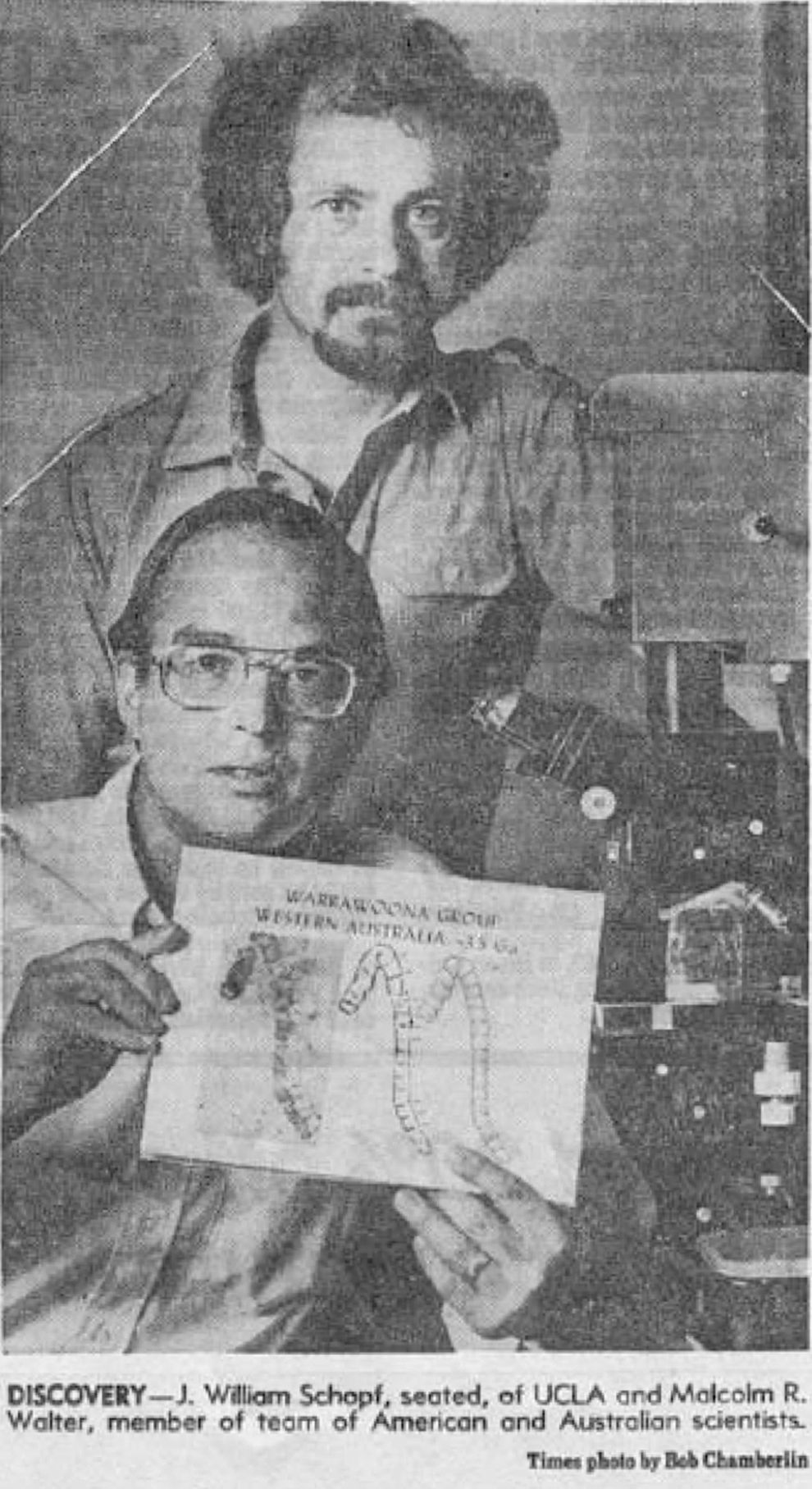
An early foray into outreach, with Bill Schopf at UCLA. Microfossils from the Pilbara discovered by Stan Awramik. Front page of the Los Angeles Times, about 1980. Photo by John M. Hayes.
A seminal event was my being invited by Brian Skinner to go to Yale on a postdoctoral fellowship. In 1971 it was my first overseas trip. Skinner had been in Adelaide on sabbatical at the time when I was completing my doctoral research, and Glaessner told him about my plan to refute the interpretation of the brilliant geologist Preston Cloud Jr. that giant stromatolites of Cambrian age indicated that the Moon was close to the Earth at that time (based on the interpretation, derived from studies in Shark Bay in Western Australia, that stromatolites are intertidal phenomena the maximum size of which reflects the tidal range, now known to be quite wrong). I think such audacity on the part of a student appealed to an iconoclastic streak in Skinner's nature. It was the time of one of the “mining booms” in Australia, and I, like many budding geologists, had several lucrative job offers. It was a pivotal point in my career: academic or applied, “penury or wealth.” With Glaessner's unequivocal encouragement, I chose the former. I have no regrets.
While browsing in the Barr Smith Library at the University of Adelaide, I had come across a beautifully illustrated U.S. Geological Survey monograph from 1889, by Walter H. Weed, on the silica and carbonate deposits of the hot springs in Yellowstone National Park. It was a case of chance favoring the prepared mind. I was interested in siliceous stromatolites in iron formations, and here was a potential modern analogue. At the time it was assumed that all stromatolites were originally calcareous, including those of the already famous Gunflint Iron Formation of Canada. So I decided that would be the focus of my research at Yale. I made contact with the eminent microbiologist Tom Brock in Wisconsin and joined his group for fieldwork. I have worked in Yellowstone on and off ever since.
Glaessner still loomed large in my life; when I finished my two years at Yale, he persuaded Norman Fisher, director of what was then called the Bureau of Mineral Resources in Canberra, that the bureau needed a Precambrian paleontologist. So I got the job and stayed there for 16 years. I learned a great deal of good basic geology while mapping in the Simpson Desert; documenting a lot of stratigraphy, sedimentology, and paleontology Australia-wide; and tidying up the record of Precambrian life in Australia, sometimes working with my former co-student and colleague Wolfgang Preiss.
The PPRG and Other Legends
During my time in Canberra I was approached by Bill Schopf of the University of California, Los Angeles (UCLA) to become part of a team that would document and interpret the earliest history of life on Earth. I had known Schopf since he was a graduate student at Harvard and had visited Australia to collect fossiliferous black chert from the Neoproterozoic Bitter Springs Formation of the Amadeus Basin. It was a big request, to move back to the US for more than a year with my family, by then including two young children. I was happy where I was in Canberra and equivocated for quite a while but eventually decided that it was too good an opportunity to miss—and my wife supported the decision. It proved to be quite a remarkable 15 months during 1980–1981, in many ways, and opened my eyes to interdisciplinary research. My mind was already prepared for such an approach, as early during my doctorate in Adelaide I had worked with a biologist (and Preiss) to study extant stromatolites (as had Mawson long before me), and that had been reinforced by my research in Yellowstone. But Schopf's team, the Precambrian Paleobiology Research Group (PPRG) was much broader and much more intense. It was a crash course in team-based research, and it would not have succeeded without Schopf's prodigious energy and distinctive talents. I have worked with him as a friend on and off ever since, and it has never ceased to be enlightening. It was also my introduction to isotope geochemistry with my friend maestro John Hayes as my (usually) patient tutor, ably supported by Manfred Schidlowski. I have dabbled in isotope geochemistry ever since. The PPRG was a remarkable group with remarkable talent, and we repeated the exercise a few years later with a focus on the Proterozoic.
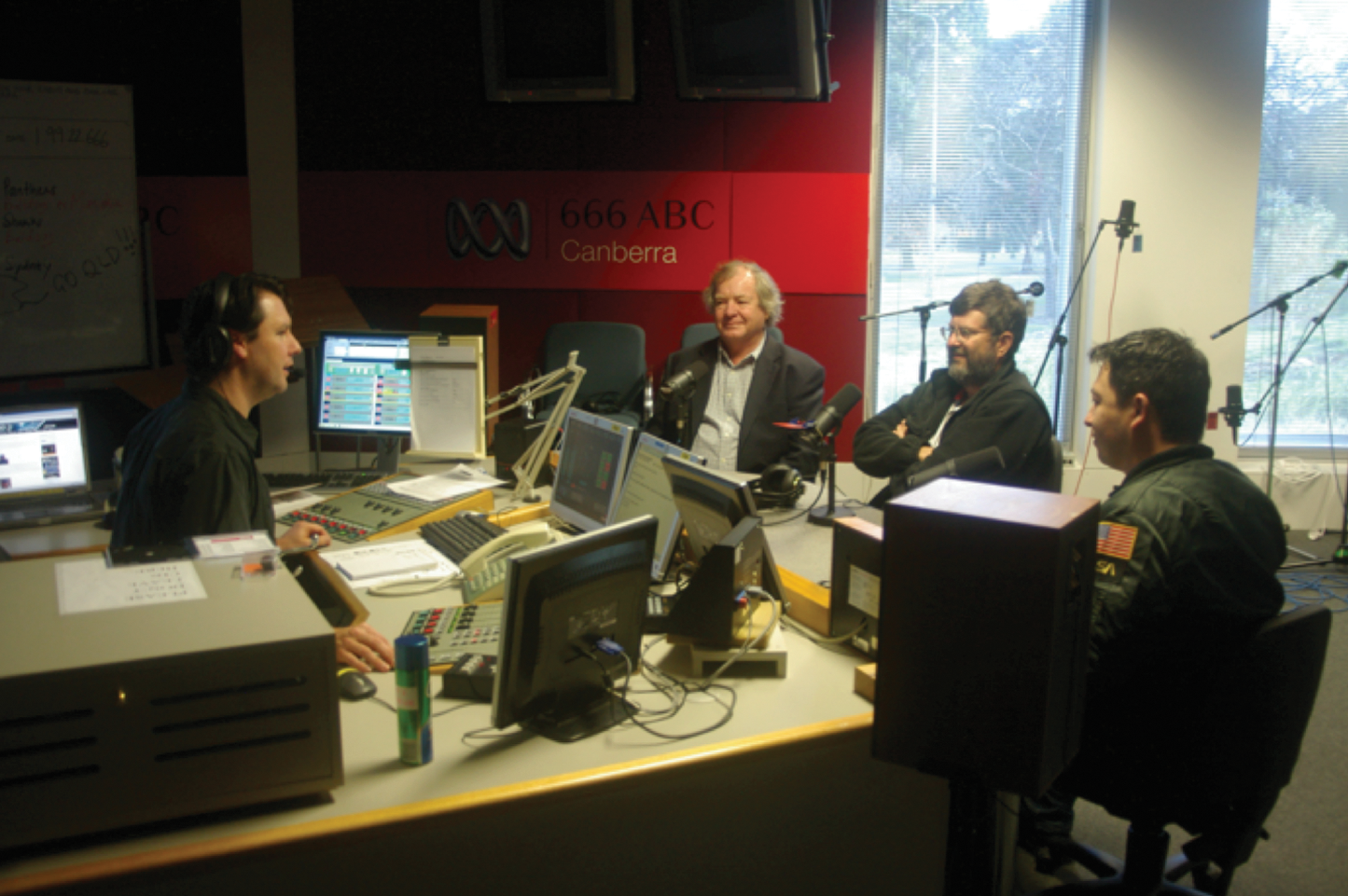
More outreach, this time in Canberra talking about Mars with Jonathan Clarke and Pascal Lee, 2009. Photo by Michael West. Color images available online at
Just before I moved to UCLA I had agreed to be an advisor to Roger Buick, then a graduate student at the University of Western Australia. His project was on the paleobiology of the early Archean of the Pilbara Craton. I had worked there as a student myself, but not on the oldest rocks, now dated at 3.5 Ga. Buick's fellow student John Dunlop, who already knew the geology of the Pilbara quite well, guided us on a field trip that included a traverse down a creek that I will never forget. As we wandered along talking about the geology, we stepped over a low outcrop of chert in the creek bed. There before my eyes was a stromatolite! Buick and Dunlop said nothing. I believe to this day that it was a setup and they already knew it was there but were waiting to see if I would notice. It was still there two years later when I led a group from the PPRG to collect it and Buick joined us at UCLA to study it. The resultant paper in Nature, with a cover photograph, in 1980, was a significant event in Archean paleobiology.
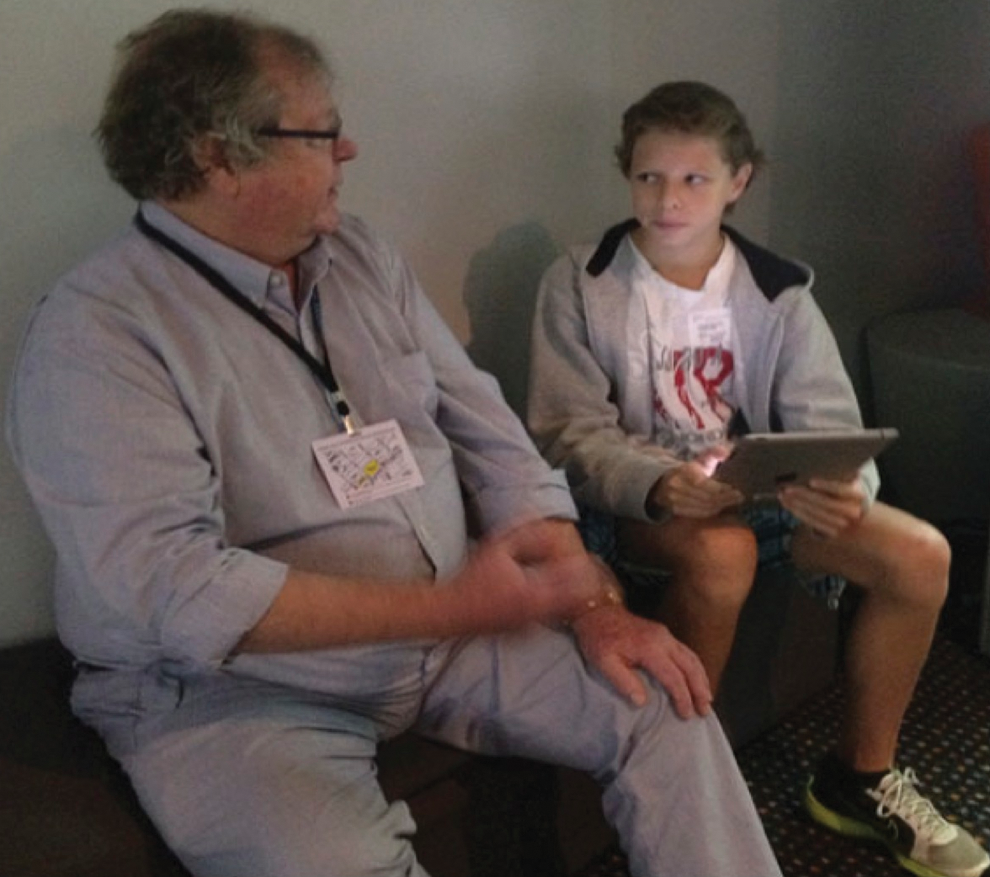
With the next generation of astrobiologists, at Carol Oliver's “Pathways to Space” project in the Powerhouse Museum, Sydney, 2012. Photo by Carol Oliver. Color images available online at
At about this same time Stan Awramik of the University of California, Santa Barbara, like Schopf and Knoll a former student of Elso Barghoorn at Harvard, was pursuing the hunt for fossiliferous black cherts in the Pilbara. He discovered what I regard as convincing microfossils and studied them in collaboration with Schopf and myself. There began a long saga of claim-and-counterclaim that still continues and has engulfed more recent discoveries by Schopf and his student Bonnie Packer, and others. This is not the place to tell that story, but suffice it to say that it is not edifying and has poisoned some relationships. It includes some salutary lessons about dealing with the news media, how stories there are oversimplified and scientific disagreements exacerbated and personalized. It was a low moment in my career, and indeed my life. Today I deal with the media more carefully, but I would still tell my side of the story. I have an absolute belief in the importance of communicating with the public. By conveying the excitement of discovery we attract young people to science, and encourage the public to fund our work.
Out of this rich brew more good fortune arose when I returned to Canberra to lead the Baas Becking Geobiological Laboratory. This was a truly remarkable organization, a leader worldwide and way ahead of its time. Laurens Baas Becking was an extraordinary polymath who in 1934 in his native Holland had published a book titled Geobiologie, reflecting his eclectic research at the intersection of biology, chemistry and sedimentology. He moved to Stanford University in California and then to Java to become Director of the Royal Botanic Gardens, and for his last decade to Australia. In Australia he established a research program on the origin of sedimentary mineral deposits. It is hard to believe now, but before the early 1950s all sulfide ore deposits were considered to be entirely igneous in origin. This of course is not the case, and Baas Becking demonstrated the probable role in their formation of sulfate-reducing bacteria and other microbes. The government laboratory established to continue his work after his death existed for more than 20 years, and it was there that my understanding of interdisciplinary research was honed. Among the many scientists who opened my eyes to newly developing fields was Roger Summons, organic geochemist.
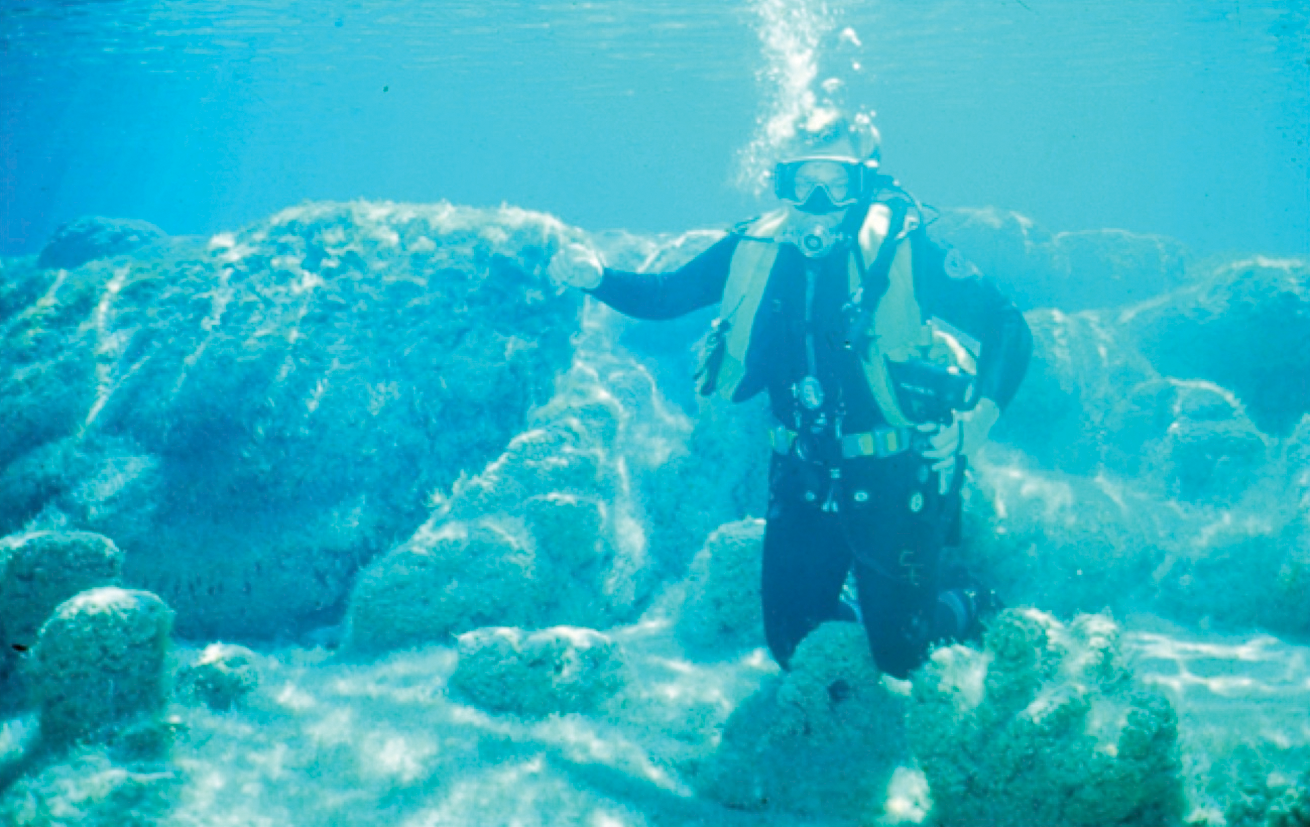
During the days at the Baas Becking Laboratory, stromatolites in Shark Bay, Western Australia, about 1980. Unknown photographer. Color images available online at
Into Deep Time
Woven through these decades was my stratigrapher's interest in deep time. There was the description of patterns of change in stromatolites over time, based on Soviet research, and then two more formal exercises. The first was the 16 years I spent as a member of an International Union of Geological Sciences working group charged with defining the base of the Cambrian System. I think only a stratigrapher could truly appreciate what this was all about and why it took so long; there were numerous field trips, formal votes, and heated discussions. Then there were 14 more years defining what we came to name the Ediacaran Period and System, the first new geological period named and formally accepted internationally for more than a century. Each of these two exercises involved many geologists, but I would be remiss not to mention the prime contributions of Andrew Knoll, Guy Narbonne, and Nicholas Christie-Blick. Some might consider it in character that Knoll and I sketched out our plan for the work on the Ediacaran during a tour of the vineyards of the Hunter Valley north of Sydney; we turned that plan into a paper in Nature.

Working in the Pilbara, about 2004, with doctoral students Adrian Brown and Abigail Allwood, local expert Martin Van Kranendonk, and field hand. Photo by Sally Sweetapple. Color images available online at
After all this history I was still not an astrobiologist. That began in 1987. David Des Marais of the NASA Ames Research Center (and a former member of the PPRG) invited me to talk at a NASA meeting on the exploration for life on Mars. After that I was hooked. I had not really thought about Mars before then. One thing led to another, and soon at the invitation of Paul Davies, theoretical physicist and philosopher, I found myself writing a book about the exploration for life on Mars. Along the way came Mars meteorite ALH84001, the establishment of the NASA Astrobiology Institute, and my establishment in 2002 of the Australian Centre for Astrobiology at Macquarie University and now at the University of New South Wales in Sydney.
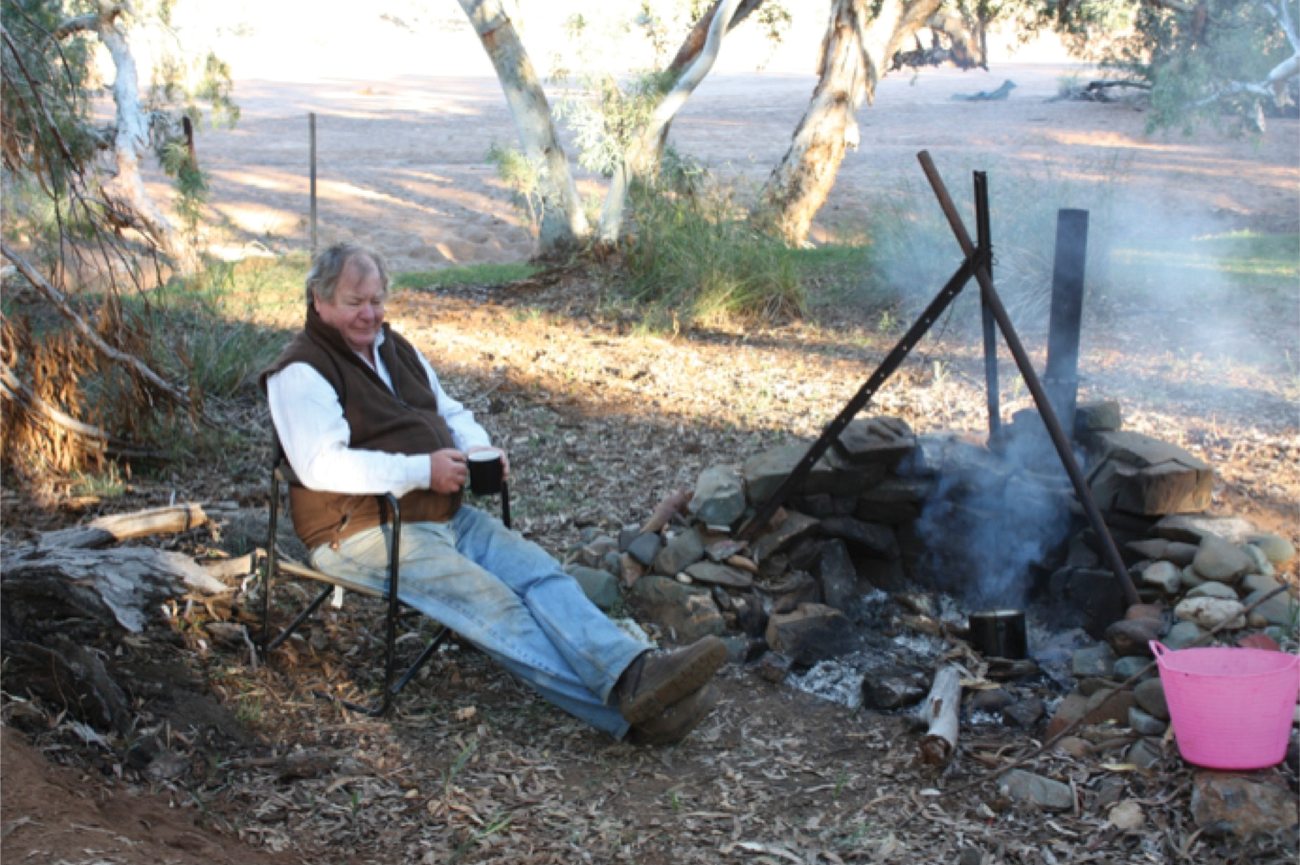
Older and wiser, still in the Pilbara, 2011. Photo by David Flannery. Color images available online at
These are just the bare bones of my journey to astrobiology. I have left out my students, who have inspired, energized, and challenged me, many influential colleagues, and early critical encouragement from my brother Dennis. I have left out a decade as a petroleum exploration consultant and as a consultant to museums, and my other research at Macquarie University with my friend John Veevers. None of the last decade working as a hard-core astrobiologist is here either, but this is the gist of how I got to where I am now.
Innate curiosity, family support, intervention by inspiring individuals, risk-taking, and stubborn persistence are the themes of my narrative. As Winston Churchill is reported to have said at a speech at Harrow school during World War II, “Never give in. Never give in. Never, never, never, never.”