




Abstract
The identification of biosignatures in Earth's ancient rock record and detection of extraplanetary life is one of the primary goals in astrobiology. Intrinsic to this goal is the improvement of analytical techniques and protocols used to identify an unambiguous signal of life. Micro Raman spectroscopy is a nondestructive method that allows for in situ identification of a wide range of minerals and compounds. The use of D (∼1350 cm−1) and G (∼1580 cm−1) band parameters to infer the biogenicity of carbonaceous materials in fossils has become a commonly used analytical tool, but carbonaceous compounds from different sources often share the same spectroscopic characteristics. Microfossil studies do not always take into consideration a nonbiological source for the carbon in their samples and therefore still rely on morphology as the primary mode of identification. Comprehensive studies that consider all carbon sources are typically done on metasediments, coals, or meteorites, and the results are not clearly applicable to microfossil identification. In this study, microfossils from a suite of sedimentary rock samples of various ages were analyzed with micro Raman spectroscopy to investigate the nature and provenance of carbonaceous material. To further constrain D- and G-band carbon characteristics, micro Raman analyses were also performed on well-characterized meteorite samples as abiological controls. The results appear to show a correlation of precursor carbonaceous material with D-band parameters and thermal history with G-band parameters. This systematic study lays the groundwork for improving the use of the G- and D-band trends as useful indicators of the origin of carbon in microfossils. Before unambiguous biosignatures can be established, further work characterizing the carbonaceous material in microfossils of different ages, thermal histories, and host rock compositions is needed. Key Words: Raman spectroscopy—Microfossils—Biosignatures—Carbonaceous material—Thermal history. Astrobiology 13, 103–113.
1. Introduction
I
Confocal Raman spectroscopic imaging is useful in this regard as the spectral signatures of carbonaceous materials can be mapped and correlated to contextual, morphological features (Kudryavstev et al., 2001; Schopf and Kudryavstev 2009; Bower, 2011; Marshall et al., 2011). Raman spectra of carbon are typically composed of disordered and ordered (graphitic) bands (“D” at ∼1350 cm−1 and “G” at ∼1580 cm−1, respectively). The peak characteristics of the D and G bands, such as width and intensity, can vary depending on a range of factors, including the degree of thermal alteration (metamorphic grade), precursor carbonaceous material, and crystallinity of the graphitized carbon (Pasteris and Wopenka, 2003; Busemann et al., 2007; Quirico et al., 2009; Marshall et al., 2010). The G band is a signature of graphitic crystalline order, and the D band is a resonant band indicative of disorder in the crystal lattice. Unlike the G band, the D band's spectral position varies slightly in response to laser excitation wavelength and power (Wang et al., 1990; Sood et al., 2001). The D band is also thought to reflect in-plane defects arising from the presence of hetero atoms (H, N, O) (Beny-Bassez and Rouzaud, 1985). A recent trend in micropaleontology has been to use the characteristics of these spectral features to investigate the origin of graphitized microfossils in ancient rocks (Kudryavstev et al., 2001; Schopf et al., 2005). These spectral features have been used as sensitive indicators of the metamorphic history of carbonaceous matter in several fossil studies (Wopenka and Pasteris, 1993; Allwood et al., 2006; Bernard et al., 2007; Marshall et al., 2010). However, the studies on ancient microfossils still rely primarily on the morphology of the feature investigated, with Raman microscopy confirming the presence of carbonaceous material. The D- and G-band parameters alone have been described as “necessary but not sufficient” for unambiguous life detection (Pasteris and Wopenka, 2003). Adding to the potential misinterpretation of Raman peak parameter signatures in life-detection studies is the lack of standardized comparative studies of biogenic and abiogenic carbonaceous material (Pasteris and Wopenka, 2003; Marshall et al., 2010). Carbon spectral features that are indicative of thermal history in highly metamorphosed rocks such as primitive meteorites or coals are not always applicable to sedimentary rocks that have experienced little metamorphism (Beyssac et al., 2002a; Rahl et al., 2005; Quirico et al., 2009).
Here, we address these issues by comparing the G- and D-band parameters of microfossils in a suite of sedimentary rocks of different ages and metamorphic histories with two well-characterized carbonaceous chondrites of abiological origin. The goal of this study was to constrain G- and D-band parameters to further understand their usefulness in determining the source of carbonaceous materials in geological samples.
2. Materials and Methods
Thin sections of 30 μm thickness were made from samples of fossiliferous rocks from different localities and ages: the 400 Ma Rhynie Formation, 600 Ma Duoshanto Formation, 1.9 Ga Gunflint Formation, 2.7 Ga Tumbiana Formation, and 3.5 Ga Apex and Strelley Pool chert deposits (Table 1). To provide comparisons with materials of known abiogenic origin, sections were also made from two well-characterized carbonaceous chondrite samples: Allende and Murchison (Table 1).
The Early Devonian (400 Ma) Rhynie chert in Aberdeen, Scotland, contains well-preserved remains of early vascular plants, lichens, algae, cyanobacteria, and insects (Boyce et al., 2003; Krings et al., 2007). The cherts are part of a sedimentary and volcanic succession (interbedded with shales and sandstones) that precipitated from silica-rich fluids in one of the earliest known subaerial hot spring environments associated with andesitic volcanism (Rice et al., 2002; Trewin et al., 2003).
The ∼600 Ma Neoproterozoic Duoshanto Formation in South China contains the fossilized remains of algae, metazoan embryos, and acritarchs—taxonomically unclassified microfossils (Xiao et al., 1998; Xiao and Knoll, 2000). The formation consists of transgressive deposits of carbonate, shale, and phosphatic shale successions and volcanic ash beds. The fossils are found in the upper-sequence phosphorite beds that grade upward into a dolomitic micrite and grainstone (Xiao et al., 2002; Condon et al., 2005). Phosphorites are lithified organically induced phosphate-rich muds that are typically associated with marine carbonates (Sheldon, 1981). These sediments lie above glaciogenic rocks and were only lightly affected by local orogenic events (Xu et al., 1997; Barfod et al., 2002).
The cherts of the ∼1.9 Ga Gunflint Formation, Ontario, Canada, contain well-documented microfossils that include filamentous and coccoidal remains of stromatolite-building and planktonic microorganisms (Cloud, 1965; Licari and Cloud, 1968; Darby, 1974; Knoll et al., 1978; Awramik and Semikhatov, 1979; Lanier, 1989). These sediments were deposited in a shelf environment in the Animike Basin during a transgressive-regressive-transgressive cycle (Schulz and Cannon, 2007). The deposits consist of proximal stromatolites, lagoonal ribbon chert-carbonates, offshore grainstones that were derived from siliceous and iron-rich chemical mud layers, as well as black shales and volcanic ash beds in the upper half (Pufahl and Fralick, 2000; Fralick et al., 2002). The bedded cherts in the Gunflint Formation are considered to be either primary or diagenetic precipitates that replaced the original stromatolitic carbonate (Winter and Knauth, 1992; Maliva et al., 2005). These rocks have experienced subgreenschist facies metamorphism (T<150°C).
The 2.7 Ga Tumbiana Formation is a stromatolitic limestone that contains organic globules (Lepot et al., 2008; Phillipot et al., 2009). It is part of the Fortescue Group of the Hamersley Basin, Australia, which consists of calcareous sandstone, stromatolitic carbonate, and micaceous sandstone, all with interlayers of volcanic siltstone (Thorne and Trendall, 2001). The carbonates were deposited in a shallow subaqueous coastal lacustrine or marine environment (Sakurai et al., 2005). The host rocks experienced only prehnite-pumpellyite facies metamorphism—thermal alteration between 100–300°C (Smith et al., 1982).
The ∼3.5 Ga Strelley Pool and Apex cherts are part of the Warrawoona Group in Western Australia. The Apex cherts contain filamentous and coccoidal features, as well as disseminated carbonaceous material; the Strelley Pool cherts contain conical stromatolitic features, as well as filamentous microstructures (Schopf and Packer, 1987; Schopf, 1993; Brasier et al., 2005). The Warrawoona Group consists of mainly basaltic rocks interbedded with felsic volcanic rocks and metasedimentary units that contain the cherts (Van Kranendonk and Pirajano, 2004). The Apex chert is part of a 10 m thick bedded chert unit interbedded with felsic tuff. The Apex chert deposits were fed by swarms of hydrothermal feeder veins that have since been recrystallized to microcrystalline quartz. Minerals and native metals indicative of high hydrothermal temperatures (250–350°C) are found in the chert veins and associated basaltic host rocks (Van Kranendonk and Pirajano, 2004; Brasier et al., 2005; Pinti et al., 2009). The Strelley Pool chert is part of a silicified carbonate succession that is also transected by silica-rich veins, and the metabasalts below the cherts have been hydrothermally altered (Van Kranendonk et al., 2002; Lindsay et al., 2005). The metamorphic grade of the Warrawoona Group is up to greenschist facies, ∼250°C (Van Kranendonk et al., 2010).
Two well-characterized meteorites were included in the study to provide comparisons with naturally derived carbonaceous material of known abiogenic origin. Sections were made from two samples of Allende (CV3) and Murchison (CM2) carbonaceous chondrites. The Murchison and Allende meteorites are ∼4.5 Ga in age and fell to Earth in 1969 (Sears and Dodd, 1988). Both were formed from the accretion of solar nebular material but differ in terms of their post-accretion parent body processing. Allende likely experienced greater heating following accretion of its parent body than Murchison, and its carbonaceous materials show this in terms of greater thermal maturity (Sears and Dodd, 1988; Krot et al., 2007). The Allende meteorite is a type 3 CV chondrite. The CV chondrites have a higher Ca/Si ratio compared to CM types and tend to have Ca- and Al-rich inclusions (CAIs) along with high-Fe olivine (Sears and Dodd 1988; Krot et al., 2007). We observed that the Allende samples contain two pools of carbon that will be discussed: graphitic carbon found in the CAIs processed at relatively high temperature, and macromolecular carbon (MMC) in the meteorite matrix. (MMC is a reduced carbon species which spans a range of crystalline ordering ranging from amorphous carbon to poorly ordered graphite.) Murchison is a type 2 CM chondrite that experienced temperatures of only ∼130°C during parent-body processing (Clayton and Mayeda, 1984). The CM chondrites reflect this low temperature in their mineralogy, featuring hydrous minerals including phyllosilicates and sulfates (Sears and Dodd, 1988).
Raman spectra of the sample thin sections were collected by using a WITec scanning near-field optical microscope (AlphaSNOM) running Scan Control Spectroscopy Plus software. The Raman scans were conducted with a frequency-doubled YAG laser with 532 nm wavelength. The laser was focused through a 25 μm diameter fiber and a 100× objective lens with 3–6 s dwell time per pixel and 0.16–2.2 mW/μm2 laser power density as measured at the focal plane (Fries and Steele, 2011). The scans were done between 5 and 10 μm into the thin sections rather than at the surface to analyze material unaffected by thin section preparation. Images and virtual maps of the spatial elemental and mineral composition of the microfossils and other features of interest were generated with WITec Project 1.9 software. Deconvolution of the collected spectra was achieved by using Gaussian peak fits in ACD Labs 12 software. Peak parameters, such as peak position, peak intensity ratios (R1), and full width at half maximum of the G- and D-bands (ΓG and ΓD) were used to elucidate the differences among different carbon types in the samples. The position of the G band is primarily a function of the energy of vibrational modes in the crystalline domains of the material, which in turn is a function of the mean size of those domains. The full width at half maximum is a function of the distribution of crystalline domain sizes sampled by the excitation beam. Both features, in turn, are functions of the thermal alteration and metamorphic history of the carbonaceous material (Tuinstra and Koenig, 1970; Pasteris and Wopenka, 1991; Wopenka and Pasteris, 1993; Ferrari and Robertson, 2000; Guedes et al., 2005). R1 is the ratio of the intensity of the D band and G band (ID/IG) and reflects the degree of order in the carbonaceous material (Wopenka and Pasteris, 1993; Rahl et al., 2005).
3. Results
Micro Raman spectroscopic imaging of the fossil samples revealed carbon-bearing features via D- and G-band peak intensity (see Fig. 1A–1C). This is clearly illustrated by spectral maps of microfossils in the 1.9 Ga Gunflint chert samples that show distinct filaments and coccoids made up of carbonaceous material embedded in the host chert (Fig. 1B). Typical spectra for the Gunflint samples are shown in Fig. 1C: the average D-band peak position was 1339 cm−1, and the G-band was centered at 1600 cm−1; the predominant quartz peaks were 208 and 467 cm−1; second-order peaks associated with hydrated silicate inclusions were also visible (Bower et al., 2010). The G- and D-band peak positions of each microfossil and chondrite sample set were also compared (Table 2). The chert microfossil samples all have similar G-band peak positions close to 1600 cm−1. Of the microfossil samples, Tumbiana carbonates had the highest G-band peak position centered around 1606 cm−1. The lowest values are found in graphitic carbon in the Allende CAI samples.

Micro Raman imaging shows spatial relationships between carbonaceous materials and host material. (
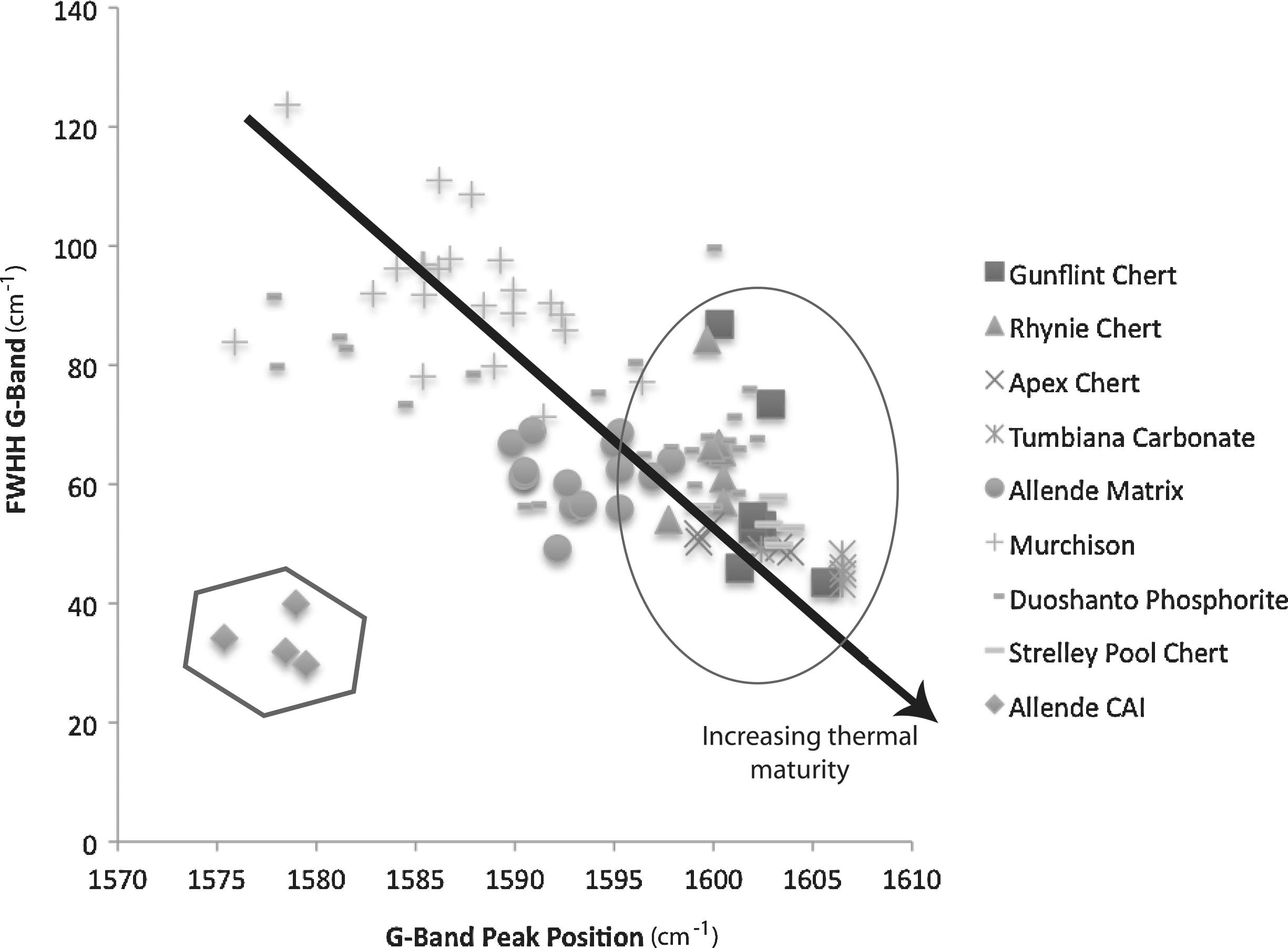
The G-band peak position of the carbonaceous material in the Duoshanto microfossils and Murchison chondrite has the highest degree of scatter of all the samples in this study (Fig. 2). This is indicative of carbon that has not been homogenized by metamorphism. While their originating materials are very different, both Duoshanto and Murchison carbon materials are naturally heterogeneous. The Duoshanto samples contain a variety of fossil types with precursor materials that were structurally different from one another; the Murchison samples contain several different complex organic molecules (Xiao and Knoll, 2000; Engel and Macko, 2001). The progressive breakdown and subsequent graphitization of these materials during low-temperature alteration produced zones of varying disorder reflected in the wide range of G-band peak positions in the Duoshanto and Murchison samples (Wopenka and Pasteris, 1993; El Amri et al., 2005; Bernard et al., 2007).
Comparison of
Comparisons of the average D-band peak positions between each sample set do not reveal any straightforward trends (Table 2). The graphitic carbon in the Allende CAI samples had the highest peak positions centered around 1346 cm−1. The peak positions for the Duoshanto phosphorite samples were the lowest around 1338 cm−1. The disparity in peak positions of these two particular sample sets might indicate some difference between known biogenic and abiogenic carbon with lower and higher D-band peak positions, respectively. This shift to lower D-band wavenumbers in the Duoshanto samples does not, however, correspond with an overlap of the hematite 1313 cm−1 band (Marshall et al., 2011). Even so, none of the other microfossil samples follow the same trend, so this cannot be used as a proxy to prove biogenicity. One point of interest is in the standard deviations of the D-band peak position of the carbon in a few of the samples (Table 2). For example, the organically complex Murchison chondrite has the biggest degree of scatter of ±9 wavenumbers. This is followed by the multi-species microfossils in the Duoshanto phosphorite (±6) and Rhynie chert (±5).
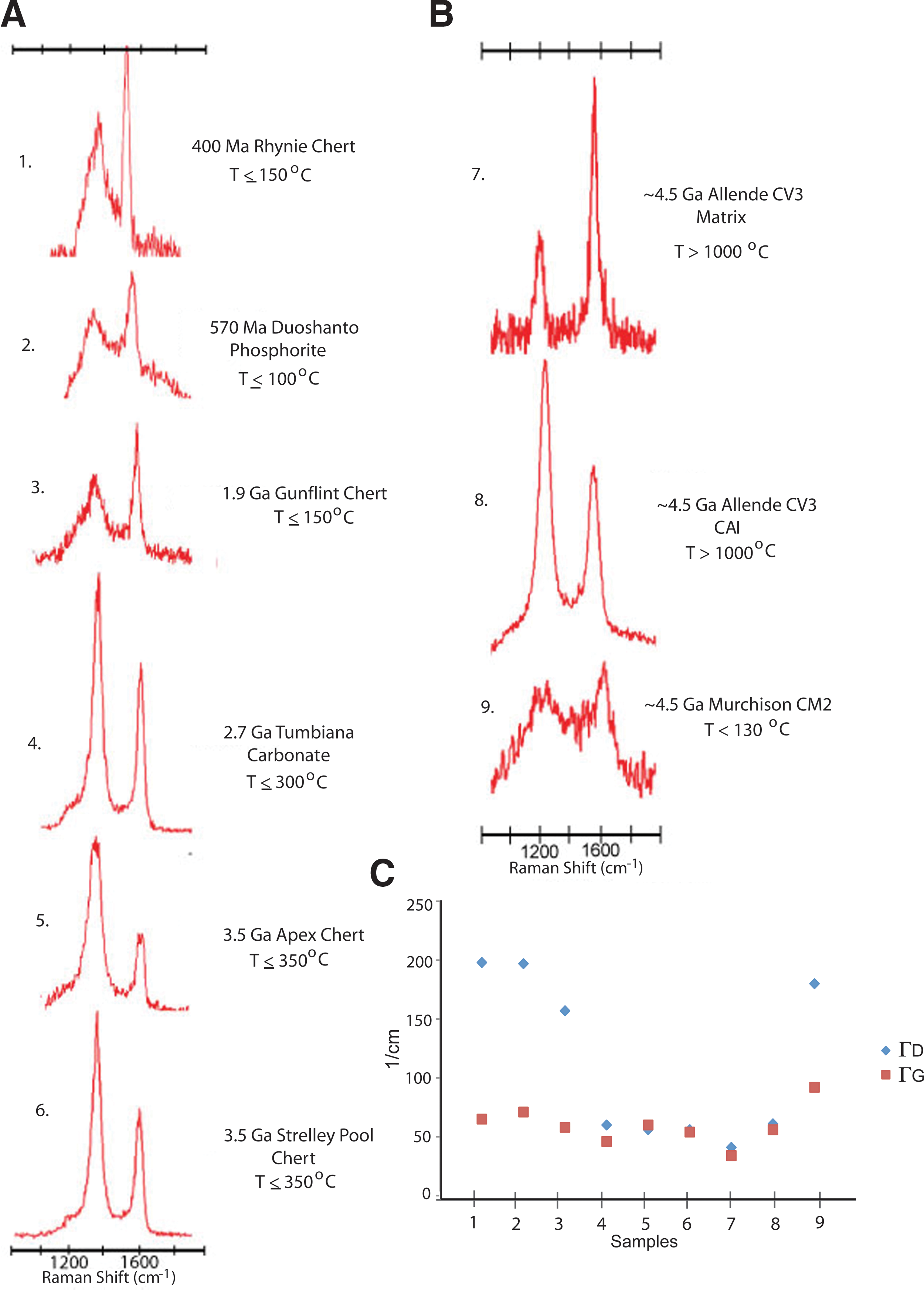
Comparisons between the average G- and D-band spectra of the carbonaceous matter also reveal some interesting characteristics (Fig. 3). Overall, in the younger fossiliferous rocks, the Rhynie chert, Duoshanto phosphorite, and Gunflint chert, the first-order carbon D bands are wider than the G bands (Fig. 3A). A comparison of the full width half height of the G and D bands (ΓG, ΓD, respectively) shows the same trend in a more quantified way (Fig. 3C). The Tumbiana carbonate, Apex chert, Strelley Pool chert samples are similar to each other, with a narrower and more pronounced D band relative to the G band (Fig. 3A, 3C). This indicates that the range of sizes of disordered domains shows less variation than in the young fossiliferous rocks. The same results have been found in previous studies showing a progressive narrowing of the D band with increasing thermal alteration as short-range disorder decreases and graphite crystals increase in domain size (Pasteris and Wopenka, 2003; Schopf and Kudryavstev, 2009). The Allende matrix and CAI samples both feature narrow D and G bands, while the carbon spectra in the Murchison samples look more like those of the fossil samples (Fig. 3B). In comparison with the known metamorphic temperatures for each sample set, the overall trend here indicates a wider D band with lower temperature and a narrower D band with higher temperature.
Representative first-order carbon spectra for each sample used in this study. (
The trend is similar with the ΓG in the meteorite samples: the graphitic Allende CAIs have the lowest ΓG, and the low-temperature Murchison chondrites have the highest (Table 2, Fig. 3C). The values for ΓG for the carbon in the microfossil samples also exhibit the same characteristics, with the younger, less thermally overprinted samples having a higher ΓG than the older samples. Previous studies on carbonaceous materials in metamorphic rocks have shown the same correlation of lower ΓG with a higher metamorphic grade (Wopenka and Pasteris, 1993; Allwood et al., 2006).
The ΓG can also be compared with the G-band peak position to indicate the thermal maturity of the carbon in a sample (Pasteris and Wopenka, 1991; Spotl et al., 1998; Beyssac et al., 2002a, 2002b; Perraki et al., 2006; Fries and Steele, 2011). In Fig. 2, the data mainly follow a linear trend that reflects the thermal maturity of the samples. Of the fossil samples, the Duoshanto phosphorite falls on the upper end of the line, representative of lower thermal alteration. This is in agreement with the known thermal history in that the Duoshanto also has undergone the least degree of alteration of the fossil samples. The rest of the fossil samples cluster together toward the lower end of the trend line indicative of a higher thermal maturity.
The Murchison chondrite samples exhibit similar trends to the Duoshanto samples, which likely reflects the lower maturity of the Murchison carbon (Fig. 2). The Allende matrix samples, however, fall between the higher-grade fossil samples and thermally less mature Duoshanto and Murchison samples. The Allende matrix carbon has experienced heating close to at least 1000°C, so we would expect the Allende matrix samples to lie well past minimally metamorphosed microfossil samples that only experienced temperatures as high as ∼350°C. The Allende CAI-hosted carbon does not lie on the trend line, indicating that it has crystallized beyond the amorphous carbon–MMC–polycrystalline carbon trendline as defined by the G-band graph and is predominantly single-crystal graphite on the scale of the Raman excitation beam (Fries and Steele, 2008). The meteorite samples follow the same overall trend as the microfossils, but the differences in precursor materials (solid-phase biogenic vs. abiogenic gas-phase precipitate) increase the difficulty in making close comparisons between these two very different sample types (Fries, 2011).
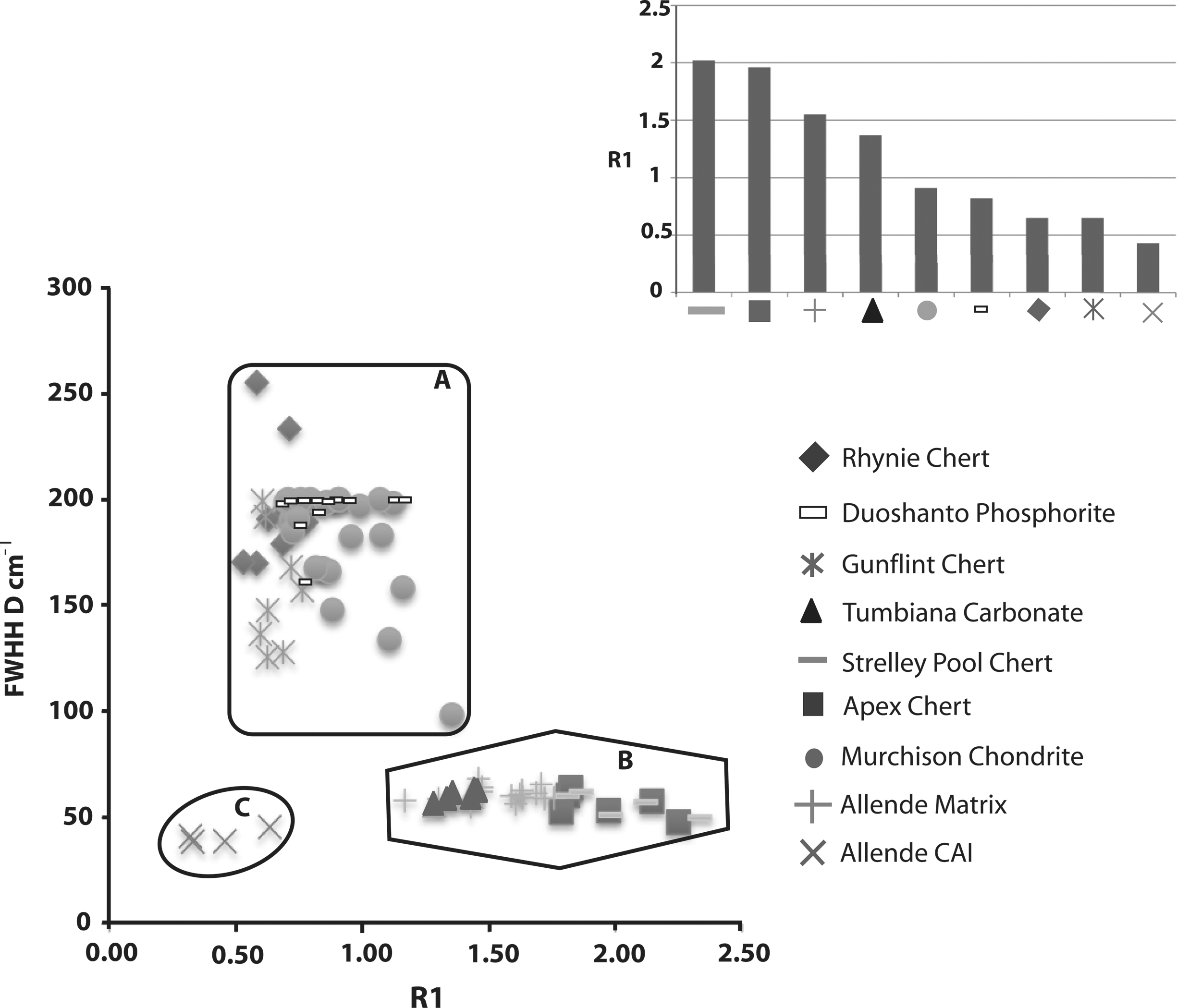
The average D- and G-band intensity ratios (R1) of the samples are graphically shown in descending value order in the inset in Fig. 4. The two similar chert samples, Apex and Strelley Pool, had the highest R1 values, and the graphitic Allende CAI-hosted carbon had the lowest (Table 2). For the fossil samples in this study, the higher R1 values mainly correlate with a higher metamorphic grade. This is in agreement with previous studies on carbons in metamorphic rocks where higher R1 values were associated with a higher degree of structural organization (Jehlicka et al., 2003 ). The values for the Duoshanto samples, however, are the exception. If the trend is higher R1=higher metamorphic grade, Duoshanto should have the lowest values of all the fossil samples. The anomalous R1 value for Duoshanto might be explained by its phosphorite host, which is unique in this data set. While microfossils in phosphorites have been documented in at least one other locality, this rock type is the least studied in comparison to cherts and nonphosphatic carbonates (Brasier and Singh, 1987).
Comparison of
When ΓD is plotted against the D- and G-band intensity ratio (R1), the sample sets cluster into different groups that correlate with the known origins of the precursor carbonaceous material in each sample (Fig. 4). The Rhynie and Duoshanto samples both contain the remains of a wide variety of organisms, including plants, arthropods, and microbes; the Gunflint chert contains fossilized prokaryotes and some primitive eukaryotes. The Murchison chondrite, which contains highly complex organic compounds, also falls into the cluster with the younger microfossil samples (Fig. 4A). In-plane defects from O, H, N heteroatoms that affect D-band characteristics may be the reason for the clustering of the fossil samples and Murchison chondrite (Beyssac et al., 2002a). Similar results have been shown for coals and chondrites, where precursor materials controlled the characteristics of the Raman spectra (Quirico et al., 2009). The Apex and Strelley Pool samples overlap and are clustered with Tumbiana and Allende matrix, and the common denominator in this case may be a hydrothermal origin and siliceous rock matrix (Fig. 4B). As with other parameters considered in this study, the crystalline graphitic Allende CAI samples plot separately from all other samples, because they have crystallized well in excess of the other materials (Fig. 4C).
4. Discussion
As shown in this study and elsewhere, distinctions can be found between G- and D-band spectral characteristics of carbonaceous materials of disparate origins. In high-grade metamorphic rocks, the G-band peak position has been shown to increase with increasing temperatures and pressures (Beyssac et al., 2002a). In the case of the lightly metamorphosed microfossil samples, however, our data agrees more with a study on low-grade metamorphic rocks by Rahl et al. (2005), in which G-band peak positions greater than 1600 cm−1 were associated with metamorphic temperatures only up to 200°C.
In meteorite-hosted carbon, the shift upward in G-band position and downward in ΓG continues up to a maximum temperature regime as MMC crystallizes toward polycrystalline graphite, but peak position deviates from the thermal trendline in the case of crystalline graphite (Busemann et al., 2007). This is exemplified here by the graphitic carbon in the Allende CAI-hosted samples, which had the lowest G-band peak position in this study centered around 1578 cm−1.
There is a pronounced increase of ΓD relative to ΓG that correlates with the complexity of the carbonaceous material in the younger microfossils and Murchison, whereas the older microfossils and high-temperature meteorites do not exhibit this trend (Fig. 3). The evolution of the G-band in our samples indicates differences in the thermal maturity, suggesting that the older microfossil samples experienced much greater temperatures than the younger ones. These data, however, do not definitively differentiate between deposition of graphite from carbon-rich high-temperature fluids and high-temperature thermal modification of pre-existing in situ organic material. The meteorite samples follow similar trends, in that higher alteration temperature correlates with higher G-band peak position and lower ΓG; however, the alteration temperatures of meteorite samples do not compare directly with those of the fossil samples. Therefore, these correlations between spectral parameters rely on starting material and cannot be applied universally.
Our values and trends for ΓD are in agreement with previous studies, where the ΓD was shown to be larger for more amorphous carbon and narrower for more graphitized carbon. This occurs because the range of sizes of disordered material diminishes with annealing (Wopenka and Pasteris, 1993). These trends may actually reveal useful information regarding the nature of the precursor carbonaceous materials in all the samples, regardless of sample provenance. While it is true that the D band is affected by external influences such as laser power and wavelength, this resonant band also reflects the degree of disorder in carbonaceous materials, and the ΓD reflects the range of amorphous domain sizes (Le Guillou et al., 2012).
Rahl et al. (2005) studied metamorphosed sedimentary rocks from different geographic locations and found a range of R1 values that varied depending on metamorphic grade. In that case, some lower-grade sample (T<200°C) R1 values actually overlap with those of a much higher grade (T ∼ 450°C) with an initial increase in R1 as temperature increases. Wopenka and Pasteris (1993) showed the same trend with a range of higher R1 values up until the chlorite grade metamorphic facies, at which point R1 values decrease with increasing metamorphic grade. The trend for the meteorite samples in this study shows a decreasing R1 with increasing metamorphic grade. Beyssac et al. (2002a) showed that a decrease in R1 values reflects an increase in metamorphic grade for carbonaceous material in metasediments, where the minimum metamorphic temperature affecting their samples was 330°C. Others describe similar results in graphitized materials in low- to high-grade metamorphic rocks (Jehlicka and Beny, 1992; Wopenka and Pasteris, 1993; Kwiecinska et al., 2010).
It may be impractical to use R1 values alone to elucidate the origins of carbonaceous materials in a wide range of sample types. When ΓD is plotted against the D- and G-band intensity ratio (R1), however, the sample sets cluster into different groups that correlate with the precursor carbonaceous material in each sample (Fig. 4). The carbon in the Rhynie chert, Duoshanto phosphorite, Gunflint chert, and Murchison chondrite samples were all derived from highly complex organic materials, and these samples are clustered together when the ΓD is compared with R1. In support of this trend, the samples containing carbon derived from less complex carbonaceous material, Apex chert, Strelley Pool chert, Tumbiana carbonate, and Allende matrix, all cluster together when the same parameters are compared. Thus, D-band parameters can be used to differentiate more complex precursor carbonaceous materials from the purer graphitic structures, and this may yet prove to be more useful for assigning the origin of carbonaceous materials as additional samples are analyzed to improve statistical relevance.
5. Conclusions
The improvement of analytical methods for life detection is an ongoing process. Nondestructive techniques such as Raman spectroscopy bring the scientific community closer to the goal of unambiguously identifying signs of life by providing essential information on the origins of materials in geological samples. Most target points in geological samples are distinct carbonaceous features related to biological processes (e.g., morphological features such as filaments, coccoids, flakes, laminae), but there are also geological samples that contain carbonaceous materials not necessarily associated with a specific physical feature. To complicate matters more, many of these features are often contained within a matrix of carbonaceous material that may or may not be related to the structures of interest. Fortunately, the unique mapping capabilities of micro Raman spectroscopy clarify these distinctions by showing the spatial relationships between carbonaceous materials and associated geological features. This tool is essential for microfossil studies where it is necessary to couple morphological and geochemical information in assigning biogenicity.
Despite the inability to unambiguously identify biogenic carbon from abiogenic carbon, the G- and D-band trends described in this study are promising. The continuing improvement of techniques such as micro Raman spectroscopy to understand the thermal processing and origin of carbonaceous material in geological samples is therefore valuable for life detection on Earth and other planets.
Footnotes
Acknowledgments
Support was provided by the NASA Astrobiology Institute at the Carnegie Institution of Washington and the NASA Postdoctoral Program. The authors wish to thank Phil Fralick of Lakehead University and Mark Jirsa of the Minnesota Geological Survey for some of the Gunflint chert samples, Maia Schweizer for the Duoshanto and Rhynie chert samples, and Owen Green for the Apex chert and Strelley Pool chert samples. We would also like to acknowledge the input of Mihaela Glamoclija and Karyn Rogers of the Carnegie Institution of Washington.
Abbreviations
CAIs, Ca- and Al-rich inclusions; MMC, macromolecular carbon.