




Abstract
White and brown dwarfs are astrophysical objects that are bright enough to support an insolation habitable zone (IHZ). Unlike hydrogen-burning stars, they cool and become less luminous with time; hence their IHZ moves in with time. The inner edge of the IHZ is defined as the orbital radius at which a planet may enter a moist or runaway greenhouse, phenomena that can remove a planet's surface water forever. Thus, as the IHZ moves in, planets that enter it may no longer have any water and are still uninhabitable. Additionally, the close proximity of the IHZ to the primary leads to concern that tidal heating may also be strong enough to trigger a runaway greenhouse, even for orbital eccentricities as small as 10−6. Water loss occurs due to photolyzation by UV photons in the planetary stratosphere, followed by hydrogen escape. Young white dwarfs emit a large amount of these photons, as their surface temperatures are over 104 K. The situation is less clear for brown dwarfs, as observational data do not constrain their early activity and UV emission very well. Nonetheless, both types of planets are at risk of never achieving habitable conditions, but planets orbiting white dwarfs may be less likely to sustain life than those orbiting brown dwarfs. We consider the future habitability of the planet candidates KOI 55.01 and 55.02 in these terms and find they are unlikely to become habitable. Key Words: Extrasolar terrestrial planets—Habitability—Habitable zone—Tides—Exoplanets. Astrobiology 13, 279–291.
1. Introduction
White dwarfs are the remnants of stars that have burned all the hydrogen in their cores into helium. As the hydrogen burning ends, the core begins to fuse the helium atoms and becomes hotter. This extra heat blows the envelope away, leaving just the core. Most WDs are about the size of Earth but have a mass of ∼0.6 M Sun and a luminosity of ∼10−3 L Sun (Bergeron et al., 2001). However, a range exists, and the luminosity actually evolves over several orders of magnitude.
Brown dwarfs are objects that are not massive enough to produce the central pressures necessary to fuse hydrogen into helium. Nonetheless, BDs can support an HZ as their slow contraction converts gravitational energy into heat (Burrows et al., 1997; Baraffe et al., 2003). The habitability of planets about BDs has received less attention than habitability of planets orbiting hydrogen-burning stars, as (a) relatively few are known, (b) it is unknown whether planets can form around them, and (c) they are very faint. However, new surveys, such as that of the WISE spacecraft, have found hundreds of these objects (Kirkpatrick et al., 2011; Mainzer et al., 2011), opening the possibility of detecting planets in orbit around BDs.
Although no terrestrial planets are currently known to orbit either a WD or a BD, there is no reason to believe they do not exist. Giant planets have been detected, such as a ∼5 M Jup planetary companion ∼55 AU from a nearby BD (Chauvin et al., 2005). Subsequent observations have confirmed this object is a companion to the BD (Song et al., 2006), but its colors and luminosity still pose a challenge to accurately estimating its mass (e.g., Gizis et al., 2007; Skemer et al., 2011). Mullally et al. (2008) used the periodicity in arrival times of pulsations of one WD, GD66, to infer the presence of a 2.4 M Jup object at 4.5 AU. Follow-up observations have only placed upper limits on the companion's mass, leaving its planetary status ambiguous (Mullally et al., 2009; Farihi et al., 2012).
Furthermore, there is ample evidence for protoplanetary disks that could transform into terrestrial planets. BDs have been observed to host protoplanetary disks that could form planets (Jayawardhana et al., 2003; Apai et al., 2005). Some WDs host metal-rich disks (Gänsicke et al., 2006), and others appear to have been polluted with metals or water, possibly from tidally disrupted planets or asteroids (Jura, 2003; Jura and Xu, 2012). While the post-MS evolution is a challenging barrier to the survival of close-in planetary companions to WDs (see, e.g., Nordhaus et al., 2010), some or all of the rocky cores may survive engulfment, or planets may form from the debris of the stellar envelope. For example, two terrestrial planet candidates have recently been discovered orbiting Kepler Object of Interest (KOI) 55, a ∼0.5 M Sun “extreme horizontal branch” star that will likely become a WD (Charpinet et al., 2011). Thus, we assume that water-rich terrestrial planets can exist around these objects.
Previous work on BD and WD HZs (Andreeshchev and Scalo, 2004; Monteiro, 2010; Agol, 2011b; Bolmont et al., 2011) determined orbits for which the radiation flux of the primary is equal to the flux limits found for MS stars (Kasting et al., 1993; Selsis et al., 2007; Barnes et al., 2008). The identification of this so-called insolation habitable zone (IHZ) is an important first step in constraining the possibility of habitable planets orbiting WDs and BDs, but one cannot neglect how a planet behaves prior to the arrival of the IHZ at its orbit. The inner edge of the HZ is defined to be the orbits at which a desiccating greenhouse, either moist, runaway, or tidal, is just possible (Kasting et al., 1993; Barnes et al., 2013). These phenomena may ultimately remove all surface water and leave an uninhabitable planet behind. Thus, planets initially interior to the HZ may not actually be habitable after the primary has cooled and/or tidal heating has subsided sufficiently for the planet to reside in it. Note that we will refer to the HZ as resulting from both irradiation and tidal heating but to the IHZ as the classic habitability model of, for example, Kasting et al. (1993).
For desiccation to occur, a multistep process must transpire. First, the surface flux must reach a critical value F crit, which is typically around 300 W m−2 (Abe, 1993; Kasting et al., 1993; Selsis et al., 2007; Pierrehumbert, 2010). At this level, water may escape the troposphere and/or become opaque to IR radiation. In both cases, water vapor in the stratosphere can then be photolyzed by high-energy radiation. Then, the freed hydrogen atoms may escape to space (Watson et al., 1981). Without the hydrogen to bond with oxygen, the planet has no water and is not habitable. Extrapolating from the Solar System, such planets will be Venus-like with large CO2-dominated atmospheres. Thus, to become sterile, the planet must also be bathed in high-energy radiation for a long enough time for all the hydrogen to be lost. Barnes et al. (2013) argued for a desiccation timescale, t des, of 108 years for low-mass stars. The situation is more complicated here, as BDs and WDs are very different objects, and we discuss this point in detail in Section 2.
The relatively low luminosities of WDs and BDs place their IHZs very close to the primary, ∼0.01 AU. At these distances tidal effects are important, and tidal heating may provide enough surface energy to drive a runaway greenhouse (Barnes et al., 2013). Therefore, planets orbiting WDs and BDs must also avoid desiccation via the “tidal greenhouse.” As planetary tidal heating scales with primary mass, WDs can tidally heat planets more effectively than BDs, all other things being equal.
Beyond identifying planets in danger of desiccation, we have also explored the diversity of terrestrial exoplanets orbiting WDs and BDs. In and around the IHZ, radiative and tidal heating will produce a mix of planetary properties, as heating fluxes can be lower than F crit. For example, some planets in the IHZ may only be tidally heated as much as Io (Jackson et al., 2008; Barnes et al., 2009a; Heller et al., 2011). Therefore, if planets are found around these objects, and within the IHZ, they may be categorized based on the strengths of tidal and radiative heating. We find a wide array is possible, including several types of Venus-like planets and some exotic types of habitable planets that do not exist in the Solar System.
Bolmont et al. (2011) considered the tidal evolution of the orbits of planets around BDs but largely ignored tidal heating. The orbital evolution can be quite complicated, as some orbits will shrink while others expand, depending on the spin period of the BD and the orbital semimajor axis. They found that planets may spend a short amount of time in the IHZ due to tidal evolution. In this study, we examine how the cooling of the primary and the tidal heating of a planet orbiting a WD or BD affect the likelihood of habitability. We find that the radiation environment prior to arrival in the IHZ is at least as important as the orbital evolution.
This paper is organized as follows. In Section 2, we outline models for primary cooling, the IHZ, tidal heating, hydrogen loss, and describe a planetary classification scheme based on tidal and radiative heating. In Section 3, we examine planets orbiting WDs. In Section 4, we turn to BDs. Finally, in Section 5, we draw conclusions.
2. Methodology
This study relies heavily on results of Barnes et al. (2013), Agol (2011b), and Bolmont et al. (2011). We first describe the cooling properties of WDs and BDs and the IHZ. Next we combine them to show how the IHZs evolve with time. We briefly review tidal phenomena but do not repeat all the equations here, as they were presented in their entirety by Barnes et al. (2013, Appendix E). Finally, we describe a planetary classification scheme that categorizes planets based on their insolation and tidal heat flux at the surface.
2.1. White dwarf cooling
Most WDs have masses near 0.65 M Sun with a dispersion of 0.2 M Sun (Bergeron et al., 2001). Agol (2011b) focused on 0.6 M Sun WDs, so we do the same here. Bergeron et al. (2001) computed masses, ages, and effective temperature for 152 WDs, using theoretical models; we excised all WDs with masses <0.55 M Sun and >0.65 M Sun from their Table 2 and plot the remaining 41 objects as stars in Fig. 1.
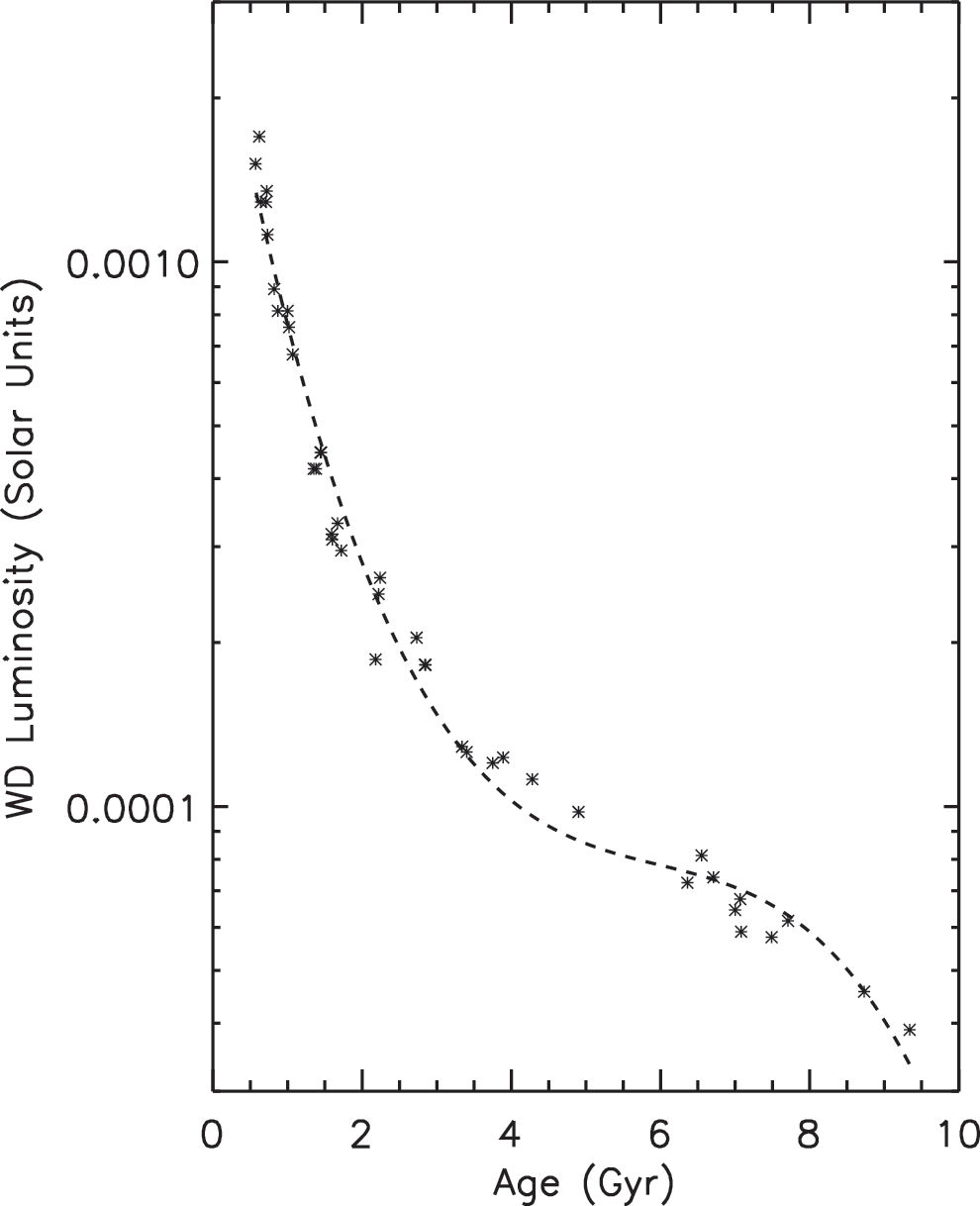
Next, we fit a third-order polynomial to the data (assuming uniform uncertainties per point) to produce a WD cooling function. If L is the base-10 logarithm luminosity in solar units and t the time in billions of years, then we find
White dwarfs cool rapidly for about 3 Gyr then level off before falling off again at about 7 Gyr. The relatively constant luminosity from 3 to 7 Gyr is probably due to the crystallization of the degenerate core (Salpeter, 1961; Hernanz et al., 1994; Segretain et al., 1994; Metcalfe et al., 2004). Note that the age given on the abscissa of Fig. 1 is the WD cooling time only. It does not include the pre-WD age of the former MS star, so we neglect the pre-WD circumstances of the system.
2.2. Brown dwarf cooling
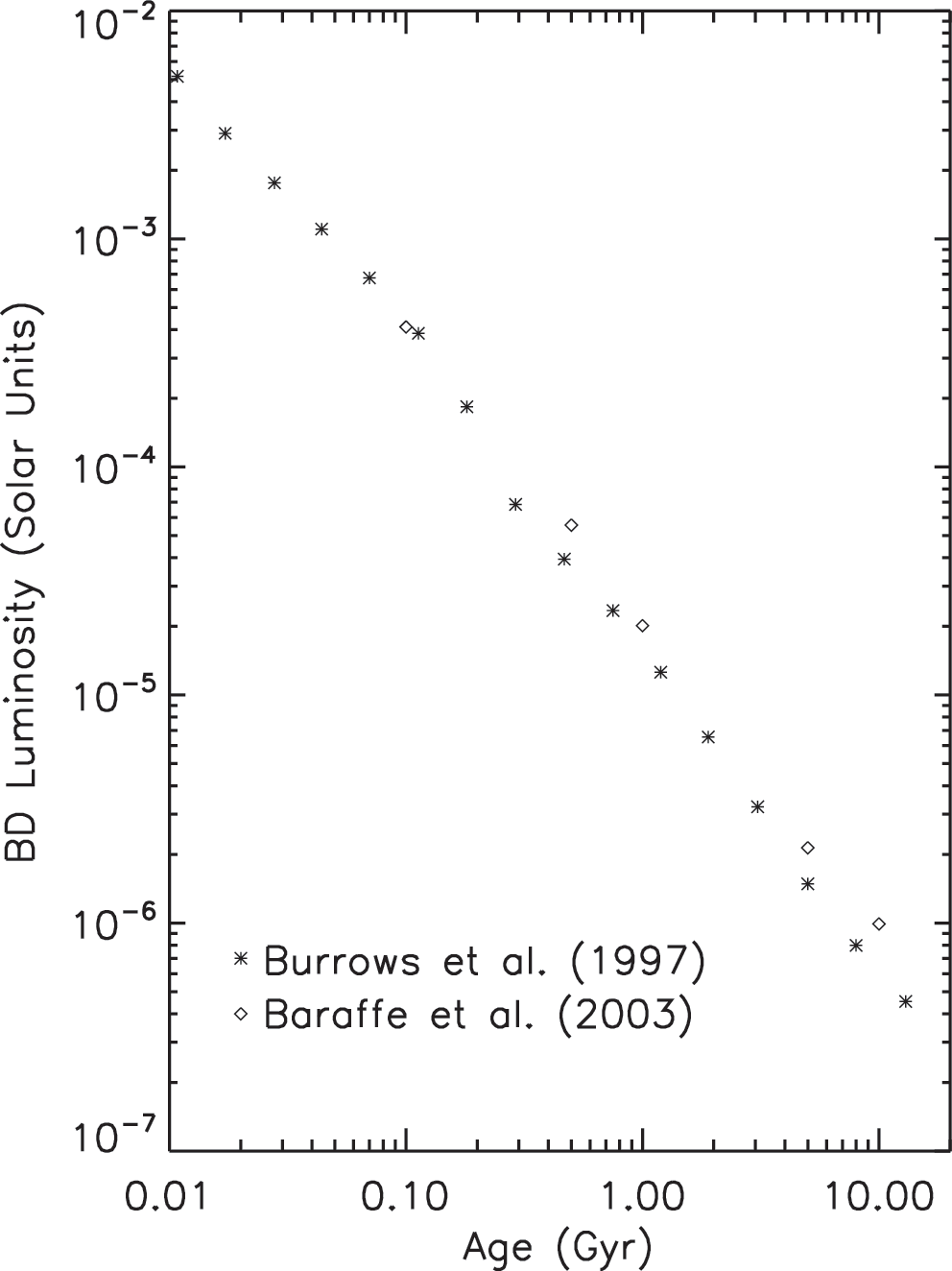
Brown dwarfs are objects that burn deuterium, but not hydrogen, and are thus less luminous than MS stars. Traditionally, BDs are assumed to have masses in the range 13–80 M Jup, but the actual limits are more complicated (see Spiegel et al., 2011, for a review). Most of their luminosity results from the release of gravitational energy via contraction. As relatively few BDs are known, and ages are difficult to constrain empirically, we rely on theoretical models to determine their luminosity L BD and effective temperature T eff. Two standard models are available (Burrows et al., 1997; Baraffe et al., 2003), and their results are shown in Fig. 2. The two models agree with each other, and we use Baraffe et al. (2003) to be consistent with Bolmont et al. (2011).
2.3. The insolation habitable zone
We follow exactly the assumptions, models, and symbols presented in Barnes et al. (2013). We label the locus of orbits for which starlight can provide the appropriate level of energy for surface water the IHZ. We use the Barnes et al. (2008) IHZ that merges the work of Selsis et al. (2007) and Williams and Pollard (2002) to estimate IHZ boundaries for eccentric orbits and ignore the role of obliquity (cf. Dressing et al., 2010). With the previous assumptions, the inner edge of the IHZ is located at
and the outer at
In these equations, l
in and l
out are the inner and outer edges of the IHZ, respectively, in astronomical units; l
in,Sun and l
out,Sun are the inner and outer edges of the IHZ in the solar system, respectively, in astronomical units; a
in=2.7619×10⁻⁵ AU/K, b
in=3.8095×10⁻⁹ AU/K2, a
out=1.3786×10⁻⁴ AU/K, and b
out=1.4286×10⁻⁹ AU/K2 are empirically determined constants; and L
* and L
Sun are the primary's and solar luminosity, respectively. T
*=T
eff – 5700 K, where T
eff is the “effective temperature” of the primary,
where R * is the primary's radius.
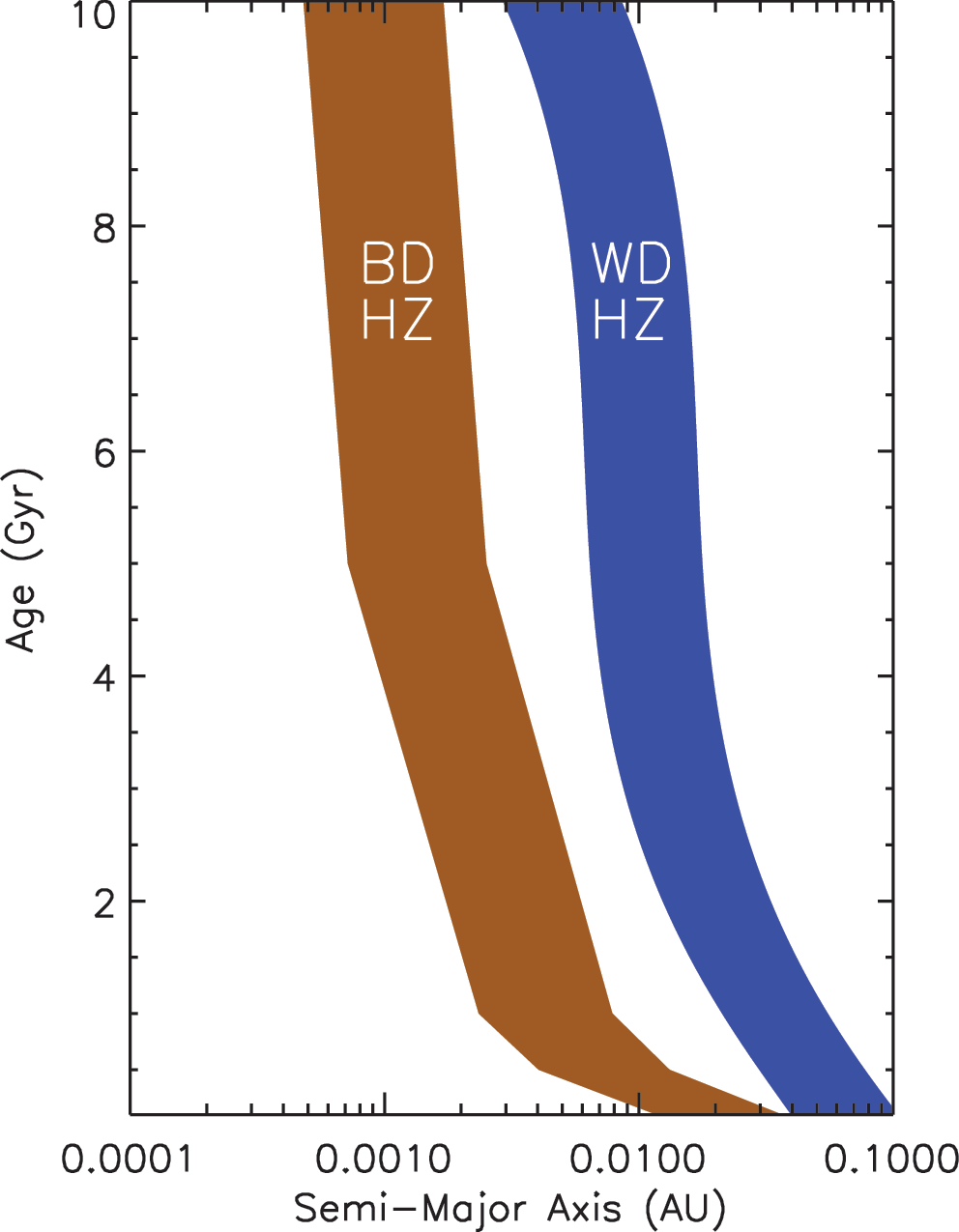
We can combine the cooling rates with the IHZ models to determine how the position of the IHZ evolves with time. In Fig. 3, we show the location of the IHZs in time for the 0.06 M Sun WD and 40 M Jup BD cases described previously. Initially, the BD's IHZ is only a factor of 2 closer in than the WD's, but for ages greater than 1 Gyr, the BD's IHZ is about an order of magnitude closer to the host.
2.4. Spectral energy distributions of white dwarfs and brown dwarfs
Not only will the luminosities of cooling WDs and BDs change, but so will their spectral energy distribution. The evolution of the extreme ultraviolet (XUV) portion of the spectrum (1–1200 Å) is particularly relevant, as photons with this energy level are the most effective at photolyzing water vapor (Watson et al., 1981); see below. Moreover, the evolution of the spectral energy distribution is important against the background that almost all land-based life on Earth depends on photosynthesis, which operates almost exclusively in the visible range, that is, between 400 and 700 nm. WD spectra typically peak in the UV, while BD emission is mainly in the IR. Thus, we shall now treat the evolution of WD and BD spectra.
We begin with the WD and consider its spectrum at 0.1, 1, 5, and 10 Gyr. Therefore, we look up the surface gravity (log(g WD)), effective temperature (T eff,WD), and radius (R WD) of a 0.609 M Sun WD in the Z=0.01 evolution tables from Renedo et al. (2010), Z being the progenitor metallicity. We find that log(g WD) increases only slightly from 7.98 dex to 8.05 dex, owed to the shrinking from 0.0132 to 0.0122 R Sun. Meanwhile, the effective temperature decreases from 18,400 to 4,200 K. In Fig. 4, we plot the corresponding WD synthetic spectra (Finley et al., 1997; Koester, 2010) weighted by (R WD/d)2, where d=0.01 AU is the distance of a potential planet from the WD. At 5 and 10 Gyr, the WD has cooled to effective temperatures for which we do not have the synthetic spectra available. Thus, we plot the corresponding blackbody profile, from which the WD would deviate less than in the upper two panels, as the WD does not emit much in the XUV.
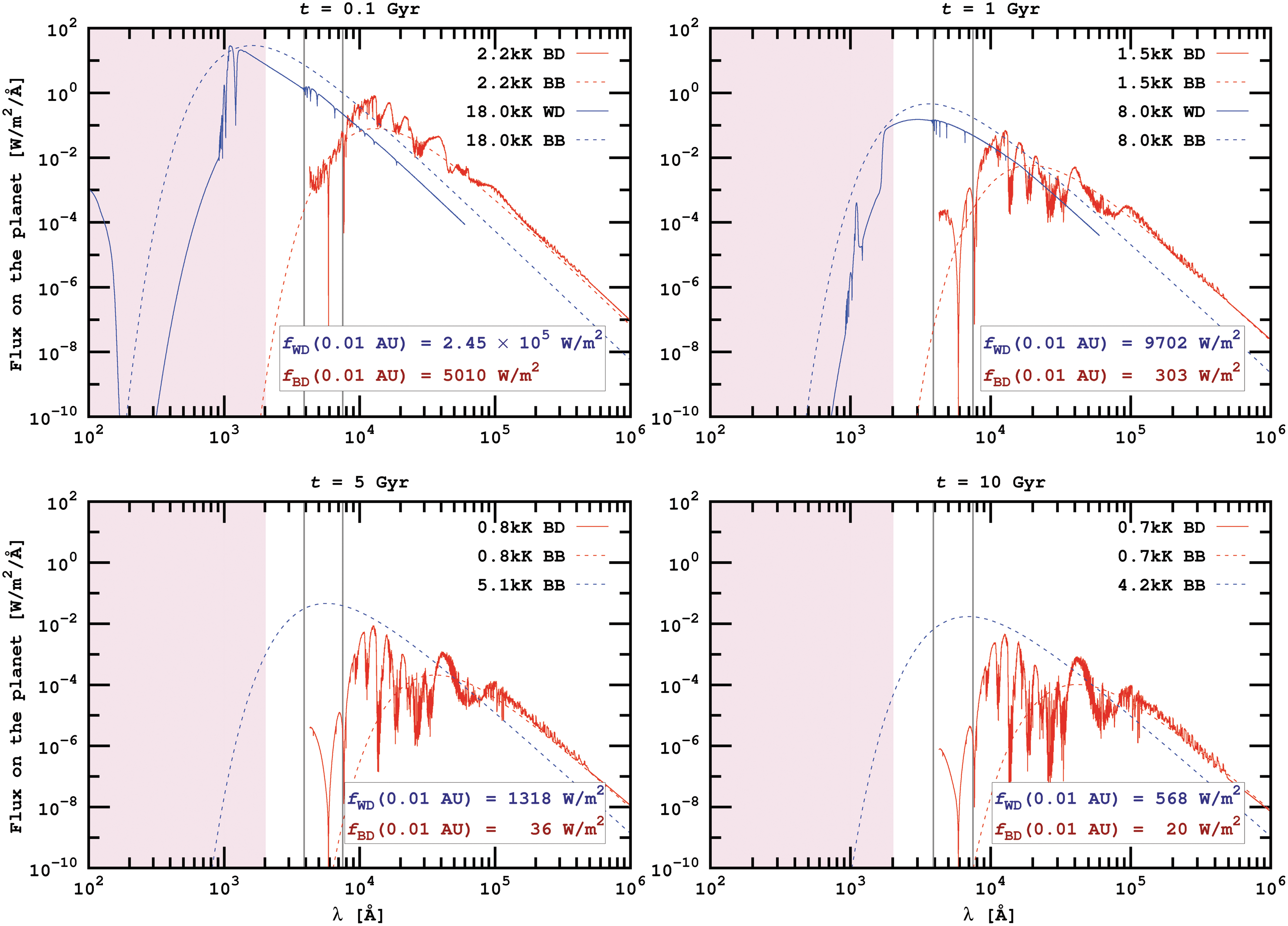
Evolution of the spectra of a 0.6 M Sun WD and a 40 M Jup BD. The XUV range, corresponding to those wavelengths that may photolyze water vapor, is shaded pink, while vertical lines denote the visible range used for photosynthesis on Earth. In the lower two panels we do not plot the corresponding WD spectra because such extremely low-temperature models are not available. We also show the Planck curve of a WD-sized and a BD-sized blackbody (BB) at 0.01 AU, respectively.
We next consider the BD spectra corresponding to the same epochs. We choose a 40 M Jup BD and look up the effective temperatures (T eff,BD) and radii (R BD) in Baraffe et al. (2003). We then use cloud-free BD spectral models from Burrows et al. (2006) at T eff,BD=2200, 1500, 800, and 700 K1 and weight them with a factor (R BD/d)2, analogous to the procedure for the WD.
Figure 4 finally displays the WD and BD spectral flux received at a distance of 0.01 AU at 0.1, 1, 5, and 10 Gyr. We indicate the XUV range (shaded in pink) to emphasize those conditions that are most likely to remove surface and atmospheric water. While the WD spectrum at ages>1 Gyr becomes more and more like the Sun's, the BD departs far into the IR. The bolometric flux of the hosts (WD and BD) at a distance of 0.01 AU is given in the lower right corner of each panel. Recall that the solar constant, that is, the Sun's flux at 1 AU, is roughly 1400 W m−2.
2.5. The desiccation timescale
As mentioned above, XUV photons are able to liberate hydrogen atoms from terrestrial planets, a process that removes water. If the XUV flux is high enough and lasts long enough, a planet can become desiccated and inhospitable for life. Crucially, the water must be photolyzed first (by UV photons with wavelengths of 120–200 nm) so as to produce the hydrogen atoms that can escape. While WDs are initially very hot and have a peak brightness in this regime (see Fig. 4), BDs are relatively cool, and UV and XUV radiation must come from emission due to activity. Observations of young BDs at these wavelengths are scarce; hence we cannot determine the likelihood that planets interior to the HZ will in fact lose their water. In this section, we review a simple model for hydrogen loss, parametrized in terms of XUV luminosity L XUV and the efficiency of converting that energy into escaping hydrogen atoms.
First, we must recognize that a wide range of water fractions are possible for terrestrial exoplanets (e.g., Morbidelli et al., 2000; Léger et al., 2004; Raymond et al., 2004; Bond et al., 2010). Planets with more initial water content are obviously better suited to resist total desiccation, as removal requires a longer time. Similarly, planets with very low water content, such as the “dry planets” proposed by Abe et al. (2011) would desiccate more quickly than an Earth-like planet. Here, we assume that planets form with Earth's current inventory of water and that the only source of hydrogen atoms in the upper atmosphere is the photodissociation of water.
We use the atmospheric mass loss model described by Erkaev et al. (2007), which improves the standard model by Watson et al. (1981). In the Watson et al. picture, a layer in the atmosphere exists where absorption of high-energy photons heats the particles to a temperature that permits escape. Photons in the X-ray and XUV have the energy to drive this escape on most self-consistent atmospheres. In essence, the particles carry away the excess solar energy.
Watson et al. (1981) calculated that Venus would lose its water in 280 Myr. The actual value is probably less than that, as they were unaware that XUV emission is larger for younger stars, as the spacecraft capable of such observations, such as ROSAT, EUVE, FUSE, and HST (Ribas et al., 2005), had yet to be launched. Furthermore, their model did not consider the possibility of mass loss through Lagrange points, or “Roche lobe overflow.” Erkaev et al. (2007) provided a slight modification to the Watson et al. (1981) model that accounts for this phenomenon on hot Jupiters. Here, we use this model for a terrestrial exoplanet, which is a fundamentally different object. However, molecules above the Roche lobe should escape regardless of their composition; hence we use the Erkaev model. We stress that the physics of atmospheric escape, especially for close-in terrestrial exoplanets, is complicated and poorly understood. In the Erkaev et al. (2007) model, mass is lost at a rate of
where R
x is the radius of the atmosphere at which the optical depth for stellar XUV photons is unity, ɛ is the efficiency of converting these photons into the kinetic energy of escaping particles, F
XUV is the incident flux of the photons. The parameter k
tide is the correction for Roche lobe overflow:
and
is the ratio of the “Hill radius” to the radius at the absorbing layer. From Eq. 5 it is trivial to show that
where M H is the total mass of all the hydrogen atoms that must be lost (∼1.4×10⁻⁵ M Earth in our model, corresponding to 10−4 M Earth of initial water) and assuming F XUV is constant. For the cases we consider, the additional mass loss via Roche lobe overflow is ∼1%.
The values of F XUV and ɛ are therefore the key parameters, as they represent the magnitude and efficiency of the process. As not all the absorbed energy removes particles, ɛ must be less than 1. Observations of hot Jupiters suggest values of ɛ of 0.4 (Yelle, 2004; Jackson et al., 2009; Lammer et al., 2009), while on Venus ɛ ∼ 0.15 (Chassefière, 1996). However, our model also requires these photons to dissociate the water molecules, hence we should expect ɛ in a water-rich atmosphere to be much less than it would be on a hot Jupiter with a predominantly hydrogen atmosphere. For reference, using the assumptions of Watson et al. (1981), we find ɛ=1.7×10⁻⁴ implies t des=280 Myr for Venus. Note that a water-rich planet that loses its hydrogen may develop an oxygen-rich atmosphere and may be misidentified as potentially habitable. Furthermore, the destruction of O3 by UV radiation would also be slow and, hence, could lead to a “false positive” for life (Domagal-Goldman et al., personal communication). This possibility requires detailed photochemical modeling for confirmation and is beyond the scope of this study.
In Fig. 5, we show the desiccation timescale for an Earth-like planet orbiting a WD or BD at 0.01 AU. This distance is just interior to the IHZ at 100 Myr and is therefore a critical location for a planet to experience sustained habitability in the future. For most young WDs, the peak brightness lies in the XUV, and the total luminosity is >10−3 L Sun. Thus, their planets are in an environment characterized by the top portion of the graph. In order to avoid desiccation, those planets must have ɛ<10−6. This value is very small, and we expect that planets initially interior to the IHZ will be desiccated by the time it arrives.
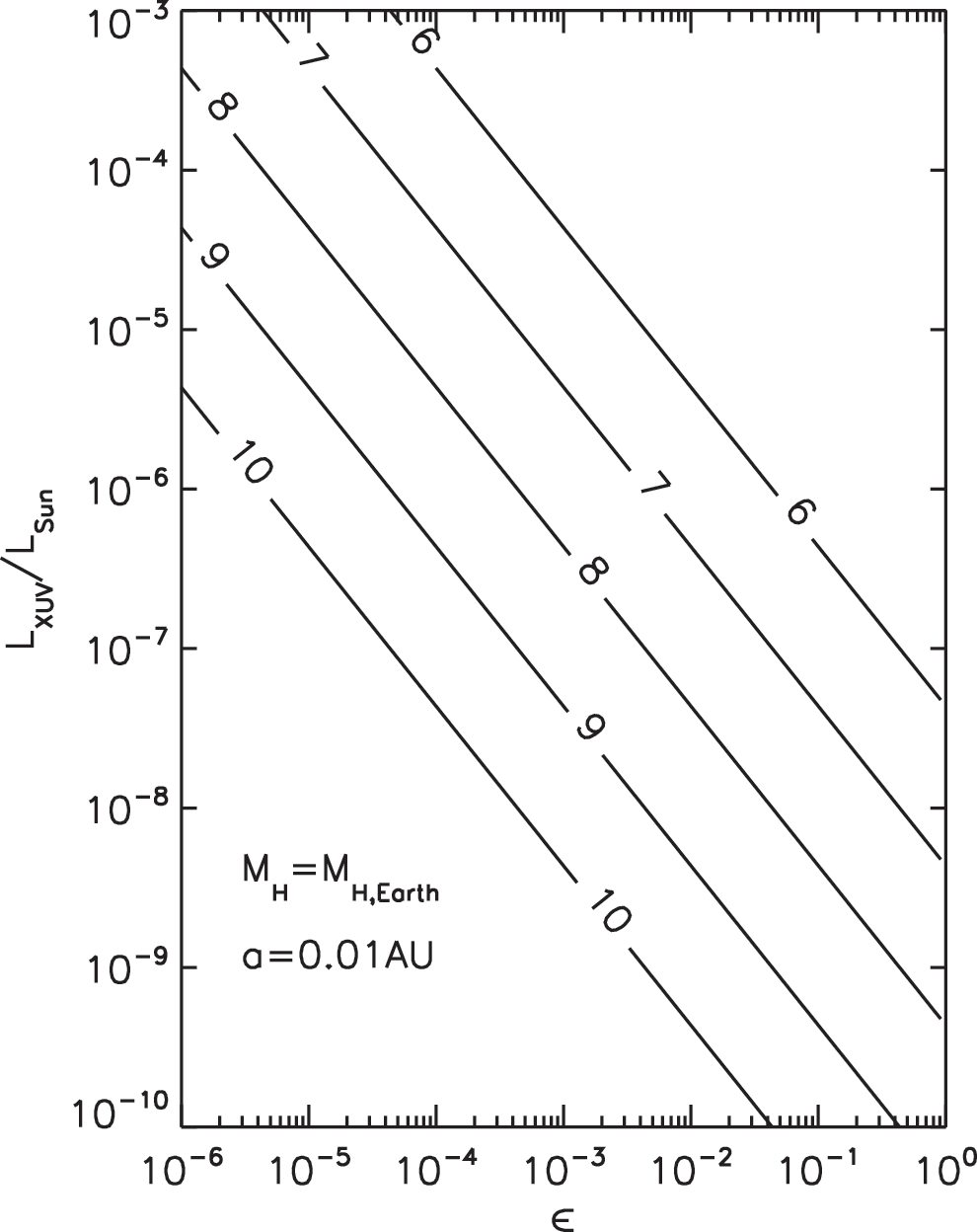
Desiccation timescale for an Earth-like planet orbiting a BD or WD at 0.01 AU. Contour lines represent the logarithm of the time for the Earth's inventory of hydrogen to be lost; that is, the planet's mass of hydrogen in water M H is equal to Earth's M H,Earth.
The situation for BD planets is difficult to assess at present. The two steps of photolysis and escape require knowledge of the evolution of UV and XUV emission, which is largely unknown at present. The cool temperatures of BDs suggest that photolysis may be the limiting step in the desiccation process, as the BD photospheres may be too cool to emit enough UV radiation to drive desiccation. Assuming that water molecules can be destroyed, it is unclear whether the XUV emission is large enough to drive mass loss, too. We can appeal to low-mass M dwarfs for guidance and extrapolate the results of Pizzolato et al. (2003) to the BD realm. They estimated the “saturation level” of XUV radiation, which is the largest amount of XUV luminosity as a fraction of total luminosity observed in stars. They found that, for stars with masses in the range 0.22–0.6 M Sun, the XUV emission never represents more than 10−3 of the total. At 100 Myr, BDs are expected to have luminosities near 10−4 L Sun; hence their XUV flux should be less than 10−7 L Sun. For a planet initially at 0.01 AU from a BD to avoid desiccation, ɛ<5×10⁻³. We caution that BD interiors are expected to be fully convective, while stars in the above mass range are not; hence the stars considered by Pizzolato et al. (2003) may not be analogous to BDs. A survey of XUV emission from a large sample of BDs is sorely needed to address this aspect of planetary habitability, but will be very challenging, even from space. On the other hand, spectral characterization of atmospheres in the IHZs of older BDs could provide the tightest constraints on the early high-energy emission of BDs.
2.6. Tidal effects
We use the two tidal models described by Heller et al. (2011) and the numerical methods described by Barnes et al. (2013) (see also Ferraz-Mello et al., 2008; Greenberg, 2009; Leconte et al., 2010). These models are qualitatively different but widely used in astrophysics and planetary science. They both assume that the tidal bulge raised on a body lags behind the apparent position of a perturber and that the shape of the deformed body can be adequately modeled as a superposition of surface waves. One, which we call the “constant time lag” (CTL) model, assumes that the time between the passage of the perturber and the passage of the tidal bulge is constant. The tidal effects are encapsulated in the product of the “tidal time lag” τ and the second-order tidal Love number k 2. The other model, which we call the “constant phase lag” (CPL) model, assumes that the angle between the lines connecting the centers of the two bodies and the center of the deformed body to the bulge is constant. The tidal effects in this model lie in the quotient of the “tidal quality factor” Q and k 2. The tidal time lag and quality factor essentially measure how effectively energy is dissipated inside a body.
In accordance with Barnes et al. (2013), we assume the planets are Earth-like with τ=640 s or Q=10 (Lambeck, 1977; Yoder, 1995). The tidal heating scales linearly with these parameters and as semimajor axis a to the −7.5, eccentricity e squared, obliquity ψ p squared and spin frequency ω p squared (see Barnes et al., 2013). The heat flux F through the surface is critical for surface life and is also a measure of how geophysical processes transport energy. Martian tectonics is believed to have shut down at a heat flux of 0.04 W m−2 (Williams et al., 1997). Earth's heat flux, due to nontidal processes, is 0.08 W m−2 (Pollack et al., 1993), and Io's heat flux due to tidal heating is 2 W m−2 (Strom et al., 1979; Veeder et al., 1994). The limit to trigger a runaway greenhouse is F crit=300 W m−2 (Pierrehumbert, 2010). We will use these limits to explore the habitability of planets orbiting WDs and BDs (see below). We shall thereby keep in mind that these values are not natural or material constants but depend strongly on a planet's composition, mass, and age.
The tidal Q of WDs is poorly constrained. Recently, Piro (2011) used the luminosities of an eclipsing He-C/O WD binary to place limits on the Q values of the two companions. He found that the former has Q<7×10¹⁰ and the latter has Q<2×10⁷. Unfortunately, these are relatively rare classes of WDs, as 80% are classified as H WDs. These values are probably larger than are those for solar-type stars (Jackson et al., 2009) and predict little dissipation in the WD from the terrestrial planet. Furthermore, these values preclude the possibility that the planet's orbit could tidally decay at a rate that allows it to remain in the IHZ as the WD cools. At 100 Myr, the IHZ is at ∼0.05 AU, and the tide on the WD is negligible. This assumes the WD rotation period is longer than the orbital period, which may not be the case. The rotation rates of WDs can span a wide range, from seconds to years, but should initially rotate with periods longer than 1 day (Kawaler, 2004; Boshkayev et al., 2012).
Tidal processes in BDs are also relatively unexplored. Heller et al. (2010) used the CPL and CTL models to explore the range of tidal heating available in the eclipsing BD binary pair 2MASS J05352184-0546085 (Stassun et al., 2006). This study indicates that tidal heating can be significant in BDs. Tidal evolution of BDs orbiting MS stars has also been calculated for a few cases (e.g., Fleming et al., 2010; Lee et al., 2011), but tidal dissipation in BDs remains poorly constrained. Here, we assume Q=106, which is a reasonable estimate based on those prior studies. We use the radius values as a function of time given by Baraffe et al. (2003).
2.7. Classifying planets by radiative and tidal heat
Different levels of insolation and tidal heat can be used to devise a classification scheme for terrestrial exoplanets orbiting in and around the IHZ. Here, we propose categories that are relevant for the discussions in Sections 3–4. The categories are defined by the origin and total amount of upward energy flux at the planetary surface. That, due to orbit-averaged insolation, and assuming efficient energy redistribution, is
Here, L p is the primary's luminosity, a is semimajor axis, e is eccentricity, and A is the planetary albedo. In addition to this heating, there is also an energy flux that results from the cooling of the planetary interior. Three sources are known to be possible: radioactive decay, latent heat of formation, and tides. Here, we will focus on the tidal heat. The amount of radioactive and latent heat is very difficult to calculate from observations, whereas the tidal heat can at least be scaled by a single parameter. When the tidal heat drops below a level that is geophysically interesting, then we will assume that the planet's interior behaves like that of Earth, which has a heat flux of 0.08 W m−2, of which a negligible fraction is due to tides. We are therefore assuming that, in the absence of tidal heating, the planetary interior behaves like Earth's. The flux due to tides is F tide (see Barnes et al., 2013). The sum of F insol and F tide is F tot.
Three Venus-like planets are possible. An “Insolation Venus” is a planet that receives enough stellar radiation to trigger a moist or runaway greenhouse. A “Tidal Venus” is a planet whose tidal heat flux exceeds the runaway greenhouse flux, F tide≥F crit. Finally, “Tidal-Insolation Venuses” are planets with F tide<F crit and F insol<F crit but F tide+F insol≥F crit.
“Super-Ios” (Barnes et al., 2009b) are worlds that experience tidal heating as large or larger than Io's (F tide>2 W), in which case the dissipation in the interior determines the onset of Io-like volcanism and tidal dissipation in the interior is 10 times less effective than in an ocean. Therefore, we determine the Super-Io boundary by using τ=64 s or Q=100.
Planets with 2 W m−2≥F tide≥0.04 W m−2 are “Tidal Earths.” Those planets with F tide<0.04 W m−2 are “Earth Twins,” as they are in the IHZ and receive negligible tidal heating.
Planets exterior to the IHZ and with 2<F tide<0.04 W m−2 are labeled “Super-Europas,” while those with F tide<0.04 W m−2 are “Snowballs.” While both may possess layers of subsurface water, these environments are not detectable across interstellar distances.
3. Planets Orbiting White Dwarfs
3.1. 0.6 MSun white dwarfs
The luminosity of a 0.6 M Sun WD is ∼10−3 L Sun (Bergeron et al., 2001); hence the IHZ is located at ∼0.01 AU (Agol, 2011b). In Fig. 6, we show the planetary classifications of 1 M Earth planets in orbit around a 0.6 M Sun WD at four different times, assuming the cooling model derived in Section 2. Note that we are not assuming any orbital evolution in this figure. Here, we assume that the planets rotate with the equilibrium period and with no obliquity. Note the low values of eccentricity, a testament to the power of tides in these systems.
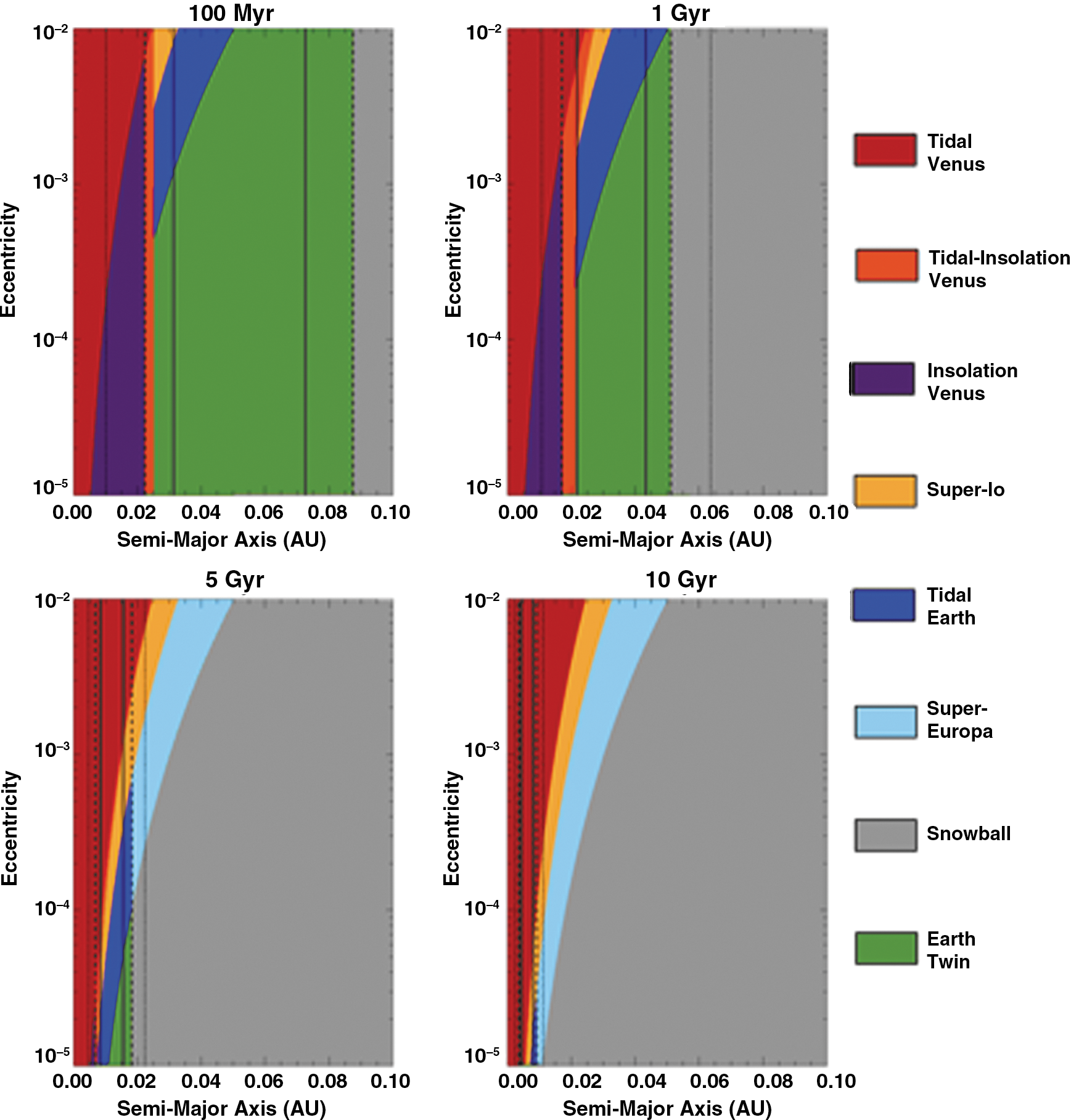
Planetary classifications for a tidally locked 1 M Earth planet with no obliquity in orbit about a 0.6 M Sun WD. As WDs cool significantly with time, we show the phases and IHZ as a function of time, from 100 Myr (top left) to 10 Gyr (bottom right).
At 100 Myr, the WD is very hot, ∼104 K. This effective temperature is outside the range considered by Selsis et al. (2007); hence in order to obtain a close match between the 50% cloud cover boundary of Selsis et al. (2007) and the runaway greenhouse limit of Pierrehumbert (2010), we set the planetary albedo to 0.87. (For the later times we used A=0.5.) Even at that large value, the inner boundary of the IHZ does not align with Pierrehumbert's prediction. Earth Twins require e<0.01.
From 0.1 to 1 Gyr, the WD cools rapidly (see Fig. 1), and afterward the IHZ has moved in by 50%. Tidal effects desiccate more of the IHZ at “large” eccentricity, and much is in the Tidal Earth regime. However, at 1 Gyr, most of the IHZ below e=0.01 still appears habitable.
By 5 Gyr, however (lower left panel), even at very low eccentricities, most planets in the IHZ will experience strong tidal effects. At e=10−5, the inner edge is experiencing at least Tidal Earth conditions, and Earth Twins must be at the outer edge and with e<10−4. Agol (2011b) identified 4–7 Gyr as a “sweet spot” for planets around WDs as the cooling levels off (see Section 2), but in order to be habitable, candidate planets require very low eccentricities to avoid a tidal greenhouse. Note that at a=0.01 AU and e=10−4 the difference between closest and farthest approach from the host is 2ae=300 km, or about 5% the radius of Earth.
At 10 Gyr (lower right panel), the situation has continued to deteriorate for habitable planets. Not only has the width of the IHZ shrunk considerably, but Earth Twins are only possible if e<10−5! Habitability at this stage probably requires a system that consists of one WD and one planet, as additional planet mass companions can raise e above this threshold (see below and Barnes et al., 2010). As with CoRoT-7 b, the galactic tide or passing stars cannot pump e to this “large” value (Barnes et al., 2010).
Tides on planets orbiting WDs are a strong constraint on habitability but are less important than the WD's cooling. Consider the left panels of Fig. 6. In the bottom panel, the IHZ lines up with Insolation Venus (purple) and Tidal Venus (red) regions of the upper panel. Therefore, planets located in the 5 Gyr IHZ were interior to the 0.1 Gyr IHZ. Furthermore, young WDs are very hot and emit substantial energy in the XUV wavelengths that photolyze H2O. As 0.1 Gyr ∼ t des, we expect planets in the 5 Gyr IHZ to have been desiccated well before the IHZ reaches them. In other words, habitability requires special circumstances that override the standard picture of habitability. Unfortunately, tidal decay of the (circular) orbit is unlikely, as the tidal Q (τ) is probably very large (small) for WDs (Agol, 2011b; Prodan and Murray, 2012). Therefore, planets orbiting hydrogen WDs will not spiral in and cannot keep pace with the shrinking IHZ.
3.2. KOI 55
Two planet candidates have recently been proposed that orbit an extreme horizontal branch star, an astrophysical object that will shortly transition to a WD. These candidates were found with the Kepler spacecraft and are designated KOI 55.01 and KOI 55.02 (Charpinet et al., 2011). The stellar mass is 0.5 M Sun, and the two planets' radii are 0.76 and 0.87 R Earth. If Earth-like in composition and structure, these planets have masses of 0.41 and 0.63 M Earth, respectively (Sotin et al., 2007). If these candidates are real, then they will orbit a WD and hence could become habitable. Moreover, their detection implies that these planets may be typical of those that orbit WDs. In this subsection, we consider the future habitability of these two objects.
The two candidates have semimajor axes of 0.006 and 0.0076 AU. The outer planet, KOI 55.02, therefore falls in the IHZ during the crystallization epoch from 4 to 7 Gyr. The primary currently has a temperature of 27,700 K and therefore emits strongly in the XUV and X-ray spectral regimes (see Fig. 3, upper left panel). These planets are therefore roasting and likely losing their water (if they had any). Hence, both objects are in danger of sterilization due to irradiation now and are unlikely to become habitable later. Furthermore, this extremely high temperature suggests that our nominal value for t des may be too high.
There is also a danger that perturbations between the two planets (which may be in a 3:2 resonance) may maintain a large enough eccentricity (>10−4) to sustain a tidal greenhouse. To test for this possibility, we ran two numerical simulations of the gravitational perturbations between the planets by using HNBody2. The first case used the nominal values from Charpinet et al. (2011), and the second forced the two planets into an exact 3:2 mean motion resonance by pushing the outer planet's period to 8.64 h. For the former, the eccentricity of KOI 55.02 oscillated between 5×10⁻⁶ and 5×10⁻⁵. This range places the planet in the Tidal Earth or Earth Twin regime. For the latter case, the resonance perturbs the eccentricity more strongly, and it varies between 10−4 and 10−3. These values are in the Tidal Venus range, and the planet would not be habitable. However, given the strong tidal forces in this region, these ranges are probably maximum values. Nonetheless, the future habitability of these two planet candidates seems unlikely.
4. Planets Orbiting Brown Dwarfs
In accordance with Bolmont et al. (2011), we consider a 0.04 M Sun BD and employ the theoretical cooling and contraction models of Baraffe et al. (2003) to calculate IHZ boundaries. Here we extend the results of Selsis et al. (2007) to the luminosity and temperatures of BDs, which give similar limits as Bolmont et al. (2011). In this case, we use the CPL model with a continuum of rotation states (see Barnes et al., 2013, Appendix E.3) to determine F tide and set the BD's obliquity to 0 and its rotation period to 1 day (note that these values do not affect the tidal heating in the planet).
In Fig. 7, we show the boundaries for planetary classes for a 1 M Earth planet after 100 Myr, 1 Gyr, 5 Gyr, and 10 Gyr. Note that the scales of the axes change for each panel. At 100 Myr, that is, t des, planets in the IHZ with e>0.01 may be in a Tidal Venus state. Also note that our model predicts that all planets interior to 0.016 AU will have lost their water. At 1 Gyr, planets must have e<5×10⁻⁵ to avoid a tidal greenhouse, but at this point, the IHZ has moved into a region in which all water should already have been lost. To avoid a Tidal Venus state at 5 and 10 Gyr, eccentricities must be less than 10−6 and 10−7, respectively. Therefore, even if a planet could maintain its water inventory until the IHZ reached its orbit, a planet must have an extremely circular orbit to avoid catastrophic tidal heating. Also note that the Roche lobe, the distance where a planet is in danger of being torn apart by tides, lies at ∼3×10⁻³ AU (Andreeshchev and Scalo, 2004; Bolmont et al., 2011), further limiting habitability.
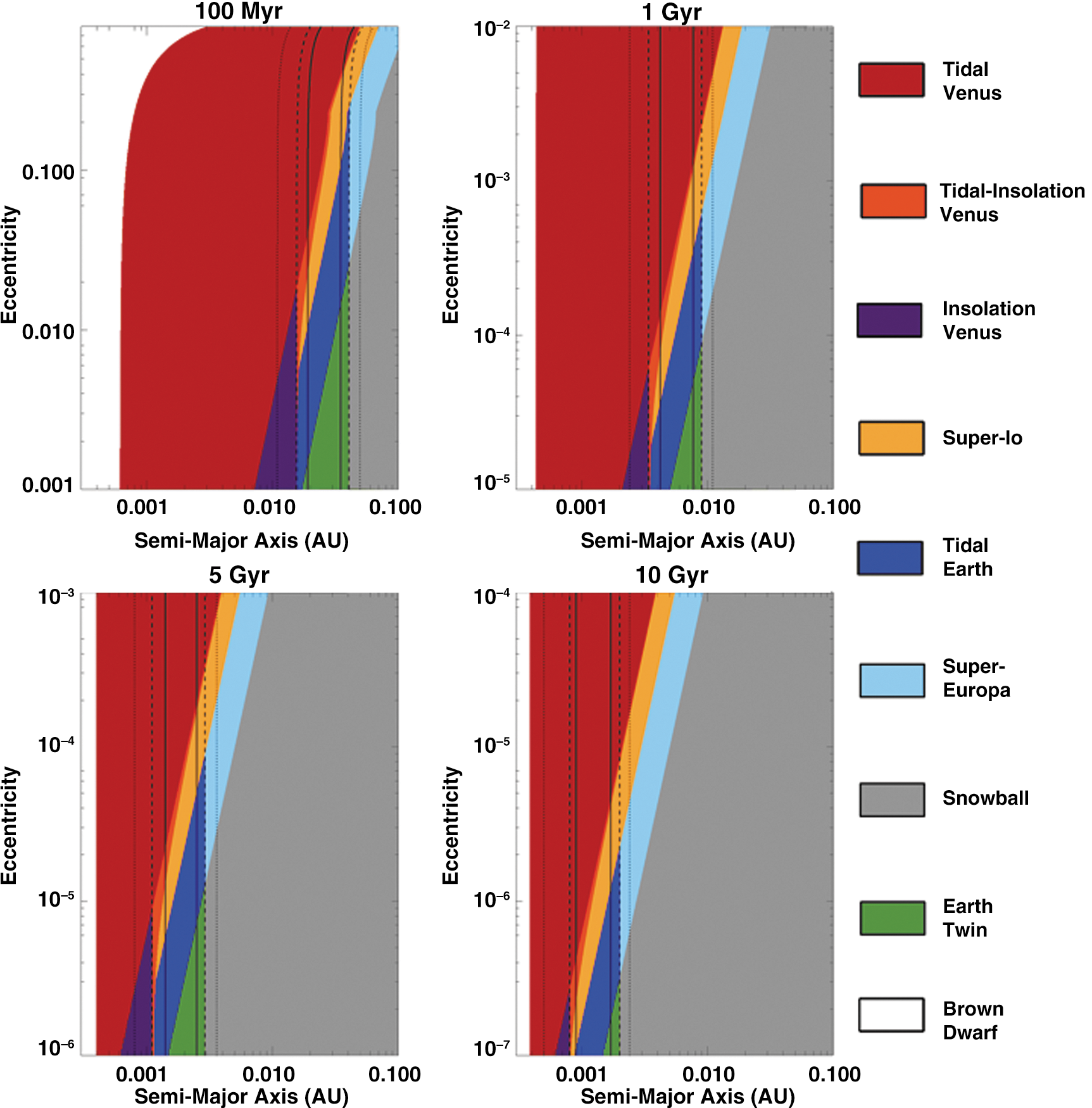
Planetary classifications for a tidally locked 1 M Earth planet with no obliquity, in orbit about a 0.04 M Sun BD at 100 Myr (top left), 1 Gyr (top right), 5 Gyr (bottom left), and 10 Gyr (bottom right). White regions correspond to orbits that intersect the BD.
Bolmont et al. (2011) pointed out that tides will tend to push planets out, in an analogous manner as the Moon recedes from Earth. Therefore, as the planets move out and the IHZ moves in, the residence time in the IHZ can be quite short. They considered the example of a planet that begins at 9×10⁻³ AU and found that planets between 0.1 and 10 M Earth will require at least 50 Myr to reach the IHZ. As this time is of order t des, the key limit to habitability may be that those planets will have already lost their water, rather than the relatively short time the planets spend in the IHZ. However, not enough is known about activity on young BDs to accurately determine the threat of photolyzation and hydrogen escape.
5. Conclusions
Planets orbiting WDs and BDs suffer a number of critical habitability issues, such as strong tidal heating, water loss due to bombardment by high-energy photons, a spectral energy distribution very different from the Sun's, and a cooling primary. Here, we have outlined how dire the situation is for life on these types of planets, using simple but standard models of the IHZ, tidal heating, and cooling rates. We conclude that WDs are even less likely to support habitable planets than BDs due to the former's stronger XUV emission.
As the luminosities of WDs and BDs change dramatically with time (see Figs. 1 –3), the IHZ moves inward. Planets interior to the IHZ experience a desiccating greenhouse phase for times longer than t des due to insolation and hence lose their water before the IHZ reaches their orbit, and are hence uninhabitable. This possibility is more likely for WDs than BDs, as the former's peak radiation lies in the near UV, while constraints on the latter's emission are difficult to obtain. New data on the duration and strength of BD activity are sorely needed. However, even if the spectral energy distribution of the host does not remove the hydrogen, the orbital eccentricities must remain very low in order to avoid a tidal greenhouse.
Once a planet is in the IHZ, there are four requirements for habitability: (1) The eccentricity must be low enough to avoid a tidal greenhouse, (2) a reservoir of water must survive the desiccating greenhouse phase, perhaps trapped in the mantle, (3) a mechanism must exist to draw down CO2 and quench the moist greenhouse, and (4) a (possibly different) mechanism must release the water reservoir to the surface. Currently, no phenomena are known that can satisfy all four of these constraints.
On the other hand, the possibility exists that the planet could arrive in the IHZ from a further distance (see, e.g., Agol, 2011a). For example, if a more distant and massive companion is present, gravitational perturbations could excite the planet's eccentricity such that the pericenter distance is close enough for tides to circularize the orbit. Then the planet could arrive in the IHZ in a circular orbit after tidal circularization (Nagasawa et al., 2008). Alternatively, a late-stage planet-planet scattering event could move a terrestrial planet from a more distant orbit to the IHZ. Recent observations suggest that planetary systems with 2:1 mean motion resonances are younger than average, suggesting they break apart as they age (Koriski and Zucker, 2011). In both these scenarios, the planet still has to contend with large eccentricities; hence tidal heating could still sterilize the surface. Additionally, the planet would have to break out of its frozen state, and it is unclear if such “cold starts” are possible (Kasting et al., 1993). Unfortunately, these sorts of histories are nearly impossible to recognize from a planet on a circular orbit; hence we should not expect to be able to determine whether a planet arrived in the IHZ without experiencing desiccating conditions. Nonetheless, future work should determine whether planets can still be habitable after an extended time in the runaway greenhouse, and the likelihood that planets orbiting WDs and BDs can migrate long after their formation.
Planets are complex objects. We hesitate to rule out habitability, but planets orbiting BDs and WDs face a difficult path to habitability. On the other hand, as pointed out by Agol (2011b) for WDs and Belu et al. (2013) for BDs, the signals for some of these objects could be very easily detected. If a planet is found in the IHZ of a cooling primary, follow-up observations should still be carried out. Regardless of their habitability, terrestrial planets found around these objects will provide fundamentally new insight into planet formation and, hence, into the extent of life in the Universe.
Footnotes
Acknowledgments
We thank Victoria Meadows, Kristina Mullins, Jim Kasting, Colin Goldblatt, Eric Agol, David Spiegel, and two anonymous referees for extremely valuable commentary on this concept and manuscript. R.B. acknowledges support from NSF grant AST-1108882 and from the NASA Astrobiology Institute's Virtual Planetary Laboratory lead team. R.H. is supported by the Deutsche Forschungsgemeinschaft (reference number schw536/33-1).
Abbreviations
BD, brown dwarf; CPL, constant phase lag; CTL, constant time lag; HZ, habitable zone; IHZ, insolation habitable zone; KOI, Kepler Object of Interest; MS, main sequence; WD, white dwarf; XUV, extreme ultraviolet.
1
Available at
2
Publicly available at