




Abstract
The search for evidence of life on Mars is the primary motivation for the exploration of that planet. The results from previous missions, and the Phoenix mission in particular, indicate that the ice-cemented ground in the north polar plains is likely to be the most recently habitable place that is currently known on Mars. The near-surface ice likely provided adequate water activity during periods of high obliquity, ∼5 Myr ago. Carbon dioxide and nitrogen are present in the atmosphere, and nitrates may be present in the soil. Perchlorate in the soil together with iron in basaltic rock provides a possible energy source for life. Furthermore, the presence of organics must once again be considered, as the results of the Viking GCMS are now suspect given the discovery of the thermally reactive perchlorate. Ground ice may provide a way to preserve organic molecules for extended periods of time, especially organic biomarkers. The Mars Icebreaker Life mission focuses on the following science goals: (1) Search for specific biomolecules that would be conclusive evidence of life. (2) Perform a general search for organic molecules in the ground ice. (3) Determine the processes of ground ice formation and the role of liquid water. (4) Understand the mechanical properties of the martian polar ice-cemented soil. (5) Assess the recent habitability of the environment with respect to required elements to support life, energy sources, and possible toxic elements. (6) Compare the elemental composition of the northern plains with midlatitude sites. The Icebreaker Life payload has been designed around the Phoenix spacecraft and is targeted to a site near the Phoenix landing site. However, the Icebreaker payload could be supported on other Mars landing systems. Preliminary studies of the SpaceX Dragon lander show that it could support the Icebreaker payload for a landing either at the Phoenix site or at midlatitudes. Duplicate samples could be cached as a target for possible return by a Mars Sample Return mission. If the samples were shown to contain organic biomarkers, interest in returning them to Earth would be high. Key Words: In situ measurement—Life detection—Mars—Planetary protection—Special region. Astrobiology 13, 334–353.
1. Introduction
T
Evidence for past liquid water on Mars was first discovered by orbital images from Mariner 9. Subsequent images from the Viking orbiters (e.g., Carr, 1981), the Mars Observer Camera (e.g., Malin and Carr, 1999), and the Mars Reconnaissance Orbiter (McEwen et al., 2007) provided images of fluvial features at ever-increasing resolution, indicating water flow on the surface of Mars in the past. Today there are indications of possible surface water flow on the equator-facing slopes of impact craters. Here, low-albedo features form and grow during the warmer months and disappear in the cold seasons (McEwen et al., 2011). While the source of water to form these features remains unclear, these observations indicate that under certain conditions small quantities of liquid water, possibly brines, can still form near the surface of Mars under the current climate. As explained below, the window for liquid water activity on Mars was likely wider during the last high-obliquity cycle, 5 Myr ago.
The two Viking landers conducted the first, and so far only, search for life on Mars. The biology experiments sought to detect viable life based on the hypothesis that microbial life would be widely present in the soils, as it is on Earth, and that it would respond to nutrients added with liquid water. The Viking biology experiments and the pyrolysis gas chromatograph–mass spectrometer (GCMS) all operated successfully on both landers (e.g., Klein, 1978) but yielded negative results with respect to the presence of organic compounds or active microorganisms (e.g., Klein, 1999). In brief, the post-Viking understanding of most scholars in regard to life on Mars is that (1) there was evidence for past active, stable liquid water on the surface of Mars, (2) there are no organics in the soils of Mars at the part-per-billion level, (3) there is an active set of oxidants, and (4) there was no life present at either Viking site.
Since Viking, a series of orbiters have mapped out ever-more-detailed morphological evidence for past liquid water and features possibly indicating present-day water activity. The Gamma Ray Spectrometer on the Mars Odyssey orbiter (Feldman et al., 2004, 2008b) mapped out the distribution of near-surface (within a meter or so of the surface) ice, showing that—consistent with predictions—ground ice was present down to latitudes of 60° in both hemispheres (Mellon and Jakosky, 1999; Mellon et al., 2004). Spectral observations from orbit showed the presence of extensive unweathered basaltic rocks (Christensen et al., 2001), massive sulfate deposits (Bibring et al., 2007), and ancient clay deposits mostly associated with craters (Bibring et al., 2006). In situ studies by the Mars Exploration Rovers confirmed the presence of deposits associated with the action of liquid water—both morphological and mineralogical (Squyres et al., 2004, 2012).
The most recent mission to Mars, Phoenix, can be viewed as a direct follow-up in many ways to the Viking missions. Like Viking, Phoenix scooped up dirt and placed it into its instrument suite—the first mission after Viking to do so. Like Viking, Phoenix added water to the soil and also searched for organic compounds by thermal release. Phoenix landed at 68°N in a location known from the Odyssey results to contain subsurface ice (Feldman et al., 2004). Ice was indeed found as expected 5–15 cm below the surface. While the ice was expected, there were three major unexpected—and to this day still not fully explained—discoveries by Phoenix. The first was the presence of segregated (“light colored”) ice in the surface materials (Mellon et al., 2009a); the second was the presence of perchlorate, presumably as magnesium perchlorate, at levels of 0.5 wt % (Hecht et al., 2009); and the third was the presence of calcium carbonate at 4–5% (Boynton et al., 2009). These discoveries have important implications for the search for evidence of life on Mars and are discussed in more detail below.
1.1. Phoenix—ground ice
Numerical simulations that were developed based on the Viking results predicted the presence of ground ice in the polar latitudes on Mars (e.g., Farmer and Doms, 1979; Fanale et al., 1986; Mellon and Jakosky, 1993). These models were based on the assumption of ground ice filling the pore spaces in the regolith and exchanging with the atmospheric moisture only by the exchange of vapor. The observations of ground ice by Mars Odyssey conformed to the predictions of these models and appeared to confirm them. However, the data also indicate that ice exists in abundances of 75–80% by volume for the Phoenix site (Feldman et al., 2008a), which would exceed the pore volume of most soils. Phoenix did reveal ice-cemented ground at a depth below the surface that appeared consistent with vapor-deposited ice. The mean depth was 4.6 cm and varied considerably in a way that seemed to correlate with slope and thermal inertia variations in the overlying soil (Mellon et al., 2009b). However, in addition to ice-cemented soil there was relatively pure light-toned ice (Fig. 1). This ice was unexpected, and Mellon et al. (2009a) suggested it appears most consistent with the formation of excess ice by soil ice segregation, such as would occur by thin film migration and the formation of ice lenses, needle ice, or similar ice. Many of these processes require a liquid phase—perhaps created by the presence of the strong eutectic solution of perchlorate.

Light-toned ice at the Phoenix landing site. The change, due presumably to evaporation over the 4-sol period, indicates that the light-toned material is indeed ice and not salt or carbonate. Color images available online at
1.2. Phoenix—perchlorate
It has been known since the early Mars missions that there is Cl in the soil of Mars. Direct determination of Cl by Viking, Pathfinder, and the Mars Exploration Rovers indicated about 0.5% by weight (see e.g., Clark et al., 1976; Rieder et al., 2004). In addition, orbital determination of Cl abundance by the Gamma Ray Spectrometer on the Mars Odyssey mission indicated 0.2–0.8% by weight over the midlatitudes (±50°) on Mars (Keller et al., 2006). However, these instruments detected the element Cl and gave no information about its chemical form, which was assumed to be NaCl (e.g., Baird et al., 1976). The detection that much, if not most, of the Cl at the Phoenix landing site is in the form of perchlorate was a surprise. The detection of perchlorate was specific and somewhat accidental to the Hofmeister electrode sensor used on Phoenix (Hecht et al., 2009). The perchlorate result is robust, and other possible explanations, such as nitrates, have been ruled out (Hecht et al., 2009).
Perchlorate has four independent and important implications in considerations of life on Mars: (1) organic detection, (2) freezing point depression, (3) electron donor for microorganisms, and (4) toxicity to humans. Perchlorate is the most oxidized form of the element chlorine, but it is not reactive at ambient conditions on Mars. However, if heated to above ∼350°C perchlorate decomposes and releases reactive chlorine and oxygen. Thus, the Viking and Phoenix thermal processing of the soils would have destroyed the very organics they were attempting to detect; thus the lack of detection of organics by Viking, and the detection of chlorinated organic species, may reflect the presence of perchlorates rather than the absence of organics (Navarro-González et al., 2010).
Perchlorates are highly soluble salts with low eutectic temperatures. As an example, a saturated solution of Mg(ClO4)2 has a freezing point of −68.6°C—within the range of the diurnal temperature cycle of the Phoenix landing site in the summer. Due to their low freezing temperature, magnesium perchlorate eutectic solutions are thermodynamically stable for a few hours during the day at the Phoenix landing site (Chevrier et al., 2009). Thus, perchlorates may be the basis for liquid solutions even on present Mars (Rennó et al., 2009; Catling et al., 2010; Stoker et al., 2010).
Perchlorates can be used in microbial metabolic pathways. It is known that microorganisms on Earth are capable of using perchlorates as electron donors (Logan, 1998; Coates et al., 2000; Coates and Achenbach, 2004). In principle, perchlorates could form a viable redox couple with any organic molecules or iron-rich basaltic rocks on Mars (Stoker et al., 2010). Thus, perchlorates establish the possibility of chemosynthetic autotrophy on Mars.
Finally, perchlorates are toxic to humans. For example, the US OSHA Permissible Exposure Levels (PELs) for magnesium perchlorate [Inert or Nuisance Dust: (d) Respirable fraction] is 5 mg/m3. Understanding the chemistry and distribution of perchlorate on Mars might become an important prerequisite before the first human mission.
1.3. Phoenix—calcium carbonate
Carbonates have long been searched for as a repository of carbon dioxide in the surface. A vast surface deposit could be the remnant of an ancient, thick atmosphere interacting with surface water to form carbonic acid that leads to the formation of carbonate. Evidence of MgCO3 and FeCO3 have been found in atmospheric dust (Bandfield et al., 2003) and surface rocks (Ehlmann et al., 2008; Morris et al., 2010). These carbonates likely formed due to impact processes or hydrothermal activity. Phoenix found CaCO3 in the dry soil above the ice at the 4–5% by weight, implying liquid water facilitated reactions to form carbonic acid and carbonate.
1.4. Recent habitability of the Phoenix site
Even during the planning stages of the Phoenix mission, it was appreciated that the ice-cemented areas in the northern plains of Mars were possibly the best location on Mars for recent habitability (for reasons summarized in Table 1). The presence of ice near the surface (only 4.6 cm deep at the Phoenix site) provides a source of H2O. The atmospheric surface pressure over the northern plains is well above the triple point of water, so the liquid phase even of pure water would be stable against boiling. This situation is in contrast with the ice-rich southern polar regions, which are at high elevation. Note that the pressure at the Viking 2 lander site located at 49°N never fell below 750 Pa; the triple point of water is 610 Pa. Thus, all that would be needed to provide liquid water activity capable of supporting life is sufficient energy to melt the subsurface ice. This may have occurred as recently as 5 Myr ago, which is when calculations indicate that Mars had an orbital tilt of 45°, compared to the present value of 25° (Fig. 2). The summer insolation in the polar regions of Mars at summer solstice for an obliquity of 45° is about twice that for an obliquity of 25°. When Mars had an obliquity of 45°, the polar regions received roughly the same level of summer sunlight as Earth's polar regions do at the present time. The sunlight levels of 200–500 W m−2 in Fig. 2 can be compared to the top-of-the-atmosphere flux at the equator on Earth, 436 W m−2, and to the averaged summer solar noon flux in the Dry Valleys of Antarctica, 400–500 W m−2 (Doran et al., 2002).
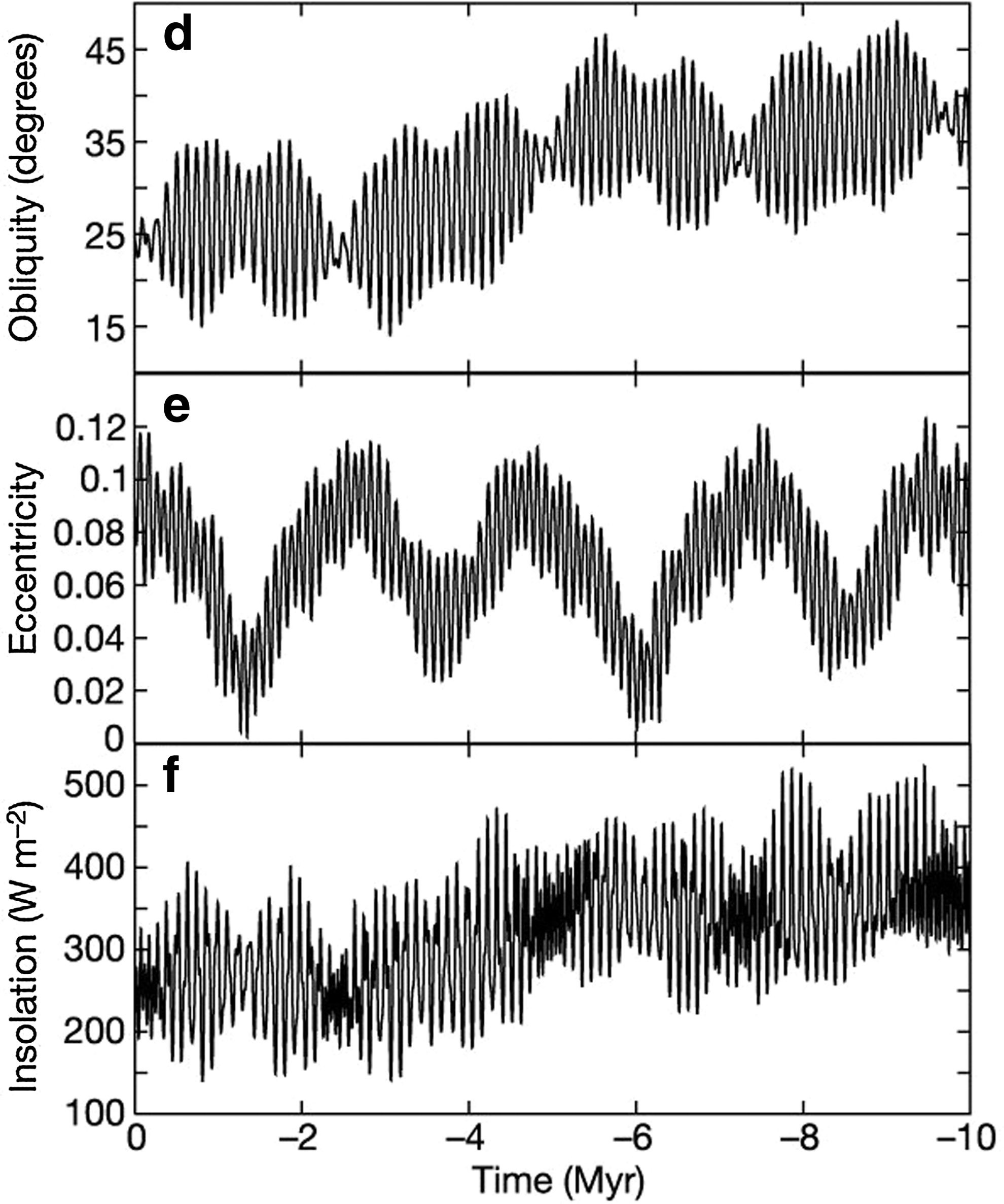
Orbital variations and north polar insolation over the past 10 Myr (reprinted with permission from Laskar et al., 2002).
Models suggest that the high insolation levels at the polar regions on Mars 5 Myr ago could have produced surface melting in the north. Costard et al. (2002) computed peak temperatures for different obliquities for varying surface properties and slopes. They found that, compared with the present north polar cap temperature high of about −60°C, peak temperatures are >0°C at the highest obliquities, and temperatures above −20°C occur for an obliquity as low as 35° (Costard et al., 2002). They suggested this as a possible cause of the gullies observed by Malin and Edgett (2000). Richardson and Mischna (2005) showed that when obliquity is 45° melting can occur 50 days per year in the high northern latitudes. The higher temperatures also enhance the hydrological cycle, evaporating water ice from the northern cap, which can then precipitate as snowfall in the northern plains.
It is well known that life can grow at subfreezing temperatures if films of water are present. Jakosky et al. (2003) discussed the potential habitability of Mars' polar regions as a function of obliquity. They concluded that temperatures of ice covered by a dust layer can become high enough (−20°C) that liquid brine solutions form and microbial activity is possible. Zent (2008) also found, in a more detailed model, that temperatures in the shallow subsurface exceed −20°C at high obliquity. This suggestion is all the more relevant given the presence, and antifreeze properties, of perchlorate. Rivkina et al. (2000) showed that microorganisms can function in ice-soil mixtures at temperatures as low as −20°C, living in the thin films of interfacial water. Such thin films have also been suggested as habitats for life on Mars (Möhlmann, 2010).
Life requires a source of nitrogen. After carbon, nitrogen is arguably the most important element needed for life (Capone et al., 2006). There is nitrogen (as N2) in the atmosphere at low levels, but this may not be adequate to support biological incorporation (Klingler et al., 1989). Nitrogen in the form of nitrate is directly usable by many microorganisms and could also be a resource for human exploration both as a nutrient for plant growth and for use in chemical processes. On Earth, nitrates correlate with perchlorates in desert environments, and this may also be true on Mars.
In summary, the Phoenix landing site on Mars is arguably the most likely site to support recent life on Mars (Stoker et al., 2010). The near-surface ice likely provided adequate water activity during periods of high obliquity. Carbon dioxide and nitrogen are present in the atmosphere, and nitrates may be present in the soil. Perchlorate in the soil together with iron in basaltic rock provides a possible energy source. Furthermore, the presence of organics must once again be considered, as the results of the Viking GCMS are now suspect given the discovery of the thermally reactive perchlorate, and ground-ice provides an ideal substrate to preserve organic molecules for extended periods of time.
1.5. Searching for organic biomarkers in ground ice
Finding evidence of organic compounds on Mars would be an important result by itself, but it would be only the first step toward establishing whether life is present on the planet, since these organics could be of nonbiological origin (i.e., meteoritic). Before a reasonable assumption of habitability can be established, it is necessary to find evidence of biomarkers. Finding mineral or morphological biomarkers would be a groundbreaking result but would inform us little of the nature of martian organisms. Mineral and morphological biomarkers can also represent an ambiguous sign of life, since a nonbiological origin is often difficult to rule out. Only organic biomarkers carry biochemical information, and as such would provide conclusive evidence of habitability and life on Mars, and at the same time would provide information on the biological nature of martian organisms, even if the organisms themselves were no longer present. Contrary to most near-surface environments on Mars, one of the most appealing aspects of studying martian ground ice is its potential to contain organic biomarkers and preserve them for extended periods of time.
Ground ice on Earth is efficient at preserving living cells, biological material, and organic compounds in general (Gilichinsky et al., 1992; Vorobyova et al., 1997; Vishnivetskaya et al., 2006; Johnson et al., 2007). It has been established that significant numbers of living microorganisms have been preserved under frozen conditions for thousands and sometimes millions of years (Gilichinsky et al., 1992; Vorobyova et al., 1997). Ground ice could also protect organic molecules on Mars from destruction by radiation and oxidants, and as a result organics from biological or meteorite sources could be detectable in polar ice-rich ground at significant concentrations (Smith and McKay, 2005). Radiation and photochemical oxidants are more damaging in dry regolith, where penetration and diffusion are less impeded; therefore, it is necessary to reach for deeper layers within the regolith, where organic molecules may be shielded from surface conditions.
1.6. Icebreaker Life mission goals
The results from previous Mars missions, particularly Phoenix, provide a strong basis for a mission that drills down into the ice-cemented ground in the northern plains and conducts a search for organic molecules and evidence of life: the Icebreaker Life mission. The Phoenix mission was able to reach the ice-cemented ground but was not able to substantially penetrate it for sampling.
To further our understanding of the habitability of the ice in the northern plains and to conduct a direct search for organics and life, the Mars Icebreaker Life mission focuses on the following science goals: (1) Search for specific biomolecules that would be conclusive evidence of life. Biomolecules may be present because the Phoenix landing site is likely to have been habitable in recent martian history. Ground ice may protect organic molecules on Mars from destruction by oxidants, and as a result organics from biological or meteorite sources may be detectable in polar ice-rich ground at significant concentrations. (2) Perform a general search for organic molecules in the ground ice. If habitable conditions were present, then any organics may be of recent (<10 Myr) biological origin. Perchlorates may have prevented the Viking GCMS from detecting these organics. (3) Determine the nature of the ground ice formation and the role of liquid water. There may have been liquid water generated in the surface soils in the north polar regions within the past <10 Myr due to orbital changes in insolation. The action of liquid water would have mobilized and redistributed soluble compounds in the martian soil. The distribution of soluble compounds can be used as an indicator of past liquid water action. (4) Understand the mechanical properties of the martian polar ice-cemented soil. Polar ice may be a resource for human exploration, and the mechanical properties will reflect the stratigraphy of ice and soil, which may inform models of climate history. (5) Assess the recent habitability of the environment with respect to required elements to support life, energy sources, and possible toxic elements. The perchlorate present at the Phoenix site could provide a useable redox couple if ferrous iron is present. A source of fixed nitrogen, such as nitrate, is required for habitability. (6) Compare the elemental composition of the northern plains with midlatitude sites. The elemental composition for elements with atomic number greater than 11 of midlatitude sites has suggested a uniformity in the martian surface soil (Clark, 1993; Wänke et al., 2001; Rieder et al., 2004; Clark et al., 2005). A similar measurement near the Phoenix site would allow for a direct comparison and help place the Phoenix results in the broad context of global martian geochemistry.
2. Mission Implementation
We now consider the requirements on the sampling system and measurements that must be made by the science payload to address the goals listed above.
2.1. Sampling
To conduct the investigation outlined above requires that samples of ice-cemented ground be obtained from the subsurface. Observations at the Phoenix site indicted that the ice was a few to tens of centimeters below the surface (Mellon et al., 2009a). To ensure reaching and sufficiently penetrating the ice therefore requires a drill capability of ∼1 m. The Phoenix observation of white ice, possibly soft, in the upper soil surface and the variation in depth to ice-cemented ground in the area accessible by the Phoenix arm suggest that variations in the ice distribution on centimeter scales is possible and that a depth of 1 m would be sufficient to sample deeply into the ice-cemented ground. Any sampling system that reaches to the ice-rich subsurface must comply with the planetary protection requirements that mandate dry heat microbial reduction and isolation for the parts of the spacecraft that reach to ice and a way to break the chain of contact between the sampling devices and the rest of the spacecraft. Thus, the sample must be delivered across at least one “air gap.”
Based on the Phoenix results, the material within the first meter of the surface of Mars in the northern plains may be grouped into one of four types: loose soil, ice-cemented soil in which the pore spaces of the soil are filled with ice, solid ice, and the white ice of unknown density. A measurement requirement on the drill and sampling system is to be able to distinguish between these four classes of materials either through the mechanics of drilling or by inspection of the samples.
The science goals for Icebreaker Life focus on the organics, biomolecules, salts, and minerals within the ice-cemented ground but not directly on the ice. Thus, it is sufficient for our purposes to collect samples in a way that the ice is lost to sublimation in the collection process. Indeed, a visual measure of the volume change after sublimation of the ice component can be used as a rough indicator of ice content.
2.2. Organics
One of the key goals of the Icebreaker Life mission is to test the hypothesis that the ice-rich ground in the polar regions has significant concentrations of organics due to protection by the ice from oxidants. If this is shown to be true, the ice-rich ground will become a compelling target for future astrobiology missions (see, e.g., Stoker et al., 2010).
Even absent any endogenous or biological production, organics should still be present on Mars simply due to the rain of meteoritic material that brings a flux of organic molecules estimated to be ∼10−10 g cm−2 yr−1 (Flynn and McKay, 1990; Stoker and Bullock, 1997).
Moores and Schuerger (2012) and Schuerger et al. (2012) showed that this rain of meteoric material will be processed by UV light to release methane, and they predicted a steady state residual of organics in the soil of 1–10 ppm.
In the polar regions, we can consider a case in which the incoming organics are sequestered in the accumulating ice and dirt. Thus, if we knew the rate of dust and ice accumulation at high latitudes, we could estimate the concentration of organic molecules expected if the infalling organic molecules are incorporated in the ice-rich martian soil without loss. Table 2 shows the results for a range of accumulation rates.
Assumes a total organic infall rate on Mars of 10−10 g C/yr.
As a lower limit, we can consider the mean redistribution rate of material on the surface of Mars, estimated to be ∼10−9 m/yr (Golombek, 1999). For this accumulation rate, the organic infall would comprise 0.1% of the surface materials if there were no loss processes. On the other extreme, Laskar et al. (2002) estimated that the rate of accumulation in the north polar layered deposits is ∼5×10⁻⁴ m/yr. This is a very high accumulation rate and probably only applies to the regions very near the poles. At this accumulation rate, the organic concentration for no losses would be 0.001 ppm. The optimal deposition rate for the Phoenix landing site would be such that 1 m of drill will sample through 6 Myr of sediment. This corresponds to an accumulation rate of 1.7×10⁻⁶ m/yr and an organic content of 0.3 ppm.
It is important to note that our hypothesis is specific to ice-rich ground. Assuming the lack of organics at the Viking landing sites at the part-per-billion level is valid (but cf. Navarro-González et al., 2010), some sort of active destruction mechanism may be present—presumably reactive oxidants (e.g., Klein, 1979; Zent and McKay, 1994) and UV light (Stoker and Bullock, 1997; Moores and Schuerger, 2012; Schuerger et al., 2012). Soil oxidants need only be present at the part-per-million level (McKay et al., 1998) to explain the reactivity seen by the Viking biology experiments. A plausible model for this oxidant is H2O2-activated TiO2 (Quinn and Zent, 1999). Bullock et al. (1994) showed that the diffusion of atmospherically produced H2O2 through the pore spaces of the soil could explain the lack of organics below rocks and at depths of up to 11 cm at the Viking landing sites. If the pore spaces of the soil are filled with ice, then diffusion of the atmospheric oxidant would be prevented and organics would be preserved in ice. The production of reactive chlorine due to the effect of ionizing radiation on perchlorate can also explain the Viking results (Quinn et al., 2011). Again, the presence of ice may inhibit the reaction of the active chlorine species with the organics.
Note that part-per-million levels of organics are low for any “soil.” Even the most barren soils on Earth, from the Dry Valleys of Antarctica and the Atacama Desert, average more than 10 ppm organics (Navarro-González et al., 2006), with the soils from the Atacama in Peru having the lowest values reported at 3–12 ppm (Valdivia-Silva et al., 2011). Glacial and polar plateau ice that formed ultimately from snowfall have far lower levels of organics, but this is not a good analogue for ice-cemented soils because of the lack of the silicate-ice interface, which creates a thin film of unfrozen water.
It is also important to note that the discovery of perchlorates at the Phoenix site may require a complete reappraisal of the nondetection of organics by the Viking missions. There have been two attempts to detect organics on Mars: the pyrolysis GCMS on Viking (Biemann et al., 1977) and the Thermal Evolved Gas Analyzer (TEGA) on Phoenix (Boynton et al., 2009). In both instances, the soil sample was heated to high temperatures (300–500°C on Viking and ramped from ambient to 1000°C on TEGA). The intent was to cause the thermal breakdown of organic molecules to vaporize them, allowing detection. However, we now know that this approach is flawed due to the presence of perchlorates in the soil. Navarro-González et al. (2010) reported on simulations of the Viking instrument with perchlorate added to Atacama soils and concluded that the traces of chloromethane (at 15 ppb at 200°C) detected by Viking 1 and dichloromethane (at 0.04–40 ppb at 200–500°C) detected by Viking 2 were not terrestrial contamination as postulated at the time but are the results of the reactivity of perchlorates with organics in the soil when heated. In their reanalysis of the Viking results, Navarro-González et al. (2010) suggested that ∼0.1% perchlorates and 1.5–6.5 ppm organic carbon were present at the Viking landing site 1, and ∼0.1% perchlorates and 0.7–2.6 ppm organic carbon were present at the Viking landing site 2. What is needed is a method that can directly detect organic molecules on Mars at the sub-part-per-million level in the presence of perchlorate. The Phoenix TEGA instrument has produced no unambiguous information about organics on Mars—possibly also due to the reactivity of perchlorate with any soil organics as well as with the walls of the instrument (Ming et al., 2009).
From the discussion above, we conclude that part-per-million detection capabilities are adequate to test our hypothesis that the ice-rich ground prevents the destruction of organics. If we do not detect organics at this level, then we have shown that the hypothesis being tested is false and that there are at best only minor enhancements of organics in the ice-rich ground. In this case, the ice-rich polar soils will not be interesting targets for future astrobiology missions. If the ice holds a rich organic record, this would provide motivation for mission engineers to overcome the practical difficulties of landing and operating in the polar regions and drilling through ice.
We note that there are new instruments that will be performing state-of-the-art searches for organics on Mars [Sample Analysis for Mars (SAM) on the Mars Science Laboratory (MSL) and instruments on ExoMars]. However, for these instruments the goal is to measure dry surface soil similar to that measured by Viking. Thus, instruments will advance the limit of organic detection in dry soils beyond the nondetection by the Viking GCMS or confirm the suggestion by Navarro-González et al. (2010) that organics are present at the part-per-million level in these soils and were undetected by Viking. In contrast, our goal is to determine whether ice-cemented ground is organic-rich on Mars as it is on Earth. If it is organic-rich, then this is of considerable astrobiological interest because of the potential recent habitability of this ice.
If the apparent lack of organics detected by the Viking GCMS was the result of thermal reaction with soil perchlorate as suggested by Navarro-González et al. (2010), then this poses challenges for the SAM instrument on MSL. However, SAM has three capabilities that should allow it to detect organics despite interference from perchlorate (Mahaffy et al., 2012). First, unlike Viking, in which the analysis occurred only after thermal processing, SAM will monitor the head space gases with a mass spectrometer during the pyrolysis steps, and organic fragments will be trapped at selected temperatures for GCMS analysis. Organic fragments may be detected as they react with the breakdown products of the perchlorate. Second, SAM has a mode in which the total organics are combusted with O2 to CO2 before detection. This mode should be completely independent of the presence of perchlorate, which also causes oxidation to CO2. Finally, SAM has the capability for liquid extraction with the use of derivatizing agents, and this mode should not cause reactive perchlorate products to form. Thus, it is likely that the SAM instrument on MSL will be able to confirm the presence of organics at low levels in the martian soil. This detection will further motivate the detection of organics in the ice-cemented ground in the polar regions.
The analysis above and in Table 2 has focused only on organics from infalling meteorites. If there have been recent (last 6 Myr) biological processes at the landing site, then the organic concentrations could be much higher.
2.3. Biomolecules
The detection of organic molecules on Mars would be of high interest to astrobiology, but it would not necessarily have any relevance to the search for evidence of life. Indeed, it is known that the Solar System is rich in organics that are not produced by biology. The search for evidence of life must target biomolecules—complex organic molecules that are only known to be produced by biological systems. Our understanding of a biomolecule is strongly influenced by terrestrial biology. However, the strategy for searching for life on Mars remains one based on the past presence of liquid water and the presence of the elements used by terrestrial life; therefore, a search for biomarkers represents a plausible strategy. Parnell et al. (2007) proposed a list of possible biomarkers that would be signatures of life. ATP (adenosine triphosphate) is an example of such a biomolecule. Some are listed in Table 3. ATP is a universal component of life on Earth, and its detection on Mars would be compelling evidence of life—even if no intact cells were discovered. Proteins specific to certain types of metabolism would also be suitable biomarkers. Of particular relevance in this regard is biological perchlorate reduction. It is now known that some microorganisms on Earth grow by the anaerobic reductive dissimilation of (per)chlorate into chloride. Perchlorate-reducing bacteria are phylogenetically, physiologically, and morphologically diverse (Coates and Achenbach, 2004); however, they all share a very similar set of biomolecules that are involved in the reduction of perchlorate, and one of the specific enzymes used, perchlorate reductase, is present in all known examples of these microorganisms (Coates and Achenbach, 2004). Perchlorate reductase is one example of the many universal biomolecules that are shared by organisms across the tree of life and can be searched for with current technology.
The advantage of searching for biomolecules is that their detection would be compelling evidence of life, present or past. A further advantage is that molecular detection methods exist for these biomolecules that are extremely sensitive and specific. The disadvantage of this approach is that the specific biomolecules (e.g., ATP, perchlorate reductase) must be planned in advance, and the list is effectively limited to molecules known to be biomolecules in life on Earth. This disadvantage can be mitigated by a careful selection of the target organic compounds and the large number of possible targets. A proper selection of targeted compounds can result in very high sensitivities (in the order of parts per billion and parts per trillion) and the unequivocal identification of organic compounds with complex structures, or even direct evidence of biogenic molecules.
In contrast to mineral and morphological fossils, and growth-based experiments such as the Viking Labeled Release experiment, the detection of modern or relic biomolecules on Mars would not only be evidence of life but would also provide some information on the biochemistry of the putative martian microorganisms, and it would possibly address deeper issues such as the nature of their genetic code or their metabolic pathways.
2.4. Amino acids
Amino acids are a key class of possible biomarker and warrant separate discussion. As discussed at length by Bada et al. (2008), amino acids are an ideal category of organic molecules to form the basis of a search for organics because they are present in both biological and nonbiological organic molecules. As the building blocks of proteins, amino acids are a type of molecule found in all biological organic material (Pace, 2001). In addition, amino acids are found in meteoric organic material and are produced in Miller Urey syntheses. Studies of organic-rich meteorites (e.g., Botta and Bada, 2002) indicate more than 70 different amino acids present. These compounds can also be readily synthesized in laboratory simulation experiments that include water (Miller, 1953; Bada, 2004). In living cells, amino acids (in the form of proteins) constitute nearly 75% by dry weight of the total organic material (Bada et al., 2008). Bada et al. (2008) stated that, although it is not certain that an extraterrestrial biology would use the same set of amino acids as on Earth, their presence in certain types of meteorites indicates they were constituents of organic material in the early Solar System and thus available for incorporation in living entities elsewhere (Sephton and Botta, 2005). In addition, amino acids are robust compounds, would be expected to survive for geological time in the martian regolith (Kanavarioti and Mancinelli, 1990; Aubrey et al., 2006), and may be as resistant to oxidation by chemical oxidants as any other light organic molecule. Thus, amino acids provide a key target class of molecules in a search for organics on Mars. Because biology selects a subset of the amino acids for use in proteins and these are chirally selected, the distribution and chirality of amino acids can be direct evidence for life.
2.5. Contamination, false positives and negatives, and null results
Any search for evidence of life in which high sensitivity and specificity are used will require controls to prevent contamination and false positives. This provides the proper context for understanding a positive or a null result.
Sample cross contamination is not an issue. Icebreaker's search for life is qualitative—finding evidence of life alone is mission success. Molecule concentration or exact location in the subsurface is of less concern than a reliable detection. Hence, sample cross contamination is not an important issue for this mission.
Terrestrial contamination is the main issue that Icebreaker Life must address. Earth contaminants on the spacecraft could lead to false positives. To minimize this possibility, the payload would need to be assembled in a clean room, and the drill would have to be sterilized and protected in a biobarrier until landing. After landing, indigenous life would be distinguished from contaminants by the nature of the signal (an approach implemented on Phoenix for TEGA). Contaminants would be high on initial runs and diminish with sampling. Biomarkers present in the martian sample would not show this pattern. Control samples would be carried to Mars and consist of organic-free blanks and blanks spiked with specific biomolecules. Organic-free blanks would confirm a positive detection of indigenous life; a blank that does not show the same signal would indicate a martian origin. Spiked blanks would confirm that lack of detection is not due to instrument failure.
False positives and false negatives are an issue with any life-detection method. False positives are of limited concern because of the high specificity of immunoassays and use of controls. False negatives are difficult to prevent and could occur if we lack the right detection method for the specific biomolecules present. Thus, detection of a list of specific biomarkers would provide a robust detection of life if positive but could not rule out life in the absence of a signal. However, we note that a null result, the lack of detection of biomarkers, would be an important result. A null result would establish that Earth-like life is likely not present in the ground ice, arguably the most habitable environment currently known on Mars, implying that Earth-like life is absent on Mars generally. This would lower the risk for biohazards during human exploration or sample return. However, this would not rule out life that does not have Earth-like biomarkers.
2.6. Salts and minerals
The most surprising, and arguably the most significant, result of the Phoenix mission was the discovery of high levels of perchlorate (∼0.5% by mass) in the soil overlying the ice-cemented ground (Hecht et al., 2009; Smith et al., 2009). The strong freezing point depression of perchlorate suggests that, when it is present in contact with ice, liquid brines may have resulted. This could result in variations of perchlorate with depth and location (see e.g., Cull et al., 2010). Thus, measurements of perchlorate concentrations over the range of 0.1% to 100% by mass may be required to understand this process.
The presence and distribution of nitrate in the martian soil and ice is of interest as well due to the importance of N to biology and N2 as a major component of the atmosphere. N2 is present in the martian atmosphere, and nitrate is expected to be stable on Mars and to have formed in shock and electrical processes. Models for the expected concentration (e.g., Manning et al., 2009) suggest levels of 1% or so, which is consistent with upper limits set by the Viking data (Clark and van Hart, 1981) and the Phoenix results (Hecht et al., 2009). Thus, measurements of nitrate over the range of 0.1% to 5% are required to address the question of its occurrence and distribution. Sulfate is another key salt that may be mobilized by liquid brines and whose distribution may reflect past water activity. Kounaves et al. (2010) reported sulfate (SO4) in the Phoenix soil samples at levels of ∼1.3(±0.5) wt %. Kounaves et al. (2010) pointed out that, with minor exceptions (Clark et al., 2005; Ming et al., 2006), soils at previous landing sites have been reported to contain 4–8 wt % sulfate (Clark, 1993; Wänke et al., 2001; Rieder et al., 2004; Clark et al., 2005) and have a nearly uniform S/Cl molar ratio of ∼4:1. However, the Kounaves et al. (2010) results suggest a S/Cl ratio that is half this value, and they suggest that this factor of 2 discrepancy may be due to (1) some of the sulfur measured by X-ray fluorescence in previous missions is in a form that is nonsoluble, or only sparingly soluble, within the time frame of the Phoenix analyses protocol; or (2) the Phoenix soil is simply different from those analyzed at other locations, and sulfate or perchlorate are lower or higher, respectively, in these soils. To map out the sulfate concentration, we require a measurement accuracy of 0.1% with a range up to 20%.
The question of comparing the soil of the Phoenix site to elemental analyses by previous missions (i.e., Viking, Pathfinder, and Mars Exploration Rovers) is raised by both the sulfate and perchlorate results from Phoenix. To make such a comparison reliable, it would be desirable to measure the soils at Phoenix with the same technique (X-ray fluorescence) that was used at Viking, Pathfinder, and the two Mars Exploration Rover (MER) sites. This is one case in which a science measurement implies a specific instrument approach. The requirement here is to measure the elemental concentrations with the same precision as was done on the previous missions, especially for sulfur. In particular, the measurement of Cl, S, Ca, K, Fe to 0.1% by mass with the Alpha Particle X-ray Spectrometer (APXS) approach is required at the Icebreaker landing site.
2.7. Habitability
To assess the habitability of the Phoenix site, we must understand the availability of carbon, the activity of water, presence of an energy source, the availability of key nutrients (N, P, S), and the absence of elements in toxic concentrations (e.g., As). Carbon is widely available on Mars in the form of atmospheric CO2; thus habitability centers on water activity, energy, and key elements.
If liquid water forms transiently at northern latitudes presently or during high obliquity, then water activity becomes a relevant factor to assess habitability (see review in Beaty et al., 2006). There appears to be a sharp limit for life on Earth as a function of water activity, with no growth recorded below a water activity of ∼0.6 (Beaty et al., 2006 and references therein). The activity of pure liquid water (a w) at any temperature is unity and is not temperature-dependent. The a w of ice is equal to the water vapor pressure of ice divided by the water pressure over pure liquid water. Thus, the a w of ice is temperature-dependent and declines from unity as temperature decreases. At T=0°C, the a w of ice=1.0; at T=−20°C, a w=0.82; at T=−40°C, a w=0.67; and so forth (Beaty et al., 2006). If ice-cemented ground at the Phoenix site was raised to temperatures warmer than −20°C, then the resultant water activity (a w=0.82) should allow for microbial activity in the thin films of unfrozen water that form on the boundary between soil grains and ice for temperatures above −20°C (Ostroumov and Siegert, 1996; Rivkina et al., 2000).
While sunlight is a powerful energy source for life, it is unlikely to be biologically useful on present Mars because it requires life to be at the surface exposed to the extremely biocidal solar UV and to dry conditions. Microbial life in porous rocks or soil may be shielded from UV and yet exposed to visible light as suggested by Sagan and Pollack (1974; see also Cockell et al., 2002; McKay, 2012), but it would still be subject to extreme dry conditions. Instead, subsurface chemoautotrophy is a valid alternative for martian life. For example, perchlorate and nitrate could form the oxidizing partner in a redox couple if suitable reduced material were available. Ferrous iron from basaltic rocks would be a suitable material, as observed in anoxic environments on Earth, where microbial iron oxidation has been demonstrated to be coupled to the reduction of nitrate, perchlorate, and chlorate (e.g., Straub et al., 1996; Weber et al., 2006). As mentioned above, perchlorate is present in the martian soil, and nitrate is probably present as well. The surface of Mars is also covered with unweathered, iron-rich basaltic rocks (Christensen et al., 2001), and mechanical weathering and commutation would produce small-sized particles of unweathered basaltic rocks in the soil. In Gusev Crater, the MER detected olivine-rich (ferrous iron–containing) basaltic rocks (Christensen et al., 2004; McSween et al., 2009). However, Quinn et al. (2011) placed an upper limit on the levels of readily soluble ferrous iron (salts) in the soil of 1 ppm at the Phoenix site. However, microorganisms can access forms of ferrous iron that are not readily soluble, so the possibility remains open (Nixon et al., 2012). Given the potential for liquid water today and during high obliquity, microbial iron oxidation coupled to perchlorate or nitrate reduction is possible. For that reason, Icebreaker Life will study the concentration and distribution of ferrous iron, nitrate, and perchlorate as a biologically useful redox couple on Mars in the ground ice.
The search for nitrate in the soil is also a key goal for habitability as a source of nitrogen. As discussed above, nitrogen is a key requirement for life, and currently there is no data on its availability. It is possible that MSL will provide the first useful detection of nitrates in the soil by detecting the release of NO from heated soil samples.
2.8. Surface geomorphology
Imaging of the terrain at the landing site and specific imaging of the sampling site provide important context information. The Phoenix landing site showed patterned ground with differences in ice depth between the polygon center and the troughs surrounding them (Mellon et al., 2009b). It is important to know which part of the polygonal distribution the drill is accessing because the polygon morphology is set by the depth to ice. Surface imaging is thus important to estimate ice depth and also to understand any surface conditions that may affect mission operations and drill placement.
3. The Icebreaker Life Payload
Extending the capability of the Phoenix spacecraft, Icebreaker will carry a drill and a selected set of instruments. The drill penetrates into the subsurface, and cuttings from the ice-cemented ground are provided as samples to the science payload. A derivative of the Wet Chemistry Laboratory determines the solution chemistry, an immunoassay microchip searches for organics and biomolecules, and an Alpha Proton X-ray Spectrometer identifies elemental composition. A surface Stereo Camera provides context images. If space, mass, and cost allow, a laser desorption mass spectrometer provides a second detection of organics.
Icebreaker's configuration with drill, sample transfer system, and science instruments is shown in Fig. 3 mounted on the Phoenix platform. A summary of payload characteristics and specifications is given in Table 4.

Icebreaker's configuration with drill, sample transfer system, and science instruments.
3.1. The Icebreaker drill
The Icebreaker drill is a rotary-percussive (both rotating and hammering) drill based on several generations of drills (Zacny et al., 2013) capable of autonomous drilling and fault recovery (Glass et al., 2008) developed in the last decade (Fig. 4). The drill is composed of three elements: (1) Rotary-percussive drill head: Tests in Mars analog environments show that rotary-percussive drills are more efficient than conventional drills, particularly at the low downward force (typically 100 N) possible in martian gravity with the spacecraft mass (Zacny and Cooper, 2006; Zacny et al., 2008). (2) Sampling auger: The drill must be simple and automated to lower risks and ensure proper drill function on Mars (Glass et al., 2008). This justifies using a single string with no attachment/detachment stages and collecting cuttings instead of coring to reduce complexity, risk, cost, and jamming potential. Icebreaker must drill cold and dry, using mechanical means, that is, augering, for cuttings removal and preventing melting of ice, which might refreeze and lock the drill. The sampling auger consists of a single, 1.2 m long, 25 mm diameter, deep flute auger that penetrates up to 1 m below the surface and collects drill cuttings. The extra 20 cm length of the auger is required to account for the auger tube and the brush assembly. In order for the tip of the bit to be brushed off by the auger, the auger has to clear the top of the auger tube and be in line with the brush, that is, approximately 20 cm above the ground surface. (3) Drill bit: The drill bit is intermediate between an ice bit (sharp cutters at positive cutting angle for ice or icy soils) and a hard rock bit (rounded cutters at zero cutting angle, for hard rocks) and designed to work with a percussive system. The drill bit has an integrated thermal sensor to measure the bit temperature and the temperature of a sample. The bit temperature is also fed directly into a drilling algorithm. If a temperature exceeds a certain value, the drilling either stops or slows down to let the surrounding formation cool down to prevent melting.

Engineering detail of the Icebreaker drill. Color images available online at
Prior to launch, the drill will be stowed in a horizontal position on top of the lander deck. After landing, the ground surface below the drill will be photographed and analyzed for rocks and surface features. Upon the drill health checkout, the 3 degrees of freedom arm will deploy the drill and lower it to the ground. The arm will then preload the drill structure against the ground with ∼200 N force, which is the “not to exceed” force. The drilling will commence with the hole-starting routine: high rotation at low weight on bit (WOB). Upon reaching 2.5 cm depth, the normal drilling operation and sampling will commence. During the drilling operation, the WOB will be software limited to 100 N.
The Icebreaker drill produces cuttings that are then sampled at specified depth intervals, notionally 5 cm. After drilling the first interval, the drill is pulled out, and the sample is collected for analysis. The drill is then lowered into the hole to acquire another sample at a greater depth. This procedure can be repeated until a depth of 1 m is reached.
The Icebreaker drill was tested to 1 m depth in a vacuum chamber at Mars atmospheric pressure and in various formations ranging from ice, icy soils, icy soils with rocks, and rocks (Paulsen et al., 2011; Zacny et al., 2012, 2013). The average penetration rate in these formations was 1 m/h, while the average power was 100 W and the WOB was limited to less than 100 N. The drill was also tested in the Antarctic Dry Valleys: the Mars analog site. The drill reached 1 m depth in ice-cemented ground in approximately 1 h with 100 W of power and less than 100 N WOB. The drill was also tested in the Dry Valleys in massive ice, where it penetrated to 2.5 m depth in approximately 2.5 h with 100 W power and less than 100 N WOB. In all cases, the drill provided samples in terms of drill cuttings in 10 cm intervals. In the case of ice drilling, although most of the ice was pulverized by the drilling process, a single ice crystal as large as 8 mm in size was frequently observed. Hence, the rotary-percussive drilling approach does not necessarily pulverize all the ice in its way.
3.2. Sample delivery system
The Icebreaker sample delivery system, shown schematically in Fig. 5 (from Davé et al., 2013), has three functional requirements: (1) Collect the samples from the drill consistent with planetary protection constraints; (2) Deliver samples to analytical instruments; (3) Operate with soils ranging from sandy to sticky—as both types have been seen by the Viking and Phoenix missions (Davé et al., 2013).
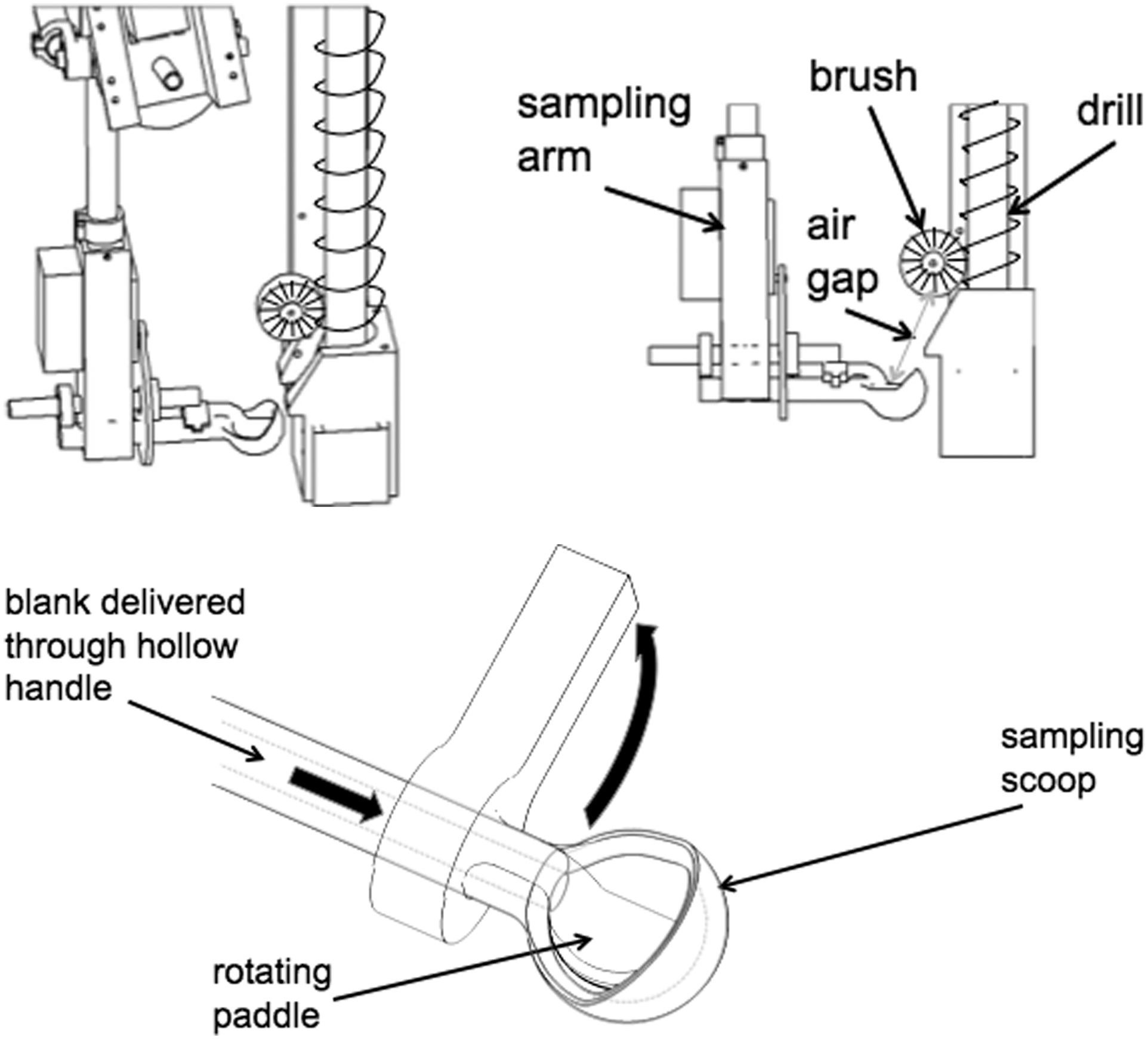
Engineering details of the sample handling system, showing the brush, air gap, and positive displacement system which can inject sticky samples (from Davé et al., 2013). Also shown is the mechanism for injecting the organic blank sample.
To comply with planetary protection requirements, the sample delivery system collects the sample from the drill without contacting the drill hardware. This air gap implies that the sample delivery system need not be sterilized or contained in a biobarrier during flight, since the break in the chain of contact prevents the sampling system from transferring any contamination from the lander deck to the drill.
The key part of the sample delivery system is the unit that obtains the sample from the drill. Material collected on the drill flutes is removed by a brush as the drill rotates (Fig. 5). This material is caught by the sample catcher. The shape of the catcher ensures that loose sandy and sticky material are both collected. (Davé et al., 2013).
Once the sample is in place, the arm moves the sample catcher to the upper deck and prepares to deliver the sample to the instruments.
The sample delivery system moves the sample catcher into position over the intended instrument. The sample catcher then rotates, and the sample is deposited into the funnel of the instrument. As the catcher rotates, the interior is swiped by a fixed vane that removes any sticky material (Fig. 5) (Davé et al., 2013). No additional processing of samples is required before delivery to the instruments, and one delivery is enough to satisfy instrument requirements (Davé et al., 2013).
The shaft of the sample delivery system is a hollow tube into which two aliquots of sterile control material have been inserted. On command, one such aliquot can be dropped into the sample catcher for delivery to the science instruments (Davé et al., 2013).
3.3. Life-detection instrument
The Signs of Life Detector (SOLID) instrument (Fig. 6) meets the mission objective to search for evidence of life. SOLID can detect whole cells, complex organic molecules, and simple polymers of possible biogenic origin. SOLID can detect cells and molecules at concentrations of 103 to 104 cells/mL and 1–2 ng/mL, respectively (Parro et al., 2005, 2007, 2011; Fernández-Calvo et al., 2006), using the latest generation lab-on-a-chip technology to detect organic molecules via immunoassays. Using a single Life-Detection Chip (LDCHIP) measuring a few square centimeters, SOLID's antibody library can detect up to 300 different organic molecules. SOLID is divided into two units (Fig. 6). The Sample Preparation Unit (SPU) receives samples from the sample handling mechanism and processes them in three steps—extraction with buffer, sonication, and filtering. After filtering, the sample is transferred to the Sample Analysis Unit (SAU). The SAU holds 16 LDCHIPs and performs sandwich immunoassay. The presence of biomolecules and organics is revealed by fluorescent signals from binding antibodies. The fluorescent antibodies are excited by a laser beam. Fluorescence is captured and imaged by a CCD camera. Data products are images showing bright spots where fluorescence occurred. Between samples, the SPU pipes and valves are rinsed with buffer solution to minimize contamination and obstruction. Control measurements are done by running measurements in the absence of a sample (only the extraction buffer and the library of antibodies) and provide a background fluorescence signal as a baseline for the sample. Tests by de Diego-Castilla et al. (2011) demonstrated the robustness of antibodies under extreme and space conditions, and the operation of SOLID has been demonstrated at high perchlorate levels (Parro et al., 2011).
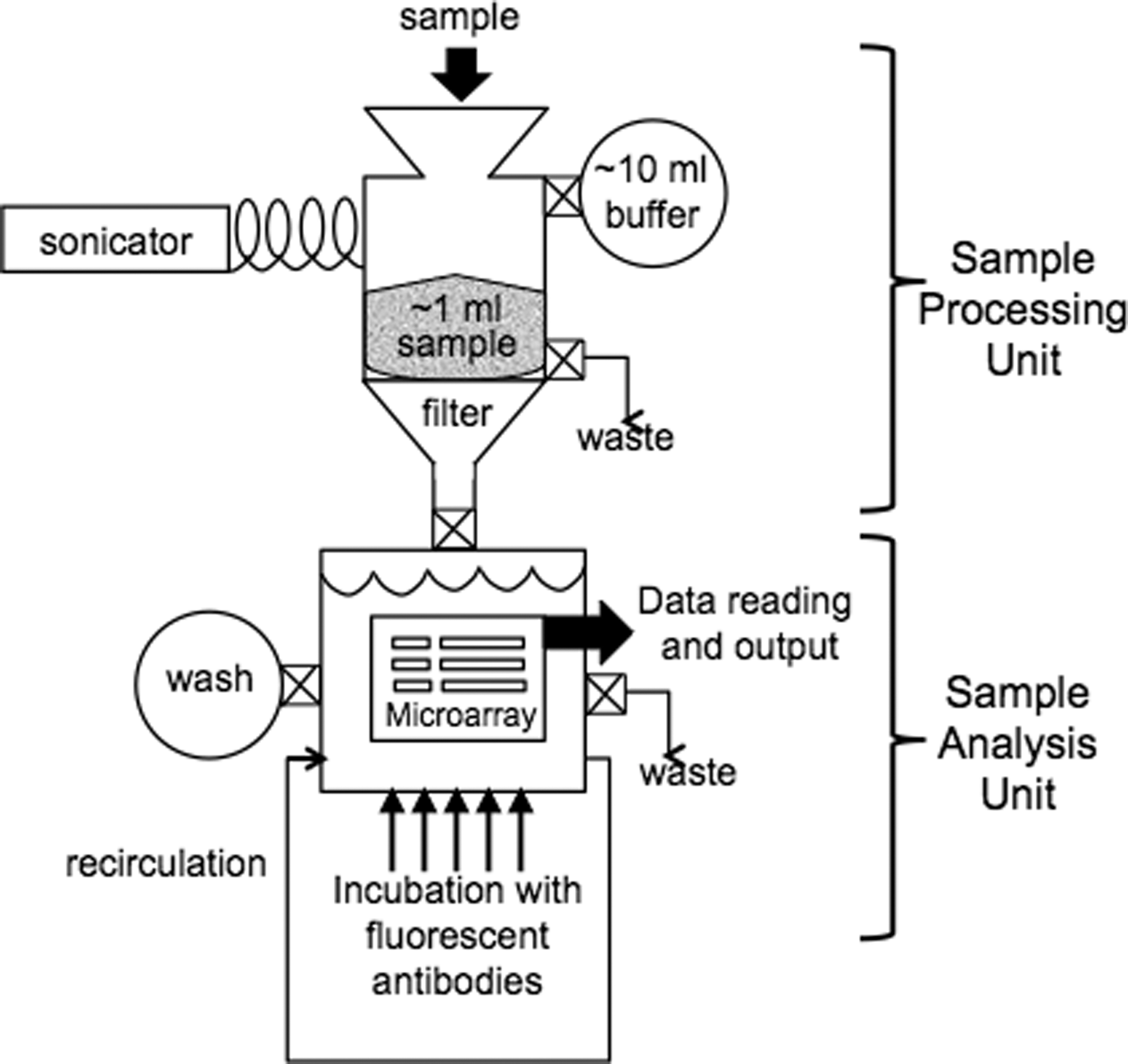
Functional schematic of SOLID.
3.4. Generic organic detection instrument
A promising candidate for organic detection on a Discovery-class mission to Mars is laser desorption mass spectrometry. In this method, a pulse from a laser is used to remove organic materials from the sample, which are then swept into a time-of-flight mass spectrometer. The laser pulse should cause the volatilization of organics without creating high temperature and density conditions that allow the perchlorate to react with the organics. Preliminary tests on Atacama soils with 10–100 ppm of organics with, and without, 1% magnesium perchlorate added confirm that this method can detect organics even in the presence of perchlorate.
3.5. Chemical analysis instrument
The Wet Chemistry Laboratory (WCL) is a powerful analytical instrument that characterizes the pH, eH, and dissolved ions in the ice-cemented ground. WCL has strong flight heritage (TRL 9) from the Phoenix payload (Fig. 7). Icebreaker uses copies of the Phoenix WCL because it meets the requirements to measure the soluble ions

Functional schematic and image of the Phoenix WCL. Color images available online at
3.6. Elemental analysis instrument
The goal of the elemental analysis instrument is to provide a measurement of the soils at the Phoenix site that can be directly compared to the elemental analysis conducted by Viking, Pathfinder, MER, and MSL, all of which used variations of the X-ray fluorescence technique. Thus, the instrument for use here is a duplicate of the most recent version of these instrument types, APXS, which was built for the MSL mission. We propose to include in the Icebreaker payload a duplicate of the MSL APXS. This APXS is an in situ X-ray spectrometer that uses 244Cm sources for a combination of particle-induced X-ray emission and X-ray fluorescence. APXS measures elemental composition of samples provided by the sample handling system. APXS is Technology Readiness Level (TRL) 9, from the MER mission and MSL. Sensitivity and range requirements are identical to those for MSL. Only one soil sample needs to be measured to meet the mission requirement.
3.7. Surface Stereo Imager
Icebreaker uses the Phoenix Surface Stereo Imager (SSI) for monitoring drill and sample delivery operations, geological mapping, multispectral analysis, and atmospheric observations. SSI is TRL 9 with heritage from Phoenix, Mars Polar Lander, and the Imager for Mars Pathfinder.
The SSI consists of an articulated camera head with two eyes separated 20 cm. Each eye has a 12-position filter wheel in its optical path, a Cooke triplet focused to 2.3 m, and a 1k×1k CCD detector with heritage from MER PanCam and Phoenix. SSI stows to fit inside the back shell during cruise and is deployed upon release of an explosive bolt after landing. In its final position it is about 2 m above the surface. The camera has a clear view of the instruments and the terrain surrounding the lander. To allow the camera to view the drill site, a notch is cut into the lander deck.
3.8. Planetary protection requirements
Icebreaker Life must comply with the planetary protection requirements established by NASA policy NPD 8020.7E and detailed in NPR 8020.12B, “Planetary Protection Provisions for Robotic Extraterrestrial Missions.”
The relevant section of the COSPAR planetary protection policy relates to Category IV missions to Mars (COSPAR, 2008):
Category IVa. Lander systems not carrying instruments for the investigations of extant martian life are restricted to a surface biological burden level of ≤3×10⁵ spores, and an average of ≤300 spores per square meter. Category IVb. For lander systems designed to investigate extant martian life, all of the requirements of Category IVa apply, along with the following requirement: The entire landed system is restricted to a surface biological burden level of ≤30 spores, or to levels of biological burden reduction driven by the nature and sensitivity of the particular life-detection experiments, whichever are more stringent OR the subsystems which are involved in the acquisition, delivery, and analysis of samples used for life detection must be sterilized to these levels, and a method of preventing recontamination of the sterilized subsystems and the contamination of the material to be analyzed is in place. Category IVc. For missions which investigate martian special regions (see definition below), even if they do not include life detection experiments, all of the requirements of Category IVa apply, along with the following requirement:
Case 1. If the landing site is within the special region, the entire landed system is restricted to a surface biological burden level of ≤30 spores.
Case 2. If the special region is accessed though horizontal or vertical mobility, either the entire landed system is restricted to a surface biological burden level of ≤30 spores, OR the subsystems which directly contact the special region shall be sterilized to these levels, and a method of preventing their recontamination prior to accessing the special region shall be provided.
Icebreaker will access the subsurface ice. If this ice is still considered a special region, the planetary protection requirements for Icebreaker will be (1) The main part of the spacecraft will need to satisfy Category IVa cleanliness. (2) The drill and any portions of the spacecraft that could come in contact with the ice in the subsurface will need to satisfy Category IVc requirements, which implies sterilization by dry heat microbial reduction, biobarrier containment, and noncontact with unsterilized lander components during operations.
The Phoenix mission to Mars was considered a Category IVc mission because the arm on the lander accessed a special region—the subsurface ice—but the mission did not include life detection. As a result, the arm was sterilized to the IVc case 2 requirements (Salinas et al., 2007; Bonitz et al., 2008), and the rest of the spacecraft was cleaned to IVa requirements. To ensure that the arm remained sterilized, it was encased in a biobarrier cocoon (Salinas et al., 2007) during assembly and deployed from the cocoon on Mars. In addition, the mission was operated in a way that prevented contact of the arm with unsterilized components of the spacecraft. This final requirement meant that the robotic arm could not contact any of the instruments or the flight deck; therefore, samples were dropped from some height above each instrument.
The concept of “special regions” on Mars was introduced (COSPAR, 2005; NASA, 2005) to refer to “a region within which terrestrial organisms are likely to propagate, or a region which is interpreted to have a high potential for the existence of extant martian life-forms. Given current understanding, this applies to regions where liquid water is present or may occur.” The definition of special regions on Mars continues to evolve (Beaty et al., 2006; Kminek et al., 2010). For example, Kminek et al. (2010) reported on the COSPAR Mars Special Regions colloquium held in 2007, and it is unclear whether they viewed the ice at the Phoenix landing site as a special region. For the purposes of our payload design, we assume that the Icebreaker mission will also be a category IVc mission.
Sterilization for planetary protection purposes is based on dry heat microbial reduction (DHMR). This is a NASA-certified process (Barengoltz, 2005; Committee on Preventing the Forward Contamination of Mars, 2006) that involves temperatures in the range of 104°C to 125°C with controlled absolute humidity for durations that depend on the temperature. Barengoltz (2005) pointed out that DHMR may be used without any assay and with the surface spore burden density specifications or with a prior assay to establish a lower pretreatment density.
Biobarrier containment was a significant challenge for the Phoenix arm (Salinas et al., 2007) and will be a challenge for the Icebreaker drill. Any sampling system that is in contact with the drill will also have to be included within the biobarrier. On Mars, the drill assembly will have to come out of the biobarrier to commence operations. At the same time, any part of the drill that penetrates the subsurface (i.e., auger) must not come in contact with sample transfer hardware that has not undergone DHMR.
The requirement that the drill not contact parts of the spacecraft that have not undergone DHMR and biobarrier transport places important constraints on the design of the sample handling system. In particular, there must be a way to break the chain of contact between the drill and the instruments on the lander deck. Thus, the sample must be delivered across at least one air gap. On Phoenix, this was accomplished by dropping the sample from the arm suspended over the instrument receiving the sample. On the Icebreaker drill, this will also be accomplished with an air gap. In particular, the cuttings conveyed up the auger will be brushed off and will gravity fall into a sample transfer hardware (e.g., a scoop).
Figure 8 shows how the required biobarrier is implemented and how deployment on Mars brings the drill free of the biobarrier.

Diagram showing the drill within the biobarrier and how it is arranged on the Phoenix lander. The figure also shows how the drill is deployed and the biobarrier ejected. Color images available online at
3.9. 2018 mission profiles
The Icebreaker Life mission has been designed based on the successful Phoenix mission in terms of mission platform and landing site. Phoenix landed at 68°N with a landed mass of 365 kg and a payload mass of 60 kg. Phoenix was a solar-powered mission and operated from Ls 77 to 180.The Phoenix lander is able to accommodate the drill and the rest of the Icebreaker Life payload with only minor modifications.
We have developed a nominal mission scenario for Icebreaker for the 2018 opportunity. The nominal mission trajectory is a Type II with 9 months in cruise, launching December 2018. The Icebreaker spacecraft arrives over the northern plains of Mars in August 2019 (Ls=61) and lands between 60°N and 70°N. Like Phoenix, the Icebreaker lander is solar powered and operates only during the polar summer months. The power system is similar to that used on Phoenix based on two deployable solar arrays. This provides more than adequate power for the payload—the drill and the instruments. Icebreaker will complete 90% of its science objectives for full mission success by Sol 40. The mission is planned to last for 90 sols, from Solar Longitude (Ls) 75–80 to Ls 170. Command, control, and data relay are all patterned after the Phoenix mission with relay to Mars orbiters and direct to Earth as a backup.
The Icebreaker Life payload has been designed around the Phoenix spacecraft and is targeted to a site near the Phoenix landing site. However, the Icebreaker payload could be supported on other Mars landing systems. The SpaceX Dragon capsule has been developed primarily for crew and cargo delivery to the International Space Station. However, it is also designed to land on Mars. Preliminary studies of the Dragon Mars lander (known as “Red Dragon”) show that it could support the Icebreaker payload for a landing either at the Phoenix site or at midlatitudes. Presumably, the Phoenix lander could also support a midlatitude landing site.
The Icebreaker Life mission can be viewed as part of a new class of astrobiology-focused missions that are proposed as follow-up missions to objects of interest in the search for evidence of life. Other missions include BOLD (Schulze-Makuch et al., 2012) and TWEEL (Levin et al., 2007) for Mars and LIFE (Tsou et al., 2012) for Enceladus.
Using its robotic arm (Davé et al., 2013), the Icebreaker Life payload could easily pack duplicates of the samples in analyses into a sample return cache. This cache would then be a possible target for a future sample return mission. If organic biomarkers were known to be present in a sample cached on Mars, this would be a strong motivation for returning that sample to Earth. Our return material is solid, rather refractory, organics and does not require special environmental control for Mars Sample Return. We are not studying or preserving ice, so the return cache does not need to be pressure or temperature controlled. The cold, ice-rich ground is a target because the ice may have been a past habitable environment and the ice may have protected and preserved organic remains.
In addition to ice-cemented ground, the Icebreaker payload would be well suited to searching for organic biomarkers in massive salt deposits if any were discovered on Mars. Salt is almost as good a preservative as ice. Reaching to 1 m depths would be desirable for better preservation.
4. Conclusion
The Phoenix mission results have shown that the ice-cemented ground in the northern plains of Mars is likely to be the most recently habitable location that is currently known on that planet. The near-surface ice is a potential source of liquid water when Mars is at high obliquity. The low elevation allows for atmospheric pressure to be above the triple point of water, and the presence of perchlorate suggests a possible redox couple with ferrous iron that could support a chemotropic metabolism. The discovery of perchlorate at 0.5% in the martian soil has profound implications for possible life, the search for organics and life, and human exploration.
The Phoenix mission confirmed the presence of ice-cemented ground but was not able to dig deeply into it. In addition, the organic analysis instrument on Phoenix (TEGA) was defeated by the presence of perchlorate in the soil. The next logical step in the exploration of this site is a mission that can sample deep into the ice-cemented ground and search directly for evidence of life. Studies in the polar regions of Earth have shown that ice is a good preservative for organics and for organic biomarkers of life.
Following this logic, we have developed the Icebreaker Life payload. The centerpiece of the Icebreaker payload is a drill capable of reaching to ∼1 m depth in ice-cemented ground. The cuttings from this drill are sampled and processed by the SOLID instrument that detects specific biomarkers, which are organic molecules too complex to have been produced nonbiologically. Thus, a robust detection of such biomarkers would constitute persuasive evidence of life—sometime in the present or past on Mars. An example of such a biomarker is the enzymes associated with perchlorate consumption by microorganisms. Persuasive evidence of life on Mars would have important scientific and societal implications. However, the lack of detection of biomarkers would also be important, as this would signal a lack of Earth-like life, at least locally, although not necessarily a complete lack of life on Mars. Confirming a lack of life-forms with similar biomarkers to Earth life would have implications for human exploration and contamination control on returned samples.
Drilling to 1 m on Mars is a challenge, but we have designed and demonstrated a drill that can accomplish this task. Testing in simulated martian conditions, and in the Antarctic and Arctic, has brought this drill to high TRL (Paulsen et al., 2011).
In addition to biomarker detection, the Icebreaker Life payload includes a version of the Phoenix WCL for analysis of the dissolved salts, including nitrate and perchlorate. An alpha proton X-ray fluorescence unit is also included to allow for a direct comparison between the soils in the northern plains and the soils from lower latitudes investigated on previous missions.
Organic analysis remains a challenge due to high perchlorate, and the nominal mission relies on the SOLID instrument for organic detection, which is capable of detecting organics in the presence of perchlorates. Work is also underway to develop and test laser desorption mass spectroscopy as a method to detect organics in perchlorate-rich soils. Such an instrument may have applicability to Discovery-class missions.
Our mission design is based on the highly capable and successful Phoenix spacecraft system. Our mission would land near the Phoenix site in 2018 and operate over a martian summer. While the Phoenix system is ideal for the Icebreaker Life payload, other landing systems could be used. Icebreaker life can readily be adapted to cache samples in advance of a Mars Sample Return.
Footnotes
Acknowledgments
This work was supported by the NASA ASTEP and ASTID programs.