




Abstract
Biotic Abstract Dual Automata (BiADA), a novel simulation concept for studying the evolution of prebiotic order, has four main attributes. (1) The energy of each form of organization is the sum of two stocks: entropy-associated energy (E s) and free energy (E g), with dissimilar meaning, energy conductive, and energy exchange properties; (2) E s and E g have user-defined absolute values and are not derived from the relative thermodynamic parameters standard entropy and standard Gibbs free energy; (3) BiADA analyzes changes in both units of transformation and units of organization; and (4) BiADA-based models analyze forward and reverse transformations separately and the brut production of forms of organization. We discuss quantitative relationships between energy, information, and order parameters proposed in BiADA-based simulations. The example we show is that of a simple system with two forms of organization. The model monitors the energy flow and budget, the evolution of order and information capacity, and the energy cost of producing and maintaining the system's state. We show the effect of six prebiotic factors on the evolution of order and energy dissipative potential of the system. These are the initial state of the system, energy availability, the intrinsic energy conductivity, catalysis of “A to B” transformations, B autocatalysis, and the terminal heat sink. We discuss benefits of employing BiADA principles in the study of the origin of order in more complex networks. Key Words: Origin of life—Prebiotic evolution—Early Earth—Modeling studies—Astrobiology. Astrobiology 12, 1123–1134.
1. Introduction
T
Because it is easier to determine changes in energy, entropy, and information than their absolute values, most prebiotic models focus on the former. This diminishes the capacity of analyzing the energy content associated with a specified amount of order, the relationship between energy and information content, or the energy flow needed to maintain a system in a state of dynamic kinetic stability. The fact that the two energy reservoirs present within each form of organization 1 , that is, the entropy-associated energy (E s) and the Gibbs-associated free energy (E g), are dissimilar in meaning, properties, and the type of energy exchanged during transformations is often disregarded. The separation between E s and E g is important for understating a system's energy and information availability, and requirements, as well as basic principles of energy flow and prebiotic organization. Lastly, the fact that increase in order often lowers energy conductivity (and thus the energy flux through a system is in many cases correlated with its entropy) is under-appreciated. During prebiotic evolution, this effect may have led to a negative feedback that worked against ordering.
Biotic Abstract Dual Automata (BiADA) is a novel modeling tool designed specifically for addressing such shortcomings. The objective of this paper is to show how BiADA-based models can help in the study of the evolution of energy flow, energy budget, and energy dissipative potential, as well as the evolution of order and information in prebiotic systems. We discuss basic rules, requirements, and advantages of applying BiADA principles in prebiotic simulations; parameters used to characterize systems and absolute values; and quantitative relationships between energy, entropy, order, and information. We show how a simple model in which BiADA principles are used can be employed in the analysis of the effects of six prebiotic factors on the evolution of a system's order and energy dissipative potential.
2. Basic Principles of BiADA-Based Models
Systems capable of coupling energy dissipation with internal ordering are widespread in the abiotic world (Prigogine, 1967). Examples include convection cells, tornadoes, energy dissipative storms, fire, experimental Rayleigh-Bénard convection, the growth of crystals, and periodic reactions (Belousov, 1959; Zhabotinsky, 1964; Finjord, 1992; Zhang and Altshuler, 1999; Hastings et al., 2003; Ahlers et al., 2009). It is widely believed that such systems offer insight into the origin of life as well. Life may exist in the universe in chemical forms with a composition unlike that of Earthly cellular life (Bartsev, 2004; Popa, 2004; Badescu, 2011). Some supra-individual systems and software-based systems may already be sufficiently complex and sufficiently self-controlled to be considered alive, or have a fair chance to become alive in the future (Bedau, 2003; Benoit, 2012). Because living systems are better described based on what they do rather than what they are made of, abstract models (where no constructive materials are specified) are an increasingly preferred strategy for studying prebiotic organization. BiADA principles help in the construction of such models.
Based on how they function, self-controlled systems can be described as automata (i.e., automatons) or informata (i.e., informatons) (Popa, 2004). Automata use exclusively analogical (direct or explicit) means of control. Examples include mechanical systems, feedback regulation, inhibition, and catalysis. A fluid vortex, fire, a mechanical clock, or a Ford Model T are typical examples of automata. To function, informatons use digital controllers or encrypted information. Typical examples include genetic mechanisms capable of Darwinian evolution, computer-controlled machines, or assembly lines, as well as social systems of animals and humans where behavior, symbols, or written instructions require translation for communicating messages about how the system should be organized or function. BiADA-based models are automata. This is important because even if automata are limited in the amount of information and their information cannot be kept at the virtual level, prebiotic networks must have been automata evolving toward increased complexity and adaptability by using mechanisms other than Darwinian selection.
From a theoretical standpoint, the ordered part of a form of organization has zero entropy and thus zero degrees of freedom and zero heat content. In turn, the disordered part has no free energy, and it is the only heat reservoir in the system. In BiADA, the energy content of each form of organization is assumed to be the sum of two reservoirs: (1) the disorder- (or entropy-) associated energy (E s); and the order- (or Gibbs) associated free energy (E g). This distinction is very useful because the source of energy, the type of energy, and how energy is released from these reservoirs and how it is exchanged with other forms of organization or with the environment will vary. It was argued earlier that the change in free energy and entropy of a system are correlated, that this relationship is not linear, and that the coefficients of the function that relates free energy with entropy will vary from one group of organization to another (Zimak et al., 2010, and Strazewski, 2010). Hence, two forms of organization can coexist in a model that have similar total energy (E T=E s+E g) yet dissimilar partition between E s and E g. Producing disorder increases the degrees of freedom of a system, which will absorb energy in the form of heat until their random dynamics becomes similar with that of their environment. In a chemical system, this average dynamics is called temperature. Producing order from disorder requires E g energy because work is needed to bias the odds (or to limit the freedom) of various transformations within the system. In chemical systems, most of E g is represented by the energy of chemical bonds. The stored E g is released when order degenerates into disorder, either because order is destroyed or because order is transferred to other forms of organization with lower order.
Conventional thermodynamics analyzes changes in free energy and entropy associated with transformations of state. Such analyses require knowing (at minimum) the stoichiometry of a chemical transformation and two relative parameters, the standard Gibbs free energy (G o) and the standard entropy (S o) of participating chemicals. The notation S* (for absolute entropy) is used here to avoid confusion, because in the history of thermodynamics instances did exist when the term absolute entropy was loosely used (Hutchens et al., 1960, 1969; Müller, 2007). In real-world systems, absolute values for the free energy (G*) and entropy (S*) are unavailable, or difficult to determine (except for when T is 0 K). For this reason, most computational models prefer addressing questions about prebiotic evolution in ways that circumvent the need for G* and S*. Yet, simply because G* and S* are difficult to determine does not make them lesser of a physical reality, nor is it diminishing their importance for understanding how prebiotic evolution works. In some analyses, G* and S* are actually required (Rodebush, 1927; Szarecka et al., 2003; White and Meirovitch, 2004, 2006; Meirovitch, 2009; Lin et al., 2010). Because of their abstract nature, BiADA-based models can use G* and S* values that are user-defined and approximations that are loosely based on real-world systems. In such models, G o and S o are not needed inputs, while parameters that describe thermodynamic changes, such as dG, dS, and dH, are derived.
In conventional thermodynamic analyses, only differences between forward and reverse transformations matter. In most processes this analysis is sufficient because the difference between the rates of forward and reverse transformations decreases significantly near equilibrium; thus little or no net exchanges in energy and changes in concentration occur. Yet, in dynamic networks (which include prebiotic automata), forward and reverse transformations will still occur in states where concentrations of various forms of organization do not change (i.e., in states of dynamic kinetic stability). Studying dynamic kinetic stability is very important for understanding mechanisms of non-Darwinian and pre-Darwinian selection (Pross, 2011). Energy continuously enters and exits, and it is transformed in self-maintained dynamic systems simply because they exist. For these reasons BiADA-based models analyze forward and reverse transformations separately.
In a system with two given forms of organization (say A and B) and a transformation stoichiometry of x A and x B, respectively, we define “one unit of transformation” as the amount of basic materials that change their state from A into B (or from B into A), so that x A and x B are smallest integers. For example, if the stoichiometry of a process is 1A=1.5B, then the unit of A ⇔ B transformation is the amount of building materials equivalent with 2A or 3B. BiADA models monitor both units of transformation and units of organization. By using this simple approach, the transformation stoichiometry becomes 1:1 (e.g., 1x A=1x B), and all energy exchanges occur in discrete increments or decrements. The fact that, in most systems and transformations, the amount of input materials is identical with that of output materials, and E g, E s are expressed per unit of transformation, streamlines the study of changes in energy, information, and order.
3. Model Parameters
where dE
T=Variation in the total energy content of a system or form of organization; dE
s=Variation in the disorder-associated (Ω- or entropy-associated) energy of a system or form of organization. This is the heat energy responsible for the dynamics and random transitions associated with all accessible microstates; and dE
g=Variation in the order-associated (or Gibbs-associated) energy. This energy is the work invested in maintaining order within a specific form of organization. It is the energy that biases the selection of microstates.
The E
s of a form of organization increases with its Ω and temperature.
where T=temperature in K;
S*=the absolute entropy=k B·ln(Ω);
k B=the Boltzmann constant; and
Ω=the number of available microstates.
The difficulty in quantifying and using E
s in a model is that in the real world S* is difficult to determine. In pragmatic terms, E
s equals the integrated heat capacity at constant pressure (C
p), or the heat absorbed by the existing degrees of freedom between 0 K and the temperature of observation. Assuming that C
p does not vary with temperature (which is inaccurate in real-world systems but sufficient in abstract models), a proxy for E
s can be derived from
where maxE S=the largest value of E S.
Standard Gibbs free energy (G o) is a parameter that can be used to determine differences in the free energy content between two forms of organization in standard conditions. G o is not a measure of the absolute free energy content but only a relative one, on a scale where the G o (or G fo’) of aqueous H+ or of any element in its elemental form is zero. Moreover, the free energy associated with a transformation is also temperature- and equilibrium-dependent (dG o=−RTlnK), and also depends on the “distance” between a given system state and the equilibrium state (dG=dG o+RTlnQ). For these reasons, G o is difficult to use in an analysis of the energy budget of defined stocks of given forms of organization.
To perform the simulations shown in this study, we used absolute values of the free energy content of participating forms of organization (E g). In real-world systems, this parameter is difficult to determine with precision, which makes it more suitable for abstract models. In chemical systems, an approximation of the E g of a substance is the sum of the energy of all chemical bonds. Because the energy of covalent bonds is large relative to other types of bonds (e.g., electrostatic, van der Waals, hydrophobic), we can ignore weak interactions between various molecules in first-tier simulations. However, subsequent BiADA-based models will have to include weak bonds as well. Such bonds are very important in the functioning and selection of complex networks.
For analyzing how various factors participate and compete for control over prebiotic order and rank in importance during the evolution of abstract systems, approximate values for E
s and E
g will suffice. Examples of
Gly=glycine, and Gly-Gly=glycyl-glycine.
(a) Weast, 1986. (b) E
s was derived from
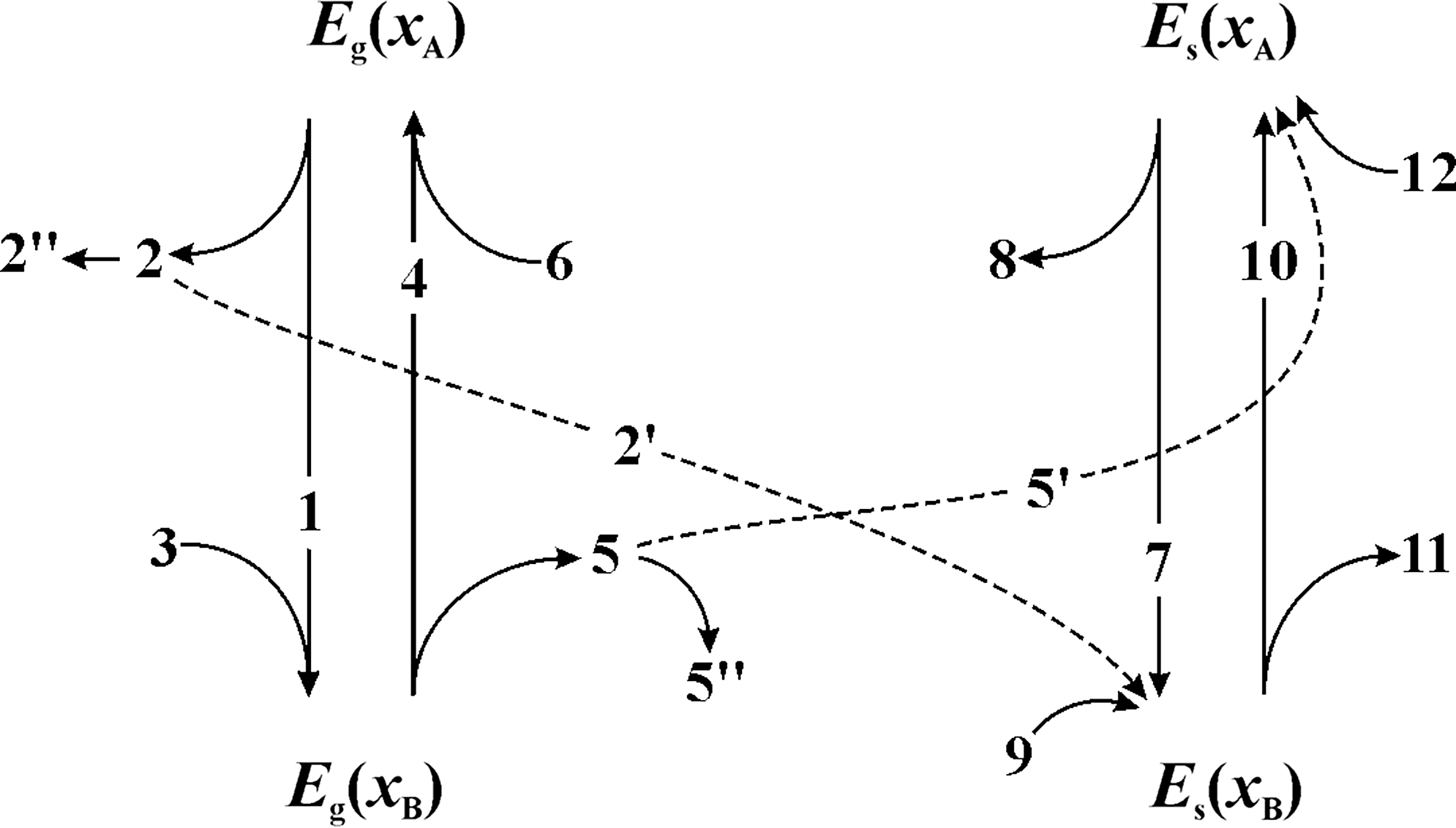
Possible energy exchanges associated with transformations between two forms of organization, A and B. Each A to B transformation includes changes related to two forms of energy: free energy and entropy-associated energy. The arrows between A and B represent the smallest integer units of transformation. x A and x B are the smallest integer coefficients of A and B, respectively. For example, if the stoichiometry of a process is 2.5A=2B, then x A=5A and x B=4B. E g(x A) and E g(x B) are the free energy content of x A and x B, respectively. E s(x A) and E s(x B) are the absolute entropy-associated energies at environmental temperature of x A and x B, respectively. (1) The E g transferred to x B from x A during x A to x B transformation (that is not used in x B), and vice versa for (4). (7) The E s transferred directly to x B from x A during x A to x B transformation, and vice versa for (10). (2) Total free energy released from x A during x A to x B transformation, and vice versa for (5). (2′) Free energy released from the decay of E g(x A) and converted into E s(x B) during x A to x B transformation, and vice versa for (5′). (2″) Free energy excess that can be released from E g(x A) in the environment during x A to x B transformation, and vice versa for (5″). (3) Free energy added to E g(x B) from the exterior during x A to x B transformation, and vice versa for (6). (8) Release of E s from (x A) during x A to x B transformation, and vice versa for (11). (9) Entropy-associated energy added to E s(x B) from the exterior during x A to x B transformation, and vice versa for (12).
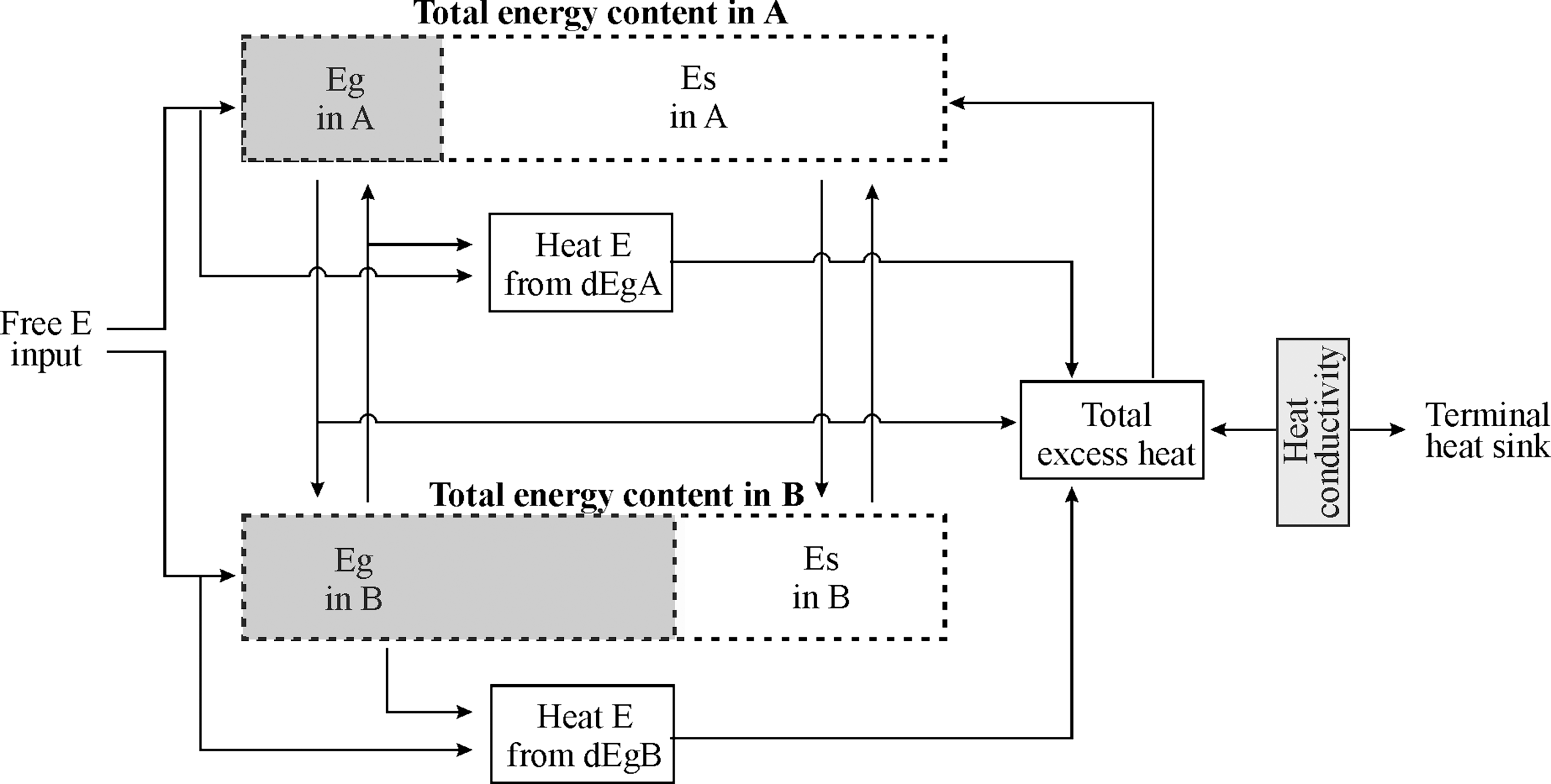
Simplified diagram of most important parts of a BiADA-based model showing the energy flux and budget through a system with two forms of organization, A and B. E=energy. The energy content of each form of organization (“Total E content”) is the sum of two stocks (E g and E s). Each transformation (forward or reverse) is analyzed individually, to allow observation of real reaction dynamics even at equilibrium. The input E g and E s values represent the absolute free energy and T·S* content.
where: S*=absolute entropy; 1 nat=1/ln2 bit=1.44 bits (Reza, 1994; Comley and Dowe, 2005); and
k B’=information-theoretic entropy=9.572·10−24 J bit−1 K−1 (Jaynes, 1957; Lindgren, 1988).
k
B’ is the quantitative link between information capacity and energy, and measures the heat energy released from E
s when I
C decreases, for example, during the creation of order (Landauer, 1961), (see Fig. 1). In a chemical system, the energy equivalent to one bit of information, (i.e., energy necessary to remove the capacity to make one binary decision about the system) is
where E bit=Landauer bound or Landauer limit (Landauer, 1961; Bennett, 2003; Ladyman et al., 2007; Gough, 2008).
In the model shown in this study, we will assume that temperature has no effect on Ω and entropy; thus in all energy-to-information interconversions we will use E bit≈2.8·10−21 J bit−1 or ∼1.69 kJ (mol·bit)−1 at 20°C (Popa and Cimpoiasu, 2012). Whether this Landauer bound value also applies to non-chemical systems remains debated (Bennett, 1982; Jarzynski, 1997a, 1997b, 1997c; Norton, 2005). We believe it does not, but such discussion is beyond the objectives of this study. If the system to be simulated is non-chemical, a separate analysis will have to establish the energy cost of a binary decision.
(1) Residual information (I rs) represents the I C still present after ordering has occurred, for example, I rs(x A)=log2(ΩA). I rs is similar to the disorder capacity C D of a system (Landsberg, 1984), sometimes also called the entropy of the parts contained in the permitted ensemble. We find the use of the word entropy in this situation inappropriate because I rs refers to information (i.e., number of decisions needed to remove free choices or degrees of freedom), while entropy refers to the energy “absorbed” by those degrees of freedom.
(2) Removed information (I rm) is the part of I C that is missing due to the presence of order. I rm is similar to the order capacity (C o) of a system or form of organization as defined by Landsberg in 1984.
(3) Virtual information (I vt=I rs+I rm) is the maximum I C in a system or form of organization, having zero order and largest possible Ω. I vt is similar with the information capacity (or Shannon's channel capacity) of a system (C i).
Two forms or organization with equal amounts of matter (e.g., x A and x B) may have similar I rm values, yet the transfer of information content from x A to x B during A ⇨ B transformation is not 100% accurate because these forms of organization are in essence different. The percentage of I rm(x A) that is common, that is, makes sense and thus can be transferred from x A to x B is called A to B meaningful information [I mn(A,B)]. How much I mn (i.e., memory regarding organization) is transmitted along a sequence of transformations through a sequence of many forms of organization within a network (and thus how much meaningful information is preserved by the collective) is thought to be a key controller of a network's “memory” and fitness.
The building blocks present in a system may be organized in many ways, for example, A, B, C,…, etc. Each of these forms of organization has a specific G* value and a specific effect of G* on Ω. E g(A) is negatively correlated with changes in O s(A), but this relationship is not linear or predictable. At T>0 K no systems exist with G large enough to remove all possible degrees of freedom from the system and to produce O s=1. Although the second law of thermodynamics states that a dynamic system will naturally evolve toward a state of higher entropy (i.e., larger O s and lower O o), in dynamic systems that are exposed to an energy flow and are capable of reflexive activity (e.g., feedback regulation, self-repair, autocatalysis, replication of meaningful information, and homeostasis), a point of equilibrium is reached between O s and O o, where the rate of order degradation equals the rate of order formation. This does not disobey the second law of thermodynamics because at a larger scale, as energy is absorbed by the system, an external energy gradient is also dissipated, leading to an overall increase in total entropy that is larger than the entropy lost through gain in order within the system (Nicolis and Prigogine, 1977; Prigogine and Stengers, 1984).
4. Example of Simulation Model Using BiADA Principles
An example of a dynamic model based on Fig. 2, and using the principles outlined above, was implemented with the software Stella 8.0 TM (isee systems, 2012) (Fig. 3). This model is that of a very simple system with components that can only assume two forms of organization, one monomer (A) and one polymer (B). B is assumed to be produced in a process analogous to polymerization, as opposed to polycondensation. The model does not analyze changes in energy and entropy due to interactions between individual forms of organization, or interactions with a solvent. “A” is assumed to be stable enough for its degradation not to be observable during a simulation of about 32,700 steps at DT=1 (the upper limit for Stella). “A” cannot evolve toward other states with larger Ω/mass ratio, and it is assumed to be the state of largest disorder (i.e., maximum Ω and largest entropy), E g(A)=0, I rm(A)=0, and I vt(A)=I rs(A). B is assumed to be ordered relative to A, [i.e., x B·ΩB<x A·ΩA; E s(B)<E s(A); E g(B)>0; I rm(A)>0, and I vt(A)>I rs(A)]. The system is closed, that is, it exchanges energy but not materials with the exterior.
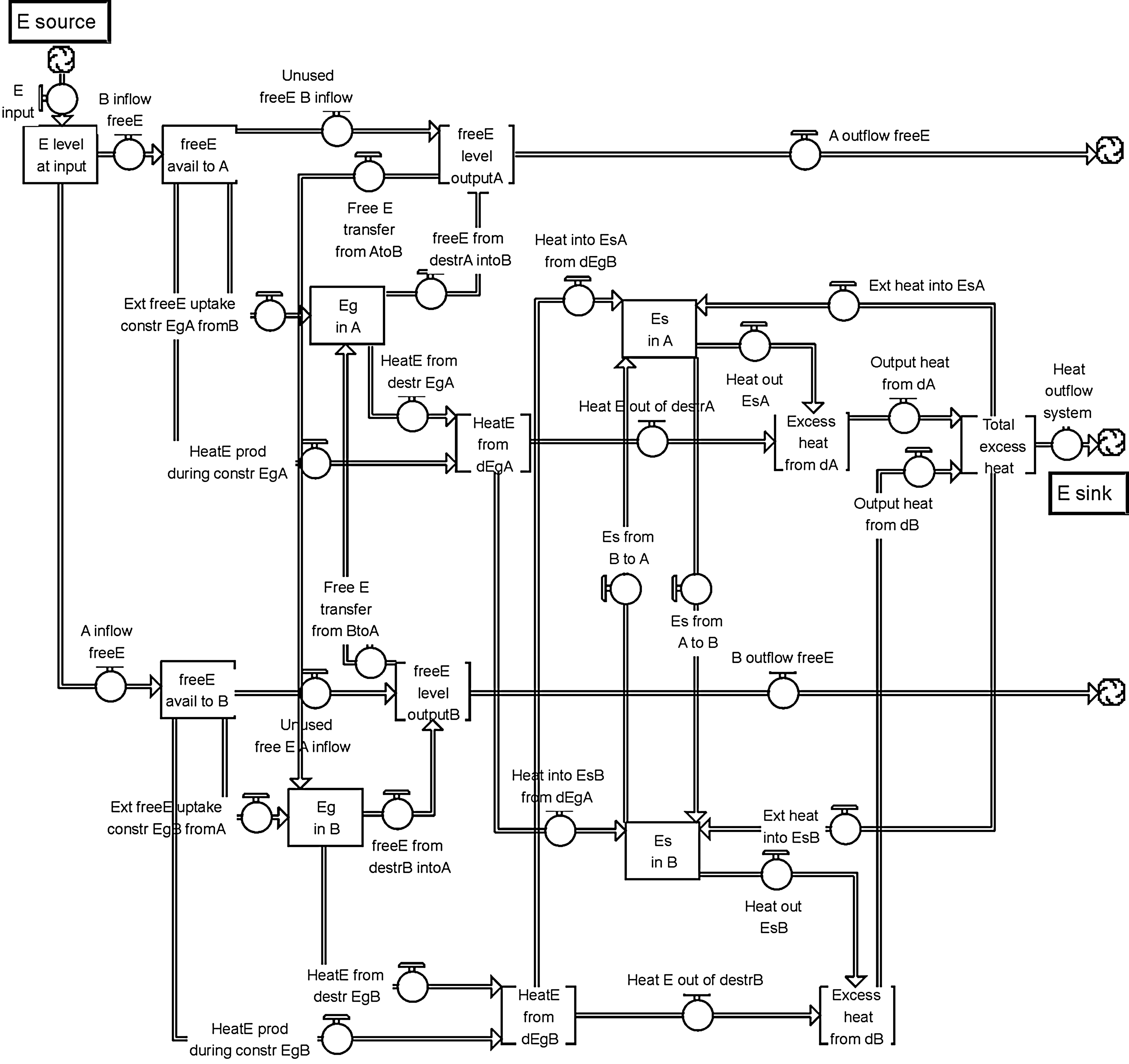
Diagram using BiADA principles to model a system with two forms of organization, A and B. This model does not analyze the transfer of building materials between A and B but only the energy budget, energy flow, and energy transformations. The energy from each form of organization (A and B) is represented by two stocks (“Eg in A and Es in A” and “Eg in B and Es in B,” respectively). For simplicity, all converters, ghosts, and connectors are hidden. The model is posted at
The full model (available at
Examples of simulation results using the model from Fig. 3 and examples of analyzing the effect of various controllers on the evolution of prebiotic order are shown in Figs. 4 –8. The graphs from these figures help monitor the evolution of O o(B) and the energy dissipative potential of the system.
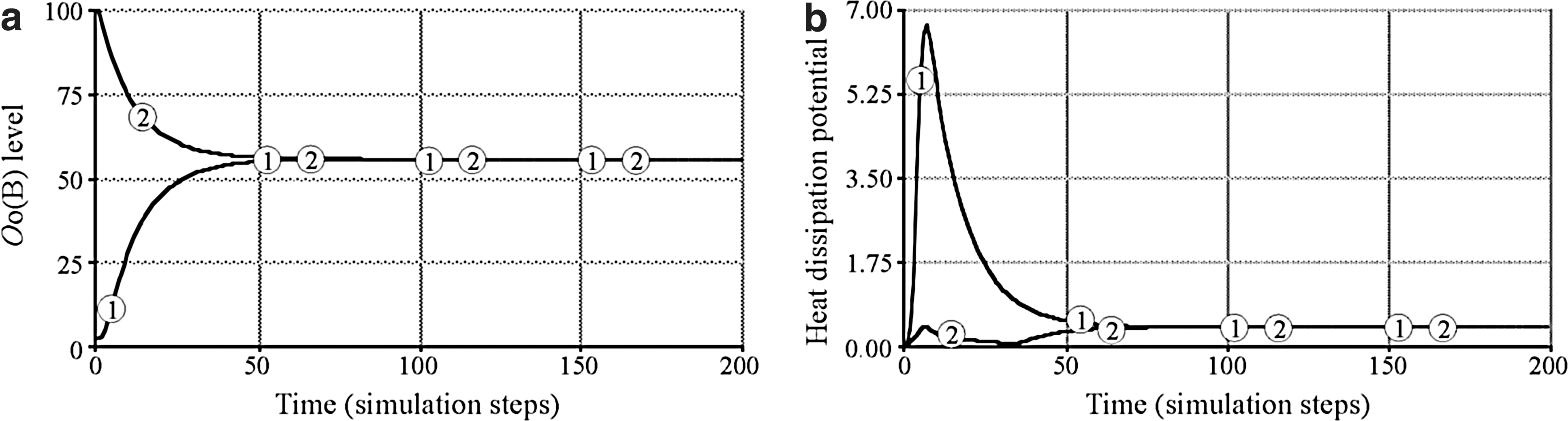
The effect of the initial state of the system (i.e., the abundance of B) on the evolution of order (

Effect of energy availability on the evolution of order (
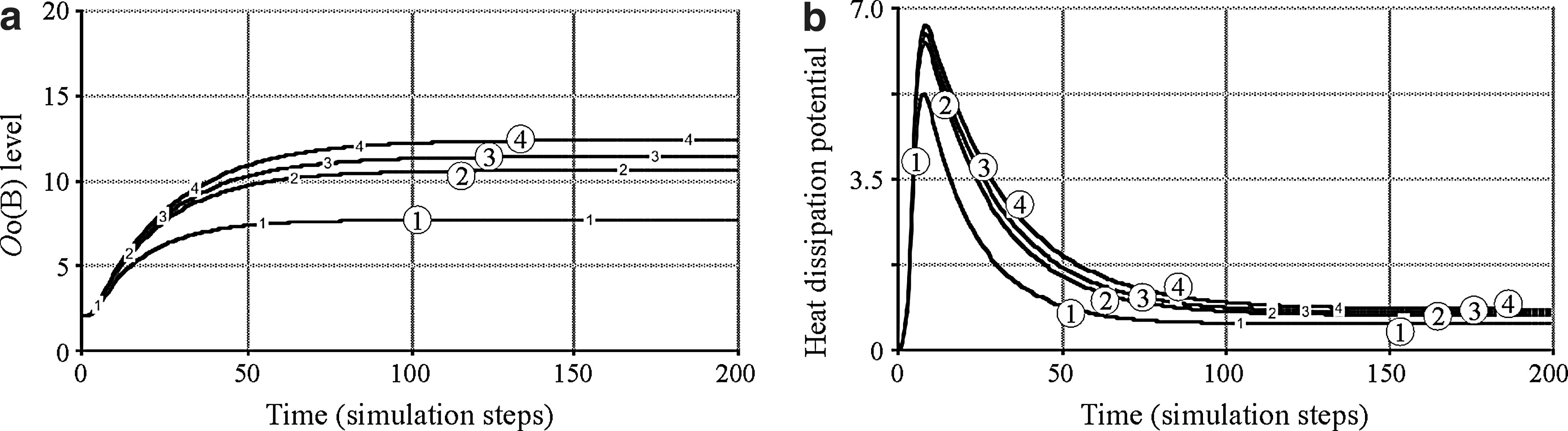
Effect of the catalysis of the internal energy flow, proxy for the internal energy conductivity, on the evolution of order (

The effect of B autocatalysis on the evolution of order (

The effect of the magnitude of a terminal heat sink on the evolution of order (
Users have to introduce input conditions by following a specific sequence of rules.
(1st) Establish the stoichiometry of the transformation by using integer values for “xA” and “xB.” The transformation stoichiometry used in this model is
(2nd) Assign positive values to the degrees of freedom per unit (i.e., “Omega A per unit” and “Omega B per unit”). This value should be larger for the compound with the largest S* per unit mass (i.e., A). For Omega approximated values, Table 1 can be used [Ω=exp(S*/k B)].
(3rd) Using Table 1 as an approximate scale, assign an absolute value for the free energy of A (i.e., “EgA J per unit”).
(4th) Assign values for the rates of forming B from A (RoA) and of forming A from B (RoB). These are the forward and reverse rates of the natural reaction without any catalyst or inhibitor present.
(5th) Next, the program will calculate the E g value of B (“EgB”).
(6th) Make adjustments to the above values as desired, while keeping in mind that in most examples of transformations from nature, where life exists, dE g>dE s.
5. Results
Results of simulating the effect of five prebiotic factors (i.e., the initial state of the system, energy availability, energy conductivity, B autocatalysis, and the magnitude of the terminal heat sink) on the evolution of order and energy dissipative potential in the system from Fig. 3 are shown in Figs. 4 –8. Here we only give a few examples to show how a BiADA-based simulation works and how it can be interpreted, with the acknowledgement that numerous combinations of factors and very interesting questions remain unanswered.
Figure 4 shows that when free energy is unlimited, irrespective of the initial state, the system will move toward the same final equilibrium [O o(B)≈55 %]. The energy dissipative potential is higher when B (i.e., the form of organization with the largest E g:E s ratio) increases in abundance and subsequently decreases at equilibrium. The heat dissipative potential, an important contributor to a system's selective fitness, is proportional to the first derivative of the evolution (i.e., the rate of change) of the O o representing the form of organization with the largest E g:E s ratio.
Although at equilibrium the balance of energy exchange with the exterior is zero, the quality of the input and output energy exchange will vary. This is due to the fact that in this system forward and reverse transformations continue to occur even at equilibrium. This behavior (i.e., energy dissipation due to equilibrium point kinetics) is interesting for prebiotic evolution because it means that a system, or a specific set of transformations, is more efficient in dissipating energy (i.e., outcompeting other systems and thus favoring the flow of energy through itself), as long as it remains dynamic and produces innovations with increasingly higher O o value. This mechanism may help explain how external physical drivers, such as energy limitation or a bottomless heat sink, are linked with increased order, origin of life, and macroevolution (Chaisson, 2003). It also gives credit to Peer Bak's (1996) opinion that “the flow of energy from a source to a sink through an intermediate system tends to order the intermediate system” (rephrased by Popa, 2004).
Figure 5 emphasizes the importance of energy availability on the evolution of order and energy dissipative potential in an A ⇔ B system. In Plot 1, the available energy is insufficient to sustain the initial level of B-related order. In Plot 2, the energy is sufficient to maintain the initial level of order. In subsequent plots (3–5) the final level of equilibrium is energy-dependent. In Plot 5, the highest possible O o(B) level is reached. Increased energy availability above the Plot 5 level will not change the equilibrium but make the system evolve faster.
In this model, the partition of free energy through the system is dependent on the amount of degrees of freedom (Ω), which inhibits the buildup of order. The effect of a mechanism (called “Cat” in the model) that changes the energy conductivity of the system in favor of B is shown in Fig. 6. As expected, increases in Cat change the final equilibrium. This only applies, however, when free energy becomes limiting (results not shown), which raises the question: Are energy-limited environments important for explaining the origin of prebiotic order?
Self-replication of information is one of the most frequently used explanations for prebiotic evolution. Figure 7 shows the effect of autocatalysis (Ref) of one form of organization on the evolution of order and energy dissipative potential in an A ⇔ B system. Simulations show that even modest increases in RefA will arrest some of the energy that was available to B and thus slow down its evolution. In this case energy availability and autocatalysis control the evolution of the system by combining their effects. With regard to the origin of life, this type of analysis can be used to rank the historical importance of various controllers of prebiotic evolution of order. Our analysis indicates that Cat and Ref are likely very early and very important requirements for initiating the evolution of prebiotic order toward higher levels of organization.
In Fig. 8 we show the effect of a terminal heat sink on the evolution of order and on the heat dissipative potential of the system. We found that if the system cannot dissipate heat, after about 14,000 steps, the accumulated temperature starts affecting the internal transformation rates and leads to loss in overall organization. The meaning of this result to prebiotic evolution is that if a dynamic system was placed in a hot environment with poor heat conductivity, the internal increase in temperature will eventually aggravate the decay of order.
Results from Fig. 9 show that in the presence of catalysis the system reaches thermodynamic equilibrium faster and also that more active degradation and restoration of B leads to increased energy dissipative potential. This can be used to speculate that in systems with competing avenues of transformation catalysis of one of the paths will drive the system to a change in equilibrium. This is very interesting because it shows that even though catalysis does not change the equilibrium between reagents and products it does affect the equilibrium relative to other components in the system.

Simulation showing the evolution of the order level (
With regard to the origin of life, Ref appears to be a more primitive condition than Cat. Yet ordered structures can lose energy conductivity proportional to their loss in entropy, which decreases the efficiency of autocatalysis. We propose that the origin of pre-living systems was a circumstance where Ref was larger than the decay rate, but specialized internal energy conductivity paths (i.e., Cat) were also created in order to compensate the loss in conductivity due to ordering. In our simulations, the evolution of the energy dissipative potential indicates that the fitness of a system is correlated with high internal turnover and the buildup of forms of organization with higher E g:E s values. The accuracy of Ref and the degeneration of the system into quasi-species (Eigen and Schuster, 1977) cannot be analyzed by the model presented here because this model does not allow having genetic variants of given forms of organization. Yet other questions, such as the tendency of self-organization in a direction that maximizes the energy flux (Bak, 1996), or the role of terminal heat sinks in self-organization of prebiotic systems (Chaisson, 2003), can be studied.
6. Discussion and Conclusion
The aim of this study was to describe basic principles of a novel simulation concept called BiADA and to show how they can be employed in the study of the evolution of prebiotic order. The fact that BiADA-based systems are abstract helps in the development of models of a wide variety of systems independent of composition. It also helps focus attention on universal properties of life and drivers of prebiotic evolution, rather than details that are only specific to a narrow palette of real-world systems. By being automata, BiADA-based systems do not require sequence information, translation, and Darwinian selection to explain how order originated and evolved. The separation of each form of organization in two distinct energy stocks (E s and E g) makes it easier to explain where, and in which form, the energy flowing through a system comes from, and why and how energy is exchanged with the exterior. Dynamic systems at equilibrium have zero difference between forward and reverse transformations, energy inputs similar to energy outputs, and no changes in composition, yet they are still energy dissipative, continuously absorbing free energy and releasing entropy in the environment. We propose that BiADA principles can be used to study kinetics near equilibrium, a topic of crucial importance for understanding the origin of life.
Using BiADA will help answer very important questions about prebiotic evolution. For example: what are the minimal conditions for increasing order in a dynamic system; how do various external and internal factors control and combine to influence the ordering of a prebiotic system; how did various controllers rank in importance during prebiotic evolution; was prebiotic organization driven toward states with increased energy dissipative potential; and was prebiotic organization driven by an ever-increasing heat sink or by competition for free energy? We propose that the origin of prebiotic order (and life) can be studied by analyzing the energy dissipative potential of dynamic systems at equilibrium while competing in an environment with limited availability of free energy. We propose that in such environments pre-Darwinian selection of order was a consequence of the terminal energy sink and functioned through combined effects of changes in transformation kinetics and autocatalysis.
Footnotes
Acknowledgments
The authors contributed equally to this work. This work was supported by Portland State University and by University of Craiova. We thank Dr. Mark Bedau, Dr. Albert S. Benight, Dr. Terry Green, Dr. Stuart Kauffman, Dr. Gyula Palyi, and Dr. Meir Shinitzky for reading the manuscript, support, and insightful suggestions.
Author Disclosure Statement
No competing financial interests exist.
Abbreviation
BiADA, Biotic Abstract Dual Automata.
1
In a chemical system, each type of chemical structure is an example of a form of organization.