




Abstract
Terrestrial moons with masses >0.1 M ⊕ possibly exist around extrasolar giant planets, and here we consider the energetics of how they might form. Binary-exchange capture can occur if a binary-terrestrial object (BTO) is tidally disrupted during a close encounter with a giant planet and one of the binary members is ejected while the other remains as a moon. Tidal disruption occurs readily in the deep gravity wells of giant planets; however, the large encounter velocities in the wells make binary exchange more difficult than for planets of lesser mass. In addition, successful capture favors massive binaries with large rotational velocities and small component mass ratios. Also, since the interaction tends to leave the captured moons on highly elliptical orbits, permanent capture is only possible around planets with sizable Hill spheres that are well separated from their host stars. Key Words: Extrasolar terrestrial planets—Habitable zone—Moon—Exoplanets. Astrobiology 13, 315–323.
1. Introduction
W
But this is some 4–5 times greater than the largest moons in the Solar System that are presumably formed through accretion in circumplanetary disks. The Galilean moons, for example, are thought to have accreted in a systematic way out of a few Earth masses of ice and rocky material circling a young, hot Jupiter (Canup and Ward, 2002), in the same way the terrestrial planets are thought to have formed around the primordial Sun. Apparently, there was not enough mass or accretion efficiency in the protosatellite disks belonging to Jupiter or Saturn to form anything larger than 0.025 M ⊕, the mass of Ganymede. The examples of Callisto and Ganymede around Jupiter and Titan around Saturn suggest that we should not expect any exomoons to exist with masses larger than ∼10−4 the mass of a host exoplanet, unless they are formed in ways other than accretion.
There are three obvious exceptions to the satellite mass-limit in the Solar System, which show that moons can and do form in ways other than ordered accretion. Earth's moon (∼10−2 M ⊕), along with Charon (∼0.1 M p) around Pluto and Triton around Neptune (10−4 M n but with a retrograde orbit), are thought to have all originated either through collision (Canup and Asphaug, 2001; Canup, 2005) or capture. To be captured, an incoming object must lose energy and transition from a circumstellar to a circumplanetary orbit possibly through gas drag (McKinnon and Leith, 1995) or a three-body “binary exchange” encounter, such as the one involving Neptune and a Pluto-mass binary to form Triton (Agnor and Hamilton, 2006). In such an event, a small binary object is tidally disrupted by a planet, and one member of the binary is lost while the other member is captured. Support for a “binary exchange” capture origin of Triton comes from the prevalence of binary objects—some 30% of Kuiper Belt objects—now known to occupy the Kuiper Belt (Noll et al., 2008), with the Pluto-Charon system being most famously representative of this population.
Binary-exchange capture could in principle occur in the inner Solar System as well, or in the inner regions of exoplanetary systems, provided (i) there exists a population of binary-terrestrial objects (BTOs) presumably formed through collision and (ii) giant planets orbit near the terrestrial objects to dynamically excite the BTO population and promote close encounters. Examples of binary asteroids (Merline et al., 2007; Descamps and Marchis, 2008), as well as the Earth-Moon system, suggest that the formation of binaries, big and small, out of swiftly orbiting terrestrial material is at least possible. In addition, the migration of giant planets into and through the terrestrial accretion zone is now thought to occur in many planetary systems (Mandell et al., 2007), including possibly our own (Gomes et al., 2005); if this is the case, the chances of close encounters between gas giant planets and rocky material are higher than previously believed. Numerical simulations by Philpott et al. (2010) showed that encounters involving a BTO placed 1 Hill radius from a gas giant planet result in tidal disruption of a small BTO and successful capture of an asteroidal moon a few percent of the time. The capture percentage in their study was highest for the most massive BTOs with the fastest barycentric spin rates, although their attention was devoted to objects less than 20 km in radius. We will here demonstrate that heavier objects are even easier to capture provided the binaries to which they belong can be tidally disrupted in the first place.
2. Methods
The purpose of this work is to determine the dynamical and physical conditions that yield a successful binary-exchange satellite capture, as well as to determine the largest terrestrial moon mass that can be formed from such an event. Figure 1 illustrates schematically how the binary-exchange interaction works. During the three-body encounter, the retrograde-moving binary mass m 1 is simultaneously accelerated by both the prograde-moving mass m 2 and the planet. The retrograde motion of m 1 around the binary barycenter provides a negative Δv relative to the planet center, which can decelerate m 1 to less than the planet escape speed. The mass is thereby inserted on a bound elliptical orbit around the planet provided the binary is near enough to the planet to be tidally disrupted and the acceleration of m 1 from m 2 becomes negligibly small.
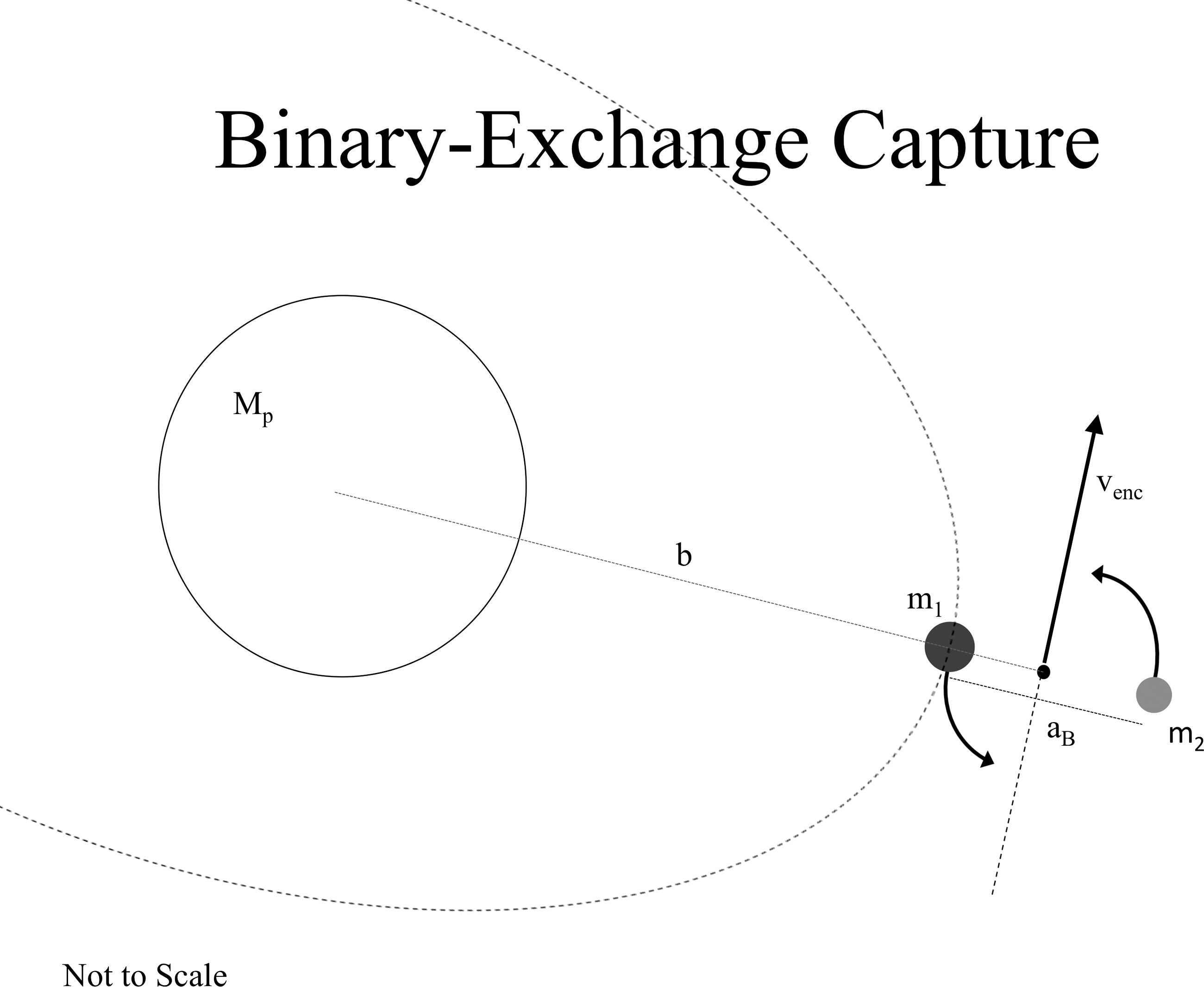
Schematic illustrating the principle of “binary-exchange” capture and giving definition to the encounter parameters. The encounter is depicted in planet-centric coordinates with the planet position fixed. Although the captured mass for the shown encounter is m 1, either mass can be captured in principle, depending on which mass is moving retrograde relative to the encounter direction. The binary is shown to be rotating in the orbital encounter plane for maximum Δv, but all spin inclinations are possible in reality.
Even though the larger mass is shown in Fig. 1 to be captured, either of the masses can be captured in principle, depending on which mass is moving in a retrograde direction when tidal disruption occurs. The binary in Fig. 1 is shown to be rotating in a prograde direction relative to the binary encounter trajectory because the chances of a successful capture are significantly improved with this configuration, as will be explained below. Also, the binary in Fig. 1 is shown to have zero inclination relative to the orbital encounter plane because this orientation yields the maximum Δv available and therefore allows an estimate of the largest mass that can be captured.
The condition for tidal disruption of the binary is for the distance a
B between the binary masses m
1 and m
2 to be greater than the binary Hill radius r
H, with the binary barycenter located at a distance b from the planet center. Therefore
with M
p being the mass of the planet. It is more instructive to express the tidal-disruption condition in terms of the encounter distance
which may be rewritten in more convenient form by using density ρ and object radii R in place of mass, and approximating m
1+m
2≈m
1. Thus,
where the subscripts “1” and “p” refer to the larger binary mass and the planet, respectively. According to Eq. 1, it is harder to disrupt compact binaries than loosely bound ones with wide separations. Also, the relative tidal disruption distance (b/R p) is independent of the binary and planet masses. Using densities appropriate for gas giants (ρ p=1200 kg/m3) and terrestrial objects (ρ 1=4500 kg/m3) in the Solar System, and setting a B/R 1=10 yields b=9.28 R p. This is an exceptionally deep encounter—within the orbits of many of the major satellites in the Solar System—which implies a low-probability event. But simulations performed for this study show there to be some gravitational focusing of the binary as it falls toward the planet, which increases the planet's target diameter 2–5×(depending on encounter velocity) at infinity. Also, the tidal disruption limit grows linearly with a B, which means that the maximum encounter distance increases to ∼20 or 30 R p for less compact binaries with a B/R 1 as high as 20 or 30. But there is a trade-off here: wider binaries have smaller barycentric orbital velocities, which results in less energy being removed from the retrograde-moving mass during the encounter and thereby makes capture more difficult.
The binary barycentric orbital velocity of mass m
1, for example, is
and is plotted in Fig. 2 as a function of m 1 and the binary mass ratio μ for an arbitrary fixed orbital separation a B=10(R 1+R 2). Gravitational interaction and centripetal acceleration of the masses ensures that massive binaries rotate faster than lighter ones, with Moon-mass binaries toward the left of the figure moving at ∼0.2 km/s and Earth-mass binaries orbiting faster than 1 km/s. This result yields a modest upper limit on the rotational velocity of the binary and, hence, the amount of deceleration that is possible in a binary-exchange interaction.
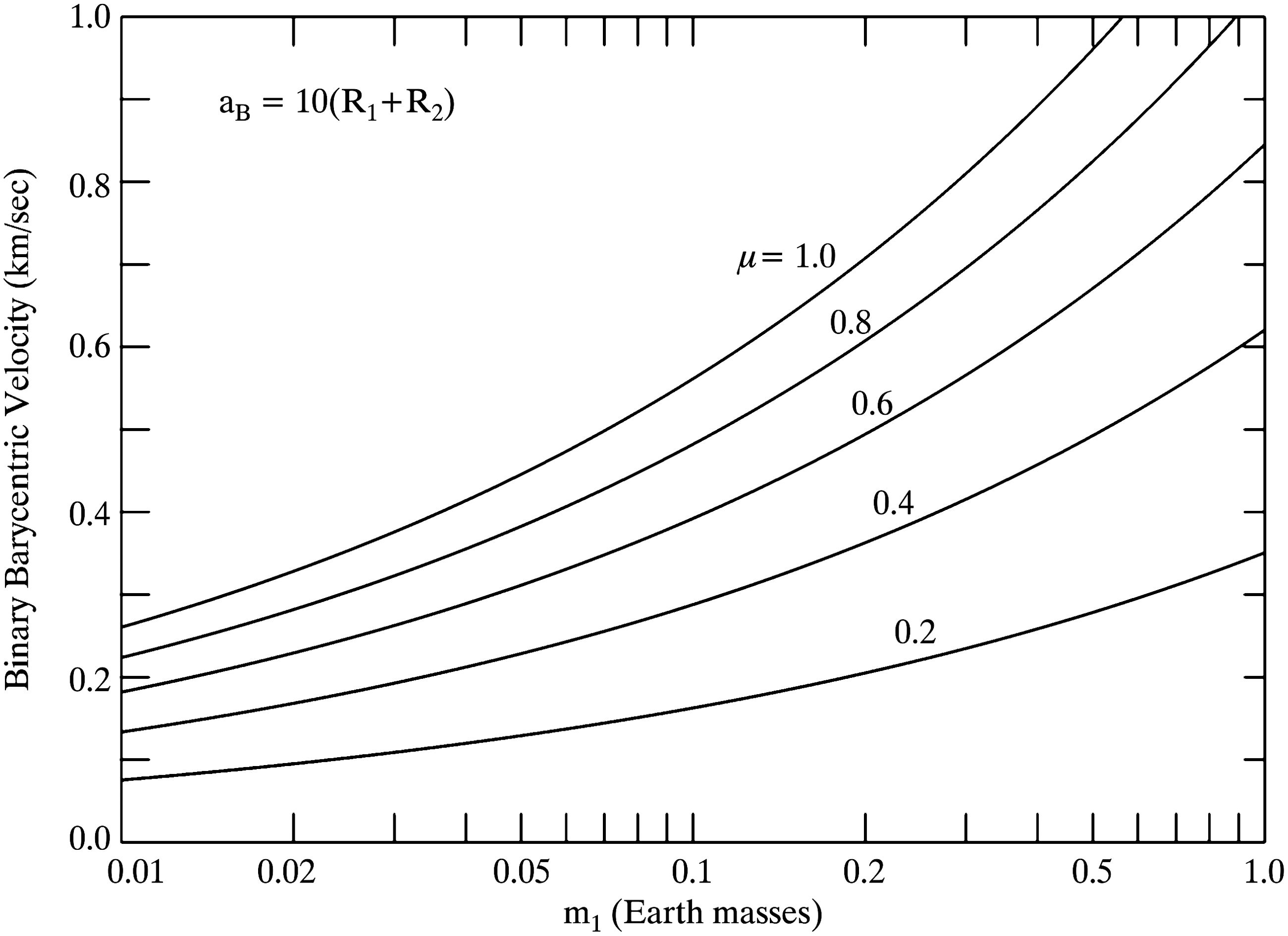
Rotational velocity of the binary as a function of component masses and mass ratio μ=m 2/m 1, which is the same as the maximum instantaneous Δv applied to m 1. The velocity is computed by holding the separation of the binary components constant at 10×their combined radii, which are calculated by using a terrestrial-object density of 4500 kg/m3.
In order for m
1 to be captured by the planet, it must be simultaneously decelerated by the orbital interaction with m
2 while being tidally uncoupled from the binary by the planet. Although this is truly a three-body interaction that can only be precisely modeled through numerical integration, a useful analytic tactic is to examine the net change in velocity of m
1 over the time between tidal disruption and capture. The necessary condition for capture is for the Δv experienced by m
1 to be greater than the difference between the binary encounter velocity and the periapse velocity of the newly isolated mass on a bound elliptical orbit about the planet. This velocity change is expressed
where
where a p is the star-planet separation. As will be shown below, the captured object is usually inserted into a highly elliptical orbit around the planet with an eccentricity in the range 0.6–0.95. But this eccentricity is only temporary since tidal friction with the planet will work to circularize the orbit in under 106 years (Porter and Grundy, 2011).
Although the maximum Δv available to m 1 is the barycentric orbital velocity of the binary in Eq. 2, the size of the Δv in Eq. 3 actually varies throughout the encounter as the binary rotates and the velocity vector of m 1 changes in its orbit past the planet. Therefore, rather than simply setting Δv=v 1 in Eq. 3, it is better to recognize that the retrograde motion of m 1, which decelerates the mass and is responsible for the capture, is provided by the pull from m 2 acting over an encounter timescale Δt enc≈πb/2v enc, where πb/2 is the approximate distance traveled by m 1 around the planet during the encounter. This estimate of how long the binary masses actually remain bound during the encounter, with m 1 completing approximately one-quarter orbit around m 2 before tidal disruption, is based largely on the results of numerical simulations. But it is important to emphasize that this is only an approximation of what actually happens in the three-body interaction.
The product of the encounter timescale and the gravitational acceleration contributed by m
2 to m
1 is a measure of the Δv available to m
1. Therefore,
and should be interpreted as the average magnitude of the time-varying vector deceleration applied during the encounter, which is of course smaller than the maximum Δv given by the circular orbital velocity v 1 from Eq. 2 since this velocity is not always perpendicular to the binary encounter velocity implied by Fig. 1.
With v enc in the denominator of Eq. 5, slower encounters mean more time for the binary in the vicinity of the planet and the longer the binary masses have to interact with each other, which improves the chances of capture. However, capture is less likely for binaries that happen to rotate retrograde relative to the encounter direction because the time over which the three masses are in an approximate alignment is significantly reduced. So however small the chances are for prograde capture depicted in Fig. 1, the net probability of capture for a swarm of binaries with random rotational inclinations is probably an order of magnitude—or less—than this value.
Using Eq. 2 to replace a
B with b in Eq. 5, and then equating Eqs. 4 and 5, allows one to obtain an analytic expression for m
1, which is the maximum mass that can be captured as a function of the escaping mass m
2, the impact parameter b, the relative velocity at infinity v
∞, the star-planet separation a
p, star mass M
*, and the planet mass M
p. Expressed in compact form, this relation is
with secondary expressions for v enc and v peri and other variables given in Eqs. 4 and 5. It is the above expression that will be used repeatedly in the next section to graphically illustrate the limits on moon mass formed through a binary-exchange encounter.
3. Results
Because the number of free parameters in Eq. 6 is large, we will first calculate m 1 as a function of m 2 and b while holding the rest constant. For example, the encounter will first be assumed to involve a Jupiter-mass planet at 1.0 AU from a 1.0 M ⊙. G class star. Also, numerical simulations discussed below reveal that a small v ∞<2–3 km/s is required to give the binary enough time in the planet's vicinity for disruption and exchange to occur. Therefore, we conservatively set v ∞ in Eq. 6 to 1.0 km/s for all the modeling in this study, which is comparable to the rotational velocity of the heaviest binaries considered here. This rather stringent criterion on v ∞ eliminates from consideration high-velocity encounters resulting from extreme dynamical stirring of strongly interacting planets. The optimal planetary interaction for a successful exchange, then, must be slow and gradual and with planets occupying the same space around a star for many orbital periods. N-body simulations involving many terrestrial objects and at least one gas giant planet are needed to test whether such a small v ∞ is ever realized in dynamically active systems.
Figure 3 shows there to be two trends: (i) the maximum captured mass increases with escaping mass; and (ii) captured mass decreases with increasing encounter distance. The first trend is simply a consequence of momentum conservation—deceleration of m 1 is enabled by the acceleration and ejection of m 2—whereas the decrease in captured mass with encounter distance is attributed to binaries needing larger a B values with increasing b to be disrupted, which implies binaries with smaller rotational velocities, smaller Δv values, and consequently smaller masses that are possibly captured.
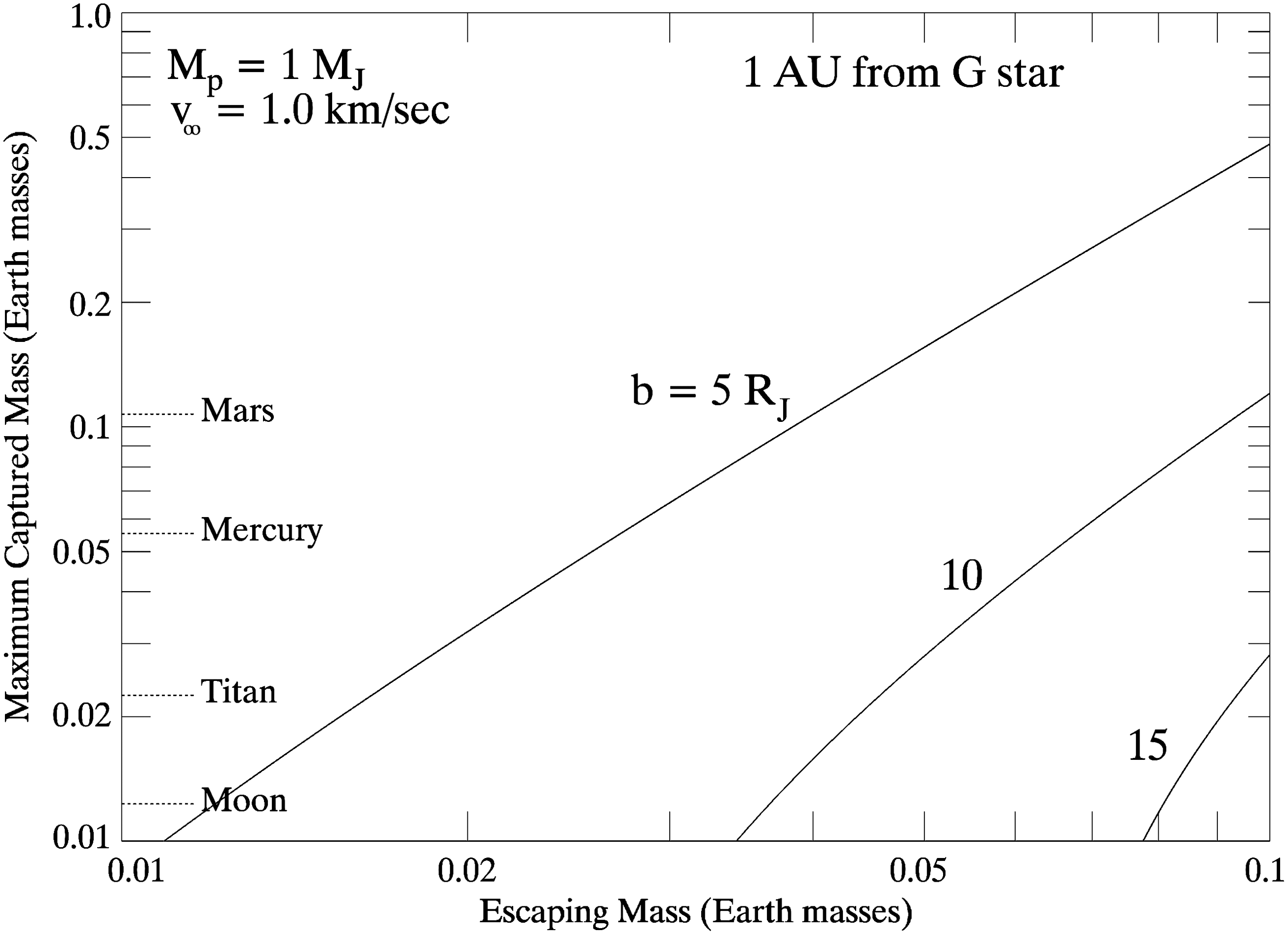
Maximum captured mass as a function of escaping mass and encounter distance: b=5R J, 10R J, and 15R J. Moons larger than 0.1 M ⊕, comparable to the mass of Mars, may form if the escaping mass exceeds 0.05 M ⊕, comparable to the mass of Mercury. The curves are calculated from Eq. 6 with planet mass set to 1 M J, the distance from the G star a* =1.0 AU, and the encounter speed at infinity v ∞ 1 km/s.
Another feature to observe in Fig. 3 is that the escaping mass is everywhere larger than the captured mass below ∼0.022 M ⊕, comparable to the mass of Titan. This does not contradict Eq. 6 since it is derived under no assumption about which is the larger mass. The trend is reversed toward the right of the figure where the captured mass is the greater one and a moon as large as Mars could apparently be captured by losing an object half its mass, or something the size of Mercury. It is worth noting, however, that Earth is too massive to be captured under these circumstances by losing the Moon.
The situation improves somewhat in Fig. 4 where the encounter between the planet and binary is imagined to occur at 2.0 AU from a G star rather than at 1.0 AU. At this larger distance, the Hill sphere around the planet is twice as wide, giving more room to capture moons that are originally on highly elliptical orbits. Here, the escaping mass needed to capture a Mars-sized (∼0.1 M ⊕) object is only a Titan mass (∼0.02 M ⊕) with b=5R J. Toward the right side of the figure, an escaping mass between Mercury and Mars would be enough to capture a full Earth-sized moon.

Maximum captured mass as a function of escaping mass and encounter distance. Same as in Fig. 3 but with the star-planet separation equal to 2.0 AU. Moons are easier to form if the star is farther away since the Hill sphere of the planet is larger.
The orbit of the captured moon is a distended ellipse whose size and shape are a function of encounter distance b. Table 1 lists the semimajor axes and eccentricities of a moon captured by a Jupiter at 1.0 AU from a G star. As the impact parameter b increases from 5 R J to 15 R J, the orbit expands and becomes less eccentric because the captured mass experiences a smaller Δv and orbital deflection in the weaker gravity of the planet.
Semimajor axis a is calculated by using Eq. 4 with a Jupiter-mass planet and a Sun-mass star. Eccentricity is found from e=(1 - b/a).
We now consider M stars, which compose the majority of stars near the Sun in the Galaxy. Binary-exchange capture can take place near or within the HZ around a Sun-like G star, but it cannot occur anywhere near the HZ around an M star. This is because M star HZs are small (0.15–0.26 AU for an M2 star; Kasting et al., 1993), and the Hill sphere of a Jupiter-mass planet shrinks to ∼30 R J at this distance. Figure 5 shows that replacing the 1.0 M ⊙ G star in Fig. 4 with a 0.3 M ⊙ M star increases the captured mass for a given escaping mass by a factor of ∼2–3, because the Hill sphere of the planet around the M star is larger. But moving the planet inward to even as much as 0.5 AU around the M star in Fig. 6 shows that the Hill sphere is no longer large enough (∼91 R J) to hold the entire ellipse of an object captured with b=15R J. It is possible for planets to hold onto moons at this distance, but they must have either formed in an accretion disk or been captured while the planet was farther away from the star before migrating inward.
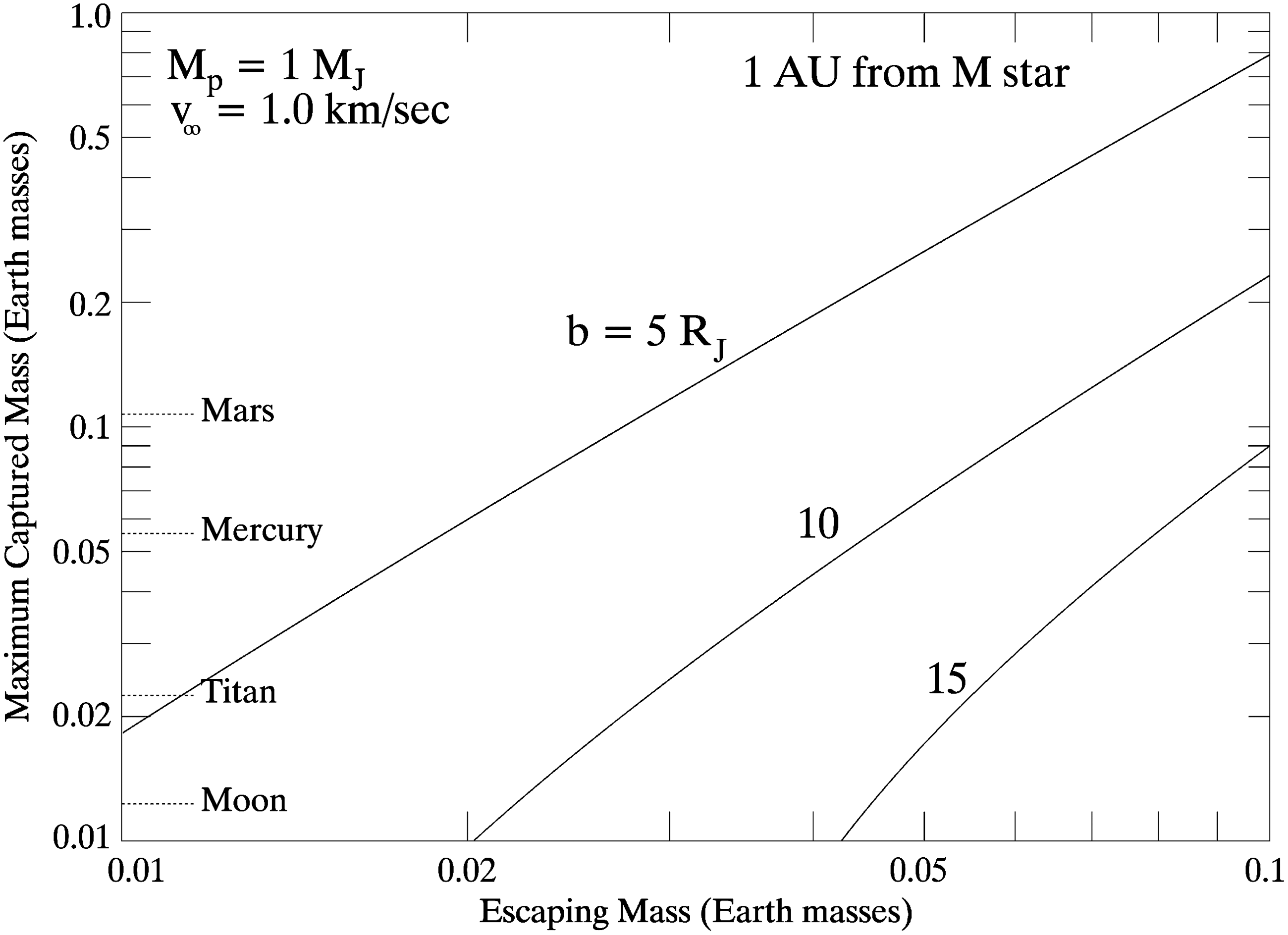
Maximum captured mass as a function of escaping mass and encounter distance. Same as in Fig. 3 but with a 0.3 M ⊙ M star at a distance of 1.0 AU. Captured masses are larger around M stars than around G stars because the planet Hill sphere is larger.
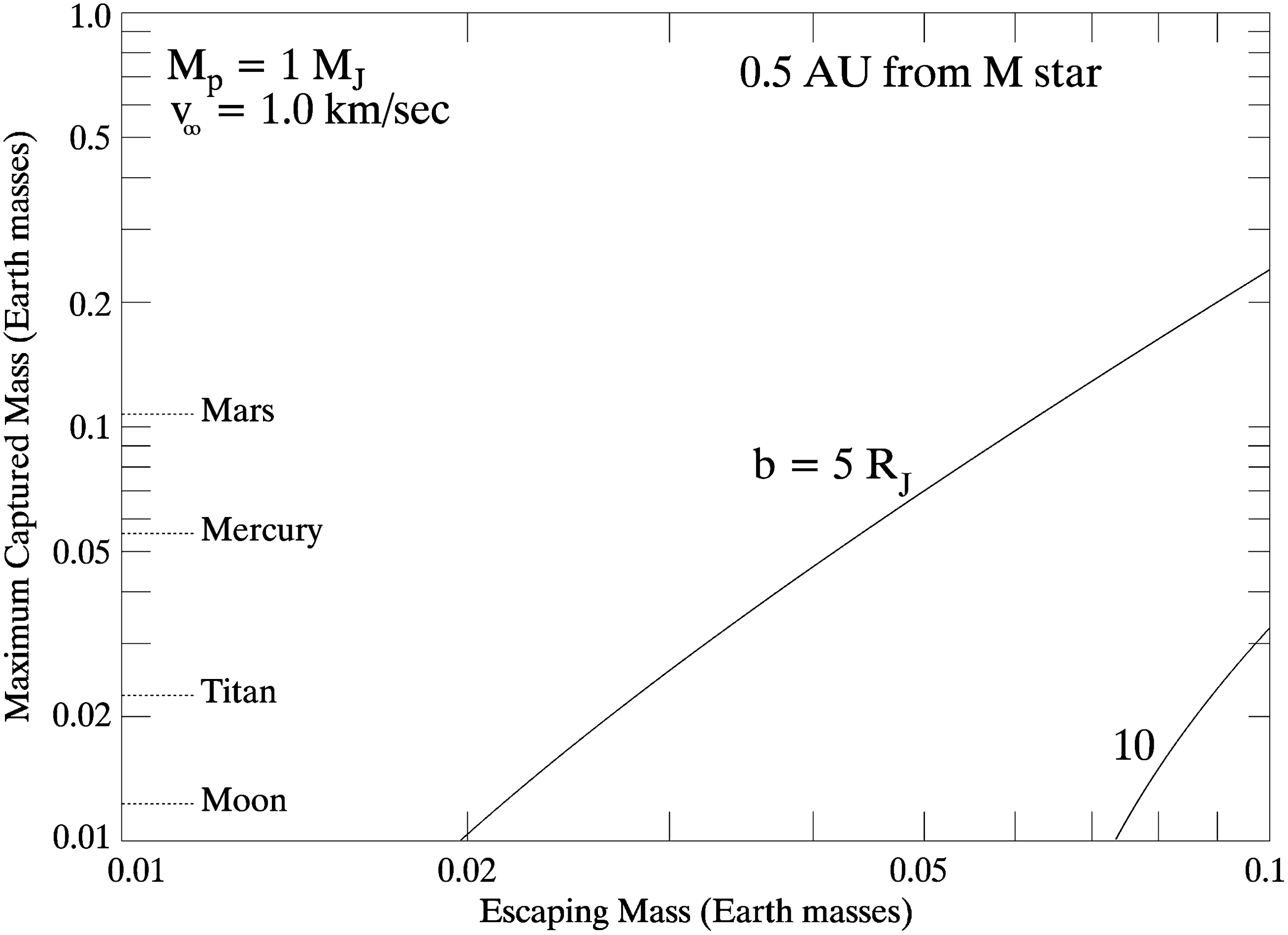
Maximum captured mass as a function of escaping mass and encounter distance. Same as in Fig. 5 but with a 0.3 M ⊙ M star at a distance of 0.5 AU, where the planet and moon are closer to the M star HZ (although still well outside). Only the b=5R p and b=10R p curves are shown. The captured mass:escaping mass ratio is here reduced since the planet Hill sphere is made smaller by the smaller star-planet distance.
How does the size of the captured moon depend on planet mass? It appears at first glance from Eq. 6 that larger planets should capture larger masses, but the encounter velocity and periapse velocity in the denominator also matter. Both velocities in the denominator increase with mass, making the net dependence negative with increasing mass. This is borne out in Fig. 7, which shows the size of the captured mass to decrease as planet mass increases with the impact parameter b held constant. Therefore, in general, it is easier to capture a moon around a Neptune-class planet than around a Jupiter or a super-Jupiter, because the encounter speeds tend to be smaller.
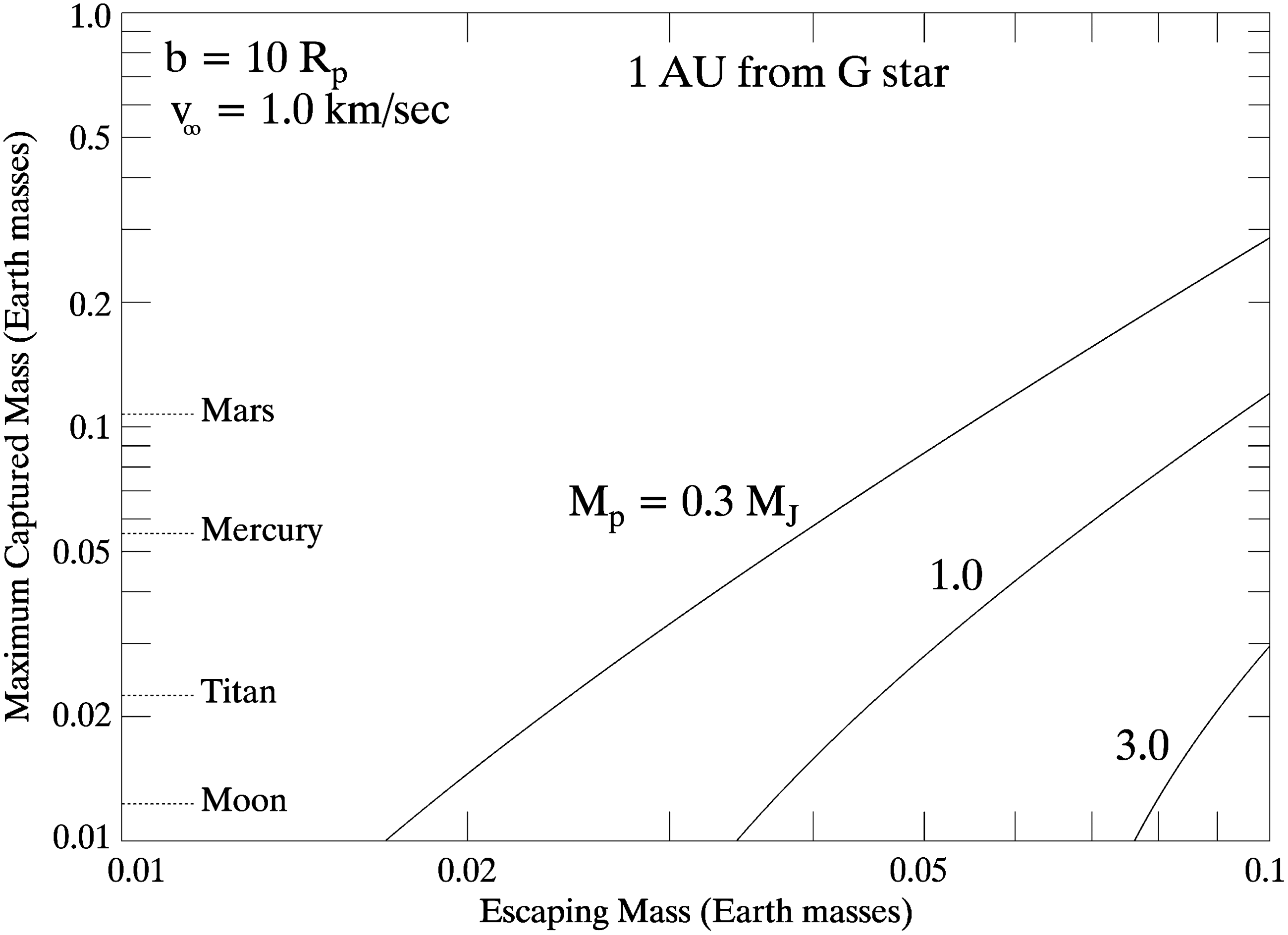
Maximum captured mass as a function of escaping mass and planet mass: M p=0.3M J, 1M J, and 3M J. Binary-exchange capture is easier around low-mass planets because the encounter speeds are smaller. The curves are calculated from Eq. 6 with encounter distance b=10R p, the distance from the G star equal to 1.0 AU, and the encounter speed at infinity v ∞=1 km/s.
An orbital integrator was used to numerically test the analytic limits imposed by Eq. 6. The integrator uses a Burlisch-Stoer subroutine based on the Chambers (1999) Mercury algorithm to integrate trajectories and conserves energy and momentum with an accuracy of one part in 1016. The simulations were all started with the binary placed over 100 R
p from the planet and launched arbitrarily in the positive x direction (toward the right) at a velocity
Figure 8 shows the result of the first successful simulation, where the planet is a Jupiter and the binary is comprised of a 0.15 M ⊕ object and a 0.06 M ⊕ companion, with a B/R 1=10. The paths of the binary components are plotted in a planet-centric reference frame with the planet pinned to the origin. In this instance, the smaller mass is captured, and the resulting orbit parameters are listed in Table 2. To capture the larger mass instead required that we slightly adjust the launch position by ∼1 R J, which altered the timing of the encounter so that the larger mass was closer to the planet during flyby. Figure 9 shows that the resulting orbit has a larger semimajor axis and eccentricity, and the specific orbit parameters are listed in Table 2.
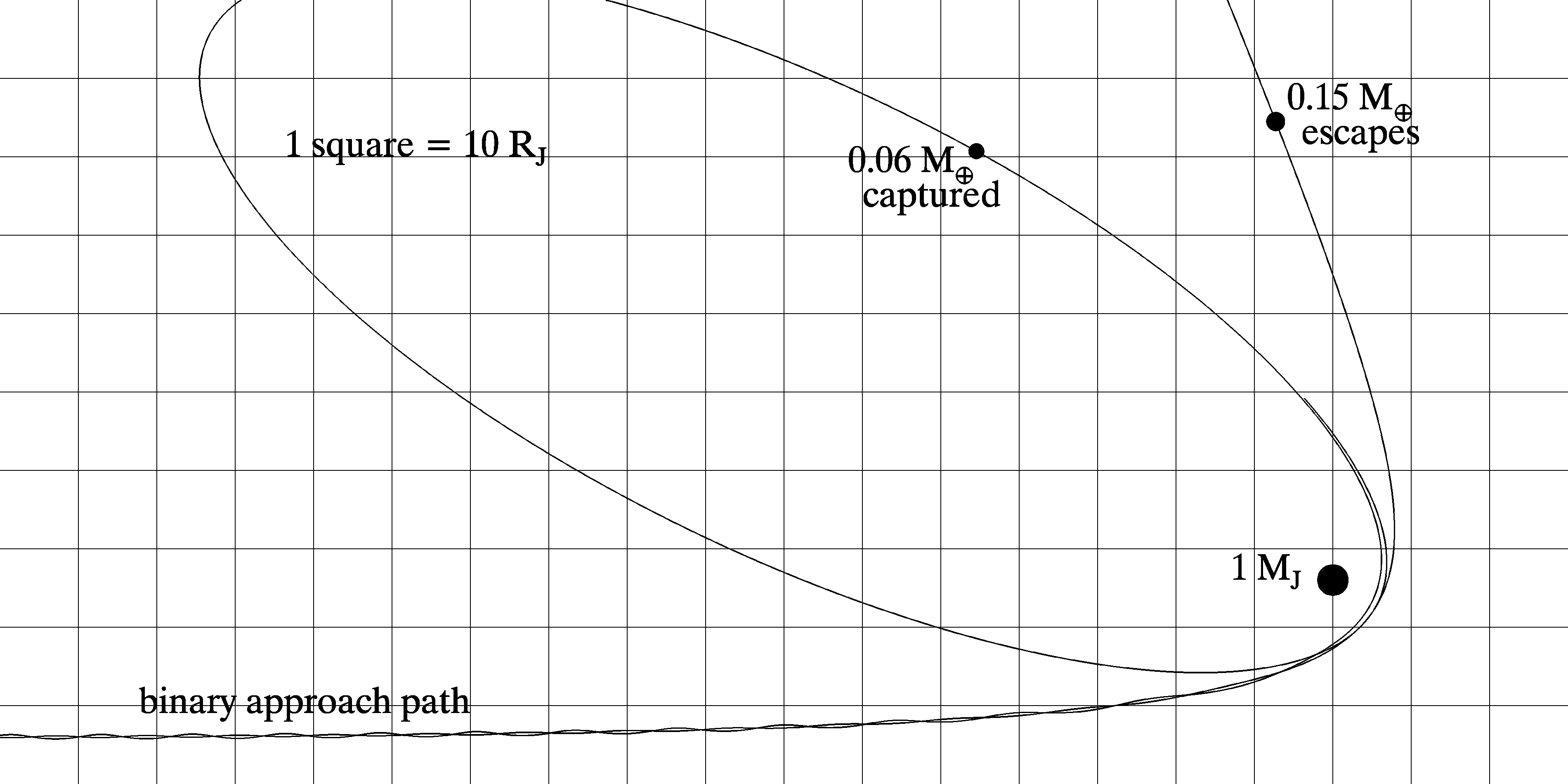
Orbital trajectory of the binary before the encounter (starting toward the right from bottom left) and orbital paths of the separated masses after tidal disruption. Squares are 10 R J wide.
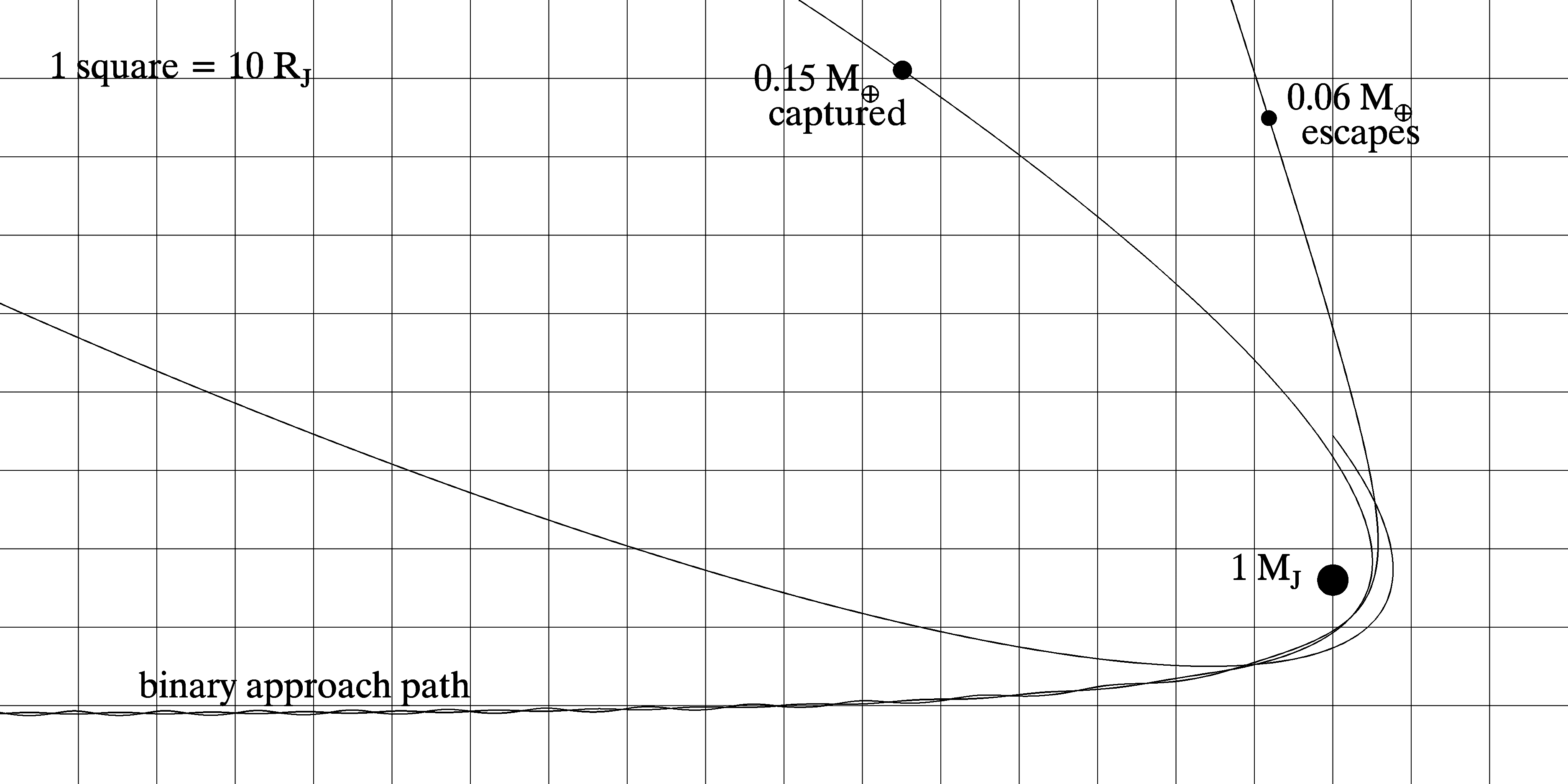
Same as in Fig. 8, but with a small Δx ∼ 1R p change in the initial position for the binary. The captured and escaping masses are reversed in this simulation because the masses are on opposite sides of the binary barycenter when the encounter occurs.
P is orbital period in days.
The second successful simulation was actually the last in a series of many runs performed to see how large an object could be captured when using a 0.06 M ⊕ object as the escaping mass. According to Fig. 4, the largest mass that should be captured when using a 0.06 M ⊕ escaping mass is ∼0.2 M ⊕ (with the impact parameter b=5R J), which is only slightly larger than the 0.15 M ⊕ object captured through integration. The difference stems from the binary-exchange encounter being a three-body interaction but with the Δv experienced by the captured object analytically approximated to occur over a time Δt enc≈πb/2v enc, which of course will not be in perfect agreement with simulation.
Lastly, we performed a series of simulations with the rotational inclination of the binary with respect to the encounter plane set equal to 180°, so that the binary was rotating in a retrograde direction opposite the encounter direction around the planet. As was discussed earlier, the retrograde rotation of the binary significantly reduces the time over which the three bodies are approximately in line and, therefore, the magnitude of the time-averaged Δv opposing the encounter velocity. It is not surprising, then, that we were unable to capture any moons with the binary rotating in the reverse direction (clockwise in Figs. 8 and 9 and opposite the encounter direction around the planet), even as the placement of the binary with respect to the planet was varied randomly and incrementally over a 10 R p wide interval at the start.
4. Discussion
The preceding analysis shows that a moon can form through binary-exchange capture if the ratio of captured mass to escaping mass is not too large. How large is “too large” depends on many additional encounter details, such as the size and proximity of both the planet and the star, as well as the encounter velocity. According to the above numerical simulations, the limiting mass ratio (captured mass:escaping mass) is ∼3:1, but the right side of Fig. 5 shows that a ratio >10:1 could yield a moon as big as Earth around a Jupiter at 2.0 AU from the Sun. Perhaps the greatest challenge to capturing Earth-sized moons is forming Mars:Earth-sized binaries in the first place, possibly through impacts or fragmentation or through some other, as yet, understudied process. Assuming large terrestrial binaries do form in some systems, their proximity to gas giant planets will determine the probability of tidal disruption and capture. Future N-body experiments similar to those performed by Philpott et al. (2010) will be needed to assess the dynamical likelihood of successful binary exchange.
The plausibility of satellite capture is a timely result given the recent attention to finding moons around extrasolar planets. The Hunt for Exomoons with Kepler project (Kipping et al., 2012; Nesvorny et al., 2012), for example, has recently identified transit-timing variations in the KOI-872 b light curve indicative of a second perturbing object around or near the planet. However, if the perturber is a moon, the planet would also exhibit a transit duration variation (Kipping, 2009), which has not been detected. Although a moon has yet to be identified in the Kepler data, the theoretical and observational prospects for finding one soon are good. Their discovery may eventually become commonplace once spectroscopy of extrasolar giant planets becomes possible (Williams and Knacke, 2004). In this way, the bright gas giants and brown dwarfs will serve as beacons for moons that might be large enough to harbor life.
Footnotes
Acknowledgments
D. Williams is a member of the Center for Exoplanets and Habitable Worlds, which is supported by the Pennsylvania State University, the Eberly College of Science, and the Pennsylvania Space Grant Consortium.
Abbreviations
BTO, binary-terrestrial object; HZ, habitable zone.